Easter Sunday in America: A Celebration of Christian Depravity
 “The lie that is sucking the life out of the American church started early and was repeated often throughout the service; Jesus Christ is alive and we are dead.”
“This is why the American church is chocked full of spiritual despots and pedophiles; we only preach Calvin and Luther’s half-gospel of one resurrection and deny the primary purpose of the second, that resurrected saints would fulfill the law of God and destroy the works of the devil for the glory of God in this life.”
My wife Susan likes music and people. I love Christ, but don’t much care for contemporary Christian music that makes Him a Brahman and not the Lord and King of the forthcoming new heavens and new earth. We Americans love our mystical Jesus. We make much of Him so we can know little of Him. He is so high above us that to claim to know anything save Him crucified is arrogance. It’s Tal Bachman theology; he knew a girl that was so high above him, “Like Cleopatra, Joan of Arc, or Aphrodite,” that, “She comes to speak to me I freeze immediately,” and, “What could a guy like me ever really offer?”
The more subjective a god is, the more we can make it a god of our own making. Many will stand before Christ’s eyes of fire in the judgment and claim Him so wonderful that they couldn’t have known anything about Him that is objective. After all, only the gospel is objective and anything we think we know is subjective at best. Dishwalla, in their song, “Tell me all Your Thoughts on God,” present us as children who can’t really know God, but the song surmises that God is a woman. But that’s ok, after all, we are merely children who, “count only blue cars and skip the cracks in the street. And ask many questions like children often do.” The world has this gig down better than Christians; we are nothing compared to whatever the higher power is, so who is the higher power to find fault? Don’t worry, she won’t, all will end well.
Oh, but like Susan, I like people too, it was one of the conditions of our marriage contract. We compromised on the music. Since the Potter’s House is a very humble upstart, and the wonderment of the Easter holiday was upon us, off we went to a morning cantata service to experience American Easternism. And because I am a mere worm like all others that attended, I won’t name the Southern Baptist church located in Xenia, Ohio that we attended. Besides, the point here is that this service was undoubtedly representative of the vast majority of Easter Sunday services taking place in the evangelical church.
The lie that is sucking the life out of the American church started early and was repeated often throughout the service; Jesus Christ is alive and we are dead. One who was leading music pontificated that Jesus was resurrected to confirm that God was pleased with the sacrifice. What he couldn’t say would get someone thrown out of the church in our day: Christ was resurrected to give us life in the here and now; the same power that raised Him from the dead (EPH 1:18-20). This is why the American church is chocked full of spiritual despots and pedophiles, we only preach Calvin and Luther’s half-gospel of one resurrection and deny the primary purpose of the second, that resurrected saints would fulfill the law of God and destroy the works of the devil for the glory of God in this life (ROM 8:3,4, 1JN 3:8, JN 14:12). As a man thinks in his heart so is he, if he thinks he is a worm, he will act like one.
After an hour of everything life of Jesus and our depravity music, the pastor delivered a mini-treatise that was the usual Heidelberg Confession construct: all wisdom and true theology is a deeper and deeper knowledge of our evil as set against the holiness of Christ. He said we are “broken people in a broken world” and unable to do anything with pure motives. This is not how the Bible describes Christians at all. We are described as being resurrected WITH Christ and in high places with Him. We are described as “more than conquerors.” And the Bible does not even describe the unregenerate as incapable of impure motives because they were born with the works of the law written on their heart. They will not be justified by that, but it doesn’t render them incapable of doing good works. Yes, works they do in order to be justified are filthy rags, but that is not a sweeping metaphysical indictment of mankind in general.
Then he added the caveat that there is no real purpose in this life. And believe me, that’s how the American church lives. What purpose could there be if only Christ was resurrected and we are dead? And the practical application? As stated, “We overcome with the joy of our salvation.” Really? This aped the song that we also sang earlier: “We overcome by the blood and our testimony.” Stated another way by the Neo-Calvinists of our day running the church: “We shouldn’t be the gospel, we should only preach the gospel.” While New Calvinists bemoan the idea that the world is mostly unevangelized, I assure them that the gospel of preaching only is well known throughout the world and God is blasphemed accordingly.
Susan and I are beginning to note a trend in these churches as we visit some that we were previously acquainted with in the past: They are dead. The worship is half-hearted. It’s like, “Are we having fun worship yet?” But what do we expect? We are dead, right? I know that the theses is that by making much of Christ and little of us that worshipful manifestations will take place, but joyful skeletons singing aloud in praise is a pipe dream that Calvinists will never realize. They are sucking what life was left of the church after Billy Graham’s first gospel wave. Dr. Kevorkian is presiding over the terminal ill patient that is the American church: a reputation for being alive, but really dead, and proud of it.
Unfortunately, Susan and I had watched the epic Star Wars movie late into the night before. By the end of all of this, a part of the movie seized my mind: Darth Vader; “I find your lack of faith disturbing.” As I focused on the pastor finishing his skeletal rendition of the resurrection, I observed my hand raised up in a grasping configuration. I looked to Susan for help, but found little on her frowning face as she commented, “I have a problem with the suggestion that God [the Father] was resurrected.” But when you reduce Christianity to a narrow objective door, you enter into a reality of subjective monstrosity. Anything goes from there. Dishwalla followers see no need to change venue; counting blue cars and going to church is all the same.
Christ never commanded us to celebrate His resurrection via a special day on the calendar. It’s optional. But if we are going to do it, don’t make it a lie and a half-gospel—celebrate not only what Christ did, but His purposes as well. He came to give us purpose in the here and now as well as eternally. Easter is not only about the resurrected Christ Himself, but what he sought to do in us being resurrected WITH him as new creatures.
The half-gospel of total depravity is a lie and a false gospel. And let those who preach it be accursed.
paul
What John Piper Really Believes
“How are we changed by God if nothing happens inside of us?”
“Reformation epistemology must exclude any improvement or grace inside of us; otherwise, by their own definition, reality cannot be known.”
“This brings us to the fact that Reformers, both old and new, seek to create a completely different reality of thought and metaphysics in order to control their followers. They also rewrite church history to match this created reality of their own making.
What John Piper really believes represents the basic principles of the Reformation gospel. The Reformation has always been endowed with those who can sell snow to the Eskimos. The official name of their doctrine sounds so theologically cutting edge: the centrality of the objective gospel outside of us. One thinks: “Right, the gospel should be central, no? And, we were not saved by any kind of knowledge that was within us; of course we were informed by the all-knowing God! Salvation wasn’t something that originated within us!” This is something that the Reformers, past and present, are absolute masters of: drawing people in by using terminology that plays on their assumptions. Hence, “total depravity” is assumed to only apply to the unregenerate. Hence, “justification by faith alone” is assumed to apply to, well, justification alone, when it really applies to both justification and sanctification. Luther and Calvin didn’t see this as disingenuous because they believed the two are the same anyway. Hence, “Scripture alone” assumes applicable knowledge rather than Christocentric contemplationism. But that’s the first one: assumptive terminology; terminology that plays on the assumptions of others.
John Piper has been very careful to stay aloof from the progressive Adventist movement that rediscovered Luther’s “justification by faith alone” gospel and spawned the present-day New Calvinist tsunami. The leader of that movement started a Reformed think tank to systemize the doctrine for contemporary consumption. He was joined by Graeme Goldsworthy who wrote several articles for the think tank’s theological journal in the seventies. But when Goldsworthy was invited to Southern Seminary to lecture, Piper couldn’t help himself; someone who really understood the heart of Reformation theology lecturing at Southern approached orgasmic reality.
TANC Publishing, our own anti-Reformation think tank has known since 2010 what this gospel is, in its least common denominator, but were perplexed concerning the big picture. We understood elements and cause/effect, but in essence, our thoughts were: “How in the world does this work in real life?” We came to believe that said think tank, The Australian Forum, had created an image that captured the big picture of the Reformation gospel, but what in the world could the picture really mean? (Click to enlarge if necessary):

As you can see, anything going on within the believer yields bad results. We called this illustration the “fetus” because we knew it captured the essence of the Reformation gospel, but again, what does it mean in real life? How are we changed by God if nothing happens inside of us? This brings us to the day in 2009 when John Piper couldn’t help himself. He wrote an article on his Desiring God blog that concurred with Goldsworthy on why the Reformation was needed. Supposedly, the Reformation was needed because Rome infused the works of Christ inside of the believer. Because Rome and the Reformers both saw justification as a continuous “chain” from eternity past to “final justification,” any “work” by the believer , whether done by Christ within us, or otherwise, makes us participants in justification. Rome is/was ok with this, the Reformers were not. This author uses almost the whole fourth chapter of The Truth About New Calvinism to document Piper’s commentary on this.
So, regardless of the entire “inside of us” lingo used by Piper et al, they don’t believe there is any grace inside us. Christ doesn’t do work inside of us; if He did, that would “make sanctification the ground of our justification.” Again, because sanctification is the middle links in the chain from eternal justification to so-called final justification. If we are involved in the links at all, we are a part of our own justification and are making “sanctification the ground of our justification.” It all must be a work of God by faith alone. I delve into this matter in detail in Sessions two and three of the 2012 TANC Conference, and in False Reformation published this year.
However, we contend that if salvation is a “chain,” EVERYTHING we do in sanctification is a work. Whether thinking, praying, or meditation, we are still involved in the links. Calvinism makes distinctions between what is a work in sanctification and what isn’t a work in sanctification and thereby classifies passive activities as faith and not works. WORKS ARE WORKS, AND ARE NOT DEFINED BY DEGREE OF PASSIVITY. This is why justification and sanctification must be separate.
Once Calvinism categorizes what is of faith in the Christian life and what is of works, these same conduits are used to live by faith alone which equals all of grace staying COMPLETLEY outside of us. Look back at the illustration—it is what it is. However, their thesis is crippled by the idea that thinking is not a work. Nevertheless, we will begin with Luther and Calvin’s dualist approach to understanding wisdom and use it to reveal how contemporary Calvinists use deliberate deception in propagating this false gospel.
Luther and Calvin believed that all reality was understood by a deeper and deeper understanding of God’s holiness as set against a deeper and deeper understanding of our sinfulness. And this is how people are saved as well: by faith (in whom God is) and repentance (from how evil we are). Neither of these change, the key is a deeper understanding on our part in regard to both. When this continues to happen, the works of Christ are continually imputed to us throughout our Christian life in the same way we were saved; i.e., justification by faith because “sanctification” is really the progression of justification. The works of Christ are imputed to us as we “see” them in the Bible. This is indisputable as illustrated by THEIR OWN chart published by a New Calvinist organization (Click to enlarge if necessary).
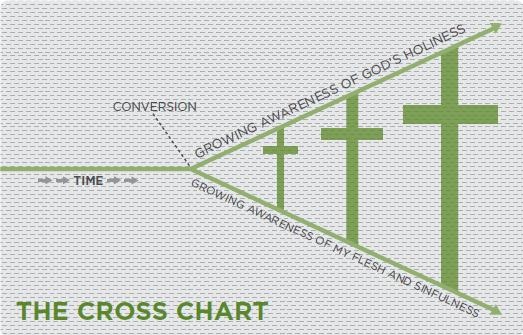
Therefore, New Calvinists communicate within the context of this dualism: the cross story, or your story. It’s either all you, or all God in sanctification. It is either the Cross Chart illustration or a chart that notes some goodness/grace within you. We call this the Either/Or hermeneutic. New Calvinist preaching /teaching well rarely present a metaphysical balance/middle ground/alternative perspective accordingly. The messages will always, in some way, merely contrast total depravity and God’s holiness.
In regard to believing that justification and sanctification are one and the same, we call this the Missing Transition communication technique. In teaching and preaching, New Calvinists continually transition between elements of justification and sanctification without a transition in subject as if they believe the two are one and the same. And that’s exactly what they believe. This has the effect of Christians functioning as if there is no sanctification due to the proverbial out of sight—out of mind consequence. While rejecting the idea of no sanctification when verbalized, that’s how they function because their mental data lacks sanctification wisdom. And be sure of it: this is by design.
New Calvinists also employ terminology that leads followers into assuming that their doctrine is normal. An example is, “heart change.” The heart speaks of that which is inside of us, right? The following New Calvinist illustration, again, THEIR OWN, illustrates that this is deception (Click to enlarge if necessary):

If we can do no work other than seeing our own depravity more and more, how does the heart on the other side of the chart pertain to us? If we change, would that not prevent us from understanding reality because there is less and less of our own depravity to see? Reformation epistemology must exclude any improvement or grace inside of us; otherwise, by their own definition, reality cannot be known. Obviously, “heart” does not pertain to our “heart” per se. It’s assumptive terminology. It plays on the known assumptions of others.
This brings us to the fact that Reformers, both old and new, seek to create a completely different reality of thought and metaphysics in order to control their followers. They also rewrite church history to match this created reality of their own making. Since reality is Christocentric, and all life must be found in the knowledge of the “Sun,” to the degree that we emphasize anything else other than the life-giving rays of the “Sun” (Son), we diminish true life.
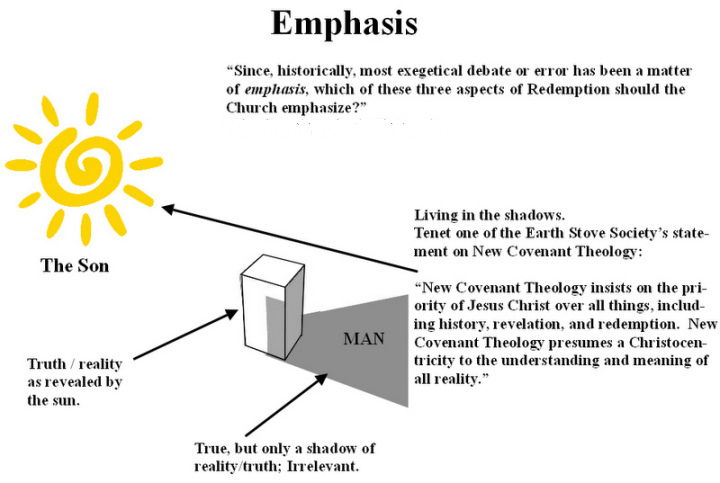
This enables New Calvinists to posit all things true, such as the new birth, “in us” terminology, and the other members of the Trinity while pointing to the whole issue of “emphasis.” Sure, all of those other things apart from Christ are certainly TRUE, but they are forms or shadows of reality (Christ) and to the degree that we focus on them apart from Christ we diminish the life-giving rays. Those things are “good things, but not the best thing.” They are “the fruit, not the root.” “Oh yes, the Holy Spirit’s sanctification is a wonderful truth! But it is a good thing, not the best thing. It is the fruit, not the root.” So, the more you deemphasize the “good thing” for the “best thing,” the better. And obviously, those things are eventually eliminated.
Obviously, the only place left to go from here for New Calvinists is Eastern mysticism. John Piper and other New Calvinists like Tim Keller are not even subtle about their beliefs in such. Neither was the primary forefather of the Reformation, St. Augustine. TANC is presently hard at work unpacking the specific connections between the two and how they function with Reformed theology, especially in regard to realms, manifestations, and spatial birthing. Susan will be bringing an astounding report to the Conference this June. In one of her sessions, she discusses how Augustine thought the Bible was the completion of Platonism.
Let’s conclude with a list of the six communication techniques used by New Calvinists:
1. Assumptive terminology: plays on the known assumptions of others.
2. Either/Or hermeneutic: interprets all wisdom through good and evil.
3. Missing Transition: excludes subject transitions as a way to subtly deny difference.
4. Metaphysical Redefinition of works and non-works.
5. Emphasis: reduces horizontal reality to one life source.
6. Dualism.
paul
The Laity Must Seize Biblical Counseling From the Spiritually Inept Reformed Clergy
 “If you haven’t received ‘proper training’ don’t try to counsel; you will do more harm than good.” Really? And many laymen buy it: “I don’t try to counsel people; if I told them the wrong thing I could do more harm than good.” How? Have you looked around at the mess called American Christianity in this country? After more than thirty years of an unprecedented biblical counseling movement spearheaded by David Powlison’s “research and development” center at Westminster Seminary, the American church has never been more unimpressive and disrespected. It’s so bad that there are at least three organizations that try to broker reconciliation in order to keep churches out of civil and criminal courts, and it is my understanding that business is booming. The country is saturated with “trained” biblical counselors and training centers, albeit mostly in upper income areas—to the tune of just under 100% according to our research. NANC and CCEF counselors are virtually nonexistent in lower income areas.
Moreover, NANC and CCEF (these two organizations comprise 90% of contemporary biblical counseling) are predicated on progressive justification. This is a gospel that posits the idea that people don’t change. In 1970, the father of the biblical counseling movement, Dr. Jay E. Adams, founded the movement on the idea that Christians can change and are competent to counsel each other. Though the results where dramatic, heretic David Powlison hijacked the movement with Westminster’s version of progressive justification, Sonship Theology. It is perplexing to me that many counselors who saw the results of Adams’ revival now refer to the movement in its present form as a “second generation” biblical counseling that is more “mature.” But where are the results? We now “need” Peacemaker Ministries and G.R.AC.E more than ever.
An example of that is Powlison comrade Pastor Mark Driscoll who claims to see visions regarding those that he counsels. Trust me, we can do better. And the time is ripe because we cannot possibly do worse. Granted, not all are inept, but where ineptness lacks, cowardliness and cronyism fills the void. Said another way; for the most part, they are either heretics or cowards. While the cowards don’t hold to the false gospel of progressive justification, they stand by silent as thousands of people are referred to these counselors daily. Plainly, the gospel really doesn’t matter. Plainly, they lack a deep love for the truth. While they sell their souls to the god of peer acceptance, they preach to others about not having idols in their heart.
Since the Scriptures teach that the average parishioner is competent to counsel, and the clergy have had their chance and completely blown it, the laity needs to get back to “encouraging one another unto good works.” Let’s start there. We are able. Here is what the apostle Paul said about our ability to counsel one another:
Romans 15:14 – I myself am satisfied about you, my brothers, that you yourselves are full of goodness, filled with all knowledge and able to instruct one another.
In contrast, the spiritual brain trust of our day teach that we are still totally depraved, and for some reason, people are perplexed that the totally depraved are acting like they are totally depraved. This has been pounded in the heads of American Christians for almost forty years now. The present-day biblical counseling movement is completely indifferent to this reality because, “It’s not about us being better, it’s about what Jesus has done—not anything we do.” Contrary to this, Paul stated that we are “full of goodness” and able to instruct on one another. It’s all there, when you were saved, you didn’t get a portion of the Holy Spirit—you got all of Him. You have His mind. You have His wisdom. You have His love. You have His goodness. You must appropriate it. That’s our role: learn and apply.
1. You are able.
2. You must learn and apply.
3….
You must trust God’s word as being sufficient. You must never waver from that:
Psalm 1:1 – Blessed is the man who walks not in the counsel of the wicked nor stands in the way of sinners, nor sits in the seat of scoffers; 2 but his delight is in the law of the Lord, and on his law he meditates day and night. 3 He is like a tree planted by streams of water that yields its fruit in its season, and its leaf does not wither. In all that he does, he prospers. 4 The wicked are not so, but are like chaff that the wind drives away.
We have two kinds of counsel here and the results. Where is the third option? Where is the pure milk cut with something as good as Scripture? (1Peter 2:2). Where is the alternative foundation in Matthew 7:24-27? Why is the word “alone” in Matthew 4:4? What great counselor of the day did Jesus cite apart from Scripture? If you have resolute confidence in the word of God—you can help people.
4. You won’t have all of the answers readily available in the beginning. It’s a process. You will lay the foundation, and then work together in the new way. This is discipleship. This is a vessel for building deep friendships. Here is what James stated in regard to this:
James 1:5 – If any of you lacks wisdom, let him ask God, who gives generously to all without reproach, and it will be given him. 6 But let him ask in faith, with no doubting, for the one who doubts is like a wave of the sea that is driven and tossed by the wind. 7 For that person must not suppose that he will receive anything from the Lord; 8 he is a double-minded man, unstable in all his ways.
There can be no thought that there is another way other than God’s word. This is double mindedness. This is hedging your bets. As you pray together, there must be confidence that God shows the way, and that it is the only acceptable way. No answer to prayer for wisdom in the situation should be expected without complete confidence in God’s word. All the other ways are instability in “all his [different] ways.” There are not alternate paths to God’s way.
5. You must know that the trial will end:
James 4:4 – And let steadfastness have its full effect, that you may be perfect and complete, lacking in nothing…. 12 Blessed is the man who remains steadfast under trial, for when he has stood the test he will receive the crown of life, which God has promised to those who love him.
6. You must know that your friend will benefit from the trial, or be separated from the faith. Here is where formal counseling is a great evil in our day. An appointment is made with the uppity pastor’s “counseling secretary.” Your session will be an hour, and then you are sent home till next week’s appointment. Few in the congregation, if any, will be involved in the situation. They aren’t “experts.” They aren’t “trained.” But by and large, the “experts” don’t really take God’s word seriously.
Any Christian who is in a trial is in grave danger of being separated from the faith. While God wants to use the trial to mature you (James 1:3 – for you know that the testing of your faith produces steadfastness), the kingdom of darkness wants to use it to separate you from the faith: “Blessed is the man who remains steadfast under trial, for when he has stood the test he will receive the crown of life, which God has promised to those who love him” (James 1:12). This doesn’t mean we can lose our salvation, but it means that we could end up on a path with an uncertain eternal future:
2Peter 1:9 – For whoever lacks these qualities is so nearsighted that he is blind, having forgotten that he was cleansed from his former sins. 10 Therefore, brothers, be all the more diligent to confirm your calling and election, for if you practice these qualities you will never fall. 11 For in this way there will be richly provided for you an entrance into the eternal kingdom of our Lord and Savior Jesus Christ.
Our goal is a rich entry, not one shrouded with doubt and fear concerning an uncertain eternity. This will cripple us in our faith. Before Peter’s trial of denying Christ after He was taken into custody, Christ told him that Satan had sought permission from God to separate Peter from the faith (a Job-like event). Trials will either make you a stronger Christian, or separate you from the faith. The words “trial” and “temptation” are therefore used interchangeably in the Scriptures. Hence, one should not be confused by what James stated in context:
James 1:13 – Let no one say when he is tempted, “I am being tempted by God,” for God cannot be tempted with evil, and he himself tempts no one. 14 But each person is tempted when he is lured and enticed by his own desire. 15 Then desire when it has conceived gives birth to sin, and sin when it is fully grown brings forth death.
7. You must know that your friend will desire to get out of the trial quickly, and even though God’s wisdom often ends a trial quickly, and circumvents some trials altogether, the world’s way of ending a trial will be crouching at the door:
“…. let steadfastness have its full effect” (James 1:4).
You must stand with your friend against the world’s shortcuts in the midst. Why does it take an expert to understand these things? The last thing a Christian in trial needs is a professional motif with an uppity secretary, a bunch of formal paperwork, and contemporary décor. They need real friends full of goodness. They need real friends who know what’s at stake. This is where true discipleship is set on fire. This is where the rubber of love meets the road.
8. You must not be surprised at the trial type. Christians can find themselves in any kind of trial:
“….when you meet trials of various kinds” (James 1:2).
1Peter 4:12 – Beloved, do not be surprised at the fiery trial when it comes upon you to test you, as though something strange were happening to you.
9. You must not doubt God. The most astounding trials must not be allowed to shake our confidence in God’s purposes and trust in His wisdom to resolve the trial. We must consider doubt an affront to God’s power, promises, and purposes. We must not have a form of godliness while denying the power thereof.
10. You must joyfully anticipate the deepening of relationship between all involved and God:
“….Count it all joy, my brothers, when you meet trials of various kinds” (Ibid).
Go. Go to your friend. Work together with them in encouragement. Discuss what you know, and pray together for wisdom in the rest. Wait on God together. Obey together. Cry together. Trust together, and defend God’s sufficiency together. Study the word together. Make a friendship deeper, and look forward to the day when you can comfort others with the comfort you have been comforted by. These are deep waters. This is where Christ comes in power. This is no place for outsiders.
This is no place for bloviated academics propagating a false gospel.
paul
Advocate for the Spiritually Abused? Then Wade Burleson Should Denounce Election in Sanctification
“This is because Western culture has never adequately exposed Reformed theology for what it really is. As long as Protestantism clings to the Reformation myth, it will never completely break free from its bondage to anemic sanctification.”
“If Burleson wants to be an advocate for the spiritually abused he should denounce his Reformed gospel of spiritual tyranny. While he may help some people heal from abuse, he will go back to his pulpit and produce twice as many abusers.”
Last night at our evening Bible study we discussed election. Not election for justification (salvation), but election in sanctification (our Christian life). This is the Reformed idea that God sovereignly elects all of our good works in our Christian life in the same way that he elects some to be saved and passes over others. This leaves them to the choice that is inevitable if God doesn’t intervene; man will never choose God on his own. In the same way concerning sanctification, man is still totally depraved, and unless God intervenes will only do works that are filthy rags before God. In salvation, God only changes man’s position, not his nature. Therefore, in sanctification, God imputes His own good works to our life via intervention and leaves us to our own total depravity in the rest. Choice in justification; works in sanctification; God completely sovereign in both.
Though the application of this is somewhat complex, it boils down to the Reformation’s definition of double imputation: Christ’s righteousness was imputed to us positionally by His death, and the perfect obedience He demonstrated in His life is imputed to our sanctification as a way to keep our justification intact until glorification. Hence, to not believe in sanctified sovereignly elected works in our Christian life is paramount to works salvation. “The same gospel that saved us also sanctifies us.” Sanctification must be a continual revisiting of salvation by faith alone in order to maintain our justification. This is the very heart of Calvinism. Yes, we do something in sanctification: we continually revisit our need for the gospel, and as we do that, the works of Christ are imputed to us by faith alone in sanctification. This is the theses of the Reformation’s magnum opus, Luther’s Heidelberg Disputation to the Augustinian Order, and articulated by John Calvin in the Institutes of the Christian Religion. This opposes Biblicism which sees double imputation as our sins imputed to Christ and God’s righteousness imputed to us and sanctification being an entirely different consideration.
We discussed how this authentic doctrine of the Reformation has wreaked havoc on the church. When God is seen as completely sovereign in sanctification, ideological conclusions are then drawn from what actually happens in real life. Rape is God’s will, and the perpetrator is seen as one who is acting out expected behavior where God has not intervened. “But for the grace of God, there go I.” We have all said it. No? All of grace in salvation—all of grace in sanctification. The only difference between you and a rapist is grace; therefore, who are you to judge? Even if you are the victim. Luther and Calvin thought righteous indignation a joke, and Calvin called justice, “mere iniquity.” Luther’s theology of the cross deemed suffering as the most valuable asset of the Reformation’s inner-nihilist theology:
He, however, who has emptied himself (cf. Phil. 2:7) through suffering no longer does works but knows that God works and does all things in him. For this reason, whether God does works or not, it is all the same to him. He neither boasts if he does good works, nor is he disturbed if God does not do good works through him. He knows that it is sufficient if he suffers and is brought low by the cross in order to be annihilated all the more. It is this that Christ says in John 3:7, »You must be born anew.« To be born anew, one must consequently first die and then be raised up with the Son of Man. To die, I say, means to feel death at hand (Heidelberg Disputation: Theses 24).
Note that this constant seeking after suffering and self-deprivation leads to being “raised up” in the Christian life. This constant seeking after death leads to joyful rebirths when Christ’s obedience is imputed to us. This is the basis of John Piper’s Christian Hedonism which also implements Theses 28 of the Disputation. As you can see, it’s what they call the new birth. The new birth is something that continually reoccurs in salvation when Christ’s obedience is imputed to us.
The indifference towards suffering that this theology breeds cannot be overstated. It is such that Calvin’s beseechment of the Geneva counsel to have a detractor beheaded rather than burned with green wood is a supposed act of compassion that is Reformed folklore. And be absolutely positive of this: the roots of authentic Calvinism are %99.99 responsible for the spiritual tyranny in the contemporary church—especially among New Calvinists.
This is why I have a problem with Pastor Wade Burleson being postured as a spiritual abuse advocate. I realize that he is a well-known pastor and therefore a valuable advocate for a cause, but promoting him as a defender of the spiritually abused separates logic from consequences. It encourages a hypothetical idea that because all Nazis didn’t execute Jews, Nazism doesn’t necessarily lead to the persecution of Jews. Right, not in all cases, but for every person Burleson helps his doctrine will produce twice the indifference and abuse in other people. Many members of the present-day Nazi party are seemingly quality people who could be utilized in good causes, but the possibility is remote because Western culture has been properly educated in regard to Nazi ideology. Such is not the case with Reformed theology. While a Nazi might make a good carpenter you would likely not hire one as an advocate for the Anti-Defamation League. There are Nazis who would do a fine job in that role but the ideology would do more harm than good in the long run.
We also discussed how authentic Calvinism dies a social death from time to time because of the tyranny that it produces and then experiences resurgence paved by the weak sanctification left in its wake. This is because Western culture has never adequately exposed Reformed theology for what it really is. As long as Protestantism clings to the Reformation myth, it will never completely break free from its bondage to anemic sanctification.

Burleson strongly endorses one of the core four individuals who helped found the present-day New Calvinist movement, Jon Zens:
One of my favorite theologians is Jon Zens. Jon edits the quarterly periodical called Searching Together, formerly known as the Baptist Reformation Review. Jon is thoroughly biblical, imminently concerned with the Scriptures …. The best $10.00 you will ever spend is the yearly subscription to Searching Together (http://www.wadeburleson.org/2010/09/searching-together-edited-by-jon-zens.html).
Zens, who has also been known as an advocate for the spiritually abused, was a key contributor to the Reformed think tank that launched present-day New Calvinism (The Australian Forum) of which some Burleson promoters refer to as the “Calvinistas.” It’s not meant as a compliment. But yet, Burleson’s theology is one and the same with them:
Those who have read Grace and Truth to You for any amount of time know that this author is persuaded the Bible teaches that the eternal rewards of Christians are those rewards–and only those rewards–which are earned by Christ. It is Christ’s obedience to the will and law of the Father that obtains for God’s adopted children our inheritance. It is Christ’s perfect obedience which brings to sinners the Father’s enduring favor and guarantees for us our position as co-heirs with Christ (http://www.wadeburleson.org/2011/11/therefore-knowing-terror-of-lord-we.html).
Those who have faith in Christ will never appear at any future judgment of God, or be rewarded for their good behavior. Our sins were judged at the cross, and the behavior for which we are rewarded is Christ’s behavior (Ibid).
Obviously, other than the previous points made, Burleson’s statement proclaiming Zens as “thoroughly biblical” and his outright rejection of 1COR 3:10-15 and 2COR 5:9-10 are troubling to say the least. Burleson also holds strongly to the exact same method of interpretation that makes elected works in sanctification possible among the “Calvinistas.” That would be the Bible as gospel meta narrative approach. It uses the Bible as a tool for gospel contemplationism which results in the works of Christ being imputed to our sanctification when we “make our story His story.” Luther got the concept from Pope Gregory the Great who believed that meditating on Christ’s works in the Scriptures endears us to Him romantically and thus inspires joyful obedience. It’s all the same rotten mysticism propagated today by John Piper and Francis Chan. It’s a mystical (actually Gnostic) approach to the Bible that makes elected works in sanctification possible.
As a cute way of propagating this nonsense, Burleson has named his para-church ministry “Istoria Ministries Blog.” His blog subheading noted that istoria is a Greek word that combines the idea of history and story:
Istoria is a Greek word that can be translated as both story and history. Istoria Ministries, led by Wade and Rachelle Burleson, helps people experience the life transforming power of Jesus Christ so that their story may become part of His story.
This ministry called him out on the fact that the word istoria does not appear anywhere in the Scriptures which led him to change the subheading a couple of days later. He then changed the subheading to a citation (GAL 1:18) that is the only place in the Bible where the word appears. Only thing is, even then, it’s not “istoria,” it’s “historeo”:
g2477. ιστορεω historeo; from a derivative of 1492; to be knowing (learned), i. e. (by implication) to visit for information (interview):— see.
This citation has nothing to do with his original point of naming his ministry as such. It’s simply the only reference he could find that proves that the word is in the Bible. Kinda, as I said, even then the word is not “istoria.” Istoria is a more contemporary Greek word that in fact can be used as “history” or “story.” But the earliest use of the word seems to be circa 1300, and is most prevalent in referring to the “story paintings” of medieval times. It’s just a lame, almost adolescent attempt to argue for this approach to the Bible.
If Burleson wants to be an advocate for the spiritually abused he should denounce his Reformed gospel of spiritual tyranny. While he may help some people heal from abuse, he will go back to his pulpit and produce twice as many abusers.
paul
Dear Christians: Don’t You Get It? Calvinists Think You Are Going to Hell
Yes, the gospel that SBC dimwits think they can colabor with denies the new birth in no uncertain terms. This isn’t rocket science: if the gospel that is good for the goose is also good for the gander; this assumes that no change takes place inside of the believer. And in case you haven’t read the papers lately that’s exactly what Christians are acting like.”
I think I have taken my last trip to SBC Today .com and SBC Voices .com. I have been referred over there a number of times to observe truth tone deafness on steroids. A heretic is running our flagship seminary, but the big news is that Tim Tebow cancelled his speaking engagement at FBCD. The big hero this time in the ongoing drama of SBC folklore (in our own pitiful minds) is Dr. Jeffress, who like all other SBC notables has never called out another leader for the same scandalous filth that is going on in most denominations. He will call out homosexuals, but the rape cover-ups in the SBC are a taboo subject. We call out the sins of the world, but to call out our own sin is “gossip.” All of these guys just really make me want to puke. Because they are sorry excuses for leadership—we are a joke in the eyes of the world and rightfully so.
Other articles posit the supposed strength of Calvinists and non-Calvinists working together in the SBC. So, the likes of David Platt will gladly play along while believing that synergistic sanctification is a false gospel and works salvation. This is a simple thing, Jerry Vines needs to call Al Mohler on the phone and ask him if synergistic sanctification is works salvation. I think the answer would surprise him if Mohler has a rare moment of truth telling. Of course, if Vines decides to do something about it, he then has to explain how he missed this all along and focused on symptoms rather than the issue of Calvin’s false gospel. I have been a lay pastor since 1986, and I missed it. Why? Because I was clueless, that’s why. More studied than a lot of Christians, I had a very poor understanding of justification, sanctification, and covenants, and still have a lot to learn. What’s so hard about that? Just admit it! What’s the big deal?
All of this conversation in the SBC about getting along with Calvinists could just as well include the Jehovah Witnesses or the Moonies. There is no difference; a false gospel is a false gospel and a cult is a cult. Calvinism was the epitome of a cult in Calvin’s Geneva and still is. You could slip a playing card in-between Calvin’s Geneva and Jonestown save the fact that Jonestown wanted to go out with a bang. But more to the point let’s talk about Calvin’s false gospel—the gospel that SBC yesomites say we should work together with.
In today’s church words don’t mean things because if they did we would have to do something about it. And we are mostly business as usual loving spiritual slugs. That’s what we need more than anything in the church today: leaders who take words seriously and will act accordingly. They will be easy to spot. When the sun is out during the day they will be walking around rather than sunning themselves on flat rocks like the majority. So, let’s talk about words.
“We must preach the gospel to ourselves every day.” Really? Does this raise any red flags? No. It is so, so indicative of how mindless Christians are in our day. “Wow, that sounds pretty cool. More fish anybody?” Come now, let’s be honest; do we really believe that we have been appointed stewards of God’s life-giving word? Is that how we function? A name that has come up in this ministry a lot this week is Miles McKee. He states a lot of things on his Facebook page that brings hearty kudos from many because their eyes immediately gravitate to the word, “gospel” in the sentence. “Oh there it is! The word gospel! Amen brother!” But let’s look at his statements more closely. Here is the subline of his Facebook page:
Preaching Christ crucified to the saved and lost alike. The goal is to pack this web site with rich gospel goodies.
Yes, and that is exactly what Christian children in adult bodies seek in our day, “rich gospel goodies.” Yum, yum, yum. We can’t take the word of God and help people in real trouble; we are too busy feeding on our gospel goodies. Note the picture below—that’s us. It is also how the world sees us, and rightfully so.

GOSPEL GOODIES! Yum, Yum!
But note that we are supposed to be preaching Christ crucified to Christians. This doesn’t raise any red flags. Note that the same message preached to unbelievers is also fundamental to the message Christians still need to hear daily. Still no red flags. Particularly alarming should be the idea that Christ’s crucifixion is perpetual in the Christian life. That’s what Calvin believed. He believed the atonement is perpetual. He believed Christ’s death is continually reapplied to the Christian’s life by faith alone until we reach heaven. We are then judged according to whether or not we continually appropriated Christ’s death in our life by faith alone until that day. It’s keeping our salvation by staying at the foot of the cross. We are saved by faith alone, and at any given time that we are not living our Christian life by faith alone we lose our salvation (or they say we were not really saved to begin with). That’s why we preach the same gospel to the saved as well as the unsaved.
It would therefore seem that the new birth would have to be redefined, and you would be right about that. This doctrine necessitates the denial of the new birth. Hence, McKee also states the following:
Contrary to much of today’s evangelical preaching, we must state that the message of New Birth is not the gospel.
Regardless of the fact that Christ’s own gospel presentation to Nicodemus was, “You must be born again,” this doesn’t raise any red flags either. The mindlessness truly boggles the imagination. Graeme Goldsworthy, the foremost hermeneutical authority recognized by Calvinists in our day footnoted (with full agreement) an article written by Anglican Geoffrey Paxton entitled, “The False Gospel of the New Birth.” Yes, the gospel that SBC dimwits think they can colabor with denies the new birth in no uncertain terms. This isn’t rocket science: if the gospel that is good for the goose is also good for the gander; this assumes that no change takes place inside of the believer. And in case you haven’t read the papers lately that’s exactly what Christians are acting like.
Moreover, Calvinists think the evangelical new birth gospel is works salvation: “It would be better to die a heathen than to live a religious life and die without Christ” (McKee). And trust me, synergistic sanctification is the “religious life” being spoken of here.
The Calvinist gospel, the centrality of the objective gospel outside of us, is a perfect storm of deception that perfectly facilitates the confounding of salvific terms—I get that. But yet, I see a prevailing arrogance among Christians that since we are so smart, deception will always be evident to us. We are so good at doing Christianity we don’t need practice or diligent study. Our claim that faith is pure and simple is a cloak of arrogance that covers for our bankrupt spirituality and the brunt of jokes among the heathen. If there is a God, where is His representation upon the earth? “Well, we don’t attempt to be the gospel with our own works, we only preach the gospel.” And to that the heathen say,
“Amen.”
paul

 Paul's Passing Thoughts
2 comments