A Doctrinal Evaluation of the Anti-Lordship Salvation Movement: Part 2
The root of all controversy: the golden chain of salvation.
Before we start part 2, we have a little unfinished business from part 1. The astute observer will ask, “If Jay Adams had the right idea about sanctification while misunderstanding what Calvin really believed, what of his biblical counseling movement that moved from mere generalities to the finer points of Christian living?” Answer: it WAS a revival…probably the only real revival the church has seen since the previous focus on practical application of the Scriptures versus redemptive focus/meditation. And when was that? I have no idea.
You remember my mention of the John “Jack” Miller disciple David Powlison. He started a contra biblical counseling movement against the Jay Adams movement. This is often referred to as first generation biblical counseling versus second generation biblical counseling. The second generation effectively wiped out the first. The crux of that civil war is relevant to this study. One model sees salvation and sanctification as separate. Salvation is completely vertical, but sanctification is mostly horizontal. Jay Adams argued in his aforementioned book against Sonship theology that the source of power in the Christian life is not salvation, but regeneration. In other words, justification is a finished work and a static declaration while the Christian life flows from the “quickening” of the new birth. We don’t return to the cross for power in the Christian life, we learn and obey the Spirit’s instrument for changing us, the law of the Spirit of life. What Adams didn’t realize is that this whole idea of life coming from a perpetual revisitation of our justification is in fact authentic Reformed dogma (see the Calvin Institutes 3.14.9-11).
Every Christian controversy from the Reformation till the present finds its roots in the golden chain. Reformed pastors wax eloquent in regard to who builds the links in the chain between justification and glorification: it’s either us, or the Holy Spirit using “what Jesus has done, not anything we do.”
From the latter 40’s to 1970, the first gospel wave (Billy Graham et al) ruled the Christian scene via EB. Cogous pushed back with a vengeance from 1970 till the present with the second gospel wave. The first wave saw a commitment to obedience as synonymous with keeping yourself saved because of the golden chain idea. To say that they overemphasized the gospel would be a gargantuan understatement. Obviously, they saw a commitment to obedience as transposed upon the Christian life. The second gospel wave demanded a commitment, and recognition of Christ as Lord, but also demanded a life of faith alone to keep the law satisfied with Christ’s perfect obedience. Again, the ALS camp misunderstands the Reformed on this point. Both camps hold to sanctification by faith alone. This is the very idea that James rudely pushed back against in his epistle.
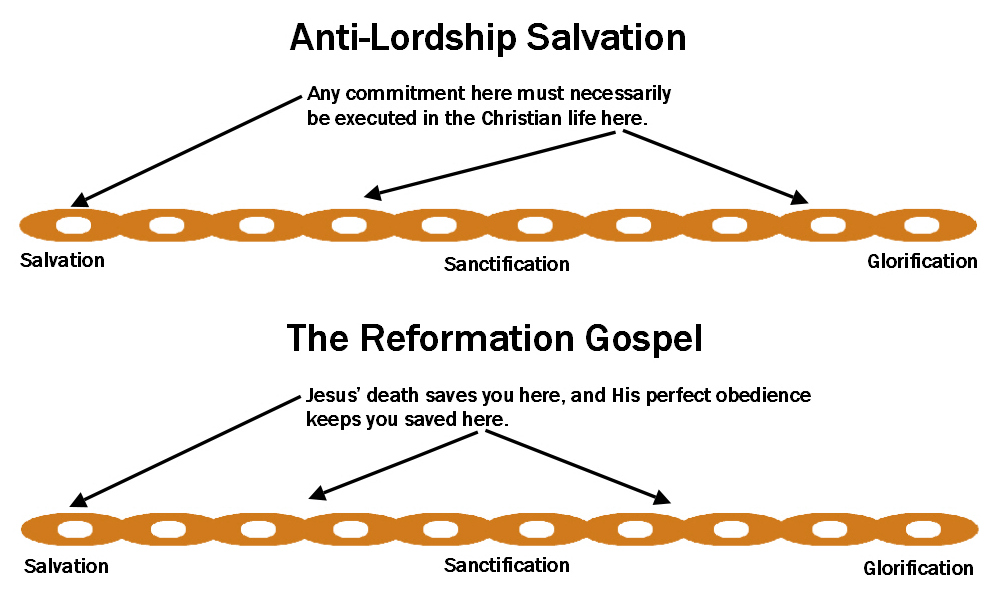
The issue made simple: Romans 8:30.
In Romans 8:30 we read the following:
And those whom he predestined he also called, and those whom he called he also justified, and those whom he justified he also glorified.
Notice that sanctification is missing from this verse even though the context spans the beginning of our salvation to our resurrection. This is the distinction between all golden chain gospels and the real gospel, the kingdom gospel. Jesus came preaching the “gospel of the kingdom.” Hereafter, KG. The golden chain gospel says that sanctification is missing from this verse because justification and sanctification are the same thing. The KG says that sanctification is missing from this verse because justification and sanctification are mutually exclusive. The context is assurance of salvation (see verses 31ff.).
Curiously, the golden chain gospel which includes both ALS and LS/Calvinism, teaches us to remind ourselves of God’s grace alone regardless of anything we do. If our behavior brings doubt, this is evidence of a fundamental misunderstanding of God’s grace and we should therefore remind ourselves of such. ALS says that concern over behavior suggests that you believe behavior finishes justification and not grace alone. With the KG, that consideration is not even on the radar screen because justification and sanctification are completely separate; finishing a finished work is impossible. You can’t have that mentality if you understand it to be an impossible reality. I might also add that simply returning to the same gospel that saved us to cure a troubled conscience instead of changing behavior sears the consequence over time. This is ill advised.
In other words, the KG says it is impossible to unwittingly attempt to please God to gain justification because that work is finished. One is free to aggressively obey God without any fear that they are unwittingly attempting to earn their justification. ALS and LS/Calvinism do not have this convenience because justification is both finished and not finished. The Reformed, already, but not yet construct that relates to predestination cannot be discussed here for lack of room and fear of confusion, but suffice to say for this study that the convenience is not there for either ALS or LS because justification is not finished. You must continue to remind yourself of free grace because you are in a continuum where unwitting works salvation can take place, and the only solution is to disavow good behavior as an evidence of conversion. Obedience must be completely optional. This used to be criticized as “Let go and let God” theology. According to the KG, such a continuum is impossible and not reality.
Consider some dialogue I have had recently with ALS proponents:
Paul, While you ponder my answer, I’d like to ask you, if you’d identify what you believe you must do, before, during and after, in order to be given eternal life. Thank you, In Him, Holly
“Before, during, and after”? to… “be given eternal life.”? The implied answer is: nothing in justification; nothing in sanctification; and nothing in glorification. But again “during” shouldn’t even be deemed possible.
LS in Cogous form already states that perpetual double imputation is needed, so bad behavior is actually a good thing because it “shows forth the gospel.” In contrast, advocates of the KG are concerned with evidence of the new birth, not the overcoming of a propensity to misunderstand the grace of God because all doing in the Christian life is attached to justification somehow. Advocates of the KG understand that nothing they do in the Christian life has anything at all to do with justification. Much assurance comes from that. However, lazy discipleship forfeits assurance because it violates the conscience, and judgment begins in the household of God regarding consequences for bad behavior in this life. The fear generated from that can get confused with fear of eternal judgment.
But don’t miss my main point here: the solution for a lack of assurance in both ALS and LS are the same: preach the gospel to yourself. Remind yourself that works done by us are completely irrelevant to our salvation which also includes sanctification (the Christian life). Both camps woefully devalue the new birth and its expectations. In effect, we have no righteousness and obedience is not really performed by us, but performed by the Holy Spirit if we are “abiding” in Christ. This is a passive sanctification of our works in sanctification in order to categorize them as living by faith alone. ANY work we do is accredited to the justification process, so it must be sanctified by the right process. In the final analysis, Christians must only EXPERIENCE an obedience imputed to us by Christ. Citations by the Reformed abound, and I can cite one from the aforementioned conversation with advocates of ALS:
We can have righteousness of our own, that is self-righteousness. I didn’t notice, did you answer any of the questions? Do you sin? How much? Or not? Are you sinless?
Park on the fact that both camps assert that the Christian has no righteousness. To have any righteousness is a “righteousness of our own.” It’s either ALL us or ALL Christ. Therefore, we can only EXPERIENCE righteousness imputed to us, but it really isn’t us performing it; hence, in relationship to the same conversation:
This passage has nothing to do with becoming saved or providing evidence through our works that we are saved. The passage is about living experientially in a manner that is consistent with our position on [sic] Christ.
Notice that the Christian lives “experientially” according to “our position [i]n Christ.” In other words, Christians only experience their position, they don’t actually perform obedience themselves. In addition, when talking to either camp, one is challenged with the question, “Did you sin today?” And in both cases, when you qualify the question with, “In justification or sanctification?”…without exception they are thrown for a loop. Why? Because they see sin in justification as no different than sin in sanctification—that’s why they ask the question in the first place. If you believe the Christian is personally righteous as well as positionally righteous, you are immediately challenged by both camps with, “Did you sin today?” Why? Because the same assumption is that righteousness and sin are mutually exclusive. For the world, this is true, but not for Christians.
Another fact of the Reformation gospel is “righteousness” is defined as a perfect keeping of the law. To remove the law’s perfect standard, and its demands for perfection from justification is the very definition of antinomianism according to the Reformers. A perfect law keeping must be maintained for each believer if they are to remain justification.
If you remember, this is a direct quote from part one. ALS and LS/Calvinism both define righteousness by perfect law keeping. Again, why the air of profundity in the terse rhetorical question designed to end the argument on the spot by coup de grace? The very essence of the question reveals a profound misunderstanding of law and grace.
Let’s get a little more full circle now with part one. Because the Christian, according to both camps, cannot be righteous if he/she sins even once (“Do you sin? How much? Or not? Are you sinless?”), the good old Reformed mainstay of double imputation is needed for both of these applications of the same golden chain gospel. From part one:
Thirdly, this requires what is known as double imputation. Christ not only died for our sins so that our sins could be imputed to Him, He lived a life of perfect obedience to the law so that His obedience could be imputed to our sanctification.
The windsock of double imputation is the idea that the righteousness of Christ is imputed to our sanctification. He died for our justification, and His perfect obedience to the law was imputed to our sanctification to keep justification rolling forward:
Model A asserts that since we cannot keep the law perfectly, we must invoke the double imputation of Christ by faith alone in order to be saved and stay saved (part 1).
Now let’s look again at the same recent conversation with ALS proponents:
Thanks Mark, I agree. We are qualified as saints, because of Christ’s righteousness imputed to us, but we still sin,..
Therefore, we only “qualify” as saints because we still sin, in order to keep our sainthood the righteousness of Christ must be imputed to us daily. Yes, that would be daily salvation. In the quote immediately prior, “Holly” was responding to this statement:
Hope you don’t mind me adding a thought, I think Paul is saying we were sinners but we are now saints (forgive me if I am wrong), it is true of course that we are saints but I believe it is also still true that we are sinners saved by grace because the Apostle Paul said, “Christ Jesus came into the world to save sinners; of whom I am chief”, present tense.
So, if Christians are still sinners, because we sin, and Christ came to save sinners, it would only make since that our need for salvation is still ongoing. Direct citations that agree with that point by John Calvin and Martin Luther is abundant low hanging fruit, but granted, such statements from the ALS camp are somewhat surprising. To further the point, I might add that “Holly” referred me to a message taught by a notable figure in the ALS movement who interpreted Romans 7:24 as a daily salvation. This is a very common rendering of that verse by the Reformed as well. The verse obviously refers to the redemption of the body and not a daily salvation.
Both are guilty of the same thing: a false double imputation construct must be applied to the Christian life by faith alone and the subjective experience thereof is optional. Like ALS—like Calvinism.
What is wrong with this gospel?
The golden chain gospel misrepresents the Trinity. The Father is removed from His role in salvation because it is His righteousness imputed to the believer before the foundation of the world. According to Romans 8:30, this guarantees glorification. The Holy Spirit is also misrepresented in regard to His role in salvation. His setting us apart before the foundation of the world is confused with His work in regeneration. Christ’s role is redefined beyond His death for our sins as a onetime act that ended sin. This is not a covering—it’s an ending. Even though the Reformed and ALS both concur that Christ died once, His death is perpetually reapplied to sins we commit as Christians when there is no such need. Neither is there a need to impute Christ’s righteousness to us perpetually. At the Bema event, it will not be God the Father looking at us and only seeing Jesus, it will be Jesus Himself judging His righteous followers. He will not be judging His own righteousness. The golden chain gospel is an egregious distortion of the Trinity.
True double imputation is our sins being imputed to Christ, and the Father’s righteousness imputed to us apart from the law. Christ came to end the law. It is because of this, and the new birth, that we are truly righteous in and of ourselves, but of course not apart from God’s power and plan of salvation. We have God’s seed in us, are no longer under any law that can judge us, and are able to please God with our lives. We are new creatures who are sinless according to justification because even if the old us that died with Christ was exhumed and brought into court, there would be no law to condemn us.
This gospel not only distorts the Trinity, rejects the new birth, and distorts double imputation, it misrepresents sonship. The sins we commit as a family member are considered to be sin against justification: “Did you sin today?” Again, if you ask them, “Sin in justification or sanctification?” all you will here is crickets, or the babblings of confused narcissists.
The golden chain gospel also strips the Christian of ability to love Christ and others by keeping Christians under the law of sin and death that Christ came to end. Said gospel makes that law the standard for righteousness. However, there is no law standard in justification, it is APART from any law—it is God’s righteousness imputed to us. Those under grace serve the law of the Spirit of life which is fulfilled by loving Christ and others:
“If you love me, keep my commandments.”
It is impossible to love Christ by keeping the law of sin and death. Besides, that law is ended when we believe. All of our sins committed before faith were against that law and in essence imputed to it. Before we were saved, we were enslaved to that law and it provoked us to sin. Consider two spouses: we were the spouse that was under the law of sin and death until we died with Christ, now we are free to serve another. Sins we now commit are against family relationship, not sins that fall short of the law of sin and death.
Said gospel prevents us from making a commitment to God’s kingdom because the commitment would have to be executed perfectly in kingdom living to maintain our citizenship. Said gospel demands that we only recognize Christ in a one-way relation while ignoring His kingdom, its law, and the king. Yea, we can only accept Him as savior in a one-way relationship. This assumes that a decision to flee the present kingdom of darkness for the kingdom of light cannot be a commitment totally separate from the kingdom citizenship. If we make a commitment, the commitment must be executed perfectly in order to remain a citizen. No, the commitment is totally separate from our citizenship in the same way justification is totally separate from sanctification.
I realize that only repentance was emphasized to the Jews, but they were already saturated with the concept of God’s kingdom. From the beginning, Abraham looked for a city built by God. As we see Gentiles coming into the church, they must be brought up to speed on their new Jewishness. We should read the Bible with this in mind and the way it affected the presentation of the gospel, and the very definition of the word “gospel” itself.
The golden chain gospel rejects the new birth by ignoring the difference in slavery between two different laws: the law of sin and death that will condemn the world, and the law of the kingdom; the law of the Spirit of life. It makes the law of the Spirit of life a fulfilment of the law of sin and death that is in fact ended. In essence we remain enslaved to a law of condemnation as “sinners.” This is a rejection of the new birth.
It also adds another seed to the covenant of promise. If the law of sin and death could impart life, it would be a second seed from which life would come to the world. It doesn’t matter who obeys it, it cannot impart life.
The golden chain gospel distorts the Trinity, distorts double imputation, misrepresents sonship, strips the Christian of ability to love Christ and others, rejects a biblical definition of the new birth, keeps Christians under the law of sin and death, distorts the atonement, perpetually reapplies the death of Christ to salvation, replaces the righteousness of God with a law standard, propagates a one-way relationship with God, makes sin as a kingdom citizen the same as condemning sin, enslaves us as a spouse still under the law of sin and death, calls for us to accept Christ as savior in a one-way relationship while ignoring His Lordship.
Do Christians have two natures? This will be examined in part 3.
paul
Horton’s Systematic Theology Adds To The Sonship/Gospel Sanctification Massive Subculture: Revised
[NOTE: This was written before I discovered that New Calvinism is in fact the same gospel that the Reformers taught. The resurgence movement began as COG in 1970, became Sonship circa 1986, Gospel Transformation in 2000, dubbed Gospel Sanctification by detractors in 2007, and finally New Calvinism in 2008. This was also written before I understood that orthodoxy is a part of spiritual caste in general].
“Gospel Sanctification, as Sonship is now called, will begin to totally rewrite orthodox Christianity” [Note also that I no longer equate “orthodoxy ” with truth per se].
[Further revision: much has been learned since this post, but the general idea is very accurate: the Neo-Calvinist movement is seeking to develop a subculture within American culture that will eventually, if all goes as planned, devour American culture as we know it. This is part and parcel with Calvinism’s dominion theology. This post submits a sketchy framework of useful categories under the general idea. For instance, one college that focuses strictly on the Neo-Calvinist vision is a far cry from the fact that this movement owns (in an intellectual capacity) most of the seminaries in America. Other categories could be added as well, e.g., Christian publishing ].
The Fix is now in. The false doctrine of the centrality of the objective gospel (COG) which found new life in Sonship Theology about thirty years ago—now has its own theology, hermeneutic, practical application, defined experience, ecumenical (inclusiveness) movement, history, college, counseling organization, missionary organization, Bible—and now, its own systematic theology. Gospel Sanctification (GS), as Sonship is now called, will begin to totally rewrite orthodox Christianity. It won’t be long; those who we minister to will have to be deprogrammed before we can help them, starting with convincing them that the Bible is to be taken as literal instruction from God as our authority for ministry and life. Not understanding GS beforehand will make any attempt to help people with the word of God—dead on arrival.
GS Theology
The movement started with a very powerful concept in the minds of its perpetrators. Supposedly, we grow spiritually by revisiting the gospel that saved us every day. Proponents were convinced (and still are) that this thesis stands alone as truth; therefore, all other propositions must bow to it.
The GS Hermeneutic
A literal interpretation of Scripture will continually contradict GS. So, the proponents have changed how we read/ interpret the Bible accordingly. The GS hermeneutic is an interpretive prism that will always yield results that make GS plausible. Unlike the rest of the elements (which are very contemporary), the hermeneutic (known as Biblical Theology or Redemptive-Historical hermeneutics) was borrowed from times past. It originated in Germany under the liberal teaching and writings of Johann Philipp Gabler (1753-1826), who emphasized the historical nature of the Bible over against a “dogmatic” interpretation thereof. Nearly a century later, Geerhardus Vos (1862-1949) was instrumental in taking the discipline of biblical theology in a, supposedly, more conservative direction. Graeme Goldsworthy tweaked the doctrine to facilitate COG, and today, Goldsworthy’s “Trilogy” is the pillar of interpretation within the movement.
Practical Application
The GS narrow approach to sanctification must be embellished and applicable to life in some way in order to be sold. This is Heart Theology, and was developed through David Powlison’s Dynamics of Biblical Change at Westminster Seminary. In 1996, two former students of Powlison articulated Heart Theology in a book entitled, “How People Change.”
Defined Experience
John Piper seeks to articulate how Sonship is experienced via Christian Hedonism. Because GS makes our works and the work of the Spirit an either/or issue, someone needed to develop a thesis that explained how the difference can be ascertained. John Piper answered the call with the development of Christian Hedonism.
Ecumenical Bent
GS now encompasses any group that agrees with its primary view of plenary monergism and the synthesis of justification and sanctification. All other disciplines are seen as secondary and irrelevant to fellowship and joint ventures. The Gospel Coalition (holding national conferences on odd years, 2011, etc.), and T4G (Together For The Gospel, holding national conferences on even years) work together to promote GS/S while promoting inclusiveness among denominations and religions.
History
GS proponents claim a historical precedent dating back to Creation, and also claim to be the second part of the first Reformation. Of course, this is laughable. Sonship, the Antioch school, TGC, T4G, NCT, CH, and HT have no historical precedent prior to 1970. Many of the notable proponents of GS are associated in some way with the father of Sonship Theology, Dr. John “Jack” Miller. Tim Keller and David Powlison were followers of Miller. Paul Tripp and Timothy Lane are followers of David Powlison. Jerry Bridges attributes his view of the gospel to Miller as well.
College
The Antioch School of leadership training has GS as its foundation and basis for training. It is located in Ames, Iowa.
Counseling Organization
The upstart Biblical Counseling Coalition, which seeks to network other counseling organizations as well, is intimately associated with T4G and The Gospel Coalition. The who’s who of Gospel Sanctification sit on its governing board including David Powlison and Paul David Tripp.
Missionary Organization
It’s primary missionary organization was founded by the father of Gospel Sanctification / Sonship—Dr. John “Jack” Miller. Banner of Truth states the following in The Movement Called Sonship: “Miller encouraged New Life Presbyterian Church into originating the ‘World Harvest Mission’, a non-denominational missionary organization. Sonship became its main teaching vehicle.”
Bible
The English Standard Version (ESV) was first published by Crossway in 2001. Its vice president of editorial is Justin Taylor who also authors The Gospel Coalition Blog, the multimedia propaganda machine for GS doctrine. One of the translators was Wayne Grudem, also well known as a major proponent of GS doctrine. The ESV’s GS connection has made it the most purchased English Bible in the past ten years. The latest promotion of the ESV by Crossway, “Trusted: Trusted Legacy [a whopping ten years]; trusted By Leaders; Trusted For Life,” features an endorsement by the who’s who of GS doctrine.
The Complete Fix
With Michael Horton’s recent publication of “The Christian Faith: A Systematic Theology for Pilgrims On the Way” (2011), the total fix is in place. The GS machine will now begin to move forward—rewriting and re-forming orthodox Christianity. I confidently predict that Horton’s book will be widely used in seminaries nationwide. Seminary students will be pumped into the local churches with a skewered view of truth—but using all of the same terminology that was formally orthodox.
What Can Be Done?
This doctrine thrives on the fact that Christians are theologically dumbed-down. If most Christians do not know the difference between justification and sanctification (and they don’t), they are helpless against this false doctrine. If most Christians don’t realize the importance of understanding hermeneutics (and they don’t), they are even more helpless. Local churches need to start in-doctrine–ating their people.
paul
Susan Dohse on Plato, Augustine, Calvin, and the Reformation
 TANC 2013 Conference on Gospel Discernment and Spiritual Tyranny
Transcript: Susan D. Dohse MEd.
Plato
I’m Susan Dohse. I’m married to Paul Dohse for two years, and it has been an adventure. My role in this year’s conference has changed. This year I became Paul’s research assistant. The pay stinks, but the fringe benefits are really nice. Unlike last year when I spoke from personal experience, which though difficult and emotional at times, was easier than this year’s assignment. This year I was asked to step outside my preschool box and share what I’ve learned through not personal experience but personal study and research. And I am thankful for the World Wide Web, computers, and the Internet even though I fuss and say unkind things to the computer, I am thankful that the Lord created those on the eighth day. If I had to find answers to the questions that I had in the old-fashioned way, by using the card catalog and the Dewey Decimal system, I wouldn’t be here this morning. I would still be at the library roaming the stacks. My role in this year’s conference is to share my research. My goal though is to provoke you to think. What I want to share is only an introduction. It’s not even a scratch on the surface of what there is to know about these historical figures. It’s up to you though to continue the research project. So you do have an assignment. I want you to think of me as just a grain of sand, an irritant in the oyster that over time though yields a pearl.
Matthew 7:24-27, Jesus is speaking here. “Therefore, whosoever hears these sayings of mine and does them, I will liken him unto a wise man who built his house upon a rock. And when the rains descended and the floods came and the winds blew and beat upon that house, it fell not, for it was founded upon a rock. And everyone that hears these sayings of mine and does them not shall be likened then to a foolish man who built his house upon the sand, and the rains descended and the floods came and the winds blew and beat upon that house, and great was the fall of it.”
The foundation of thought that I want to illustrate is built upon a historical figure that I just knew initially in a Jeopardy quiz show fashion, you know. Student of Socrates, Greek philosopher, The Republic. Who is Plato? Well, if I were to ask you to tell me something that you know or you’ve been taught about this man, I’m certain I would get classic textbook answers. Greek philosopher, student of Socrates, established the first university called The Academy, wrote The Republic, I would give you credit for being correct. For over 2,500 years, Plato has been studied, admired, modified, personalized, and deified. He has been described as a great thinker, lover of wisdom, a crusader against error, and an enemy of falsehood. Well, after reading hundreds of pages about him, I cannot help but agree that he was a man of great intelligence. He was a mathematical genius, an advocate of education. In your list of trivia facts, would you also include pagan, polytheist, crusader against individuality, founder of communistic, socialistic, and Darwinian evolutionary thought, enemy of God, hero of the reformers?
Born in 427 BC, the son of noble and wealthy Athenian parents with the blood of ancient kings of Attica flowing through his veins. It was this status in life that gave him the way and the means to pursue his quests. Unlike others of his day, he didn’t have to earn a living and go to school at night or hold two jobs to pay for his education. He was of the ruling class of Athens, a privileged elite.
At the age of 20, Plato came to Socrates and asked to be his pupil. And Socrates saw before him a handsome youth, broad shoulders of an athlete, a noble brow of a philosopher, the limpid eyes of a poet. Those aren’t my descriptive terms. This is how Socrates described him. Socrates accepted him as a student, and this became the beginning of a tender and an intimate relationship that lasted until Socrates’ death. The respect and admiration of the student for his teacher was profound and lasting.
Well, after Socrates was executed, Plato and the other disciples of Socrates took to the world, and they traveled the ancient world. Now whether of fear that they would be arrested and also executed because of their association with Socrates or because they wanted to be foreign exchange students is not really well documented. Plato went to Cyrene where Theodorus instructed him in mathematics. He went to southern Italy where he studied the science of numbers under three of the most learned doctors of the Pythagorean mathematical system of his day, went to Egypt to receive instruction from those learned doctors and priests of that ancient land. Some records say he visited Persia, Babylonia, and even India. So he returns to Athens and establishes his Academy, the first university in Europe where he taught until the age of 81.
So up until his return to Athens, we can say letter P for professional student, P for pagan polytheist. Plato regarded the sun, moon, stars, and planets as the visible gods. These heavenly bodies do not come into beings and then pass away. Plato attributed divine souls to the sun, moon, stars, and planets because they followed that intelligible course through the sky. He also held [SOUNDS LIKE] the invisible gods, the gods of the civilized life where the king was Zeus. These gods care about humans. They’re aware of whether we are good or evil. Though invisible, they can reveal them themselves when they want to. They are not standards of justice, beauty, truth, and goodness, but they were living beings who have the perfect knowledge of those standards. Plato wrote, “I do believe that there are gods, and that in a far higher sense than that which any of my accusers believe in them.”
P for platonic wisdom which unites with methodology. P for philosopher ruler. Plato referred to himself as a philosopher ruler. He stressed the importance of living the life of a philosopher by worshipping ideas. The search of ideas, the appreciation of ideas, the participation of the ideas—that’s the life of a philosopher, and that’s what he taught, and that’s what he believed. So the life of Plato was a tireless quest for those ideas. His life is a sustained effort to live by those ideas and to teach others to do so.
P, political scientist, his political philosophy was explained in his writing The Republic. The ideal state, he says, should be divided into three classes of citizens, and each class has its own particular duty to be performed and a special virtue to be developed. The lower class, the laborers and the artisans, their immediate task, acquire skill. The second class, that’s the warriors, and they’re given the opportunity to develop courage and fortitude at their stage of evolution. And the ruling class, those are those men who have learned how to govern themselves and are therefore fit to govern others. I quote from Plato, “Unless philosophers become rulers or rulers become true and thorough students of philosophy, there will be no end to the troubles of the state and humanity.” When each state concentrates upon its own duty and virtue, there will be a well-balanced and harmonious state in which all of the citizens will work, but not for the interest of self but for the common good of the whole. The state will be in charge of production and that sphere of physical goods and life.
And according to Plato, the state would regulate marriages and the breeding of children. In his Republic, we have a foreshadowing of the modern theory of eugenics. There will be selective breeding as with animals. Bad specimens of humanity will be ruthlessly destroyed. There will be no individual families because there’s only one family, and that’s the state. The state will control mating among the sexes. And when children are born, they will be brought up by the state. Thus both breeding and rearing of children will be in the hands of the community. The community of wives and children is part of more ambitious program, however. And that is the abolishment of self. Plato’s ideal is that we shall cease to use a pronoun: mine. These are the foundational ideas as you study history of Nazism, communism, socialism.
Plato was a mystic pagan. He respected and defended Greek mythology even though he recognized that mythology was a myth. He referred to it as a belief, not reason. His metaphysics is confined to the existence of eternal ideas of which the supreme eternal idea is that of the good, the true, the beautiful. Plato, pagan, polytheistic, philosopher ruler, political scientist.
So do we build a biblical doctrine upon his philosophical recommendations? Well, one block does not a foundation make, and one letter doesn’t spell the name. So let’s go to L, link. To understand the place of Plato in Greek civilization, you have to have a snapshot of what Athens was like in his time. Before Athens had produced any great figure of thought, the Greek colonies had a full quota of poets and philosophers and mathematicians. But when the Persians and the Lydians began their advance westward, the Ionian colonists were compelled to return to the mainland. Pericles, the leader of Athens, offered them protection and liberty of expression. So what was created in Athens was a cultural babble [SOUNDS LIKE]. So the significance of Plato lies in the fact that he took this cultural babble and converted it into his beloved city. And he welded it into a system of thought. So in his philosophy these miscellaneous cults and doctrines from all over the known world were fused into a whole new concept of the universe.
Plato claimed no originality for his ideas. He was the world’s interpreter. By giving unity to scattered ancient truisms, Plato’s word took on the appearance of a string, a string which tied together a bundle of ideas that he had gone to this garden of the world’s best thinkers and plucked them and tied them together. With Plato, the Socratic method of education would have been unknown. The abstruse [SOUNDS LIKE] numerical system of Pythagoras would have remained unintelligible to the average mind. Without Plato, the philosophical and psychological systems of the Hindu sages, the Laws of Manu and Buddhist doctrines would have remained hidden from the Western world. Plato was the link between the East and the West. As Emerson wrote, “The excellence of Europe is in its brain.” So his philosophies then were the links between paganism and Western Christian thought.
A, atheist. Plato was a worshipper of many gods. So why do I refer to him as an atheist? Well, he didn’t believe in Yahweh, Jehovah, the God of the Christians. There’s none of it in Plato. The God of the Bible did not exist in Plato or in any ancient Greek literature. Plato writes of the gods, and in some cases he does write a god or god, but he does so in the same way we would talk of man, in a generic name. Contrary to what some scholars write, including Saint Augustine, Plato’s The Good was not a reference to God. It’s a reference to Plato’s perfect idea of good. In another of Plato’s writings, he says that love is divine. When Plato referred to the craftsmen or the artisan of the universe who formed sensible things by using the forms as blueprint, he was speaking metaphorically. According to Plato, there was no creator of the universe. There were principles and according to how things emanate from the One. Now be careful, the word “one” used by Plato is not a reference to the one true God. You can click on my third slide.
The One refers to the forms of the true, the good, and the beautiful. The One does not pay any attention to the universe, but it simply emanates, okay? Do you like that word, “emanate”? There it is. You see it? You have the forms. Does not pay any attention to the universe but simply emanates a lower being that emanates a lower being that emanates a lower being, so on and so forth, oh like a ladder, until the lowest of all matter that comes to be.
Our foundation now is taking shape, isn’t it? The foundation of Christian doctrine is going to be built on a pagan polytheistic philosopher’s ideas created from links made from welding miscellaneous cults and doctrines all emanating from an atheistic belief system.
T, I’m doing the sign language for Heather. T for theory. Plato had a trinity. Huh, he had a trinity. But it is not to be equated with God the Father, God the Son, and God the Holy Spirit, although there are some writers who try to make that assumption because they want to make Platonic ideas palatable to Christian students. His trinity were the forms: the good, the true, and the beautiful. Now these forms are not spirit as God is spirit and they that worship him does worship him in spirit and in truth. These forms are ideals. Humans have access to them through the mind, through reason. Forms are ultimate reality. They are the causes of all knowledge. And they’re interconnected. Plato felt that they were one. Truth is good and beautiful, and good is true and beautiful. And the beautiful is true and good. So how do we know them? Well, Plato thought that we know these pure, perfect forms intuitively. It is only through intuition that fundamental truth can be known. There are some scholars that say Plato’s theory of the forms has the greatest influence in the philosophy of religion. This exaltation of the spiritual over the physical in Platonism carried over into Judaism, and the writings of Philo influenced the Neo-Platonists, astounded the apologists, and the early Christian fathers.
O for ontology. Now that’s a fifty-cent word. It means the philosophy of existence, being. To Plato, true reality was the world of being. We don’t live in this word; we live in an approximation or a shadow of this world. True reality can only be discovered by the mind. Ideas are the patterns that participate in the shadows of our everyday world. So what we have is Plato’s ontological impact on other important Christian doctrines. What we have is an oxymoron, you know, like white chocolate, jumbo shrimp. Christian Platonism, that’s the oxymoron. It’s a philosophy that has blended Platonism with Christianity. Author Randy Alcorn describes what Christian Platonism has done. He says it’s a poison that has caused many Christians to resist other biblical truths—the bodily resurrection of the dead, life on the new earth, specific activities we will engage in heaven such as eating and drinking, walking and talking, living in dwelling places, traveling down the streets, going through gates from one place to another, ruling, working, playing, engaging in earthly culture and that new heaven and new earth.
Okay, so what? So what? I talked for 20 minutes. So what? What do you need to take from this essay that I read to you on Plato? See the sand? The foundation of Reformed doctrine is built on the ideas of a pagan, polytheist who linked other pagan ideas into an atheistic framework that he called his Theory of Forms, and by doing so has ontologically affected the way Christians understand truth, and it robs them of hope. Jesus said, “Everyone that hears these sayings of mine and does them not shall be likened into a foolish man who builds his house upon the sand.”
Augustine
This morning I talked about our dear friend Plato, and John gave more embellishment upon the man. I was looking through the lens of the foundation of Christian doctrine and what contributions that Plato made to what we’re hearing and seeing and being forced to believe in our Christian churches. Just a quick overview for Pastor Robert there, I made a way for me to get a handle on what this man believed in the most concise way that I could. I said that he was a pagan polytheist, philosopher ruler, political scientist. That’s the letter P that linked other philosophies and cults together and welded them into an understandable way of thinking. He was an atheist because he did not believe in the Christian God and the God that we believe in. His T for theory was the forms, the universal, good, true, and the beautiful. And then his ontology was his philosophy of existence or being that there was the reality, the real world and then the world of shadows that we live in.
Now I’m going to talk about Augustine. If you look, he has lots of letters in his name, so I have lots of things to say about him. You can tell my sixth grade teacherhood is coming out here. The letter A is for accolades for Augustine. Aurelius Augustine, or we know him lovingly as Augustine. He was born in November 13, 354 in a small town near the eastern border of what is now Algeria, Thagaste. He is so venerated. He has his own day. His birthday is celebrated in the Roman Catholic Church. His father was a Roman official. His father was a Roman pagan, but his mother, Monica, was a Catholic Christian. In 386 after studying law and philosophy and the classics and a year of teaching grammar and a brief career as a rhetorician—I don’t know if I pronounced that right, in rhetoric—he embraced Christianity. His known writings, the Confessions, part of it autobiographical, part of it not, is a collection of articles, letters that he wrote that talk about his conversion.
He entered what was essentially the Roman Catholic Church of his day. He established the monastery when he moved to Hippo, North Africa after being appointed its bishop. He actually created the monastic lifestyle when he created or established his monastery. Wearing the dark black robes, the celibate lifestyle, the whole monastic bearing came from Augustine and passed down then to other monastic sects of the Roman Catholic Church. His Catholic epitaph would read, “Great Sinner, Great Saint,” North African bishop, father of the Roman Catholic doctrine, his teachings heavily influenced later philosophers, and his teachings have a great influence even among evangelicals today. We could add a second line to that plaque [SOUNDS LIKE]: Father of the Inquisition, Father of the Reformation, Christian Neo-Platonist, teacher of heresy. And both of those epitaphs would be true.
His life was marked by passion, sexual passion in his early life which was encouraged by his pagan father, educational passion which was encouraged by his mother, and a pursuit for wisdom. That pursuit for wisdom blurred the boundaries between philosophy, religion, and psychology. And then upon his conversion he had a passion for the Roman Catholic Church. Like his hero, Plato, he was intelligent, and he pursued with a focused-purpose philosophy as Plato did. His enamorment with the Latin classics led him to Cicero’s Hortensius, which was the catalyst for that passion for philosophy. That passion for philosophy centered on coming up with the answer to the problem of evil or how we make sense of and live within a world that seems so adversarial and dangerous, a world which matters much and everything we love is easily lost. And he expresses those ideas in Book 4 of his Confessions.
Now nine years he spent with, and I’m going to mispronounce this group, the Manicheans, M-A-N-I-C-H-E-A-N-S. He was with that particular group for nine years and really thought that he had found the truth, but then he became disenchanted with them particularly because of their beliefs in astrology. He became acquainted with Ambrose of Milan, a bishop of the Roman Catholic Church who introduced him to the books of the Platonists. While in Milan, his encounter with Platonism provided the major turning point which reoriented his thought among the basic things that were consistent till his death. Augustine himself makes it clear the that it was his encounter with the books of the Platonists that made it possible for him to view both the church and its scriptural tradition—the key word there is tradition—as having an intellectually satisfying and indeed resourceful content.
He was one of the four doctors of the Roman Catholic Church, Jerome, Ambrose, Gregory the Great being the other three. Pope John II called Augustine the common father of the Christian civilization, and some even place him in this little T trinity—Jesus, Paul and Augustine—as being the most influential figure in the history of Christianity. The Catholic Encyclopedia calls Augustine the founder of Western Christianity and the first real Roman Catholic. So accolades to Augustine: thinker, theologian, prolific writer. However, conversion to Christianity and writing volumes of material does not guarantee that the doctrines generated will be correct. Now remember this when you read and study prolific Christian writers of our day such as John Piper and MacArthur. Just be careful.
U, unity. One of the decisive developments in the Western philosophical tradition that was widespread during his day was the merging of Greek philosophy and Greek philosophical tradition and the Judeo-Christian religious and scriptural tradition, and I want to emphasize that word “tradition.” Augustine is one of the main figures through and by whom this merging was accomplished. “Never did man unite in one and the same soul such stern rigor of logic with such tenderness of heart.” That’s the opinion of the research scholar Harnack and other scholars. Great intellectuality admirably fused with enlightened mysticism, that’s Augustine distinguishing characteristics.
Augustine is referred to as one of the great Christian Platonists. And there’s that oxymoron again. In particular, Augustine’s interpretation of Plato dominated Christian thought for the next thousand years after his death in the 5th century. In his Confessions, Augustine openly describes the help he received from the Platonists. Platonism colored the whole future thought of Augustine, and thus this gift of Plato’s writing set a current in the thought of Western Christendom. Augustine believed that Plato lifted him to a true and almost worthy knowledge of God. And early in his Christian career he declared, “I am convinced that I shall discover among the Platonists nothing repugnant to our religion.” The Platonists are therefore the only serious antagonists just because they need so slight a change to make them Christians. Augustine’s physical, logical and moral philosophy, all this learned first and most thoroughly from Plato, and many a formula of Platonic ethics have been passed down through Augustine and Christian literature.
What happens when this unity of thought occurs? You have pagan philosophy and Christian doctrine. Pagan philosophy becomes Christianized, and Christian doctrine becomes paganized. And that is what Augustine did. He took pagan philosophy, changed some terminology, definitions, tweaked the vocabulary so that it took on an acceptable Christian format that was palatable to the church. And in doing so, he paganized Christian doctrine. If paganism was conquered by Christianity, it is equally true that Christianity was corrupted by paganism. Many of the pagan tenets invented by the Egyptians and idealized by Plato were retained and held worthy of belief by Augustine.
In the Catholic Encyclopedia I quote: “The great majority of the Christian philosophers down to Saint Augustine were Platonists. They appreciated the uplifting influence of Plato’s psychology and metaphysics and recognized in that influence a powerful ally of Christianity in the warfare against materialism and naturalism.” I’m going to quote Augustine in one of his books called Retractions, book 1 part 12. “That which is known as the Christian religion existed among the ancients, and never did not exist from the beginning of the human race until the time when Christ came in the flesh, at which time the true religion, which already existed, began to be called Christianity.” In this statement Augustine that Christianity existed before Christ’s sojourn on the earth, and Saint Augustine not only was a student of both Plato and Plotinus, but he also read and studied some ancient Egyptian hermetic writings. He obviously had read the hermetic text because he quotes one extensively in his own work called The City of God.
So the unifying of Plato’s philosophies and Christian thought was foundational to Augustine’s teachings and from his Confessions to his later works. So should a believer, such as we are, study Augustine? Absolutely. But alongside his writings, the Word of God needs to be opened. Over time the Catholic Church has given his writings powerful authority, even making his writings equal in authority as Scripture, and in doing so gives church authority to the pagan philosophy of Plato and other Neo-Platonists Augustine credits as the source of his knowledge.
I’m going to quote Augustine from his writing on Christian doctrine. “If those who are called philosophers, and especially the Platonists, have said aught that is true and in harmony with our faith, we are not to shrink from it. We are to claim it for our own use from those who have unlawful possession of it.” Now I want you to know that that looks good on the surface. You find something true, and you claim it. But I want you to note his phrase, “harmony with our faith,” the faith in the Roman Catholic Church, not in harmony with Scripture but harmony in the faith that he found in the Roman Catholic Church.
G, genius. Augustine, he was a genius. He was not simple-minded, and he was not an idiot. He loved logic. He loved rhetoric and philosophy. He was not a simple-minded man. His genius made it possible to unify and combine the powerful and penetrating logic of Plato. His intellectual genius took the deep scientific concepts of Aristotle, the knowledge and intellectual suppleness of Origen, the grace and eloquence of Basil and then meld them into Christianized acceptable belief systems. And it’s because of his genius that he is considered a philosopher, theologian, and an exegetist. He is given the name Master of all the centuries. He’s admired above all for giving the church a rare union of the speculative talent of the Greek and practical spirit of a Latin church. Great intellectuality, enlightened mysticism. You fuse them together and you have the characteristics of Augustine’s genius. This is why people do not have a problem describing him and using the term Christian Platonist.
Hegel, the modern day philosopher, believed that Christian theology was significantly influenced by Neo-Platonism. The German philosopher Martin Heidegger agreed with Nietzsche that Christianity is Platonism for the people. Friedrich Nietzsche, if I’m saying his name right, and Martin Heidegger, they were raised as Christians. Nietzsche was raised Lutheran, Heidegger Catholic, and both concluded that Christianity was basically, and I’m quoting, a dumbed down, simplified version of Platonism altered to make it understandable and popular with the uneducated masses. That’s their words, not mine. Augustine was a genius.
Oh, we have two U’s in his name. The second, unity. And that was Augustine’s unity of church and state. Please bear with me because what happens here and how he worked for this unity of church and state to me was just baffling as to the spiritual tyranny and control that the church wants to have today. Based upon what John has already said, you will see some of this Greek philosophy coming through Augustine’s. Number one, he felt the human will was weak and subject to all sorts of temptations and had no external support, so the individual was helpless in his battle against Satan. So because his world was in crisis at the time and the Christian-hating bands of robbers were constantly raping, pillaging, and burning Catholics and their property, he felt that compulsory measures on behalf of Christian ideals was called for, and so the right thing to do to help bring order to the Roman Empire was to use the wrong reason, take the civil government as an extension of the church to accomplish this.
Now you have to understand Augustine’s thinking here and what his teaching was about the Holy Roman Empire and the perilous time in which he lived. Augustine thought that the Roman Empire had been prophesied in the Old Testament and was a fulfillment of Old Testament prophecies. The Church’s unity and authority reveals who the true church is. It affirms that the unity of the church, its expansion and recognition throughout the empire, was fulfillment of Old Testament prophecy. So since the churches spread, according to prophecy, the true church then is the Catholic Church. Now Augustine claimed that the empire that’s now Christian by God’s providence and its emperor who is divinely appointed has full rights or authority to correct those who opposed the unity and authority of the church.
Secondly, unity achieved by forced conversion through the authority that the church has according to Scripture [UNINTELLIGIBLE] from Augustine’s unity, seemed to be more important than sincere conversion. He believed if you forced them to convert that they would be sitting among true believers and perhaps eventually get truly converted. But he did have a proof text for forced conversion, and that was Paul’s conversion on the road to Damascus. Christ used violence against Paul, Augustine said. I can’t help but laugh that he was a teacher of logic and this is so illogical, okay? Christ used violence against Paul, and Augustine said that the church is just following Christ in coercing the heretics. By using force, Augustine argues, Christ made Paul a far better disciple than the others who came to Christ by their own wills, so Augustine expected the same in cases of forced conversion in order to keep the unity of the church. He felt that the church should have the authority to enforce unity with the help of the civil government which he always referred to civil government as the Christian state. And I quote, “And these times when the whole world became a choir praising Christ is different from the time of the early church when the Christians were being persecuted by the state.” These Christian times gave him support and encouragement to assert that Christian unity should be imposed through the authority of the church because to do so was fulfilling Scripture. Scripture prophesied what the emperor’s duties were as the head of the empire and as a Christian because he had been baptized in the Catholic Church. So as a Christian, the emperor was divinely appointed to defend the church and oppose heresy.
So the Catholic Church looked to Augustine for help with this whole idea of the church really being disunified because of different heresies being promoted, so he took the attitude that if verbal persuasion didn’t work, then force might be necessary to combat heresy and bring unity back to the church. His political and social views flowed directly from his theology. As a philosopher, he states his arguments using Platonic traditions that he learned probably from the Neo-Platonists at Alexandria. As a citizen of the city of Rome, he states that the Roman Empire is a divine origin through which the truths of the Catholic Church are to be safeguarded and spread.
Augustine believed that the state is a divinely ordained punishment for fallen men with its armies, its power to command, coerce, punish and even put to death as well as its institutions of slavery and private property. God shapes the ultimate ends of man’s existence through the divinely appointed government. Although he did oppose the death penalty for heresy, he provided all of the rationale for the Spanish Inquisition. His rationale came from the parable of Christ, the Great Banquet. Augustine used this parable because it contains the line “compel them to come” to justify using force to bring the unconverted into the church. So by taking Scripture out of context and using it to justify his philosophical and political justification to yoke together church and state, Augustine’s unity was a political unity. It depended upon human resources. But when the Apostle Paul talked of church unity in Ephesians 4:3, he speaks of spiritual fellowship, and Jesus explicitly commands his followers not to use force in the conversion process, Mark 10, and Paul’s call to universalism is not an invocation to the church to conquer more territory, Ephesians 4.
In Sermon 46 Augustine commented to his parishioners that while in the beginning the apostles were fishers of men, now Christians must be hunters, [UNINTELLIGIBLE] beating the thickets and driving – this is crucial. Beating the thickets and driving the wandering sheep into the nest that will save them. He believed that identifying the civil authorities as the servants who were sent out by the Lord of the banquet to gather the recalcitrant guests was also suggested in Psalm 81:11. The historian J. A. Neander accurately perceived that Augustine’s heresy contains the germ of the whole system of spiritual despotism, intolerance, persecution even to the court of the Inquisition. The fact that Augustine was doctrinally incorrect on so many things even to the point of persecuting those who disagreed with him should be cause for alarm. For if he was so wrong on so much, why would anyone think he would be correct on other doctrines particularly predestination?
Take a breath. We’re in the middle of his name. S, soteriology. For Augustine, Matthew 24:13 becomes the sine qua non of eternal salvation, without which it could not be. One can genuinely believe but cannot be elect. It is indeed to be wondered at and greatly to be wondered at that to some of his own children whom he has regenerated in Christ, to whom he has given faith, hope, and love God does not give the perseverance also. One can be regenerated but not elect. “Some are regenerated but not elect since they do not persevere,” direct quotation from Augustine.
The only way, according to Augustine, to validate one’s election was to persevere until the end of his physical life on earth. And if you did, this was the ultimate sign that you were elected. However, Augustine did not think anyone could know that he was elected until he died and stood before the Lord. So no matter how righteous, pious, good a life the believer might be living, he could always fall away from the faith before he died, and such a falling away would prove that this former believer was never elect to begin with. It would also prove that any assurance derived from the righteousness of his former life was false assurance. Augustine believes that no one could be certain that he was saved until death.
So with this understanding of Matthew 24:13 as the driving force behind his doctrine of salvation, Augustine had to also reason that justification was a lifelong process. No one could know if you were justified until his physical death since no one could know if he would persevere in the Christian faith and practice until his physical death. Thus, members of the Roman Catholic Church have no assurance if their life of perseverance is actually good enough to be accepted by God.
One consequence to this approach to soteriology is a life of self-denial and asceticism so as to help ensure that the believer is not seduced from the straight and narrow by the sirens of this world, Augustine said. Self-denial then becomes a requirement for eternal salvation. Augustine, I quote, “Self-denial of all sorts, if one perseveres to the end of his life, will bring salvation.” This is a works-based salvation.
Augustine could not explain how God can graciously give some baptized, regenerate believers the gift of eternal life, perseverance to the end but doesn’t give it to others. He always had a fallback position. I quote, “If you could not explain something from Scripture,” he said, “it’s a mystery.” When the theologian can transform obvious contradictions into mysteries, one can easily explain the unexplainable, solve the insoluble and unscrew the inscrutable. The soteriology of Augustine is gloomy, full of contradictions, and was used by Calvin as a framework for his systematic theology.
T, we’re getting to the end, theology. Converting to Christianity, I’m going to repeat this because it’s important, writing volumes of material does not guarantee that a person’s theology is correct. Augustine is called the Father of Orthodox Theology—and John talked about that word “orthodox”—yet many of his theological premises depart from Scripture, but they’re accepted by the Roman Catholic Church as being biblical, and even Protestants, accept some of his doctrines as biblically acceptable. On baptism, he not only departed from the Bible but became an innovator of this doctrine, came the infant baptism. Infants dying without baptism are consigned to limbus infantium, limbo. An infant who is not baptized into the Roman Catholic Church and dies will be resigned to the outskirts of hell, Augustine believed and taught, and there they receive a lighter punishment. “It may therefore be correctly affirmed that such infant that’s quit the body without being baptized will be involved in the mildest condemnation of all.” The only thing that Augustine said that can take the place of baptism is martyrdom. This is why he was hesitant about the death penalty for heresy because the Donatists who were his conflict for years, he did not want them to be executed because he was afraid they would gain heaven through martyrdom. This is why he was very reluctant to use the death penalty for heretics because you could stand before God as somebody who had been executed and God may say, “Hark, you receive salvation because I claim you are a martyr,” so Augustine was reluctant. But then he did concede in the end that there were certain times when off with the head or burning at the stake was appropriate.
Augustine is regarded in a true sense as the founder of Roman Catholicism. There are other theological heresies that he claimed were biblical. Mary was sinless. He promoted her worship. He allowed for the intercession of saints, the adoration of relics. He was the first to ascribe that the so-called sacraments were visible sign of invisible grace, and he adds confirmation, marriage, and ordination to the Lord’s Supper and baptism. He believed in the apostolic succession of bishops starting with Peter as being one of the marks of the true church, and his doctrine on the church leads on to the papal supremacy over secular governments. Augustine was the one who gave the doctrine of purgatory its first definite form. The most relevant aspect of Augustine’s theology is his belief in the predestination of the elect and the related doctrines that accompany it. He asserted that the number of the elect was fixed. Predestination was synonymous with foreknowledge, and no one can be sure of his predestination or salvation.
There are those of us sitting here at the Protestant ilk, we sit and nod at the ridiculous notion of some of Augustine’s theology. We shake our heads and tsk, tsk, tsk, tsk, tsk and, because these doctrines are foundational to the Roman Catholic Church. We wipe our Baptist brows and thank the Lord that we don’t believe or practice those heresies. But I do have a Baptist friend who brags that her husband who when they first got married was not a Calvinist, but now she has set him straight. Where did Calvin get his theology? From our dear little friend Augustine. Christ said a little leaven leavens the whole lump. So how much false doctrine do we allow in a systematic theology before the whole of one’s theology is affected?
I, interpretation. And I do apologize, but it’s not my fault that he has a long name. Since the Scripture are the final authority for Christians, since the Scripture is the final authority, it’s important to discuss Augustine’s view of the Bible. On the surface his view on inspiration and authority seems quite satisfactory. Regarding the New Testament, he accepted the 27 books as being part of the canon of Scripture, but when it came to the Old Testament, which was settled long before the time of Christ, he accepted the apocrypha which he admitted as being inspired Scripture that even the Jews reject it as being a part of the canon of Scripture. Augustine quoted from the apocryphal books of Baruch, Bel and the Dragon, Susanna and the Song of Three Children, and he believed the Septuagint, the Greek translation of the Pentateuch, that it was the Septuagint that was divinely inspired, and he wrote to Jerome and told him to translate the Old Testament from it instead of from the Hebrew. Augustine confessed that he didn’t know Hebrew, and he was pretty weak on the Greek. So on the testimony of Augustine’s work, he had a limited knowledge of biblical Greek, a very slight knowledge of patristic Greek, and no working knowledge of classical Greek. So although he professed orthodoxy on the inspiration of Scripture, his acceptance of apocrypha as authoritative and coupled with his faulty hermeneutics should make him suspect.
He had a broad and flexible view of interpretation of the Bible, and he based it on the allegorical method. And I want you to perk up your ears here because this is part of this hermeneutics that New Calvinists use as, what is it, honey?
PAUL: Christocentric.
Christocentric, you know, you have to find Jesus in every verse. He was so intent on drawing spiritual lessons out of every single word in the Bible that he resembled a magician pulling rabbits out of a hat. He produced the Gospel message from the unlikeliest passages of Scripture. I’ll give you some examples. The five porches at the pool of Bethesda, those were the five books of Moses according to Augustine. The water in that pool represented the Jews, and when the water was troubled, that was the suffering of Christ. That’s how he taught that passage of Scripture from an allegorical point of view. Nathaniel’s victory stood for his sins because the leaves reminded him of Adam and Eve, you know, when God made clothes out of the leaves. Zacchaeus’ sycamore tree is the cross of Jesus because if you climb the tree or the cross, you will see Jesus. In the psalms the expression sons of Korah meant Christian because Korah means baldness, and Jesus was crucified at the place of the skull. You see the ridiculousness of some of his allegorical method of trying to find a gospel message in every passage of Scripture. You could get dizzy following his logic on interpreting the significance of the 153 fish in John 21 or the 40 days Jesus, Moses, and Elijah fasted in the wilderness. He went so far as to interpret Noah’s drunkenness as a symbol of Christ’s passion. Noah and Jesus both suffered. They both drank the cup, Noah literally, Jesus figuratively. The ark and the cross were both made of wood.
So the bishop of Hippo believed that the Bible is so far above and beyond human minds that if it is to be made available to us all, it has to be done in a series of signs and allegory. Figurative language sometimes difficult to comprehend, according to Augustine, is the way God communicates with his children.
N, narrow. Augustine held to a very narrow view of the church. In my research I studied article after article on Augustine and his views on the church, and I deleted many lines that I had taken from selected articles because he has a long name and I’ve talked a lot about him. How was I to support my statement that Augustine had a narrow view of the church when he had such a broad and flexible view on interpreting Scripture? So I’m going to just let Augustine speak for himself. I quote, “No man can find salvation except in the Catholic Church. Outside the Catholic Church one can have everything except salvation. One can have honor. One can have sacraments. One can sing hallelujah. One can answer amen. Once have faith in the name of the Father and of the Son and of the Holy Ghost, and preach it too. But never can one find salvation except in the Catholic Church.” Ah, that’s narrow.
In another one of his writings, Saint Augustine and the Council of Cirta, he said, “He who is separated from the body of the Catholic Church, however laudable his conduct may seem, will never enjoy eternal life, and the anger of God remains on him by reason of the crime of which he is guilty in living separated from Christ because he was separated from the Catholic Church.” Another one, “He who does not have the church as his mother does not have God as his father.” Augustine held to a narrow, exclusive Roman Catholic view of the church and how important the church was to salvation.
We’re to the last letter, E, eschatology. Augustine claimed to have once adhered to premillennialism, that he taught from a millennialist [SOUNDS LIKE] framework. He reinterpreted the millennial, the thousand-year reign of Christ, to refer to the church, and he equated the thousand-year reign of Christ and his saints with the whole duration of this world. So this is how he interpreted Revelation 20. Jesus has bound Satan and restrained him from seducing the nations at Calvary. Don’t listen to the news tonight because there’s still a lot of evil out there in the world that I personally believe Satan is responsible for, but Augustine believed that Jesus bound Satan at Calvary. The saints are currently reigning with Christ in the millennial kingdom which presently exists. So we are living in the millennial kingdom. Satan will be loosed for a three-and-a-half-year period of time during which the church will be severely persecuted, and then after this Christ will return. He also equated the church with the kingdom and had the church reigning now. I quote from him, “Therefore the church even now is the kingdom of God and the kingdom of heaven, accordingly, even now, his saints praying with him.” Augustine stated that the literal view of the scope of the millennium would not be objectionable. If the nature of the millennial kingdom was a spiritual one rather than a physical, that was okay. Augustine’s doctrine, his dominant eschatology here has been dominant for centuries. Premillennialism, with a few exceptions, soon became the view of the outcasts and heretics.
In summary, we have Augustine who created his own doctrines, misinterpreted God’s Word, holds church authority in equality with God’s Word, built his framework of theology upon a Greek philosopher’s belief system, taught eschatology with those Platonist ideas as his foundation. The interpretive errors of the early Christian fathers, Augustine as well as others, were made because of the circumstances in which these men found themselves. So they were living in hard times. The church was, it was in uproar. The Roman Empire was falling apart. Evil men were invading. It was a horrible time. It was actually a precursor to the Dark Ages. But unfortunately, Augustine took the circumstances in which he found himself and interpreted the Bible according to current events, and you can’t do that. We have to continually go back to the Scripture as our source for doing theology. As much as we may respect and admire the early church fathers or the Reformers or the Puritans or a particular modern spiritual leader, we must always remember to be Bereans, checking their conclusions and reasoning against the plumb line of God’s word. In closing, I’m going to use Matthew 7 again. And Jesus said, “Whosoever hears my words and does them not shall be likened to a man who built his house upon sand.”
Calvin
I have to really confess that Plato, Augustine, and Calvin, I had rudimentary knowledge of them. You know, I have a master’s degree. I graduated from Cedarville University, and I only had the jeopardy answers for this man, you know, just little Greek philosopher, saint in the Catholic Church. TULIP is all I knew about John Calvin, didn’t know what TULIP meant, but I knew his acronym TULIP.
Okay, building up on Augustine, we have our friend, Calvin. C for character. Does character mean anything to you when you choose a pastor for your church? In the interview process and candidating that occurs in our churches today, does not the character of the man matter? You know, your church committee gathers character references, recommendations, qualifications, and they ask the men to present themselves through the congregation, you know, this pastoral candidate, right? Does character matter? Or just credentials? Calvin was abusive, derisive, contentious, insulting, disparaging, harsh, and sarcastic in his writings and in his opinions expressed of others, not only in his language but frequently in how he actually treated people who dared to disagree with him. Calvin lived in Geneva and he envisioned his city as a model Christian community that would be based on the Bible, patterned after the early church, and it got lots of nicknames. Geneva was to be a theocracy, a bibliocracy, a clericocracy [SOUNDS LIKE] or the Christocracy, whichever one you want to peg on to the town’s son [SOUNDS LIKE].
From the very beginning of his ministry in Geneva, Calvin was intimately involved in both church and state. Ahhh! I wonder where that idea came from. Well, you know, John Calvin was baptizing the Roman Catholic Church, okay? So he was well aware of Saint Augustine’s teachings on church and state. So he accounted among the duties of civil government to cherish and protect the outward worship of God. “The civil government was to defend its sound doctrine of piety and the position of the church. The civil government was to adjust our life to the society of men, to form our social behavior to civil righteousness, to reconcile us one with another, and to promote general peace and tranquility,” quote from John Calvin. The civil government was also to prevent idolatry, sacrilege using God’s name, blasphemies against his truth, and other public offenses against religion. The rules and regulations introduced in Geneva during Calvin’s ministry left no area of life untouched. And this is why Calvin has been called the Genevese Dictator. He would tolerate in Geneva the opinions of only one person: his own.
So here’s some examples of his regulations. Besides the usual laws against dancing, profanity, gambling, and immodesty, the never [UNINTELLIGIBLE] eating of a meal was regulated. Attendance at public worship was made mandatory, and watchmen were directed to see that people went to church. He had his own church police to make sure that you were in church. Press censorship was instituted. Any book judged to be heretical or immoral was burned. The naming of children was regulated. If you were named after a saint, you had a penal offense, a fine, or imprisonment. During the plague, over 20 people were burned alive for witchcraft, and Calvin was involved in all 20 of those prosecutions. He was involved in every conceivable aspect of city life, and he was particularly severe with adulterers. And for that sin, he favored the death penalty. Those found guilty of adultery though were fined or/and imprisoned. The civil government did disagree with his harsh rule there. Well, these laws obviously didn’t stamp out adultery for Calvin’s own sister-in-law and stepdaughter were found guilty of adultery. Calvin virtually made every sin a crime and did not hesitate to make use of the civil power for the execution of church discipline. His view of the subordination of the civil power to the ecclesiastical is no different than what the papal authority was in the church.
Sadly, here is a man who put into effect in Geneva the very principles of punishment, coercion, and death that Augustine advocated and the Roman Catholic Church followed consistently for centuries. Augustinianism was worked into a still more rigid and uncompromising system by the severe intellect of John Calvin. And Calvin justified himself by the same erroneous interpretation of Luke 14 as Augustine did: “Compel them to come.” He took that word out of that verse to give legitimacy for his severe laws.
So here is a man standing before your church for the position of pastor, and his character references reveal that he’s a tyrant. He has vindictive tendencies. He’s abusive in word and deed, judgmental and opinionated. So you want to vote him in?
MAN: Sure.
Sure. Well, there are a lot of Calvinist-believing pastors that are voted in, and we all know by personal experience that punishment, coercion, and threats were used against us by those Calvinist pastors because they felt they had the authority to do so. So one cannot separate character from doctrinal beliefs. Doesn’t God’s words say in Proverbs, as a man thinks in his heart so is he?
A, Augustinian. Here’s that man’s name again. The main features of Calvin’s theology are found in the writings of Saint Augustine to such an extent that many theologians regard Calvinism as just a more fully developed form of Augustinianism.
MAN: A more violent form.
So as not to be accused of being biased or selective in my research, because you know you can be that way. You can only pick research that supports your point of view and just not quote people that don’t support your – letter A, okay? So I’m going to quote Calvin in regard to his connection to Augustine. “Augustine is so holy with me that if I wish to write a confession of my faith, I could do so with all fullness and satisfaction to myself out of his writing.” That’s from John Calvin.
Confirmed by the authority of Augustine, Calvin often credits Augustine with having formulated his key concepts. Calvin called himself an Augustinian theologian. Of Augustine, Calvin said, “And we quote frequently as being the best and most faithful witness of all Antiquity.” “We have all come into this way of faith,” says Augustine. And then Calvin says, Let us continually constantly adhere to it.” John Calvin: “I say with Augustine that the Lord has created those who,” as he certainly foreknew, “were to go to destruction.” And he did so because he so willed. “I say with Augustine that the Lord created those to go to destruction.” “If your mind is troubled, decline not to embrace the counsel of Augustine.” Those are quotes from John Calvin.
There are many other examples of Augustine’s influence upon Calvin from the scores of times that Calvin quotes Augustine in his writings. Leading Calvinists admit that Calvin’s basic beliefs were formed when he was still a devout Roman Catholic. Calvinists praise Augustine and claimed that he is one of the greatest theological and philosophical minds that God has ever seen fit to give his church. The greatest Christian since New Testament times, greatest man who ever wrote Latin. His labors and writings more than those of any other man in the age of which he lived contributed to the promotion of sound doctrine and the revival of true religion. These aren’t my words. These are quotes taken from scholars and other people who research Augustine. This is what they say. “Did not these men forget that Augustine believed that grace came through the Roman Catholic Church? Calvinists shower such praise upon Augustine it becomes easier to understand why they heap the same praise upon Calvin. If Calvin heaped all of these praise on Augustine, can you not understand why the Calvinists heap all this praise upon these men?
Calvin drew from a polluted stream when he embraced the teachings of Augustine. But this speculation and formative Roman Catholicism has acknowledged to be the source of Calvinism and is praised by the evangelicals.
I don’t have time, but I have lots of quotes from people who hate him. I’ll leave you with one. Those who hate him say this about him. The Oxford Dictionary of the Christian Church: “Calvin was the unopposed dictator of Geneva.” I have to share this one. The Yale professor of history, Roland Bainton: “If Calvin ever wrote anything in favor of religious liberty, it was a typographical error.”
L, legacy. Calvin left behind a global legacy, and it was due to his missionary work in France, his program of reform eventually reached out to the French-speaking provinces of The Netherlands. Calvin was adopted under Frederick III, which led to the Heidelberg Catechism in 1563, leading [UNINTELLIGIBLE] sympathetic to Calvinism, settled in England and Scotland. And during the English Civil War the Calvinistic Puritans produced the Westminster Confession, which became the confessional standard for the Presbyterians in the English-speaking world. Now having established itself in Europe, the movement continued to spread to other parts of the world including North America, South Africa, and Korea. Calvin did not live to see the foundation of his work grow into this international movement, but his death allowed his ideas to break out of Geneva and succeed far beyond their borders. Calvinists recognized as a renewer of the Church, that’s what the Lutheran churches call Calvin, Renewer of the Church. And then the Church of England, he is a saint. Saint John Calvin.
V, who’s going to guess what V is? Villain? No. Vigilante? No. Roman numeral 5, V, for the five points of Calvinism. The acronym TULIP, T-U-L-I-P is used to summarize the five points of Calvinism. To the uninformed, when you say TULIP, you think of this beautiful flower growing out in your garden. But in religious circles, you say TULIP and you know what it refers to: Total depravity, Unconditional election, Limited atonement, Irresistible grace and Perseverance of the saints. Now Calvinists are adamant in their insistence of these five points. TULIP is the Gospel according to Calvinists. These five doctrines form the basic framework of God’s plan for saving sinners. I quote, “God’s plan of salvation, rebuilding the scriptures consists of what is popularly known as the five points of Calvinism.” I didn’t make that up. These are quotes from Calvinistic authors. Of the ten words that make up that acronym, four of them are not even found in the Bible. Total, depravity, unconditional, and irresistible, you won’t find those words in God’s Word. Two were only found once—limited and perseverance. And as for the phrases that are expressed by each of these letters—total depravity, unconditional election, limited atonement, irresistible grace, and perseverance of the saints—none of them appear anywhere from the beginning of Genesis to the end of Revelation. So we need to be cautious in approaching these key Calvinistic concepts. The burden is upon them to show that these ideas in spite of their absence from Scripture are indeed taught in Scripture. It’s not our burden to disprove them; it’s their burden to prove them. I’ll give you an example. Scripture does not use the word “trinity” in there. But Trinity is taught, the Trinity is taught in the Bible. It’s clearly taught. The word “trinity” is not there, but it is clearly taught in God’s Word. So it’s up to the Calvinists to take these five points that they claim is the gospel in God’s plan for saving sinners and prove to us that that is true.
Calvinism has a special definition of total depravity. It’s called inability. This definition of inability necessitates both unconditional election and irresistible grace. But this declaration of inability expresses human opinion, and it’s never stated in the Bible. Calvinism insists that all, being totally depraved, are unable to repent. But they also teach that man is a cannibal for failing to repent. So how can a person be unwilling to do what he is unable to do? So there is no way to prove or disprove this statement of total depravity through Scripture.
The heart of Calvinism is unconditional election. That’s another phrase that’s not found in the Bible. Limited atonement is a Reformed Calvinistic doctrine and should not be equated with biblical Christianity. How does one know if one is saved or not? It is difficult to understand and defend that many Calvinists reject this point of the five points, the limited atonement. Although salvation is unquestionably we would say by grace, irresistible grace is salvation by another gospel. Perseverance of the saints is at enmity [SOUNDS LIKE] with the eternal security of the believer. Thousands of pages have been written about these five points of Calvinism. I have read about these five points. And I read about those who only hold four-point Calvinism and three-point Calvinism. And so we could spend the rest of our conference debating these doctrinal points, but we won’t.
I, we’re getting to the end, Institutes. The importance of Calvin’s Institutes to the development of the Reformed faith is monumental. The Institutes have been translated into other languages and made the name Calvin a household word among Protestants. It’s called the masterpiece of Protestant theology, one of the ten or twenty books in the world of which we may say without exaggeration that they have determined the course of history and have changed the face of the earth. The best and most reliable witness to Calvin’s Institutes is none other than Augustine. Calvin and Augustine are inseparable. They are inseparably conjoined because Augustine was so strongly Calvinistic and John Calvin refer to himself as an Augustinian theologian. One cannot read five pages in the Calvin Institutes without seeing the name Augustine. Calvin quotes him over 400 times. He even called Augustine holy father and holy man. And he closes his introduction to the Institutes with a quote from Augustine. So when you study the Institutes, Augustine’s philosophies, and the Word of God, you need to be utilizing, again open up God’s Word, one to compare the philosophies and the other to determine truth.
N, not know nothing. 1 Corinthians 1, I’m going to read two portions of Scripture here. “Now this I say that every one of you saith, I’m of Paul and I’m of Apollos or I am of Cephas and I of Christ. Is Christ divided? Was Paul crucified for you? Or were you baptized in the name of Paul?” I am of John Calvin. I am of John Wesley. I am of Martin Luther. I am of John Piper. “I thank God that I baptized but Crispus and Gaius lest any should say that I had baptized in the name of Paul. For Christ sent me not to baptize but to preach the Gospel, not with wisdom of words lest the Cross of Christ be made of no effect. For the preaching of the Cross is to them that perish foolishness, but unto us who are saved it is the power of God. For it is written, I will destroy the wisdom of the wise and bring to nothing the understanding of the prudent.” I’m going to go down some verses. “Because the foolishness of God is wiser than men, and the weakness of God is stronger than men.” The preaching of the Cross, the philosophies of Plato, Augustine, the theology of Calvin, not with man’s wisdom, lest the cross be of no effect. “For it is written, I will destroy the wisdom of the wise and bring to nothing the understanding of the prudent.”
If you could go to my last slide. If we return to Matthew 7, do you see that? Plato, Augustine, Calvin, the Reformation Church. Matthew 7, Jesus said, “Any man who hears my words and does them not shall be likened to a man who builds his house upon sand and the rains came down and the floods came up, the rains came down and floods came up, and the house on the sand went splat. This is a structure built on the sand of man’s wisdom. Pagan philosophies melded with Christian ideas and honored as biblical truth.
My question for us one, two, three, four, five, six, seven, and whoever is on the Internet watching, my question for us, where’s the storm? Where’s the flood? We can be the storm. We can be the flood. And we have a promise. Great will be the fall thereof.
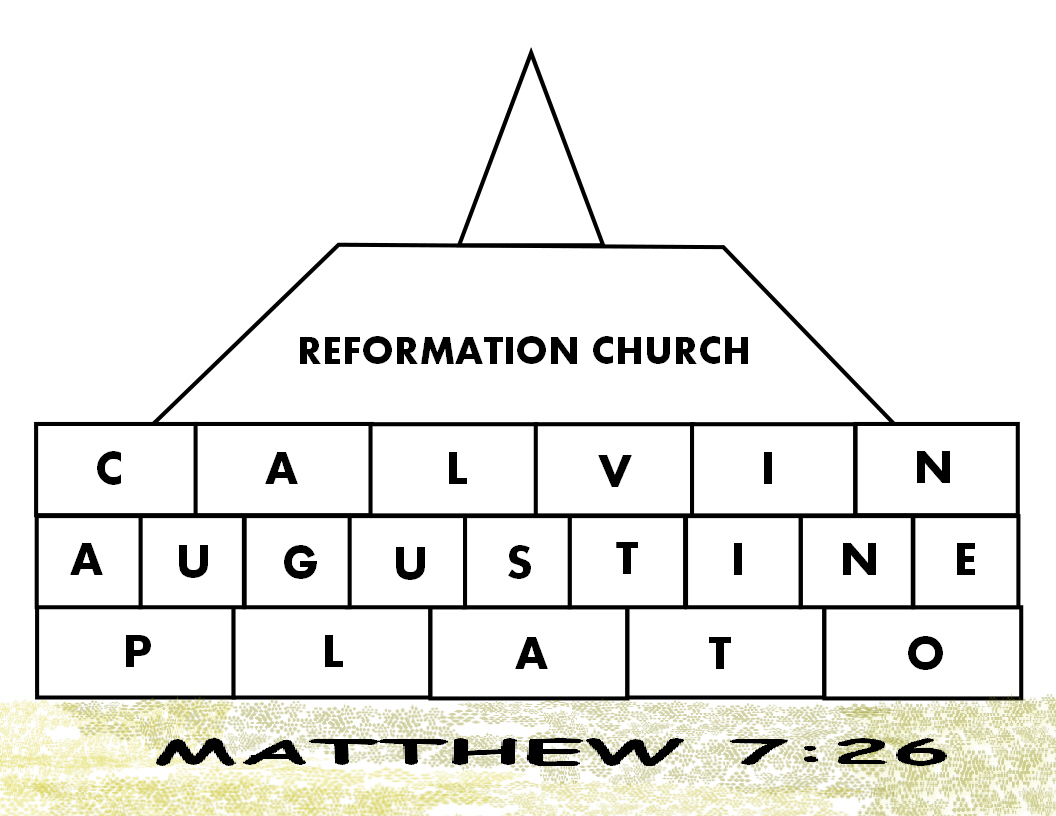
Dear Jane, I Don’t Know About NT Wright, But I do Know Phil Johnson is a Heretic
Paul,
What do you think about this video about NT Wright being called a heretic by Phil Johnson? Phil says Apostle Paul warns in Galatians about the heretic belief that denies imputed righteousness of Christ.
I think Phil is a puffed-up talking head, but curious on your take of this.
Jane.
Jane,
Thanks for this. Phil Johnson is a hardcore proponent of authentic Calvinist (AC) Reformed doctrine. It holds to the double imputation of Christ’s righteousness being imputed to our justification and sanctification. The Bible emphasizes that the righteousness of the Father was imputed to us APART from the law before the foundation of the world. For AC, it is important that it is specifically stated that it is Christ’s righteousness that was imputed to us because He is the only member of the Trinity that would have “kept the law” as a man. And that’s the crux of the heresy, it advocates a righteousness that is NOT APART from the law. It fuses WORKS with grace.
The cute little Calvinist end-around on that is the idea that it is alright that justification is based on perfect works because Jesus keeps the law in our stead. IF we live by the same faith-alone gospel that saved us, the perfect obedience (Christ’s righteousness) of Christ will be perpetually applied to our life and we will be found covered by the righteousness of Christ at the ONE final judgement where the law must be satisfied. The problem here is that a satisfaction of the law is in view, and that is completely antithetical to the point that the apostle Paul strives to make in the Scriptures about grace being apart from the foundation of works. WHO DOES THE WORKS IS NOT THE POINT–WORKS PERIOD IS THE POINT.
But in this false doctrine a practical problem arises. We have to keep our salvation by faith alone so that perfect works will be perpetually applied to our account in sanctification so that we can remain justified. Because of this fusion of justification and sanctification and the fusion of grace and works, our Christian life becomes focused on the ambiguous endeavor of living by faith alone apart from works. The standard for what saved us is now the same standard for our Christian life. “It is [NOT] finished.” If our justification was not finished at the cross, what was Jesus talking about? Plainly, justification is not finished, we have to maintain it by faith alone. This is merely works salvation by proxy; ie., our faith alone in sanctification is a rectifier that imputes works to grace.
Furthermore, it requires a complicated theological system that defines what IS A WORK in sanctification versus what IS NOT a work in sanctification. Critical to the AC construct therefore is the Redemptive Historical hermeneutic that rectifies biblical commands to a faith-alone construct. Simply put, it is a way to only EXPERIENCE obedience rather than to be the actual DOER of the law in sanctification lest it become, “the GROUND of our justification.” Hence, interpreting our Bible grammatically leads to works salvation because it necessarily implies “a leap from the imperative to obedience” rather than the imperative being rectified by the progressive imputation of Christ’s obedience.
It’s backdoor works salvation.
Moreover, it makes sanctification exactly what the Reformers themselves called it: “subjective.” That’s their words exactly, not mine. The power in our sanctification is subjective because we only experience obedience and do not participate in it. We are to meditate on the OBJECTIVE gospel and passively observe the SUBJECTIVE results by faith alone. Hence, “the subjective power of the objective gospel.” John Immel would say that this is all about control; it makes sanctification an ambiguous and fearful endeavor that beckons the saints to depend on God’s annointed to guide them through the tricky and treacherous waters of Christian living by faith alone. Of course, James addressed this very problem in his epistle.
And Immel is absolutely correct about the control issue. That’s why Phil Johnson advocates this doctrine: he is a despicable tyrant filled with lust for the need to control people. Like Calvin, he advocates this false doctrine so as the apostle Paul said, let them both be accursed.
paul
How to Debate a Calvinist Made Easy
 The first thing one must remember in debating a Calvinist is the Calvinist protocol: set and create the framework for the argument in order to dictate a certain outcome. Calvinists will speak from a certain construct and communicate from that viewpoint only, usually without the opponent knowing what the construct is, but if the Calvinist stays within that framework, he/she will have an answer for everything and this will quickly confuse the opponent. Calvinists win the argument every time because opponents don’t understand their metaphysics and epistemology. But that is a discussion not needed here if you follow my directions carefully.
Do not discuss symptoms. You must distinguish symptoms from the core problem. Stay away from quotes that address other issues (symptoms), and issues such as the doctrine of election. Calvinism encompasses a mass of symptomatic issues. These are the tentacles of the octopus. Fighting an octopus one tentacle at a time will lead to a quick demise—stay focused on the head.
A debate doesn’t have to be limited to one visit, and you are not obligated to move on to other issues from a concern that is not answered. Let me repeat that: “you are not obligated to move on to other issues from a concern that is not answered.” And here are your three concerns:
1. Calvinism denies eternal security.
2. If you can lose your salvation, what do you have to do to keep it?
3. Calvinists don’t believe people change.
John Piper is the universally accepted elder statesman of New Calvinism. Use this short article to establish concerns one and two.
Concern three is the HOW we keep our salvation which answers concern number two. Since we have to live our Christian life the same way we were saved to maintain/keep our salvation, we must live by the same gospel that saved us. The mantra, “We must preach the gospel to ourselves every day” should speak for itself. We keep ourselves saved by staying at the foot of the cross which entails a perpetual need for the same forgiveness that saved us, and that can only be perpetually received by a perpetual reliance on the same gospel that saved us. If we believe we change for the better, the need for the same gospel that saved us is eradicated and we lose our salvation.
This is what is behind the “T” in TULIP (total depravity) which unbeknown to many also includes the saints. Hence, the following chart is universally accepted among the Reformed:

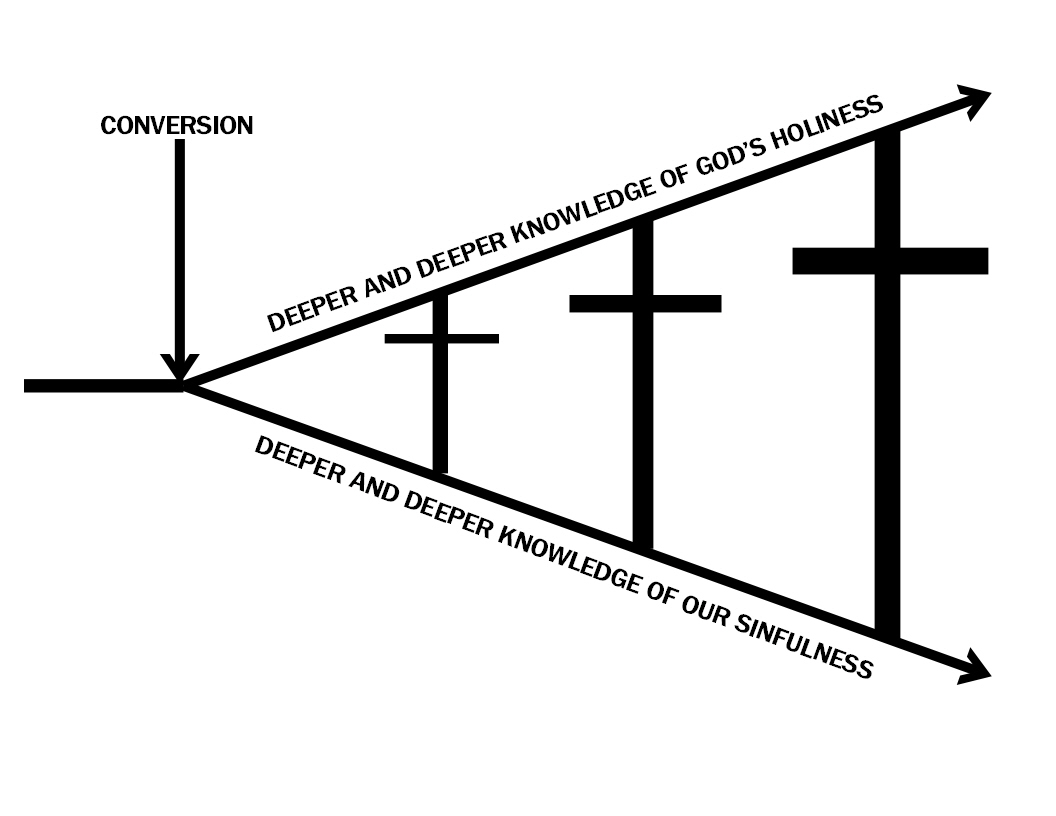
Notice that we don’t change, only the cross changes. Don’t get into what the cross represents in this illustration as that involves complex Reformed metaphysics. Stick with the point/concern, not symptoms. You are not the Calvinist—they are; therefore, you’re the one with the questions and it’s your agenda. “Living by the gospel” in order to stay saved entails focusing on our unchangeable evil verses God’s holiness and thereby perpetually recognizing our need for the gospel and continued salvation from our sins.
Relevant quotes:
“Where we land on these issues is perhaps the most significant factor in how we approach our own faith and practice and communicate it to the world. If not only the unregenerate but the regenerate are always dependent at every moment on the free grace of God disclosed in the gospel, then nothing can raise those who are spiritually dead or continually give life to Christ’s flock but the Spirit working through the gospel. When this happens (not just once, but every time we encounter the gospel afresh), the Spirit progressively transforms us into Christ’s image. Start with Christ (that is, the gospel) and you get sanctification in the bargain; begin with Christ and move on to something else, and you lose both” (Michael Horton: Christless Christianity; p.62).
“Moreover, the message of free reconciliation with God is not promulgated for one or two days, but is declared to be perpetual in the Church (2 Cor. 5:18, 19). Hence believers have not even to the end of life any other righteousness than that which is there described. Christ ever remains a Mediator to reconcile the Father to us, and there is a perpetual efficacy in his death—viz. ablution, satisfaction, expiation; in short, perfect obedience, by which all our iniquities are covered” (John Calvin: CI 3.14.11) [note: “ablution” means “A washing” which refers to salvation and stated as a onetime past event in the Bible; 1COR 6:11, John 13:9-11].
“The flesh, or sinful nature of the believer is no different from that of the unbeliever. ‘The regenerate man is no whit different in substance from what He was before his regeneration.’ — Bavinck. The whole church must join the confession, ‘Have mercy upon us miserable sinners.’ The witness of both Testaments is unmistakably clear on this point (Present Truth: Sanctification-Its Mainspring Volume 16 Article 13).
“There are several problems with that essentially Legalistic view of Sanctification, as reflected in the following observations:
1) Our flesh cannot get better. In Romans 7:18 Paul wrote, “For I know that NOTHING good dwells in me, that is, in my flesh…” Your flesh cannot be improved. Flesh is flesh, and spirit is spirit.
2) Our new nature, on the other hand cannot get better, because it has already been made new and perfect through regeneration. We have been given a “new heart” (new nature, or new spirit), and not a defective one, which would be absurd. This new spirit has been made “one spirit with Him” (1 Corinthians 6:17), such that when we “walk according to the Spirit” (i.e., the Holy Spirit), we also walk according to our own new spirit.
3) Those who deal with Sanctification by zeroing in on so-called “Progressive” Sanctification as the main point of Sanctification are at best in Kindergarten (Terry Rayburn: Grace for Life blog; Progressive Sanctification – Are We Sanctified By Works? 2/16/2012).
paul

 Paul's Passing Thoughts
leave a comment