What Calvinists Believe About Election is Worth Repeating
An excerpt from a reply to someone about election and covenants:
It’s perpetual covenant renewal. By experiencing perpetual death and rebirth (“mortification and vivification”) you gain assurance of salvation, but you won’t know for certain that you are saved until the final judgement. Calvin held to three classes of election: the non-elect, the called (temporarily elected), and those who persevere (those who stand in the judgement). Calvin actually taught that the “called” were temporarily illumined by the Holy Spirit. Most Calvinists of the Neo-Calvinist resurgence are aware that Calvin believed this and hold to it.
Our God Pays His Servants
Justification/salvation is a finished work and is completely separate from sanctification/Christian living. There is only one connection between justification and sanctification; one precedes the other. Seeing the radical dichotomy between justification and sanctification is key to much needed revival among Christians. Fusion of the two in varying degrees is the spiritual cancer that presently plagues the Christian community in our day.
A good way to see the vast separation between justification and sanctification is the difference between gift and reward. A gift cannot be earned, but a reward is something that is earned. Something that is earned, or worked for, cannot be a gift. When your employer pays you, he/she doesn’t hand you a check while saying, “This is a gift from me to you.”
In the Bible, salvation is a gift, and kingdom living is rewarded. Calvinism tries to get around this dichotomy by using Covenant theology. Supposedly, Adam violated a covenant of works when he disobeyed God, and the Covenant of Grace is a gift to us by faith alone, but is a result of Christ fulfilling the Covenant of Works (the covenant violated by Adam) for us. This enables them to explain away the following:
Hebrews 6:10 – For God is not unjust so as to overlook your work and the love that you have shown for his name in serving the saints, as you still do.
If God overlooked the work we do in kingdom living, that would make Him unjust. You can compare this to an employer who doesn’t pay an employee what they have earned. A reward is something you earn.
Calvinists say verses like this must be interpreted redemptively and not grammatically. In the grammatical interpretation, “your” means “you.” It is work done by you and you have earned a reward accordingly. If God overlooks what YOU have earned, that would make Him unjust. But if this verse is interpreted redemptively, it becomes the work Christ has done for you rather than by you. It is Christ’s fulfillment of the Covenant of Works that is being referred to, and your reward is salvation accordingly.
So, our “reward” is really a “gift.” And the “gift” is a reward given to us because the work is done by someone else. Hence, one cannot be a grammarian and Calvinist both. In addition, any claim by Calvinists that they use exegesis is not in the realm of reality. Covenant theology is clearly eisegesis. You must go to the Bible with a prism that can explain the contradictions that arise when sentences are evaluated by the plain sense of the words.
paul
Why the Institutional Church is Mostly Unregenerate, Dead, and Just Plain Boring

Notes for Sunday July 13th 2014:
Romans Series Interlude: Predestination, a Potter’s House Journey; Part 8, “What’s in the Word, ‘Perseverance’”? Part 2 on “Perseverance”
“It boils down to a distinction between gift and reward. Is the reward salvation?”
“This is the Reformed gospel to a “T.” Already—not yet. Salvation/justification as a process that includes our present lives is unavoidable.”
“Hence, because past and present Reformers see salvation as a present/future process, the future redemption of the body is applied to an incomplete salvation of the soul. This is VERY problematic…Though this position shocks the spiritual sensibilities of the average Christian, it is in fact the Reformed position on salvation.”
An institutional church to replace Rome was Luther’s idea; Calvin articulated it in his Institutes of the Christian Religion. The Reformation gospel is primarily responsible for sucking the life out of many professing Christians, but that is rounded out by the caste system inherent in most institutions. The Reformation gospel killed our soul while the institution puts us in a straightjacket for good measure.
The Reformation gospel accomplished this by making justification, or salvation, a PROCESS instead of a finished work. The gift of salvation, and the gifts we receive at salvation, are just that, gifts that we cannot earn. However, the Bible has much to say about Christians being rewarded for putting those gifts into practice. When you begin to see the Bible’s emphasis on blessings and rewards for putting our gifts into practice—a very energetic call to action arises.
John Calvin and his wicked wannabe theologians made the various rewards/blessings in the Bible one thing and one thing only: salvation. The reward for running the race of faith is salvation. When justification, or salvation, is a PROCESS, that must necessarily include our Christian lives; so, REWARD cannot be a part of that—the reward must be salvation. And, since no part of justification can have reward, the reward must be living our Christian lives the same way we originally received the gift: by faith alone, or living by the gospel, or preaching the gospel to ourselves, etc.
In contrast, when we see the biblical Grand Canyon that we should see between the finished work of salvation and the call to hard work in our Christian lives, a whole new world of possibilities is seen. Blessings and promises aside, we see that we are very unique individually as Christians. No, we are not merely, “ALL just sinners saved by grace.” We ALL have unique gifts that distinguish us from other believers by kind and degree of faith. Those who excel at certain gifts will receive a crown that makes that distinction.
Institutional caste is designed to take focus off of the individual. Instead, the institution and its leaders become the focus. In addition, because living by faith alone in order to keep the salvation process moving along correctly is really tricky business, Christians will be understandably introspective about what they do in their Christian lives; i.e., constant fear of “moralism” etc.
It boils down to a distinction between gift and reward. Is the reward salvation? As we discussed in last week’s lesson, the book, The Race Set Before Us posits the traditional Reformed line on this question:
In this chapter we shall attempt to show that our salvation is both present and future (p. 47).
Both the present and future dimensions of salvation should be viewed as two aspects of an invisible whole. Almost inevitably the impression that separable parts are intended will tend to creep into readers’ minds, but we must fix in our minds from the beginning that the wholes instead of parts are in view. The present possession of all the gifts we will ascribe is ours because the eschaton (end time) has invaded history…Salvation is not merely a past reality; it is also our future destiny (p.47).
When we study the New Testament writers, however, we discover something quite surprising. Though they occasionally describe salvation as a present possession of believers, they usually envision salvation as something that will occur in the future. For example, Jesus says, “All men will hate you because of me, but he who stands firm to the end will be saved.” (Mt 10:22 NIV; cf. also Mt 24:13). Matthew does not say that the one who endures to the end has been saved or that this person shows evidence that he or she is saved. Matthew says that the one who stands fast and perseveres will be saved, that is, will be saved on the future day of the Lord (p. 49).
This is the Reformed gospel to a “T.” Already—not yet. Salvation/justification as a process that includes our present lives is unavoidable. Notice, as a proof text, that the authors use Matthew 10:22 and 24:13. We addressed this last week: the context of those verses is the tribulation period, and Christ is speaking of the salvation of the body/life, not eternal salvation. Christ instructs those who are living during that time to flee from town to town, and before they run out of towns to flee to, Christ will have returned. This fact should get our attention in regard to this sloppy proof texting.
This necessarily requires a discussion in regard to one of many flaws in the Reformation gospel: the confounding/fusion of salvation and redemption. Salvation is the saving and regeneration of the soul, but redemption is the saving of the mortal body when Christ comes for us. Redemption is guaranteed, and spoken of as a possession in regard to its guarantee (Romans 8:30), but it is a separate consideration from eternal salvation in regard to the saving of the body. Paul clearly spoke of this as a separate and future salvation:
Romans 7:24 – Wretched man that I am! Who will deliver me from this body of death? 25 Thanks be to God through Jesus Christ our Lord! So then, I myself serve the law of God with my mind, but with my flesh I serve the law of sin.
As we have discussed before, the word for “wretched” used in many English translations means “afflicted.” The law of sin and death (the law that we used to be under and enslave to) continually provokes us and wages war against the law of our regenerated minds. The Amplified Bible renders the passage this way:
24 O unhappy and pitiable and wretched man that I am! Who will release and deliver me from [the shackles of] this body of death?
25 O thank God! [He will!] through Jesus Christ (the Anointed One) our Lord! So then indeed I, of myself with the mind and heart, serve the Law of God, but with the flesh the law of sin.
Hence, because past and present Reformers see salvation as a present/future process, the future redemption of the body is applied to an incomplete salvation of the soul. This is VERY problematic. “Salvation” to them, ALWAYS means eternal salvation. This also necessarily confounds/fuses gift and reward. Gift and reward both are applied to eternal salvation. The race of faith now becomes, The Prize To Be Won: Our Present & Future Salvation (Ibid: title of chapter 2, p. 46). Though this position shocks the spiritual sensibilities of the average Christian, it is in fact the Reformed position on salvation.
We strongly contend that rewards pertain to present and future blessings for the Christian. This is irrefutable by process of elimination. If the gift of salvation is not past tense and complete, it is not a gift, but exactly what the Reformers say it is, a reward, and that in blatant contradiction to the very words of the apostle Paul:
Romans 4:4 – Now to the one who works, his wages are not counted as a gift but as his due.
Romans 11:6 – But if it is by grace, it is no longer on the basis of works; otherwise grace would no longer be grace.
Ellicott’s Commentary for English Readers: The proposition is put in a general form. Those who base their claim on works have a right to their reward. It is not conceded to them by any sort of imputation, but is their desert.
The reward.—Literally, his wages. The relation between what he receives and what he does is that of wages for work done. He can claim it, if need be, in a court of law. There is in it no element of grace, or favour, or concession.
Matthew Henry’s Concise Commentary: From this example it is observed, that if any man could work the full measure required by the law, the reward must be reckoned as a debt, which evidently was not the case even of Abraham, seeing faith was reckoned to him for righteousness.
The idea of reward is synonymous with earned wages. “reward” is an official synonym of something earned.
Revelation 22:10 – And he said to me, “Do not seal up the words of the prophecy of this book, for the time is near. 11 Let the evildoer still do evil, and the filthy still be filthy, and the righteous still do right, and the holy still be holy.”
12 “Behold, I am coming soon, bringing my recompense with me, to repay each one for what he has done. 13 I am the Alpha and the Omega, the first and the last, the beginning and the end.”
14 Blessed are those who wash their robes, so that they may have the right to the tree of life and that they may enter the city by the gates. 15 Outside are the dogs and sorcerers and the sexually immoral and murderers and idolaters, and everyone who loves and practices falsehood.
The word for “recompense” follows:
g3408. μισθός misthos; apparently a primary word; pay for service (literally or figuratively), good or bad:— hire, reward, wages. AV (29)- reward 24, hire 3, wages 2; dues paid for work wages, hire reward: used of the fruit naturally resulting from toils and endeavours in both senses, rewards and punishments of the rewards which God bestows, or will bestow, upon good deeds and endeavours of punishments
For the saved, there are all kinds of various and sundry blessings and rewards for work in the Christian life. In fact, God would be unjust to not remember them:
Hebrews 6:10 – For God is not unjust so as to overlook your work and the love that you have shown for his name in serving the saints, as you still do.
Why would God be unjust to forget our works in the Christian life? Well, this is radical, but plain in Scripture, and something that Christians must come to grips with: we are owed a reward for our work in the Christian life—God would be unjust to overlook our works. This completely upsets the Reformed applecart. If justification is in-process, it goes without saying that the reward must be made synonymous with a gift. Again, one can add this to the long list of common words that must be redefined as metaphysical anomalies. A reward is redefined as a gift.
But the gift of salvation is ALWAYS spoken of in the past tense within the pages of Scripture, and God’s calling and gifts are without repentance:
Romans 11:28 – But as regards election, they are beloved for the sake of their forefathers. 29 For the gifts and the calling of God are irrevocable.
Clearly, the Reformers DO teach that God revoked Israel’s election and replaced her with the “church. “ Who would deny this? For Christians, the gift of the Holy Spirit is a done and settled issue, Period!
Galatians 3:1 – O foolish Galatians! Who has bewitched you? It was before your eyes that Jesus Christ was publicly portrayed as crucified. 2 Let me ask you only this: Did you receive the Spirit by works of the law or by hearing with faith? 3 Are you so foolish? Having begun by the Spirit, are you now being perfected by the flesh?
The “’gift’ of the Spirit” is a phrase found in the New Testament often, and also the idea that we are “sealed” by the Spirit until the day of redemption and therefore, at times, “grieve” Him when not walking in His ways. Justification is a settled issue. Certainly, part of our reward is the blessings we will receive at redemption, but redemption is not salvation. Salvation is a settled issue, complete, and irrevocable. Redemption, though guaranteed, is future. Rewards include present blessings, future blessings, and recognition by God…in the form of CROWNS.
This is where perseverance is a reward and not the attaining of salvation. One of the rewards of perseverance is a “rich” entry into the kingdom. Perseverance doesn’t reward us with salvation—that’s a gift, the reward is the “rich entry” as opposed to those who have forgotten that they were cleansed and see salvation from afar:
2Peter 1:5 – For this very reason, make every effort to supplement your faith with virtue, and virtue with knowledge, 6 and knowledge with self-control, and self-control with steadfastness, and steadfastness with godliness, 7 and godliness with brotherly affection, and brotherly affection with love. 8 For if these qualities are yours and are increasing, they keep you from being ineffective or unfruitful in the knowledge of our Lord Jesus Christ. 9 For whoever lacks these qualities is so nearsighted that he is blind, having forgotten that he was cleansed from his former sins. 10 Therefore, brothers, be all the more diligent to confirm your calling and election, for if you practice these qualities you will never fall. 11 For in this way there will be richly provided for you an entrance into the eternal kingdom of our Lord and Savior Jesus Christ.
For the most part, the word for “crown” in the New Testament is stephanos:
g4735. στέφανος stephanos; from an apparently primary στέφω stephō (to twine or wreathe); a chaplet (as a badge of royalty, a prize in the public games or a symbol of honor generally;
The exception is diadēma which is only used three times in the Bible—all in the book of Revelation. Several titles are attached to these crowns regarding rewards, honor, or recognition. Curiously, the Reformed crowd insists that these crowns represent salvation. And seemingly, this makes since. Take for instance the “crown of righteousness” (2Timothy 4:8). Righteousness is a word closely linked to salvation, but it is also attached to the idea of a reward for doing righteousness:
Matthew 10:40 – “Whoever receives you receives me, and whoever receives me receives him who sent me. 41 The one who receives a prophet because he is a prophet will receive a prophet’s reward, and the one who receives a righteous person because he is a righteous person will receive a righteous person’s reward. 42 And whoever gives one of these little ones even a cup of cold water because he is a disciple, truly, I say to you, he will by no means lose his reward.”
Each crown title is probably a category with its own list of good works. We know that the crown of righteousness is a reward for those who love the appearing of Christ. I firmly believe that Christians with an intense interest in eschatology will receive this crown. But according to what we have just noted from Matthew 10, this could also be a crown for those who help other Christians as a lifestyle. We should all do that, but I believe crowns represent those who excel in that particular spiritual gift given to them.
This brings us to the subject of perseverance and the crown of life:
James 1:12 – Blessed is the man who remains steadfast under trial, for when he has stood the test he will receive the crown of life, which God has promised to those who love him.
Revelation 2:10 – Do not fear what you are about to suffer. Behold, the devil is about to throw some of you into prison, that you may be tested, and for ten days you will have tribulation. Be faithful unto death, and I will give you the crown of life. 11 He who has an ear, let him hear what the Spirit says to the churches. The one who conquers will not be hurt by the second death. ‘
Perseverance is one of the building blocks of the Christian life, and those who excel in overcoming, even unto death, will receive a crown. I believe these crowns represent blessings that we cannot presently comprehend (1Corinthians 2:9). However, failure to persevere does not mean that you are not saved. Remember, the apostles abandoned Christ before He was crucified.
But, doesn’t the “second death” in Rev. 2:11 refer to the great white throne judgment? It would seem that conquering is a prerequisite to not being hurt by that judgment. I don’t think conquering is a prerequisite or requirement to escaping the second death, I think what we have here is a statement of fact as a way to encourage. Again, if it’s a prerequisite, salvation is a reward owed to the believer by God and not a gift. I don’t think Christ is stating this as a requirement, but rather a reminder of future blessings in order to encourage.
I realize that the Reformed would be quick to cite this passage as proof that Christians will all be standing in that judgment, but if they persevere they will not be hurt by it. But note Revelation 20:6, “Blessed and holy is the one who shares in the first resurrection! Over such the second death has no power, but they will be priests of God and of Christ, and they will reign with him for a thousand years.” Those who partake in the first resurrection will not stand in the white thrown judgment at all, so that is an argument they cannot use to begin with. Remember, they believe that the law is still the standard for justification, so there is only one judgment and one resurrection. We discussed this at length last week.
The book of 1John was written so that we can “KNOW” that we have eternal life (1John 5:13). The key to that book is a life of love. Christians who are slothful in the practice of love will doubt their salvation. I also believe that there will be believers that will be ashamed at His coming:
1John 2:28 – And now, little children, abide in him, so that when he appears we may have confidence and not shrink from him in shame at his coming. 29 If you know that he is righteous, you may be sure that everyone who practices righteousness has been born of him.
2Timothy 2:15 – Do your best to present yourself to God as one approved, a worker who has no need to be ashamed, rightly handling the word of truth.
These passages address “children” and workers. These are Christians who need not be ashamed at His coming; instead of shrinking back in shame, they love and long for His appearing.
A required perseverance or fruit to finish a salvation process must be rejected—perseverance is a gift among Christians that some will excel at and receive a reward accordingly, but it is a reward for the application of a gift—not a wage owed.
Inquiring Protestants Want to Know: What Does Salvation “Look Like”?
 “In all of the rhetoric by John MacArthur et al, if you observe their specific words carefully, what is missing is the idea that we are in fact righteous beings who DO righteous deeds. This is the same old Gnostic song and dance that has plagued God’s people since the angel blocked access to the garden with a flaming sword.”
“MacArthur et al cannot escape this fundamental Reformed error regarding law and gospel. They can dance around it all year long, but there is ultimately no escape, this is simple theological math”.
“Ever heard of a dead person being indicted? In our case, being saved, the old us could be exhumed and dragged into court, but even then there would be no law to judge us. This is why Christ died on the cross—to end the law. Glory to His name, and I love to tell this story.”
Presently, I am taking part in a discussion over at Spiritual Sounding Board. It’s one of the more beneficial discussions I have taken part in on any blog. Bottom line: why do we need a commercial building to do church? Who owns truth? What is the true authority structure of the New Covenant? Why are we at the mercy of choosing these answers from a smorgasbord of “experts” who do not agree? Why are we at the mercy of institutional leaders to stop abuse? Why are we begging them to do something about it? And, for the love of mercy, what’s up with the Nones? Think about it, to say “enough is enough” with the institutional church is to quit church altogether. Huh? See the problem here? The Reformers have effectively sold the whole idea of orthodoxy versus heterodoxy. Orthodoxy is a catechism given to the masses to live by from those who were chosen to be enlightened. It’s dignified mythology which is truth in storybook form palatable for the unenlightened masses.
And in order to control us according to European caste tradition, they have effectively dumbed us down. You can’t control an empowered priesthood of believers who have studied to show themselves approved. Weak saints are fleeceable and manageable. Point is case among many: “We know the institutional church is bogus, but we attend so our children can be involved in activities with other children.” Wow, just wow. Saving our kids from boredom is more important than the truth? Really? And then we get on blogs and whine about abuse? Truly, the 500 year campaign to make God’s people weak and manageable has been a grand success. Now, I don’t know if any of us would die for the truth, but why throw all doubt of that to the dogs by making the inbred weak sensibilities of our children more important than the truth? Let’s be honest with ourselves: we have bought the Reformed package that salvation can only be gained in the institutional church.
But in the aforementioned discussion, a question was posed that once again reminds us of the following: 500 years later, and billions paid to Reformed academics by laboring saints later, there is still confusion about what salvation is. This is by design. We are paying philosopher kings to keep us confused. I was sent a link by someone yesterday written by one of the premier Reformed academics of our day, John MacArthur Jr. In the article, he concedes that confusion about salvation is rampant among Christians, but his causal theory is very interesting, and frankly, as old as the hills: Christians want to figure everything out through reason and they don’t understand “paradox.” In fact, the Reformed tradition is littered with pithy truisms that state this very idea:
“Already—not yet.”
“Justification and sanctification are distinct, but never separate.”
“Simultaneously saint and sinner.”
These truisms are expressed in lofty Latin terms for purposes of intimidation. The Protestant psyche is perpetual doubt and fear—this was Calvin and Luther’s very definition of the Christian experience. Fearful people are easy to control, and put their hope in the magical yellow salvation bus driven by Plato’s philosopher kings. I have written of this and supplied specific citations until I have become blue in my fat face. In my book It’s Not About Election, I denote a whole chapter to this fact and cite many references. The title of chapter 5 is, “A Gospel of Works, Fear, and NO Assurance” (PS, my offer to send 10 free copies to 10 people involved in said conversation still stands. Send request to pmd@inbox.com this also includes The Reformation Myth). And as I discuss in the book, the icing on the cake is Calvin’s trump card, the get out of election free card. While propagating fear on the one hand, the power of the keys are propagated on the other. Let me give you the thumbnail: if your local Reformed elder thinks well of you—you are going to heaven because whatever he binds on earth will be bound in heaven, and whatever he looses on earth will be loosed in heaven. It is the perfect storm of control. That’s why it is important that your children are involved in the institutional church. Come now, look in the mirror and be honest with yourself.
Now, let’s get to this…
…very telling question by one using the internet handle, “Waking Up”:
To paulspassingthoughts or anyone else able to answer, what does salvation look like, and act like? How does a saved person live and think about God? Since most of us have been fed various flavors of errors, from Calvin on down, please shed some light.
“What does salvation LOOK LIKE, and ACT LIKE.” Stop right there. This is why Protestants will never have the assurance promised to us by John, Jude, Peter, and Paul. Salvation is something that we can merely look at and observe what IT acts like. This is Luther’s alien righteousness to a T.
“Oh, that means God’s righteousness is a gift given to us when we are saved; such saving righteousness was of course foreign to us before salvation.”
NO! Protestant orthodoxy insists that this righteousness remains outside of the believer. Saving faith is the ability to merely EXPERIENCE “saving acts” done TO US and not done BY US. In all of the rhetoric by John MacArthur et al, if you observe their specific words carefully, what is missing is the idea that we are in fact righteous beings who DO righteous deeds. This is the same old Gnostic song and dance that has plagued God’s people since the angel blocked access to the garden with a flaming sword. I don’t give a damn what these guys seemingly state, the official contemporary designation for their authentic Reformed gospel is “The Objective Gospel Outside of Us.”
Much could be said about this, but for now, let’s answer the question with definitive theological mathematics. Teacher Andy Young said it well at this year’s TANC conference: the law is for sanctification. There is no law in justification; we are justified apart from the law, and justification ENDS the law for those who believe. Reformed theology keeps the law as an ongoing standard of justification. Where there is no law, there is no sin, so sin is ended, but in the Reformed gospel where law remains the standard for justification after salvation, sin is not ended, it is “covered” by the “saving acts” (plural) of Christ’s life as well as His death. So, according to the Reformed gospel, Christ’s death did not end the law for justification, it was only a perpetuation for our past sin, now the obedience of Christ must be applied to the law in order to keep us saved. And of course, this requires a perpetual reapplication of the same gospel that saved us by faith alone to fulfill the law in order to keep us saved.
MacArthur et al cannot escape this fundamental Reformed error regarding law and gospel. They can dance around it all year long, but there is ultimately no escape, this is simple theological math. There are two salvific relationships to the law: the law of sin and death, and the law of the Spirit of life (Romans 8:2). Before we are saved, our mortality is enslaved to the law of sin and death, what the Bible calls being under law and not, under grace. This is the very definition of a lost person: “under law.” Ironically, the Reformed gospel keeps “believers” under law and defines a Christian according to the biblical definition of a lost person. So, there is warfare between two laws within a lost person: the law of sin and death which provokes them to sin, and the works of the law written on their hearts and judged by their conscience which either accuses or excuses. This is why the lost are not even totally depraved, much less the saved.
When a person is saved, they are no longer under the law of sin and death nor enslaved to it. That law is ended. Therefore, for purposes of justification, the believer is PERFECT for two reasons. First, there is no law to judge his/her justification. Second, said person died with Christ, and a dead person cannot appear in a court of law (see Romans 7:1ff). Ever heard of a dead person being indicted? In our case, being saved, the old us could be exhumed and dragged into court, but even then there would be no law to judge us. This is why Christ died on the cross—to end the law. Glory to His name, and I love to tell this story. Sin is not covered—it is ended for those who are justified. The old us is so dead to the law, that our mortality must be kept alive by Christ (Gal 2:20). In regard to the law of sin and death, it is no longer we who live, we died with Christ.
But according to the law of the Spirit of life, that’s a different story. We do live; we not only died with Christ, but we now share in His resurrection. The death part of our baptism is a finished work, but the resurrection life is just beginning. The new us is under grace, and able to please God by walking in the Spirit. And, the Spirit calls on us to learn and obey the law (the Bible); this is what he uses to change us (John 17:17). He promises to help us in our endeavor to please God and lead others to this same life. Yes, all that we do in obeying the law is out of love because we know that there is no law for justification. We have no motive to earn our justification—that’s absolutely impossible—there is no law that we can obey to do that. “If you love me, keep my commandments.” We are under grace and obey the law of Christ for love. As new creatures, it is impossible to attempt to obey any law for justification unless we do so out of ignorance and a fundamental misunderstanding of the gospel.
Granted, there is a salvation and a rest yet waiting for Christians: the redemption of our mortal bodies. Until then, the law of sin and death can still provoke us to sin, but it cannot condemn us. It can provoke us, but it can’t judge us (Romans 7:23). It can provoke us, but we are not enslaved to it, but we are rather now enslaved to the law of the Spirit of life (Romans 6;18, 7:25). There is NO fear in the love of the Spirit of life, but yes, in working out the salvation of the mortal body, there is fear, for judgment begins in the house of God. There are present consequences for sin, but not eternal ones for the believer.
Protestantism keeps us under the law of sin and death, and fear, but there is no fear in love. Our obedience cannot have any kinship with justification. Hence, in the same way that one violates all of the law if he/she violates one point while being under it, the Christian fulfills all of the law by one act of love. I love this story. The story of freedom from the law of sin and death.
To all Protestants in the institutional church I say: come out from among them and be separate. Come out from among them and be free from the law of sin and death. Come, love our blessed Lord who died on that cross to free us by obeying the law of the Spirit of life. You are free to aggressively learn and obey—you are free to love your neighbor and God with your labor of love.
To “Waking Up” and all of us I say…
“’Awake, O sleeper, and arise from the dead, and Christ will shine on you.’ Look carefully then how you walk, not as unwise, but as wise, making the best use of the time, because the days are evil.”
paul
The God Who Seeks Us
“Supralapsarianism and infralapsarianism are not good news. It will make evangelism anemic, and will defile what little evangelism takes place.”
We have all heard it many times: no one seeks after God. Salvation isn’t like God throwing us a life preserver; we are floating in the water dead—we can’t even grab the life preserver. We have no choice in the matter in regard to an ability to choose God for salvation. If left to ourselves, we will always choose death. So yes, man can choose, but unless God intervenes he will always choose eternal death. He only has an ability to not choose God, God must choose him first. The verse most often cited is:
Romans 3:10 – As it is written, There is none righteous no not one. 11 There is none that understandeth: there is none that seeketh God. 12 They have all gone out of the way: they have been made altogether unprofitable: there is none that doeth good, no not one. 13 Their throat is an open sepulcher: they have used their tongues to deceit: the poison of asps is under their lips. 14 Whose mouth is full of cursing and bitterness. 15 Their feet are swift to shed blood. 16 Destruction and calamity are in their ways: 17 And the way of peace they have not known. 18 The fear of God is not before their eyes (Geneva Bible 1599). Psalms 13:1-3, 5:10, 139:4, 9:28, 35:2, Isaiah 59:7,8 (LXX Brenton). Psalms 14:1-3, 53:1-3, 5:9, 140:3, 10:7, 36:1, Proverbs 1:16, Isaiah 59:7,8 (Masoretic AV).
As the apostles did many times in their writings, Old Testament quotations in the New were a combination of many different verses to make one point. But should this text be interpreted as a specific rule, or does it characterize the enemies of God? Does the subject of these references, the “fool” understand absolutely nothing about God? Is he completely devoid of any good work? Does the fool NEVER fear God etc., or is this a characterization rather than a hard fast rule? Since other Scriptures contradict the rule, for example, there are many instances of unbelievers fearing God in the Bible; we must conclude that this description characterizes the unbeliever, but is not a definitive description. It is like saying, “You never _______.” We aren’t saying that they never do this, that, or the other, it is a manner of speaking that regards a life pattern.
Granted, man does not initiate a relationship with God. We see this in the fall of man. Adam and Eve hid from God after they sinned, and it was God who searched for them in the garden. After Cain slew Able, it was God who confronted Cain to elicit repentance.
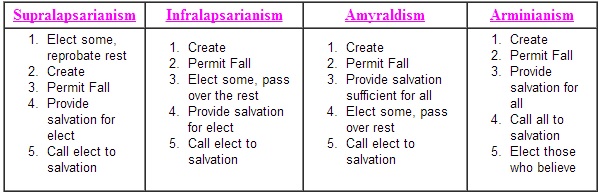
Did God create man as a despised thing in order to bring Himself glory? Did God predetermine the fall of man in order to contrast evil with His good? Does His wrath demonstrate His righteousness? Does His wrath accentuate His grace? Protestantism can be divided into two camps in this regard: supralapsarianism and infralapsarianism. The following chart (other source) demonstrates the difference between the two views.

As you can see, supralapsarianism holds to the position that God preordained the fall of man. Infralapsarianism holds to the idea that it was God’s intent to create man, but not His intent that man fall. In other words, God didn’t create man for the express purpose of his fall. Both hold to the idea that God preselected some for eternal life and others for eternal destruction. Calvin was a superlapsarian.
The human mind, when it hears this doctrine, cannot restrain its petulance, but boils and rages as if aroused by the sound of a trumpet. Many professing a desire to defend the Deity from an invidious charge admit the doctrine of election, but deny that any one is reprobated (Bernard. in Die Ascensionis, Serm. 2). This they do ignorantly and childishly since there could be no election without its opposite reprobation. God is said to set apart those whom he adopts for salvation. It were most absurd to say, that he admits others fortuitously, or that they by their industry acquire what election alone confers on a few. Those, therefore, whom God passes by he reprobates, and that for no other cause but because he is pleased to exclude them from the inheritance which he predestines to his children. Nor is it possible to tolerate the petulance of men, in refusing to be restrained by the word of God, in regard to his incomprehensible counsel, which even angels adore. We have already been told that hardening is not less under the immediate hand of God than mercy. Paul does not, after the example of those whom I have mentioned, labour anxiously to defend God, by calling in the aid of falsehood; he only reminds us that it is unlawful for the creature to quarrel with its Creator (Institutes 3.23.1).
Hence, evangelism is a “savor of death, and a savor of life,” and God is glorified by both. Evangelism isn’t for the purpose of “saving” the lost; it is for the purpose of putting a response to the gospel on display for the glory of God.
There is a universal call, by which God through the external preaching of the word invites all men alike, even those for whom he designs the call to be a savour of death, and the ground of a severer condemnation (Institutes 3.24.8).
He arranges all things by his sovereign counsel, in such a way that individuals are born, who are doomed from the womb to certain death, and are to glorify him by their destruction (3.23.6).
Calvin also held to the idea that Adam and Eve were fallen before the fall:
Even If man had remained in his integrity, still his condition was too base for him to attain to God. How much less could he have raised himself so far, after having been plunged by his ruin into death and hell, after staining himself with so many defilements nay, even stinking in his corruption and all overwhelmed with misery? (Institutes 2.12.1).
This is in stark contradiction to Genesis 1:28-31;
28 And God blessed them. And God said to them, “Be fruitful and multiply and fill the earth and subdue it, and have dominion over the fish of the sea and over the birds of the heavens and over every living thing that moves on the earth.” 29 And God said, “Behold, I have given you every plant yielding seed that is on the face of all the earth, and every tree with seed in its fruit. You shall have them for food. 30 And to every beast of the earth and to every bird of the heavens and to everything that creeps on the earth, everything that has the breath of life, I have given every green plant for food.” And it was so. 31 And God saw everything that he had made, and behold, it was very good. And there was evening and there was morning, the sixth day.
If Eve was “very good,” we must assume free will at that point.* Eve had a choice to trust and obey God who had glorious plans for mankind without the fall (Genesis 1:28). Evil entered into the world through the angelic rebellion led by Satan (Eze 28:11-19, Isa 14:12-14, Rev 12:3,4), and apparently, though speculative, this is a backdrop that effected the way God decided to interact with Adam and Eve. He installed two trees in the garden amidst many other trees, and the one tree that they were forbidden to eat of was the tree of the knowledge of good and evil. They were allowed to eat of the tree of life, but not the other tree of the knowledge of good and evil. God didn’t keep it from them that evil existed, He just didn’t want them to experience it (Gen 2:2-8, 15,16).
It is interesting to note that God intervened to prevent Adam and Eve from eating of the tree of life which would have resulted in them living forever, so He banned them from the garden (Gen 3:22-24). Therefore, we must conclude that to some extent the world and man operates separately from the will of God and God therefore intervenes in the affairs of men, in time, to bring about His desired outcome. We see the same in Genesis 11:1-9—God confused the languages to prevent an undesired outcome. As an aside, let me mention that Gen 11:6 does not bode well for the idea of total inability:
And the Lord said, “Behold, they are one people, and they have all one language, and this is only the beginning of what they will do. And nothing that they propose to do will now be impossible for them.
This study focuses on the fact that God intervenes in the affairs of men by seeking them and calling them to repentance. Does He do this according to a predetermined outcome, or does He know what’s going to happen, and how men will react to specific circumstances? Is God’s intervention merely for the sport of self-glorification in life and death, or does God exhaust every effort to call man to Himself, and when it gets right down to it (in the final analysis), does every person have an ability to choose, the fact that God knows the future notwithstanding?
The latter is for forthcoming study, but we will now look at how God seeks to be reconciled to man.
John 1:12 – But to all who did receive him, who believed in his name, he gave the right to become children of God, 13 who were born, not of blood nor of the will of the flesh nor of the will of man, but of God.
In the garden, Adam and Eve hid from God, they did not seek Him, He sought them out. Neither was it their will to come up with a means of reconciliation according to God’s righteousness. God announced that on the spot after He confronted them:
Genesis 3:15 – and I will put enmity between thee and the woman, and between thy seed and her seed: he shall bruise thy head, and thou shalt bruise his heel (ASV).
Man doesn’t seek God, and he certainly did not come up with the plan of salvation, but does that mean he has no choice when he is cornered by God with the solution for his sin? It seems to me that many verses concerning God’s seeking and His means of reconciliation are interpreted as inability to choose.
We have discussed before how man is created with an intuitive knowledge of God and His righteousness and deliberately suppresses that truth in unrighteousness. Mankind descended from Adam and Eve who talked with God face to face. Creation also testifies about God. Man has been endowed with an ability to know God. Supralapsarianism posits the belief that God predetermined to endow mankind with an inability to choose God before the fall, infralapsarianism posits the belief that inability came after the fall. Their concern is the idea that God is the creator of evil. But in their assessment that God chooses some and not others for salvation, are those not chosen being tempted to greater evil by God in accordance with James 1:13? In other words, is God temping some to greater condemnation with the “good news”? Well, if God is glorified by the savor of death, it would seem so.
There are many ways that God seeks us, but let us name one as evangelism with the “good news” which would seem to be good news to some, but very bad news to others who are endowed with more condemnation every time they hear the gospel. I have even heard some pastors use this savor unto life/death as an incentive for evangelizing. What is the PURPOSE of the good news, to save only, or further condemn as well? (Perhaps John 3:17 answers that question).
Consider that the offer of reconciliation to all men is a legitimate offer. Christ secured salvation for all men—Christ died for all men—this is irrefutable:
2Peter 2:1 – But false prophets also arose among the people, just as there will be false teachers among you, who will secretly bring in destructive heresies, even denying the Master who bought them, bringing upon themselves swift destruction.
Being “bought with a price” is salvific language in the New Testament (1Cor 6:20). Also, we are warned to not “neglect” salvation in Hebrews 2:3. How can we neglect something that is not truly ours for the taking?
God seeks us out with a legitimate offer of salvation. We are also told that we can understand the offer, and even experience the goodness of the offer, and yet reject it (Heb 6:4-6). Final judgment is horrific and eternal because they have rejected the Christ who died for them.
Secondly, God seeks us by sending the Holy Spirit after Christ’s ascension to convict the world of sin:
John 16:6 – But because I have said these things to you, sorrow has filled your heart. 7 Nevertheless, I tell you the truth: it is to your advantage that I go away, for if I do not go away, the Helper will not come to you. But if I go, I will send him to you. 8 And when he comes, he will convict the world concerning sin and righteousness and judgment: 9 concerning sin, because they do not believe in me; 10 concerning righteousness, because I go to the Father, and you will see me no longer; 11 concerning judgment, because the ruler of this world is judged.
Thirdly, as we have discussed in previous parts, it is not God’s desire that any person perish. This is further demonstrated by the fact that God did not create hell for man, but the devil and his angels (Matthew 25:41). In contrast, the prepared place for mankind is God’s mansion (John 14:2,3). I think this is telling; the Bible NEVER states that God created hell for mankind. In light of supralapsarianism and infralapsarianism, this doesn’t add up.**
As we move forward in promoting home fellowships, it is important to me that our incentive for evangelism is valid. Our incentive should be that God died for the sins of every person. Our incentive should be that it is His desire that all men be saved. It should be a call to not neglect such a great salvation. It should be a call not to go to a hell that was not prepared for them.
Supralapsarianism and infralapsarianism are not good news. It will make evangelism anemic, and will defile what little evangelism takes place.
Notes
*Keep in mind the “holy” angels as well. Those who followed Satan in the rebellion must have done so by choice. Inherent in their created being was an ability and freedom to choose.
**A good study is the “book of life.” It would appear that all people born into the world are originally written in the book of life which includes the righteous. It would also appear that they are only “blotted out” when they ultimately reject God’s way of reconciliation.
Other views (other source):

 Paul's Passing Thoughts
leave a comment