For the Sake of the True Gospel STOP Saying that Christ’s Righteousness is Imputed to Us
 Originally published December 3, 2013
Please stop picking up on every little jingle that sounds good and mindlessly repeating it. In Christian circles, every hour on the hour, whether on TV, radio, or a blog, we see or hear, “the imputed righteousness of Christ,” or “we have the righteousness of Christ” etc. Is this technically true? And why does it matter? The fact is, the Bible never states that the righteousness of Christ has been imputed to us, but rather states in many, many, many places that the righteousness of God the Father has been imputed to us. Is that distinction, or if you will, technicality, relevant? Yes it is; very much so.
Why the constant emphasis on the righteousness of Christ being imputed to us when the Bible emphasizes the righteousness of the Father instead? Well, this is a tradition originally promoted during the Reformation out of necessity. It is the righteousness of Christ that must be imputed to us because the Reformers taught that Christ had to keep the law perfectly during His life in order to secure our justification. Hence, righteousness had to be secured by someone fulfilling the law. So, since the righteousness had to be earned or established by Christ, it can only come from Him. If this approach creeps you out—it should.
Reformed types call this the active obedience of Christ. His death on the cross is the passive obedience of Christ. This makes Christ the primary procurer of our salvation and devalues the role of God and the Holy Spirit. God calls and declares us righteous (imputation), Christ died for our sins (the imputation of our sins to Christ), and the Holy Spirit regenerates (the new birth). Salvation is Trinitarian. If God doesn’t call and impute righteousness, no salvation. If Christ doesn’t die for our sins, no salvation. If the Holy Spirit doesn’t regenerate, no salvation.
A Trinitarian view of salvation keeps law in its proper place, a Christocentric view of salvation causes all sorts of problems with the law. It posits the idea that the law had to be fulfilled as a standard for justification—that’s a huuuuge problem.
We are justified APART from the law. This makes it possible for us to aggressively obey the law in sanctification without it affecting our justification.
Adding to the creepiness is the idea that since the law is a standard for our justification, and we can’t keep it perfectly, the perfect obedience of Christ is continually applied if we live by the same gospel that saved us. This also necessitates the death of Christ being perpetually applied to our lives as well (the Calvin Institutes 3.14.11).
When Christians speak of the imputed righteousness of Christ, they are unwittingly partaking in a distortion of the Trinity. Because the Reformers were Platonists, they believed that Christ was the true, good, and beautiful, and everything else, and everyone else, are shadows. And I do mean everyone else, including the Father and the Holy Spirit. Consider these quotes by Reformed teachers:
Christ alone means literally Christ alone, and not the believer. And for that matter, it does not even mean any other member of the Trinity!
~ Geoffrey Paxton
The pastor who makes anything or anyone other than Christ the focus of his message is actually hindering the sanctification of the flock…We don’t ‘see’ Christ literally and physically, of course (I Peter 1:8). But His glory is on full display in the Word of God, and it is every minister’s duty to make that glory known above all other subjects.
~John MacArthur Jr.
And in regard to the Holy Spirit:
But to whom are we introducing people to, Christ or to ourselves? Is the “Good News” no longer Christ’s doing and dying, but our own “Spirit-filled” life?
~Michael Horton
Yes, In Fact, the Law does have the Power to Change Us: Romans 8:2
Originally published May 25, 2014

The confusion concerning sanctification in our day is totally over the top. Sanctification is the Christian life in which we are set apart for God’s purposes. The Bible has been around for a long time; yet, the debate rages. Those who would dare suggest that the Christian can change through obedience to God’s word are quickly muzzled by being accused of “suggesting the law has the power to change people” or “the law of God provides the power to produce what it commands.” These accusations send people running for cover for fear of being labeled a “legalist”, “Pharisee,” or worse.
In all of the discussion, it is assumed that the law has one dimension: that of exposing sin and death. Also, the discussion centers around an ambiguous understanding of what we mean exactly by the term, “law.” The word “law” for all practical purposes refers to the Bible, or the “Scriptures,” or the “law and the prophets,” or merely “law.”
In Matthew 5:17,18, Christ refers to all Scripture canonized at that time as “the law or the prophets.” But then in verse 18, he refers to everything as “the law.” In Luke 24, we have “the prophets” (v.25), “Moses and all the prophets” (v.27), “the Scriptures” (v.32), “the law of Moses, …the prophets…the psalms” (v.44), “the Scriptures” (v.45), “the writings” (v.46), all used interchangeably in this chapter.
In fact, verse 27 officially calls the whole cannon of that time, i.e., the Old Testament, “the Scriptures.” In the first part of verse 27, Christ refers to the Scriptures as “Moses and all of the prophets.” In the second part of the verse, He calls Moses and all of the prophets “the Scriptures.” It’s all the same . It’s all the “law.”
There is no way you can take the Decalogue (a theological term for the Ten Commandments), the prophets, the psalms, the writings of Moses, or any other segment-like portions of Scripture and relegate it to less significance for faith and order. I even take exception to a present uselessness for parts of the law. Though we would not stone rebellious children in our day, the fact that God at one time commanded his people to do so should teach us how much God loathes rebellion in any form.
Other laws that declared things unclean for that time, but not now; such as, for example, Gentiles, should be instructive as well. Certainly, we are not obligated to the Old Testament Law that commands us to let the poor glean what’s left of our harvested fields, but does it teach us what God expects concerning our attitude towards the poor? Absolutely. Scripture has specific application, general application, and different purposes for different times.
It’s all the same. It’s all “Scripture” with equal authority. According to Matthew, 22:23-33 Jesus argued with the Sadducee’s from the writings of Moses and called it “Scripture.” He even based his argument on the present tense verb “am” to argue for a resurrection. Obviously therefore, technical arguments in regard to truth can be made from the Old Testament alone. Scripture is also called the “law” in Psalms 1:2 and James 1:25. Christ called Scripture “all that I have commanded you” in Matthew 28:20. The apostle Paul proclaimed his writings to be “the commands of the Lord” in 1Corinthians 14:37.
Therefore, “All Scripture” is profitable for the things that make a person of God equipped for every good work (2Timothy 3:16). And Christ said that we don’t live by bread alone, but every word that comes forth from the mouth of God (Matthew 4:4). When we use the term ‘law” we are really talking about the Bible.
The Bible has two different purposes, or applications: one for the lost, and one for the saved. It has two dynamics in this regard, and that is completely absent from the present-day discussion on sanctification. Your relationship to the law determines your spiritual state before God. By the way, the fact that the law is only discussed from the perspective of a single dynamic should be alarming to us. Let’s begin our study by examining Romans 8:2,
There is therefore now no condemnation for those who are in Christ Jesus. 2 For the law of the Spirit of life has set you free in Christ Jesus from the law of sin and death.
If the law does not have the power to change us, we are not free from the law of sin and death. Both words for “law” in this verse are the same:
g3551. νόμος nomos; from a primary νέμω nemō (to parcel out, especially food or grazing to animals); law (through the idea of prescriptive usage), genitive case (regulation), specially, (of Moses (including the volume); also of the Gospel), or figuratively (a principle):— law.
It is this law in Christ that sets us free, that is why James calls it the “law of liberty.”
1:25 – But the one who looks into the perfect law, the law of liberty, and perseveres, being no hearer who forgets but a doer who acts, he will be blessed in his doing.
James also stated the practical use of this law as well:
1:22 But be doers of the word, and not hearers only, deceiving yourselves.
As did Christ:
Matthew 7:24 – “Everyone then who hears these words of mine and does them will be like a wise man who built his house on the rock. 25 And the rain fell, and the floods came, and the winds blew and beat on that house, but it did not fall, because it had been founded on the rock. 26 And everyone who hears these words of mine and does not do them will be like a foolish man who built his house on the sand. 27 And the rain fell, and the floods came, and the winds blew and beat against that house, and it fell, and great was the fall of it.”
Clearly, in any discussion these days about sanctification, only our relationship to “the law of sin and death” is discussed as if that is the only law; this is very telling. This defines Christians as yet being under that law and not free from it. Hence, lots of verbal wrangling about how Christians make some sort of a relationship with that law and sanctification. Ironically, being under that law is the very definition of a lost person:
Romans 6:12 – Let not sin therefore reign in your mortal body, to make you obey its passions. 13 Do not present your members to sin as instruments for unrighteousness, but present yourselves to God as those who have been brought from death to life, and your members to God as instruments for righteousness. 14 For sin will have no dominion over you, since you are not under law but under grace.
The problem with only recognizing one law is invariably, in one way or the other, “Christians” remain under law and not under grace. You have to be under one or the other. Clearly, the Reformers kept Christians under the law, and concocted a formula that fulfilled the demands of the law of sin and death through faith only in the idea that Christ fulfilled it. They say themselves that the law is God’s “standard of righteousness.” This is otherwise known as the “third use of the law.” Not so, the law of the Spirit of life is the standard of righteousness, which by the way is love, and also known as the law of Christ (Gal 6:2). To be under grace is to be under the law of Christ and fulfilling it.
This is the law that Christ came to fulfill, NOT the law of sin and death. He came to fulfill the law of love through us (compare Matt 5:17 and Rom 8:4). It’s peculiar; the Reformed ESV translation adds the word “requirement” to Romans 8:4. Why? Because they assert that there is only one law and that it “requires” perfection as a standard for righteousness. This is only true for those who are under it. For those under grace, that law is ended (Rom 10:4). Many assert that the law of sin and death is not ended and must be fulfilled by Christ for us through faith in the cross alone. As I have said before, this idea asserts that there is life in the law of sin and death if it is kept perfectly; viz, “fulfilled.” Galatians 3:21makes it clear that there is not a law that can give life regardless of who keeps it.
But as we shall see, “walking in the Spirit” does give life, and that is obedience to the law of the Spirit of life. We may aggressively pursue obedience to this law, which is the Spirit’s counseling book, because it has nothing to do with our justification. We are sanctified with the word of truth (John 17:17). What is that? That is the law of the Spirit (Ephesians 6:17). Yes, disobedience brings present consequences, but our sins are not increasing an eternal judgment because we are no longer under that law. Hence, this is why Paul states in our verse at hand, “There is therefore now no condemnation for those who are in Christ Jesus.”
Be sure of this: making the Bible ONE law is at the core of ALL the confusion over sanctification in our day, and yes, it has gospel consequences. UNDER LAW is under law no matter who keeps it. This is Galatians 5. In the early 70’s when the Australian Forum was reeducating the church in regard to what the Reformers really believed about the law, Jon Zens contacted Robert Brinsmead, the brainchild of the Forum, and warned him that the new resurgence was in jeopardy because of this flawed theological math. Together, they came up with what is known today as New Covenant Theology. Seeing the problem with Christians still being under law, and only under grace because Jesus keeps the law for us, known as the active obedience of Christ, or double imputation, NCT concurs that the law is ended, and replaced with the “single law of love” determined and ruled by one’s conscience.
This is an attempt to take the apostle Paul’s concept of the biblically trained conscience according to rules and make it a law unto itself. In the final analysis, the standard of love is what everyone sees as right in their own eyes. But actually, not any different than authentic Reformed doctrine, NCT makes pastors the final authority on what the right application of love is in any given situation. I have seen this in action in real life and in real time. In arguing for a right position on a certain topic, Reformed pastors who hold to NCT have said to me, my conscience and that of the elder board are clear on this matter. Remember that we learn from the apostle Paul that a clear conscience does not always mean we are right.
You might say that NCT is closer to the truth because it endorses an ending of the law of sin and death as opposed to a fulfillment of it, but the application is an ambiguous standard in regard to what walking in the Spirit is. Rather than a grammatical obedience to the law as acts of love towards God and others, it is a “guiding” of the Spirit according to how one feels.
Therefore, actual guidelines, or a grammatical interpretation does not transcend the ending of the one law to the other. In fact, both camps hold to a redemptive interpretation rather than a grammatical one resulting in even more confusion! In the one camp, we must live by faith alone in our Christian life so that Christ will continue to fulfill the law of sin and death for us in order to keep us justified. In the other camp, we must be “led by the Spirit” apart from a literal interpretation of the Scriptures. Either way, the means is the same: every verse in the Bible is about the cross, and the meditation thereof yields the results of the Spirits work completely apart from anything we do.
Please note that one of the most popular applications is the view that the two “laws” in Romans 8:2 are two laws of nature or two realms. The very definition of salvation is positional only in regard to one of these two realms. If you are unsaved, you are only pressured by the “law of sin” that is like the law of gravity. If you are saved, you feel the force of both realm and at any given time “yield” to one or the other. This is determined by the degree of grace given to us by the Spirit at any given time. In essence, he determines whether we obey or not, and thus, “the Christian life is as much of grace as our original salvation.” Please understand that this view is VERY popular in both camps.
While the propagators claim that those who disagree with them are guilty of being the Judaizers that Paul argues against in Galatians, the extreme opposite is true. The prevailing gospel of our day is the Galatian problem all over again with Galatians 5 being paramount and 5:7 being the crux:
You were running well. Who hindered you from obeying the truth?
If you look to what Paul said prior to this statement, it makes my point, but note that living by the law of the Spirit of life involves an obedience to a truth.
Nothing is changed in our day—the goal is to separate us from running well in obeying the law of the Spirit of life.
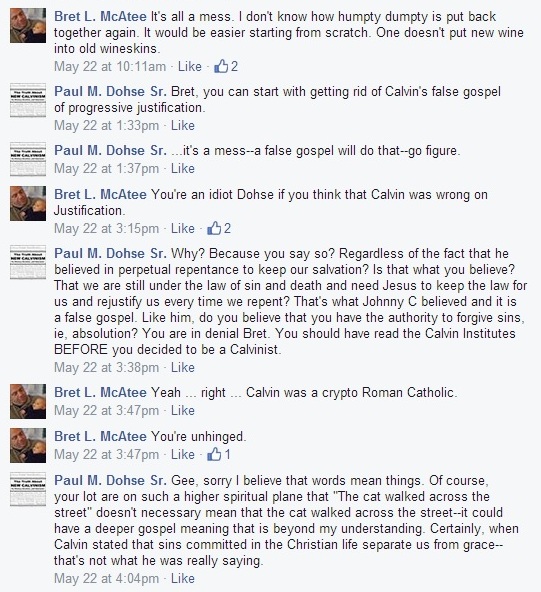
A related conversation:


Addendum:


Romans 13:11 | What’s in the Word “Saved” Part 2: The Other Salvation
Originally posted March 23, 2014
Last week we laid a foundation critical for understanding the Bible: the dichotomy of justification and sanctification. Justification is a finished work; sanctification is not a finished work. If this is not understood, a biblical dichotomy is contradiction. Furthermore, sanctification is not a matter of being empowered, or God working “through us” alone, but our new creaturehood makes our colaboring with God possible. In fact, we will be judged according to how we participate in kingdom living:
1 Corinthians 3:1 – But I, brothers, could not address you as spiritual people, but as people of the flesh, as infants in Christ. 2 I fed you with milk, not solid food, for you were not ready for it. And even now you are not yet ready, 3 for you are still of the flesh. For while there is jealousy and strife among you, are you not of the flesh and behaving only in a human way? 4 For when one says, “I follow Paul,” and another, “I follow Apollos,” are you not being merely human?
5 What then is Apollos? What is Paul? Servants through whom you believed, as the Lord assigned to each. 6 I planted, Apollos watered, but God gave the growth. 7 So neither he who plants nor he who waters is anything, but only God who gives the growth. 8 He who plants and he who waters are one, and each will receive his wages according to his labor. 9 For we are God’s fellow workers. You are God’s field, God’s building.
10 According to the grace of God given to me, like a skilled master builder I laid a foundation, and someone else is building upon it. Let each one take care how he builds upon it. 11 For no one can lay a foundation other than that which is laid, which is Jesus Christ. 12 Now if anyone builds on the foundation with gold, silver, precious stones, wood, hay, straw— 13 each one’s work will become manifest, for the Day will disclose it, because it will be revealed by fire, and the fire will test what sort of work each one has done. 14 If the work that anyone has built on the foundation survives, he will receive a reward. 15 If anyone’s work is burned up, he will suffer loss, though he himself will be saved, but only as through fire.
16 Do you not know that you are God’s temple and that God’s Spirit dwells in you? 17 If anyone destroys God’s temple, God will destroy him. For God’s temple is holy, and you are that temple.
18 Let no one deceive himself. If anyone among you thinks that he is wise in this age, let him become a fool that he may become wise. 19 For the wisdom of this world is folly with God. For it is written, “He catches the wise in their craftiness,” 20 and again, “The Lord knows the thoughts of the wise, that they are futile.” 21 So let no one boast in men. For all things are yours, 22 whether Paul or Apollos or Cephas or the world or life or death or the present or the future—all are yours, 23 and you are Christ’s, and Christ is God’s.
This is a long passage, but it speaks much to our subject, especially the other salvation. As discussed last week, there is still a salvation left for God’s people—the salvation from mortally that was previously under law. Though the old us died with Christ, as long as we are mortal, the flesh that once enslaved us can wage war against our minds that are now enslaved to righteousness. Unfortunately, by and large, Christianity defines itself as still enslaved to the flesh—this is perceived everywhere you look as testified to by the following popular Christian placard.

So, as Christians, we are still a “mess.” The only difference is the Jesus label. We were a mess, and we are a mess. Not only does this stand in stark contrast to the corpus of Holy Writ, but it is far from being good news to the world who would normally have one eye towards escaping a world that they know is a mess—why would they want to trade one mess for another one?
Last week, we discussed the fact that Paul made it plain in Romans 7:25 that Christians await a salvation from the weakness of the flesh. Again, in the passage we are starting with today, we see that Christians will stand in a judgment that will determine rewards, and even though we will suffer loss of rewards to some degree, we will be saved “by fire.” There are two different salvations: one from eternal judgment, and a second one for Christians in regard to mortality, or the “flesh.” Let’s establish the fact that two separate judgments coincide with two different salvations:
Revelation 20:4 – 4 Then I saw thrones, and seated on them were those to whom the authority to judge was committed. Also I saw the souls of those who had been beheaded for the testimony of Jesus and for the word of God, and those who had not worshiped the beast or its image and had not received its mark on their foreheads or their hands. They came to life and reigned with Christ for a thousand years. 5 The rest of the dead did not come to life until the thousand years were ended. This is the first resurrection. 6 Blessed and holy is the one who shares in the first resurrection! Over such the second death has no power, but they will be priests of God and of Christ, and they will reign with him for a thousand years.
7 And when the thousand years are ended, Satan will be released from his prison 8 and will come out to deceive the nations that are at the four corners of the earth, Gog and Magog, to gather them for battle; their number is like the sand of the sea. 9 And they marched up over the broad plain of the earth and surrounded the camp of the saints and the beloved city, but fire came down from heaven and consumed them, 10 and the devil who had deceived them was thrown into the lake of fire and sulfur where the beast and the false prophet were, and they will be tormented day and night forever and ever.
11 Then I saw a great white throne and him who was seated on it. From his presence earth and sky fled away, and no place was found for them. 12 And I saw the dead, great and small, standing before the throne, and books were opened. Then another book was opened, which is the book of life. And the dead were judged by what was written in the books, according to what they had done. 13 And the sea gave up the dead who were in it, Death and Hades gave up the dead who were in them, and they were judged, each one of them, according to what they had done. 14 Then Death and Hades were thrown into the lake of fire. This is the second death, the lake of fire. 15 And if anyone’s name was not found written in the book of life, he was thrown into the lake of fire.
These are two different resurrections, and two different judgments. Those in the first resurrection are “holy” and the “second death” has no power over them. The great white throne judgment concerns those who will be condemned under the law. I believe the “first resurrection” spoken of here concerns those who die during the tribulation period. Notice that there will be multiple judges; I believe these are the apostles and this judgment concerns Israel:
Matthew 19:28 – Jesus said to them, “Truly, I say to you, in the new world, when the Son of Man will sit on his glorious throne, you who have followed me will also sit on twelve thrones, judging the twelve tribes of Israel.
I believe the judgment that Paul wrote of in 1Cor 3, what we are presently examining, speaks to what is commonly known as the Bema Seat of Christ. This follows the “resurrection of the just” (Luke 14:12-14) at the end of the “church” age and will be immediately followed by the rapture of the assemblies or “church” (1Cor 15:51,52, 1Thess 4:15-18). It is clear that the next coming of Christ is imminent and will occur at a time when people least expect it—this is hardly the case during the tribulation period. I suppose the Bema Seat of Christ and the first resurrection could be one and the same, but with certainty we can ascertain that the great white throne judgment is a separate event. So therefore, we are saved from the final judgment and also saved from the warfare with the flesh. The Bible must be interpreted in that context.
Justification necessarily encompasses the prophecy issue—it reflects the true gospel and this kind of continuity in the Bible shouldn’t surprise us: separate judgments and resurrections in regard to the finished work of justification versus kingdom living. In both cases we are judged by our works, but Christians escape the judgment of condemnation. As strange as it seems, what we do in our Christian lives will determine what we do for God in eternity (Matt 25;23). Christianity lacks a biblical informed vision of what we will be doing in eternity. Such a study is a wide-open frontier of knowledge. This shouldn’t surprise us either if the main focus of the Christian life is being ready for a judgment that determines our eternal destiny.
In all probability, there are three resurrections and four judgments: a resurrection and judgment at the end of this age regarding believers and including the rapture; a judgment of the nations at the end of the tribulation period; the first resurrection, and the second resurrection which have their own judgments associated with them. There will necessarily be a judgment of the living at the end of the tribulation period because the millennial kingdom will be inhabited by mortals who are left alive at the end of the tribulation period. Many will be those who heed the instruction of Matthew 10:23. Prophecy must be understood in the light of a proper soteriology. It all fits together.
So, we are looking this week at a biblically developed argument for more than one type of salvation that allows for our eternal salvation to be a finished work while the other salvation waits for redemption, or salvation from our mortality. This brings us back to 1 Corinthians: Paul addresses the problem of man-following in the Corinthian church at that time. The assembly at Corinth would have been like most New Testament assemblies at that time, the single assembly was made up of several home fellowships, and some of those fellowships were made up of families only. In Jewish tradition, “small sanctuary” was another term for synagogue, and many were merely extended families that met together for the breaking of bread and Bible study. The primary tenets of a synagogue follow:
• A Jewish “church” is called a synagogue, shul or temple
• A synagogue is a place of worship and study, and a “town hall”
• Synagogues are run by laypeople and financed by membership dues
• There are several important ritual items found in the synagogue
• Non-Jews may visit a synagogue, but dress and should behave appropriately
• The Temple is the ancient center of Jewish worship where sacrifices were performed
This pattern goes all the way back to the exodus, and when the Temple was destroyed, all that remained was the synagogues. This pattern carried over to the New Testament Jewish church. At Corinth, home fellowships that were not following the misguided behavior of the other fellowships reported to Paul what was going on (1Cor 1:11; best translated, a group associated with Chloe or “Chloe’s people” ESV).
Let’s first note that Christians can behave according to the old us that died with Christ, otherwise known as “the flesh” which is the weakness of mortality (Matt 26:41, 1Cor 15:50-58). Paul accuses them of acting like “mere mortals” (NET). We have the treasure of the new birth, the seed of God (1Jn 3:4-9) in jars of clay (2Cor 4:7). Because we are born of God, we are in fact holy, our mortality notwithstanding. Hence, Christ came to do two things through us: fulfill the law and put an end to the works of the devil (Matt 5:17-20, Rom 8:1-4, 1Jn 3:8) Why would Christ come to fulfill a law that empowers sin? (1Cor 15:56). Christ came to end the law (Rom 10:4) so that he could fulfill its righteous requirements with us and in us. Christ didn’t come to fulfil the law FOR us, He came to end the law so that He could fulfill it with us and in us. The institutional church doesn’t get this; therefore, the institutional church is a plenary waste of God-given time.
In verses 6-9, Paul explains our role clearly in the sanctification process; it’s no different from farming. The farmer plants and waters, but who is responsible for the miracle of a dead seed bringing forth life? Ultimately, God gets the glory, but we will be judged according to how we plant and water. But Paul also states that we will receive a “wage” for our planting and watering. This couldn’t be talking about justification! Clearly, this must be talking about reward for how we build on the foundation which is Christ. The “foundation” is the gospel of first order (1Cor 15:3-6).
We will clearly “suffer loss” because of “wood, hay, and stubble” (bad behavior), but yet we will be saved in this judgment by “fire.” Debate rages among theologians about what that means exactly, but the definitive point here is that there remains a salvation for Christians that has nothing to do with justification. It is a salvation from mortality, and in both cases, whether the resurrection with Christ via the new birth for our justification, or the resurrection unto immortality, both are a work of God alone. Even when we choose God, the sending of the Holy Spirit to regenerate us in obviously ordered by God Himself and totally out of our control, albeit a promise if we believe.
And this is how the word “salvation” must be discerned in the Scriptures.
Romans 13:11 | What’s in the Word, “Saved” Part 1: A Salvation Paradigm
Originally published March 19, 2014
“You were purchased and the sale is final. Christ did not purchase you on a Reformed installment plan. We wait for redemption when Christ comes to claim what He purchased.”
“Moreover, if justification and sanctification are not separate, and are the same thing the Bible must be interpreted through the prism of justification only and in fact that is the very interpretive craze of our day; i.e., every verse in the Bible is about Jesus. Unfortunately, this would not explain the interpretive dichotomies of the Bible and would instead make them contradictions. There are many, many examples of this throughout the Bible, but the primary one is works. On the one hand, the Bible continually calls for faith alone without works, but on the other hand, it also calls for vigorous labor and obedience to the law. How can these be reconciled? Answer: some verses are talking about justification while others are talking about sanctification. If justification and sanctification are not separate, the Bible is nothing more than a book of confusion.”
Click to enlarge illustrations if needed.
I am very happy that we have arrived at Romans 13:11 because what Paul states here is the source of much misunderstanding in our day. As a pastor, I have said it: “We were saved, are being saved, and will be completely saved.” What was I thinking when I used to say things like that? I really don’t know. But isn’t that what Paul is saying here in Romans 13:11?
Besides this you know the time, that the hour has come for you to wake from sleep. For salvation is nearer to us now than when we first believed.
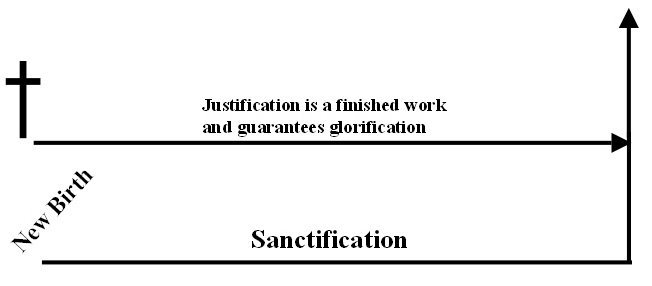
Paul seems to be saying what I used to say: our original salvation culminates into a final salvation. At TANC LLC, our research institute, we call that the “linear gospel.” In Reformed circles it is called the “golden chain of salvation.” Now listen, this is a really big deal. One must choose between the linear gospel and the parallel gospel. Let’s look at the illustrations below:
Illustration A

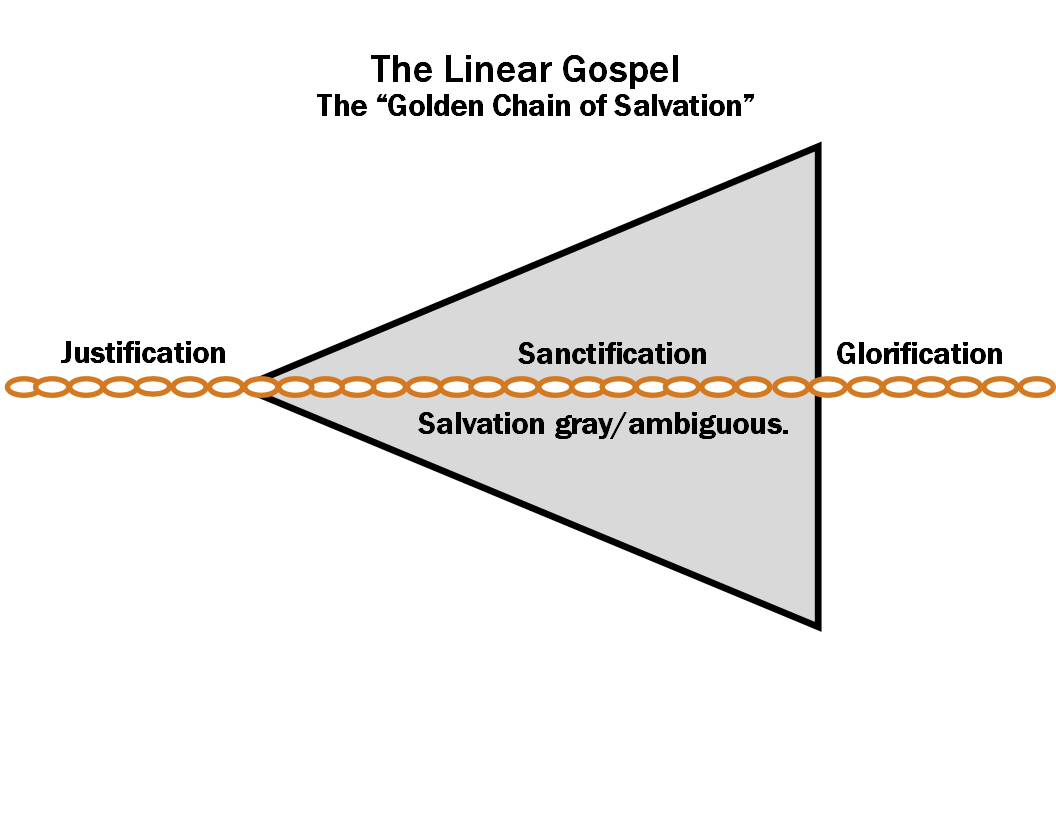
Illustration B
I have been making these illustrations for some time, and was surprised to find the following like-illustrations in the archives of the Australian Forum, the reformed think tank that spawned the present-day neo Calvinist movement:
Illustration C
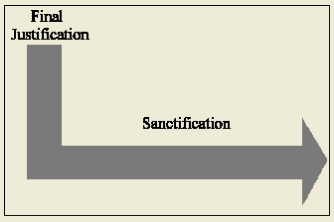
Illustration D

Illustration E
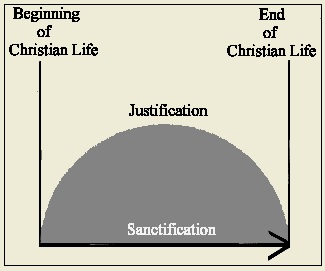
The Australian forum used these illustrations to convince the church that the true gospel of the Reformation had been lost. These illustrations were key in clarifying what the Reformers really believed. And, though the recent Neo-Calvinist movement parrots much of the Forum’s dialect and other illustrations to teach authentic Reformed doctrine, they avoid these illustrations like a plague. Why? Because these concepts are the most clarifying, and what was used to clarify can also be used to refute the same doctrine.
I agree with the Forum, my illustration B and their Illustration C was the model that the church, for the most part, was teaching when the Australian Forum showed up in 1970 (Hereafter: AF). Don’t get me wrong, I don’t think the church was applying the model, but it is what they held to. They were actually functioning like model A and E.
Model A combines salvation with the Christian life. That may sound like a statement in regard to the obvious, but it really isn’t. When someone asks us if we are saved, we say yes, but the answer is in regard to models B and C. We were saved, so we are now saved. It was a onetime permanent act. Valerie, the family dog was born in the past, but her dogness is permanent. Valerie is not in the process of becoming a complete dog, she is a dog, she is perfect dogness. The AF would agree with my assessment here. Note in model C that justification is “finished.” When Valerie was born, her doghood was finished. Valerie will now start acting like a dog because that is her nature.

Not so with the Reformed models A and E. If someone asks a Reformed person if they are saved, they most say, “already—not yet” which is the nomenclature of an official Reformed doctrine. It means that one is in the process of BEING saved—their complete salvation is future. Again, the AF would have agreed with this assessment. Note the following illustration published by them:
Illustration F
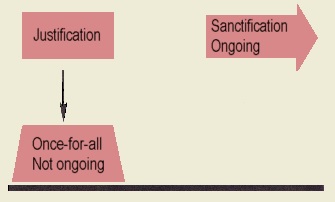
I would also like to use their illustration to make a point. They, in representing the Reformed view take issue with justification being finished. They believe it is ongoing, but look what they call it: “sanctification.” Why wouldn’t they call it “ongoing justification”? Normally, the term for the Christian life is progressive sanctification, but Reformed theologians stay well clear of the term progressive justification. The only exception is in the Calvin Institutes (3.14.title). At issue is what they illustrate with model E—justification and sanctification are combined. Salvation is a progression and worse yet, we are in the midst of the progression. That means we can mess up the progression, this is an unavoidable inference, and is indeed an element of Reformed thinking.
This is where I want to make a point about illustration D. The AF, like all of the Reformed, refutes this model as Christ plus something. Salvation only covers past sins, but we have to do something in our sanctification to maintain our righteous standing. In both models justification (salvation) is not finished, but the Reformers say that is ok for their model because justification is finished by justification.
But yet, this is the problem with all linear gospels like model A: we are in the middle of the process, so the question must be answered; “what is our role?” And that very question is a huge problem because mankind has NO role in being justified. No man other than Christ could pay the penalty for our sins. However, the Reformed answer is, “The Vital Union.” Basically, it is ok for us to be in the midst of the unfinished justification process because we participate in the same way that we were saved; viz, by faith alone. So models A, D, and E are the same thing, but the Reformed say that is ok for their model because it is Christ plus faith alone in Christ. In order to keep justification moving along properly, we must live our lives by faith alone.
Personally, I contend that if we have ANY role in our salvation other than the decision that brought the death of the old us and the birth of a new us, that’s works salvation by doing nothing with intentionality. In fact, it’s called abstaining and that’s a verb. Salvation by Christ plus doing nothing is still model D. Calvinist Tullian Tchividjian wrote a book titled Jesus plus nothing equals everything, but in a linear gospel where justification and sanctification are fused together, IT’S IMPOSSIBLE TO DO NOTHING because doing nothing is something. The only way that we can do nothing is if …
1. The work itself is finished. You can’t do anything to finish a finished work.
2. You are not present to do anything. The work is not located in your realm of operation.
This requires a discussion regarding the separation of justification and sanctification which is anathema to the Reformed thinker. They say, “Justification and sanctification are never separate, but distinct.” However, because of the terms used by Scripture, the Reformers are forced to do something with sanctification, especially in light of 1Thess 4:3,4, so the progression of justification falls under the auspices of progressive sanctification. This brings us back to illustration F. If Valerie, a dog, specifically a beagle, is justification, why would we call her something different because she gets up and starts walking? Is that cause to call her a duck? Indeed, a Valerie sitting is “distinct” from Valerie walking, but does that make her something other than a dog? If Calvin himself spoke of justification as being progressive in the title of chapter 14 | book 3, and that in fact is what you deem it to be, why not call it progressive justification and be done with it?
We hold that justification is a finished work and completely separate from the Christian life. Model B is the ONLY “plus nothing” model because you cannot add to a finished work nor can you work on something that is otherworldly. Christ came to finish a work that we cannot touch. Justification declares that the law that would judge us has no jurisdiction over us. Our sanctification comes from the regeneration of the new birth, not the finished work of justification. This was the rhetorical question that Paul asked of the Galatians:
3:2 – this only do I wish to learn from you—by works of law the Spirit did ye receive, or by the hearing of faith?
3 so thoughtless are ye! having begun in the Spirit, now in the flesh do ye end?
(YLT).
In other words, after receiving the Spirit, do you finish a finished work by circumcision? Note the previous verse:
3:1 – O thoughtless Galatians, who did bewitch you, not to obey the truth—before whose eyes Jesus Christ was described before among you crucified? (YLT).
Christ’s death on the cross finished the work of justification.
But doesn’t Paul say that our salvation is future? The question is salvation from what? We know it is not salvation from sin that would condemn us for sin is not counted where there is no law (Rom 4:15, 5:13) and Christ put an end to the law (Rom 10:4). However, it is clear that the world will be judged by the law (Rom 3:19, 20). It is not salvation from sin that would condemn us.
While the believer is born again and truly righteous, we must carry around the old us that was crucified with Christ. The things Christ died for are still with us (2Cor 4:7-18). As Christians, we await a deliverance from this body of death. (Rom 7:25). Clearly, salvation from condemnation is finished (Rom 8:34), salvation from the sin that condemns is past and complete, but there is left a salvation from sin that harasses us daily. If the gospel is linear, and justification is not finished, Paul is speaking of a future salvation from condemnation—we reject that idea with prejudice, Paul is talking about the other salvation from the sin of our mortality.
The Bible also refers to that as redemption. Remember last week and our discussion of the exchange of slavery? We were purchased from the other slave owner by the blood of Christ (1Cor 6:19,20, 7:22,23), and Christ will one day return to redeem His purchase (Gal 3:13, Luke 21:28). In the linear model, there can be no exchange of slavery because we are not finally free till the end. Neither is there an exchange of law because faith only is required to maintain the “vital union” that keeps our original justification moving forward.
Moreover, if justification and sanctification are not separate, and are the same thing the Bible must be interpreted through the prism of justification only and in fact that is the very interpretive craze of our day; i.e., every verse in the Bible is about Jesus. Unfortunately, this would not explain the interpretive dichotomies of the Bible and would instead make them contradictions. There are many, many examples of this throughout the Bible, but the primary one is works. On the one hand, the Bible continually calls for faith alone without works, but on the other hand, it also calls for vigorous labor and obedience to the law. How can these be reconciled? Answer: some verses are talking about justification while others are talking about sanctification. If justification and sanctification are not separate, the Bible is nothing more than a book of confusion.
The linear gospel also leads to all sorts of confusing doctrines that make doing nothing in our Christian life feasible. One is double imputation. This is the belief that Christ died for our justification and lived a perfect life of obedience for our sanctification. That way, Christ’s perfect obedience to the law is imputed to our Christian life as we live by faith alone.
Illustration G
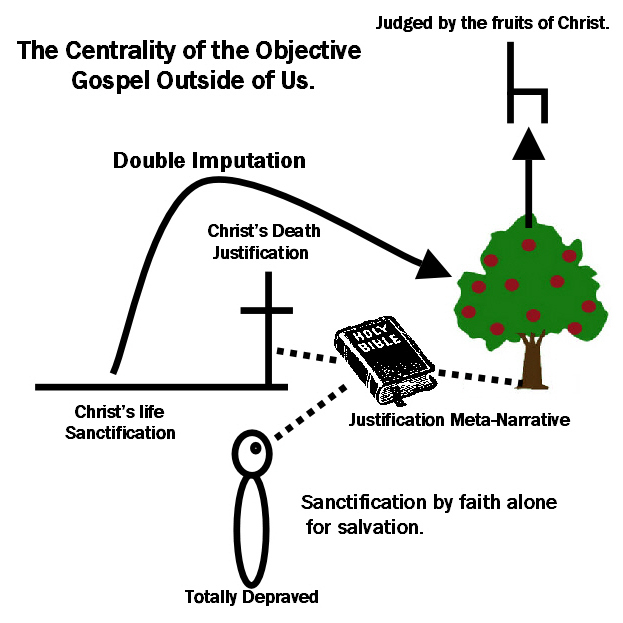
This Reformed doctrine also makes law the standard for justification in regard to Christians. Since perfect adherence to law remains the standard, but Christ fulfilled and keeps it for us, neither is an exchange of law needed in salvation as we discussed last week—the relationship to the law doesn’t change.
This results in an attempt to reduce sanctification to a mere “awareness” or “experience” with all kinds of mystic doctrines following of which there is no shortage in Reformed circles. An excellent example is the following excerpt from a sermon I heard recently:
Years ago, there was a pastor named Ichabod Spencer, and he was talking to a young student who was convicted of a sin and wasn’t a believer but wanted to come to Christ. And he wrote of the conversation, and it’s in a book called Pastoral Sketches, and Ichabod Spencer’s section in there has this conversation. And it’s fascinating because it’s called “I Can’t Feel.” Listen to this interchange. Ichabod Spencer said,
“I don’t know, my dear sir, what more can be said to you. I’ve told you all that I know. Your state as a sinner, lost, exposed to the righteous penalty of God’s law and having a heart alienated from God and the free offer of redemption by Christ, I’ve told you those things, and your instant duty to repent of sin and give up the world and give God your heart and the source of your help through the power of the Holy Spirit assured to you if you will receive Christ.” In other words, self-empty, and believe it, all these things have become as familiar to you as household words. What more can I say? I know not more what there is to be said.” He said, “I cannot read your heart. God can. And you can by his aid. Some things you’ve said almost made me think you a Christian, and other things again have destroyed that hope. I now put it to your own heart. If you’re not a Christian, what hinders you?”
And he thought for a moment, and he said, “I can’t feel.” “Well, why didn’t you tell me this before?” He said, “I never thought of it before, sir.” “Well, how do you know this hinders you?” “I can’t think of nothing else. I’m sure I shall never be converted to God if I have no more feeling than I have now. That is my own fault. I know you can’t help me.” And he said, “No, sir, I cannot, nor can you help yourself. Your heart will not feel at your bidding.” “What then can I do?” said he with much anxiety. “Come to Christ now. Trust him. Give up your darling world. Repent so inequity shall not be your ruin.” Well, he seemed perplexed, annoyed, vexed. And with an accent of impatience such as I had never witnessed in him before, he replied, “That is impossible. I want the feeling to bring me to that, and I can’t feel.”
And Spencer said, “Hear me, sir, and heed well what I say. I have several points. Number one, the Bible never tells you you must feel, but you must repent and believe. Number two, your complaint that you cannot feel,” listen to this, “is just an excuse by which your wicked heart will justify you for not coming to Christ now.”
First of all, this idea that we cannot command our feelings is something that I hear often and is not biblical. The apostle Paul instructed us to keep a clear conscience before God. Elsewhere, we find that our consciences either accuse us or excuse us. We all know how bad we feel when our consciences accuse us; therefore, we may assume that the opposite is true when we do right. We are also instructed by Paul as well to make it our goal to please God; certainly, a feeling of accomplishment can be expected here as well.
Clearly, we can command our feelings by doing what is right. In contrast, the above dialogue is the result of the linear gospel where an act of grace must precede all feelings. Again, if we are in the middle of a process that saves us, and we are good Reformed thinkers with faith alone always in the forefront, we must only believe and merely be a witness to “grace.” Can you see this in the above dialogue? Only believe is the exhortation of the pastor, and we cannot command our feelings anyway.
In contrast, this young man isn’t going feel any different UNTIL he makes a decision to follow Christ. Why? Because he is under judgment! When you are under law, all that awaits you is a fearful judgment under the law. Why would he feel any different until he is no longer under threat of judgment? This would have been my counsel to this young man. At the very least, the vacancy of fear and the knowledge that you are going to spend eternity in heaven will produce good feelings on some level.
Yes, this leads into all kinds of Reformed wackiness that I believe shuts up the door of heaven to many. I myself know of a young man that wouldn’t make a commitment to Christ because he was yet to see Christ as a “treasure chest of joy.” This all speaks to the Reformed concern that man is able to make an intellectual decision that is part of the salvation process. Yea, we must have some kind of sign that we were enlightened first before we make the decision. But why would it be delight? What of a fear of judgment that we know we deserve?
The fact that the aforementioned young man was vexed and in turmoil is a sure sign from heaven that he understand that he is under the law. Good grief! Lord come quickly and deliver us from this ignorance dressed in academic garb! Remember what we have learned previously in this Romans study? Our service to God is a what? Right, “reasonable service.” Remember what that word means? It means “rational.” My father was an intellectual who always had an interest in God throughout his whole life, but in the end, he assured me that he had made a personal commitment to Christ. But be sure of this, my dad would not have made a commitment to mystic nonsense coming from the Reformed crowd. The decision to be saved is a rational decision, and our service to Christ is rational.
“Just believe” is no answer, we must tell people WHY they mustn’t wait on a feeling. It is because feelings follow thinking and doing. For the most part, feelings are a choice. What do you do if you feel unsafe? You make a decision to change your circumstance to something safer, and then you feel safer. My friends, this is hardly rocket science.
But this can now bring us to another consideration of linear versus parallel—that of end times. The linear gospel can only speak of one final judgment where the children of God are “manifested.” If you look at the parallel gospel, it supplies the possibility of two judgments. Note the illustration below:
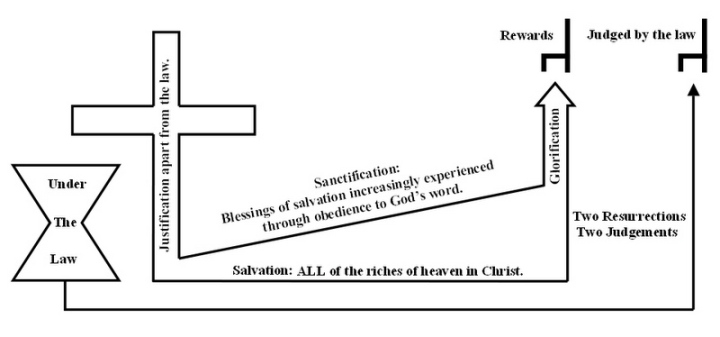
What comfort is there in thinking that our “final justification” will be confirmed at some plenary judgment at the end of the age? We should take comfort in the fact that we will not stand in that judgment at all! And again, this points to the need for interpretation according to the following interpretive question: Is it a justification verse, or a sanctification verse? In the linear construct, it must always be a justification verse; either a sitting still dog or a walking dog that is apparently a duck because he is now walking. But in the parallel construct, I can point to numerous biblical dichotomies that are defined by parallelism. Let’s look at a couple.
In 1John, John tells us there is no fear in love and fear has to do with “judgment.” But then Paul tells us to work out our own salvation with trembling and fear. This is not the same salvation being spoken of. John is writing of the difference between the law of sin and death that will judge us, and the law of love which is the difference between being under law and under grace. Paul is writing of having a sober stance towards our sanctification. The Christian life isn’t a birthday party; it’s a many-faceted intellectual warfare. “Salvation” in the Bible doesn’t always speak of salvation from eternal judgment, there is yet a salvation for God’s people—the salvation from carrying about in our bodies all of the things that Christ died for. Let’s close by looking at an example of how the linear perspective gets us into difficulty. In the Reformed scholarly work “The Race Set Before Us,” the authors cite Matthew 24:13 as proof that salvation is future and that Christians must persevere till the end of their life:
But the one who endures to the end will be saved.
Again, the assumption is that “saved” always means eternal salvation. But let’s qualify that with Matthew 10:
21 Brother will deliver brother over to death, and the father his child, and children will rise against parents and have them put to death, 22 and you will be hated by all for my name’s sake. But the one who endures to the end will be saved. 23 When they persecute you in one town, flee to the next, for truly, I say to you, you will not have gone through all the towns of Israel before the Son of Man comes.
What is Christ saying? He is saying that when you see certain things happen during the tribulation period, you will be able to save yourself from physical death by fleeing from town to town because the Lord’s return is near. He is talking about saving yourself from physical death, not eternal salvation.
“Saved” has more than one meaning. In verse 11, Paul is talking about salvation from this present warfare against evil within and evil without. In the same way Christ stated that those who see certain things in the tribulation period draw near to their “redemption.” That word refers to a ransom that has already been paid on the cross.
You were purchased and the sale if final. Christ did not purchase you on a Reformed installment plan. We wait for redemption when Christ comes to claim what He purchased.
How to Lead a Calvinist to the Lord
Originally published June 28, 2013
“What imperils the Calvinist soul is a fundamental anti-biblical view of the law. They must be shown the new way of the Spirit.”
Know Calvin’s Gospel
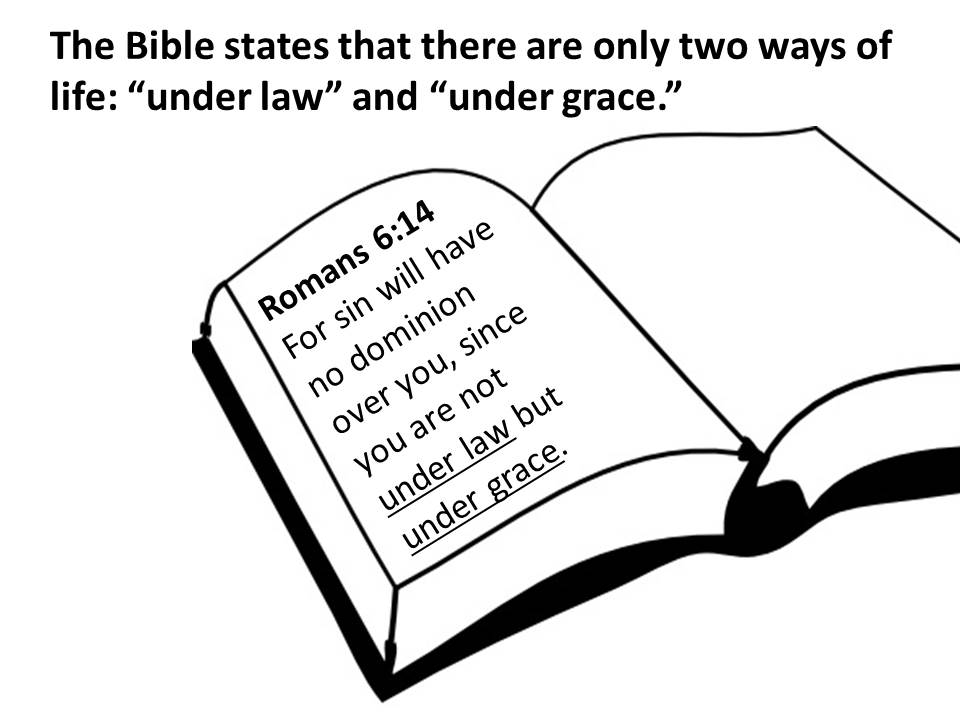
Calvinism is a false gospel that imperils the soul. The apostle Paul made it clear in Romans that there are only two people groups in the world: those under law, and those under grace (ROM 6:14). The lost and the saved. Calvinists declare themselves to be under law. They try to get around this by saying you can be under law and under grace both, but such is not the case. They say it is ok to be under law and covered by grace if we live by faith alone in sanctification; or, living by the same grace that saved us. The whole, “We must preach the gospel to ourselves every day” is indicative of where they stand on law and grace. According to their other gospel, we need the same grace that saved us every day for one reason and one reason only: we are supposedly still under law. Certainly, all people live under the grace of God whether saved or unsaved—we are addressing the grace that saved us initially.
Calvinists use the book of Galatians in an effort to make the opposite point; supposedly, the Galatians were putting themselves under law by attempting to please God in sanctification by keeping the law. Hence, in the Calvinist mind, attempting to keep the law in sanctification is the same thing as trying to keep the law for our justification—they are still under it accordingly….for justification….IN sanctification. In other words, a demand for perfect obedience to the law in sanctification is still the standard to maintain justification. This was Paul’s actual beef with the Galatians: that the law was still a standard for maintaining their justification. The Galatians were adding law to grace in order to maintain grace. So, instead of the law informing their sanctification, they were putting themselves back under the law to maintain justification. That’s why Paul wrote the following to them:
Galatians 4:21 – Tell me, you who desire to be under the law, do you not listen to the law?
Paul continues from there to drive home the point that justification is a settled issue and obligation to the law is separated from it. We are obligated to listen to the law for sanctification, but there is no longer any law obligation to our justification. To say that justification has to be maintained by perfect law-keeping is to be under the law. The Galatians were being taught that rituals such as circumcision completely satisfied the law. But again, being under law is the point here. That is why Paul stated the following:
Galatians 5:2 – Look: I, Paul, say to you that if you accept circumcision, Christ will be of no advantage to you. 3 I testify again to every man who accepts circumcision that he is obligated to keep the whole law. 4 You are severed from Christ, you who would be justified by the law; you have fallen away from grace.
The Galatians were being taught that circumcision satisfied all of the requirements of the law for justification. This led to an antinomianism in sanctification because in these systems there is no distinction between hearing and doing the law in sanctification and the laws relationship to justification. For the unbeliever, the law is the standard for justification because unbelievers are under the law. Christians are under grace and not under the law, so the law has no relevance to their justification. Paul was simply telling the Galatians that if they are under the law, they are obligated to keep all of it for justification. Circumcision or any other ritual does not satisfy the law.
Paul states that we are not under law because the old us that was under the law is dead (ROM 7:1-11), and therefore, the law cannot judge the sins of our mortality (Rom 3:19, 7:8,9). But on the other hand, we are enslaved to the law in sanctification (Rom 8:7,8). Even though we cannot keep it perfectly due to our present mortality, we are enslaved to it and nonetheless strive to keep it in our sanctification. The law was never fulfilled to maintain our justification because there is no law in justification. The law is fulfilled through us in sanctification (ROM 8:3,4). Christ’s death separated the law from justification in the same way that a spouse is no longer under a marriage covenant when the other spouse dies (ROM 7:1-3).
This excludes the necessity for perfect law-keeping in sanctification. Christ accomplished this through His death, not keeping the law for us in sanctification. Calvinists call this, “Christ 100% for us.” Christ’s perfect law-keeping is a given by virtue of who He is and not because perfect law-keeping was part of the Abrahamic covenant of promise which occurred 430 years before the law (GAL 3:17,18).
Which Brings Us to Calvin’s Galatian Error
No works salvation system ever promotes a perfect, intelligent obedience to the law. It posits activity on our part that imputes something that counts for a perfect keeping of the law to maintain our salvation. This always leads to antinomianism because a ritual replaces actual law-keeping. Those under grace strive to please God by law-keeping because they are enslaved to the law, but on the other hand, perfection is not the standard because they are hindered by mortality (ROM 8:3,4) and the law can’t judge them because they are no longer under it (ROM 3;19). They are enslaved to it for sanctification, but not under it for justification. Those under grace are enslaved to the law but will not be judged by it; those under law are enslaved to sin and will be judged by the law. The Bible has an awesome way of stating this: those under the law violate it at all points by one sin; those under grace fulfill the law by loving their neighbors and God. The enslavement hindered by the weakness of the flesh fulfills the law in sanctification.
Calvin’s error/false gospel merely replaced the ritual of circumcision with daily re-salvation for the atonement of sin and the perpetual imputation of Christ’s perfect law-keeping for sanctification in order to maintain our justification (Calvin Institutes: 3.14.9-11). “We must preach the gospel to ourselves every day” is a ritual that imputes Christ’s perfect obedience to our sanctification in order to maintain our justification. This was also the fatal error of the Pharisees who replaced the law of God with their traditions and thus, “you have made void the law of God” (MATT 15:6 [most translations : “set aside” and “commandments”). The law is void for justification (the dead letter and covenant of death), but not sanctification.
Therefore, Calvinism keeps the “believer” under the law for justification leading to antinomianism in sanctification because Christ is 100% for us and keeps the law for us in sanctification in order to maintain our just standing. This is well exemplified via the following tweet by a well-known Calvinist:

This was the same result at Galatia as well:
Galatians 5:7 – You were running well. Who hindered you from obeying the truth?
This rejects the believer’s hindered enslavement to the law in sanctification and only leaves one other alternative: under the law. For all practical purposes: lost. Therefore, the Calvinist must be informed that he/she is still under the law and trusting in a false gospel. What imperils the Calvinist soul is a fundamental anti-biblical view of the law. They must be shown the new way of the Spirit.
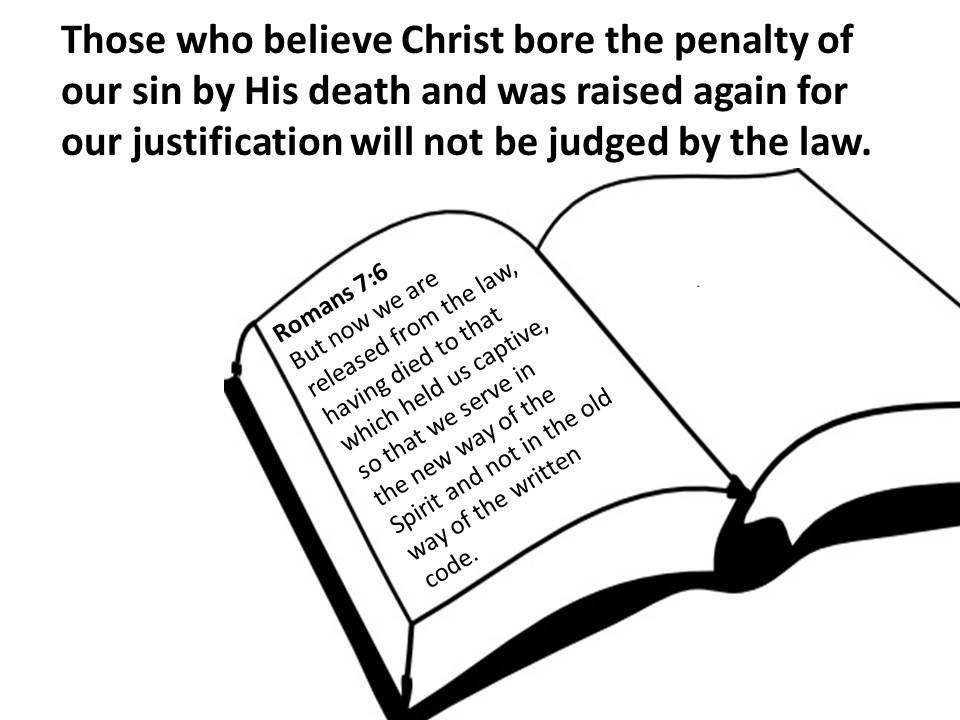
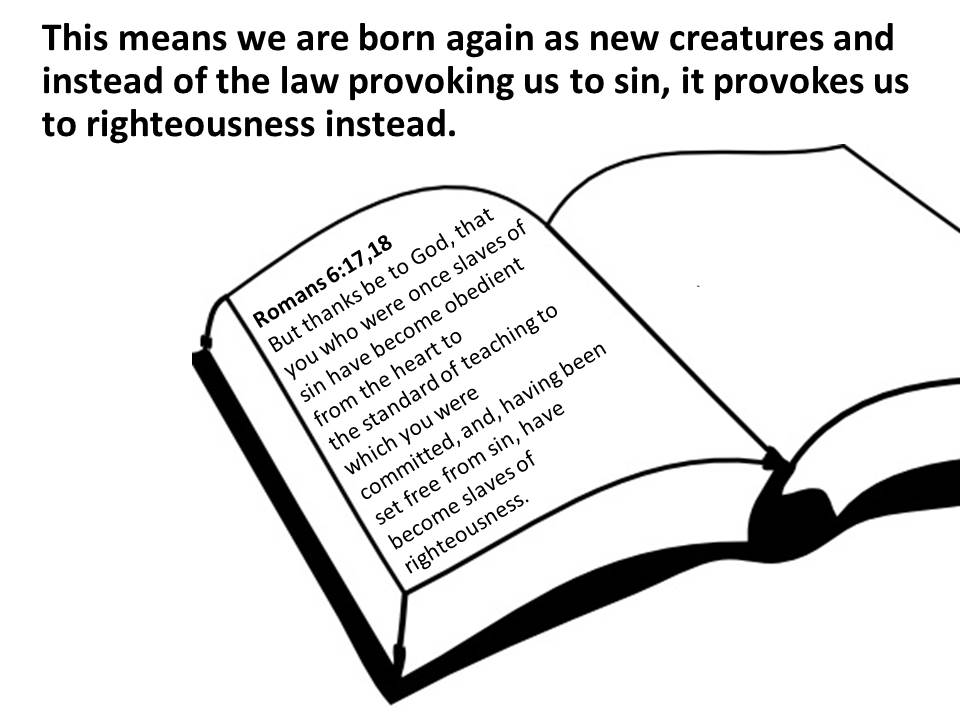
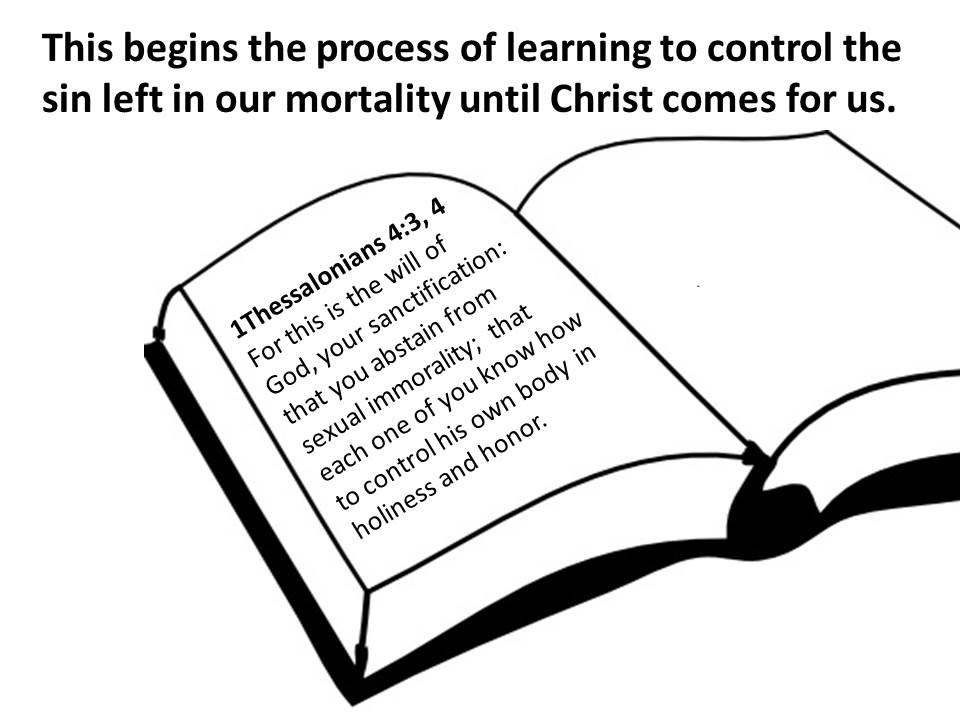
Let me recommend that you then teach them through the following booklet (Click on images to enlarge if necessary):







leave a comment