Ground Zero for Understanding the Biblical Counseling Movement
Originally published September 18, 2013
“I believe this will go down in church history as one of the most grotesque betrayals ever perpetrated on a man in the name of friendship and the gospel.”
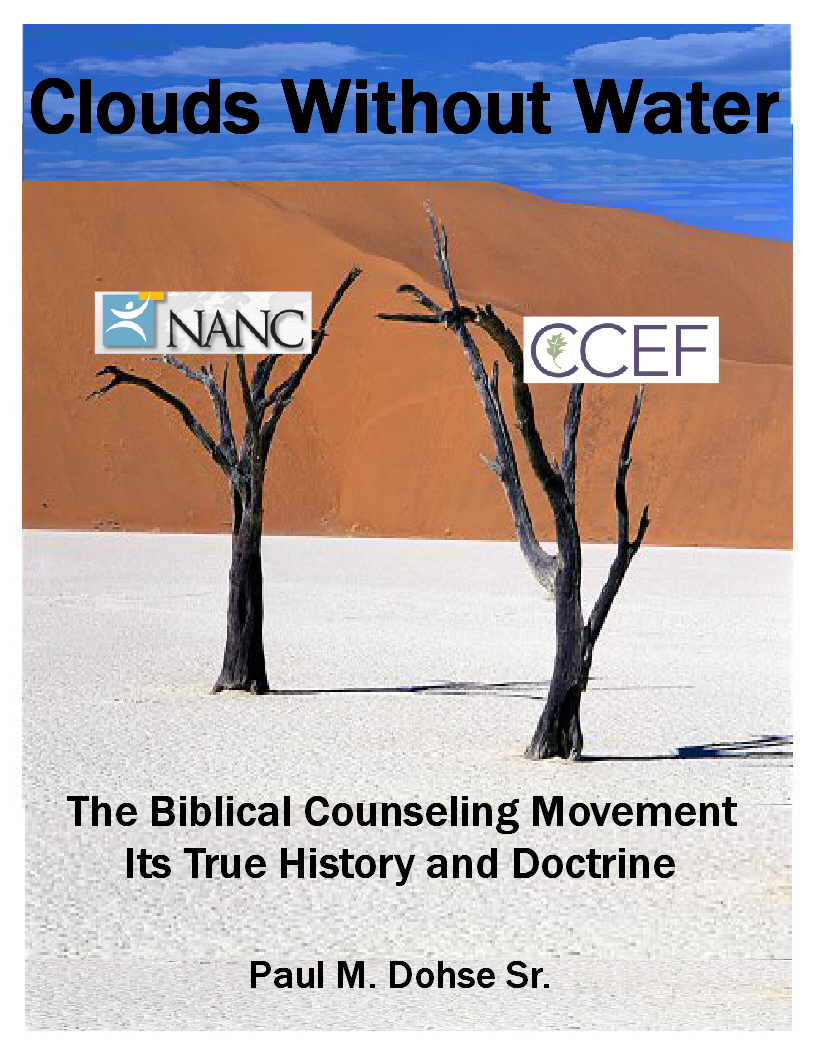
A Chapter Theses for Clouds Without Water: The Biblical Counseling Movement; It’s True History and Doctrine
In the Beginning, Plato, and then Augustine.
During the first century, the upstart assemblies of the risen Christ suffered a viral affront from Gnostic sects. The first century church was made up of people from all socioeconomic strata, and the Gnostics infiltrated Christianity for that purpose. Those in the first century church well-endowed with money were a valuable resource, and this is who the Gnostic sects primarily targeted with their false doctrine.
Gnosticism has always been about elitism, power, and money. If you want to see an immaculate mural of the American church, read Philip J. Lee’s “Against the Protestant Gnostics.”
Gnosticism finds its roots in the philosophy of Plato. Every American born into the world should be thoroughly apprised of Plato the man and his philosophy. To understand Plato is to understand Western culture politically and spiritually. All the philosophers agree on this point. From there, the math is easy: Augustine was the father of Reformation doctrine, and a rabid follower of Plato. Augustine had little use for the Bible without Platonist insight, and considered Plato a Pre-Christianity Christian.
Of course, the favorite red herring is that Plato is not agreed with on every point, but the fact remains that his primary construct founded Reformed theology: the incompetence of man, and the need for a select few (the enlightened) to rule over the masses. Those with gnosis know how society best functions, and they know how the masses can find individual peace from the desires that rule over them.
The Age of Enlightenment (circa 1630) produced men who were the first to confront Plato’s construct successfully. The most formidable product of that movement was the American experiment which obviously turned out quite well. It was founded on the competence of the individual. The competition was the Platonist Puritans who unfortunately survived the voyage from Europe and wreaked havoc on the East coast. But fortunately, their worldview kept them from settling further inland. “Go west young man!” is hardly the motivational words of competence found among the purer forms of Reformed thought.
Let there be no doubt about it, the idea of merging church and state is grounded in the religion of man’s incompetence. The masses need the state to take care of them. Plato’s philosopher kings contrive orthodoxy, and the soldiers enforce it. This concept did not find its way into the Westminster Confession by accident. Even those who think the state should be separate from the church think a utopia would arise if the church ran the state. “Separation of church and state” doesn’t mean no theocracy; theocracy would be a good thing, supposedly. The state has always had an interest in ruling over religion because ideas are dangerous, and the church has always been a willing participant if the state agrees to enforce their orthodoxy. The battle between the two for the upper hand of control is the political intrigue that is European history in a nutshell. And that is how the world as we know it will end: the zenith of church statecraft as described in the book of Revelation.
This is Western history, and the children of the enlightenment would have no part of it on American soil. Ten years after the Declaration of Independence, James Madison successfully stopped a European style push for a church state in A Memorial in Remonstance Against Religious Assessments. For all practical purposes, it was an indictment against the fruits of European Reformed doctrine.
The Reformation’s Historical Cycle of Social Death and Resurgence
The Reformers, being children of Plato, didn’t interpret reality with a normative epistemology. Plato’s Achilles’ heel has always been the application of Eastern mysticism. Instead of reality being interpreted empirically, and a course of action being determined by discovery, conclusions are drawn by using interpretive gateways to the “pure” form of reality that is hopefully good. Plato thought it was good, but his interpretive gateway to reality rejected the five senses out of hand. Gnosis was the key.
The Reformers merely replaced gnosis with the personhood of Christ as a sort of stargate to reality. That reality was predicated on the difference between the unchangeable pure form of Christ, and the inherent evil of man dwelling in a world that constantly changes. Plato equated the pure forms with immutable objectivity, and evil matter with mutable subjectivity. Hence, today’s Platonist Reformers speak of the “objective gospel experienced subjectively.” This is clearly Plato’s metaphysical construct based on the incompetence of man in regard to interpreting reality. Like Plato, the Reformers of old and new alike bemoan man’s attempt to understand reality “in the shadows” of all matters that “eclipse Christ.” While donning the persona of Biblicism, pastors like Steve Lawson call for pastors to “come out from the shadows.”
This is the theme of books like “Uneclipsing the Son” by John MacArthur confidant Rick Holland. In his book, he hints at why purest Reformed theology gets lost in the minds of Christians from time to time and therefore needs periodic resurgences and rediscoveries. He notes in his book that good grammar makes bad theology. The mystic heretic Paul David Tripp makes the same assertion in “How People Change,” noting that a literal interpretation of Scripture circumvents the personhood of Christ and His saving work. What’s in an interpretation method? According to Tripp—your salvation.
This is the paramount point at hand: the Reformers did not interpret the Bible grammatically, objectively, exegetically, or literally at any point; they interpreted the Bible through the dual prism of “reality” seen in God’s holiness and our evil. The only objective truth is the person of Christ leading to a mere subjective experience of His power and grace manifestations. Hence, many Reformed purists in our day embodied in the New Calvinist movement speak of, “spiritual growth in seeing our own evil as set against the holiness of God.” Therefore, commands in the Bible become part of the narrative that helps us see what we are unable to do rather than commands to be obeyed. We merely seek to see, and wait for the subjective experience of “vivification.” The seeing is the “mortification.” Reformed theologians like Michael Horton explain this as a continual re-experience of our original baptism as we perpetually revisit the same gospel that saved us “afresh.”
This reduces the Christian life to experiences of perpetual rebirth found in Eastern concepts Plato borrowed for “practical life application.” This is the foundation of Historical Redemptive hermeneutics born of Reformed purism. This is also the interpretive method that is all of the rage in our day through programs like BibleMesh.
This is not the natural bent towards interpreting truth. We are wired to interpret truth objectively, and grammatically—tools like allegory and parables notwithstanding. This is why Reformed purism dies a social death from time to time throughout history. Thus, this metaphysical anomaly experiences “rediscovery” and “resurgence” movements. Be certain of the following: this is the New Calvinist movement in our day, and in essence, a return to the exact same viral Gnosticism that plagued the New Testament church with this caveat added: we by no means possess the doctrinal intestinal fortitude of the first century church.
Ground Zero: The 1970 Resurgence
1970 is ground zero for the present landscape of American Christianity. In that year, two movements emerged. Since colonial times, the third resurgence of Reformed purism was born through a project called the Australian Forum. In that same year, Dr. Jay E. Adams, a hybrid of Calvinism and Historical Grammatical interpretation, launched the biblical counseling movement. His movement was predicated on the competence of enabled congregants to counsel each other through the deepest of human problems. Adams also recognized the simple concept of anthropology and its relationship to helping people. Because all humans are created by God, what works well for the unsaved should work even better for the saved. If unsaved people who don’t violate their consciences are happier, this should also aid Christians in their walk with God. Bad ideas are simply bad for everyone, the ultimate need for eternal salvation notwithstanding. But that doesn’t mean you throw out the unsaved baby with the bath water of practicality. And in addition, does practicality show forth the wisdom of God and thereby point people to God? Should God not know what makes people tick? Moreover, what is the authority for interpreting human existence? Philosophy, or the Bible?
Adams’ biblical construct produced astounding conclusions, especially in areas where a medical model covered for escape mechanisms that create another reality for realties one may not like. If Bob is in big trouble, he merely becomes Ted, or maybe even Jane. This is a bad idea for Christians. Adams created a dichotomy between salvation and the Christian life. He believed in the utter incompetence of man to save himself, but abundant competence in colaboring with God for a victorious life over sin. With Adams, it is about CHANGE for the glory of God and the happiness of His people.
Thus, with the resurgence of Reformed purism at the same time, the battle lines were drawn, and a confusion of conflict emerged in the biblical counseling movement. The one predicated on the utter incompetence of man whether saved or unsaved, and the other predicated on the competence of the Spirit-filled Christian. The one predicated on Christians only being righteous positionally, and the other predicated on the idea that Christians are also practically righteous. The one predicated on contemplationism, the other predicated on obedience. This is the civil war that has raged in the biblical counseling movement from its conception until this day. It is for the most part a civil war of servility, lest two different gospels be separate, and careerism maimed.
The Forum doctrine quickly found footing at Westminster Seminary in Pennsylvania where Adams was a professor. The initial vestige of relevant infection was found in Dr. John “Jack” Miller, also a professor at Westminster Seminary. True, Westminster was founded by Reformed purists that believed the many acts of Christ’s righteousness were part of the atonement, not just His one act of death on the cross, but for the most part, the Reformation’s metaphysical anomalies had reduced Westminster to moderate Reformed ideology. If you will, a hybrid Calvinism that interpreted reality grammatically.
Miller changed that. While the doctrine was in the process of suffering a brutal death in Reformed Baptist circles by moderate Calvinists, being labeled as antinomianism, it found resurgent life at Westminster in Miller’s Sonship Theology incubator. The forerunner of this doctrine in Reformed Baptist circles, Jon Zens, discovered the doctrine in the early years of the Forum while he was a student at Westminster. He actually became heavily involved with the Forum in the 70’s, convincing them that everyday Covenant Theology would be a hindrance to infecting Christianity with the newly rediscovered disease. From that conversation came the birth of New Covenant Theology circa 1981. It was a significant addition to the present repertoire of elements that confuse the real crux of the issue. Till this day, few moderate Calvinists make this historical connection between New Covenant Theology and New Calvinism.
But it was a particular mentoree of Miller’s that saw Adam’s construct as a threat to the successful spread of the Forum’s rediscovery: Dr. David Powlison. Powlison, working closely with Miller, developed the Dynamics of Biblical Change which is a counseling construct based on Reformation purism. This became the counseling model for Westminster’s biblical counseling wing known as The Christian Counseling & Education Foundation (CCEF). Later, there was a proposal for an organization that would certify counselors for CCEF. Adams was opposed to it as it smacked of the kind of elitism that he was trying to avoid. Remember, Adams was all about the competence of the average congregant to counsel. But Purist Reformed ideology is all about elitism because Gnosticism is all about elitism; the two go hand in glove.
Show Me the Money
Gnosticism rejects the average man’s ability to understand reality. So, assimilation for purposes of functionality is the main concern; ie., that the masses are controlled by indoctrination that is not necessarily understood, but invokes behavioral goals. But another primary goal is the spiritual caste system that provides millions of dollars for elitist educators. In essence, these are the professional Sophists produced by Platonism. This is why Gnosticism always dwells in the upper socioeconomic strata, as Phillip J. Lee notes in the aforementioned book, Gnosticism is a rich man’s game. CCEF certified counselors are extremely rare in zip codes of average incomes less than $80,000 per year, and nowhere to be found in zip codes of $50,000 or less. This of course, is very telling. Their conferences require registration fees of $300.00 per person or more.
Meanwhile, NANC Happens
Powlison followed a classic mode of Gnostic deception by seeking to be identified with the persona of Adams’ successful counseling construct while despising the doctrine as a supposed false gospel. To be more specific, he wanted to gain ground by being identified with Adams’ success, and with a deliberate long-term goal of destroying the historical grammatical approach to biblical counseling.
Unfortunately, and to the chagrin of Adams, the National Association of Nouthetic Counselors was born (NANC). “Nouthetic” counseling was a Greek term introduced by Adams and often associated with him. Therefore, Powlison et al were able to be identified with the tsunami like personal transformations of the Adams reformation as a jump start for their own construct, and with a long-term goal of destroying the competition. They did this so effectively that Adams was often thought of as the founder of NANC, which was never true.
Consequently, Adams experienced an increased persecution from within the contemporary biblical counseling movement that he founded. His counseling was dubbed “first generation” biblical counseling and referred to as nothing more than “producing better Pharisees.” I believe this will go down in church history as one of the most grotesque betrayals ever perpetrated on a man in the name of friendship and the gospel.
The fallout in our day is indicative of the spiritual carnage that has always been left in the path of Gnosticism. While the spiritual peasantry cries out in hopes that the elite will police their own, the Nicolaitans of our day laugh all the way to the bank. After all, subjective reality is messy business and peasants just don’t understand. The biblical counseling community has founded organizations who seek to keep them out of court and prevent the obscuring of cash flow. The New Calvinism movement is intrinsically connected by a complicated and massive network of associations—in many cases disagreeing with each other on “secondary issues.” A prime example is the G.R.A.C.E mediatory organization headed by Boz Tchividjian. While playing the part of advocates for the spiritually abused, they are professionally networked with serial abusers of the worst sort.
Conclusion
The biblical counseling movement embodied in New Calvinism is nothing more or less than a return to the exact same Gnosticism that plagued the first century church. The fact that Eastern mysticism is often the application can be seen by what happened at a Passion Conference where the who’s who of New Calvinism led the audience in a form of Transcendental Meditation. Tim Keller, a co-mentoree of Miller along with David Powlison in the early days, is a staunch advocate of Eastern mysticism as a practical application for Christian living.
CCEF, and NANC are the epitome of false advertising. They advertise the gospel and change, but believe in neither. Like the father of their faith, St. Augustine, it is Plato they trust. The banner over them is not love, but a sense of elitist entitlement to be paid and supported by the unenlightened masses for their own good. Sheep that don’t get it are more than expendable; the one in 99 is expendable for the 99 who know their place and pay the Shamans their tax deductible dues.
They invent and sell orthodoxy, the layman’s manual for experiencing perpetual rebirth. On the one hand, there is a Christianity that posits the living water that is received once, the onetime washing, and the moving on to maturity from the beginning principles of baptisms, and then there is the gospel of our day that posits the perpetual rebirth of Eastern mysticism.
But this is not a mere disagreement about how to live the Christian life. How we see the Christian life reveals the gospel that we really believe. When our salvation is not a finished work, something must be done by us to finish it—even if that means doing nothing with intentionality. NOT living by a list of do’s and don’ts is the work that keeps us saved. It is playing it safe by hiding our talents in the ground and giving the Lord back what He originally gave.
Christians would do well to choose which gospel they will live by in our day. At this point, that conversation has not arrived yet. And to be sure, many do not want the conversation to be clarified to that point. The gospel itself has become the elephant in the room.
paul
Indicative of What Ails the SBC: Johnny Hunt Denies the New Birth at Ohio Men’s Summit
 “Hunt’s confusion concerning the new birth was further exemplified when he stated, ‘Christ died for all of your past, present, and future sins.’ This also unwittingly denies the new birth. Christ did not die for sins we committed after we were born again. This makes sin in justification the same thing as family sin in sanctification. Christ did not die to save us from sin that does not condemn us; this denies that the old us actually died with Christ and was ‘under law,’ and where there is no law there is no sin.”
Not that I get paid for it, but I will inform any SBC pastor who cares to know why the SBC is a dying unregenerate cesspool. You can hide the fact by squeezing out the smaller churches and pointing to the emotional orgies at the megachurches, but the numbers do not lie. And listen, the praise and worship format that is presently redistributing the sheep will eventually get old—this ministry is already seeing sharp declines in megachurch attendance.
The present-day SBC Neo-Calvinist surge is the same movement that has come and gone exactly five times since the Protestant Reformation. My guess is that it will die again. Susan and I recently visited churches that were on the cutting edge of this movement back in the 80’s, and the deadness that we experienced was explained this way by our teenage son: “That place is just creepy.” The energy once associated with the format is waning because there is no underlying substance and the novelty is passing. Yet, the format continues without the energy which projects an almost surreal creepiness experienced by those who visit. For the longtime members it’s a slow leak going unnoticed, for visitors it’s a blowout.
Aside: Was all of the recent Mark Driscoll drama just cover for the fact that the Mars Hill campuses were in decline? I wonder.
Another aside: The Catholic Church has bought the defunct Crystal Cathedral. It would seem that the Catholic Church is the only institution with the money to buy defunct Protestant campuses. Why does the Catholic Church have so much money? Answer: because it has always been upfront about its salvation by institution gospel. Will the Neo-Calvinist movement begin to be more out-of-the-closet about that approach in order to save the movement? It already is. People will pay big bucks to be saved by merely giving at the office (see, “Roman Catholic Church”).
Johnny Hunt would deny that he is a Neo-Calvinist and that is probably fair, but what I heard him say at last night’s Men’s Summit at Urbancrest Baptist church in Lebanon, OH is indicative of the problem. If there is confusion among Southern Baptists regarding the role of the Holy Spirt in Christian living, and there clearly is, that should explain everything, and it does.
Look, I don’t have the mp3 yet, but a slight paraphrase of a particular sentence spoken at the summit by Hunt goes like this: “The righteousness of Christ is the only thing that gets us into heaven.” Here we have a former president of the SBC, and a premier SBC pastor for something like thirty years, and that statement is just really bad theology if not an outright false gospel.
I keep saying it and will continue to do so: the Bible never states that the righteousness of Christ has been imputed to us. Though you can take a leap from one logical point to another on a few verses, why the steroidal emphasis on Christ’s righteousness when the Bible clearly states that it is the righteousness of God the Father that we possess? Is this emphasis important? It is if the Bible emphasizes the righteousness of the Father, and it does. Why not emphasize what the Scriptures emphasize?
But the concern goes way beyond semantics. In his Friday sessions, Hunt peppered that concept with the often heard idea that we don’t possess a righteousness of our own. Come now, would any of us still be working if we had a dollar for every time we heard that in SBC circles? But what is it saying?
First, if we ONLY possess the righteousness of Christ, fire insurance is the only gift and not righteousness. Follow? When you receive a gift, you take possession of it…no? Is the idea that we possess no righteousness of “our own” a backdoor way of saying we have not been made righteous and possess no personal holiness? Yes, I think it is. And by the way, forget all of the fuss about election—that idea is Calvinism in a nutshell.
Secondly, while one properly concurs that our sins were imputed to Christ because the Bible states that specifically, is it correct to say that righteousness has been “imputed” to us? I contend that this is NOT correct, and in fact is a denial of the new birth. Why? Because righteousness is not imputed to us, we are MADE righteous through the new birth. The whole “our own” business is a red herring deliciously favored at the table of demons. We don’t tell people we have no life of our own because we were born of parents. That’s just plain silly. “I have no life of my own; it was imputed to me by my parents.” No, you are alive just like your parents because they gave birth to you. In the same way, we ARE righteous because we were given life by a righteous Father through the Holy Spirit.
Hunt’s confusion concerning the new birth was further exemplified when he stated, “Christ died for all of your past, present, and future sins.” This also unwittingly denies the new birth. Christ did not die for sins we committed after we were born again. This makes sin in justification the same thing as family sin in sanctification. Christ did not die to save us from sin that does not condemn us; this denies that the old us actually died with Christ and was “under law,” and where there is no law there is no sin.
The idea that Christ died for our sin post salvation, at the very least denies the death part of the Spirit’s baptism and keeps the “believer” under law (see Romans 7:1ff). In not sparing any confusion in his lame presentation of the gospel, Hunt concurred that God chastises us for sins we commit as Christians which means God chastises us for sins Christ already died for. Hence, why wouldn’t God also chastise us for sins committed before we were Christians?
Therefore, Hunt, like most SBC pastors, flirts with John Calvin’s double imputation. This is the idea that Christ died for our justification, and lived a perfect life to fulfil the law so that His perfect righteousness can also be imputed to our sanctification. This is exactly why the “righteousness of Christ” is so strongly emphasized. The Bible is clear: this is a justification by the law that leads to antinomian living (see “a typical life in the SBC”). Why? Because we only have the righteousness of Christ and no righteousness of our own which is nearly a verbatim quote by Calvin from his Institutes of the Christian Religion (3.14.11).
This is an outright denial of the new birth and keeps the “Christian” under law. It doesn’t matter who keeps the law, even if the law was kept by Christ in our stead, it is not another seed that can give life (Galatians 3:15-21). We are like Christ because He is our brother by birth, righteousness was not imputed to us—we are MADE righteous by the new birth. We are literally new creatures, and ALL things are new.
But, if we have no ownership of righteousness through the new birth, if only our standing is exchanged and not our lives, Christ’s righteousness must be perpetually imputed to our “Christian” lives because we are still under law and not under grace. This would require a return to the same gospel that saved us in order to receive perpetual forgiveness for sins committed under the law, and this is exactly what is behind the viral mantra of “We must preach the gospel to ourselves everyday” running amuck in the SBC. Forbid that we would lose our gratitude for salvation and only limit its remembrance to the Lord’s Table for we still supposedly need that forgiveness.
And this is exactly what John Calvin believed; that new sins committed as saints removes us from grace and perpetual forgiveness must be sought which can only be found in the institutional church where we continually “revisit the gospel afresh.” Yet, the who’s who of the SBC continually affirms that the issue with Calvinism in the SBC is a secondary issue unworthy of parting fellowship. It’s cluelessness on steroids. Calvin advocated the belief that necessarily goes hand in glove with progressive justification; and, sanctification is the Old Testament Sabbath rest. If we do any works on our sanctification Sabbath, it’s the eternal death penalty. As a result, Christ’s perfect obedience to the law must be imputed to us. This is where antinomianism and justification by law are the same thing; a perfect keeping of the law, which we of course can’t obtain so we must let Jesus obey for us lest we have a “righteousness of our own” becomes another seed other than Christ.
At the end of one session Hunt suggested that those who made a profession of faith follow up with the elders at Urbancrest concerning their “new relationship” with Christ. New relationship? Really? It’s not just a new relationship—it’s literal death and rebirth. We don’t just add Jesus to our still under the law lives for fire insurance or as Hunt put it, in essence, daily rescue. It’s not a daily rescue because we long for the one future rescue by Christ from this mortal body where sin still resides, but our inward man has been literally raised with Christ and free to love God and others through obedience to the same law that once condemned us.
It has been suggested to me that institutional religion and the new birth mix like oil and water: “Paul, if believers are truly born again and endowed with the power of the Holy Spirit, why would they need an evangelical industrial complex?” Indeed, that may well be the money question. I have been at two institutional church gatherings this week, and in both cases pastors were held up as upper strata of spiritual caste. At Urbancrest, the emphasis was totally over the top and downright shameful. Other than handing out freebies to the pastors who attended, the senior pastor at Urbancrest talked of a program of sorts through which parishioners could show their pastor that, “I have your back.”
So, is the new birth a threat to religious institutions? Can Holy Spirit empowered ministries thrive in an institutional setting? We will not know until pastors stop denying the new birth. But nevertheless, this is a gut check for every SBC pastor and Hunt in particular. What would be the result of a poll in most churches where the following question is asked?
“Are you only positionally holy in Christ, or are you a holy person?” I fear most would answer, “I am only positionally holy because I still sin.” Yet, pastors who continually wax eloquent about Christians not having any righteousness of their own somehow expect decent behavior from their parishioners.
To his credit, Hunt did advocate obedience, but anyone who was listening closely would have found that confusing. Hunt also emphasized “finishing strong.” He even said that all of his accomplishments in ministry would be worthless if he didn’t finish well. Here is what pastors need to understand: finishing well may mean you end up pastoring a church of 25 people because you stood for the truth. It is high time that pastors draw a line in the sand and definitively define the new birth in no uncertain terms. Please tell your parishioners who they are—are they positionally holy, or are they personally holy?
Did they exchange one “standing before God” for another one, or did they exchange their old life for a new one through the baptism of the Holy Spirit?
paul
For the Sake of the True Gospel STOP Saying that Christ’s Righteousness is Imputed to Us
 Originally published December 3, 2013
Please stop picking up on every little jingle that sounds good and mindlessly repeating it. In Christian circles, every hour on the hour, whether on TV, radio, or a blog, we see or hear, “the imputed righteousness of Christ,” or “we have the righteousness of Christ” etc. Is this technically true? And why does it matter? The fact is, the Bible never states that the righteousness of Christ has been imputed to us, but rather states in many, many, many places that the righteousness of God the Father has been imputed to us. Is that distinction, or if you will, technicality, relevant? Yes it is; very much so.
Why the constant emphasis on the righteousness of Christ being imputed to us when the Bible emphasizes the righteousness of the Father instead? Well, this is a tradition originally promoted during the Reformation out of necessity. It is the righteousness of Christ that must be imputed to us because the Reformers taught that Christ had to keep the law perfectly during His life in order to secure our justification. Hence, righteousness had to be secured by someone fulfilling the law. So, since the righteousness had to be earned or established by Christ, it can only come from Him. If this approach creeps you out—it should.
Reformed types call this the active obedience of Christ. His death on the cross is the passive obedience of Christ. This makes Christ the primary procurer of our salvation and devalues the role of God and the Holy Spirit. God calls and declares us righteous (imputation), Christ died for our sins (the imputation of our sins to Christ), and the Holy Spirit regenerates (the new birth). Salvation is Trinitarian. If God doesn’t call and impute righteousness, no salvation. If Christ doesn’t die for our sins, no salvation. If the Holy Spirit doesn’t regenerate, no salvation.
A Trinitarian view of salvation keeps law in its proper place, a Christocentric view of salvation causes all sorts of problems with the law. It posits the idea that the law had to be fulfilled as a standard for justification—that’s a huuuuge problem.
We are justified APART from the law. This makes it possible for us to aggressively obey the law in sanctification without it affecting our justification.
Adding to the creepiness is the idea that since the law is a standard for our justification, and we can’t keep it perfectly, the perfect obedience of Christ is continually applied if we live by the same gospel that saved us. This also necessitates the death of Christ being perpetually applied to our lives as well (the Calvin Institutes 3.14.11).
When Christians speak of the imputed righteousness of Christ, they are unwittingly partaking in a distortion of the Trinity. Because the Reformers were Platonists, they believed that Christ was the true, good, and beautiful, and everything else, and everyone else, are shadows. And I do mean everyone else, including the Father and the Holy Spirit. Consider these quotes by Reformed teachers:
Christ alone means literally Christ alone, and not the believer. And for that matter, it does not even mean any other member of the Trinity!
~ Geoffrey Paxton
The pastor who makes anything or anyone other than Christ the focus of his message is actually hindering the sanctification of the flock…We don’t ‘see’ Christ literally and physically, of course (I Peter 1:8). But His glory is on full display in the Word of God, and it is every minister’s duty to make that glory known above all other subjects.
~John MacArthur Jr.
And in regard to the Holy Spirit:
But to whom are we introducing people to, Christ or to ourselves? Is the “Good News” no longer Christ’s doing and dying, but our own “Spirit-filled” life?
~Michael Horton

 Paul's Passing Thoughts
leave a comment