The Real Integrity of the Men of the 2012 Resolved Conference
The Advertisement:
Who they are and what they endorse:
Transcript of Phone Conversation between C.J., [Mahaney] Doris and Larry Tomczak on October 3, 1997 [pp. 10-11]
C.J.:
Doctrine is an unacceptable reason for leaving P.D.I. [now SGM].
Larry:
C.J., I‘m not in sync with any of the T.U.L.I.P., so whether you agree or not, doctrine is one of the major reasons I believe it is God‘s will to leave P.D.I. and it does need to be included in any statement put forth.
C.J.:
If you do that, then it will be necessary for us to give a more detailed explanation of your sins.
Larry:
Justin‘s name has been floated out there when there‘s statements like “revealing more details about my sin.” What are you getting at?
C.J.:
Justin‘s name isn‘t just “floated out there” – I‘m stating it!
Larry:
C.J. how can you do that after you encouraged Justin to confess everything; get it all out. Then when he did, you reassured him, “You have my word, it will never leave this room. Even our wives won‘t be told.” I repeatedly reassured him: “C.J. is a man of his word. You needn‘t worry.” Now you‘re talking of publically sharing the sins of his youth?!
C.J.:
My statement was made in the context of that evening. If I knew then what you were going to do, I would have re-evaluated what I communicated.
Doris:
C.J., are you aware that you are blackmailing Larry? You‘ll make no mention of Justin‘s sins, which he confessed and was forgiven of months ago, if Larry agrees with your statement, but you feel you have to warn the folks and go national with Justin‘s sins if Larry pushes the doctrinal button? C.J., you are blackmailing Larry to say what you want!
Shame on you, C.J.! As a man of God and a father, shame on you!
This will send shock waves throughout the teens in P.D.I. and make many pastor’s teens vow, “I‘ll never confess my secret sins to C.J. or any of the team, seeing that they‘ll go public with my sins if my dad doesn‘t toe the line.”
C.J., you will reap whatever judgment you make on Justin. You have a young son coming up. Another reason for my personally wanting to leave P.D.I. and never come back is this ungodly tactic of resorting to blackmail and intimidation of people!
C.J.:
I can‘t speak for the team, but I want them to witness this. We‘ll arrange a conference call next week with the team.
Doris:
I want Justin to be part of that call. It‘s his life that‘s at stake.‖
C.J.:
Fine.
C.J. never spoke with us [Larry and Doris] again. He was not a participant in the critical phone meetings that followed.
Shame On You John MacArthur!
 Once a rabid respecter of John MacArthur, I now have absolutely no respect for him. I am keeping some of his books in my library for reference purposes, but that’s about it. And as one who actively promoted financing/support for Christians to attend his college, I now consider him a danger to the wellbeing of Christianity in general. I have watched his decline (due to bad company with the likes of mega-heretic John Piper) for some time, but his willingness to support and associate with CJ Mahaney reveals the true heart of John MacArthur Jr.
I am almost finished reading “Blight In The Vineyard” by John Immel, and I’m looking forward to writing a review on it, and I’m taking this review very seriously as I believe this book is one of the most relevant books of our day. I have made the book required reading for all in the Dohse household. Immel, among the other hefty services rendered to the church in said book, provides Cliff Notes (in a manner of speaking) for SGM Wikileaks.
I have gone to Wikileaks and read, primarily because Reformed despots say it is gossip to do so (and thereby doing my duty), but have really been unable to ascertain any great evil on the part of CJ Mahaney because of the massiveness of the documents. Well, Immel clears that all up by pointing out a few atrocities and the page numbers. The only one I had to see follows: the transcript of a recorded conversation between CJ Mahaney and SGM cofounder Larry Tomczak. CJ Mahaney, according to the transcript by anybody’s measure, is trying to blackmail Tomczak who left SGM for doctrinal reasons (Calvinism).
Ok, look, what happened to Tomczac plays out over, and over, and over again in churches daily because of the new resurgence of Geneva style true-blue Calvinism. Aka, New Calvinism. As Charles Spurgeon once said, “Calvinism is the Gospel.” Therefore, as CJ said to Larry, “Doctrine is an unacceptable reason for leaving P.D.I” (People of Destiny International—later renamed SGM). If I only had a nickel for every time we see this played out here at TANK/PPT. It goes like this:
- The elders are informed someone is leaving for doctrinal issues.
- They are immediately confronted with “unrepentant, longstanding sin” in their lives. Like Calvin, they believe (out of necessity for control) that ANY sin is fodder for church discipline.
- They are placed in a church discipline “process” that includes counseling. When you have shown forth “fruits meet for repentance” as judged by fruit inspecting elders, you are released from the counseling (ie., you convert to Gospel Sanctification).
- If you try to leave the church without being released from “counseling,” the assembly is told that you are jumping ship in the middle of the Matthew 18 process. The congregation usually assumes the victim was confronted with an issue or dispute, and left before the offended party could come back with witnesses. The anti-gospel (synonymous with anti-Calvinism per Spurgeon) individual is then excommunicated which totally discredits him/her from blowing the whistle or challenging the doctrine of God’s anointed.
Apparently, in Tomczak’s case, that wasn’t going to fly, so CJ threatened to reveal sins committed by Tomczak’s (at the time a minor) son. Tomczak’s wife, who was on the line, called Mahaney out in regard to the fact that it was pure, unadulterated blackmail. Also consider that the son had confessed the sin and was granted forgiveness thereof. Unbelievably, when CJ is reminded of that, he tells the Tomcsaks that he wouldn’t have promised to keep the forgiven sins confidential if he knew at the time that they were going to leave for doctrinal reasons.
Immel also points out (according to Wikileaks documents) that Mahaney and SGM cronies had their attorneys review a proposal for revealing the sin/sins publically. Their attorneys strongly advised against it because Georgia law protects the rights of minors in such cases. But in a brilliant observation, Immel asks what would have happened if the church and the state of Georgia were the same! (as propagated by the Reformers for the necessary control of the totally depraved zombie sheep). Game over. Tomcsak submits or SGM reveals the information.
And this is the crux. Because Reformed leaders of the John Calvin Geneva Theocracy club cannot evoke the state to enforce their authority (not yet, anyway), they all stick together. MacArthur, Dever, Mohler, Piper et al, see a huge lack of respect in the church for the authority that they think they should have among God’s people. How they choose to save the totally depraved zombie sheep from themselves is none of our business. They have no time to be concerned with the necessary fallout that accompanies the John Calvin gospel of the enlightened ones leading the totally depraved through the fabricated spiritual minefield they call sanctification.
This explains why the cries of abused sheep fall on the deaf ears of other leaders, time, and time again. I have become convinced of this unequivocally. Nevertheless, and while one also wonders what else might be in the Wikileaks documents, MacArthur’s willingness to associate with CJ Mahaney is deplorable. But this is who John MacArthur really is. My God fearing grandmother said it well, and often: “Birds of the feather flock together.”
paul
MacArthur; 2012 Resolved Conference; Feminism; John Huss; and Mac’s Continued New Calvinesque Demise
“But again, this is a prime example of how New Calvinists put dead men between us and our Bibles, and then distort history to make their case for progressive justification.”
“What’s good for the goose is good for the gander; if Huss is an authority for promoting Christocentrisity in all reality, then he also ought to be an authority for ordaining women in the church.”
As I learn more and more about the New Calvinist movement, and Reformed history in general, I have to believe that the blogosphere drives New Calvinists blogkers. More on that later. New Calvinism is a return to hardcore Reformed philosophy. In 1970, the real Reformation gospel was rediscovered and systematized by the Australian Forum. The Forum was one of several recovery movements that rediscovered the Reformation gospel since the 17th century. Why does this gospel tend to disappear from time to time? Because it’s not the truth (it’s progressive justification), and it is always accompanied by spiritual tyranny. In fact, the Pilgrims fled to the New World to escape the Augustinian Church of England. You see, among many other issues, the Pilgrims disagreed with it being against the law to not attend C of E “worship” services. However, the Church of England was a little more merciful than New Calvinist Mark Dever—they would merely have the government fine you for not going to church; Mark Dever excommunicated 256 of his church members for nonattendance, an act that launched him into New Calvinist folklore and his present thriving popularity among New Calvinists.
The movement has continued to build on the original foundations of Reformed tradition, even persecuting Old Calvinists that have been sanctified over time by spiritual common sense. New Calvinists continue to promote their neo-reformation by pointing to all things old: creeds; counsels; confessions; catechisms (shorter and longer); and especially dead men of legendary status. Augustine, Calvin, Luther, Owen, Edwards, Spurgeon, etc., and the subject of this year’s 2012 Resolved Conference, John Huss, who will be promoted into New Calvinist iconic canonism by John MacArthur at this year’s Resolved Conference (sponsored by MacArthur’s church). From here, it just gets too rich.
I watched the promotional video clip on Resolved.org ( http://vimeo.com/iamresolved/re12theme ). Four years ago, I would have taken what MacArthur says in the clip at face value because of my former respect/trust for him. But he is a New Calvinist now, and this clip will be used to demonstrate how New Calvinism is making a fool of John MacArthur in the eyes of what used to be a stalwart of the faith. If not for the internet and the blogosphere, God’s people would helpless against the New Calvinist propaganda machine. Back in the day, if you were reading the Calvin Institutes and wanted more information on Augustine because Calvin quotes him in what seems like every other sentence, you were pretty much out of luck. But not in our day. Trust me, Al Gore didn’t invent the internet—God did.
So, since I no longer trust MacArthur, I simply googled “John Huss,” and what Robert Brinsmead said to me the other day in an email immediately came to mind; this is a paraphrase: “I wrote a treatise on Ellen White’s theology that only highlighted the positive points, but that’s what everybody else does with Luther’s writings.” Amen, and this is what the New Calvinists do to build their Reformation motif (at least Brinsmead is honest about it) that drives their propaganda machine; except in this case with Huss, it’s fodder for good humor.
In the clip, MacArthur claims that Huss was burned at the stake for preaching “three things”: every believer is part of the church; the Bible as sole authority; but primarily, Huss’ contention that Christ was the head of his church, and not the pope. Oh really? Of course, the third “thing” is to make the case for New Calvinism’s belief that only Christ is significant in regard to redemptive history. But again, this is a prime example of how New Calvinists put dead men between us and our Bibles, and then distort history to make their case for progressive justification.
Huss was burned at the stake for many other “things” other than the three that MacArthur mentioned in the clip, and one of them is greatly illumined by the lamp of hypocrisy if you consider this year’s Shepherd’s Conference (also sponsored by MacArthur’s church). One of the featured speakers was Voddie Baucham who is a high profile figure in the Patriarchy movement. Baucham was all the rage at the conference which produced endless Twitter posts singing his praises. New Calvinists are also responsible for the Danvers Statement sponsored by The Counsel on Biblical Manhood and Womanhood. MacArthur himself has said: “God cannot be on display in a church where a woman is preaching.” This quote is from his series that contended against speaking in tongues. Oh, did I mention that the “Reformed Charismatic” CJ Mahaney will be featured at the Resolved Conference this year?
This brings us back to all of the much ado about Huss at this year’s Resolved Conference. Other than the “three things” MacArthur mentions, Huss was tricked into attending a counsel at Prague to discuss his many “radical” teachings:
He became a proponent of the ideas of the English reformer and theologian John Wycliffe. Huss like Wycliffe denounced the immorality of clergy, the sale of indulgences, accumulation of wealth by the clergy and the church and saw the Bible as the final authority in ecclesiastical matters. He was a proponent of the laity taking communion in both kinds, that is to say the bread and the wine, at a time when only the clergy received communion in both kinds. He translated the Bible into the language of the people and said “Women were made in the image of God and should fear no man” setting the stage for women to preach at Hussite services and participate in governing councils, not to mention fight beside their men in battle. It was the teaching and writing about his radical ideas that brought the attention of the Pope to Jan Hus [emphasis mine (Online source: http://historyreconsidered.net/The_Hussites.html)%5D.
Oh my. Huss was an advocate of feminism. On the one hand, Huss was executed for the crux of the Reformation (supposedly), but on the other hand, God was not on display in the churches of his followers because women were preaching there. Which is it Mac? I’m sorry, you can’t have it both ways—the blogosphere will not allow it. Let me add some additional references to this point:
Hus was influenced by Wyclif, but he went further than the Englishman ever did. Like Wyclif, much of what Hus wanted was a kind of return to basics: an end to abuses in the clergy, an emphasis on simple Christianity of the sort practiced by the Apostles. He went further in advocating unfettered preaching, and he explicitly refused to recognize a special status for the clergy. He came close to the Donatist heresy in claiming that Christians should listen only to priests who lived virtuous lives. He condemned the upper clergy as corrupt parasites and denied the pope any special powers in the secular world. He acknowledged the apostolic succession, but said only virtuous men were true popes and in any case their authority was strictly spiritual. Like Wyclif, when the Church appeared unwilling to reform itself, Hus argued that it was the duty of the Christian prince to undertake the reform and to use the coercive powers of the state if necessary. The reformed Church should be placed under the dominion of the prince.
Hus advocated both a Czech and a German Bible. He believed the common man could read the word of God without priestly intervention. He published a New Testament and Psalms in 1406 in Czech, followed by a complete Bible in 1413-1414.
It’s interesting to note that in 1412 Hus published a tract entitled “Recognizing the true way to salvation” in which he chose a woman to represent humanity in general. He told women they were made in the image of God and that they should act with dignity and courage and should fear no man. Among the Hussites, women preached and wrote. But after 1421, men again dominated the movement. I do not know the details of why this change occurred [emphasis added (Dr. E.L. Skip Knox, Boise State University; online source: http://europeanhistory.boisestate.edu/latemiddleages/heresy/13.shtml)%5D.
This can also be verified by the fact that Huss was primarily influenced by Wycliffe, and the Lollard Movement spawned by him was populated with women preachers. Why is it ok to prop the Reformers up as authorities by picking and choosing from their teachings only that which helps one’s agenda? Why not leave dead men out of the equation and do what MacArthur used to do: point to the Scriptures as our authority—not dead Reformers. Why can’t the Resolved Conference Have a Scriptural theme instead of a man theme? This is the credibility problem you run into when men are your primary authority. What’s good for the goose is good for the gander; if Huss is an authority for promoting Christocentrisity in all reality, then he also ought to be an authority for ordaining women in the church. But of course, the fruit of such hypocrisy does not fall far from the tree of those he associates with: http://solasisters.blogspot.com/2012/02/john-piper-comments-about-reverend.html .
Something else about this promotional clip makes me wonder. MacArthur presents Huss as a gospel preacher turning the World upside down with the whole the pen is mightier than the sword scenario. I wonder if Mac is going to mention that Huss had a standing military army? Huss set the pace for the following Reformation mentality:
Like Wyclif, when the Church appeared unwilling to reform itself, Hus argued that it was the duty of the Christian prince to undertake the reform and to use the coercive powers of the state if necessary. The reformed Church should be placed under the dominion of the prince (Ibid).
The Hussite army had one of the most feared military leaders in all of human history, Johann Ziska, and he invented one of the most effective military weapons of all time which was named after Huss. A picture of it follows. After Huss was executed, The Hussites kicked some serious Catholic butt and took names.

Say, that picture will look awesome on those high-tech screens at the Resolved Conference, don’t you think? In general, the Reformers followed the philosophy of Plato that government powers are needed to keep the totally depraved (and their uncontrollable instincts) contained. And if you read the email I get, you would know that present-day New Calvinists use everything but a Hussite wagon to keep their totally depraved zombies in line.
MacArthur needs to bail from this movement, ask the church for forgiveness, and salvage what’s left of his legacy. That is, if it’s not already too late. Meanwhile, the more bloggers the better. Let the earth be full of them. Let them be ever fruitful and multiply. Let every word that comes from the mouths of New Calvinists be googled. But, of course, all truth is God’s truth unless it comes from the internet—the other internet—not the Geneva internet.
paul
Rick Holland’s “Uneclipsing The Son” Part 4: Mr. Holland Was For Obedience Before He was Against It, And The Sonship / AF Connection
 On pages 46 through 56 (most of chapter 4), Holland makes a case that the book of Job is all about Christ. Of course, New Calvinist believe every verse in the Bible is about Christ so that’s no surprise. Though I believe his exegesis is a stretch to come to that conclusion, these pages are by far the less ghastly so far and have some merit. In addition to making this point, he seems to slightly redefine the word transcendence as primarily the difference between two things, rather than something that is superior or not confined by immanence. I know, this seems like nitpicking, but Holland seems to use his primary definition to make some sort of strict dichotomy between the Son and the Father that effects how we perceive the Trinity, and such dichotomies tend to make me suspicious. Not only that, it’s eerily similar to the “objective” part of COG (the centrality of the objective gospel) which teaches that gospel reality is completely outside of us. This can subtly set up a prism that requires all realities about the Father to be seen through the Son, rendering the Father as true, but insignificant when compared to Christ; and in fact, our biggest problem—with Christ coming to the rescue. Of course, there is some truth to that, but that approach also makes me uncomfortable with what seems like an unbalanced view of the Trinity that can lead to bad places.
Nevertheless, what follows is much easier to expound on. On page 59, Holland reiterates what makes GS what it is: contemplative spirituality. Holland states on page 59: “In other words, we see Christ now, and the more we know Him and the more we study Him, the more we become like the clear image we see of Him. Looking for [emphasis mine. This is supposedly what job one is for Christians when reading their Bible] and seeing and gazing [my emphasis] at the excellencies, the glories of Jesus leads to greater vision, sharper focus, deeper awareness of Jesus and His permanent abiding presence. It elevates the soul to a higher vantage point of worship. We must learn to stare at the Son of God such that we are blinded to all the allurements of the world! All encumbrances aside, all slack hardeness aside, everything aside but…Him.”
Along with this statement being a superb specimen of how GS instructs followers to read the Bible, looking for Jesus only; and specifically, his “excellencies” and “glories,” the statement shows the kinship between GS and Sonship Theology. In a book Jay Adams’ wrote to warn the church about Sonship, he wrote the following:
“The problem with Sonship is that it misidentifies the source of sanctification (or the fruitful life of the children of God) as justification. Justification, though a wonderful fact, a ground of assurance, and something never to forget, cannot produce a holy life through strong motive for it.”
And,
“Certainly, all of us may frequently look back to the time when we became sons and rejoice in the fact, but there is no directive to do so for growth, or even an example of this practice, in the New Testament….The true reminder of the good news about Jesus’ death for our sins is the one that he left for us to observe-the Lord’s supper (‘Do this in remembrance of Me’).”
Holland follows this up on page 60 and 61 with the usual GS slight of hand. On page 60, using John 14:21 as a point of reference, he makes several orthodox statements concerning obedience. He seems to be clearly saying that obedience is the gateway to a deeper love for Christ. He seems to be saying the same thing Christ is clearly saying in that text: obedience to Christ is synonymous with loving Him. In other words, obedience is a loving act (John 3:16).
I used to become perplexed by these sudden bursts of orthodoxy after reading page after page of “truth” seasoned with nuance because God’s people are not yet ready to accept that we have been supposedly living under a false gospel for the past 100 years. I calmly read pages 60-61 while enjoying a nice lunch Susan fixed for me. Two all beef patties smothered in pepper-jack cheese and jalapeños. No buns because I’m on a low-carb diet that is working fabulously (email me at pmd@inbox.com if you want the details). She also brought me a glass of tea sweetened with something other than sugar, but it was really good. Before I finished the last bite, Holland began to explain exactly what he means by “obedience” on page 61. He was for it on page 60, but on page 61, well, you see, what Jesus meant in John 14:21 is love and obedience are the same thing.
But you say: “Paul, that agrees with what you just said was orthodox!” Not exactly. I said that obedience is an act among many that is a demonstration of love. On page 61, Holland makes the point that they are the same thing, but obedience must be defined by love, and now we must ask ourselves what “love” is. Hmmmmm—get you hand on your wallet:
“So what does it mean to love Jesus? Yes, we’ve already seen obedience. That’s a given [I’m sure]. But [just like the “But”Light commercial: “Here we go!”] true Christians are distinguished from unbelievers not only by their obedience, but by their love for Christ. Let this question echo in your soul: Do you love Christ? Is He precious to you, as He was to Peter? Is He the hub of your faith and your life, [and here is the crux:] or have you made Christianity something of a way to live instead of a person to love?”
NOTE, after saying obedience and love are intrinsically connected, he makes a dichotomy that is impossible to distinguish in real life. How can one possibly distinguish Godly obedience from making “Christianity something of a way to live instead of a person to love?” It’s a false dichotomy that forces the reader to decide whether true love is a way of life or a “person to love.” And again, and again, regardless of a calling to live in a new way throughout Holy Writ, Holland does not qualify the statement.
HOWEVER, Holland then defines what this true love is on pages 61-67 after the pesky subject of obedience is relegated to its proper place in the back of the bus. He then breaks down a “biblical” definition of love into three categories: Love And Faith (p.61), Love And Understanding (p.64), and Love And Affections (p.66).
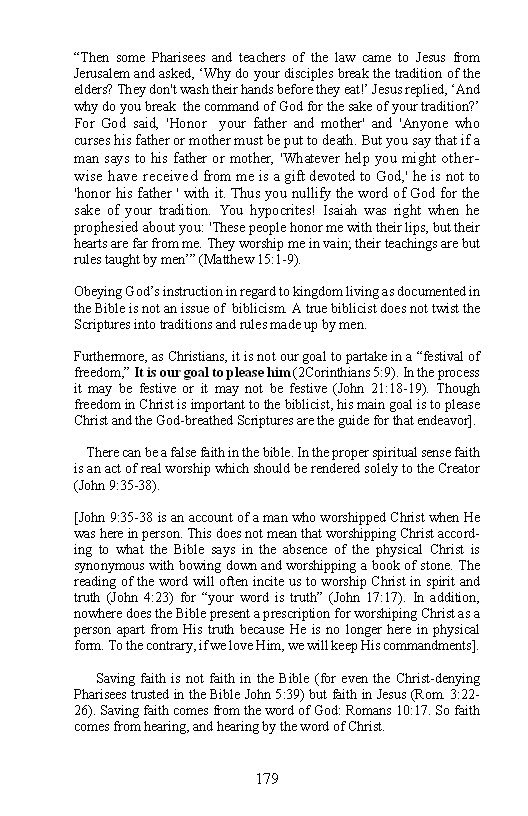
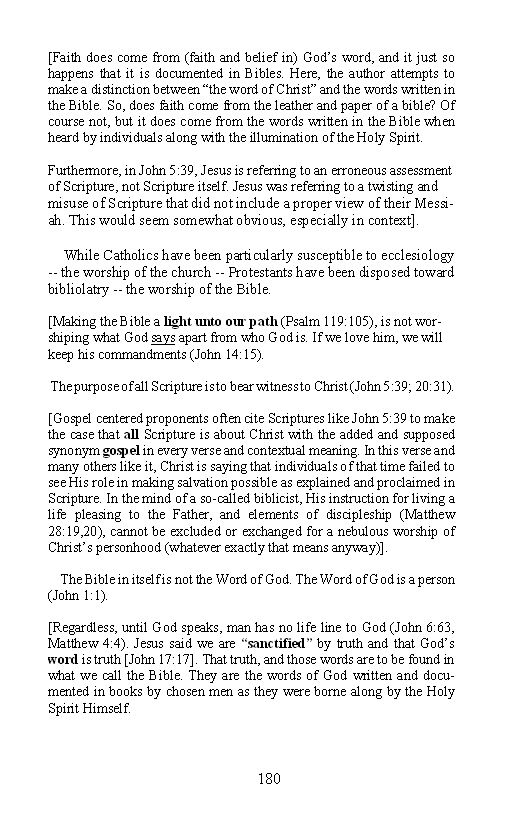
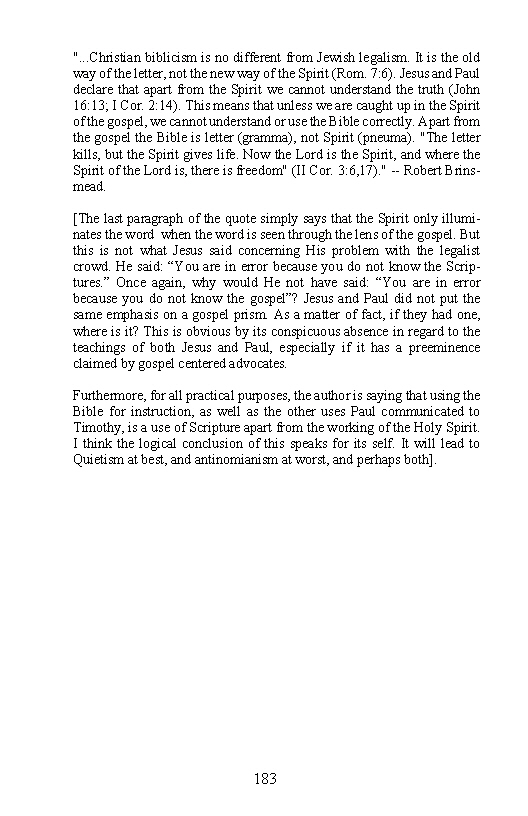
In the first segment, “Love And Faith,” Holland clearly shows this book’s kinship with the Australian Forum. I devote a whole chapter in my book, “Another Gospel” to Robert Brinsmead’s interpretive prism as taught by him and Paxton / Goldsworthy. Following this post, a full copy of that chapter can be viewed. On page 62, Holland describes faith as the “eye of the soul.” He then writes that Scripture is the lens used by faith and the Holy Spirit illuminates Scripture for one purpose and one purpose only: “Suddenly the Bible comes alive and we see Christ’s excellence, His splendor!” Hence, this is the EXACT position of the AF: the Bible’s only purpose is to obtain a deeper knowledge of the gospel, and the Holy Spirit will not illuminate anything else but that. Holland writes on page 63: “There must be a faith that engages with God’s Word on Jesus and estimates it to be the most important information in the world” [which then becomes the interpretive mode of operation].
Therefore, the Bible is for the purpose of plunging the depths of seeing the glory of Christ and nothing else. Any other information in the Bible that seems to be contrary to that thesis is descriptions of what Christ has done and should teach us more about Him instead of being an instruction book for a different “way to live.” All of the commands in the Bible are meant to show us what Christ has done for us already, and to humble us because we can’t keep all of them perfectly anyway. As I heard one pastor say from a pulpit about three months ago: “You can’t keep all of God’s law anyway, so don’t even try.” Pondering the volume of commands should also drive us to the foot of the cross and more dependence on Christ. Supposedly.
Therefore, the only logical conclusion is that obedience is a natural result of “Staring At The Son” (the actual title of chapter 5). But how do we know when we are committing the horrible sin of “obeying Jesus in our own efforts?” Well, because it will FEEL like it—that’s how you supposedly know, and Holland emphasizes that point throughout the rest of chapter 5. Throughout the book, Holland reiterates the same worn-out GS points made by Francis Chan (“When it’s love, it feels like love”), John Piper (“Beholding as a way of becoming” and joy is synonymous with faith), Paul David Trip (Christians are still spiritually dead), and Michael Horton (we only grow spiritually when we “revisit the gospel afresh”). The following is the chapter of my future book where the AF view of interpretation is dealt with—which is the same approach propagated by Holland:




Rick Holland’s “Uneclipsing The Son,” Part 3: Mr. Holland’s Theological Train Wreck Has A Destination
There isn’t much new thus far in Mr. Holland’s “Uneclipsing The Son,” other than being the usual theological train wreck one expects from the New Calvinist crowd.
On pages 4-7, Holland expounds on the whole how Ephesus lost their first love routine. They supposedly lost their first love by not focusing on seeing Jesus in deeper and deeper ways as a person (ie., contemplative spiritually). However, Christ makes it clear how the Ephesians were to repent and find their first love again: “….do the works you did at first.” Holland begins the book by butchering Scripture and does not relent moving forward.
On page 8, Holland connects “think[ing] of Christianity as behavior modification” with “effectively estrange[ing] ourselves from Christ.” Regardless of the fact that many verses in Scripture are concerned with behavior modification, Holland doesn’t qualify the statement. In fact, consider 1Thess. 4:3; “For this is the will of God,your sanctification:that you abstain from sexual immorality….” Neither does he qualify what being “estrange[d] from Christ” means. The statement strongly insinuates that behavior concerns in sanctification will separate us from Christ. This is run of the mill Gospel Sanctification stuff.
On page 9, things get a little creepy: “After all, Christianity is the worship of Jesus Christ. It’s the worship of Jesus Christ exclusively, and it’s the worship of Jesus Christ comprehensively. He alone is worthy; He alone is God….” Uh, what about the Father? In many instances, GS proponents hint at some kind of skewed view of the Trinity, and Holland is no exception. There is very little doubt that GS theology often eclipses the other two members of the Trinity.
On page 10, Holland again takes a jab at obedience by saying biblical books “….are not a mere directive for a new way to live, but a manifesto of the amazing greatness of Jesus.” The focus is the greatness of Jesus, not what Jesus says (….”teaching them to observe all that I have commanded you.”). Holland’s thesis seems to clearly contradict Luke 11:27, 28 which records the reaction of a woman who realized the greatness of Christ: “As Jesus was saying these things, a woman in the crowd called out, ‘Blessed is the mother who gave you birth and nursed you.’ He replied, ‘Blessed rather are those who hear the word of God and obey it.’”
On page 11, Holland writes that the book of James presents Christ as the “rule and standard of all spiritual instruction” (in other words, as Paul David Tripp says: “All commands must be seen in their gospel context”). This is simply not true, and again, what about the Father?! The Father has no part in spiritual instruction? What standard did James use to “serve” God AND the Lord Jesus Christ? Holland plainly contradicts James’ opening statement of the book.
On page 12, he reiterates the thesis of the book; primarily, conjuring up a heightened “value” of Christ in our minds as the key to emerging from the eclipse which he assumes most Christians are in because after all, like all New Calvinists, he is on the cutting edge of the great Reformation that wasn’t finished by Luther et al. All and all, it reduces the Scriptures to a tool for contemplating the greatness of Christ exclusively for the purpose of being motivated by emotions, as we will see later.
On page 14, obedience is again devalued by describing it as a “treadmill” of engagements, polite conversation, and good behavior. Yet, Peter exhorted Christian wives to win their lost husbands through their “good behavior.” Once again, Holland does not qualify any of these statements regardless of the fact that they contradict the plain language of Scripture.
On page 15, he toe’s the usual GS line by indicting Christianity for considering the gospel to be “Basic/Christian /Truth,” and reiterates the need to see the gospel “afresh.” This contradicts 2Peter 1 and Hebrews 5:11-6:3, as well as many other Scriptures that speak of the gospel as a foundation of faith that we build on. In addition, and on the same page, he makes feelings the standard for whether or not the gospel is once again stirring our hearts: “Do these words move you as they once did?”
In the previous post, I eluded to Holland’s butchering of Romans 5 starting on page 18 and following where he speaks of Christians as being presently in a pre-salvation condition. In other words, it is strongly insinuated that Christians are still spiritually dead as they were before salvation. This idea is often promoted by other New Calvinists such as John Piper, Paul David Tripp, and Michael Horton by citing pre-salvation texts that are clearly in the past tense as pertaining to Christians presently. On page 39, Holland has the audacity to make the following statement under the heading “When Bad Grammar Makes Good Theology”: “The rules of grammar are intended to be guardrails for communication. But sometimes they prevent it.”
At that particular place in the book, Holland uses that point to speak of the apostle Paul’s supposed “awkward” grammar. His idea is that Paul used the phrase “to live is Christ” to communicate the idea that true spiritual life only comes from contemplating the person[hood] of Christ. Also insinuated is the idea that Christ’s greatness transcends mere grammatical rules, and therefore, one must break those rules to communicate how consumed our life must be with Christ. But in what context? Who Christ is as a person (whatever that means) only, or what Christ teaches about our role in sanctification? But in his relentless onslaught of distortion, he claims that Paul’s grammar is “awkward”; no it isn’t, Paul is using a simile to communicate the idea that Christ should be first priority in our lives—it’s not awkward or “bad grammar” at all. But first priority doesn’t equal a nebulous contemplation that supposedly results in a passive obedience earmarked with a joy that gives all obedience moral value. That isn’t biblical truth, and Paul didn’t distort grammar guardrails—it’s the New Calvinists that do the distorting based on their version of the gospel interpreting all reality. And if grammar gets in the way, they do what all good antinomians do—change the rules.
On page 23, Holland addresses one of the newest challenges to New Calvinism—that being the subject of hell and the New Calvinist paranoia that somebody might think that hell is an incentive to confess the gospel rather than the pure unadulterated motive of seeing Christ in His full glory and the accompanying treasure chest of joy that validates the confession. The story line that seems to be emerging from New Calvinists is that hell is good news because it shows how Christ saves us from God. In fact, the heading on page 23 reads, “Saved—From God.” So, apparently, hell is a God the Father sort of thing. On page 43 and following, Holland presents God as “our most pressing problem.” And, “man’s greatest problem is God, God Himself.” And of course, it’s Christ to the rescue, right? Though few would reject that premise, it’s not exactly right and promotes the subtle New Calvinist goal of making Christ more significant than God the Father. Holland gives no Scripture references for this concept of Christ saving us from God because there isn’t any. God was just as involved in the salvation solution as Christ was, and Christ is also a God of wrath just as much as the Father is (Rev. 6:16,17 and 19:11-16) This whole concept is a subtle, but dangerous distortion. At the very least, making a strict dichotomy that associates wrath with God and salvation with Christ is ill advised.
On page 25 and 26, Holland espouses the well traveled indicative / imperative GS paradigm. This is the idea that all commands in the Bible are always preceded by a description of what Christ has done through the gospel, which incites gratitude and awe, which in turn incites joy, and the joy incites us to do whatever the following verses describe in the way of imperatives. Michael Horton describes it as a formula (formulas are ok if they are NC approved): Gratitude + (leads to) Doxology = (leads to) Obedience. Of course, the notion that the Scriptures always follow that grammatical pattern is patently absurd, but yet, New Calvinists now realize that our dumbed-down Christian culture will drink anything you put in front of them. This is especially crippling for Christians to buy into because the Bible often presents the exact opposite: obedience + (leads to blessings) doxology = gratitude (for example: James 1:25). To refute this, New Calvinists will refer back to a text several chapters prior and claim that the indicative there is linked to the other pattern in question, which is ridiculous.
On pages 29 through 41, chapter 3, Holland toes the GS line on the desire = value paradigm. This entails using the Bible for the sole purpose of contemplating the greatness of Christ and the gospel (as Piper describes: “always reading with an eye for the gospel”) with the result of our desires being changed, which in turn changes our value, which in turn changes our behavior. It’s based on the premise that we are controlled by our desires, and therefore, change the desire, and you will change behavior and what you worship. This also coincides with the supposed purity of feelings with the action that gives obedience its moral value. In fact, throughout chapter three, Holland suggests that feelings are an acid test for how we are progressing in uneclipsing the Son: “Do you seek to enjoy and honor and feel the fellowship of the risen, living Jesus?” And, “What does that feel like? It’s all about appraising Jesus as infinitely and personally precious. It’s all about a conscious, deliberate enjoyment of His worth.” Oh really? Is that what it is “all about”? I thought it was all about “make[ing] it our goal to please him.” What’s so complicated about the word “goal” and the fact that it is God’s pleasure being the focus, not ours?
To drive this point home, Holland uses “Gollum” of JRR Tolkien’s Lord of the Rings to make his point. Gollum called the ring “precious” because that was his focus. In the same way, Christ will be precious to us if we focus on just Him, and our lives will be consumed with Him like the ring consumed Gollum’s life. But this is not the biblical paradigm of fighting desires of the flesh while putting off the old man and putting on the new creation. Christians are to withhold provisions from the flesh that bolster sinful desires while walking in the Spirit. Nowhere in Scripture are we commanded to change our desires through spiritual contemplation as the singular discipline from which all other disciplines flow as a natural result. Rather, “walk by the Spirit (according to the Spirit’s will as revealed in the Bible), and you will not gratify the desires of the flesh.”
In order to make his points in this chapter, Holland blatantly distorts several texts. According to Holland, when Christ restored Peter with the three questions, He only wanted to know if Peter loved Him, not “Do you have your philosophy of ministry down?’ Not, “do you have church strategy ready?’ Not, ‘have you practiced your sermon for the day of Pentecost?’” Holland’s point is that “affection” is the issue, not anything we do. However, Holland completely excludes the fact that Christ followed-up each question with three imperatives that cover three different aspects of ministry—all but a total contradiction of how he exegetes that particular text. Does Holland think his audience is biblically illiterate? To conclude the chapter, Holland summarizes the main point: “If there’s anything in your faith that isn’t anchored in the person of Jesus, you’re living in an eclipse. You are not enjoying the eternal life made available by the gospel.” Note the focus of all biblical truth, according to Holland (and all other New Calvinists as well) is the nebulous “person of Christ” rather than the objective “….teaching them to obey all that I have commanded” which was Christ’s mandate to the church.
What a theological train wreck! But yet, it has a destination: away from the law; and to let go and let God theology.
paul

 Paul's Passing Thoughts
11 comments