Albert Mohler, Nelson Mandela, and the Crusade for a New Calvinist Host
 I have to think long and hard these days for something that annoys me more than Albert Mohler. His presidency at Southern Seminary is a boondoggle rivaled only by the election of Barak Obama, who is, by the way, advocated by Mohler. As the world was blessed with another week, Mohler failed not to mark his territory with an article about the passing of Nelson Mandela lest the world not know his opinion about it. Hence, the Louisville Kool-Aid drinkers who wait with bated breath for his unctions from on high are now apprised.
The article compared Nelson Mandela to George Washington. Ok, the buffoonery of that theses aside, why does Mohler meddle in this stuff? What makes the president of Southern Seminary a political player? For crying out loud, why does Mohler, Piper et al weigh in on every political tryst that comes down the pike? Why did a lot of these guys vote for Barak Obama? Answer: Calvinist history predicated by Calvinist need.
As you know, New Calvinism is the latest resurgence of authentic Reformed doctrine. Historically, authentic Calvinism dies a social death and experiences periodic resurgences in 100-year cycles. New Calvinism is the fifth resurgence since Calvin’s Geneva. Volume 2 of TTANC will document the history of these cycles and the reasons for them.
Protestantism is predicated on passive sanctification/Christian living. Therefore, in an attempt to stop the death spiral Protestantism finds itself in from time to time because it is a light form of its original lager recipe, it attempts to go back to the original recipe for a solution. The only solution in history since the Reformation that offered aggressive sanctification as a solution was the biblical counseling movement founded by Dr. Jay Adams. However, his movement was spawned in the same year that New Calvinism was born (1970), and a war ensued accordingly.
The true biblical counseling movement and its aggressive sanctification lost the war. I witnessed the movement and was involved in it firsthand when it really started

Target Publication 2015
making a radical difference in Christianity circa 1990. New Calvinism (then known as Sonship Theology), infiltrated the true biblical counseling movement through Westminster Seminary and effectively destroyed it by 2006. The high priest of this inquisition was Dr. David Powlison who was a mentoree of the father of Sonship Theology, Dr. John “Jack” Miller. I therefore assume that Powlison will one day receive his just reward for snuffing out one of the most significant revivals in church history.
There are six reasons authentic Calvinism dies:
1. Protestantism was founded on the ancient ideology of spiritual caste. As a result, the Reformation gospel integrated Neo-Platonism with the Bible and offered not just a different gospel, but an entirely different way to interpret reality. Luther, taking his cue from St. Augustine, made the cross the sum of epistemology in and of itself. Many didn’t understand this and still don’t.
In other words, the Reformers interpreted reality through a redemptive prism, while the natural tendency is to interpret reality grammatically. The former believes that creation is a narrative that points to nothing but redemption; the latter doesn’t reject the idea that redemption is referred to in some way, but also believes other things are going on, and the plain sense of words are the key to understanding reality. The redemptive view of reality relies heavily on allegory because it demands a redemptive outcome.
The Reformers actually believed, as many do today, that a grammatical interpretation of reality is synonymous with works salvation and the glory of man. This was Luther’s epistemology. New Calvinists such as Paul David Tripp and Rick Holland have said that a literal, exegetical approach to Scripture separates us from the saving works of Christ (Tripp), and makes bad theology (Holland). Salvation is therefore married to redemptive eisegesis.
Hence, as time progressed, redemptive Protestants grew fewer, and grammatical Protestants increased in number. Remember, at issue is the very interpretation of reality itself. This has resulted in the present-day reality of redemptive Calvinists and grammatical Calvinists; ie., “Old Calvinists” and “New Calvinists.” Both claim Calvin, the former unwittingly. Therefore, in the midst of these resurgences, you have Calvinists fighting Calvinists. Examples of this are ample in church history and will be detailed in TTANC2. Along with every resurgence is an antinomian controversy between Calvinists.
The first point here is that authentic Calvinism dies a social death because its contra intuitive interpretation of reality is a natural anomaly. As it dies, it is replaced with the weaker form that came from it, and a need for solutions once again arise, and the original once again presents itself as the solution: “See, we have gotten away from our roots. That’s the problem.”
2. The original calls for a perpetual revisiting of the same gospel that saved us. This simply becomes boring and people lose interest. Susan and I have recently visited New Calvinist churches that were on fire in the early 80s. They are now deader than dead. Imagine our teenage son pointing this out without any cue from Susan and me at all.
3. The doctrine does not produce spiritual growth which results in a plethora of negative issues that arise from spiritual immaturity. See Hebrews 5:11-6:8. Infants in adult bodies will eventually devour each other.
4. The spiritual tyranny that is ALWAYS part and parcel with this doctrine. Remember, it is basically a spiritual cast system that puts a high premium on control.
5. God’s people eventually figure out that it is a false doctrine.
6. Ultimately, it needs to survive by getting in bed with the government as a way to enforce its orthodoxy. If this doesn’t happen, reasons 1-5 result in its death. Everyone agrees that the Enlightenment era destroyed authentic Reformed orthodoxy because it severed church and state—first in America, and then Europe followed. When this happened, it resulted in the proliferation of cults because government force had to be replaced with various forms of manipulation and mind control.
And this is why New Calvinists such as Albert Mohler are so politically minded. Authentic Calvinism has always been a parasite that will ultimately die unless it finds a government host. Be sure of it: this is what happened to the colonial Puritans, they were kept out of the American political process when they attempted to use the American Constitution to enforce their orthodoxy. This resulted in the death of American Puritanism. Before the American Revolution, the Colonies were Puritan theocracies.
Mohler et al knows their movement will eventually die unless they can use the government to enforce it, and this is behind their liberal political leanings. It takes a collectivist government to enforce a collectivist religion. They know this; hence, “No Government is perfect.” This is why Mohler thinks that “one man’s terrorist is another man’s freedom fighter.” This is why Mohler thinks the differences between Washington and Mandela are “ironic” despite the fact that Mandela was a communist.
Frankly, I believe that this is why John Piper retired from the pastorate and made a video in Geneva that announced his future vision. New Calvinists will continue to become more and more involved in the political realm. There is an agenda to get in bed with the state in order to enforce their faith. If they don’t, history will repeat itself—they know this. They will go the way of the colonial Puritans.
This is just simply history. Calvinists will do what Calvinists have always done. Sure, grammatical Calvinists may deny this historic agenda because they don’t get it, but the authentic Calvinists do get it…
It’s about the collectivist parasite feeding from the host of individualism.
paul
Calvinism’s Platonist Rejection of the Trinity
 How do Calvinists reject the Trinity? Basically, they make God the Father and the Holy Spirit lesser forms of Jesus Christ. Their rejection of the Trinity is based on Plato’s theory of forms. This shouldn’t be any big surprise as one of the forefathers of the Reformation, St. Augustine, was a Plato groupie. My wife Susan will address the Plato/Augustine love affair in significant detail at this year’s TANC conference.
Plato’s basic idea of forms led to the Reformed Emphasis Hermeneutic, also known as the Redemptive Historical Hermeneutic. Plato’s trinity was the good, the true, and the beautiful, and all other forms, or solid matter if you will, are lesser forms of the true form. In one sense, Calvin believed that Jesus Christ brought the two together, but that is a philosophical angle we will not pursue here because other manifestations of this heresy are more plainly and easily seen. Calvinists merely make Jesus Christ the full expression of the good, true, and beautiful while representing the other members of the Trinity as lesser forms.
Hence, Jesus Christ, and His works become the stargate to all understanding of reality. The “gospel” is a term that encompasses the personhood of Christ and His works—this is the gateway to understanding ALL reality. The saving act (singular) of Jesus Christ is not something done in history as part of the Trinity’s plan to reconcile them to mankind, but is the key to understanding all reality. Therefore, many Calvinists refer to the “saving acts” (plural) of Christ and His personhood as keys to understanding. The Bible is therefore 100% about the gospel i.e., the personhood and works of Christ. More on this further along.
This is abundantly evident via the everything Jesus mentality of today’s churchianity. The books, the sermons, and the music are everything Jesus. This is why; it is a Protestant family tradition set on fire by the Neo-Calvinist movement. And it all begins in a galaxy far, far away known as Western philosophy. Calvin notes the following in his Institutes of the Christian Religion:
For this reason Augustine [who he quotes on average every 2.5 pages in the Institutes], treating of the object of faith (De civitate Dei lib. 11 c. 2), elegantly says, “The thing to be known is, whither we are to go, and by what way”; and immediately after infers, that “the surest way to avoid all errors is to know him who is both God and man, It is God we tend, and it is by man we go, and both of these are found only in Christ.
Therefore, supposedly, the “only” sure way to avoid error is to focus on Jesus Christ only, the idea that spiritual reality and physical reality are only seen in Christ notwithstanding. A clearer way to see how this all fleshes out is in the first tenet of New Covenant Theology which is a spinoff of Neo-Calvinism:
New Covenant Theology insists on the priority of Jesus Christ over all things, including history, revelation, and redemption. New Covenant Theology presumes a Christocentricity to the understanding and meaning of all reality.
Considered to be the foremost authority on Reformed hermeneutics in our day, Graeme Goldsworthy stated the following on page 48 of Gospel-Centered Hermeneutics (InterVarsity Press 2006):
If the story is true, Jesus Christ is the interpretative key to every fact in the universe and, of course, the Bible is one such fact. He is thus the hermeneutic principle that applies first to the Bible as the ground for understanding, and also to the whole of reality.
Calvinism concurs. ALL reality is Chrsitocentricity. The gospel is a stargate to the pure form of the good. Geoffrey Paxton, an Anglican theologian and authority on the Reformation, stated the following on page 41 of The Shaking of Adventism (Baker Book House 1978):
Christ alone means literally Christ alone, and not the believer. And for that matter, it does not even mean any other member of the Trinity!
This statement is both shocking and representative of Reformed trinitarian thinking. Paxton is absolutely right, Solus Christus means just that. Another way of understanding this is via the solar eclipse. This is the most popular example of how Christ must be the gateway to pure understanding. Christ is the Sun, the life-giving rays of light. To let anything obscure that light, no matter what it is—is to deprive ourselves of wisdom and life to that degree. When we let objects, even objects that are factual and true obscure Christ, we are “living in the shadows.” This is the theses of longtime John MacArthur confidant Rick Holland’s book, Uneclipsing The Son. The book is a Platonist/Gnostic treatise that is not even ambiguous. On page 11, Holland writes that the book of James presents Christ as the “rule and standard of all spiritual instruction.” On the same page, Holland asserts that Christ is the “one true God” and then cites five Scripture references that say no such thing.
John MacArthur wrote the Forward to Holland’s book being presently considered, and made these statements:
Rick Holland understands that truth. This book is an insightful, convicting reminder that no one and nothing other than Christ deserves to be the central theme of the tidings we as Christians proclaim—not only to one another and to the world, but also in the private meditations of our own hearts.
The pastor who makes anything or anyone other than Christ the focus of his message is actually hindering the sanctification of the flock.
No greater subject exists than Jesus Christ–no greater gift can be given than uplifting His glory for another soul to see it and be changed by it. This book will be a wonderful help to anyone who senses the need to orient one’s life and message properly with a Christ centered focus. It is full of fresh, practical, and memorable spiritual insight that will show you how to remove whatever obstacle is blocking your vision of the Son and allow His light to blind you with joy.
Christ, while praying to the Father, referred to the Bible as “your word” and “your word is truth” (John 17:17). We pray to God the Father, not Christ, and we baptize in the name of all three Trinity members. The Bible is not Chrsitocentric. The Bible has many major themes. The father of our faith looked for “a city built by God.” This contradicts the plain sense of Scripture, which brings me to my next point.
The Redemptive Historical Hermeneutic calls for a contemplation on Christ and His works only, or the gospel, and a logical conclusion drawn from the formation of verbs, nouns, adjectives, prepositions, etc., must be disregarded for a Chrsitocentric conclusion or a “truth” that “shows forth the gospel.” In the aforementioned book, on page 39, Holland has the audacity to make the following statement under the heading “When Bad Grammar Makes Good Theology”: “The rules of grammar are intended to be guardrails for communication. But sometimes they prevent it.” Insinuated is the idea that Christ’s greatness transcends mere grammatical rules, and therefore, one must break those rules to communicate how consumed our life must be with Christ.
A good example of this is a statement by Paul David Tripp on page 27 of How People Change (Punch Press 2006). Tripp acknowledges that the Bible in-fact does state that we should apply biblical commands to our life, but to take that literally, and not in its “Christ-centered gospel context” (p. 26) is to “omit” Christ in our life as “Savior.” Therefore, a literal approach to the Bible harkens to works salvation. The results of this can be seen in this approach to preparing Bible lessons:
At this time, resist the temptation to utilize subsequent passages to validate the meaning or to move out from the immediate context. Remembering that all exegesis must finally be a Christocentric exegesis.
Look for Christ even if He isn’t there directly. It is better to see Christ in a text even if He isn’t, than to miss Him where He is (Biblical Theological Study Center: A Christo-Presuppositional Approach to the Entire Scriptures; Max Strange. Online source: http://goo.gl/5sGjP).
Another authority on the Reformation, Robert Brinsmead, states this perspective concisely:
That which makes the Bible the Bible is the gospel. That which makes the Bible the Word of God is its witness to Christ. When the Spirit bears witness to our hearts of the truth of the Bible, this is an internal witness concerning the truth of the gospel. We need to be apprehended by the Spirit, who lives in the gospel, and then judge all things by that Spirit even the letter of Scripture (Brinsmead, Robert D. ”A Freedom from Biblicism” in The Christian Verdict, Essay 14, 1984. Fallbrook: Verdict Publications. Pgs. 9-14).
In other words, the meaning of Scripture according to the letter [i.e., logical interpretations from the grammatical construction] must be judged by “that Spirit” which “lives in the gospel.” All bets are off concerning any interpretation that seems to be the plain sense of the text.
Moreover, New Calvinists take this concept dangerously close to disparaging God the Father. In the book here cited by Holland, he suggests that Christ saved the world from God. In fact, the heading on page 23 reads, “Saved—From God.” So, apparently, hell is a God the Father sort of thing. On page 43 and following, Holland presents God as “our most pressing problem.” And, “man’s greatest problem is God, God Himself.” And of course, it’s Christ to the rescue, right?
Though few would reject the idea that Christ saved us from God’s wrath, it’s hardly the whole story and promotes the subtle New Calvinist goal of making Christ more significant than God the Father. Holland gives no Scripture references for this concept of Christ saving us from God because there isn’t any. God was just as involved in the salvation solution as Christ was, and Christ is also a God of wrath just as much as the Father is (Rev. 6:16,17 and 19:11-16). This whole concept is a subtle, but dangerous distortion. At the very least, making a strict dichotomy that associates wrath with God and salvation with Christ is ill advised and smacks of Marcionism.
Holland is hardly alone in this approach among New Calvinists. Paul Washer suggested to an audience of European college students that the goodness of God is man’s biggest problem (Online source: http://wp.me/pmd7S-1A3). At any rate, a standalone dichotomy of wrath versus love associated with Christ and the Father that is unqualified, is a concept that should make Christians very uncomfortable.
Calvinism promotes a Platonist-like distortion of the Trinity. It shouldn’t surprise us as the Plato/Reformed love affair is well documented. New Calvinists in our day even sport ministry subtitles with Platonist themes: “Between Two Worlds,” “Between Two Spheres,” and in regard to Plato believing that pure truth is static, “Truth Unchanging.”
Like all cultic false religions throughout history, they distort and therefore reject the Trinity.
paul
ADDENDUM
Calvin presented the priority of Christ over the other two Trinity members in the following way as explained by Mark Driscoll associate Justin Holcomb:
According to Calvin, the object of faith’s knowledge is Jesus Christ. He defines faith by proceeding to the center of a series of concentric circles: God’s existence, God’s power, God’s truthfulness, God’s will “toward us” as revealed in Scripture, and finally Christ. All these circles are implied in faith, but only the last is properly understood as the object of faith. Calvin goes so far as to say that those who say that God is the proper object of faith “rather mislead miserable souls by vain speculation, than direct them to the proper mark” (Institutes III.2.i). Christ as mediator is necessary if humans are to know God. Christ is not set over against God. Rather, Calvin asserts, Christ is the means—the only means—by which we can believe in God (Online source: http://theresurgence.com/2009/07/10/calvin-on-faith-christ-and-his-gospel).
ADDENDUM
One might consider the ruckus that was created over my suggestion that salvation involves all members of the Trinity and not Christ alone. I think this is telling. The following is a reprint of the controversy on Pastor Joel Taylor’s blog that resulted from some comments I had made on that subject:
5 pt salt .com
JUSTIFICATION IS NOT OF CHRIST ALONE
POSTED BY JOEL TAYLOR ON DECEMBER 15, 2011 IN GENERAL | 24 COMMENTS
I’m not even sure I like the title of this post. Not because it’s not true, but because it’s confusing.
Let me explain.
A few days ago I posted this piece promoting the book by Paul Dohse entitled The Truth About New Calvinism: It’s History, Doctrine, and Character. It’s worth reading. In fact, I think his book is an important one, and yes, I highly recommend you get it.
But, of course, not everyone feels that way.
Yesterday, after reading that post of mine, one 5ptsalt reader left this comment to me regarding Dohse and his book:
I’m pretty shocked you are promoting this book. Taking a peak inside reveals some pretty far out stuff. Just one example:
“First, justification is not by Christ ALONE. If God didn’t elect Christ, elect the elect, and draw them to Christ, along with sacrificing His only Son, what Christ did would have been for naught. So, justification is not by Christ alone.”
Buyer beware. This is dangerous stuff.
Well brethren, don’t be shocked that I promote this book. Be glad. And for you buyers, no need to beware.
Dohse is Right
Fact is, Paul Dohse is spot on, and even though he doesn’t need me to defend his statements, this reader’s comment gives us the opportunity to look at Scripture and, hopefully, instruct all of us. As Martha Stuart is apt to say, “That’s a good thing.”
See, it’s always important to look at statements in their proper context, a practice often overlooked and disregarded in the heat of defending what one is doctrinally comfortable with. But we need more importantly to examine all things in light of Scripture, it being – yes, I’m saying it again – the final authority in all things.
This comment by Dohse can be found from this post [link] of his which itself is a response to a series of questions by one of his readers. Here’s the question of the reader, followed by Dohse’s response:
Q: You have raised many issues in the last post that would take a book to answer. If I may, I would like to ask a few questions that might help us to clarify the issues on which we disagree. First, I want to state a couple of points on which I think we agree. Incidentally, I am convinced Piper and others would also agree.
…….
2. Justification is based on the work of Christ alone and our works do not contribute to it at all.
…..
Dohse responds to the second point:
2. First, justification is not by Christ ALONE. If God didn’t elect Christ, elect the elect, and draw them to Christ, along with sacrificing His only Son, what Christ did would have been for naught. So, justification is not by Christ alone.
Now, as I said earlier, Dohse is right. In fact, spot on. Here’s why: In a nutshell, it took all three persons of the Trinity to accomplish our justification. Father, Son and the Holy Spirit. If one dogmatically asserts that the Son alone is responsible for our salvation, including our justification, such a statement is clearly, from the Biblical testimony, an error.
Yes, the basis of our justification is the finished work of Christ alone, apart from our own works. That is true. Yet Dohse is merely pointing out the fact that unless the Father had predestined some to salvation, there would be none. The Father sent the Son to redeem us. The Holy Spirit works in us to make us holy. So Dohse is pointing out the involvement of the Trinity in our complete salvation. Although the basis for justification is Christ alone, there would be no justification without the involvement of all three persons of the Trinity in our redemption.
First, let’s give a simple definition of what justification is. Be sure and learn this, I implore you. When this is learned, hopefully, much confusion will be dismissed altogether.
Justification Defined
Justification is a declaration from the throne of God the Father concerning our legal status before His law. It is a single act, occurs one time, is never again repeated and is definitely not a process.
God the Father is the Author and Origin of Our Justification:
since indeed God who will justify the circumcised by faith and the uncircumcised through faith is one. – Romans 3:30
But to the one who does not work, but believes in Him who justifies the ungodly, his faith is credited as righteousness, – Romans 4:5
and these whom He predestined, He also called; and these whom He called, He also justified; and these whom He justified, He also glorified. – Romans 8:30
By the way, who predestination the elect unto salvation? Jesus Christ the Son? No! God the Father predestination us, according to Scripture. You see, it is God the Father who makes the declaration of justification, so to think justification is of Christ alone, well, that is simply not a biblical position.
Blessed be the God and Father of our Lord Jesus Christ, who has blessed us with every spiritual blessing in the heavenly places in Christ, just as He chose us in Him before the foundation of the world, that we would be holy and blameless before Him – Ephesians 1:3-4
Who will bring a charge against God’s elect? God is the one who justifies; – Romans 8:33
When anyone objects to statements like “Justification is not by Christ alone”, I would suggest one needs to pull back, calm down, and search the Scriptures and strive towards of a biblical understanding of precisely what justification is, a declaration from God the Father.
Brethren, I hear far, far, far too much praying for the Holy Spirit to “come down” and manifest Himself. I strongly object to such, and I would encourage pastors, and elders who are allowing such to continue to rethink what they are encouraging.
Listen. The Holy Spirit, third person of the Trinity, points us to Christ, not to Himself, and does not anywhere in Scripture ask us to ask more of Him! (John 16:13, 14).
Listen again, please. Christ Jesus points us to the Father! He is the way to the Father, not just to Himself! John 14:6.
Look at Ephesians 2:18, 19 brethren, and for all you New Calvinists, contemplate this:
for through Him we both have our access in one Spirit to the Father. So then you are no longer strangers and aliens, but you are fellow citizens with the saints, and are of God’s household
Now, why do so many focus only on the Son? For you to be redeemed, it took the entire Trinity, the triune Godhead, in perfect agreement together regarding a predestined, glorious plan of redemption of those given by the Father to the Son by the work of the Holy Spirit.
Sonship theology, indeed. Paul Dohse is right, because Paul Dohse is listening to God’s written Word, not the latest guru of truth.
Brethren, in love, I ask you not to ignore two members of the Trinity. Christianity is not wearing a Calvinistic t-shirt, boasting of your reformed views, and getting people to contemplate on the Gospel more.
That is utterly absurd. It is ignoring the whole counsel of God. This business of “Gospel sanctification” and Sonship theology is a dangerous – and exceedingly popular movement. And it is a movement that endangers souls.
So get that book, read it, be alert, and learn and be aware of anything and anyone who, in your heart, trumps the Word of God. May we all strive to better acknowledge the final authority of God’s Word, and rest our beliefs on its veracity alone.
24 COMMENTS
JOSHUA
DECEMBER 15, 2011
Did you believe this before Dohse made his statements or did he lead you to this understanding?
REPLY
ELLEN
DECEMBER 15, 2011
What then are we to think about the following scripture, relating to the reasoning in this post? In the beginning was the Word and the Word was with God and the Word
was God. John 1:1
REPLY
JOEL TAYLOR, PASTOR-TEACHER POST AUTHOR
DECEMBER 15, 2011
You should think that Jesus was in the beginning, eternal, and was with God, with God the Father, God the Holy Spirit, and was/is God Himself, and created all things, and all things are upheld by Him, for Him and through Him.
REPLY
JOE
DECEMBER 15, 2011
I like John 3:16
REPLY
JOHNDUNNINGUK
DECEMBER 15, 2011
I believe that if we are to truly accept the doctrines of grace as being true, we cannot do so sincerely, and yet fail to understand the crucial role that all three Persons of the Godhead play in our salvation.
In covenant theology, there is a sense whereby that which we know as the covenant of grace, flows directly out of an agreement within the Godhead made before creation, known as the counsel of peace, and sometimes as the covenant of redemption.
It was in this coming together of the Godhead to form a plan of creation, redemption and salvation, that each Person of the Godhead took upon their role. (I realise this is a pretty poor description on my part, so please excuse me). Each Person of the Godhead being indispensible to the other, and the faithful work of each Person, utterly vital for the plan of salvation to succeed.
Although I can sort of understand peoples reaction to this post generally, I have to agree that I think it more emotional than intellectual. It is undoubtedly true to say that there is absolutely no sacrifice for sin that is acceptable to God, other than Christ. However it would also be true that without the sovereign election of the Father, giving a people to His Son to redeem through His own blood, His sacrifice would be for nought. And were it not for the Holy Spirit, sealing those who have been chosen and redeemed, acting as the deposit that guaranteed their inheritance in Christ, then none would be brought to glory anyway.
REPLY
MAY
DECEMBER 15, 2011
However it would also be true that without the sovereign election of the Father, giving a people to His Son to redeem through His own blood, His sacrifice would be for nought.
Why would His sacrifice be for nought? The Father knows that some will and some will not believe.
REPLY
JOHNDUNNINGUK
DECEMBER 16, 2011
Why would His sacrifice be for nought? The Father knows that some will and some will not believe.
If you read through John 6:37-44 you will see what I meant more clearly. Christ did not come to the earth to do His own will, but the will of the One who sent Him. Namely the Father.
It is the Father who elects those who are to be saved and gives them to His Son to raise up on the Last Day, and we are told that ALL those who are given by the Father shall come to the Son.
The willingness of Christ to lay down His life to save us as the redeeming price, can only redeem those the Father has given Him to redeem. Therefore without being given a people by His Father, His sacrifice would purchase nothing.
REPLY
TIM SCOTT
DECEMBER 15, 2011
I’m a little confused. I want to ask a clarifying question, just to make sure I have read your article correctly. Aren’t you denying a central tenet of the Reformation? I mean, yes, salvation involves all persons of the Godhead but how was that salvation accomplished? Through Christ right?
REPLY
JOEL TAYLOR, PASTOR-TEACHER POST AUTHOR
DECEMBER 15, 2011
What ‘central tenet’ of the reformation would I be denying? The Father is the one who justifies, according to Scripture.
REPLY
Pingback: God Making His Appeal Through Us. « Kevin Nunez
TIM SCOTT
DECEMBER 15, 2011
Solus Christus
REPLY
JOEL TAYLOR, PASTOR-TEACHER POST AUTHOR
DECEMBER 15, 2011
Tim, the Father elected those who would be saved, and gave them to the Son to be redeemed, which He did at the cross. That is the testimony of Holy Scripture. We must be careful not to make being ‘reformed’ more important than being biblical. Solus Christus is not about the doctrine of justification brother.
REPLY
TIM SCOTT
DECEMBER 15, 2011
Thanks. That is why I was making sure I understood what you were saying. Appreciate your answer bro.
JOHNDUNNINGUK
DECEMBER 16, 2011
It seems to me that this is the result of a sloppy question/statement followed by a precise answer. I’m not saying that to lay blame on anyone, but merely to say that where matters of doctrine are concerned, precision in our language is essential. All the JW’s do is add one little letter “a” to John 1:1 and it turns the whole Gospel on its head!
The statement made was: “2. Justification is based on the work of Christ alone and our works do not contribute to it at all.” To which the response made was bang on. The intent of the statement maybe obvious enough to some, but it is far from being accurate, and may well lead to wrong doctrine developing if left unchallenged.
REPLY
VINCEPLANETTA@GMAIL.COM
DECEMBER 16, 2011
It doesn’t seem to me the statement should be shocking at all (Jam 2:24). I think reformers have placed too much emphasis on “alone” and is so often misleading. Not that it is incorrect but can potentially detract from man’s response and action.
REPLY
GRACEWRITERRANDY
DECEMBER 16, 2011
The real issue is not whether all three persons of the Trinity are involved in the work of salvation, That should go without saying for anyone who has read the Scriptures. The question that I originally asked to Paul Douche concerned the basis of the sinner’s justification before God. Is it the work of Christ alone or is it the work of Christ’s work or Christ’s work plus our obedience. Whether you like it or not, the Father’s work in electing believers was not the basis of our justification; the Spirit’s work in regeneration was not the basis of our justification. Were those works necessary in order to justify us? Of course they were! Were they the basis of our justification? No way! The basis of our justification was the obedience of Christ alone.
REPLY
JOEL TAYLOR, PASTOR-TEACHER POST AUTHOR
DECEMBER 19, 2011
The basis of our justification is the finished work of Christ, absolutely. However, this post never mentions you, nor is it about you. it concerns a comment left on 5ptsalt in regards to PD.
REPLY
GRACEWRITERRANDY
DECEMBER 16, 2011
“Solus Christus is not about the doctrine of justification brother.”
If it is not about justification. what is it about?
REPLY
JOEL TAYLOR, PASTOR-TEACHER POST AUTHOR
DECEMBER 17, 2011
Salvation.
Acts 4:12 – and there is salvation in no other One, for neither is there any other name under Heaven having been given among men by which we must be saved.
1Ti 2:5 For there is one God, and there is one mediator between God and men, the man Christ Jesus,
1Ti 2:6 who gave himself as a ransom for all, which is the testimony given at the proper time.
REPLY
GRACEWRITERRANDY
DECEMBER 17, 2011
johndunninguk,
You stated that there is something inaccurate about the statement I made. I would be interested in knowing what part of that statement you find sloppy. Do you think it is inaccurate to say that God’s declaration is based on [not by] Christ’s finished work alone or do you think it is inaccurate to state that our works do not contribute to justification at all? If it is not based on Christ’s finished work, on what basis do you think an absolutely holy God could declare sinners righteous and remain righteous himself?
REPLY
JOHNDUNNINGUK
DECEMBER 17, 2011
Hello Andy,
Firstly I do fully believe that our justification is based upon the finished work of Christ on our behalf. I also believe that the very reason that God is willing to justify sinners, can only be because by faith we have accepted and put our trust in the only acceptable sacrifice that can be made for our sins, and that is the One who God sent as that sacrifice. Our own works have nothing to do with it, apart from maybe fighting against the process.
The thing I disagree with is your initial statement “Justification is based on the work of Christ alone”, which is not fully true. Our justification can only come through repentance and faith, both of which I would consider the works of Father and Holy Spirit, as opposed to Christ Himself.
I only object because unless we are elected by the Father, given the gift of faith and drawn by Him, and regenerated and convicted of our sin by the Holy Spirit; then the completed works of Christ alone do not justify us at all. To believe otherwise leaves pitfalls such as universalism wide open for us to fall into.
God bless you, and please excuse me if I have come across harsh in any way. John.
REPLY
GRACEWRITERRANDY
DECEMBER 17, 2011
John,
Thanks for your reply. I don’t think we disagree re: the statement I made. It seems our only areas of disagreement have to do with the difference between the basis of justification and how justification is received. Justification is clearly THROUGH faith which includes repentance, but we are never told that justification is BASED ON, that is on account of or because of the sinner’s faith.
It is important that we distinguish between redemption planned, redemption accomplished and redemption applied. Although the Father and the Spirit were both involved in the offering up of Christ’s obedience unto death, it was his obedience that formed the basis upon which the Father declares us righteous in his sight. It is his righteousness that is put to our account and forms the basis for the Father’s declaration that we are righteous before him. The Father’s primary work in the process of redemption occurred in the area of redemption purposed or planned. He is also involved in the application phase, i.e., effectual calling. The Spirit’s primary work occurs in the application phase. As essential as these works of the Father and the Spirit are, none of those activities on their part form the judicial basis upon which God justifies sinners.
Randy
GRACEWRITERRANDY
DECEMBER 17, 2011
John,
One additional thought. Part of Christ’s redemptive work is reconciliation that not only effects the putting away of the Father’s holy wrath toward the elect, but also guarantees the putting away of our unholy hostility toward God. It is this redemptive accomplishment that the Spirit applies to the elect in regeneration. If we are believers, we have now received the reconciliation (Rom. 5:11) that Jesus accomplished objectively on the cross. That is, Jesus’ accomplishment has now been applied.
Randy
The “Cross Story” and Sanctified Rape in the Church
 “Be sure of it: this is how Calvinists think; this is their worldview.”
“Don’t misunderstand: the problem of ‘victim mentality’ is not even on the radar screen—they have removed the word “victim” from their metaphysical dictionary.”
“Justice necessarily implies victim. Victim necessarily implies worth. All three are conspirators with the glory story.”
Martin Luther had more on his mind than silly Popes when he nailed his 95 Theses to the front door of All Saints’ Church in Wittenberg, Germany. That protest launched the Reformation, but six months later Luther presented the systematic theology of the Reformation to the Augustinian Order in Heidelberg. Luther’s Heidelberg Disputation laid the foundation, and John Calvin later articulated and applied its basic principles to the full spectrum of life in his Institutes of the Christian Religion.
The Cross Story and the Glory Story
Luther’s cross story, or theology of the cross is the crux of the Heidelberg Disputation and introduced in the first sentence of the Calvin Institutes:
Our wisdom, insofar as it ought to be deemed true and solid wisdom, consists almost entirely of two parts: the knowledge of God and of ourselves.
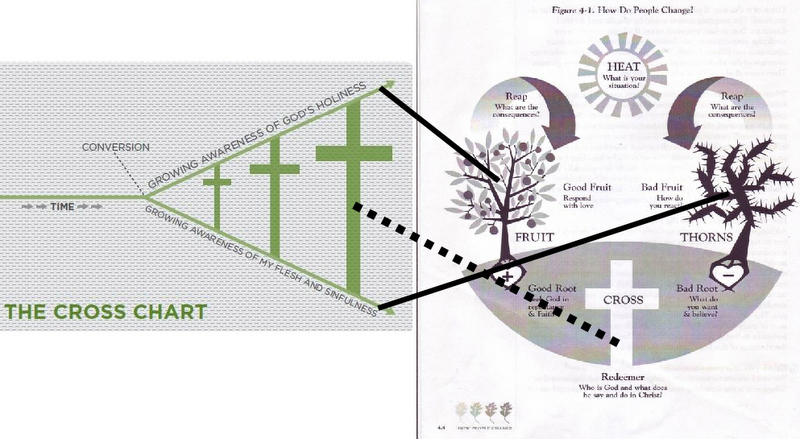
That’s Luther’s theology of the cross: a deeper and deeper knowledge of our putrid humanity as set against God’s holiness. And NOTHING in-between. All of creation, all events, and all reality contribute to deeper knowledge of one of these two, and then both as a deeper knowledge of each gives more understanding to the other; knowledge of both, and the experience of both. Hence, every blessing, including our good works which are done by the Holy Spirit to begin with, lends more understanding of God’s glory. Every evil event, sin, and tragedy lends deeper understanding in regard to our total depravity and worthlessness. But of course your mother is dying of cancer; I am amazed that God would give anyone as many years as He has given her. Who are we to think we deserve even one year of life? And what a wonderful opportunity for her to suffer the way Jesus suffered for us!
This is the cross story. See the illustration below. This is a contemporary depiction from that camp—this is their assessment:

Anything else at all that gives any credit to humanity—Christian or non-Christian is the “glory story.” That would be our glory specifically, and not Christ’s. To the degree that humanity is considered, the glory of Christ is “ECLIPSED.” This is the theses of a book written by John MacArthur associate Rick Holland: Uneclipsing The Son. Everything is perceived as speaking through one of these two perspectives. ANYTHING coming from what is perceived as the “glory story” is summarily dismissed. Be sure of it: this is how Calvinists think. This is their worldview.
In one of the former Resolved Conferences sponsored by John MacArthur and Holland, in one of his messages, Holland extols a letter written to Puritan Christopher Love by his wife as he awaited execution. Holland forgot to mention to those listening that Love was executed for espionage against the English government while letting the audience assume he was executed for loftier spiritual-like reasons. The following is excerpts from the letter:
O that the Lord would keep thee from having one troubled thought for thy relations. I desire freely to give thee up into thy Father’s hands, and not only look upon it as a crown of glory for thee to die for Christ, but as an honor to me that I should have a husband to leave for Christ…. I dare not speak to thee, nor have a thought within my own heart of my own unspeakable loss, but wholly keep my eye fixed upon thy inexpressible and inconceivable gain. Thou leavest but a sinful, mortal wife to be everlastingly married to the Lord of glory…. Thou dost but leave earth for heaven and changest a prison for a palace. And if natural affections should begin to arise, I hope that the spirit of grace that is within thee will quell them, knowing that all things here below are but dung and dross in comparison of those things that are above. I know thou keepest thine eye fixed on the hope of glory, which makes thy feet trample on the loss of earth.
Justice? That implies that humanity has some sort of value. That implies that life itself has some sort of value. That implies that humanity should be protected through threat of punishment. That’s the glory story. Therefore, Calvin stated the following:
Those who, as in the presence of God, inquire seriously into the true standard of righteousness, will certainly find that all the works of men, if estimated by their own worth, are nothing but vileness and pollution, that what is commonly deemed justice is with God mere iniquity; what is deemed integrity is pollution; what is deemed glory is ignominy (CI 3.12.4).
Death by Biblical Counseling
The church must face up to a sobering reality in our day. The vast majority of biblical counseling that goes on in our day is based on this construct—you will be counseled from the perspective of the cross story, and anything that smacks of the glory story will be snubbed. You are not a victim. There is no such thing as a victim. Christ was the only true victim in all of history. Don’t misunderstand: the problem of “victim mentality” is not even on the radar screen—they have removed the word “victim” from their metaphysical dictionary. “Victim” is part of the glory story; Christ as the only victim is the cross story. I am not a victim. That’s impossible because my sin nailed Christ to the cross. Thank you oh Lord that I was raped. Thank you for this opportunity to suffer for you. Thank you for the strength to forgive the one who raped me in the same way you forgave me. What a wonderful opportunity to show forth your gospel!
Hence, when the leaders of a Reformed church came to inform parents that a young man in that church had molested their toddler, this was the opening statement:
Today, we have before us an opportunity to forgive.
The parents were then counseled to not contact the authorities. Those who do are often brought up on church discipline. Justice necessarily implies victim. Victim necessarily implies worth. All three are conspirators with the glory story. And be not deceived: this is the logic that drives Reformed organizations that are supposed to be mediators in the church; specifically, Peacemaker Ministries and G.R.A.C.E. A major player in the Biblical Counseling Movement is Paul David Tripp. In 2006, he wrote a book that articulates the horizontal application of Luther’s theology of the cross: “How people Change.” Of course, the title is a lie; if he really believed people change, that would be the glory story. Notice also that it is, “How People Change” and not, “How Christians Change.” That’s because this bunch see no difference in the transforming power of the new birth and ordinary Christ-rejecting people.
In the book, Tripp, like all who propagate Luther’s theology of the cross, posits the Bible as a “big picture” narrative of our redemptive life. The Bible is a mere tool for one thing only: leading us more and more into the cross story and away from the glory story. This is accomplished by using the Bible to enter into the cross narrative and thereby seeing our preordained part in the “big picture” narrative of redemptive history. Though Tripp is not forthright about it in the book, this is known as the Redemptive Historical Hermeneutic. By seeing our life through the cross story, we are empowered to live life for God’s glory. This is done by seeing ALL circumstances in life (Heat) as preordained in order to show our sinfulness (Thorns) and God’s goodness (Fruit) for the purposes of having a deeper understanding of both resulting in spiritual wellbeing. In other words, all of life’s circumstances are designed to give us a deeper understanding of the cross story: God’s holiness, and our sinfulness. I have taken his primary visual illustration from the book and drawn lines to the cross story illustration to demonstrate the relationship (click on image to enlarge):
Understanding this lends insight to Tripp citations on the Peacekeepers Ministries website:
Paul Trip wrote a great post over at The Gospel Coalition blog all about the need for pastors to pursue a culture of forgiveness in their ministry. Pastors (and anyone serving Christ) have a choice:
“You can choose for disappointment to become distance, for affection to become dislike, and for a ministry partnership to morph into a search for an escape. You can taste the sad harvest of relational détente that so many church staffs live in, or you can plant better seeds and celebrate a much better harvest. The harvest of forgiveness, rooted in God’s forgiveness of you, is the kind of ministry relationship everyone wants.”
Then he describes three ways forgiveness can shape your ministry. I’ve listed them, but you can read how he explains them in detail.
“1. Forgiveness stimulates appreciation and affection.
2. Forgiveness produces patience.
3. Forgiveness is the fertile soil in which unity in relationships grows.”
He closes with this exhortation:
“So we learn to make war, but no longer with one another. Together we battle the one Enemy who is after us and our ministries. As we do this, we all become thankful that grace has freed us from the war with one another that we used to be so good at making.”
And concerning another author, they also stated:
Last week, Steve Cornell at The Gospel Coalition blog posted some really great insight into the difference between forgiveness and reconciliation. They also offered up some excellent and biblically sound steps in dealing with a situation where an offending party is hesitant to reconcile.
Here he summarizes a key distinction:
“It’s possible to forgive someone without offering immediate reconciliation. It’s possible for forgiveness to occur in the context of one’s relationship with God apart from contact with her offender. But reconciliation is focused on restoring broken relationships. And where trust is deeply broken, restoration is a process—sometimes, a lengthy one”…. His ten guidelines for those hesitant to reconcile are rooted in scripture and, I think, incredibly helpful.
1. Be honest about your motives.
2. Be humble in your attitude.
3. Be prayerful about the one who hurt you.
4. Be willing to admit ways you might have contributed to the problem.
5. Be honest with the offender.
6. Be objective about your hesitancy.
7. Be clear about the guidelines for restoration.
8. Be alert to Satan’s schemes.
9. Be mindful of God’s control.
10. Be realistic about the process.
Notice the overall blurring of distinction between the offended and offender with the subject of forgiveness.
The Cross-centered Anti-justice Pandemic is No longer Exclusively a Reformed Thing
Apart from Calvinism, the redemptive historical cross-centered approach is crossing denominational lines en masse. We at TANC see doctrines that were born of Luther’s theology of the cross in non-Reformed circles constantly; specifically, heart theology (deep repentance), exclusive interpretation of the Scriptures through a redemptive prism, Gospel Sanctification, and John Piper’s Christian hedonism. And we also see the same results. It is not beyond the pale for a pastor who has raped a parishioner to be the one counseling the victim sinner. You know, the “sinner saved by grace.”
God is a God of justice, and throughout the Scriptures He demands that we be people of justice. He demands that we come to the defense of the victim. I close with fitting words from church historian John Immel:
And this is the challenge. This is the challenge that I have as a man who is passionate about thinking: to inspire people to engage in complex ideas that drive tyranny. So here’s my challenge to those who are listening.
Do not be seduced into believing that righteousness is retreat from the world.
Do not be seduced into believing that spirituality is defined by weakness and that timid caution for fear of committing potential error is a reason to be quiet.
Do not be intimidated by vague, hazy threats of failure.
Do not let yourself believe that faith is a license to irrationality. I’m going to say that again to you. This is good. Do not let yourself believe that faith is a license to irrationality.
Do not mistake the simple nature of God’s love for a justification for simple-mindedness.
Do not deceive yourself with the polite notion that you are above the fray, that your right to believe is sufficient to the cause of righteousness. There is no more stunning conceit.
Do not pretend that your unwillingness to argue is the validation of truth.
Know this: Virtue in a vacuum is like the proverbial sound in the forest–irrelevant without a witness. Character is no private deed. To retreat is nothing more than a man closing his eyes and shutting his mouth to injustice.
Virtues are not estimates to be lofted gently against evil.
Virtues are not to be withheld from view in the name of grace.
Virtues are not to be politely swallowed in humble realization that we are all just sinners anyway.
Love is not a moral blank check against the endless tide of indulgent action.
Love is not blind to the cause and effect of reality.
Love is not indifference to plunder and injustice and servitude.
The time is now, you men of private virtue, to emerge from your fortress of solitude and demonstrate that you are worthy of a life that bears your name. The time is now, you men of private virtue, to answer Mick Jagger and all the nihilists that insist we are living on the edge and we cannot help but fall. It is time for you men of private virtue to take up the cause of human existence and think.
~TANC 2012 Conference on Gospel Discernment and Spiritual Tyranny: John Immel; session 1, “Assumptions + Logic = Action.”
paul
The True Gospel Verses Calvinism: Part 3
 “Pleasing God can’t be the goal because we are not free to aggressively obey and apply the word of God to our lives lest we unwittingly ‘make sanctification the ground of our justification.’”
What’s in a name? With “The Centrality of the Objective Gospel Outside of Us,” much. This is the core doctrine of Reformed theology.
Centrality
Reformed theology puts strong emphasis on the works of Christ to the exclusion of the other Trinity members. In fact, given their concept of “emphasis,” the other members of the Trinity are relegated to insignificance. Reformed theology distorts the Trinity. “Emphasis” is an actual Reformed hermeneutic that has its roots in Gnosticism. Again, let the Reformed scream and cry like alley cats in the night—their theology is deeply rooted in Gnosticism, and if you’re looking for it—it’s easy to see. The very illustration of the two men, one with Christ within, and the other with Christ without, is a Gnostic concept. It’s based on the idea that matter is evil, and spirit is good. That’s why the likes of Piper et al have a problem with “infused grace” as discussed in part 2. The righteousness of Christ (by the way, the Bible always refers to the righteousness of God the Father being imputed to us, not Christ) must always remain outside of us because we are still evil and of the earth. The biblical concept of the new birth flies in the face of Gnosticism. This is at the heart of the recent “Jesus in my heart” controversy of late.
“Centrality” makes Christ (or “gospel”) the key to all truth and relegates all else to insignificance. This clever Gnostic concept enables Reformed academics to agree that something is indeed truth, but insignificant. And in fact, if the insignificant is emphasized, it is an aberration of the truth because a “good thing is being emphasized, but not the BEST thing.” Which is always Christ and the gospel. This comes from the Gnostic concept that reality cannot be seen through the material world, but must be obtained through the spirit world. Matter, and the objects thereof are shadows of reality, or inferior copies of reality and goodness. Life is experienced via the “two worlds” with a minority having insight into the world of reality. Plato, the father of Gnosticism, believed that philosophers who had (through striving) come to see spiritual things, should rule over the masses who function in the shadows of reality.
Reformed theology merely makes “the gospel” that reality, and everything else “shadows.” And they aren’t even ambiguous about it. This concept is a major theme of Rick Holland’s book, “Uneclipsing The Son.” Holland is a former associate of John MacArthur who wrote the Forward to said book. MacArthur’s statements in the Forward are nothing short of shocking:
Rick Holland understands that truth. This book is an insightful, convicting reminder that no one and nothing other than Christ deserves to be the central theme of the tidings we as Christians proclaim—not only to one another and to the world, but also in the private meditations of our own hearts….The pastor who makes anything or anyone other than Christ the focus of his message is actually hindering the sanctification of the flock. Second Corinthians 3:18 describes in simple terms how God conforms us to the image of His Son: ‘And we all, with unveiled face, beholding the glory of the Lord, are being transformed into the same image from one degree of glory to another’ (emphasis added). We don’t ‘see’ Christ literally and physically, of course (I Peter 1:8). But His glory is on full display in the Word of God, and it is every minister’s duty to make that glory known above all other subjects.
This, of course, is not the truth, and gives license to acknowledging the other two members of the Trinity and the new birth as truth while rendering them insignificant due to “emphasis.” In Gnosticism, emphasizing the shadows over the life giving sun is to emphasize a mere reflection or inferior copy of the truth. Hence, challenges by Holland/MacArthur associates like Pastor Steve Lawson to “come out from the shadows” are no mere coincidental use of words. Major Reformed ministries of our day have “Between Two Worlds” and “Between Two Spheres” (well- known Gnostic themes) as their major themes. Am I here right now? What could be more obvious?
Objective Gospel
According to Gnosticism, all reality (objective truth) is outside of man, and in another realm. Reformed theology merely makes Christ and the gospel the totality of all reality in the other world. Like Gnosticism, the gospel is deemed a higher knowledge that can’t be obtained by observing the shadows of the gospel, but the gospel itself must be meditated on to obtain the higher knowledge. That is why the importance of “always getting to Christ and the gospel in every passage” is strongly emphasized. On a Reformed website entitled the “Objective Gospel,” there are several videos posted that are lectures from the who’s who of today’s Reformed teachers. In one video, Paul Washer teaches that the gospel is eternal knowledge and can’t be completely known. I am not sure what I can add to that in order to make my point. Reformed teachers are merely Plato’s philosopher kings in my book. The Earth Stove Society, a Reformed think tank for New Covenant Theology, states the following in regard to tenet number one of New Covenant Theology:
New Covenant Theology insists on the priority of Jesus Christ over all things, including history, revelation, and redemption. New Covenant Theology presumes a Christocentricity to the understanding and meaning of all reality [emphasis mine].
Outside of Us
According to Gnosticism, man cannot possess goodness because he is of the material world. This is why 1st century Gnostics taught that Jesus didn’t really come in the flesh and continually drove the Apostles nuts. The New Testament is replete with contentions against Gnosticism. Hence, Reformation theology rejects the idea that Christians change for the better. The cross illustration in part 2 should make that case. This Reformed concept is articulated well by Reformed pastor/blogger Terry Rayburn:
There are several problems with that essentially Legalistic view of Sanctification, as reflected in the following observations:
1) Our flesh cannot get better. In Romans 7:18 Paul wrote, “For I know that NOTHING good dwells in me, that is, in my flesh…” Your flesh cannot be improved. Flesh is flesh, and spirit is spirit.
2) Our new nature, on the other hand cannot get better, because it has already been made new and perfect through regeneration. We have been given a “new heart” (new nature, or new spirit), and not a defective one, which would be absurd. This new spirit has been made “one spirit with Him” (1 Corinthians 6:17), such that when we “walk according to the Spirit” (i.e., the Holy Spirit), we also walk according to our own new spirit.
3) Those who deal with Sanctification by zeroing in on so-called “Progressive” Sanctification as the main point of Sanctification, are at best in Kindergarten.
Therefore, if one carefully examines the words used by Reformed teachers, they rarely, if ever state specifically that we actually change as born again people. If we are totally depraved, how can we really change? Obviously, we can’t. Therefore, when Reformed academics seem to say that we change, that’s not what they really mean. “Spiritual Transformation” is the term most often used. Or, “Christ is formed in you.” In other words, we somehow manifest a spirit realm without really changing ourselves. Admittedly, I do not have the Reformed details of how this works nailed down completely, but without a doubt, the answer will be found in a deeper understanding of Gnosticism itself. Again, it’s obvious that the totally depraved do not change.
Reformed theology is a form of Gnostic antinomianism that has plagued the church from the beginning when Satan said to Eve, “Has God really said….,” and claimed to have a higher knowledge called “good and evil.” The goal for the believer is justification—not Paul’s imperative to make it our goal to please God. Pleasing God can’t be the goal because we are not free to aggressively obey and apply the word of God to our lives lest we unwittingly, as discussed in part 2, “make sanctification the ground of our justification.” Reformed theology promises to be a greater danger to the church than any cult would ever dream of. It must be exposed.
Anytime that aggressive sanctification is circumvented, lack of assurance fills the void—the Apostle Peter makes this clear in the first chapter of his second epistle. Also, the world is not impressed with a philosophy of incompetence among God’s people—they will not be convinced that he who fathers the inept can save their souls.
I will finish with a last word on the question by a reader that prompted this three-part article. Part of the question concerned the perseverance of the saints. This, of course, is tied closely with the subject of assurance. Unfortunately, false assurance or lack thereof will be rampant in Reformed circles because of the circumvention of free and aggressive sanctification. Like many other aspects of the Christian life, perseverance is a joint colaboring with God. The effort is many faceted. First, God promises to keep us (Jude 24). But that doesn’t mean we have no role in the process. God’s commands are to us, not the Holy Spirit. Secondly, God controls circumstances in order to prevent us from falling (John 18:4-9, 1Cor. 10:13). This indicates that theoretically we could fall away, but He intervenes in circumstances so that we are able to bear it. So, whatever he allows to happen—we can bear it. Thirdly, applying the word of God to our lives builds up our ability to persevere (James 1:2, but especially Matthew 7:24-27). Fourthly, God encourages us by promising rewards for perseverance (James 1:12, Rev. 2:26). But much more could be added here. God’s word and its life applications are deep and rich—not narrow according to Reformed theology.
Lastly, Reformed theology is works salvation by antinomianism, and its practical application, what there is of it, is Gnosticism. The Apostle Paul said that if anyone comes preaching another gospel, “let them be accursed.” And I say amen to that, and I really don’t care what their names are.
paul
What’s in a Video? Part Two: Rick Holland as Sectarian
“For the most part, these are the most influential pastors in the country being challenged with an exclusive gospel. How can that not send cold chills up the backs of discerning Christians?”
My YouTube page is not something that I promote; it is really just a workshop for my videos that are used on PPT. So, any hits on them directly on YouTube are just incidental from web surfers. However, the amount of hits on the 2012 Resolved promo clip, even in the short time that I have had it uploaded is astounding, not to mention my surprise that incidental surfers are also commenting on the video. The video has received nothing but negative comments, zero likes, and to date, 12 dislikes. Apparently, the promo clip doesn’t play well with the world in general. Keep in mind that these videos are not posted on YouTube in any particular context.
But that’s no big deal with this bunch; as others have aptly pointed out, they do not target individuals, unregenerate or otherwise, they are targeting churches, and rich ones. Note the locations of their conferences; even if many could afford the entry fee, most folks can’t afford to take one step in Palm Springs. Of course, a lot of this is being funded out of church budgets; i.e., churches (and the hard working average Joes that support them) are paying for their leaders to learn a false gospel, and to come back to take over their church with it.
Since Grace Community Church has been the promoter of this conference for nine years, the order of the pontification in the promo clip by the enlightened ones are of logical order. First, the big cheese, MacArthur; second, former GCC staff member and primary promoter Rick Holland; third, Al Mohler; fourth, Steve Larson; lastly, CJ Mahaney.
The words used by Holland are very specific and telling. The conference is very “serious” about, “God,” “sin,” “commitment,” and “the gospel.” The clear implication is that most churches don’t really know God in a significant way, what sin really is, or what the gospel really is. Farfetched? Well, words mean things. Holland states in the clip that the conference is an “opportunity” to “INTRODUCE” how to “experience” God in an “intimate” way. The clear assumption is that attenders don’t already know that. For what other reason would there be an introduction? For the most part, these are the most influential pastors in the country being challenged with an exclusive gospel. How can that not send cold chills up the backs of discerning Christians?
The biblical definition of “heretic” in the Bible is really “sect.” The word primarily refers to groups that promote false doctrine, or individuals who belong to such groups. Specifically, they are groups that divide the church with false doctrine. That is the specific biblical definition of heresy, and it is always linked to division in the church. Quibbling about the color of the carpet may cause divisions in the church, but the Bible never mentions it. Again, division is always linked to sectarianism.
Hence, churches might as well be efficient and hire Dr. Kevorkian to come in and do the job forthwith. It’s cheaper, faster, and far less painful. Congregants can also get a head start with “moving on with their lives.” And also, they won’t have to be offended by hearing about how all the sacred sacrifice that built their church was for naught, and performed by people who didn’t even know what the gospel is.
Ya, pay for your pastor to go to the 2012 Resolved Conference. Do that, great idea.
paul

 Paul's Passing Thoughts
3 comments