Ground Zero for Understanding the Biblical Counseling Movement
Originally published September 18, 2013
“I believe this will go down in church history as one of the most grotesque betrayals ever perpetrated on a man in the name of friendship and the gospel.”
A Chapter Theses for Clouds Without Water: The Biblical Counseling Movement; It’s True History and Doctrine
In the Beginning, Plato, and then Augustine.
During the first century, the upstart assemblies of the risen Christ suffered a viral affront from Gnostic sects. The first century church was made up of people from all socioeconomic strata, and the Gnostics infiltrated Christianity for that purpose. Those in the first century church well-endowed with money were a valuable resource, and this is who the Gnostic sects primarily targeted with their false doctrine.
Gnosticism has always been about elitism, power, and money. If you want to see an immaculate mural of the American church, read Philip J. Lee’s “Against the Protestant Gnostics.”
Gnosticism finds its roots in the philosophy of Plato. Every American born into the world should be thoroughly apprised of Plato the man and his philosophy. To understand Plato is to understand Western culture politically and spiritually. All the philosophers agree on this point. From there, the math is easy: Augustine was the father of Reformation doctrine, and a rabid follower of Plato. Augustine had little use for the Bible without Platonist insight, and considered Plato a Pre-Christianity Christian.
Of course, the favorite red herring is that Plato is not agreed with on every point, but the fact remains that his primary construct founded Reformed theology: the incompetence of man, and the need for a select few (the enlightened) to rule over the masses. Those with gnosis know how society best functions, and they know how the masses can find individual peace from the desires that rule over them.
The Age of Enlightenment (circa 1630) produced men who were the first to confront Plato’s construct successfully. The most formidable product of that movement was the American experiment which obviously turned out quite well. It was founded on the competence of the individual. The competition was the Platonist Puritans who unfortunately survived the voyage from Europe and wreaked havoc on the East coast. But fortunately, their worldview kept them from settling further inland. “Go west young man!” is hardly the motivational words of competence found among the purer forms of Reformed thought.
Let there be no doubt about it, the idea of merging church and state is grounded in the religion of man’s incompetence. The masses need the state to take care of them. Plato’s philosopher kings contrive orthodoxy, and the soldiers enforce it. This concept did not find its way into the Westminster Confession by accident. Even those who think the state should be separate from the church think a utopia would arise if the church ran the state. “Separation of church and state” doesn’t mean no theocracy; theocracy would be a good thing, supposedly. The state has always had an interest in ruling over religion because ideas are dangerous, and the church has always been a willing participant if the state agrees to enforce their orthodoxy. The battle between the two for the upper hand of control is the political intrigue that is European history in a nutshell. And that is how the world as we know it will end: the zenith of church statecraft as described in the book of Revelation.
This is Western history, and the children of the enlightenment would have no part of it on American soil. Ten years after the Declaration of Independence, James Madison successfully stopped a European style push for a church state in A Memorial in Remonstance Against Religious Assessments. For all practical purposes, it was an indictment against the fruits of European Reformed doctrine.
The Reformation’s Historical Cycle of Social Death and Resurgence
The Reformers, being children of Plato, didn’t interpret reality with a normative epistemology. Plato’s Achilles’ heel has always been the application of Eastern mysticism. Instead of reality being interpreted empirically, and a course of action being determined by discovery, conclusions are drawn by using interpretive gateways to the “pure” form of reality that is hopefully good. Plato thought it was good, but his interpretive gateway to reality rejected the five senses out of hand. Gnosis was the key.
The Reformers merely replaced gnosis with the personhood of Christ as a sort of stargate to reality. That reality was predicated on the difference between the unchangeable pure form of Christ, and the inherent evil of man dwelling in a world that constantly changes. Plato equated the pure forms with immutable objectivity, and evil matter with mutable subjectivity. Hence, today’s Platonist Reformers speak of the “objective gospel experienced subjectively.” This is clearly Plato’s metaphysical construct based on the incompetence of man in regard to interpreting reality. Like Plato, the Reformers of old and new alike bemoan man’s attempt to understand reality “in the shadows” of all matters that “eclipse Christ.” While donning the persona of Biblicism, pastors like Steve Lawson call for pastors to “come out from the shadows.”
This is the theme of books like “Uneclipsing the Son” by John MacArthur confidant Rick Holland. In his book, he hints at why purest Reformed theology gets lost in the minds of Christians from time to time and therefore needs periodic resurgences and rediscoveries. He notes in his book that good grammar makes bad theology. The mystic heretic Paul David Tripp makes the same assertion in “How People Change,” noting that a literal interpretation of Scripture circumvents the personhood of Christ and His saving work. What’s in an interpretation method? According to Tripp—your salvation.
This is the paramount point at hand: the Reformers did not interpret the Bible grammatically, objectively, exegetically, or literally at any point; they interpreted the Bible through the dual prism of “reality” seen in God’s holiness and our evil. The only objective truth is the person of Christ leading to a mere subjective experience of His power and grace manifestations. Hence, many Reformed purists in our day embodied in the New Calvinist movement speak of, “spiritual growth in seeing our own evil as set against the holiness of God.” Therefore, commands in the Bible become part of the narrative that helps us see what we are unable to do rather than commands to be obeyed. We merely seek to see, and wait for the subjective experience of “vivification.” The seeing is the “mortification.” Reformed theologians like Michael Horton explain this as a continual re-experience of our original baptism as we perpetually revisit the same gospel that saved us “afresh.”
This reduces the Christian life to experiences of perpetual rebirth found in Eastern concepts Plato borrowed for “practical life application.” This is the foundation of Historical Redemptive hermeneutics born of Reformed purism. This is also the interpretive method that is all of the rage in our day through programs like BibleMesh.
This is not the natural bent towards interpreting truth. We are wired to interpret truth objectively, and grammatically—tools like allegory and parables notwithstanding. This is why Reformed purism dies a social death from time to time throughout history. Thus, this metaphysical anomaly experiences “rediscovery” and “resurgence” movements. Be certain of the following: this is the New Calvinist movement in our day, and in essence, a return to the exact same viral Gnosticism that plagued the New Testament church with this caveat added: we by no means possess the doctrinal intestinal fortitude of the first century church.
Ground Zero: The 1970 Resurgence
1970 is ground zero for the present landscape of American Christianity. In that year, two movements emerged. Since colonial times, the third resurgence of Reformed purism was born through a project called the Australian Forum. In that same year, Dr. Jay E. Adams, a hybrid of Calvinism and Historical Grammatical interpretation, launched the biblical counseling movement. His movement was predicated on the competence of enabled congregants to counsel each other through the deepest of human problems. Adams also recognized the simple concept of anthropology and its relationship to helping people. Because all humans are created by God, what works well for the unsaved should work even better for the saved. If unsaved people who don’t violate their consciences are happier, this should also aid Christians in their walk with God. Bad ideas are simply bad for everyone, the ultimate need for eternal salvation notwithstanding. But that doesn’t mean you throw out the unsaved baby with the bath water of practicality. And in addition, does practicality show forth the wisdom of God and thereby point people to God? Should God not know what makes people tick? Moreover, what is the authority for interpreting human existence? Philosophy, or the Bible?
Adams’ biblical construct produced astounding conclusions, especially in areas where a medical model covered for escape mechanisms that create another reality for realties one may not like. If Bob is in big trouble, he merely becomes Ted, or maybe even Jane. This is a bad idea for Christians. Adams created a dichotomy between salvation and the Christian life. He believed in the utter incompetence of man to save himself, but abundant competence in colaboring with God for a victorious life over sin. With Adams, it is about CHANGE for the glory of God and the happiness of His people.
Thus, with the resurgence of Reformed purism at the same time, the battle lines were drawn, and a confusion of conflict emerged in the biblical counseling movement. The one predicated on the utter incompetence of man whether saved or unsaved, and the other predicated on the competence of the Spirit-filled Christian. The one predicated on Christians only being righteous positionally, and the other predicated on the idea that Christians are also practically righteous. The one predicated on contemplationism, the other predicated on obedience. This is the civil war that has raged in the biblical counseling movement from its conception until this day. It is for the most part a civil war of servility, lest two different gospels be separate, and careerism maimed.
The Forum doctrine quickly found footing at Westminster Seminary in Pennsylvania where Adams was a professor. The initial vestige of relevant infection was found in Dr. John “Jack” Miller, also a professor at Westminster Seminary. True, Westminster was founded by Reformed purists that believed the many acts of Christ’s righteousness were part of the atonement, not just His one act of death on the cross, but for the most part, the Reformation’s metaphysical anomalies had reduced Westminster to moderate Reformed ideology. If you will, a hybrid Calvinism that interpreted reality grammatically.
Miller changed that. While the doctrine was in the process of suffering a brutal death in Reformed Baptist circles by moderate Calvinists, being labeled as antinomianism, it found resurgent life at Westminster in Miller’s Sonship Theology incubator. The forerunner of this doctrine in Reformed Baptist circles, Jon Zens, discovered the doctrine in the early years of the Forum while he was a student at Westminster. He actually became heavily involved with the Forum in the 70’s, convincing them that everyday Covenant Theology would be a hindrance to infecting Christianity with the newly rediscovered disease. From that conversation came the birth of New Covenant Theology circa 1981. It was a significant addition to the present repertoire of elements that confuse the real crux of the issue. Till this day, few moderate Calvinists make this historical connection between New Covenant Theology and New Calvinism.
But it was a particular mentoree of Miller’s that saw Adam’s construct as a threat to the successful spread of the Forum’s rediscovery: Dr. David Powlison. Powlison, working closely with Miller, developed the Dynamics of Biblical Change which is a counseling construct based on Reformation purism. This became the counseling model for Westminster’s biblical counseling wing known as The Christian Counseling & Education Foundation (CCEF). Later, there was a proposal for an organization that would certify counselors for CCEF. Adams was opposed to it as it smacked of the kind of elitism that he was trying to avoid. Remember, Adams was all about the competence of the average congregant to counsel. But Purist Reformed ideology is all about elitism because Gnosticism is all about elitism; the two go hand in glove.
Show Me the Money
Gnosticism rejects the average man’s ability to understand reality. So, assimilation for purposes of functionality is the main concern; ie., that the masses are controlled by indoctrination that is not necessarily understood, but invokes behavioral goals. But another primary goal is the spiritual caste system that provides millions of dollars for elitist educators. In essence, these are the professional Sophists produced by Platonism. This is why Gnosticism always dwells in the upper socioeconomic strata, as Phillip J. Lee notes in the aforementioned book, Gnosticism is a rich man’s game. CCEF certified counselors are extremely rare in zip codes of average incomes less than $80,000 per year, and nowhere to be found in zip codes of $50,000 or less. This of course, is very telling. Their conferences require registration fees of $300.00 per person or more.
Meanwhile, NANC Happens
Powlison followed a classic mode of Gnostic deception by seeking to be identified with the persona of Adams’ successful counseling construct while despising the doctrine as a supposed false gospel. To be more specific, he wanted to gain ground by being identified with Adams’ success, and with a deliberate long-term goal of destroying the historical grammatical approach to biblical counseling.
Unfortunately, and to the chagrin of Adams, the National Association of Nouthetic Counselors was born (NANC). “Nouthetic” counseling was a Greek term introduced by Adams and often associated with him. Therefore, Powlison et al were able to be identified with the tsunami like personal transformations of the Adams reformation as a jump start for their own construct, and with a long-term goal of destroying the competition. They did this so effectively that Adams was often thought of as the founder of NANC, which was never true.
Consequently, Adams experienced an increased persecution from within the contemporary biblical counseling movement that he founded. His counseling was dubbed “first generation” biblical counseling and referred to as nothing more than “producing better Pharisees.” I believe this will go down in church history as one of the most grotesque betrayals ever perpetrated on a man in the name of friendship and the gospel.
The fallout in our day is indicative of the spiritual carnage that has always been left in the path of Gnosticism. While the spiritual peasantry cries out in hopes that the elite will police their own, the Nicolaitans of our day laugh all the way to the bank. After all, subjective reality is messy business and peasants just don’t understand. The biblical counseling community has founded organizations who seek to keep them out of court and prevent the obscuring of cash flow. The New Calvinism movement is intrinsically connected by a complicated and massive network of associations—in many cases disagreeing with each other on “secondary issues.” A prime example is the G.R.A.C.E mediatory organization headed by Boz Tchividjian. While playing the part of advocates for the spiritually abused, they are professionally networked with serial abusers of the worst sort.
Conclusion
The biblical counseling movement embodied in New Calvinism is nothing more or less than a return to the exact same Gnosticism that plagued the first century church. The fact that Eastern mysticism is often the application can be seen by what happened at a Passion Conference where the who’s who of New Calvinism led the audience in a form of Transcendental Meditation. Tim Keller, a co-mentoree of Miller along with David Powlison in the early days, is a staunch advocate of Eastern mysticism as a practical application for Christian living.
CCEF, and NANC are the epitome of false advertising. They advertise the gospel and change, but believe in neither. Like the father of their faith, St. Augustine, it is Plato they trust. The banner over them is not love, but a sense of elitist entitlement to be paid and supported by the unenlightened masses for their own good. Sheep that don’t get it are more than expendable; the one in 99 is expendable for the 99 who know their place and pay the Shamans their tax deductible dues.
They invent and sell orthodoxy, the layman’s manual for experiencing perpetual rebirth. On the one hand, there is a Christianity that posits the living water that is received once, the onetime washing, and the moving on to maturity from the beginning principles of baptisms, and then there is the gospel of our day that posits the perpetual rebirth of Eastern mysticism.
But this is not a mere disagreement about how to live the Christian life. How we see the Christian life reveals the gospel that we really believe. When our salvation is not a finished work, something must be done by us to finish it—even if that means doing nothing with intentionality. NOT living by a list of do’s and don’ts is the work that keeps us saved. It is playing it safe by hiding our talents in the ground and giving the Lord back what He originally gave.
Christians would do well to choose which gospel they will live by in our day. At this point, that conversation has not arrived yet. And to be sure, many do not want the conversation to be clarified to that point. The gospel itself has become the elephant in the room.
paul
Predestination and Fatalism: “How Much?” is the Question that Only Leaves Two Choices

Originally published May 30, 2014
“This speaks to conditional and unconditional promises by God, cause and effect, and hope. What is at stake is our very understanding of reality itself.”
“What am I saying? A am saying that predeterminism is not a paradox in and of itself, I am suggesting that we consider the idea in our study that predeterminism is a slippery slope to making all of life a paradox. In other words, it makes objective truth unknowable.”
This is part 6 of our series on predestination. We are in the process of evaluating predestination from the viewpoint of love, promises, judgment, cause and effect, hope, commandments, obedience, fear, foreknowledge, freewill, choice, ability, total depravity, evangelism, the gospel, Bible doctrine, paradox, and salvation. In most cases, determinism creates a strained understanding of what some of these words mean to us in real life.
For instance, if God loves the world and man does not have the ability to choose, why does God choose some and not others? He is impartial, no? Why will God judge those who never had a chance to escape judgment? Would God really command us to do things that He knows we are not able to do? How is God’s love really defined? Paradox is a reality, but to what extent do we except paradox as a replacement for the common understanding of life concepts and the words that describe them? Are the simple concepts of commands, love, and choice really a paradox in spiritual matters but necessarily taken literally in the milieu of life? Does whosoever will really mean whosoever has been chosen? And if it does, why doesn’t God simply state that accordingly?
In part one, we established an important starting point: the doctrine of predestination has always been primarily framed and assimilated by Reformed theologians. That’s a problem because they had/have the gospel wrong. This is a matter of simple theological math; they were on the wrong side of the law and gospel. Therefore, the doctrine must be reexamined.
In part 2, we examined God’s will in regard to the lost and the relationship of evangelism and paradox. Evangelism is another word that becomes paradoxical in light of predestination. Obedience is a paradox, love is a paradox, judgment is a paradox, and evangelism as well because the legitimacy of the offer of salvation is called into question. Whosoever will becomes whosoever has been elected. If election is a paradox, all of the concepts connected to it are paradoxical as well.
In part 2, we established that God does not desire that any person perish. He does not take pleasure in the death of the wicked. Which brings up another paradox: does God plead and exhort man to be saved while knowing that he is unable to respond? When God states, “come, let us reason together,” is he saying that while knowing that man is unable to reason?
At any rate, we concluded in part 2 that God does not desire the death of the wicked—He desires that all would be saved.
In part 3, we established that predestination was not unique with the Reformers. In fact, determinism is an ancient concept that has dominated human history. We also examined the historical bad fruit produced by its ideology, and biblical contradictions as well.
In part 4, we looked at the means by which God seeks man. Man is created with intuitive knowledge of God, man begins life in the book of life and must be blotted out if he/she perishes, and Christ died for all men, not just the elect. Though not in the study, the fact that all sins are imputed to the Old Covenant, and belief in Christ eradicates the Old Covenant and all of the sin imputed to it, it implies a readiness and desire of God to vanquish one’s sin. The imputation of all sin to a covenant is sort of the opposite of starting life in the Book of Life; God wants to keep you in the one book and get rid of the other one.
Moreover, God sent the Holy Spirit to convict the world of sin and the judgment to come while the works of God’s law are already written on the heart of every person. On the one hand, God has set up a gargantuan infrastructural reality to facilitate the salvation of man, but in all of this, who enters in is ultimately predetermined by Him. Why all the drama? Why all of the paradox? Why all of the confusion? Yet, another paradox that could be added is the Holy Spirit’s warning in regard to judgment along with all of God’s prophets; why offer this incentive to escape judgment to those who are unable to respond? This speaks to conditional and unconditional promises by God, cause and effect, and hope. What is at stake is our very understanding of reality itself.
In part 5, we begin to answer the question, “How much?” Let’s say that man is unable to choose God initially, but what about post new birth? Is man then able to make choices? Curiously, the Reformers say, “no.” We looked at the Reformed redemptive-historical hermeneutic that interprets all reality as a gospel metaphysical narrative. We simply put ourselves in the narrative by believing everything in life points to a truth about Christ and is predetermined. We called this plenary determinism. Also, while discussing this, we introduced the possibility that certain things are predetermined by God, while other things are not. We used the following chart to illustrate this:

Granted, we want some things to be predetermined by God. We want a happy ending. We want justice. We want the good guys to win. We want everyone to live happily ever after. In times of danger, we want our fears tempered by knowing that God is control. In the book of Revelation, for certain, the opening of the six seals will make it seem like the earth is in complete chaos and spinning out of control, but the fact will be that God is in control of every bit of that. Will that temper the fear of those who know that at the time? Sure it will.
But is everything predetermined? Does man have any role in reality at all? The main source for predestination doctrine has always been the Reformers, at least in Western culture, and they disavow choice in both the saved and unsaved state. Consequently, from an eschatological view, there is only one judgment in which both believers and unbelievers stand in to determine one’s eternal fate. Opposing eschatological views posit a separate judgment for believers and unbelievers, one for reward (believers), and one that condemns (unbelievers).
Obviously, the idea of reward strongly suggests that the reward is for something earned by making a right choice. In Reformed circles, rewards spoken of in the Bible are attributed to salvation (the reward[s] is salvation), but now we have yet another paradox because it is not really a reward that we get for something that we did! What am I saying? I am saying that predeterminism is not a paradox in and of itself, I am suggesting that we consider the idea in our study that predeterminism is a slippery slope to making all of life a paradox. In other words, it makes objective truth unknowable.
However, the Reformers state that truth can be known, and that there is no paradox at all: Man and history were created to glorify God. Everything that happens is predetermined by God (cause), and everything that happens is for God’s glory, and in fact, does glorify Him (effect). Hence, man has no ability to choose in being the cause for anything that happens. Judgment reflects God’s glory alone in simply revealing what God has preordained via good or evil. If this is not true, then how much choice does man have? That must be determined. If true, then how much choice does man not have? This must be determined as well.
At the T4G 2008 conference, John MacArthur stated the following:
The sum is that man is evil and selfish, unwilling and unable because he is dead. He loves his sin. He loves the darkness. He thrives on selfish lust. He’s happy to make a god of his own, manufacturing and convinced himself that he is good enough to satisfy that god. He may see his sin in his sin, but he does not see his sin in his goodness, and he does not see his sin in his religion, and it is his sin in his goodness that is most despicable for there is the deception and it is his sin in his religion that is most blasphemous because there it is that he worships a false god…
The contemporary idea today is that there’s some residual good left in the sinner. As this progression came from Pelagianism to Semipelagianism and then came down to sort of contemporary Arminianism and maybe got defined a little more carefully by Wesley who was a sort of a messed up Calvinist because Wesley wanted to give all the glory to God, as you well know, but he wanted to find in men some place where men could initiate salvation on his own will. That system has literally taken over and been the dominant system in evangelical Christianity. It is behind most revivalism. It is behind most evangelism. That there’s something in the sinner that can respond.
Notice how MacArthur combines ability with goodness. Ability is made to be a moral issue. Why does an ability to choose something, or make a wise choice, or desire to have something that is rooted in anthropology, have to be an issue of inherent goodness? If unregenerate man can make wise choices, or at least correct choices, and certainly he can, why couldn’t one of those wise choices be that of salvation? Yes, certainly the Bible teaches that man’s inclination is away from God, but once God seeks him out and confronts him, does he have the ability to be persuaded? Why is man able to choose to stop at a red light (cause) to prevent an accident (effect), but unable to choose God?
Throughout the same message, MacArthur asserts the following like points:
Wesley wanted to give all the glory to God, as you well know, but he wanted to find in men some place where men could initiate salvation on his own will.
Here, MacArthur makes an ability to choose equal with initiating the means of salvation and initially seeking God. Our previous lessons assert that man doesn’t initially seek God, but once God seeks him by various means, man has the ability to choose. Man has many abilities that are morally neutral, even in his weakness, why can’t the ability to choose be one of them when he/she is aided by God and convicted by the Holy Spirit? In Scripture, we have instances of men being nearly persuaded (Mark 12;34, Acts 26:25-32); what are we to surmise from this, that man has the ability to be partially persuaded, but not the ability to be fully persuaded? James suggested that some men can believe in God, but fall short of believing in a saving way (2:19). This means man has an ability to believe in God intellectually, but is unable to understand saving truth about God and make his own choice? Why would man then have the ability to believe in God at all?
According to MacArthur,
A new wave followed as people struggled to hang on to human freedom which said that Adam’s sin had “in some measure” affected and disabled all men, but sinners were left with just enough freedom of the will to make the first move of faith toward God. And then God’s grace kicked in. But sinners made the first move, and that’s what became known as semi-Pelagianism. Some would call it prevenient grace. There’s a component of grace in all human beings that gives them in the freedom of their own will the ability to initiate salvation. The idea is that depravity is real, but it is not total. Saving grace from God then becomes a divine response rather than the efficient cause of our salvation. This view is denounced, as you know, by several councils starting around 529.
How does an ability to choose equal the initiation of salvation? How does an ability to choose, or the freedom of the will to choose equal us making the first move? We by no means made the first move! Clearly, God made the first move by supplying the means of salvation, and the second move by calling all men unto salvation. After this, how does our abilty to choose constitute the “first move”? It’s not the first move, it’s a response to God’s love. And in regard to the point of our first lesson, throughout his message, MacArthur validates his points by citing St. Augustine; that is very problematic in and of itself. MacArthur then moves on in the same message to make the new birth synonymous with our ability to choose. If we have an ability to be persuaded, that is supposedly like giving birth to ourselves:
When the Bible speaks about the condition of the sinner, with what words does it speak? Well, when the Bible speaks of the sinner’s condition, it is usually in the language of death, sometimes darkness, sometimes blindness, hardness, slavery, incurable sickness, alienation, and the Bible is clear that this is a condition that affects the body, the mind, the emotion, the desire, the motive, the will, the behavior. And it is a condition that is so powerful no sinner unaided by God can ever overcome it… John 3, you are very familiar with it, Nicodemus, and no one is going to be able to see the kingdom of God unless he’s born again, Jesus said in verse 3, very interesting. Nicodemus said to him, “How can a man be born when he is old? He cannot enter a second time into his mother’s womb and be born, can he?” He is not stupid. He’s a teacher in Israel. He’s speaking metaphorically. He’s picking up on Jesus’ born again metaphor and asking the question, how does that happen? How does it happen? You can’t do it on your own. You can’t birth yourself. That’s his point. He gets it. He understands that man has no capability to bring birth to himself. Jesus follows up by saying, “Truly, truly, I say to you, unless one is born of water and the spirit,”
First, MacArthur’s concession, perhaps unwittingly, that “it is a condition that is so powerful no sinner unaided by God can ever overcome it” is exactly what we are saying, and not by any means that man can choose God solo. God supplies the means of salvation and seeks after man with the conviction of the Holy Spirit and the word of God. But in the end, man is able to neglect this great salvation, and to his own eternal detriment. Also, the new birth is part of the means of salvation totally out of man’s control; the new birth is a promise to those who believe, and obviously not man giving birth to himself.
When you start thinking about these things apart from Reformed orthodoxy, some observations become interesting. MacArthur used the following proof texts to make one of his points:
But let me just work you through John for a minute, John 1:12-13. “But as many as received him, to them he gave the right to become the children of God even to those who believed in his name who were born, not of blood nor of the will of the flesh nor of the will of men, but of God.” That is unmistakable. Unmistakable. Salvation being the work of God.
First, notice that man’s role is simply to receive, and then man is “given” the “right” to become the children of God. Then MacArthur bemoans the following:
It is behind most revivalism. It is behind most evangelism. That there’s something in the sinner that can respond. And this is sort of like the right in a free country. You have to have this right. This wouldn’t be fair if God didn’t give the sinner the right to make his own decision so that the sinner unaided by the Holy Spirit must make the first move. That’s essentially Arminian theology. The sinner unaided must make the first move. And God then will respond when the sinner makes the first move.
This is exactly what the proof text that MacArthur stated says, that those who receive Christ do in fact have the “right” to become part of God’s kingdom. Also, in stating his Reformed logic in another way, he suggested that hearing the gospel message and receiving it was the same thing as preaching ourselves:
What can remedy that? We do not preach ourselves, verse 5, we preach Christ Jesus as Lord and ourselves as your slaves for Jesus’ sake. We preach the gospel of Christ as lord and ourselves as slaves. And what happens? Verse 6, God who said light shall shine out of darkness, that’s taking you back to creation, God who created, who spoke light into existence is the one who has shown in our hearts to give the light of the knowledge of the glory of God in the face of Christ.
Aside from the fact that having the ability to be persuaded is not preaching ourselves rather than Christ, note that MacArthur equates creation with the gospel which insinuates that the fall was built into creation itself. This is part and parcel with the supralapsarianism that we discussed in previous lessons.
But the thrust of this lesson centers on the “how much” when it comes to any role at all for man in salvation and the logical end of it, and in the final analysis how God’s love is defined. This is a sobering consideration. In both the 2013 Shepherds’ Conference and T4G 2008, MacArthur presents the idea that John 3, regarding the new birth, is something that is done to the individual without any participation on the part of the believer. The clear message in both cases was that any decision or belief on the part of the believer was excluded also. It was very much like the following rendition of the same text:
When we consider the great teachings of Scripture, they are not there just to give us information and they are not to teach us what we can do in our own strength. In Musings 34 (http://www.godloveshimself.org/?p=2018) we looked at how believing that the doctrine of justification is true is not the same thing as being justified. The new birth was also mentioned at the end. In the passage above (John 3:3-5) Jesus speaks pointedly and with power in a way that reflects on the issue being mused on here. Jesus did not tell Nicodemus that he must know the truth about the new birth in order to enter the kingdom. Jesus also did not tell Nicodemus that he must believe the truth about the new birth in order to enter the kingdom. Instead of that, Jesus told Nicodemus that he must actually be born again in order to enter the kingdom. There is a huge difference between believing what is true and what is true actually happening to you.
If we take this as a picture or even as an example of the teachings of Scripture, we can view what it means to believe something with different eyes or with a different perspective. Neither Jesus or Paul declared that a person must believe the facts about justification in order to be justified, but simply that a person must be justified (God Loves Himself .wordpress .com: Musing 35; February 10, 2014).
So, if reality is a prewritten metaphysical narrative for the sole purpose of glorifying God in all that happens in the narrative, it only stands to reason that God is motivated by self-glorification and self-love as the highest purpose for all that he does:
Perhaps this concept that Edwards gives just above cannot be stated too strongly or emphasized too much since all true Christianity depends on the truth of it. If God is not centered upon Himself and He does not do all for His own glory, then God Himself is not holy and acts against the perfection of His own nature, wisdom, holiness, and perfect rectitude. If God Himself does not love Himself and do all He does out of love for Himself (as triune), then He does not keep the same standard that He commands all others to do. If God does not love Himself and do all He does out of love for Himself, then the both the great Commandments and the Ten Commandments are not a transcript of the character of God. If God Himself does not love Himself and do all He does out of love for Himself (as triune), then He does not do what He requires of others in the first three petitions in the Lord’s Prayer. If God Himself does not love Himself and do all He does out of love for Himself (as triune), then He does not do all in His own name as He requires others to do so. If God Himself does not love Himself and do all He does out of love for Himself (as triune), then He does not do all for His own glory which He requires others to do (God Loves Himself .wordpress .com: Edwards on the God Centeredness of God; 11 December 7, 2013).
Add yet another paradox in regard to love. God didn’t send His Son to the cross because he loves mankind, he sent His Son to the cross because He loves Himself. The list of commonly understood words in a grammatical reality that have been redefined by the doctrine of determinism is now very lengthy. Why indeed did God even bother to write the Bible in a grammatical format? No wonder that Rick Holland, a former associate of John MacArthur has stated that good grammar makes bad theology. No kidding? Add yet another paradox: the idea that God is not a God of confusion. Of course, the Reformed would say that there is no confusion at all—ALL things are predetermined for God’s glory and completely out of our control—end of story.
Let’s pad this point a little more with some quotes from John Piper:
I would like to try to persuade you that the chief end of God is to glorify God and enjoy himself forever. Or to put it another way: the chief end of God is to enjoy glorifying himself.
The reason this may sound strange is that we tend to be more familiar with our duties than with God’s designs. We know why we exist – to glorify God and enjoy him forever. But why does God exist? What should he love with all his heart and soul and mind and strength? Whom should he worship? Or will we deny him that highest of pleasures? It matters a lot what God’s ultimate allegiance is to! (Desiring God .org: Is God for Us or for Himself?; October 23, 1984).
Actually, the Bible states that the chief end of man is to obey God, and that God takes more pleasure in obedience than sacrifice (Ecc 12:13,14 1Sam 15:22). I am not sure that the Bible ever states any “chief end” of God. Really? God’s life has a primary purpose that we can understand? And its narcissism?
Though there seems to be many Scriptures that bolster determinism, it requires the redefining of many commonly understood word meanings, and inevitably leads to an unavoidable illogical outcome. If the doctrine of predetermination in and of itself was the only paradox, that would be different, but the problem we see here is that it makes all of reality a paradox unless you accept the mythological Reformed metaphysical narrative.

The “Cross Story” and Sanctified Rape in the Church
Originally published January 21, 2013

“Be sure of it: this is how Calvinists think; this is their worldview.”
“Don’t misunderstand: the problem of ‘victim mentality’ is not even on the radar screen — they have removed the word “victim” from their metaphysical dictionary.”
“Justice necessarily implies victim. Victim necessarily implies worth. All three are conspirators with the glory story.”
Martin Luther had more on his mind than silly Popes when he nailed his 95 Theses to the front door of All Saints’ Church in Wittenberg, Germany. That protest launched the Reformation, but six months later Luther presented the systematic theology of the Reformation to the Augustinian Order in Heidelberg. Luther’s Heidelberg Disputation laid the foundation, and John Calvin later articulated and applied its basic principles to the full spectrum of life in his Institutes of the Christian Religion.
The Cross Story and the Glory Story
Luther’s cross story, or theology of the cross is the crux of the Heidelberg Disputation and introduced in the first sentence of the Calvin Institutes:
Our wisdom, insofar as it ought to be deemed true and solid wisdom, consists almost entirely of two parts: the knowledge of God and of ourselves.
That’s Luther’s theology of the cross: a deeper and deeper knowledge of our putrid humanity as set against God’s holiness. And NOTHING in-between. All of creation, all events, and all reality contribute to deeper knowledge of one of these two, and then both as a deeper knowledge of each gives more understanding to the other; knowledge of both, and the experience of both. Hence, every blessing, including our good works which are done by the Holy Spirit to begin with, lends more understanding of God’s glory. Every evil event, sin, and tragedy lends deeper understanding in regard to our total depravity and worthlessness. But of course your mother is dying of cancer; I am amazed that God would give anyone as many years as He has given her. Who are we to think we deserve even one year of life? And what a wonderful opportunity for her to suffer the way Jesus suffered for us!
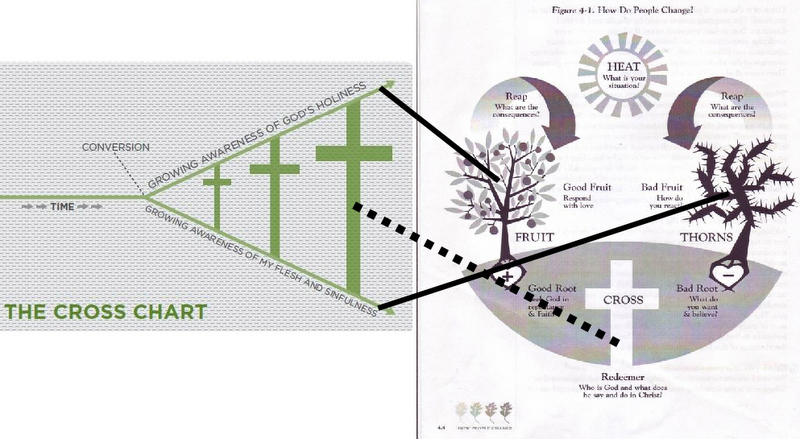
This is the cross story. See the illustration below. This is a contemporary depiction from that camp—this is their assessment:

Anything else at all that gives any credit to humanity—Christian or non-Christian is the “glory story.” That would be our glory specifically, and not Christ’s. To the degree that humanity is considered, the glory of Christ is “ECLIPSED.” This is the theses of a book written by John MacArthur associate Rick Holland: Uneclipsing The Son. Everything is perceived as speaking through one of these two perspectives. ANYTHING coming from what is perceived as the “glory story” is summarily dismissed. Be sure of it: this is how Calvinists think. This is their worldview.
In one of the former Resolved Conferences sponsored by John MacArthur and Holland, in one of his messages, Holland extols a letter written to Puritan Christopher Love by his wife as he awaited execution. Holland forgot to mention to those listening that Love was executed for espionage against the English government while letting the audience assume he was executed for loftier spiritual-like reasons. The following is excerpts from the letter:
O that the Lord would keep thee from having one troubled thought for thy relations. I desire freely to give thee up into thy Father’s hands, and not only look upon it as a crown of glory for thee to die for Christ, but as an honor to me that I should have a husband to leave for Christ…. I dare not speak to thee, nor have a thought within my own heart of my own unspeakable loss, but wholly keep my eye fixed upon thy inexpressible and inconceivable gain. Thou leavest but a sinful, mortal wife to be everlastingly married to the Lord of glory…. Thou dost but leave earth for heaven and changest a prison for a palace. And if natural affections should begin to arise, I hope that the spirit of grace that is within thee will quell them, knowing that all things here below are but dung and dross in comparison of those things that are above. I know thou keepest thine eye fixed on the hope of glory, which makes thy feet trample on the loss of earth.
Justice? That implies that humanity has some sort of value. That implies that life itself has some sort of value. That implies that humanity should be protected through threat of punishment. That’s the glory story. Therefore, Calvin stated the following:
Those who, as in the presence of God, inquire seriously into the true standard of righteousness, will certainly find that all the works of men, if estimated by their own worth, are nothing but vileness and pollution, that what is commonly deemed justice is with God mere iniquity; what is deemed integrity is pollution; what is deemed glory is ignominy (CI 3.12.4).
Death by Biblical Counseling
The church must face up to a sobering reality in our day. The vast majority of biblical counseling that goes on in our day is based on this construct—you will be counseled from the perspective of the cross story, and anything that smacks of the glory story will be snubbed. You are not a victim. There is no such thing as a victim. Christ was the only true victim in all of history. Don’t misunderstand: the problem of “victim mentality” is not even on the radar screen—they have removed the word “victim” from their metaphysical dictionary. “Victim” is part of the glory story; Christ as the only victim is the cross story. I am not a victim. That’s impossible because my sin nailed Christ to the cross. Thank you oh Lord that I was raped. Thank you for this opportunity to suffer for you. Thank you for the strength to forgive the one who raped me in the same way you forgave me. What a wonderful opportunity to show forth your gospel!
Hence, when the leaders of a Reformed church came to inform parents that a young man in that church had molested their toddler, this was the opening statement:
Today, we have before us an opportunity to forgive.
The parents were then counseled to not contact the authorities. Those who do are often brought up on church discipline. Justice necessarily implies victim. Victim necessarily implies worth. All three are conspirators with the glory story. And be not deceived: this is the logic that drives Reformed organizations that are supposed to be mediators in the church; specifically, Peacemaker Ministries and G.R.A.C.E. A major player in the Biblical Counseling Movement is Paul David Tripp. In 2006, he wrote a book that articulates the horizontal application of Luther’s theology of the cross: “How people Change.” Of course, the title is a lie; if he really believed people change, that would be the glory story. Notice also that it is, “How People Change” and not, “How Christians Change.” That’s because this bunch see no difference in the transforming power of the new birth and ordinary Christ-rejecting people.
In the book, Tripp, like all who propagate Luther’s theology of the cross, posits the Bible as a “big picture” narrative of our redemptive life. The Bible is a mere tool for one thing only: leading us more and more into the cross story and away from the glory story. This is accomplished by using the Bible to enter into the cross narrative and thereby seeing our preordained part in the “big picture” narrative of redemptive history. Though Tripp is not forthright about it in the book, this is known as the Redemptive Historical Hermeneutic. By seeing our life through the cross story, we are empowered to live life for God’s glory. This is done by seeing ALL circumstances in life (Heat) as preordained in order to show our sinfulness (Thorns) and God’s goodness (Fruit) for the purposes of having a deeper understanding of both resulting in spiritual wellbeing. In other words, all of life’s circumstances are designed to give us a deeper understanding of the cross story: God’s holiness, and our sinfulness. I have taken his primary visual illustration from the book and drawn lines to the cross story illustration to demonstrate the relationship (click on image to enlarge):
Understanding this lends insight to Tripp citations on the Peacekeepers Ministries website:
Paul Trip wrote a great post over at The Gospel Coalition blog all about the need for pastors to pursue a culture of forgiveness in their ministry. Pastors (and anyone serving Christ) have a choice:
“You can choose for disappointment to become distance, for affection to become dislike, and for a ministry partnership to morph into a search for an escape. You can taste the sad harvest of relational détente that so many church staffs live in, or you can plant better seeds and celebrate a much better harvest. The harvest of forgiveness, rooted in God’s forgiveness of you, is the kind of ministry relationship everyone wants.”
Then he describes three ways forgiveness can shape your ministry. I’ve listed them, but you can read how he explains them in detail.
“1. Forgiveness stimulates appreciation and affection.
2. Forgiveness produces patience.
3. Forgiveness is the fertile soil in which unity in relationships grows.”
He closes with this exhortation:
“So we learn to make war, but no longer with one another. Together we battle the one Enemy who is after us and our ministries. As we do this, we all become thankful that grace has freed us from the war with one another that we used to be so good at making.”
And concerning another author, they also stated:
Last week, Steve Cornell at The Gospel Coalition blog posted some really great insight into the difference between forgiveness and reconciliation. They also offered up some excellent and biblically sound steps in dealing with a situation where an offending party is hesitant to reconcile.
Here he summarizes a key distinction:
“It’s possible to forgive someone without offering immediate reconciliation. It’s possible for forgiveness to occur in the context of one’s relationship with God apart from contact with her offender. But reconciliation is focused on restoring broken relationships. And where trust is deeply broken, restoration is a process—sometimes, a lengthy one”…. His ten guidelines for those hesitant to reconcile are rooted in scripture and, I think, incredibly helpful.
1. Be honest about your motives.
2. Be humble in your attitude.
3. Be prayerful about the one who hurt you.
4. Be willing to admit ways you might have contributed to the problem.
5. Be honest with the offender.
6. Be objective about your hesitancy.
7. Be clear about the guidelines for restoration.
8. Be alert to Satan’s schemes.
9. Be mindful of God’s control.
10. Be realistic about the process.
Notice the overall blurring of distinction between the offended and offender with the subject of forgiveness.
The Cross-centered Anti-justice Pandemic is No longer Exclusively a Reformed Thing
Apart from Calvinism, the redemptive historical cross-centered approach is crossing denominational lines en masse. We at TANC see doctrines that were born of Luther’s theology of the cross in non-Reformed circles constantly; specifically, heart theology (deep repentance), exclusive interpretation of the Scriptures through a redemptive prism, Gospel Sanctification, and John Piper’s Christian hedonism. And we also see the same results. It is not beyond the pale for a pastor who has raped a parishioner to be the one counseling the victim sinner. You know, the “sinner saved by grace.”
God is a God of justice, and throughout the Scriptures He demands that we be people of justice. He demands that we come to the defense of the victim. I close with fitting words from church historian John Immel:
And this is the challenge. This is the challenge that I have as a man who is passionate about thinking: to inspire people to engage in complex ideas that drive tyranny. So here’s my challenge to those who are listening.
Do not be seduced into believing that righteousness is retreat from the world.
Do not be seduced into believing that spirituality is defined by weakness and that timid caution for fear of committing potential error is a reason to be quiet.
Do not be intimidated by vague, hazy threats of failure.
Do not let yourself believe that faith is a license to irrationality. I’m going to say that again to you. This is good. Do not let yourself believe that faith is a license to irrationality.
Do not mistake the simple nature of God’s love for a justification for simple-mindedness.
Do not deceive yourself with the polite notion that you are above the fray, that your right to believe is sufficient to the cause of righteousness. There is no more stunning conceit.
Do not pretend that your unwillingness to argue is the validation of truth.
Know this: Virtue in a vacuum is like the proverbial sound in the forest–irrelevant without a witness. Character is no private deed. To retreat is nothing more than a man closing his eyes and shutting his mouth to injustice.
Virtues are not estimates to be lofted gently against evil.
Virtues are not to be withheld from view in the name of grace.
Virtues are not to be politely swallowed in humble realization that we are all just sinners anyway.
Love is not a moral blank check against the endless tide of indulgent action.
Love is not blind to the cause and effect of reality.
Love is not indifference to plunder and injustice and servitude.
The time is now, you men of private virtue, to emerge from your fortress of solitude and demonstrate that you are worthy of a life that bears your name. The time is now, you men of private virtue, to answer Mick Jagger and all the nihilists that insist we are living on the edge and we cannot help but fall. It is time for you men of private virtue to take up the cause of human existence and think.
~TANC 2012 Conference on Gospel Discernment and Spiritual Tyranny: John Immel; session 1, “Assumptions + Logic = Action.”
paul
The 5 Solas: Worshiping Under the Banners of Heresy

“If justification is completely finished, and NOTHING that we do in sanctification can change that, what do we need an elitist priesthood for? That question strikes fear in the heart of every Calvinist.”
In another article on the five solas, we looked at sola fide, or faith alone and examined why that is false soteriology. In short, it denies the new birth and redefines it as a mere perpetual death and rebirth experience only. Because the Christian life is merely an extension of the finished work of justification, which is supposedly not finished, one must live their Christian life by faith alone in order to get from beginning justification to final justification.
It also makes law the measure of justification. The Christian life becomes an endeavor to live by sola fide in a way that results in the perfect obedience of Christ being applied to our lives in place of anything that we would do. Hence, if sanctification is not done TO US by Christ instead of us DOING the Christian life—it’s works salvation. We also looked at how this cuts off the believer from the true practice of love.
But, when justification is not a finished work, and sanctification is the progression of justification, EVERYTHING is a work. Even if you are doing nothing so that you are supposedly not involved in finishing justification, you are in fact assuming a role in the process by making sure that you don’t do anything, or closely adhere to prescribed ways of doing things that qualify as doing nothing.
This is how Reformed heresy deceives based on assumption. It is assumed that sola fide concerns justification alone, but it doesn’t. In the same way, it is assumed that solus Christus (Christ Alone) means believing in no other man as a mediator between God and you for salvation. No, solus Christus means literally Christ alone as opposed to the other Trinity members. It also means Christ alone as opposed to anything we would do in what they call “progressive sanctification” which is really progressive justification. This is also known as Christ for us or Christ 100% for us.
It begins with the idea that Christ’s role in salvation was two-fold: he died for our justification, and lived in perfect adherence to the law so that His obedience could then be applied to our Christian lives by faith alone, or sola fide. Therefore, the “believer” must continually revisit the “saving works of Christ in all of the Bible” (sola scriptura) in order to keep themselves saved. It should be called Bachman Turner Overdrive soteriology because of their famous song “Taking Care of Business.” The main refrain is, “I love to work at nothing all day.” In this case, the Reformed work at nothing in order to keep yourself saved.
This is where we get into the issue of Trinitarianism leading to a role for the believer in sanctification other than sola fide. If it is the Father’s righteousness imputed to the believer apart from a perfect fulfillment of the law by Christ, that naturally implies a role for the believer in sanctification. That’s a problem for Reformed soteriology on many levels.
If the Holy Spirit is merely a manifestation of what Christ does, that excludes the enablement of believers to participate in kingdom living apart from the finished work of justification. If justification is completely finished, and NOTHING that we do in sanctification can change that, what do we need an elitist priesthood for? That question strikes fear in the heart of every Calvinist.
Protestantism and Catholicism BOTH see justification (salvation) as a PROCESS. BOTH believe in a beginning justification, progressive justification, and a final justification. BOTH are false gospels—the only disagreement is in the details about how you get from point A to point B, and the disagreement is primarily Trinitarian. Catholics traditionally believe that God does a work inside of the believer to help them finish their justification with the help of the Mother Church. Authentic Protestantism believes that NO work is done within the believer because that enables them to participate in the finishing of justification. True classical Protestantism believes that Christians do not DO anything; they only EXPERIENCE the salvific works of Christ—Catholics believe that you actually do something other than believe. It is not sola fide.
Therefore, in regard to Catholicism, they replace a perfect keeping of the law with a set of rituals to make participation in finishing justification plausible. However, remember, since it is the finishing of justification, it requires the same necessity of returning to the same gospel that saved us; viz, the Mass and absolution because sinning as a Christian is no different than sinning as an unbeliever; in both cases, the “Christian” is still under law and not under grace.
In regard to Protestantism, they cry foul because the Catholics distort the law while they uphold the law by making it the standard for justification, but the dirty little secret is that Jesus keeps the law for us via sola fide. This cuts off love from sanctification. One removes the law from sanctification by ritual; the other removes the law from sanctification by making it the sole responsibility of Christ because the perfect keeping of it finishes justification. In both cases, it is not the righteousness of God APART from the law FOR justification. One is a co-laboring with the church to finish justification, the other is “Christ 100% for us” to finish justification.
So, solus Christus means literally solus Christus…for justification and sanctification both because sanctification is really progressive justification; it isn’t Christ plus us, and for that matter, not even Christ plus the other members of the Trinity. One of the foremost authorities and proponents of Reformed soteriology stated it this way:
Luther and Calvin did not simply stress Christ alone over against the Roman Catholic emphasis on works-righteousness. The Reformers also stressed Christ alone over against all—be they Roman Catholics or Protestants—who would point to the inside of the believer as the place where justifying righteousness dwells. Christ alone means literally Christ alone, and not the believer. And for that matter, it does not even mean any other member of the Trinity! (Geoffrey Paxton: The Shaking of Adventism: p. 41).
For all practical purposes, solus Christus is the controversial modulist view of the Trinty. This is the idea that one of the Trinity members is the one, true God, and the other two members are only manifestations of the one true God. This not only makes realm manifestations that are ONLY experienced possible, but it also makes the separation of justification and sanctification impossible. In other words, a modulist view of the Trinity is the necessary companion of progressive justification. This point is reflected in statements by leading Calvinists of our day like John MacArthur Jr.:
As Christians we have one message to declare: “Jesus Christ, and Him crucified” (1 Corinthians 2:2). “For we do not preach ourselves but Christ Jesus as Lord, and ourselves as your slaves for Jesus’ sake” (2 Corinthians 4:5; cf. 1 Corinthians 2:2; Galatians 6:14).
Rick Holland understands that truth. This book is an insightful, convicting reminder that no one and nothing other than Christ deserves to be the central theme of the tidings we as Christians proclaim—not only to one another and to the world, but also in the private meditations of our own hearts.
Christ is the perfect image of God (Hebrews 1); the theme of Scripture (Luke 24); the author of salvation (Hebrews 12:2); the one proper object of saving faith (Romans 10:9-10); and the goal of our sanctification (Romans 8:2). No wonder Scripture describes the amazing growth-strategy of the early church in these terms: “They ceased not to teach and preach Jesus Christ” (Acts 5:42). That is the only blueprint for church ministry that has any sanction from Scripture.
The pastor who makes anything or anyone other than Christ the focus of his message is actually hindering the sanctification of the flock. Second Corinthians 3:18 describes in simple terms how God conforms us to the image of His Son: “And we all, with unveiled face, beholding the glory of the Lord, are being transformed into the same image from one degree of glory to another” (emphasis added). We don’t “see” Christ literally and physically, of course (1 Peter 1:8). But His glory is on full display in the Word of God, and it is every minister’s duty to make that glory known above all other subjects.
As believers gaze at the glory of their Lord—looking clearly, enduringly, and deeply into the majesty of His person and work—true sanctification takes place as the Holy Spirit takes that believer whose heart is fixed on Christ and elevates him from one level of glory to the next. This is the ever-increasing reality of progressive sanctification; it happens not because believers wish it or want it or work for it in their own energy, but because the glory of Christ captures their hearts and minds. We are transformed by that glory and we begin to reflect it more and more brightly the more clearly we see it. That’s why the true heart and soul of every pastor’s duty is pointing the flock to Christ, the Great Shepherd.
Notice in this statement that Christians merely “REFLECT” the glory of Christ as a result of meditating on His personhood and works. Notice also that any emphasis at all on anything or ANYBODY detracts from sanctification. This goes hand in hand with MacArthur’s rejection of eternal sonship as well. A debate about that issue is not the point here, the point is why they take this view of the Trinity. The point is to show the relationship between this view and their Catholicism-like progressive justification.
paul
As Predicted by PPT: Mike Fabarez and Compass Bible Church Chooses New Calvinism over Truth
 Mike Fabarez has caved-in from the pressure to be like everyone else. He has sold out and prostituted himself in the worst way possible: his coronation into the New Calvinist cartel will be at a conference that is CJ Mahaney’s return to the New Calvinist limelight. Heretic Steve Lawson and Neo-Gnostic Rick Holland have decided to expend/risk political influence by standing with Mahaney at the same conference: Anchored 2014.
Undoubtedly, because of his former cause of “Aggressive Sanctification,” Fabarez has been drafted to go along with Jerry Wragg and Kevin DeYoung as the, We believe that believers have a roll in sanctification other than faith alone (wink wink) contingency of the New Calvinist cartel. Like Wragg, Tullian Tchividjian is the target for Fabarez as well because Tchividjian lacks nuance in teaching the exact same thing that they all believe: progressive justification. However, Fabarez was against Tchividjian before he was for him.
The Neo-Calvinists are so utterly vile that one is endeared to Tchividjian for his honesty about what he believes. This also points to his respect for others in regard to not teaching nuanced “truth” that the totally depraved herd is, “not ready for yet.” This also points to his bravery in, The truth is the truth whether folks are ready for it or not so I am going to teach what Luther believed plainly and let the chips fall where they may. Now see, that’s commendable. Furthermore, it would appear that Tullian refuses to hang-out with doctrinal vagrants that get caught in criminal acts and are unrepentant. You have to respect that.
Following is the article that predicted the apostasy that has unfolded:

 Paul's Passing Thoughts
leave a comment