Know Your Cuts of Calvinism
1. Total Depravity: Pertains to the saints also.
2. Justification by Faith Alone: Pertains to sanctification also.
3. Mortification and Vivification: Perpetual death and rebirth for living by faith alone in sanctification to maintain justification. The reliving of our baptism “again and again.”
4. Double Imputation: Christ’s passive obedience to the cross for justification, and His active obedience as a substitution for our obedience in sanctification.
5. Deep Repentance (aka Intelligent Repentance): Seeks the death of mortification in re-experiencing our new birth.
6. New Obedience (aka New Fruit): The experience of Christ’s active obedience in sanctification (vivification).
7. The New Birth: Perpetual mortification and vivification.
8. The Objective Gospel: All reality is interpreted through the redemptive works of Christ.
9. Christ for Us: Christ died for our justification, and lived a perfect life for our sanctification.
10. The Imperative Command is Grounded in the Indicative Event: Biblical commands show forth what Christ has accomplished for us and what we are unable to do in sanctification. Works are experienced only as they flow from the indicative event of the gospel.
11. Neo-Nomianism (New Law, aka New Legalism): The belief that we can please God by obeying the law in sanctification.
12. Progressive Sanctification: The progression of justification to glorification.
13. Progressive Imputation: Whatever is seen in the gospel narrative and meditated upon is imputed to our sanctification, whether mortification or vivification.
14. The Golden Chain of Salvation: See cut 12.
15. Good Repentance: Repenting of good works.
16. In-Lawed in Christ: Christ fulfilled the law perfectly and imputed it to our sanctification.
17. Redemptive Historical Hermeneutics (the Christocentric Hermeneutic, aka the Apostle’s Hermeneutic): The Bible as historical narrative for the sole purpose of showing forth Christ’s redemptive works.
18. Faith: A neutral entity within us with no intrinsic worth that is able to reflect the object of its focus outside of us. The object of focus can be experienced within, but remains outside of us.
19. The Heart: The residence of evil desires and faith. It can be reoriented (the “reorientation of the heart” or “reorientation of desires”) to reflect Christ via mortification and vivification.
20. Flesh: The world realm where evil is manifested and experienced.
21. Spirit: The Spirit realm where the imputed works of Christ are manifested and experienced (not applied through our actions).
22. Christian Hedonism: Seeks to experience the joy of vivification.
23. Obedience of Faith: New Obedience.
24. Christ in Us: “By faith,” and faith only has substance and reality to the degree of the object it is placed in; i.e., Christ outside of us.
25. Vital Union: Makes experiencing the gospel possible. Makes mortification and vivification possible.
26. Eclipsing the Son (aka the Emphasis Hermeneutic): Focusing on anything other than Christ. Anything that is not seen through a Christocentric prism creates shadows that we live in. The obstacles that create the shadows may be truth, but they aren’t the “best truth.” “They may be good things, but not the best thing.”
27. Sabbath Rest: Sanctification. We are to “rest and feed” on Christ for our Christian life. The primary day this is done is Sunday. Through preaching and the sacraments we “kill” (mortification, or the contemplation of our evil and misery) resulting in vivification throughout the rest of the week.
28. The Subjective Power of the Gospel: The manifestation of the gospel that flows from gospel contemplationism. We never know for certain whether it is a result of our efforts or the Spirit’s work (although the Spirit’s work is always experienced by joy); hence, the power of the objective gospel is subjective (Heidelberg Disputation: Thesis 24).
29. Mortal Sin: Good works by the Christian not attended by fear that they may be of one’s own effort (HD 7).
30. Venial Sin: Good works by the Christian attended with fear (HD 7).
31. Power of the Keys (aka Protestant Absolution): Reformed elders have the authority to bind or loose sin on earth (Calvin Institutes 3.4.12).
32. Redemptive Church Discipline: In all cases to convert one to cuts 1-31. This redeems them to the only one, true faith. This can be a long process, and said person is not free to leave a given church until the elders bind or loose.
33. Preach the Gospel to Yourself: See cuts 1-32.
Another Purpose for Preaching the Gospel to Ourselves: Perpetual Death and Rebirth in Sanctification
 Here at PPT and TANC we like to learn new things, especially in regard to Calvinism and Reformed theology. Recently, we have discovered another purpose behind “preaching the gospel to ourselves every day.” The Reformed term for it is, mortification and vivification. What’s that? It is the perpetual subjective experience of death and rebirth in sanctification. As we use the Scriptures to gain a deeper and deeper understanding of our wickedness, we experience a mourning over our vile condition (death) resulting in joy (rebirth). This passive “subjective experience” enables us to live our Christian life by the same gospel that saved us. Who knew? Truly, in regard to creepiness, Calvinism is the gift that keeps giving and giving.
Of course, this approach is necessary so that we can continually live our Christian lives by faith alone because in Calvinism one is still under the law and in constant need of atoning and re-salvation. This perpetual death and rebirth imputes the perfect obedience of Christ to our justification in sanctification and the law is satisfied. It’s sanctification with two squirts of Hinduism.
We see the premise of this idea in Luther’s Heidelberg Disputation (Thesis 16, 17), and John Piper’s Christian Hedonism. Piper is adamant that joy is continually evidenced in a Christian’s life as proof of salvation. Right, because the perpetual baptism of death and resurrection must experience the exultation of resurrection and not just death. A melancholy Christian is a half gospel that is only death; resurrection must follow for the perpetual cycle to be valid. Michael Horton sates it this way in his book on systematic theology:
Progressive sanctification has two parts: mortification and vivification, “both of which happen to us by participation in Christ,” as Calvin notes….Subjectively experiencing this definitive reality signified and sealed to us in our baptism requires a daily dying and rising. That is what the Reformers meant by sanctification as a living out of our baptism….and this conversion yields lifelong mortification and vivification “again and again.” Yet it is critical to remind ourselves that in this daily human act of turning, we are always turning not only from sin but toward Christ rather than toward our own experience or piety (pp. 661-663 [Calvin Inst. 3.3.2-9]).
Stay tuned as we gleefully serve you with stuff that is truly stranger than science itself.
paul
TANC 2013: John Immel; The History of Western Philosophy and Its Societal Impact on the Church

Video link for John Immel’s first session.
Tip: Open two tabs for this post; one for the video link and one for the illustrations. Click on “back” arrow to go back to list of illustrations from enlargement.
Click on Images to Enlarge….
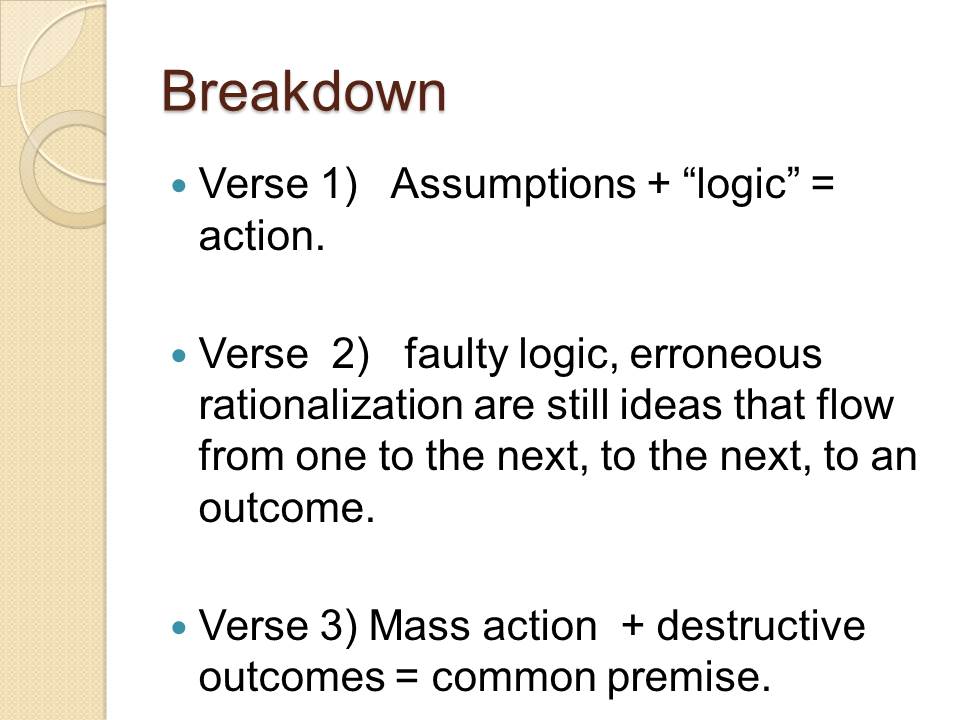
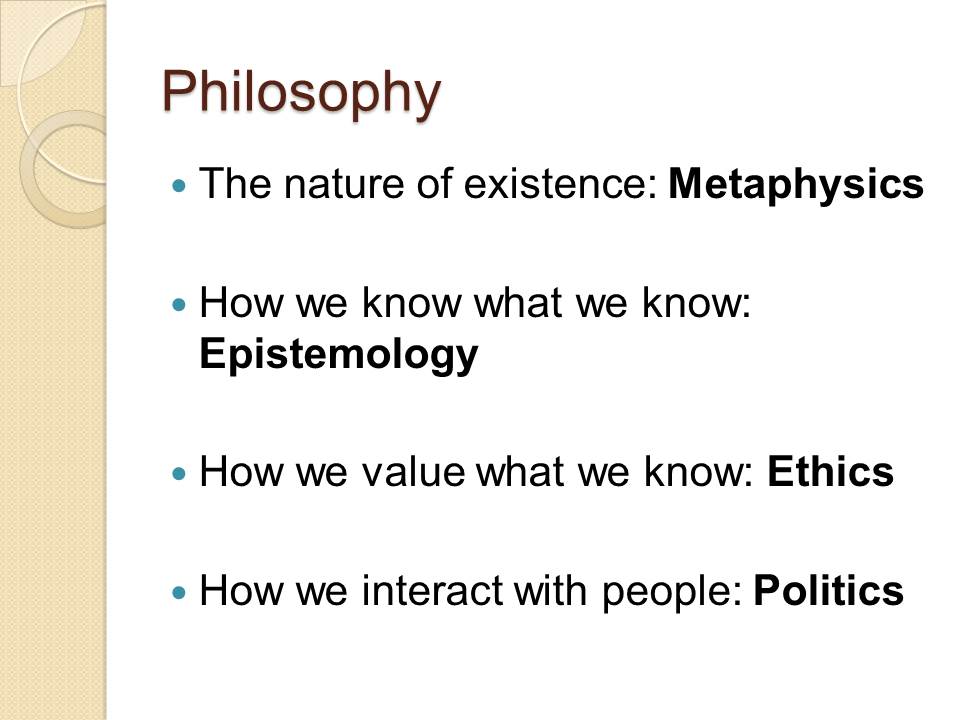
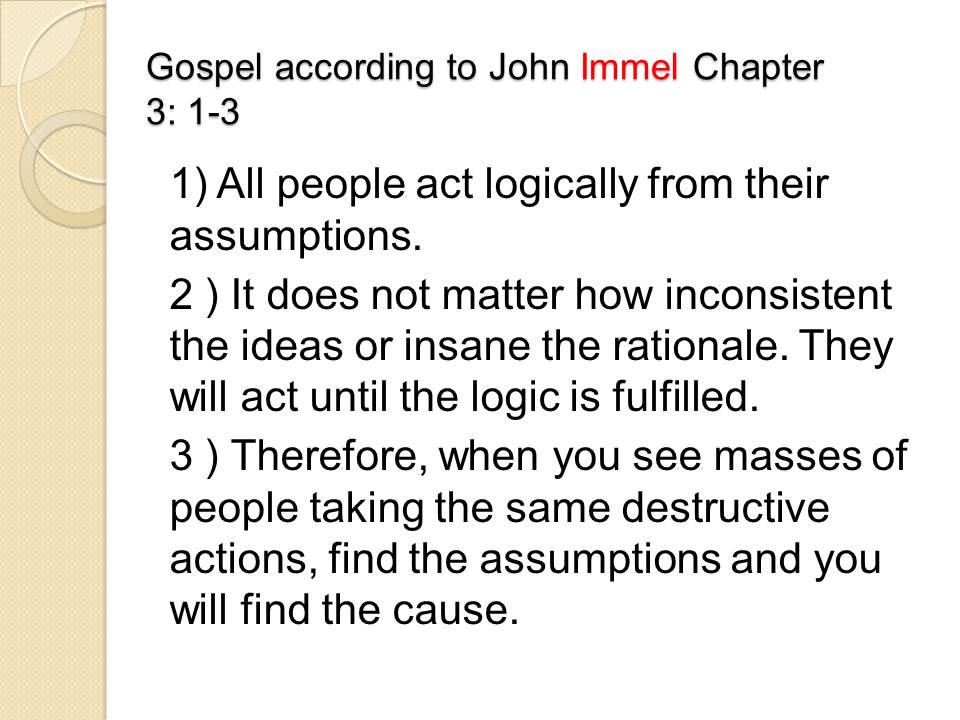
John Immel session 2, part 1 video link.
John Immel session 2, part 2 video link.
John Immel session 2, part 3 video link.
John Immel session 2, part 4 video link.

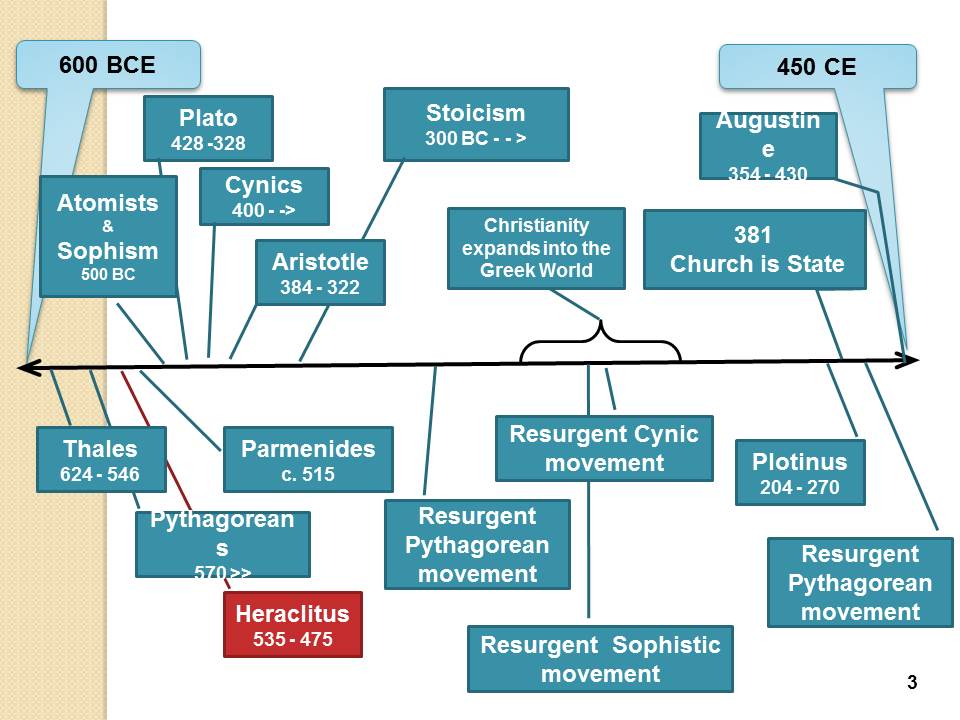
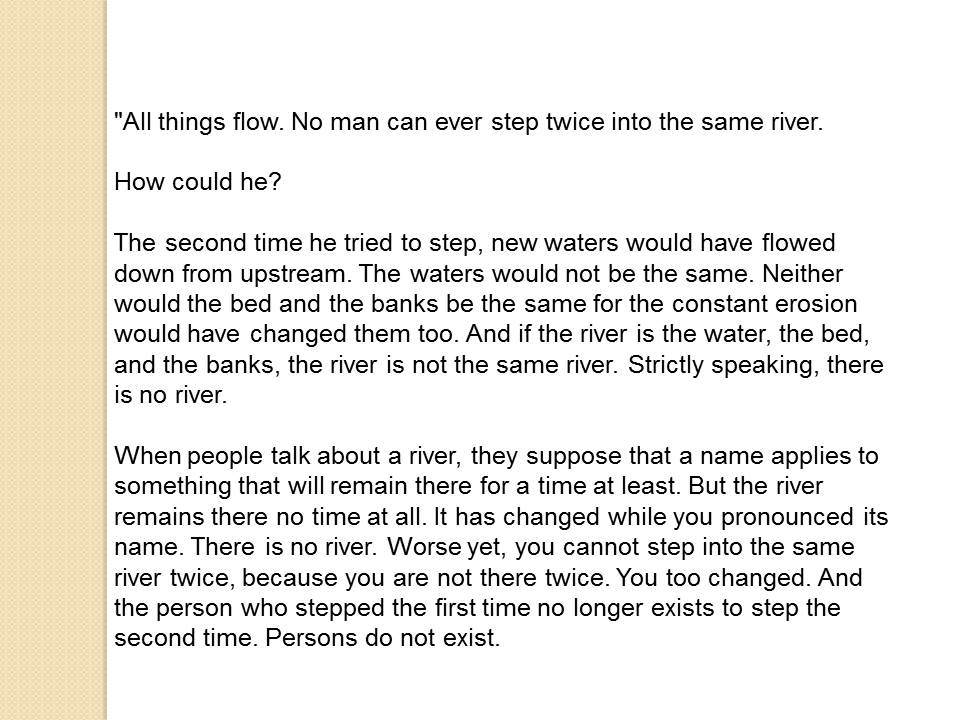
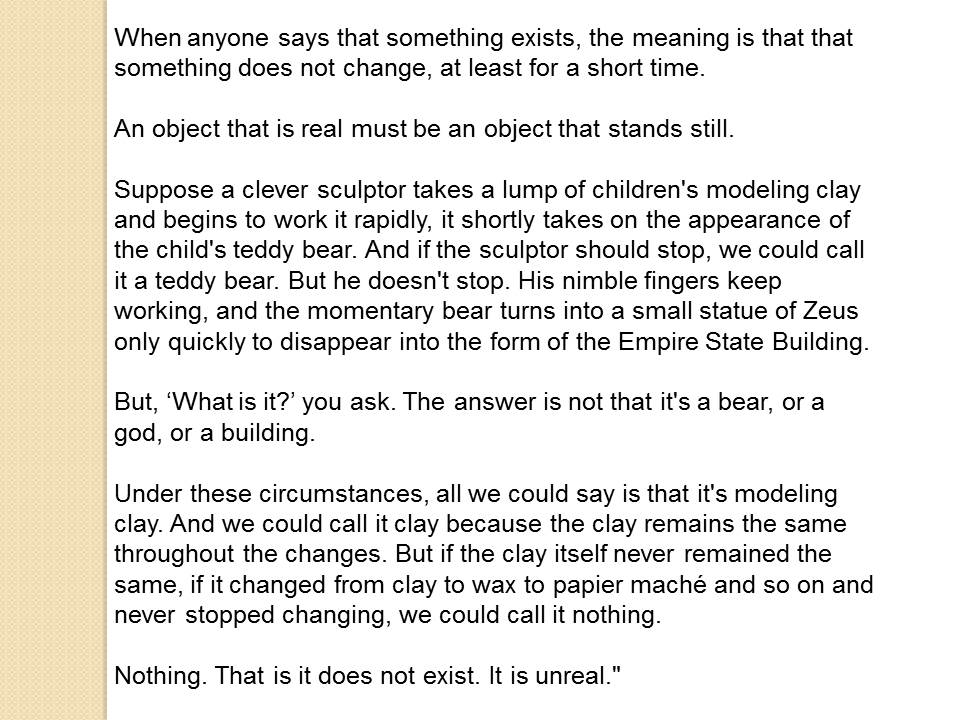
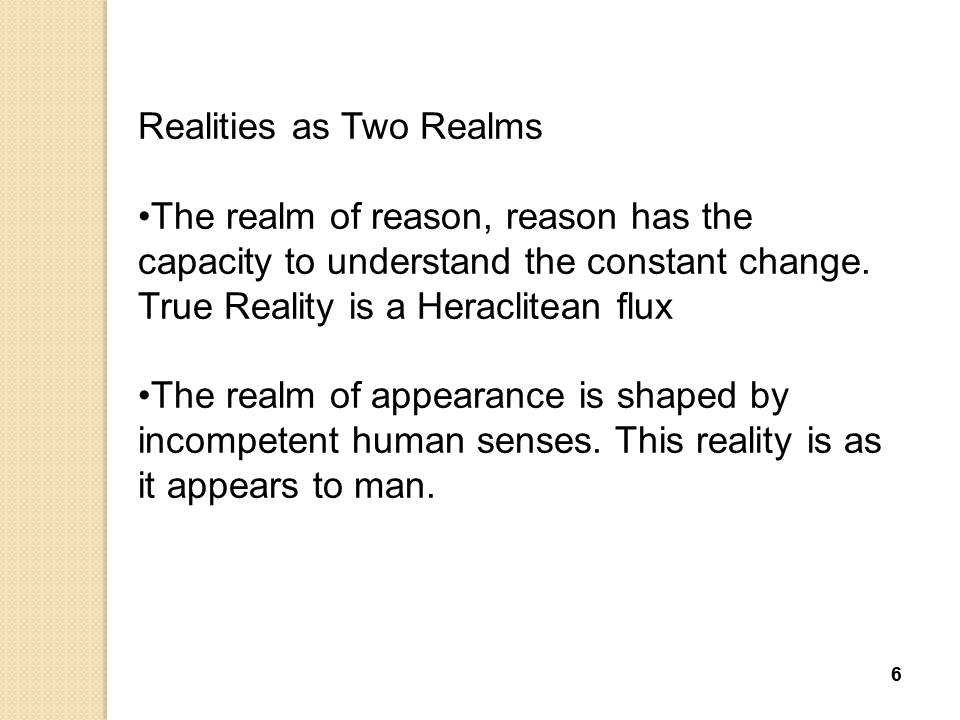
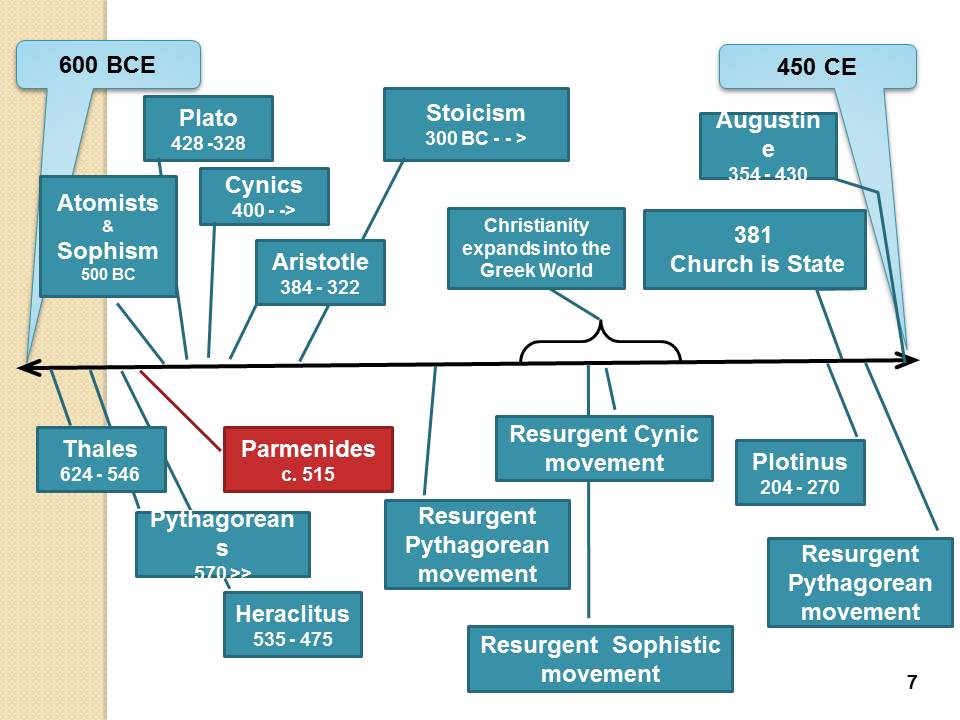

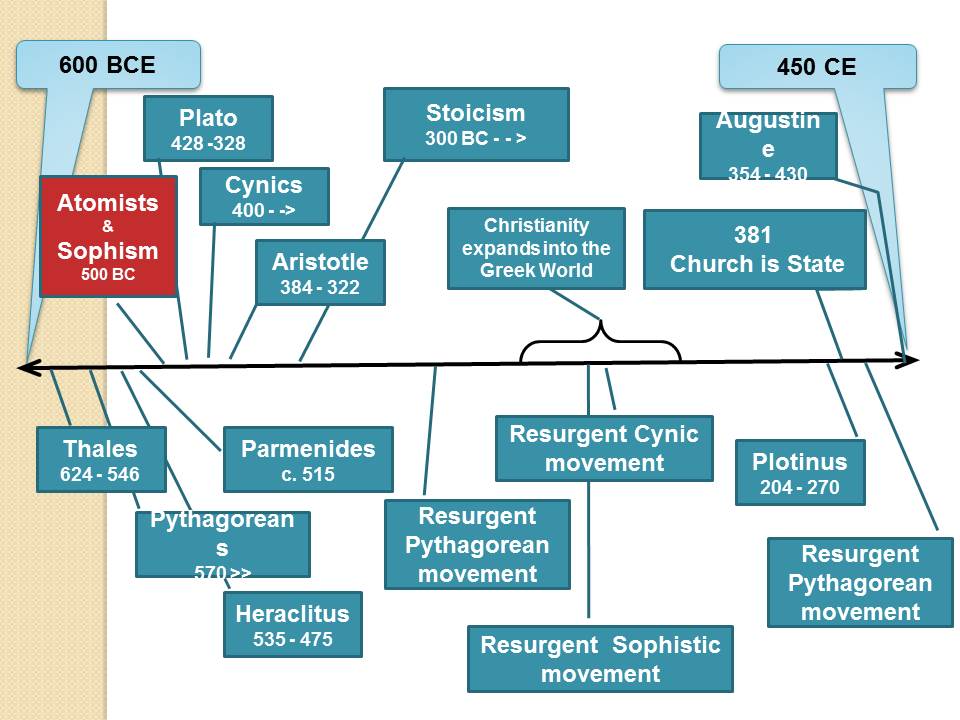
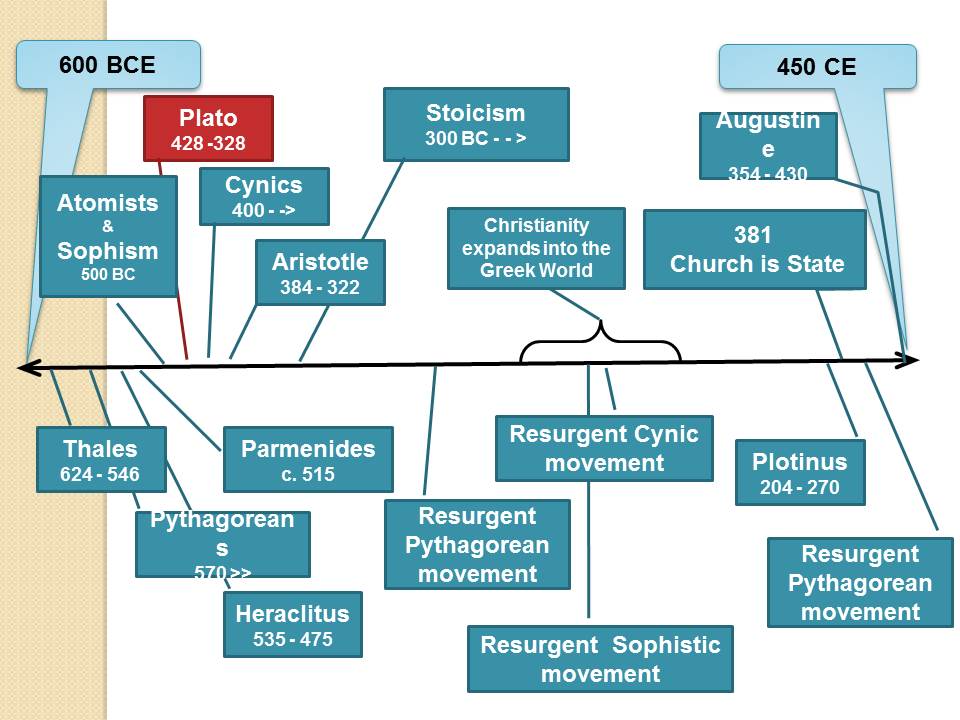
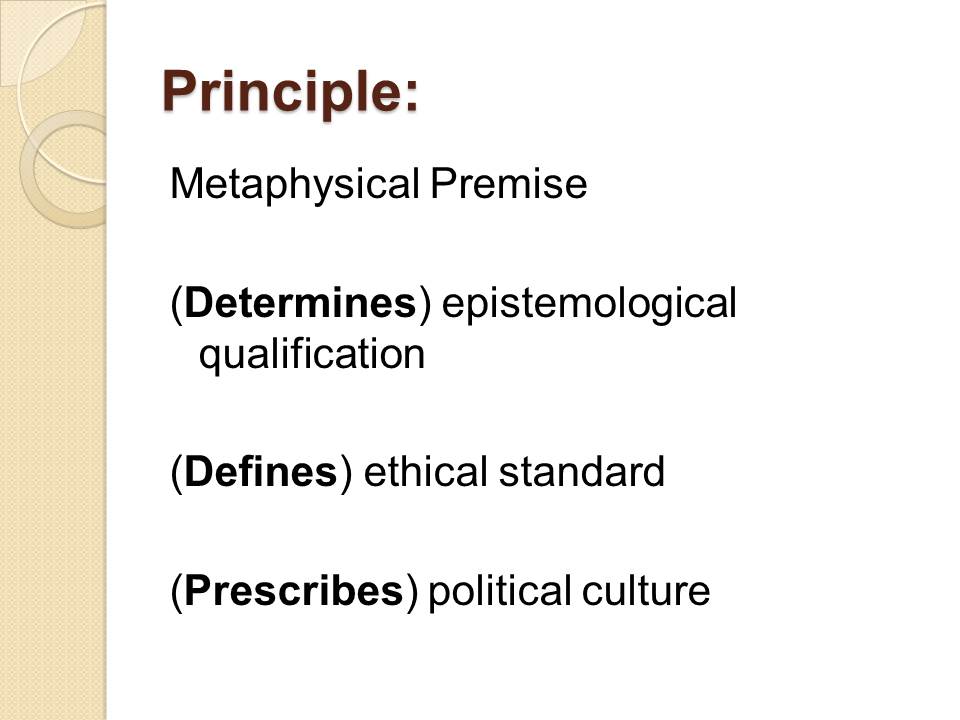
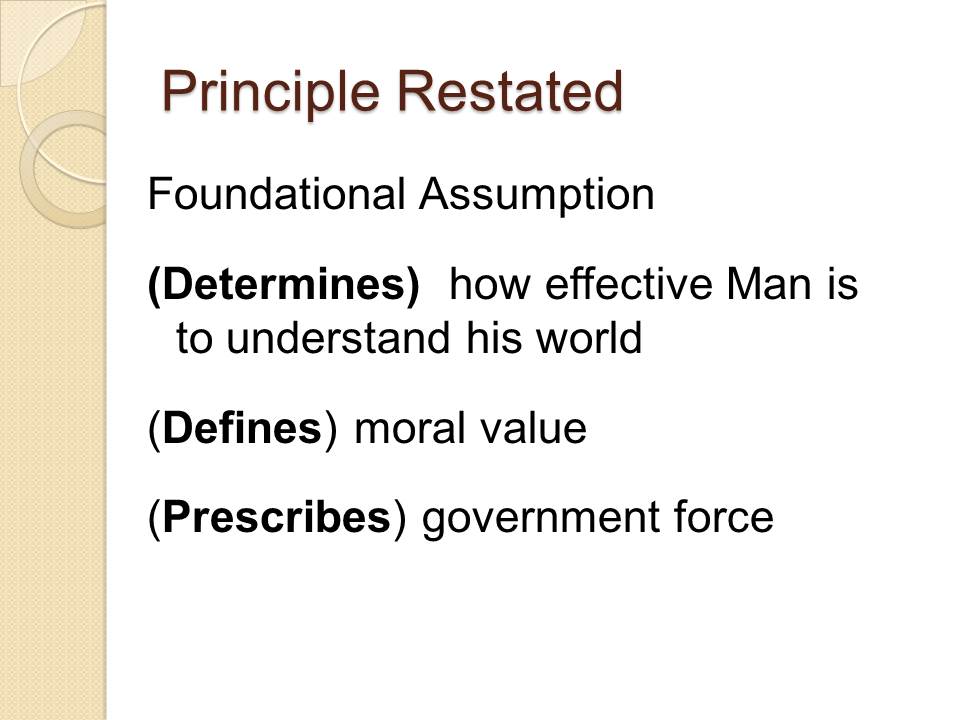
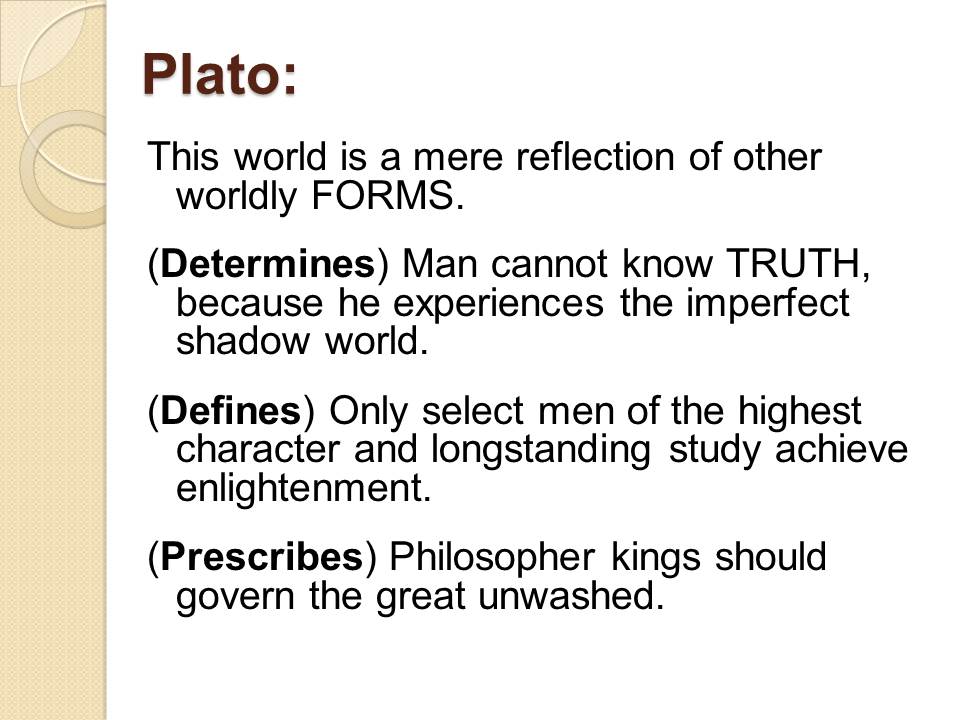

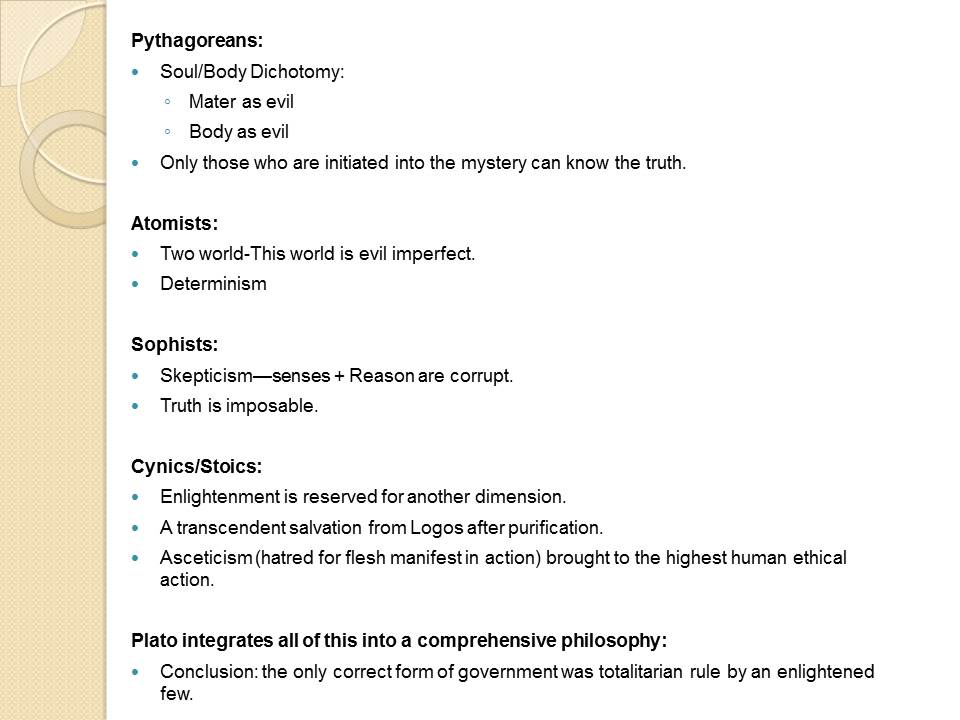
John Immel session 3 video link.


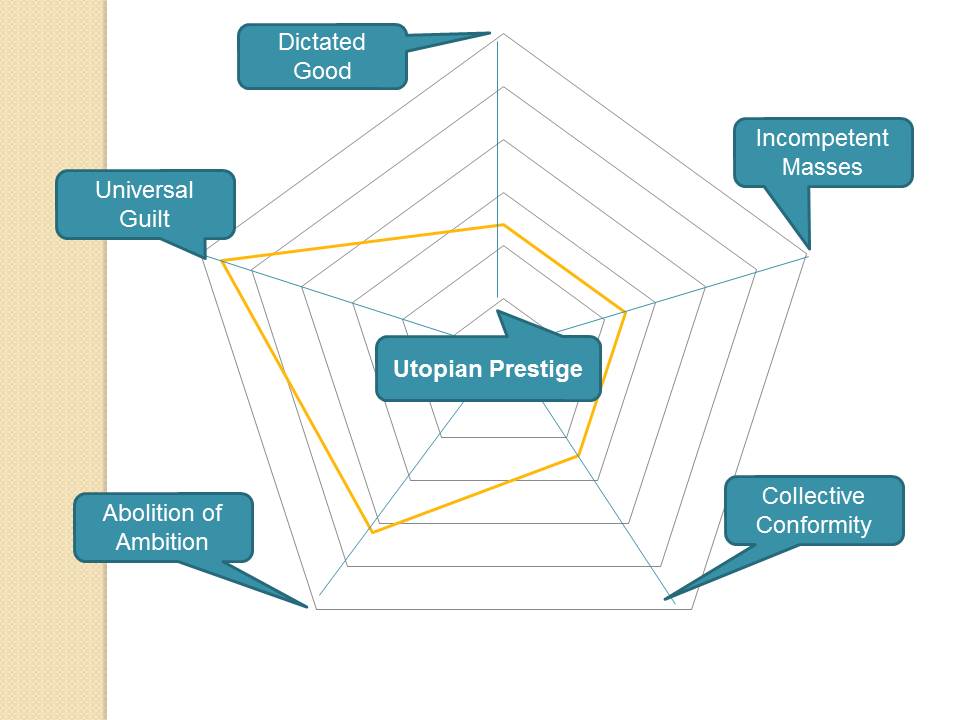
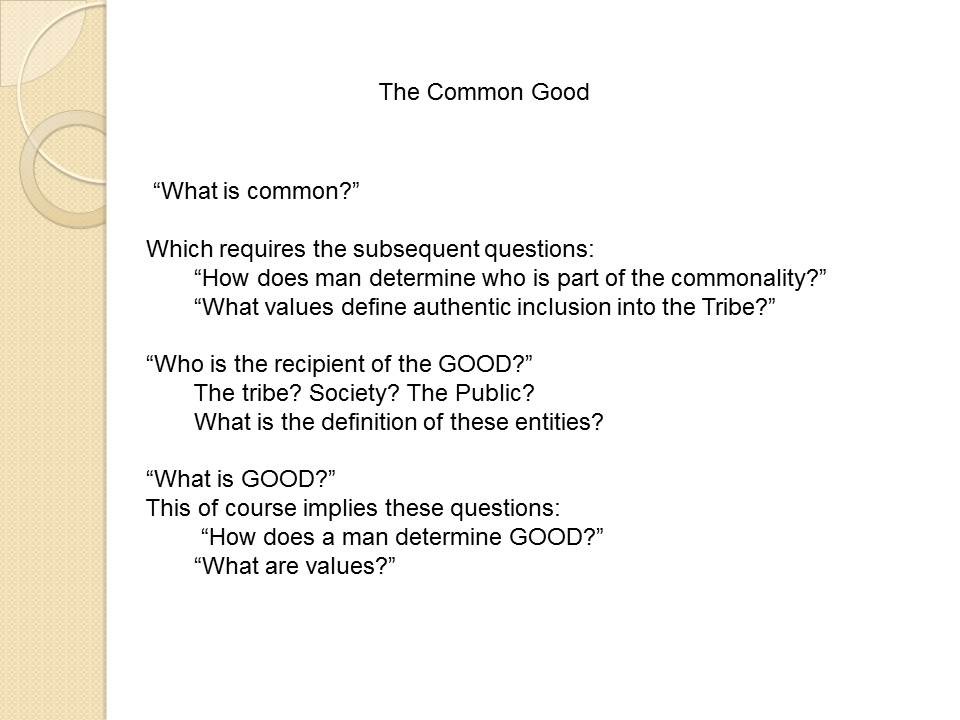
Some Good “Right Hand” Information on Calvinism’s Death Knell
 “The Reformers take their place in human history as those who throw the gauntlet down at Christ’s feet when He warned to not take away or add to the word of God. Nothing affords the ability to do that like a meta-narrative. There has never been a more formidable onslaught against the truth of God than the Reformation’s meta-narrative.”
Calvinist’s don’t often know their right hand from their left hand because Reformed theology communicates from an entirely different metaphysical construct than the norm. Calvinists live in a world that is comfortable with contradictions because Calvinists reject literal grammaticism as a tool for interpreting reality. Calvinists have replaced literal grammaticism with meta-narrative, and the central theme of the meta-narrative (reality as narrative) is “Christocentricity.” Luther laid all of the foundations for this in his Heidelberg Disputation. This is a really, really big deal because Christians are people of The Book. Christianity lives or dies based upon what method interprets the Bible. If we can’t properly interpret truth, there is NO abundant life.
This is my primary theme at this year’s TANC Conference. Christ called on us to interpret the Bible literally within a grammatical construct. Allegory, etc., are communication tools that aid us in understanding objective truth that is to be applied literally. We don’t apply elements of allegory (i.e., pluck out your eye or cut off your hand), but we do apply the literal applications. Christ gave us brains so that we can think for ourselves: “it would be better” should indicate the point Christ was making; God is extremely offended by sin.
Christ propagated grammaticism in no uncertain terms when He annihilated all arguments against a resurrection by pointing out the verb tense of “I am.” The exchange is well worth reading in the full context:
Matthew 22:23 – The same day Sadducees came to him, who say that there is no resurrection, and they asked him a question, 24 saying, “Teacher, Moses said, ‘If a man dies having no children, his brother must marry the widow and raise up offspring for his brother.’ 25 Now there were seven brothers among us. The first married and died, and having no offspring left his wife to his brother. 26 So too the second and third, down to the seventh. 27 After them all, the woman died. 28 In the resurrection, therefore, of the seven, whose wife will she be? For they all had her.”
29 But Jesus answered them, “You are wrong, because you know neither the Scriptures nor the power of God. 30 For in the resurrection they neither marry nor are given in marriage, but are like angels in heaven. 31 And as for the resurrection of the dead, have you not read what was said to you by God: 32 ‘I am the God of Abraham, and the God of Isaac, and the God of Jacob’? He is not God of the dead, but of the living.” 33 And when the crowd heard it, they were astonished at his teaching.
The Reformed method of interpretation is not that of Christ. The Reformers take their place in human history as those who throw the gauntlet down at Christ’s feet when He warned to not take away or add to the word of God. Nothing affords the ability to do that like a meta-narrative. There has never been a more formable onslaught against the truth of God than that of the Reformation’s meta-narrative. Hence, the Reformers of our day state that grammar is merely a “guardrail for communication” but actually “hinders” the Bible’s true meaning (propagated by John MacArthur confidant Rick Holland). Throughout the book How People Change, Paul David Tripp concurs that the Bible states many truths laterally, but to take those truths literally circumvents the “saving work of Christ” in the believer. As an aside, note also that Christians still need to be saved.
So, no wonder that contradictions abound within the Reformed community. The ONLY objectivity is the gospel narrative. But narratives are open to a plethora of interpretation. Instead, the apostle Paul called for the “one mind in Christ.”
The most notable contradiction is disagreement on double imputation. To effectively argue against double imputation is to drive a dagger through the heart of the Reformation. Because the Reformed definition of righteousness is a perfect keeping of the law to maintain our just standing, the idea that Christ’s perfect obedience was imputed to our sanctification (and continues to be on the basis of us living out our sanctification by faith alone) is efficacious to the Reformed gospel.
The meta-narrative is that Christ died for our justification and lived a perfect life for our sanctification so that we can secure our just standing by faith alone in sanctification. In contrast, the grammatical approach sees sanctification as totally separate from justification, and double imputation being: our sins imputed to Christ and God the Father’s righteousness being imputed to us. A two-way double imputation versus a one-way double imputation. In the latter, Christians remain totally depraved, in the former they are new creatures because they now bear God’s seed within them. Hence, they co-labor with God in sanctification completely separate from justification. In the latter, progressive justification is made possible by progressive imputation; in the former, all imputation is a finished work before the foundation of the world.
We inherited the fullness of the Godhead before creation; we appropriate its power in the present through obedience, and will be redeemed by God (when He comes to collect what belongs to Him) in our glorification.
Nevertheless, some in the Reformed camp lodge par excellent argumentation against Reformed double imputation; the right hand doesn’t know from the left. With all of the above said, I would like to present a right-handed apology against Reformed double imputation. In the classic tradition of orthodoxy, a Reformed term for academic truth repackaged for parishioner mantraism, the following articles are predicated on the opinions of men. Regardless, the quotes that argue against Reformed double imputation couldn’t be better stated. Without further ado, here is the list of links:
http://johngreenview.wordpress.com/2010/09/26/imputed-active-obedience-iao-a-must-or-a-misdirection/
Page with all links:

 Paul's Passing Thoughts
22 comments