How to Debate a Calvinist Made Easy
 The first thing one must remember in debating a Calvinist is the Calvinist protocol: set and create the framework for the argument in order to dictate a certain outcome. Calvinists will speak from a certain construct and communicate from that viewpoint only, usually without the opponent knowing what the construct is, but if the Calvinist stays within that framework, he/she will have an answer for everything and this will quickly confuse the opponent. Calvinists win the argument every time because opponents don’t understand their metaphysics and epistemology. But that is a discussion not needed here if you follow my directions carefully.
Do not discuss symptoms. You must distinguish symptoms from the core problem. Stay away from quotes that address other issues (symptoms), and issues such as the doctrine of election. Calvinism encompasses a mass of symptomatic issues. These are the tentacles of the octopus. Fighting an octopus one tentacle at a time will lead to a quick demise—stay focused on the head.
A debate doesn’t have to be limited to one visit, and you are not obligated to move on to other issues from a concern that is not answered. Let me repeat that: “you are not obligated to move on to other issues from a concern that is not answered.” And here are your three concerns:
1. Calvinism denies eternal security.
2. If you can lose your salvation, what do you have to do to keep it?
3. Calvinists don’t believe people change.
John Piper is the universally accepted elder statesman of New Calvinism. Use this short article to establish concerns one and two.
Concern three is the HOW we keep our salvation which answers concern number two. Since we have to live our Christian life the same way we were saved to maintain/keep our salvation, we must live by the same gospel that saved us. The mantra, “We must preach the gospel to ourselves every day” should speak for itself. We keep ourselves saved by staying at the foot of the cross which entails a perpetual need for the same forgiveness that saved us, and that can only be perpetually received by a perpetual reliance on the same gospel that saved us. If we believe we change for the better, the need for the same gospel that saved us is eradicated and we lose our salvation.
This is what is behind the “T” in TULIP (total depravity) which unbeknown to many also includes the saints. Hence, the following chart is universally accepted among the Reformed:

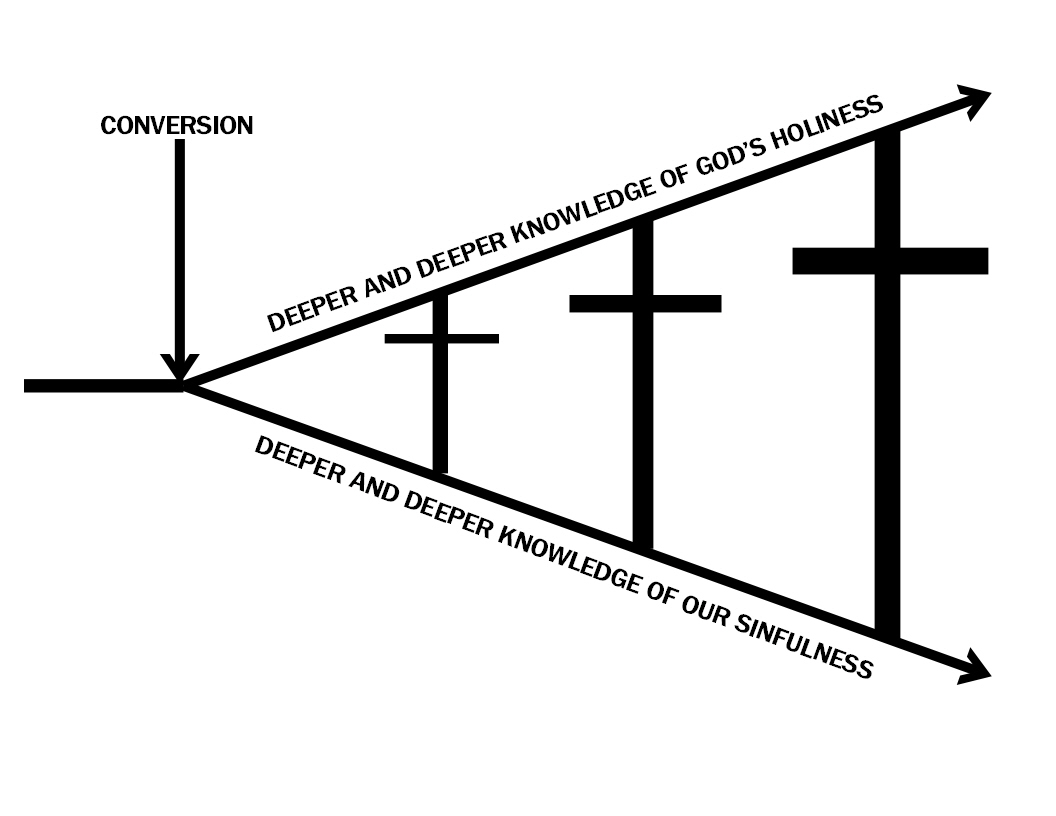
Notice that we don’t change, only the cross changes. Don’t get into what the cross represents in this illustration as that involves complex Reformed metaphysics. Stick with the point/concern, not symptoms. You are not the Calvinist—they are; therefore, you’re the one with the questions and it’s your agenda. “Living by the gospel” in order to stay saved entails focusing on our unchangeable evil verses God’s holiness and thereby perpetually recognizing our need for the gospel and continued salvation from our sins.
Relevant quotes:
“Where we land on these issues is perhaps the most significant factor in how we approach our own faith and practice and communicate it to the world. If not only the unregenerate but the regenerate are always dependent at every moment on the free grace of God disclosed in the gospel, then nothing can raise those who are spiritually dead or continually give life to Christ’s flock but the Spirit working through the gospel. When this happens (not just once, but every time we encounter the gospel afresh), the Spirit progressively transforms us into Christ’s image. Start with Christ (that is, the gospel) and you get sanctification in the bargain; begin with Christ and move on to something else, and you lose both” (Michael Horton: Christless Christianity; p.62).
“Moreover, the message of free reconciliation with God is not promulgated for one or two days, but is declared to be perpetual in the Church (2 Cor. 5:18, 19). Hence believers have not even to the end of life any other righteousness than that which is there described. Christ ever remains a Mediator to reconcile the Father to us, and there is a perpetual efficacy in his death—viz. ablution, satisfaction, expiation; in short, perfect obedience, by which all our iniquities are covered” (John Calvin: CI 3.14.11) [note: “ablution” means “A washing” which refers to salvation and stated as a onetime past event in the Bible; 1COR 6:11, John 13:9-11].
“The flesh, or sinful nature of the believer is no different from that of the unbeliever. ‘The regenerate man is no whit different in substance from what He was before his regeneration.’ — Bavinck. The whole church must join the confession, ‘Have mercy upon us miserable sinners.’ The witness of both Testaments is unmistakably clear on this point (Present Truth: Sanctification-Its Mainspring Volume 16 Article 13).
“There are several problems with that essentially Legalistic view of Sanctification, as reflected in the following observations:
1) Our flesh cannot get better. In Romans 7:18 Paul wrote, “For I know that NOTHING good dwells in me, that is, in my flesh…” Your flesh cannot be improved. Flesh is flesh, and spirit is spirit.
2) Our new nature, on the other hand cannot get better, because it has already been made new and perfect through regeneration. We have been given a “new heart” (new nature, or new spirit), and not a defective one, which would be absurd. This new spirit has been made “one spirit with Him” (1 Corinthians 6:17), such that when we “walk according to the Spirit” (i.e., the Holy Spirit), we also walk according to our own new spirit.
3) Those who deal with Sanctification by zeroing in on so-called “Progressive” Sanctification as the main point of Sanctification are at best in Kindergarten (Terry Rayburn: Grace for Life blog; Progressive Sanctification – Are We Sanctified By Works? 2/16/2012).
paul
John Calvin’s False Gospel: How Faith Alone is Made Into a Works Salvation
 The key to being saved by faith alone is once saved always saved. My father in the faith, Pastor Richard Peacock, was most impressed with a rhetorical question that I asked him in one of our conversations when I was a young believer: “If you can lose your salvation, what do you have to do to keep it?” While beaming with approval at what his young mentoree said, he replied, “That is the question isn’t it?” If you have to do something to keep your salvation, that’s works salvation.
John Calvin’s gospel is a works salvation because you have to do something to keep your salvation. You must live by the same faith alone that saved you in your Christian walk (or life; ie., sanctification). You have to do something to maintain your salvation: do not add works to your faith in your Christian walk. Salvation by Christ plus (+) NOT WORKING. This ministry has described in detail how that supposedly works in real life for the Calvinist in False Reformation: Four Tenets of Luther and Calvin’s Egregious False Gospel.
Hence, Calvin and Augustine believed the Sabbath rest was symbolic of the Christian life; working on the Sabbath would result in death. Therefore, to live is to not work. This is evident in the New Calvinist mantra that reflects the authentic Reformed gospel: “We must preach the gospel to ourselves every day.” This isn’t merely stating that the same gospel that saved us also sanctifies us; it is stating that we must do this to maintain our justification in sanctification. Salvation by Christ plus (+) preaching the gospel to ourselves every day. This is the crux of the perseverance of the saints, the “P” in TULIP. The idea is that the essence of our sin is the desire to
Delves into Calvin’s view of Law.
show ourselves righteous by works, so we must persevere against our Pharisaical tendencies that will damn us by constant appeal to the free grace of the cross.
But that’s not all; there is yet another thing that Calvinists must do to keep themselves saved: they must believe that a perfect keeping of the law is the standard for justification and that we are totally depraved. That’s the “T” in TULIP. Because the “believer” remains totally depraved, all of his works are “filthy rags” and will only bring
“condemnation.” But what makes total depravity all-important is the fact that Calvinism makes justification answerable to the law. A perfect keeping of the law must be maintained and imputed to us throughout our Christian life. If we live by faith alone in sanctification, the perfect works of Christ continue to fulfill the law for us. But at any given time that we add works to our faith, that’s not persevering.
I delve into these arguments in-depth in False Reformation and New Calvinism for Dummies which include citations from the Calvin Institutes, Scripture, and Luther’s Heidelberg Disputation. Both books can be found at tancpublishing.com
paul

Calvin: The Essence of God the Father Can Only be Known Through Christ
 When we listen to our friendly neighborhood Calvinist say that God can only be known through Christ, we assume that he means “knowledge” in regard to knowing God in a salvific way. Not so. What is meant is that we can only see any fact or essence of God through a Christocentric prism. In other words, God and the Holy Spirit are shadows of Christ. This goes hand and hand with Luther’s Heidelberg Confession which posits the idea that all realty is interpreted through Christ. This same assertion can be found in Reformed statements such as the first tenet of New Covenant Theology. “All” reality would include God and the Holy Spirit.
Hence, all realty, including the other members of the Trinity, are shadows of Him. In fact, at a funeral just yesterday, I heard a Reformed pastor speak of the Holy Spirit’s work within us as “shadows of Christ.” John MacArthur Jr. stated in the Forward to “Uneclipsing the Son” by Rick Holland that a focus on “anything” or “anyone” other than Christ hinders the sanctification of the flock. Graeme Goldsworthy contributed to an article entitled “The False Gospel of the New Birth” that warns against any emphasis on the Spirits work within us as opposed to the works of Christ. I have also added the following to make the point from the Calvin Institutes. Paragraphs are added.
2.6.4. By familiarising the Jews with these prophecies, God intended to teach them, that in seeking for deliverance, they should turn their eyes directly towards Christ. And though they had sadly degenerated, they never entirely lost the knowledge of this general principle, that God, by the hand of Christ, would be the deliverer of the Church, as he had promised to David; and that in this way only the free covenant by which God had adopted his chosen people would be fulfilled. Hence it was, that on our Saviour’s entry into Jerusalem, shortly before his death, the children shouted, “Hosannah to the son of David,” (Mt. 21:9).
For there seems to have been a hymn known to all, and in general use, in which they sung that the only remaining pledge which they had of the divine mercy was the promised advent of a Redeemer. For this reason, Christ tells his disciples to believe in him, in order that they might have a distinct and complete belief in God, “Ye believe in God, believe also in me,” (John 14:1). For although, properly speaking, faith rises from Christ to the Father, he intimates, that even when it leans on God, it gradually vanishes away, unless he himself interpose to give it solid strength. The majesty of God is too high to be scaled up to by mortals, who creep like worms on the earth.
Therefore, the common saying that God is the object of faith (Lactantius, lib. 4 c. 16), requires to be received with some modification. When Christ is called the image of the invisible God (Col. 1:15), the expression is not used without cause, but is designed to remind us that we can have no knowledge of our salvation, until we behold God in Christ. For although the Jewish scribes had by their false glosses darkened what the Prophets had taught concerning the Redeemer, yet Christ assumed it to be a fact, received, as it were, with public consent, that there was no other remedy in desperate circumstances, no other mode of delivering the Church than the manifestation of the Mediator.
It is true, that the fact adverted to by Paul was not so generally known as it ought to have been—viz. that Christ is the end of the Law (Rom. 10:4), though this is both true, and clearly appears both from the Law and the Prophets. I am not now, however, treating of faith, as we shall elsewhere have a fitter place (Book 3 Chap. 2), but what I wish to impress upon my readers in this way is, that the first step in piety is, to acknowledge that God is a Father, to defend, govern, and cherish us, until he brings us to the eternal inheritance of his kingdom; that hence it is plain, as we lately observed, there is no having knowledge of God without Christ, and that, consequently, from the beginning of the world Christ was held forth to all the elect as the object of their faith and confidence. In this sense, Irenæus says, that the Father, who is boundless in himself, is bounded in the Son, because he has accommodated himself to our capacity, lest our minds should be swallowed up by the immensity of his glory (Irenaeus, lib. 4 cap. 8).
Fanatics, not attending to this, distort a useful sentiment into an impious dream,185 as if Christ had only a share of the Godhead, as a part taken from a whole; whereas the meaning merely is, that God is comprehended in Christ alone. The saying of John was always true, “whosoever denieth the Son, the same has not the Father,” (1 John 2:23). For though in old time there were many who boasted that they worshipped the Supreme Deity, the Maker of heaven and earth, yet as they had no Mediator, it was impossible for them truly to enjoy the mercy of God, so as to feel persuaded that he was their Father. Not holding the head, that is, Christ, their knowledge of God was evanescent; and hence they at length fell away to gross and foul superstitions betraying their ignorance, just as the Turks in the present day, who, though proclaiming, with full throat, that the Creator of heaven and earth is their God, yet by their rejection of Christ, substitute an idol in his place.
“Pastor” Steve McCoy’s Tweet Begs the Question: Whatever Happened to the Bible?
Many American Protestants understand Calvinism is wrong, but they really don’t understand why. It’s hard for Protestants to figure out why Protestantism is wrong because the source of their information is Protestant orthodoxy and not the Bible.
Baptists are Protestants, and some don’t like Calvin. Really? If you would note, the name refers to those who protested something. That would be Luther and Calvin et al. And here we go again; a New Calvinist pastor has tweeted something that other Protestants think is outrageous:

Outrageous? That is merely Protestant theology to a “T.” Americans are ignorant in regard to church history other than the Protestant propaganda taught to all of our pastors in the seminaries, but let’s talk Bible.
Protestant theology is antithetical to Scripture in the extreme. McCoy’s tweet is just one example of that. The Achilles’ heel of Protestantism is its anti-biblical view of law. Few Christians understand the Pauline theology of under law versus under grace.
But let’s talk about total depravity; the “T” in the TULIP acrostic. Some 500 years later, Christians still don’t know, most Calvinists in particular, that this also pertains to the saints. Hence, McCoy’s tweet.
But if Christians knew Pauline theology like they should, they would know that unbelievers are not even totally depraved, much less believers.
First of all, everyone born into the world has the works of the law written on their hearts with a conscience that either accuses them or excuses them. Unbelievers are able to listen to their consciences and often do (ROM 2:12-16).
Secondly, the difference between the lost and the saved is the position of two dynamics: slavery and freedom. This denotes a life direction, not perfection. The lost are enslaved to sin, but free to do righteousness. That’s why lost people do righteous things; they are free to do such. But the overall direction of their life is enslavement to sin. On the other hand, Christians are enslaved to righteousness, but are free to sin. That’s why Christians still sin. So, the Christian is not perfectly righteous, and the sinner is not perfectly sinful; in both cases, it’s the direction and not the perfection. The apostle John calls it, “practice.”

Now, how this all results in Christians being truly righteous in the here and now takes an understanding of Pauline law/gospel; ie., under law versus under grace.
A. There is no room to get into all of that here.
B. Start studying your own Bible and stop listening to men.
paul

 Paul's Passing Thoughts
10 comments