Calvinism’s Platonist Rejection of the Trinity
 How do Calvinists reject the Trinity? Basically, they make God the Father and the Holy Spirit lesser forms of Jesus Christ. Their rejection of the Trinity is based on Plato’s theory of forms. This shouldn’t be any big surprise as one of the forefathers of the Reformation, St. Augustine, was a Plato groupie. My wife Susan will address the Plato/Augustine love affair in significant detail at this year’s TANC conference.
Plato’s basic idea of forms led to the Reformed Emphasis Hermeneutic, also known as the Redemptive Historical Hermeneutic. Plato’s trinity was the good, the true, and the beautiful, and all other forms, or solid matter if you will, are lesser forms of the true form. In one sense, Calvin believed that Jesus Christ brought the two together, but that is a philosophical angle we will not pursue here because other manifestations of this heresy are more plainly and easily seen. Calvinists merely make Jesus Christ the full expression of the good, true, and beautiful while representing the other members of the Trinity as lesser forms.
Hence, Jesus Christ, and His works become the stargate to all understanding of reality. The “gospel” is a term that encompasses the personhood of Christ and His works—this is the gateway to understanding ALL reality. The saving act (singular) of Jesus Christ is not something done in history as part of the Trinity’s plan to reconcile them to mankind, but is the key to understanding all reality. Therefore, many Calvinists refer to the “saving acts” (plural) of Christ and His personhood as keys to understanding. The Bible is therefore 100% about the gospel i.e., the personhood and works of Christ. More on this further along.
This is abundantly evident via the everything Jesus mentality of today’s churchianity. The books, the sermons, and the music are everything Jesus. This is why; it is a Protestant family tradition set on fire by the Neo-Calvinist movement. And it all begins in a galaxy far, far away known as Western philosophy. Calvin notes the following in his Institutes of the Christian Religion:
For this reason Augustine [who he quotes on average every 2.5 pages in the Institutes], treating of the object of faith (De civitate Dei lib. 11 c. 2), elegantly says, “The thing to be known is, whither we are to go, and by what way”; and immediately after infers, that “the surest way to avoid all errors is to know him who is both God and man, It is God we tend, and it is by man we go, and both of these are found only in Christ.
Therefore, supposedly, the “only” sure way to avoid error is to focus on Jesus Christ only, the idea that spiritual reality and physical reality are only seen in Christ notwithstanding. A clearer way to see how this all fleshes out is in the first tenet of New Covenant Theology which is a spinoff of Neo-Calvinism:
New Covenant Theology insists on the priority of Jesus Christ over all things, including history, revelation, and redemption. New Covenant Theology presumes a Christocentricity to the understanding and meaning of all reality.
Considered to be the foremost authority on Reformed hermeneutics in our day, Graeme Goldsworthy stated the following on page 48 of Gospel-Centered Hermeneutics (InterVarsity Press 2006):
If the story is true, Jesus Christ is the interpretative key to every fact in the universe and, of course, the Bible is one such fact. He is thus the hermeneutic principle that applies first to the Bible as the ground for understanding, and also to the whole of reality.
Calvinism concurs. ALL reality is Chrsitocentricity. The gospel is a stargate to the pure form of the good. Geoffrey Paxton, an Anglican theologian and authority on the Reformation, stated the following on page 41 of The Shaking of Adventism (Baker Book House 1978):
Christ alone means literally Christ alone, and not the believer. And for that matter, it does not even mean any other member of the Trinity!
This statement is both shocking and representative of Reformed trinitarian thinking. Paxton is absolutely right, Solus Christus means just that. Another way of understanding this is via the solar eclipse. This is the most popular example of how Christ must be the gateway to pure understanding. Christ is the Sun, the life-giving rays of light. To let anything obscure that light, no matter what it is—is to deprive ourselves of wisdom and life to that degree. When we let objects, even objects that are factual and true obscure Christ, we are “living in the shadows.” This is the theses of longtime John MacArthur confidant Rick Holland’s book, Uneclipsing The Son. The book is a Platonist/Gnostic treatise that is not even ambiguous. On page 11, Holland writes that the book of James presents Christ as the “rule and standard of all spiritual instruction.” On the same page, Holland asserts that Christ is the “one true God” and then cites five Scripture references that say no such thing.
John MacArthur wrote the Forward to Holland’s book being presently considered, and made these statements:
Rick Holland understands that truth. This book is an insightful, convicting reminder that no one and nothing other than Christ deserves to be the central theme of the tidings we as Christians proclaim—not only to one another and to the world, but also in the private meditations of our own hearts.
The pastor who makes anything or anyone other than Christ the focus of his message is actually hindering the sanctification of the flock.
No greater subject exists than Jesus Christ–no greater gift can be given than uplifting His glory for another soul to see it and be changed by it. This book will be a wonderful help to anyone who senses the need to orient one’s life and message properly with a Christ centered focus. It is full of fresh, practical, and memorable spiritual insight that will show you how to remove whatever obstacle is blocking your vision of the Son and allow His light to blind you with joy.
Christ, while praying to the Father, referred to the Bible as “your word” and “your word is truth” (John 17:17). We pray to God the Father, not Christ, and we baptize in the name of all three Trinity members. The Bible is not Chrsitocentric. The Bible has many major themes. The father of our faith looked for “a city built by God.” This contradicts the plain sense of Scripture, which brings me to my next point.
The Redemptive Historical Hermeneutic calls for a contemplation on Christ and His works only, or the gospel, and a logical conclusion drawn from the formation of verbs, nouns, adjectives, prepositions, etc., must be disregarded for a Chrsitocentric conclusion or a “truth” that “shows forth the gospel.” In the aforementioned book, on page 39, Holland has the audacity to make the following statement under the heading “When Bad Grammar Makes Good Theology”: “The rules of grammar are intended to be guardrails for communication. But sometimes they prevent it.” Insinuated is the idea that Christ’s greatness transcends mere grammatical rules, and therefore, one must break those rules to communicate how consumed our life must be with Christ.
A good example of this is a statement by Paul David Tripp on page 27 of How People Change (Punch Press 2006). Tripp acknowledges that the Bible in-fact does state that we should apply biblical commands to our life, but to take that literally, and not in its “Christ-centered gospel context” (p. 26) is to “omit” Christ in our life as “Savior.” Therefore, a literal approach to the Bible harkens to works salvation. The results of this can be seen in this approach to preparing Bible lessons:
At this time, resist the temptation to utilize subsequent passages to validate the meaning or to move out from the immediate context. Remembering that all exegesis must finally be a Christocentric exegesis.
Look for Christ even if He isn’t there directly. It is better to see Christ in a text even if He isn’t, than to miss Him where He is (Biblical Theological Study Center: A Christo-Presuppositional Approach to the Entire Scriptures; Max Strange. Online source: http://goo.gl/5sGjP).
Another authority on the Reformation, Robert Brinsmead, states this perspective concisely:
That which makes the Bible the Bible is the gospel. That which makes the Bible the Word of God is its witness to Christ. When the Spirit bears witness to our hearts of the truth of the Bible, this is an internal witness concerning the truth of the gospel. We need to be apprehended by the Spirit, who lives in the gospel, and then judge all things by that Spirit even the letter of Scripture (Brinsmead, Robert D. ”A Freedom from Biblicism” in The Christian Verdict, Essay 14, 1984. Fallbrook: Verdict Publications. Pgs. 9-14).
In other words, the meaning of Scripture according to the letter [i.e., logical interpretations from the grammatical construction] must be judged by “that Spirit” which “lives in the gospel.” All bets are off concerning any interpretation that seems to be the plain sense of the text.
Moreover, New Calvinists take this concept dangerously close to disparaging God the Father. In the book here cited by Holland, he suggests that Christ saved the world from God. In fact, the heading on page 23 reads, “Saved—From God.” So, apparently, hell is a God the Father sort of thing. On page 43 and following, Holland presents God as “our most pressing problem.” And, “man’s greatest problem is God, God Himself.” And of course, it’s Christ to the rescue, right?
Though few would reject the idea that Christ saved us from God’s wrath, it’s hardly the whole story and promotes the subtle New Calvinist goal of making Christ more significant than God the Father. Holland gives no Scripture references for this concept of Christ saving us from God because there isn’t any. God was just as involved in the salvation solution as Christ was, and Christ is also a God of wrath just as much as the Father is (Rev. 6:16,17 and 19:11-16). This whole concept is a subtle, but dangerous distortion. At the very least, making a strict dichotomy that associates wrath with God and salvation with Christ is ill advised and smacks of Marcionism.
Holland is hardly alone in this approach among New Calvinists. Paul Washer suggested to an audience of European college students that the goodness of God is man’s biggest problem (Online source: http://wp.me/pmd7S-1A3). At any rate, a standalone dichotomy of wrath versus love associated with Christ and the Father that is unqualified, is a concept that should make Christians very uncomfortable.
Calvinism promotes a Platonist-like distortion of the Trinity. It shouldn’t surprise us as the Plato/Reformed love affair is well documented. New Calvinists in our day even sport ministry subtitles with Platonist themes: “Between Two Worlds,” “Between Two Spheres,” and in regard to Plato believing that pure truth is static, “Truth Unchanging.”
Like all cultic false religions throughout history, they distort and therefore reject the Trinity.
paul
ADDENDUM
Calvin presented the priority of Christ over the other two Trinity members in the following way as explained by Mark Driscoll associate Justin Holcomb:
According to Calvin, the object of faith’s knowledge is Jesus Christ. He defines faith by proceeding to the center of a series of concentric circles: God’s existence, God’s power, God’s truthfulness, God’s will “toward us” as revealed in Scripture, and finally Christ. All these circles are implied in faith, but only the last is properly understood as the object of faith. Calvin goes so far as to say that those who say that God is the proper object of faith “rather mislead miserable souls by vain speculation, than direct them to the proper mark” (Institutes III.2.i). Christ as mediator is necessary if humans are to know God. Christ is not set over against God. Rather, Calvin asserts, Christ is the means—the only means—by which we can believe in God (Online source: http://theresurgence.com/2009/07/10/calvin-on-faith-christ-and-his-gospel).
ADDENDUM
One might consider the ruckus that was created over my suggestion that salvation involves all members of the Trinity and not Christ alone. I think this is telling. The following is a reprint of the controversy on Pastor Joel Taylor’s blog that resulted from some comments I had made on that subject:
5 pt salt .com
JUSTIFICATION IS NOT OF CHRIST ALONE
POSTED BY JOEL TAYLOR ON DECEMBER 15, 2011 IN GENERAL | 24 COMMENTS
I’m not even sure I like the title of this post. Not because it’s not true, but because it’s confusing.
Let me explain.
A few days ago I posted this piece promoting the book by Paul Dohse entitled The Truth About New Calvinism: It’s History, Doctrine, and Character. It’s worth reading. In fact, I think his book is an important one, and yes, I highly recommend you get it.
But, of course, not everyone feels that way.
Yesterday, after reading that post of mine, one 5ptsalt reader left this comment to me regarding Dohse and his book:
I’m pretty shocked you are promoting this book. Taking a peak inside reveals some pretty far out stuff. Just one example:
“First, justification is not by Christ ALONE. If God didn’t elect Christ, elect the elect, and draw them to Christ, along with sacrificing His only Son, what Christ did would have been for naught. So, justification is not by Christ alone.”
Buyer beware. This is dangerous stuff.
Well brethren, don’t be shocked that I promote this book. Be glad. And for you buyers, no need to beware.
Dohse is Right
Fact is, Paul Dohse is spot on, and even though he doesn’t need me to defend his statements, this reader’s comment gives us the opportunity to look at Scripture and, hopefully, instruct all of us. As Martha Stuart is apt to say, “That’s a good thing.”
See, it’s always important to look at statements in their proper context, a practice often overlooked and disregarded in the heat of defending what one is doctrinally comfortable with. But we need more importantly to examine all things in light of Scripture, it being – yes, I’m saying it again – the final authority in all things.
This comment by Dohse can be found from this post [link] of his which itself is a response to a series of questions by one of his readers. Here’s the question of the reader, followed by Dohse’s response:
Q: You have raised many issues in the last post that would take a book to answer. If I may, I would like to ask a few questions that might help us to clarify the issues on which we disagree. First, I want to state a couple of points on which I think we agree. Incidentally, I am convinced Piper and others would also agree.
…….
2. Justification is based on the work of Christ alone and our works do not contribute to it at all.
…..
Dohse responds to the second point:
2. First, justification is not by Christ ALONE. If God didn’t elect Christ, elect the elect, and draw them to Christ, along with sacrificing His only Son, what Christ did would have been for naught. So, justification is not by Christ alone.
Now, as I said earlier, Dohse is right. In fact, spot on. Here’s why: In a nutshell, it took all three persons of the Trinity to accomplish our justification. Father, Son and the Holy Spirit. If one dogmatically asserts that the Son alone is responsible for our salvation, including our justification, such a statement is clearly, from the Biblical testimony, an error.
Yes, the basis of our justification is the finished work of Christ alone, apart from our own works. That is true. Yet Dohse is merely pointing out the fact that unless the Father had predestined some to salvation, there would be none. The Father sent the Son to redeem us. The Holy Spirit works in us to make us holy. So Dohse is pointing out the involvement of the Trinity in our complete salvation. Although the basis for justification is Christ alone, there would be no justification without the involvement of all three persons of the Trinity in our redemption.
First, let’s give a simple definition of what justification is. Be sure and learn this, I implore you. When this is learned, hopefully, much confusion will be dismissed altogether.
Justification Defined
Justification is a declaration from the throne of God the Father concerning our legal status before His law. It is a single act, occurs one time, is never again repeated and is definitely not a process.
God the Father is the Author and Origin of Our Justification:
since indeed God who will justify the circumcised by faith and the uncircumcised through faith is one. – Romans 3:30
But to the one who does not work, but believes in Him who justifies the ungodly, his faith is credited as righteousness, – Romans 4:5
and these whom He predestined, He also called; and these whom He called, He also justified; and these whom He justified, He also glorified. – Romans 8:30
By the way, who predestination the elect unto salvation? Jesus Christ the Son? No! God the Father predestination us, according to Scripture. You see, it is God the Father who makes the declaration of justification, so to think justification is of Christ alone, well, that is simply not a biblical position.
Blessed be the God and Father of our Lord Jesus Christ, who has blessed us with every spiritual blessing in the heavenly places in Christ, just as He chose us in Him before the foundation of the world, that we would be holy and blameless before Him – Ephesians 1:3-4
Who will bring a charge against God’s elect? God is the one who justifies; – Romans 8:33
When anyone objects to statements like “Justification is not by Christ alone”, I would suggest one needs to pull back, calm down, and search the Scriptures and strive towards of a biblical understanding of precisely what justification is, a declaration from God the Father.
Brethren, I hear far, far, far too much praying for the Holy Spirit to “come down” and manifest Himself. I strongly object to such, and I would encourage pastors, and elders who are allowing such to continue to rethink what they are encouraging.
Listen. The Holy Spirit, third person of the Trinity, points us to Christ, not to Himself, and does not anywhere in Scripture ask us to ask more of Him! (John 16:13, 14).
Listen again, please. Christ Jesus points us to the Father! He is the way to the Father, not just to Himself! John 14:6.
Look at Ephesians 2:18, 19 brethren, and for all you New Calvinists, contemplate this:
for through Him we both have our access in one Spirit to the Father. So then you are no longer strangers and aliens, but you are fellow citizens with the saints, and are of God’s household
Now, why do so many focus only on the Son? For you to be redeemed, it took the entire Trinity, the triune Godhead, in perfect agreement together regarding a predestined, glorious plan of redemption of those given by the Father to the Son by the work of the Holy Spirit.
Sonship theology, indeed. Paul Dohse is right, because Paul Dohse is listening to God’s written Word, not the latest guru of truth.
Brethren, in love, I ask you not to ignore two members of the Trinity. Christianity is not wearing a Calvinistic t-shirt, boasting of your reformed views, and getting people to contemplate on the Gospel more.
That is utterly absurd. It is ignoring the whole counsel of God. This business of “Gospel sanctification” and Sonship theology is a dangerous – and exceedingly popular movement. And it is a movement that endangers souls.
So get that book, read it, be alert, and learn and be aware of anything and anyone who, in your heart, trumps the Word of God. May we all strive to better acknowledge the final authority of God’s Word, and rest our beliefs on its veracity alone.
24 COMMENTS
JOSHUA
DECEMBER 15, 2011
Did you believe this before Dohse made his statements or did he lead you to this understanding?
REPLY
ELLEN
DECEMBER 15, 2011
What then are we to think about the following scripture, relating to the reasoning in this post? In the beginning was the Word and the Word was with God and the Word
was God. John 1:1
REPLY
JOEL TAYLOR, PASTOR-TEACHER POST AUTHOR
DECEMBER 15, 2011
You should think that Jesus was in the beginning, eternal, and was with God, with God the Father, God the Holy Spirit, and was/is God Himself, and created all things, and all things are upheld by Him, for Him and through Him.
REPLY
JOE
DECEMBER 15, 2011
I like John 3:16
REPLY
JOHNDUNNINGUK
DECEMBER 15, 2011
I believe that if we are to truly accept the doctrines of grace as being true, we cannot do so sincerely, and yet fail to understand the crucial role that all three Persons of the Godhead play in our salvation.
In covenant theology, there is a sense whereby that which we know as the covenant of grace, flows directly out of an agreement within the Godhead made before creation, known as the counsel of peace, and sometimes as the covenant of redemption.
It was in this coming together of the Godhead to form a plan of creation, redemption and salvation, that each Person of the Godhead took upon their role. (I realise this is a pretty poor description on my part, so please excuse me). Each Person of the Godhead being indispensible to the other, and the faithful work of each Person, utterly vital for the plan of salvation to succeed.
Although I can sort of understand peoples reaction to this post generally, I have to agree that I think it more emotional than intellectual. It is undoubtedly true to say that there is absolutely no sacrifice for sin that is acceptable to God, other than Christ. However it would also be true that without the sovereign election of the Father, giving a people to His Son to redeem through His own blood, His sacrifice would be for nought. And were it not for the Holy Spirit, sealing those who have been chosen and redeemed, acting as the deposit that guaranteed their inheritance in Christ, then none would be brought to glory anyway.
REPLY
MAY
DECEMBER 15, 2011
However it would also be true that without the sovereign election of the Father, giving a people to His Son to redeem through His own blood, His sacrifice would be for nought.
Why would His sacrifice be for nought? The Father knows that some will and some will not believe.
REPLY
JOHNDUNNINGUK
DECEMBER 16, 2011
Why would His sacrifice be for nought? The Father knows that some will and some will not believe.
If you read through John 6:37-44 you will see what I meant more clearly. Christ did not come to the earth to do His own will, but the will of the One who sent Him. Namely the Father.
It is the Father who elects those who are to be saved and gives them to His Son to raise up on the Last Day, and we are told that ALL those who are given by the Father shall come to the Son.
The willingness of Christ to lay down His life to save us as the redeeming price, can only redeem those the Father has given Him to redeem. Therefore without being given a people by His Father, His sacrifice would purchase nothing.
REPLY
TIM SCOTT
DECEMBER 15, 2011
I’m a little confused. I want to ask a clarifying question, just to make sure I have read your article correctly. Aren’t you denying a central tenet of the Reformation? I mean, yes, salvation involves all persons of the Godhead but how was that salvation accomplished? Through Christ right?
REPLY
JOEL TAYLOR, PASTOR-TEACHER POST AUTHOR
DECEMBER 15, 2011
What ‘central tenet’ of the reformation would I be denying? The Father is the one who justifies, according to Scripture.
REPLY
Pingback: God Making His Appeal Through Us. « Kevin Nunez
TIM SCOTT
DECEMBER 15, 2011
Solus Christus
REPLY
JOEL TAYLOR, PASTOR-TEACHER POST AUTHOR
DECEMBER 15, 2011
Tim, the Father elected those who would be saved, and gave them to the Son to be redeemed, which He did at the cross. That is the testimony of Holy Scripture. We must be careful not to make being ‘reformed’ more important than being biblical. Solus Christus is not about the doctrine of justification brother.
REPLY
TIM SCOTT
DECEMBER 15, 2011
Thanks. That is why I was making sure I understood what you were saying. Appreciate your answer bro.
JOHNDUNNINGUK
DECEMBER 16, 2011
It seems to me that this is the result of a sloppy question/statement followed by a precise answer. I’m not saying that to lay blame on anyone, but merely to say that where matters of doctrine are concerned, precision in our language is essential. All the JW’s do is add one little letter “a” to John 1:1 and it turns the whole Gospel on its head!
The statement made was: “2. Justification is based on the work of Christ alone and our works do not contribute to it at all.” To which the response made was bang on. The intent of the statement maybe obvious enough to some, but it is far from being accurate, and may well lead to wrong doctrine developing if left unchallenged.
REPLY
VINCEPLANETTA@GMAIL.COM
DECEMBER 16, 2011
It doesn’t seem to me the statement should be shocking at all (Jam 2:24). I think reformers have placed too much emphasis on “alone” and is so often misleading. Not that it is incorrect but can potentially detract from man’s response and action.
REPLY
GRACEWRITERRANDY
DECEMBER 16, 2011
The real issue is not whether all three persons of the Trinity are involved in the work of salvation, That should go without saying for anyone who has read the Scriptures. The question that I originally asked to Paul Douche concerned the basis of the sinner’s justification before God. Is it the work of Christ alone or is it the work of Christ’s work or Christ’s work plus our obedience. Whether you like it or not, the Father’s work in electing believers was not the basis of our justification; the Spirit’s work in regeneration was not the basis of our justification. Were those works necessary in order to justify us? Of course they were! Were they the basis of our justification? No way! The basis of our justification was the obedience of Christ alone.
REPLY
JOEL TAYLOR, PASTOR-TEACHER POST AUTHOR
DECEMBER 19, 2011
The basis of our justification is the finished work of Christ, absolutely. However, this post never mentions you, nor is it about you. it concerns a comment left on 5ptsalt in regards to PD.
REPLY
GRACEWRITERRANDY
DECEMBER 16, 2011
“Solus Christus is not about the doctrine of justification brother.”
If it is not about justification. what is it about?
REPLY
JOEL TAYLOR, PASTOR-TEACHER POST AUTHOR
DECEMBER 17, 2011
Salvation.
Acts 4:12 – and there is salvation in no other One, for neither is there any other name under Heaven having been given among men by which we must be saved.
1Ti 2:5 For there is one God, and there is one mediator between God and men, the man Christ Jesus,
1Ti 2:6 who gave himself as a ransom for all, which is the testimony given at the proper time.
REPLY
GRACEWRITERRANDY
DECEMBER 17, 2011
johndunninguk,
You stated that there is something inaccurate about the statement I made. I would be interested in knowing what part of that statement you find sloppy. Do you think it is inaccurate to say that God’s declaration is based on [not by] Christ’s finished work alone or do you think it is inaccurate to state that our works do not contribute to justification at all? If it is not based on Christ’s finished work, on what basis do you think an absolutely holy God could declare sinners righteous and remain righteous himself?
REPLY
JOHNDUNNINGUK
DECEMBER 17, 2011
Hello Andy,
Firstly I do fully believe that our justification is based upon the finished work of Christ on our behalf. I also believe that the very reason that God is willing to justify sinners, can only be because by faith we have accepted and put our trust in the only acceptable sacrifice that can be made for our sins, and that is the One who God sent as that sacrifice. Our own works have nothing to do with it, apart from maybe fighting against the process.
The thing I disagree with is your initial statement “Justification is based on the work of Christ alone”, which is not fully true. Our justification can only come through repentance and faith, both of which I would consider the works of Father and Holy Spirit, as opposed to Christ Himself.
I only object because unless we are elected by the Father, given the gift of faith and drawn by Him, and regenerated and convicted of our sin by the Holy Spirit; then the completed works of Christ alone do not justify us at all. To believe otherwise leaves pitfalls such as universalism wide open for us to fall into.
God bless you, and please excuse me if I have come across harsh in any way. John.
REPLY
GRACEWRITERRANDY
DECEMBER 17, 2011
John,
Thanks for your reply. I don’t think we disagree re: the statement I made. It seems our only areas of disagreement have to do with the difference between the basis of justification and how justification is received. Justification is clearly THROUGH faith which includes repentance, but we are never told that justification is BASED ON, that is on account of or because of the sinner’s faith.
It is important that we distinguish between redemption planned, redemption accomplished and redemption applied. Although the Father and the Spirit were both involved in the offering up of Christ’s obedience unto death, it was his obedience that formed the basis upon which the Father declares us righteous in his sight. It is his righteousness that is put to our account and forms the basis for the Father’s declaration that we are righteous before him. The Father’s primary work in the process of redemption occurred in the area of redemption purposed or planned. He is also involved in the application phase, i.e., effectual calling. The Spirit’s primary work occurs in the application phase. As essential as these works of the Father and the Spirit are, none of those activities on their part form the judicial basis upon which God justifies sinners.
Randy
GRACEWRITERRANDY
DECEMBER 17, 2011
John,
One additional thought. Part of Christ’s redemptive work is reconciliation that not only effects the putting away of the Father’s holy wrath toward the elect, but also guarantees the putting away of our unholy hostility toward God. It is this redemptive accomplishment that the Spirit applies to the elect in regeneration. If we are believers, we have now received the reconciliation (Rom. 5:11) that Jesus accomplished objectively on the cross. That is, Jesus’ accomplishment has now been applied.
Randy
Calvinism’s Denial of Scripture, the New Birth, and the Trinity
 Part and parcel with being a cultist is the ability to communicate your false doctrine in a truthful sounding way. Martin Luther and John Calvin were perhaps the best there has ever been at that.
Volume one of The Truth About New Calvinism sought to primarily do one thing: document the contemporary history of New Calvinism and address some of its doctrinal quirks. New Calvinists claim to have rediscovered the authentic Reformation gospel; I didn’t address that question in volume one because much additional research was required to answer that question. Volume two answers that question, and the answer is “yes.” New Calvinists have the authentic Reformed doctrine down pat, and if not for them, we probably would have never known what the Reformers really believed. I believe John MacArthur has adopted New Calvinism because he was rightfully convinced by John Piper and others that this is what the Reformers believed. In other words, MacArthur’s enamoration with the Reformation motif has led him astray.
What makes Calvinism, the articulation of Lutheranism, so deceptive is the emphasis on two metaphysical realities and the interpretation of all reality through that dualism: our sinfulness and God’s holiness. Much can be written and agreed upon in regard to these two points. So, Sunday after Sunday we hear sermons based on these two biblical concepts only, and probably without much complaint and in many cases much praise.
But this isn’t the full counsel of God, and the overemphasis on these two points and the exclusion of all else eventually leads to the unenviable results. The apostle Paul equated teaching the full of God from house to house night and day with not having the blood of men on his hands.
This brings us to the Emphasis hermeneutic. This is THE Reformation epistemology. This is their key to putting the Bible into use. Luther laid the framework in his Heidelberg Disputation to the Augustine Order and Calvin articulated it in the Institutes of the Christian Religion. In the first sentence of chapter one, Calvin introduces Luther’s dualism, and the rest of the Institutes flow from this concept. All of the Institutes build on the very first sentence that states wisdom is known by knowing us and knowing God more and more. For all practical purposes, the knowledge of good and evil. This is Luther’s Theology of the Cross in his disputation which was written six months after the 95 Theses. The latter was the moral protest; the former is the foundation of Reformation theology. Almost everything that the New Calvinists teach can be found in Luther’s Disputation including John Piper’s Christian Hedonism.
Luther believed that all reality was to be interpreted through the cross story. And by the way, as an aside, this is the first tenet of New Covenant Theology. Luther’s construct was strictly dualist: God’s story, or our story—the cross story or the glory story. A matter of emphasis. Certainly, Luther concurred that many things other than the cross story are TRUE, and to some extent VALUABLE for lesser concerns apart from the Christian faith, but in Luther’s view, any religious matter that distracted from the cross work of Christ diminished God’s glory and in most cases emphasized us instead; i.e., the glory story—our glory, not God’s.
The Emphasis hermeneutic is a Gnostic concept. This shouldn’t surprise us as Augustine’s penchant for Gnosticism is well known and Luther/Calvin were his mentorees. Calvin cites Augustine, on average, every 2.5 pages in the Institutes. Earthly things are a shadow of reality and the “true and the good.” Through education and knowledge one can obtain understanding of the true and the good. In Luther’s construct, Christ was the full representation of the true and the good. Christ is the true and the good; as New Calvinists state it, He is “THE gospel.” The gospel is the true and the good. He is the SUN (Son). The sun/shadows interpretive illustration is key to understanding this Gnostic/Platonist concept.
This interpretive method enables Calvinists to deem many things true, but to the extent that we allow these things to take away from a laser focus on the source of all wisdom and life, THE SUN, sanctification is diminished. Let me repeat that, because it is the crux:
This interpretive method enables Calvinists to deem many things true, but to the extent that we allow these things to take away from a laser focus on the source of all wisdom and life, THE SUN, sanctification is diminished
The diminishing of sanctification: to the extent that we focus on anything else but Christ and the reason for the cross—our wickedness. The focus must be Christ’s crosswork. EVERYTHING points to Christ and interprets Christ. Anything that is true but doesn’t lead to more understanding of Christ casts a SHADOW on reality and wisdom. It is focusing on the shadow caused by whatever is blocking the Sun/Son. Anything that is not seen in a Chrsitocentric reality “ECLIPSES THE SON/SUN.”
Hence, seeing biblical commands in the Scripture as something we should see and do is the what? The glory story. It’s about “what we do, not what Christ has done” a favorite New Calvinist truism. Therefore, biblical imperatives are to be seen in their “gospel context” as a standard that Christ kept for us and imputed to our sanctification. The cross story is then lifted up because it shows Christ’s holiness as set against our inability to uphold the law in sanctification.
To do otherwise is to “eclipse the Son.” Once you know how to look for this, you can see it everywhere in the American church. John MacArthur wrote the Forward to the Rick Holland book, “Uneclipsing the Son” in which this Gnostic paradigm is the very theses. In the Forward, MacArthur states in no uncertain terms that to emphasize “ANYTHING” or “ANYONE” other than Christ is to diminish sanctification. “Pastor” Steve Lawson, in an address at the 2012 Resolved Conference implored young pastors to “come out from the shadows.” Pseudo biblical counselor Michael Emlet framed it as “CrossTalk” in his book that bears that same title. It is a cute play on words that frames any talk other than Christ’s crosswork as crosstalk, a technical communications term that refers to interference from multiple telephone lines transmitting over each other resulting in many jumbled conversations being heard. In this case, shadows and confusion are the same.
Also, another way that this is framed is in regard to our fruits, or good works. By emphasizing anything we do, we are “making a good thing the best thing” or “making the fruit the root.” In other words, to emphasize fruit obscures the root that gives the tree life: Christ. We should focus on Christ only which results in “transformation.” But “transformation” isn’t personal transformation. If we are transformed, that is the what? Right, the glory story. Here, the Calvinistic lingo is very subtle; instead of us changing via the new creaturehood of the new birth, we are transformed “into the image of Christ.” We don’t change, we experience MANIFESTATIONS.
In the recent 2013 Shepherds’ Conference MacArthur used John 3:3 to make a case that our good works are like “the wind blowing.” We feel its effects, we see its effects, but of course, we have no control over the wind. Like Luther, and according to authentic Reformed doctrine, MacArthur believes that these experiences of the wind are rebirths experienced by joy. That’s the Reformed definition of the new birth: a joyful experience of the wind accompanied by joy. This is why MacArthur made the absurd statement in the book “Slave” that obedience is never bittersweet, but always sweet. Right, apparently, Abraham was singing praises while on the way to drive a knife through his son.
This doctrine utterly dismisses any and all work, even by Christ, occurring inside the believer. “Faith” is in us, but according to Reformation doctrine, is not a work. Therefore, anything spoken of as being IN US, is actually, BY FAITH. Which is not a work. FAITH is therefore the conduit that makes ALL works taking place outside of us possible. This is why the doctrine is referred to as “The Centrality of the Objective Gospel Outside of Us.” Anything inside of us is subjective, or shadowy, because it involves the glory story.
Moreover, the work that we see outside of us is also subjective because it deals with wind-like occurrences. And because we are a “reflector” of the image, it will be difficult to know whether the occurrences are through our “own efforts” or the wind. This is why Luther stated in his Disputation that Christians should not be concerned with works or their manifestations. Even when it is the wind and not us, we “see through a glass dimly” and the wind is using a “dull instrument.” New Calvinists call this, “the subjective power of an objective gospel.” We focus on the objective through gospel contemplationism, and leave the manifestations to Christ. This is why John MacArthur has stated that it is his job to explain the biblical text, and then leave the results to the Spirit.
But even in regard to the Holy Spirit and God the Father, they are seen as members of the Trinity that better define Christ. To do otherwise would be to “eclipse the Son.” Remember, MacArthur said, “anything” or “ANYBODY.” It means just that, and is indicative of a large body of Reformed thought.
This undermines and denies the full counsel of God, the new birth, and the Trinity.
paul
NOTES
Forward to Uneclipsing the Son by John MacArthur:
As Christians we have one message to declare: “Jesus Christ, and Him crucified” (1 Corinthians 2:2). “For we do not preach ourselves but Christ Jesus as Lord, and ourselves as your slaves for Jesus’ sake” (2 Corinthians 4:5; cf. 1 Corinthians 2:2; Galatians 6:14).
Rick Holland understands that truth. This book is an insightful, convicting reminder that no one and nothing other than Christ deserves to be the central theme of the tidings we as Christians proclaim—not only to one another and to the world, but also in the private meditations of our own hearts.
Christ is the perfect image of God (Hebrews 1); the theme of Scripture (Luke 24); the author of salvation (Hebrews 12:2); the one proper object of saving faith (Romans 10:9-10); and the goal of our sanctification (Romans 8:2). No wonder Scripture describes the amazing growth-strategy of the early church in these terms: “They ceased not to teach and preach Jesus Christ” (Acts 5:42). That is the only blueprint for church ministry that has any sanction from Scripture.
The pastor who makes anything or anyone other than Christ the focus of his message is actually hindering the sanctification of the flock. Second Corinthians 3:18 describes in simple terms how God conforms us to the image of His Son: “And we all, with unveiled face, beholding the glory of the Lord, are being transformed into the same image from one degree of glory to another” (emphasis added). We don’t “see” Christ literally and physically, of course (1 Peter 1:8). But His glory is on full display in the Word of God, and it is every minister’s duty to make that glory known above all other subjects.
As believers gaze at the glory of their Lord—looking clearly, enduringly, and deeply into the majesty of His person and work—true sanctification takes place as the Holy Spirit takes that believer whose heart is fixed on Christ and elevates him from one level of glory to the next. This is the ever-increasing reality of progressive sanctification; it happens not because believers wish it or want it or work for it in their own energy, but because the glory of Christ captures their hearts and minds. We are transformed by that glory and we begin to reflect it more and more brightly the more clearly we see it. That’s why the true heart and soul of every pastor’s duty is pointing the flock to Christ, the Great Shepherd.
After more than four decades of pastoral ministry, I am still constantly amazed at the power of Christ-centered preaching. It’s the reason I love preaching in the gospels. But I discovered long ago that the glory of Christ dominates Romans, Galatians, Colossians, Hebrews, Revelation—and the rest of Scripture as well. Focusing on that theme has led my own soul and our congregation to a fuller, richer knowledge of Christ—loving Him, worshipping Him, serving Him and yearning for the day when we shall be like Him, having seen Him in His glory (1 John 3:2).
Our prayer is that of Paul: “that I may know Him!” (Philippians 3:10). The apostle knew Him well as Savior and Lord (having been privileged to be the last person ever to see the resurrected Christ face to face, according to 1 Corinthians 15:8)—but never could Paul plumb the rich, sweet depths of the glories of Christ, the inexhaustible, infinite Treasure. Far from allowing Christ to be eclipsed—even partially—by any other object or affection, every believer should pursue with relentless zeal the “full knowledge of the glory of God” provided by a fervent concentration “on the face of Christ” (2 Corinthians 4:6).
The Christian life is Christ—knowing Him in the height and breadth of His revelation, loving Him for the greatness of His grace, obeying Him for the blessing of His promises, worshipping Him for the majesty of His glory, and preaching Him for the honor of His Name: “But grow in the grace and knowledge of our Lord and Savior Jesus Christ. To Him be the glory both now and to the day of eternity. Amen” (2 Peter 3:18).
No greater subject exists than Jesus Christ—no greater gift can be given than uplifting His glory for another soul to see it and be changed by it. This book will be a wonderful help to anyone who senses the need to orient one’s life and message properly with a Christ-centered focus. It is full of fresh, practical, and memorable spiritual insight that will show you how to remove whatever obstacle is blocking your vision of the Son
and allow His light to blind you with joy.
—John MacArthur
Pastor-Teacher, Grace Community Church, Sun Valley, California
April, 2011
John Piper: Don’t Waste Your Life (pp. 58-59).
The sunbeams of blessing in our lives are bright in and of themselves. They also give light to the ground where we walk. But there is a higher purpose for these blessings. God means for us to do more than stand outside them and admire them for what they are. Even more, he means for us to walk into them and see the sun from which they come. If the beams are beautiful, the sun is even more beautiful. God’s aim is not that we merely admire his gifts, but, even more, his glory.
Now the point is that the glory of Christ, manifest especially in his death and resurrection, is the glory above and behind every blessing we enjoy. He purchased everything that is good for us. His glory is where the quest of our affections must end. Everything else is a pointer – a parable of this beauty. When our hearts run back up along the beam of blessing to the source in the blazing glory of the cross, then the worldliness of the blessing is dead, and Christ crucified is everything.
This is no different than the goal of magnifying the glory of God that we saw in Chapter 2. Christ is the glory of God. His blood-soaked cross is the blazing center of that glory. By it he bought for us every blessing – temporal an eternal. And we don’t deserve any. He bought them all. Because of Christ’s cross, the wrath of God is taken away. Because of his cross all guilt is removed, and sins are forgiven, and perfect righteousness is imputed to us, and the love of God is poured out in our hearts by the Spirit, and we are being conformed to the image of Christ.
Therefore every enjoyment in this life and the next that is not idolatry is a tribute to the infinite value of the cross of Christ – the burning center of the glory of God. And thus a cross-centered, cross-exalting, cross-saturated life is a God-glorifying life – the only God-glorifying life. All others are wasted.
Advocate for the Spiritually Abused? Then Wade Burleson Should Denounce Election in Sanctification
 “This is because Western culture has never adequately exposed Reformed theology for what it really is. As long as Protestantism clings to the Reformation myth, it will never completely break free from its bondage to anemic sanctification.”
“If Burleson wants to be an advocate for the spiritually abused he should denounce his Reformed gospel of spiritual tyranny. While he may help some people heal from abuse, he will go back to his pulpit and produce twice as many abusers.”
Last night at our evening Bible study we discussed election. Not election for justification (salvation), but election in sanctification (our Christian life). This is the Reformed idea that God sovereignly elects all of our good works in our Christian life in the same way that he elects some to be saved and passes over others. This leaves them to the choice that is inevitable if God doesn’t intervene; man will never choose God on his own. In the same way concerning sanctification, man is still totally depraved, and unless God intervenes will only do works that are filthy rags before God. In salvation, God only changes man’s position, not his nature. Therefore, in sanctification, God imputes His own good works to our life via intervention and leaves us to our own total depravity in the rest. Choice in justification; works in sanctification; God completely sovereign in both.
Though the application of this is somewhat complex, it boils down to the Reformation’s definition of double imputation: Christ’s righteousness was imputed to us positionally by His death, and the perfect obedience He demonstrated in His life is imputed to our sanctification as a way to keep our justification intact until glorification. Hence, to not believe in sanctified sovereignly elected works in our Christian life is paramount to works salvation. “The same gospel that saved us also sanctifies us.” Sanctification must be a continual revisiting of salvation by faith alone in order to maintain our justification. This is the very heart of Calvinism. Yes, we do something in sanctification: we continually revisit our need for the gospel, and as we do that, the works of Christ are imputed to us by faith alone in sanctification. This is the theses of the Reformation’s magnum opus, Luther’s Heidelberg Disputation to the Augustinian Order, and articulated by John Calvin in the Institutes of the Christian Religion. This opposes Biblicism which sees double imputation as our sins imputed to Christ and God’s righteousness imputed to us and sanctification being an entirely different consideration.
We discussed how this authentic doctrine of the Reformation has wreaked havoc on the church. When God is seen as completely sovereign in sanctification, ideological conclusions are then drawn from what actually happens in real life. Rape is God’s will, and the perpetrator is seen as one who is acting out expected behavior where God has not intervened. “But for the grace of God, there go I.” We have all said it. No? All of grace in salvation—all of grace in sanctification. The only difference between you and a rapist is grace; therefore, who are you to judge? Even if you are the victim. Luther and Calvin thought righteous indignation a joke, and Calvin called justice, “mere iniquity.” Luther’s theology of the cross deemed suffering as the most valuable asset of the Reformation’s inner-nihilist theology:
He, however, who has emptied himself (cf. Phil. 2:7) through suffering no longer does works but knows that God works and does all things in him. For this reason, whether God does works or not, it is all the same to him. He neither boasts if he does good works, nor is he disturbed if God does not do good works through him. He knows that it is sufficient if he suffers and is brought low by the cross in order to be annihilated all the more. It is this that Christ says in John 3:7, »You must be born anew.« To be born anew, one must consequently first die and then be raised up with the Son of Man. To die, I say, means to feel death at hand (Heidelberg Disputation: Theses 24).
Note that this constant seeking after suffering and self-deprivation leads to being “raised up” in the Christian life. This constant seeking after death leads to joyful rebirths when Christ’s obedience is imputed to us. This is the basis of John Piper’s Christian Hedonism which also implements Theses 28 of the Disputation. As you can see, it’s what they call the new birth. The new birth is something that continually reoccurs in salvation when Christ’s obedience is imputed to us.
The indifference towards suffering that this theology breeds cannot be overstated. It is such that Calvin’s beseechment of the Geneva counsel to have a detractor beheaded rather than burned with green wood is a supposed act of compassion that is Reformed folklore. And be absolutely positive of this: the roots of authentic Calvinism are %99.99 responsible for the spiritual tyranny in the contemporary church—especially among New Calvinists.
This is why I have a problem with Pastor Wade Burleson being postured as a spiritual abuse advocate. I realize that he is a well-known pastor and therefore a valuable advocate for a cause, but promoting him as a defender of the spiritually abused separates logic from consequences. It encourages a hypothetical idea that because all Nazis didn’t execute Jews, Nazism doesn’t necessarily lead to the persecution of Jews. Right, not in all cases, but for every person Burleson helps his doctrine will produce twice the indifference and abuse in other people. Many members of the present-day Nazi party are seemingly quality people who could be utilized in good causes, but the possibility is remote because Western culture has been properly educated in regard to Nazi ideology. Such is not the case with Reformed theology. While a Nazi might make a good carpenter you would likely not hire one as an advocate for the Anti-Defamation League. There are Nazis who would do a fine job in that role but the ideology would do more harm than good in the long run.
We also discussed how authentic Calvinism dies a social death from time to time because of the tyranny that it produces and then experiences resurgence paved by the weak sanctification left in its wake. This is because Western culture has never adequately exposed Reformed theology for what it really is. As long as Protestantism clings to the Reformation myth, it will never completely break free from its bondage to anemic sanctification.

Burleson strongly endorses one of the core four individuals who helped found the present-day New Calvinist movement, Jon Zens:
One of my favorite theologians is Jon Zens. Jon edits the quarterly periodical called Searching Together, formerly known as the Baptist Reformation Review. Jon is thoroughly biblical, imminently concerned with the Scriptures …. The best $10.00 you will ever spend is the yearly subscription to Searching Together (http://www.wadeburleson.org/2010/09/searching-together-edited-by-jon-zens.html).
Zens, who has also been known as an advocate for the spiritually abused, was a key contributor to the Reformed think tank that launched present-day New Calvinism (The Australian Forum) of which some Burleson promoters refer to as the “Calvinistas.” It’s not meant as a compliment. But yet, Burleson’s theology is one and the same with them:
Those who have read Grace and Truth to You for any amount of time know that this author is persuaded the Bible teaches that the eternal rewards of Christians are those rewards–and only those rewards–which are earned by Christ. It is Christ’s obedience to the will and law of the Father that obtains for God’s adopted children our inheritance. It is Christ’s perfect obedience which brings to sinners the Father’s enduring favor and guarantees for us our position as co-heirs with Christ (http://www.wadeburleson.org/2011/11/therefore-knowing-terror-of-lord-we.html).
Those who have faith in Christ will never appear at any future judgment of God, or be rewarded for their good behavior. Our sins were judged at the cross, and the behavior for which we are rewarded is Christ’s behavior (Ibid).
Obviously, other than the previous points made, Burleson’s statement proclaiming Zens as “thoroughly biblical” and his outright rejection of 1COR 3:10-15 and 2COR 5:9-10 are troubling to say the least. Burleson also holds strongly to the exact same method of interpretation that makes elected works in sanctification possible among the “Calvinistas.” That would be the Bible as gospel meta narrative approach. It uses the Bible as a tool for gospel contemplationism which results in the works of Christ being imputed to our sanctification when we “make our story His story.” Luther got the concept from Pope Gregory the Great who believed that meditating on Christ’s works in the Scriptures endears us to Him romantically and thus inspires joyful obedience. It’s all the same rotten mysticism propagated today by John Piper and Francis Chan. It’s a mystical (actually Gnostic) approach to the Bible that makes elected works in sanctification possible.
As a cute way of propagating this nonsense, Burleson has named his para-church ministry “Istoria Ministries Blog.” His blog subheading noted that istoria is a Greek word that combines the idea of history and story:
Istoria is a Greek word that can be translated as both story and history. Istoria Ministries, led by Wade and Rachelle Burleson, helps people experience the life transforming power of Jesus Christ so that their story may become part of His story.
This ministry called him out on the fact that the word istoria does not appear anywhere in the Scriptures which led him to change the subheading a couple of days later. He then changed the subheading to a citation (GAL 1:18) that is the only place in the Bible where the word appears. Only thing is, even then, it’s not “istoria,” it’s “historeo”:
g2477. ιστορεω historeo; from a derivative of 1492; to be knowing (learned), i. e. (by implication) to visit for information (interview):— see.
This citation has nothing to do with his original point of naming his ministry as such. It’s simply the only reference he could find that proves that the word is in the Bible. Kinda, as I said, even then the word is not “istoria.” Istoria is a more contemporary Greek word that in fact can be used as “history” or “story.” But the earliest use of the word seems to be circa 1300, and is most prevalent in referring to the “story paintings” of medieval times. It’s just a lame, almost adolescent attempt to argue for this approach to the Bible.
If Burleson wants to be an advocate for the spiritually abused he should denounce his Reformed gospel of spiritual tyranny. While he may help some people heal from abuse, he will go back to his pulpit and produce twice as many abusers.
paul
The Christocentric Redemptive Historical Hermeneutic and “Touchdown Jesus”
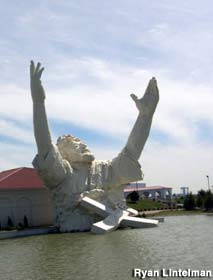 When you are Reformed, you have to get to heaven by faith alone. It’s easy being saved by faith alone, but how do you live the Christian life by faith alone? It would seem that there is stuff in the Bible that God tells us to do. But if we obey, that’s works salvation. What to do?
So the Reformers came up with a way to get to heaven by faith alone via being continually/perpetually saved by faith alone. Hence, we must “preach the gospel to ourselves every day.” Self-serve perpetual salvation. So, that necessitated making the whole Bible about salvation. Instead of reading the Bible for instruction on kingdom living, the Bible became a way to live by the same gospel that saves us until the end.
How do we pull that off? Well, we make every verse in the Bible about Jesus’ “personhood.” Hence, “He’s not a precept, He’s a person.” “It’s His-story.” “It’s not about what we do—it’s about what Jesus has done” etc. So, how do we make every verse in the Bible about Jesus? Just “look to Jesus.” There is no better example of how this works than the infamous “Touchdown Jesus.” I explain in another article:
The Bible is full of symbolism and rich imagery—more so than most literature. And that presents a grave danger. We don’t have the liberty to go into the Bible with the bull of our imagination in a china shop. Imagery and ambiguous verbiage can become idols that are a god of our own making because variances of interpretations are myriad. You merely pick the one of your own imagination and preference, or the same from the musings of others. So here is the point: we can make passages like Exodus 25-27 a tool for creating truth of our own making. In fact, whole denominations are formed based on interpretations of the imagery in these chapters.
What better example than the infamous “Touchdown Jesus” that was an icon of a church in Monroe, Ohio. The statue of Jesus was 60ft. high and was merely a couple of hundred ft. from I-75. That is, until it was struck by lightning. The flames could be seen for miles in the night and the pictures thereof can be best described as apocalyptic. The next day, it was the talk of the nation. But telling was the hundreds of testimonies recorded on the news and in newspapers; i.e., “what the image meant to me.” Yikes! The hundreds of different interpretations were staggering, and the statue never spoke one word! Most interesting was a comment by an unbeliever who worked in the Monroe area: “Obviously, God did it.” Often, there is a disconnect between the secular mindset and the Christian mindset which involves the disintegration of common sense that is a natural endowment; mysticism often abandons the matter and faith becomes a license for mindlessness.
The appeal of idols is the supposed objective prism that leads to subjective “truth.” That’s the appeal; we can make idols speak the truth of our own preference. When a verse of Scripture has to be about Jesus, whatever our imagination comes up with is correct because it’s about Jesus, and if it’s about Jesus, a Jesus outcome must be correct.
It’s a Touchdown Jesus approach, and is the taking away and adding to the word of God on steroids. Good luck to those who propagate it.
paul
Bible as Story? Have We Lost our Minds?
Here at the Potter’s House we do family readings. Right now, we are reading through the novel, The Witch of Blackbird Pond by Elizabeth George Speare. The book is what we call a historical novel. These are fictional books that attempt to convey the experience of historical facts. Historical novels attempt to put you into the historical event experientially. So, historical novels aren’t “just facts,” but attempt to enable you to understand how people in said historical event experienced it.
This is done well in Speare’s Blackbird Pond. You feel Kit’s angst as she peruses the Puritan shoreline of America for the first time. She senses the abysmal aura as set against the colorful structures in Barbados. And for anybody who knows Puritan history, Kit’s suspicions that something is culturally array in the new land is truly chilling. You want to say, “Run!” But, of course, it’s just a story. Historical novels “put you in the story.” The counterpart is academic history which focuses on facts and is not concerned with personal experience.
Vestiges of the concept can be found in mythology and Plato’s concept of Genre which Aristotle and others helped him develop. The concept was integrated into biblical hermeneutics circa 180AD. The idea of Bible as historical narrative was eventually dubbed Biblical Theology by Johann Philipp Gabler (circa 1785) and further developed by Geerhardus Vos in the 19th century. It was known as Redemptive Historical Hermeneutics in the Dutch Reformed churches during the 1940’s. In the secular realm the debate rages as to which approach educates more effectively (http://goo.gl/zo7zp).
And here we are today. The propagation of Bible as a history narrative is in Blitzkrieg mode. The Bible is not to be researched grammatically, but is to be approached like a novel; our goal is to enter into the “unfolding drama of God’s redemptive story.” Those are the words that are actually used. With any novel, it is the writer’s burden to draw the reader into the plot; in this case, the Holy Spirit. All that is necessary is to approach the Bible as gospel narrative, and the Holy Spirit will do the rest. In fact, many Reformed teachers assert that the Holy Spirit will not teach unless you are reading your Bible as a gospel narrative:
That which makes the Bible the Bible is the gospel. That which makes the Bible the Word of God is its witness to Christ. When the Spirit bears witness to our hearts of the truth of the Bible, this is an internal witness concerning the truth of the gospel. We need to be apprehended by the Spirit, who lives in the gospel, and then judge all things by that Spirit even the letter of Scripture.
I want you to feel the truth and depth and wonder that awaits your lifelong labor of love in pondering the inexhaustible portraits of Jesus given us by Matthew, Mark, Luke, and John.
Nothing can raise those who are spiritually dead or continually give life to Christ’s flock but the Spirit working through the gospel. When this happens (not just once, but every time we encounter the gospel afresh), the Spirit progressively transforms us into Christ’s image (Paul Dohse: The Truth About New Calvinism pp. 99, 100).
Recently, I made some observations about Wade Burleson’s blog, Istoria Ministries:
“If the Bible is God’s revelation to man, and it is, be sure that he will also reveal how he wants his word to be interpreted. Fact is, the Bible has built-in rules for interpretation throughout. ANY rules of interpretation for a text must be validated by the Bible itself. So, what about Bible as story or narrative? After an exhaustive study on what the Bible would state about this interpretive model, it begs the question: where is it?”
On that note, let’s start with a blog named “Istoria Ministries” by Reformed teacher/pastor Wade Burleson. The subtitle reads as follows:
Istoria is a Greek word that can be translated as both story and history. Istoria Ministries, led by Wade and Rachelle Burleson, helps people experience the life transforming power of Jesus Christ so that their story may become part of His story.
Burleson is right, it is a Greek word, but is it in the Greek New Testament? After hours of research, I cannot find it anywhere. In fact, Hebrew or Greek canon words that project the English idea of history, narrative, or story are either extremely scarce or nonexistent. The closest idea is the word “parable” which is a story that helps define truth. It’s a teaching tool. But in every case where a parable is implemented as a teaching method, the Bible plainly introduces it as such beforehand. It doesn’t appear that parables in the Bible are meant to be stories that explain the story.”
The next day, Burleson changed the subtitle to the blog as follows:
“I went to Jerusalem to become acquainted (Greek: istoria) with Cephas.” Paul’s words in Galatians 1:18.
Only thing is, the word is not “istoria,” it is “historeo.” Istoria seems to be a word that, in fact, can be interpreted as story and history both, but is primarily a Greek word of contemporary origin. Not only that, according to Spiros Zodhiates, historeo appears in the Greek New Testament ONCE; specifically, the verse Burleson cites in his revised subtitle. A Strongs number search with Olive Tree software confirms such as well.
We don’t obey novels. We don’t obey narratives. We don’t obey stories. And the Lord wants us to experience what we learn in the Bible by applying it to our lives (James 1:25). Parables in the Bible are teaching tools that aid us in understanding the primary points—a history parable is not the sole interpretive genre that makes the Bible what it is.
You do not build a life on a rock by reading novels—you do it by putting what the Lord teaches into practice (Matthew 7:24). If Christ wanted us to read “these words of mine” as a story why would He have not plainly said so? If we live by the redemption story, why wouldn’t Christ plainly state that instead of, “every word that comes from the mouth of God?” If it’s a story, why would Christ call it “all that I have commanded”?
Have we lost our minds?
paul

 Paul's Passing Thoughts
5 comments