JC Ryle Verses John Calvin on the Separation of Justification and Sanctification
Originally published April 20, 2012
“Christ cannot be torn into parts, so these two which we perceive in him together and conjointly are inseparable—namely, righteousness and sanctification. Whomever, therefore, God receives into grace, on them he at the same time bestows the spirit of adoption [Romans 8:15], by whose power he remakes them to his own image. . . Yet Scripture, even though it joins them, still lists them separately in order that God’s manifold grace may better appear to us.” — John Calvin, Institutes of the Christian Religion (Philadelphia: The Westminster Press, 1960), Bk. 3, chap. 11, sec. 6).
“But the plain truth is, that men will persist in confounding two things that differ–that is, justification and sanctification. In justification the word to address to man is believe–only believe; in sanctification the word must be ‘watch, pray, and fight.’ What God has divided let us not mingle and confuse” (JC Ryle, Holiness: Introduction).
The “Cross Story” and Sanctified Rape in the Church
Originally published January 21, 2013

“Be sure of it: this is how Calvinists think; this is their worldview.”
“Don’t misunderstand: the problem of ‘victim mentality’ is not even on the radar screen — they have removed the word “victim” from their metaphysical dictionary.”
“Justice necessarily implies victim. Victim necessarily implies worth. All three are conspirators with the glory story.”
Martin Luther had more on his mind than silly Popes when he nailed his 95 Theses to the front door of All Saints’ Church in Wittenberg, Germany. That protest launched the Reformation, but six months later Luther presented the systematic theology of the Reformation to the Augustinian Order in Heidelberg. Luther’s Heidelberg Disputation laid the foundation, and John Calvin later articulated and applied its basic principles to the full spectrum of life in his Institutes of the Christian Religion.
The Cross Story and the Glory Story
Luther’s cross story, or theology of the cross is the crux of the Heidelberg Disputation and introduced in the first sentence of the Calvin Institutes:
Our wisdom, insofar as it ought to be deemed true and solid wisdom, consists almost entirely of two parts: the knowledge of God and of ourselves.
That’s Luther’s theology of the cross: a deeper and deeper knowledge of our putrid humanity as set against God’s holiness. And NOTHING in-between. All of creation, all events, and all reality contribute to deeper knowledge of one of these two, and then both as a deeper knowledge of each gives more understanding to the other; knowledge of both, and the experience of both. Hence, every blessing, including our good works which are done by the Holy Spirit to begin with, lends more understanding of God’s glory. Every evil event, sin, and tragedy lends deeper understanding in regard to our total depravity and worthlessness. But of course your mother is dying of cancer; I am amazed that God would give anyone as many years as He has given her. Who are we to think we deserve even one year of life? And what a wonderful opportunity for her to suffer the way Jesus suffered for us!
This is the cross story. See the illustration below. This is a contemporary depiction from that camp—this is their assessment:

Anything else at all that gives any credit to humanity—Christian or non-Christian is the “glory story.” That would be our glory specifically, and not Christ’s. To the degree that humanity is considered, the glory of Christ is “ECLIPSED.” This is the theses of a book written by John MacArthur associate Rick Holland: Uneclipsing The Son. Everything is perceived as speaking through one of these two perspectives. ANYTHING coming from what is perceived as the “glory story” is summarily dismissed. Be sure of it: this is how Calvinists think. This is their worldview.
In one of the former Resolved Conferences sponsored by John MacArthur and Holland, in one of his messages, Holland extols a letter written to Puritan Christopher Love by his wife as he awaited execution. Holland forgot to mention to those listening that Love was executed for espionage against the English government while letting the audience assume he was executed for loftier spiritual-like reasons. The following is excerpts from the letter:
O that the Lord would keep thee from having one troubled thought for thy relations. I desire freely to give thee up into thy Father’s hands, and not only look upon it as a crown of glory for thee to die for Christ, but as an honor to me that I should have a husband to leave for Christ…. I dare not speak to thee, nor have a thought within my own heart of my own unspeakable loss, but wholly keep my eye fixed upon thy inexpressible and inconceivable gain. Thou leavest but a sinful, mortal wife to be everlastingly married to the Lord of glory…. Thou dost but leave earth for heaven and changest a prison for a palace. And if natural affections should begin to arise, I hope that the spirit of grace that is within thee will quell them, knowing that all things here below are but dung and dross in comparison of those things that are above. I know thou keepest thine eye fixed on the hope of glory, which makes thy feet trample on the loss of earth.
Justice? That implies that humanity has some sort of value. That implies that life itself has some sort of value. That implies that humanity should be protected through threat of punishment. That’s the glory story. Therefore, Calvin stated the following:
Those who, as in the presence of God, inquire seriously into the true standard of righteousness, will certainly find that all the works of men, if estimated by their own worth, are nothing but vileness and pollution, that what is commonly deemed justice is with God mere iniquity; what is deemed integrity is pollution; what is deemed glory is ignominy (CI 3.12.4).
Death by Biblical Counseling
The church must face up to a sobering reality in our day. The vast majority of biblical counseling that goes on in our day is based on this construct—you will be counseled from the perspective of the cross story, and anything that smacks of the glory story will be snubbed. You are not a victim. There is no such thing as a victim. Christ was the only true victim in all of history. Don’t misunderstand: the problem of “victim mentality” is not even on the radar screen—they have removed the word “victim” from their metaphysical dictionary. “Victim” is part of the glory story; Christ as the only victim is the cross story. I am not a victim. That’s impossible because my sin nailed Christ to the cross. Thank you oh Lord that I was raped. Thank you for this opportunity to suffer for you. Thank you for the strength to forgive the one who raped me in the same way you forgave me. What a wonderful opportunity to show forth your gospel!
Hence, when the leaders of a Reformed church came to inform parents that a young man in that church had molested their toddler, this was the opening statement:
Today, we have before us an opportunity to forgive.
The parents were then counseled to not contact the authorities. Those who do are often brought up on church discipline. Justice necessarily implies victim. Victim necessarily implies worth. All three are conspirators with the glory story. And be not deceived: this is the logic that drives Reformed organizations that are supposed to be mediators in the church; specifically, Peacemaker Ministries and G.R.A.C.E. A major player in the Biblical Counseling Movement is Paul David Tripp. In 2006, he wrote a book that articulates the horizontal application of Luther’s theology of the cross: “How people Change.” Of course, the title is a lie; if he really believed people change, that would be the glory story. Notice also that it is, “How People Change” and not, “How Christians Change.” That’s because this bunch see no difference in the transforming power of the new birth and ordinary Christ-rejecting people.
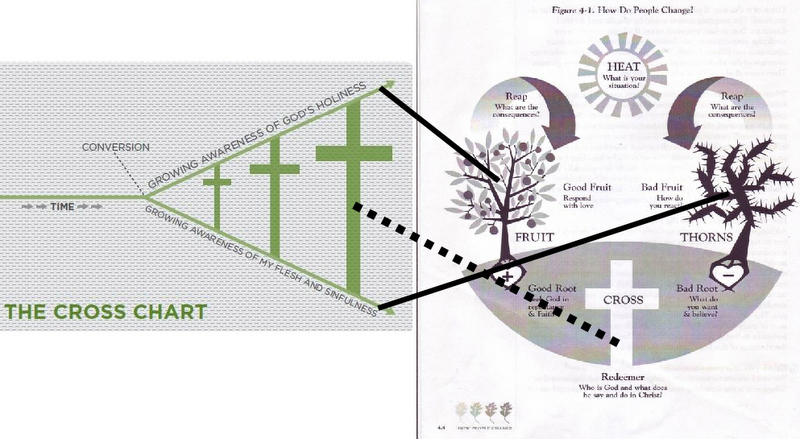
In the book, Tripp, like all who propagate Luther’s theology of the cross, posits the Bible as a “big picture” narrative of our redemptive life. The Bible is a mere tool for one thing only: leading us more and more into the cross story and away from the glory story. This is accomplished by using the Bible to enter into the cross narrative and thereby seeing our preordained part in the “big picture” narrative of redemptive history. Though Tripp is not forthright about it in the book, this is known as the Redemptive Historical Hermeneutic. By seeing our life through the cross story, we are empowered to live life for God’s glory. This is done by seeing ALL circumstances in life (Heat) as preordained in order to show our sinfulness (Thorns) and God’s goodness (Fruit) for the purposes of having a deeper understanding of both resulting in spiritual wellbeing. In other words, all of life’s circumstances are designed to give us a deeper understanding of the cross story: God’s holiness, and our sinfulness. I have taken his primary visual illustration from the book and drawn lines to the cross story illustration to demonstrate the relationship (click on image to enlarge):
Understanding this lends insight to Tripp citations on the Peacekeepers Ministries website:
Paul Trip wrote a great post over at The Gospel Coalition blog all about the need for pastors to pursue a culture of forgiveness in their ministry. Pastors (and anyone serving Christ) have a choice:
“You can choose for disappointment to become distance, for affection to become dislike, and for a ministry partnership to morph into a search for an escape. You can taste the sad harvest of relational détente that so many church staffs live in, or you can plant better seeds and celebrate a much better harvest. The harvest of forgiveness, rooted in God’s forgiveness of you, is the kind of ministry relationship everyone wants.”
Then he describes three ways forgiveness can shape your ministry. I’ve listed them, but you can read how he explains them in detail.
“1. Forgiveness stimulates appreciation and affection.
2. Forgiveness produces patience.
3. Forgiveness is the fertile soil in which unity in relationships grows.”
He closes with this exhortation:
“So we learn to make war, but no longer with one another. Together we battle the one Enemy who is after us and our ministries. As we do this, we all become thankful that grace has freed us from the war with one another that we used to be so good at making.”
And concerning another author, they also stated:
Last week, Steve Cornell at The Gospel Coalition blog posted some really great insight into the difference between forgiveness and reconciliation. They also offered up some excellent and biblically sound steps in dealing with a situation where an offending party is hesitant to reconcile.
Here he summarizes a key distinction:
“It’s possible to forgive someone without offering immediate reconciliation. It’s possible for forgiveness to occur in the context of one’s relationship with God apart from contact with her offender. But reconciliation is focused on restoring broken relationships. And where trust is deeply broken, restoration is a process—sometimes, a lengthy one”…. His ten guidelines for those hesitant to reconcile are rooted in scripture and, I think, incredibly helpful.
1. Be honest about your motives.
2. Be humble in your attitude.
3. Be prayerful about the one who hurt you.
4. Be willing to admit ways you might have contributed to the problem.
5. Be honest with the offender.
6. Be objective about your hesitancy.
7. Be clear about the guidelines for restoration.
8. Be alert to Satan’s schemes.
9. Be mindful of God’s control.
10. Be realistic about the process.
Notice the overall blurring of distinction between the offended and offender with the subject of forgiveness.
The Cross-centered Anti-justice Pandemic is No longer Exclusively a Reformed Thing
Apart from Calvinism, the redemptive historical cross-centered approach is crossing denominational lines en masse. We at TANC see doctrines that were born of Luther’s theology of the cross in non-Reformed circles constantly; specifically, heart theology (deep repentance), exclusive interpretation of the Scriptures through a redemptive prism, Gospel Sanctification, and John Piper’s Christian hedonism. And we also see the same results. It is not beyond the pale for a pastor who has raped a parishioner to be the one counseling the victim sinner. You know, the “sinner saved by grace.”
God is a God of justice, and throughout the Scriptures He demands that we be people of justice. He demands that we come to the defense of the victim. I close with fitting words from church historian John Immel:
And this is the challenge. This is the challenge that I have as a man who is passionate about thinking: to inspire people to engage in complex ideas that drive tyranny. So here’s my challenge to those who are listening.
Do not be seduced into believing that righteousness is retreat from the world.
Do not be seduced into believing that spirituality is defined by weakness and that timid caution for fear of committing potential error is a reason to be quiet.
Do not be intimidated by vague, hazy threats of failure.
Do not let yourself believe that faith is a license to irrationality. I’m going to say that again to you. This is good. Do not let yourself believe that faith is a license to irrationality.
Do not mistake the simple nature of God’s love for a justification for simple-mindedness.
Do not deceive yourself with the polite notion that you are above the fray, that your right to believe is sufficient to the cause of righteousness. There is no more stunning conceit.
Do not pretend that your unwillingness to argue is the validation of truth.
Know this: Virtue in a vacuum is like the proverbial sound in the forest–irrelevant without a witness. Character is no private deed. To retreat is nothing more than a man closing his eyes and shutting his mouth to injustice.
Virtues are not estimates to be lofted gently against evil.
Virtues are not to be withheld from view in the name of grace.
Virtues are not to be politely swallowed in humble realization that we are all just sinners anyway.
Love is not a moral blank check against the endless tide of indulgent action.
Love is not blind to the cause and effect of reality.
Love is not indifference to plunder and injustice and servitude.
The time is now, you men of private virtue, to emerge from your fortress of solitude and demonstrate that you are worthy of a life that bears your name. The time is now, you men of private virtue, to answer Mick Jagger and all the nihilists that insist we are living on the edge and we cannot help but fall. It is time for you men of private virtue to take up the cause of human existence and think.
~TANC 2012 Conference on Gospel Discernment and Spiritual Tyranny: John Immel; session 1, “Assumptions + Logic = Action.”
paul
Today’s Christian Husband and Father: Killing His Family with Awesome Preaching
Originally posted December 6, 2012
Bob is on his way to Jerry’s house for dinner. Bob is the chairman of their church’s elder board. Jerry is being considered for eldership and Bob will be dining at his house for a pre-interview en lieu of further discussion. Pizza is the cuisine. And apparently, not just on this night—Bob notes that every trashcan in the house is stuffed with pizza boxes. Dishes full of M & Ms also adorn many of the table tops. Bob is taken to the kitchen by Jerry to meet his wife, and Bob perceives no less than twenty-five bags of potato chips staked about in various places. One corner of the kitchen is occupied with a tall stack of Coca-Cola 12packs. Big on taste—small in nutrition.
Precious few will disagree that Bob’s family is headed for serious health problems if they do not change their ways. Yet, Bob is a picture of how the vast majority of Christian husbands oversee the spiritual diets of their families. However, the “Bob” motif falls woefully short of making the point; at least Bob knows what his family is eating for better or worse. Christian husbands of our day don’t even know the difference between Redemptive Historical hermeneutics and Grammatical Historical hermeneutics. In fact, when the subject comes up, a rolling of the eyes follows.
That’s because the preaching/teaching is awesome where they go to church. Uncompromising, and God glorifying. As one pastor exhorted me when inquiring about what hermeneutic he used in his preaching: “Come and see if it tastes good, and if you still want to, we will talk about theology.” But I never doubt it will taste good. Who doesn’t love pizza for dinner, potato chips as a side, Coke to drink, and M&Ms for desert?
Fact is, nearly 90% of preaching/teaching in today’s American church is fundamentally based on Luther’s Heidelberg Disputation. This document is the very heart of the Reformation and the engine that drives the present-day New Calvinist movement. Its premise was based on the idea that all spiritual reality, wisdom, and truth comes from the combination of two perspectives, and only these two: the holiness of God, and the wretchedness of all men whether they are Christians or not. Luther called this perspective the “theology of the cross.” It has come to be known as Gospel-Centered preaching/teaching. It is also the foundation of the Calvin Institutes. Everything in the Calvin Institutes, in some way, points to the glory of God “as set against our sinfulness.”
This has become job one: as described in the Heidelberg Disputation; this way of teaching is the “cross story,” and all other spiritual wisdom is the “glory story.” Hence, the contemporary clarion call of the Reformation derived from Luther’s Disputation is, the centrality of the objective gospel outside of us. Anything at all that has anything to do with us is “subjective,” and part of the “glory story.” Unless it concerns our wretchedness. Therefore, the Disputation ridiculed a negative attitude towards suffering as well for this serves to further reveal our woeful state in life which magnifies the redemptive work of Christ and our utter worthlessness. The whole motif can be visualized by the following Reformed chart:

Yes, you can preach wonderful sermons on those two dimensions. They are both abundantly true. Charles Spurgeon is known as the “prince of preachers.” All of his sermons are based on the “cross story.” All, I repeat “all” of John Piper’s sermons and the (seems like) 600 books he has written are based on nothing but, I repeat, nothing but the “cross story.” Amen, pass the potato chips. In circa 1994, John MacArthur abandoned the “glory story” aspects of his preaching and now focuses on the “cross story.” Amen, pass the M&Ms. And those babies slide down nice with a big swig of Coca-Cola.
“But Paul, what’s so sweet about focusing on our own wickedness?” My dear friend, haven’t you seen any Staples commercials? It’s easy. You totally stink. Nothing is expected of you: “Hey honey! Good news! We don’t change! Our marriage isn’t about a bunch of do’s and don’ts! Our failures make us wiser!” That was easy. In fact, teachers like Michael Horton and John Piper continually espouse the idea that expectations are just, “more bad news.” And regarding leaders? “Alright, time to prepare my message for tomorrow, and all I have to do is look for two things, and two things only in the text: how great God is, and how bad we are.” That was easy. In fact, we find the following on a well-known Reformed blog regarding instruction on how to prepare a Bible lesson:
At this time, resist the temptation to utilize subsequent passages to validate the meaning or to move out from the immediate context. Remembering that all exegesis must finally be a Christocentric exegesis.
Look for Christ even if He isn’t there directly. It is better to see Christ in a text even if He isn’t, than to miss Him where He is.
But as the apostle asked rhetorically, “What saith the Scriptures?” Is there another story other than the “cross story”? Anybody interested in the House on a Rock story?
Matthew 7:24 -“Everyone then who hears these words of mine and does them will be like a wise man who built his house on the rock. 25 And the rain fell, and the floods came, and the winds blew and beat on that house, but it did not fall, because it had been founded on the rock. 26 And everyone who hears these words of mine and does not do them will be like a foolish man who built his house on the sand. 27 And the rain fell, and the floods came, and the winds blew and beat against that house, and it fell, and great was the fall of it.”
Learn and do. That’s how we have a life built on a rock. It is the very definition of a disciple:
Matthew 19 – Go therefore and make disciples of all nations, baptizing them in the name of the Father and of the Son and of the Holy Spirit, 20 teaching them to observe all that I have commanded you. And behold, I am with you always, to the end of the age.”
So, here is my suggestion. When you go to church this Sunday, and other days following that involve sitting under the teachings of your leaders, take a legal pad with you. Draw a line at a downward angle on the bottom labeled, “our sin.” Draw a line at the top with an upward angle, and label it “Christ.” Then draw a line in the middle and label it, “What? Why? And How?” Or, “Not only what Jesus did, but what did He SAY?” Or simply, “Life built on a rock.” If there isn’t a three-dimensional balance—get out of there. You either love your family or you don’t. You will be judged by Christ accordingly.
I was approached by my wife Susan this morning. My son by marriage had approached her asking questions about demonology. Apparently, he had questions concerning some things he had heard about the subject (demonology) in the secular realm. I was astonished; though both of them have been in church for a combined total of 72 years, they didn’t even know the basics regarding this subject. My wife wanted to know the answers to his questions—other than the usual answers: “Jesus” and “gospel.”
And if we don’t know, the world will gladly inform our children accordingly. Knowledge equals authority.
Men, wake up.
paul
Let’s be Honest: Does God Really Want Christians to “Live by the Gospel” Every Day?
Originally published December 21, 2011
“The application of the gospel in regard to the saints is clearly stated here. It is a ministry of reconciliation that we preach to the world, not to ourselves. We are already reconciled. This would seem evident.”
It was maybe a year ago in Fort Wayne, Indiana. I showed up for morning service to find a huge cross assembled at the altar with a couple of hundred white ribbons draped across the horizontals. At the beginning of the service, red ribbons were passed out to all those in attendance. The message was on Isaiah 1:18:
“Come now, and let us reason together,” says the LORD, “though your sins are as scarlet, they will be as white as snow; though they are red like crimson, they will be like wool.”
As the pastor preached a gospel-centered message on “Though Your Sins are as Scarlet,” everyone was holding those red ribbons, a great reflective tool while listening to the message. At the end of the message, everyone went up front and exchanged their red ribbon for a white ribbon, laying their red ribbon on the cross and taking a white ribbon. The sight of hundreds of people doing that was very moving. As we then held our white ribbons, he closed.
Till this day, I still have that white ribbon in my Bible. Though I had already decided I was going to start visiting other churches, and I knew where the message was coming from in the whole scheme of that particular church’s doctrine (gospel sanctification), I was extremely glad for the message. Why? Because I love the gospel and grieve the fact that the mantle of its splendor often fades as I wade through the milieu of life.
How could I not be continually exhilarated by this unfathomable sacrifice? The message left me with an awesome feeling. I felt very close to the Lord and was full of joy. When I stopped for gas on the way home, did the clerk not see the very joy of the gospel on my face? In such a state is one not ready and willing to serve the Lord with joy and without a moment of hesitation? Who then would dare say that we should not continually dwell on the message of the gospel?!
Well, among many: Christ, the apostle Paul, the apostle Peter, and the Hebrew writer. I’m right there with you, having that experience makes you feel pretty darn spiritual. Who wouldn’t want that every day? That day I was glad for the reminder of what Christ had done for me, but the apostle’s question should always be before us: “What does the Scripture say?”
Hang on as you read the following run-on sentence, it’s a long one:
Of course to some the following argument is dead on arrival because every verse in the Bible is about the gospel and you have to see all Scripture through that prism and therefore everything must come out gospel and by the way that should be great news for me because if I find the gospel in every verse I can have the same experience I had that day in Fort Wayne and obey the Lord without effort and with joy so what’s my stinking problem and why am I writing this essay?
Does the “Gospel” Need the Truth?
…….because I love something more than my own experience; even the one of that day in regard to the gospel, the truth (2 Thessalonians 2:10).
One day Peter experienced the glory of God through Christ and went on to say that we have a “more sure” testimony. Namely, the word of God (2 Peter 1:16-21). I must pause here to make a point before I move on to answer the primary question of the title and some closing comments about the gospel. All of the contemporary mantras speaking of worshiping Christ as a person with the gospel being synonymous with his personhood, rather than through objective truth, is an affront to our Holy God. Why? Because all knowledge of Him goes through what He says, period! To bypass what He says specifically and objectively for a subjective worship of his “personhood” via an eisegetical interpretation of the Scriptures, is grave error. Christ had a run-in with a person who should be the poster child for subjective worship. He threw a bucket of cold water on her worship of Him, right there in front of everybody:
“As Jesus was saying these things, a woman in the crowd called out, ‘Blessed is the mother who gave you birth and nursed you.’ He replied, ‘Blessed rather are those who hear the word of God and obey it’” (Luke 11:27,28).
When it came to the worship of Christ as a person, He pointed the woman right back to what He says, and insisted that it be obeyed. That’s where the blessings are (“Blessed rather are those who hear the word of God and obey it”). All roads go through what God says about Himself, and many in our day should take caution as to whether presuppositions of any sort have usurped that process. Besides, in obedience to His word is where blessings reside (James 1:25 also).
Does True Worship Need Instruction?
In Psalm 138:2, King David says the following:
“I will bow down toward your holy temple and will praise your name for your love and your faithfulness, for you have exalted above all things your name and your word” (emphasis mine).
God is well aware of how majestic He is and doesn’t need us to remind Him of it. Our worship of Him is in “spirit and truth” (John 4:23). All of the talk about “gazing” on His glory “through the gospel” is all well and good, but it had better be an objective gazing and studious thinking on His truth with application accordingly. So says God Himself. King David received good life lessons in regard to this as recorded in chapters 7-12 of 2 Samuel. David’s propensity for subjective worship caused him trouble more than once. As a matter of fact, many today would say that his desires were “properly oriented.” Nobody possessed a stronger desire to worship God than King David and this was often expressed through singing, dancing and exalted praise. But in chapter seven, David went to Nathan and complained that God lived in a tent while he lived in a cedar house. Basically, he was looking for Nathan’s approval and got it. Later in the same day, God came to Nathan and said the following:
“Go and tell my servant David, “This is what the LORD says: Are you the one to build me a house to dwell in? I have not dwelt in a house from the day I brought the Israelites up out of Egypt to this day. I have been moving from place to place with a tent as my dwelling. Wherever I have moved with all the Israelites, did I ever say to any of their rulers whom I commanded to shepherd my people Israel, ‘Why have you not built me a house of cedar?’”
There is only one way God could ask such a rhetorical question of David using the history of Israel; He was referring to the written revelation available at that time. In essence, He was saying this: “David, where do you find it in Scripture that I want a house built for myself?”
In the following verses, we have God reminding David of where He brought him from and where he is going to take his descendants (also known as the Davidic Covenant), all without David’s help. David’s subjective love for God was steeped in arrogance. When it’s not based on truth, our own flesh will most certainly fill the void.
David gets the message and begins his responsive prayer with the following in 2 Samuel 7:18:
“Who am I, O Sovereign LORD, and what is my family, that you have brought me this far?”
Subjective love usually leads to arrogance and sometimes worse. Let me share what God said was at the heart of David’s murderous adultery with Bathsheba:
“Why did you despise the word [emphasis mine] of the LORD by doing what is evil in his eyes? You struck down Uriah the Hittite with the sword and took his wife to be your own. You killed him with the sword of the Ammonites” (2 Samuel 12:9).
God knew David did not despise Him personally, but a lack of attention to the word (what God says) led to sin against God Himself. The constant mantra we hear today, “Christ is a person and not a precept” (or the negative synonyms they choose to make a point: “rules, do’s and dont’s,” etc. etc.), is a subjective mentality that will lead to arrogance or worse.
Where would one even stop to comprehensively compile all there is in Scripture to further this point? In 1 Samuel, chapter 15, every indication points to the fact that King Saul’s attempt to worship God had good intentions except for one thing:
“But Samuel replied: ‘Does the LORD delight in burnt offerings and sacrifices as much as in obeying the voice [emphasis mine] of the LORD? To obey is better than sacrifice, and to heed is better than the fat of rams’”
Of course the Lord delights in our worship. But what did Samuel say God delights in more? It’s not His personhood, It’s the following of His voice: “My sheep listen to my voice; I know them, and they follow me” (John 10:27).
What is the Gospel, and Do We really live By It Every Day?
The word means “good news.” There is much talk concerning a definition of the gospel. Every time I turn around in Reformed circles you read or hear that question. My missionary son-in-law says it’s because Reformed theologians spend all their time torturing simplicity instead of sharing the gospel they are always researching and debating. He may have a point. However, the question itself has always confounded me because the good news seems to be expressed in a many faceted way (in the Bible) while being one central truth. Basically, my answer is the following: “The gospel is the good news concerning how God reconciled man to Himself.” How God did that and why He decided to is kind of a long story. Study all the various presentations of the gospel in the Bible; they are far from cookie cutter. I am going to use one biblical definition by the apostle Paul in regard to the gospel being called “reconciliation.” It is from 2 Corinthians 5:18-21;
“All this is from God, who reconciled us to himself through Christ and gave us the ministry of reconciliation: that God was reconciling the world to himself in Christ, not counting men’s sins against them. And he has committed to us the message of reconciliation. We are therefore Christ’s ambassadors, as though God were making his appeal through us. We implore you on Christ’s behalf: Be reconciled to God.”
The gospel’s relationship to the saints is clearly stated here. It is a ministry of reconciliation that we preach to the world, not to ourselves. Obviously, we are already reconciled. We are not ambassadors to our own country, but rather ambassadors to the world. This would seem evident. Also, “good news” implies something not heard before. You know, the “news” part. It seems somewhat oxymoronic for daily use in regard to Christians.
Was Christ and the Apostles Poor Communicators?
“Then Jesus came to them and said, ‘All authority in heaven and on earth has been given to me. Therefore go and make disciples of all nations, baptizing them in the name of the Father and of the Son and of the Holy Spirit, and teaching them to obey everything I have commanded you. And surely I am with you always, to the very end of the age’” (Matthew 28:19,20).
This is our Lord’s mandate to the church. Making disciples and baptizing them is the ministry of reconciliation. “Teaching them to observe all that I have commanded” is obviously our role in the sanctification process. If living by the gospel every day is our paramount role in the sanctification process, how could this passage be constructed or worded in this way? Certainly, for Christ to instruct obedience to all that He commanded, implies a variety of information as opposed to the single good news of the gospel. Why would Christ not rather say, “Teaching them to observe the gospel”? If Christ wanted the gospel observed every day, why would He not simply state that accordingly? Also, if Christ “is the gospel” and the gospel is He, why did He command baptism in the name of all three? If all of Scripture is about Christ and His gospel, here is a grand opportunity to drive that point home. Furthermore, if we are to live by the gospel every day, why not baptize everyday as well? Why not? It’s a New Testament picture of the gospel. If all of Scripture is about the gospel, what verse would exclude this notion? (Mark my words, this will soon be coming to a church near you).
Furthermore, John chapter 13 (note verses 9 and 10 specifically) contains the account of Christ washing Peter’s feet. Peter at first declines until Jesus tells him to agree in order to have a relationship with Him. Peter then tells Christ to wash his whole body. In return, Christ tells Peter that he who has bathed, only needs to have his feet washed. All the major Bible commentators agree that this refers to the salvation / sanctification relationship in regard to forgiveness of sins. Why would Christ use that example if we need the full effect of the gospel every day?
Was Peter a Poor Communicator?
If we are to live by the gospel every day, Peter did not get the memo in the worst way. 2Peter 1: 3-17 encompasses a teaching Peter thought was most important before his departure from this world (see verses 14 and 15) and it wasn’t the gospel. What was that message? The message was a call to diligently add eight practices to the foundation of our faith (see verses 5-8). Peter then says adding these virtues to our faith results in assurance of salvation:
“Therefore, my brothers, be all the more eager to make your calling and election sure. For if you do these things, you will never fall” (verse 10).
To the contrary, proponents of living by the gospel everyday teach that assurance comes from “preaching the gospel to ourselves every day.” That is clearly contrary to what Peter said.
In verse 3, Peter says that God’s power has given us all things that pertain to life and godliness. Why wouldn’t he rather say that God’s power has given us all things that pertain to the gospel? Or better yet, why would he not say that we have all things that we need for life and godliness through the gospel? In verses 12-15, Peter expresses his concern that they may forget to diligently add these qualities after he was gone. This is an unreasonable disconnect if in fact the paramount role of the believer is to live by the gospel every day. It just doesn’t make sense!
Was Paul a Poor Communicator?
In 1Corinthians 3:10-15, Paul says that we build upon the foundation of Christ. He even says that we will be judged by Christ according to how we build. Therefore, living by the gospel (and Christ being the gospel according to advocates of GS) daily would then be a rebuilding of the foundation every day. It turns Paul’s metaphor completely upside down.
Furthermore, in Romans 15:20, Paul makes it clear that the gospel is a “foundation,” and said he would not go where Christ had already been named because that would be building on the foundation of others.
Was the Hebrew Writer a Poor Communicator?
“We have much to say about this, but it is hard to explain because you are slow to learn. In fact, though by this time you ought to be teachers, you need someone to teach you the elementary truths of God’s word all over again. You need milk, not solid food! Anyone who lives on milk, being still an infant, is not acquainted with the teaching about righteousness. But solid food is for the mature, who by constant use have trained themselves to distinguish good from evil. Therefore let us leave the elementary teachings about Christ and go on to maturity, not laying again the foundation of repentance from acts that lead to death, and of faith in God, instruction about baptisms, the laying on of hands, the resurrection of the dead, and eternal judgment. And God permitting, we will do so.” (Hebrews 5:11- 6:3).
The Hebrew writer says that spiritual immaturity is the result of not putting God’s word into practice, not a failure to live by the gospel every day. Again, somebody didn’t get the memo. Also, even though 6:2 most certainly refers to Old Testament practices, a reference to doctrines of Christ in 6:1 is irrefutable. Therefore, it seems to be in direct contradiction to a living daily by the gospel approach. An exclusive, daily focus on the glorious, but foundational gospel, is antithetical to what the Hebrew writer is prescribing.
I contend that I am in good company here. Jay Adams uses this same argument from Hebrews 5:11-6:2 (as I do) to refute Biblical Sonship (pages 38-41 “Biblical Sonship,” Timeless Texts 1999). Biblical Sonship, like gospel sanctification, advocates an everyday living by the gospel:
“Certainly all of us may frequently look back to the time when we became sons and rejoice in the fact, but there is no directive to do so for growth, or even of an example of this practice, in the New Testament. And surely there is nothing to support the ritual act of repeatedly doing so as a technique of growth! Something so prominent as the prime practice in the Sonship movement ought to have a corresponding prominent place in the Bible. The true reminder of the good news about Jesus’ death for our sins is the one that He left for us to observe, the Lord’s supper (‘Do this in remembrance of Me’).” ( Jay Adams, page 41, “Biblical Sonship,” Timeless Texts 1999).
Living By the Gospel.
We should most certainly live out the gospel each day by being faithful to our call as ministers to the “ministry of reconciliation.” However, we are ambassadors to the world, not ourselves. Sure, in some respects, we mirror the gospel with our lives every day. We should forgive like Christ forgave us. We should sacrifice self as Christ did, and daily. We also still repent and do so daily. But it is clear that we are to continue to build on our faith from the word of God. Gospel Sanctification is a nebulous concept that focuses on subjective worship and disregards the plain sense of biblical mandates.
At the beginning of this essay, I supplied a good look into the mentality of Gospel Sanctification; every sermon, every Bible lesson, and every daily reading of the Bible should focus on the gospel. In doing so, we are changed from glory to glory, supposedly. Experiential sermons like the one I attended in Fort Wayne sells the theory well, as does John Piper’s emphasis on “exultation” during his sermons. Basically, it makes everything about what God did, instead of what God says. Buyer beware, God has not only exalted His name above all, but His word as well (again, Psalms 138:2).
paul
When We Use Words, Should We Know What They Mean? Truth, Mythology, Orthodoxy, and Creed
 In order to control people, you have to control their minds. And in order to control their minds, you have to control the definitions of words. The meanings of words form what we believe about truth and reality. And, when it gets right down to it, a proper assessment of reality is the foundation of truth (and by the way, you can only control people by force for so long. The key is to control their minds).
Truth is not “fact.” Truth has a moral value to it. Facts are building blocks that can build any theory of truth.
I have written about all of this before, but this short essay was inspired by one of my Facebook friends. She announced that she was using The Westminster Shorter Catechism for kids to instruct her young child. Why would she do that? Because the WSC is “orthodoxy,” and that word has come to mean…TRUTH. Hence, the opposite of “orthodoxy” is “heterodoxy,” a practice that I am often accused of: meaning; untruth.
Now, the WSC is often spoken of as being “subordinate truth.” And in fact, that is a fact, but let’s think about this; why is a subordinate truth needed? Isn’t truth powerful enough by itself?
“Well Paul, a creed, or confession, or catechism, is just a form of truth that is taught on the common person’s level, it makes truth easier to understand for the average person.”
Exactly.
The assumption is that there is a truth caste system. There are those who understand Truth, big T, and then those who are only capable of understanding a revisal form of truth on a more elementary level.
Orthodoxy is NOT truth, orthodoxy is an elitist interpretation of truth by those preordained by God (or mother nature) to have a special gift for interpreting truth. People merely pick the orthodoxy of preference which ranges from A-Z of world religions. Protestantism, like Catholicism, or for that matter Hinduism, was founded on orthodoxy which has become a word fictitiously associated with the meaning of the word…truth. The title of those who penned the Westminster Confession should be telling: the “Westminster Divines.” What would be our first clue?
Orthodoxy is not truth, orthodoxy is some man’s interpretation of truth. This is what separates Protestantism from the true called out assembly of Christ: the priesthood of believers. Clearly, this states that every human being is capable of understanding truth on their own, and is culpable before God ALONE for the adjudication of that truth. This also assumes that man is created with freedom of conscience. And by the way, the horizontal political expression of this, is an idea that we call the United States of America. And by the way, there is a reason why the Pope and New Calvinists alike are brazen Socialists, confused Protestants notwithstanding. Will we be judged individually for following God, or men appointed by God? This should be evident. We only follow men who follow Christ according to our own assessment of truth.
“But Paul! That will lead to Chaos!”
Exactly.
Herein is the rub: reality, and presuppositions regarding man; ability to understand reality, or epistemological caste? That’s it in a nutshell folks. It’s the exact lie first perpetrated in the garden: Hey Eve, you really can’t understand God without a mediator. You need somebody who has special insight into the spiritual, “nay, has God really said…?”And the priesthood of believers versus spiritual caste was a major battlefront in the first century church and a major theme of the apostle John’s writings.
Right out of the gates of the garden came the declaration of the kingdom of darkness: spiritual caste enforced by government, and the ownership of truth by Plato’s philosopher kings. Philosopher, and king, and the divine right of kings. All of human history was saturated with wars over orthodoxy until 1776. The vast number of wars fought throughout human history have been religious civil wars, or more accurately, wars over orthodoxy.
The divine right of kings is responsible for chaos, not kings who protect a reasonable freedom of conscience. This was the crying out of small voices in the wilderness of a European culture drenched in blood.
In ancient times, spiritual caste was expressed in mythology. To see mythology as ancient superstition shrouded in ignorance would be an incorrect assessment. Mythology is merely stories (parables) created by philosopher kings so that the unenlightened masses can understand principles of society for purposes of social justice. For Plato, that was UNITY period. Whatever “truth” unified was the proof in the pudding; unity equals truth.
Mythology is no different than orthodoxy, and the various teachings thereof: creeds; confessions, and catechisms. Of course it is “subordinate truth.” Of course there is a “higher truth,” but the rub is that the common folks can’t really understand THE Truth…capital T. Hence, you follow the orthodoxy of your choice…presumably to heaven. Pick well, the choices are vast, and the various enlightened choices are better than yours because of the reality that you have accepted: orthodoxy.
The prime example of this in our evangelical day is the Redemptive Historical hermeneutic that dominates the institutional church. It is, Bible as story. Bible as “gospel narrative.” This is absolutely NOTHING more or less than mythology itself dressed in uppity European intellectualism.
Christ promised YOU that you would find truth if you seek it. This isn’t a seeking to find the right man to follow, this is between you and God Himself. And this issue goes way, way back in time. It was a major issue with Moses, and the apostle John, and it is a major issue in our day. Therefore, I close with these words from Moses:
The secret things belong to the Lord our God, but the things that are revealed belong to us and to our children forever, that we may do all the words of this law… For this commandment that I command you today is not too hard for you, neither is it far off. It is not in heaven, that you should say, ‘Who will ascend to heaven for us and bring it to us, that we may hear it and do it?’ Neither is it beyond the sea, that you should say, ‘Who will go over the sea for us and bring it to us, that we may hear it and do it?’ But the word is very near you. It is in your mouth and in your heart, so that you can do it.
paul

 Paul's Passing Thoughts
2 comments