Gospel Sanctification and Sonship’s Gospel-Driven Genealogy, Part 11: Walter Chantry’s Suffering
 One day I hope to meet him. Soon, it would be like those meetings we used to see on Oprah where people who have suffered the same type of traumas meet to share their experiences. In fact, there are clubs all over the country where people meet to do just that. It’s like they have always known each other, and the very first meetings are filled with tears and hugging. Whether it’s the My Poodle Was Slain by a Pitbull in Front of My Eyes Club or some other club of trauma, the reunions seem to be a healing balm of some sort.
Chantry and I could start our own club for those who are traumatized by debating proponents of New Covenant Theology. Chantry tried to destroy the evil child soon after it was delivered and wasn’t yet named ( http://wp.me/pmd7S-Ld ). Apparently, survivors of Chantry’s onslaught split from Reformed Baptist into a meager fellowship called Continental Baptist. New Covenant Theology (NCT) is based on the Australian Forum’s centrality of the objective gospel (COG) which found new life in Sonship Theology and is now a gargantuan movement known as New Calvinism. Chantry’s bantering back and forth with one of two patriarchs of NCT, Jon Zens, is well documented and exhausting. One example can be seen here: http://solochristo.com/theology/nct/zens-chantry.htm .
Method 1: Annoying, and repetitious oversimplified denial.
Chantry, knowing that NCT hacks like to confuse and wear down their opponents with an endless flogging of residual issues, rightly focused on the fact that it all boils down to Antinomianism. The very annoying way in which Zens debates can be seen clearly in present-day COG proponents; for example, “Show me one reference where I have ever written that I am an Antinomian you slanderer!” Chantry’s reply usually followed along these lines: “For substantiation of what I have to say, I could quote almost the entirety of the articles that you [Zens] have printed in ‘Baptist Reformation Review.'” Further, he [Chantry] viewed my [Zens] pleas for documentation as “quibbling about words, a mere strife about terminology that has no point to it.”
Method 2: Rewrite traditional meaning.
COG proponents are very sensitive to the Antinomian charge, so they continually attempt to rewrite the English language and church history to avoid the accusation. Recent articles by Tullian Tchividjian and Elyse Fitzpatrick deny that there is any such thing as Antinomianism. They also try to replace the word “antinomianism” with what they call “neonomianism (“new legalism” as opposed to “anti-law”). Likewise, “obedience” (we obey) is replaced with “new obedience” (Jesus obeyed in our place as part of the atonement, and apparently still obeys for us via the imputed active obedience of Christ). Sanctification is now “progressive sanctification” which is nothing more than the unfolding of our justification via John Piper’s “beholding as a way of becoming.” Of course, he includes “….a way….” so if he’s confronted he can say that he’s talking about contemplative spirituality being just one of many avenues while assuring us that he believes in “obedience.” But of course, he’s really talking about “New Obedience.”
Method 3: Fake contentions against supposedly contrary beliefs.
COG proponents contend against many other belief systems as a way to appear like standguards for orthodox truth. Often, the “contrary” beliefs are very similar to their own. An assistant to DA Carson recently wrote a book on Keswick theology, which has many similarities to COG. Carson also disses Keswick theology on a routine bases, but according to one article:
“Beginning in the 1920s, the Keswick Convention’s view of sanctification began to shift from the view promoted by the leaders of the early convention. William Graham Scroggie (1877–1958) led that transformation to a view of sanctification closer to the Reformed view. Today its speakers include people like D. A. Carson and Sinclair Ferguson, whose views on the Christian life differ significantly from the Keswick Convention’s first generation.” http://ccclh.org/blog/?p=1234
….But apparently, not the second generation of Keswick theology. One of their (COG proponents) favorite targets is postmodernism or the Emergent Church who they share like philosophies with. I go into detail on this subject here: http://wp.me/pmd7S-Lk
Method 4: Quote other leaders who have written against COG-like doctrines.
JC Ryle wrote extensively on doctrines that distorted biblical sanctification, and many of them were very similar to New Calvinism and NCT. In fact, such doctrines that were running about in his day inspired his famous “Scriptural Holiness” which is considered to be one of the best works on Christian living ever written. The introduction outlines seven elements of Quietist type doctrines that fit Gospel Sanctification to a T. Therefore, COG proponents like Kevin Deyoung now quote Ryle extensively. A proponent of NCT has recently sent me emails that contain excerpts from Scriptural Holiness that seem to indicate Ryle supported a synthesis of justification and sanctification, and asked me to post them. Only problem is, I am very familiar with Ryles writings and find the suggestion preposterous. Knowing what I know about Ryle’s theological positions, I assume the quotes pertain to a contention against those who believe that sanctification is a much lesser concern than justification. This doesn’t mean Ryle believed they are exactly the same in essence as the proponent implied.
Mix those four methods with an attitude that is driven by a belief that God is using them to orchestrate a “second reformation” (I’m not joking), and the same kind of confidence the apostle Paul mentioned about the false teachers he contended with, and what you have is a serious Excedrin headache. With that said, one remembers what Jay Adams said about Quietist type doctrines: they will “ruin people’s lives.” He also said Gospel Sanctification is “dangerous and must be stopped.” No doubt—so the fight continues.
paul
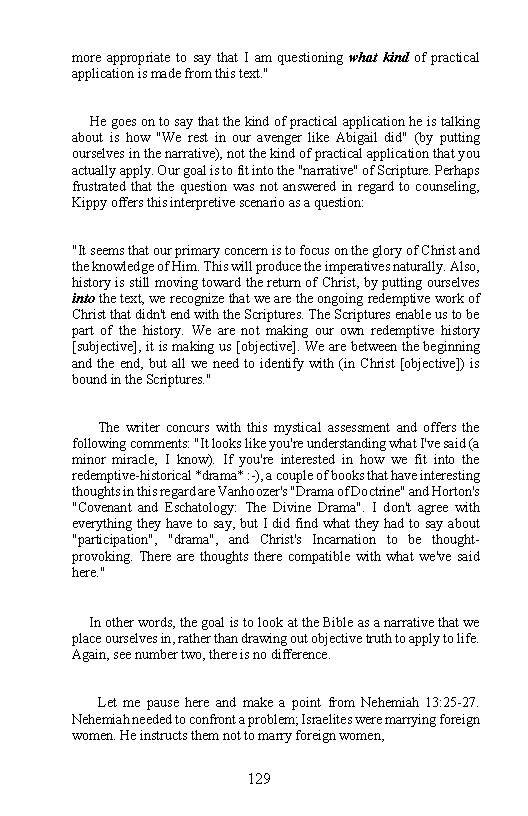

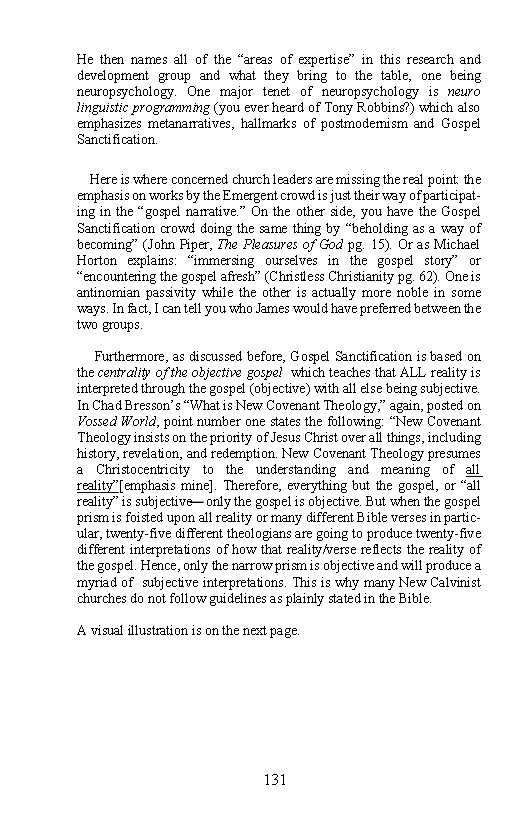
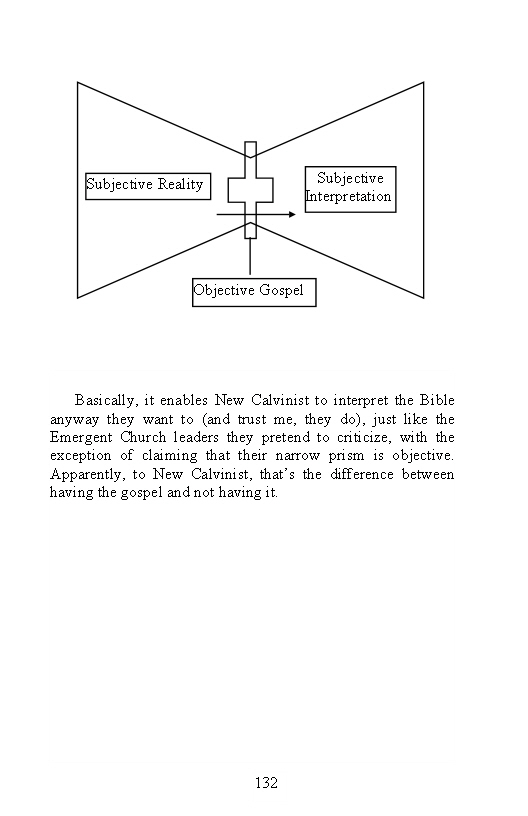
Clearcreek Chapel’s “All in the Family”
“I gathered up jewels that others here and there had mined, and just put it together in a way that seemed clear and important to me. If I could, it would be easier to reply that I had copied the package from somewhere in particular, but I am not able to do that. What I was on about impacted others and sharpened others up – like Paxton and Goldsworthy – and Jons [as confirmed later: Jon Zens] and a guy called Edward Fudge and others along the way.” ~ Robert Brinsmead
Clearcreek Chapel in Springboro, Ohio is a good representation of the kinship between all of the elements in our genealogy chart ( http://wp.me/pmd7S-K7 ). One of the joys of this ministry is reconnecting family members with long-lost relatives. It is intriguing to see how remnants of the genealogy chart are all gathered at the bottom—thirty-something years later, but with family members like Robert Brinsmead and Jon Zens (the original patriarchs) missing. Heartbreaking.
Not only that, credit is not being given where credit is due; for example, Jack Miller’s Sonship Theology, which pumped new life into the centrality of the objective gospel (aka Gospel Sanctification and New Covenant Theology) after it received a brutal beating from Walter Chantry and others on the left side of the chart, is never mentioned at T4G, TGC, and SGM gatherings, even though the primary disciples of Jack Miller (Tim Keller and David Powlison) are major players in those movements. Could it be because the Sonship label was shot full of holes by Jay Adams and Chad Van Dixhoorn on the right side of the chart? It would really do my heart good to see the Sonship label proudly displayed at the 2012 T4G. I mean, we’re talking family here.
Though I will be writing about many of these bottom-of-the chart family reunions, Clearcreek Chapel is an excellent specimen. The “elder” in charge of their “adult education” is Christian radio personality Chad Bresson, who authors a blog dedicated to Geerhardus Vos. Bresson is a member of the Earth Stove Society which promotes New Covenant Theology. Bresson has recently posted a lengthy article on eighty elements of New Covenant Theology followed by four articles on the writings of Graeme Goldsworthy. Also, a post by Bresson that articulates how New Calvinists interpret the Bible using a lengthy excerpt from the writings of Robert Brinsmead drew a lot of heat from some readers: http://goo.gl/qbeS4 .
Bresson was a recent speaker at the John Bunyan Convention which is a yearly conference that fictitiously uses the name of Bunyan to promote New Covenant Theology (NCT). This year’s conference included two primary figures of NCT, Fred Zaspel and John Reisinger. The conference was held at Reformed Baptist Church in Lewisburg, PA and I have not ascertained whether or not it is a Continental Baptist church which are a small fellowship of NCT churches that split from Reformed Baptist circles over the NCT issue. The debate that fueled the split was primarily between the father of NCT, Jon Zens, and Walter Chantry. Reformed Baptist protestants staunchly proclaimed NCT to be Antinomianism and were not the least bit apologetic about the accusation. Jon Zens is now in the background, probably because of his close association with the likable, but controversial Robert Brinsmead.
While Bresson shows Clearcreek’s kinship with Jon Zens, Brinsmead, and Goldsworthy, the Chapel leadership as a group focuses heavily on David Powlison’s Theology of the Heart ( http://goo.gl/8UnBe ) and John Piper’s Christian Hedonism. In fact, the pastor of Clearcreek is a well known rabid follower of John Piper. It is my understanding that Piper’s Christian Hedonism is presented yearly in the adult Sunday school class. Paul David Tripp is a frequent speaker there and the Chapel was one of the pilot churches that “tested” Tripp’s book How People Change, which is based on Powlison’s Dynamics of Biblical Change.
The common thread that ties all of the family members together is the Australian Forum’s centrality of the objective gospel (COG). This core thread (COG) was primarily developed by Brinsmead and Zens. Though it includes what Brinsmead describes (in our interview) as a collection of jewels, there is no doubt that Brinsmead and Zens formulated the basic systematic theology that makes its present-day life possible. In regard to any such system prior to the Forum, Brinsmead stated: “I gathered up jewels that others here and there had mined, and just put it together in a way that seemed clear and important to me. If I could, it would be easier to reply that I had copied the package from somewhere in particular, but I am not able to do that. What I was on about impacted others and sharpened others up – like Paxton and Goldsworthy – and Jons [as confirmed later: Jon Zens] and a guy called Edward Fudge and others along the way.”
COG states that all spiritual growth comes from contemplating the gospel outside of us. Any truth that is placed in the same priority at any given time is said to eclipse Christ. Inside considerations (the inner us [subjective]) would be included, which relegates the new birth to a position of insignificance—paving the way for the total depravity of the saints, “The same gospel that saved you also sanctifies you,” and “we must preach the gospel to ourselves everyday” (coined by Jack Miller and aped excessively by Jerry Bridges). As this foundational thread (system) has weaved through contemporary church history, it has been endowed with an explanation of how it is experienced (Christian Hedonism); how it applies to life (Heart Theology); its view of covenants (New Covenant Theology); and an interpretive model that enables outcomes that fit together logically (The Goldsworthy Trilogy [research on how the Dutch Reformed movement and Vos may have influenced Goldsworty is still pending]).
In an introduction to a Christian Hedonism class at Clearcreek Chapel, Chad Bresson said, “This is what makes us unique.” While one wonders why the goal is to be unique, we all can agree that it’s family that makes it all so special.
paul
Gospel Sanctification and Sonship’s Gospel-Driven Genealogy, Part 8: The Brinsmead / Zens Affair Gives Birth To New Calvinism
As I continue to absorb an astounding document written by Jon Zens, “Law And Ministry In The Church: An Informal Essay On Some Historical Developments (1972-1984),” the Zens/Brinsmead connection and its contribution to the birth of New Calvinism becomes evident. Zens’ essay covers the early years of the movement until the time when it took on a life of its own—1984.
Zens became a Calvinist in 1967 and joined Sovereign Grace Baptist Church in Prospectville, PA in 1972. During this time, according to him, he began his quest into the “law/gospel issue.” He became a teacher there and started preparing Sunday school lessons that refuted Dispensationalism and Covenant Theology. Apparently, these theologies contradicted where he wanted to go with the law/gospel issue. At least ten students from Westminster Seminary were in his class. In the same timeframe, he became a student at Westminster and was receiving Present Truth (hereafter PT), the theological journal of the Australian Forum. It seems that the journal had a wide readership there because it was “the largest English-speaking theological journal in the world at the time.” Hence, the father of New Covenant Theology (hereafter NCT) and the Australian Forum were impregnating Westminster with elements of New Calvinism from the very beginning. The infusion of other Reformed Baptist such as John Piper could have happened in a number of different ways as Zens was a Reformed Baptist and PT had a wide readership among Reformed Baptist as well.
Furthermore, Zens moved to Nashville in 1975 and was writing articles for the Baptist Reformed Review (hereafter BRR) which was started by Norbert Ward in 1972. It is clear that Zens turned the magazine into a vessel for promoting a “Christ-centered approach to ethics.” In reading this historical account by Zens, it makes one’s head spin as it seems he was on a mission with a vengeance while living out of a suitcase—to create and spread some sort of new twist on “the centrality of Christ in obedience.” Nevertheless, the vessels at his disposal were very influential; and therefore, it is surprising that it has taken thirty-six years for this movement to arrive at its present zenith. BRR later became the official theological journal for the Continental Baptist who split from Reformed Baptist over NCT.
Meanwhile, the desire to synthesize justification and sanctification is nothing new. JC Ryle said: “ But the plain truth is, that men will persist in confounding two things that differ—that is, justification and sanctification.” Overemphasizing Christ to the exclusion of the Father and the Holy Spirit in order to do so is not that difficult. In fact, that’s exactly the error Ryle was contending with in his time. But in regard to eschatology, God’s emphasis on last things seems to bring up all kinds of pesky issues that eclipse the centrality of His Son, like Israel etc. What to do? Answer: invoke good ole’ fashioned Hagelian Historicism (pp. 67, 68, Tim Black: The Biblical Hermeneutics of Geerhardus Vos). It is clear that the Australian Forum (hereafter AF) was a think tank seeking to codify sanctification by justification alone into a unified theological system (with the primary motive of reforming Adventism). In doing this, law/gospel; obedience, and eschatology would have been key considerations. The Zens/Af connection filled the order.
Zens met with Brinsmead at length in 1979 and pointed out a contradiction in the AF’s view of law verses the centrality of Christ in evangelism. Zens said that the result was “brilliant” essays appearing in Verdict (formally PT). Zens wrote at least one article for the AF (when it was still PT) that apes the NC motif that any other consideration of Scripture apart from a redemptive-historical view is existentialism. This is also a major theme in Michael Horton’s writings. In 1981 and 1982, Zens spoke at “several” Verdict (AF seminars) seminars on the west coast, and admits that he changed the name of BRR to “Searching Together” in order to accommodate Adventist readers. Toward the end of the essay, Zens quotes Brinsmead from Judged by the Gospel in which Brinsmead states the AF’s affirmation that all of history must be seen through the gospel, a NCT staple.
It is clear that remnants of sanctification by justification alone were loosely about along with attempts to convert eschatology into a plenary gospel historicism, but there is little doubt that Zens and the AF were the ones who did the heavy lifting in regard to forming these ideas into a systematic theology. Without that systematic theology, the New Calvinism movement is not what it is today, if anything at all. In fact, Zens’ cohorts among Reformed Baptist (including John Reisinger, a longtime friend of Zens) sought to form their own association because they feared the “movement” would end up being a “flash in the pan.”
paul
Gospel Sanctification and Sonship’s Gospel-Driven Genealogy, Part 7: The Birth of New Covenant Theology
“Apparently, this will be the legacy of New Covenant Theology—it was concocted by a Seventh-Day Adventist turned Reformed before he became apostate.”
As things become clearer, it seems the crux of New Calvinism is sanctification by objective justification. What’s that? Simply stated: all things relevant focus on Christ and His works outside of us (what they call the gospel). Any consideration of ourselves (subjective) in the mix, and anything else other than Christ and His works amounts to Existentialism. All reality must be interpreted through the gospel. In fact, truth can be truth until it is taught without being seen through the interpretive lens of Christ—then it becomes error. So, we aren’t really born again—that’s a subjective interpretation and insinuates that we can have a part in the sanctification process. The new birth must be seen “in its gospel context.” Hence, the Australian Forum said the following about the new birth, and even election: “Those who preach ‘Ye must be born again’ as the gospel are preaching a false gospel.” And, “A doctrine of election which takes as its starting point a philosophical concept instead of the gospel makes the Father the center and not Christ. A doctrine of election apart from Christ is inimical to sanctification and not its powerful source” (Present Truth Magazine Archives Vol. 24 #2).
This interpretive prism can be seen clearly in what is taught by contemporary New Calvinist. A predominant mantra among them is the idea that we are unable to approach the Scriptures without personal presuppositions (subjective). Therefore, ideas must not be drawn from the text (exegesis) because that’s subjective—the text must be interpreted through the gospel (eisegesis). This is why contemporary New Calvinist, as with the Australian Form, deny the new birth from our perspective: “But to whom are we introducing people, to Christ or to ourselves? Is the ‘Good News’ no longer Christ’s doing and dying, but our own ‘Spirit-filled’ life?” (Michael Horton, In The Face Of God).
Compare Horton’s quote with one of the Australian Three, G. Paxton:
“It robs Christ of His glory by putting the Spirit’s work in the believer above
and therefore against what Christ has done for the believer in His doing and dying” (Present Truth Archives Vol. 37 #4)
The fruit doesn’t fall far from the tree, but let me now use this quote by Chad Bresson to further this point and lead us into our subject:
“New Covenant Theology presumes a Christocentricity to the understanding and meaning of all reality” (Vossed World, “What is New Covenant Theology?”).
Jon Zens, the father of New Covenant Theology, was totally onboard with sanctification by objective justification. He wrote an article for the Australian Forum entitled “Why Existential Theology Is Bankrupt” (Id Vol. 37 #4). Though sanctification by objective justification was probably not original with the Australian Forum (but the jury is still out on that), they definitely called for a systematic theology that would reconcile that doctrine to Scripture in all areas, and they specifically called for a “framework” in the areas of history, covenants, and eschatology (Ibid Volume XLVI). G. Goldsworthy, one of the AF3, would have been priceless in regard to a historical and eschatological framework, but it is my contention that Jon Zens answered the call for a covenantal framework.
Dennis M. Swanson of Master’s Seminary stated in his “Introduction to New Covenant Theology” that though Zens is not a focal person in the movement at this time—“he really started the movement” (p.152). Swanson further states that he believes Zens coined the phrase “New Covenant Theology” in 1981 (p.153).
In an unusual document by Zens entitled Law And Ministry In The Church: An Informal Essay On Some Historical Developments (1972-1984), by Jon Zens, 1984”—Zens writes the following:
“I started receiving Present Truth (now Verdict) at Westminster Seminary (1972). I didn’t read it much, however, until 1975. The emphasis on justification was helpful to me at this time [that would be sanctification by objective justification alone].
In August, 1979 — through a series of fluke circumstances — I heard about some unadvertised meetings at a Ramada Inn in Nashville. For three days the editor of Verdict, Robert D. Brinsmead [the editor of Present Truth and the primary leader of the Australian Forum, and one of the AF3], was addressing about 150 Adventist-oriented people. I came Friday night and spoke with RDB and Jack Zwemer in their motel room for about two hours. We also talked for another two hours on Sunday night.
I was impressed by Brinsmead’s teachable, open spirit. He obviously did not feel threatened by my pointed and probing questions. One area that I asked him about was the idea that the law had to do a “work” before the gospel could come to folks. His magazine had been permeated with this concept. I suggested that if all things are to be approached through Christ, why do we put the law ahead of Him in evangelism? Where in Acts were the Ten Commandments preached before the gospel? He said he thought I had some good points and that he would reflect upon them. On Sunday night I gave him Richard Gaffin’s The Centrality of the Resurrection, Meredith Kline’s The Structure of Biblical Authority, and all of the back issues of BRR.
In January, 1980, Brinsmead called from California, just before he was to leave for Australia. He said that he had read the back issues, that he thought we [note: “WE”—] were on to something important [emphasis mine], and that he would study these matters closely in Australia. In 1981 some brilliant essays appeared in Verdict. “Sabbatarianism Re-examined,” “Jesus and the Law,” And “The Heart of N.T. Ethics” presented a Christ-centered approach to ethics. It was certainly heartening to see this shift by the largest English-speaking theological journal in the world at that time (sadly, since mid-1984 RDB went markedly downhill [right, not only was he a Seventh-Day Adventist, but he is now openly apostate by all standards]).”
Zens elaborated on his interaction with Brinsmead and discussed several Australian Forum articles published in Present Truth (later, Verdict), in This is My Beloved Son, Hear Him (Searching Together. Summer-Winter 1997, Vol. 25:1,2,3. Pages 67-71) Zens attached the following footnote to the article: “I met Mr. Brinsmead in August 1979, asked him to consider the centrality of Christ in Christian obedience, and gave him some materials to read. In January 1980, Brinsmead called me and indicated that these redemptive-historical points were worthy of consideration and further study.”
Here, we perceive the very cradle of New Covenant Theology. While working through the issues himself, Zens confronted Brinsmead in regard to the AF’s view on the law’s relationship to justification—which Zens had been “helped” by (their view on justification) while at Westminster. Brinsmead then called Zens in 1980 to say, “We [are] onto something important.” Then Brinsmead, according to Zens, published a string of “brilliant” articles as a result in 1981—the same year Swanson says Zens coined the phrase “New Covenant Theology.” Apparently, this will be the legacy of New Covenant Theology—it was concocted by a Seventh-Day Adventist turned Reformed before he became apostate.
Zens was a Reformed Baptist pastor at the time, so it is easy to see how the doctrine has spread in that camp. Present Truth also had a significant readership in Reformed Baptist circles. Zens’ leanings toward antinomian type doctrines had already caused trouble among Reformed Baptist which resulted in William J Chantry writing the book, God’s Righteous Kingdom. As far as the Johnny-come-lately names of NCT, one website is quoted as saying the following: “Since 1980 there has been a great resurgence of Reformed theology in Baptist circles. As a result, some have sought to develop a new, non-covenantal approach to theology distinct from the Second London Confession position. Leaders of this movement include such theologians as John Reisinger, Jon Zens, Fred Zaspel, Tom Wells, Gary Long, Geoff Volker, and Michael W. Adams.”
According to Richard C Barcellos in Defense Of The Decalogue, the doctrine was still in transition as late as 2001 when he wrote his book. Its proponents will have to let us know when they get it nailed down, or perhaps they can solicit some help from Robert Brinsmead. Robert–phone home.
paul

 Paul's Passing Thoughts
99 comments