TANC 2015: Paul Dohse Session 1 – Introduction to Biblicism
Session 1: Introduction to Biblicism
Who do we think we are? Why would Western culture be immune from populous deception? In fact, history, even recent history reveals the dangers of collective logic whether by tradition or some sort of neo-movement. Moreover, examples of bad fruit coming from collective logic can be taken from the best of what Western culture has to offer.
There is one constant that shapes culture; change occurs as a result of bad fruit. The collective pain threshold begins to surpass the threshold of life value. Society then becomes split into two types of people: those with new ideas and those willing to listen.
Tyranny has always been a foolish endeavor by virtue of God’s design of things. The reason is simple: the people always outnumber the rulers, and the rulers need people to have a government, and you can only kill so many people. This is why controlling the way people think is so important; this taps into the human resource without killing the donor.
From the cradle of society, caste was the norm. Unfortunately, the consensus had always been that bad fruit had nothing to do with the system, but only those running it. The American experiment was the first successful challenge to collectivism. The definition of the words and the understanding of them are a matter of life and death on a massive scale. For example, “individualism” does not exclude cooperation and organization for the common good, but rather, asks who will determine what the common good is and how one reaches that conclusion. The assumption that individualism leads to societal chaos has in fact produced chaos in incomprehensible proportions.
Once again, history is repeating itself in many ways, but the particular aspect that TANC focuses on is Protestantism. Once again, fruit demands reevaluation because of the threshold of pain. But this time of historical reevaluation is utterly unique because it is post American Revolution. For the first time in over 500 years, Protestantism faces a reevaluation without the force of state at its disposal.
Nevertheless, Protestantism has done its job well. It yet has no fear of replacement because those who have given up on it believe there is no alternative. Hence, its utter failure has produced no competitors. The Nones and the Dones are just that, none and done. Yet, lest Protestantism would break from protocol and show mercy to its detractors, the Nones and the Dones are declared damned to hell on their way out to the wilderness of hopelessness because being a member in good standing in the institutional church is synonymous with loving Christ and being a legitimate part of His body.
We at TANC reject such an arrogant notion with extreme prejudice, and believe we understand a legitimate alternative—a return to the assembly of Christ and its priesthood of believers. A return to individual gifts, not spiritual collectivism; fellowship, not membership; leadership, not dictatorship; organization, not institutionalization; not many masters, but only one; a body, not a corporation, and finally, freedom of conscience. Individual saints with one word, one Lord, and one body. It’s a body, not a spiritual caste system, and we have but one mediator—the Lord Jesus Christ.
Biblicism
The alternative to Protestant orthodoxy is Biblicism. What is it? Let’s begin with a definition from Wikipedia. This is by far the best definition of Biblicism that I have ever found, and unfortunately listed under an alternative name for Biblicism, “Biblical Literalism.” And, as rightfully noted by Wikipedia, often used as a pejorative. Don’t you know, any Biblicist that has read Matthew 5:30 has cut off his right hand or feels guilty that he hasn’t. Let’s examine the definition:
Alternatively, the term can refer to the historical-grammatical method, a hermeneutic technique that strives to uncover the meaning of the text by taking into account not just the grammatical words, but also the syntactical aspects, the cultural and historical background, and the literary genre. It emphasizes the referential aspect of the words in the text without denying the relevance of literary aspects, genre, or figures of speech within the text (e.g., parable, allegory, simile, or metaphor).
Let me add that Biblicism starts with literalism and the plain sense of the text first, and then utilizes the elements of the historical-grammatical methods as needed to make the rendering consistent with the rest of Scripture. As one person has said, “When the plain sense of Scripture makes common sense, seek no other sense.” Let me also add that Biblicists would normally be impressed with a method of interpretation known as Occam’s razor. Again, we are indebted to Wiki for a definition:
…a problem-solving principle devised by William of Ockham (c. 1287–1347). It states that among competing hypotheses, the one with the fewest assumptions should be selected. Other, more complicated solutions may ultimately prove correct, but—in the absence of certainty—the fewer assumptions that are made, the better.
In context of the lay person, learning is a jigsaw puzzle. I want to use this example of a jigsaw puzzle that is a map of Xenia, Ohio. Let’s say the map, to the degree that it is fitted together, represents knowledge of Xenia. Until the puzzle is completely fitted together with all of the pieces, what do we do with the pieces that we can’t get to fit into the map presently? Answer: we lay those pieces aside for the time being. Dear layman, you don’t need the scholars. In fact, please remember that we live in the Information Age. Study to show yourself approved as a “workman.”
As a parenthesis regarding interpretation, let me offer all the proof you need to know that every verse of Scripture must be interpreted in context of justification or sanctification; Christians, throughout the New Testament, are referred to as “workman.” If justification is not a finished work, the fact that we are participants in it is unavoidable, either by direct participation or intentional non-participation. Intentional non-participation is doing something. If justification is not a finished work, invariably, religious formulas for work works and faith alone works emerge. The problem here is evident: if you can lose your salvation, what do you have to do, or not do, in order to keep it?
The Dirty Little Secret
What we are talking about here is deductive/inductive study of the Bible that begins with the presupposition that man is able to reason. Here is where we must stop and state a huge historical fact in this matter that is irrefutable. Historically, there have only been two schools of thought on Bible interpretation: the historical-grammatical method, and the historical-redemptive method.
But please, if you don’t take anything else away from this first session, please know the dirty little secret in all of this: these are ALSO two different ways of interpreting reality itself. Listen: the Protestant Reformers started first with their interpretation of reality, and then extrapolated that method onto the Bible as well.
If you have been following our TANC series on the first and foundational doctrinal statement of the Reformation, the Heidelberg Disputation, you know that Martin Luther laid the foundations in that document for the historical-redemptive method of interpreting reality and consequently the Bible as well. Luther believed that all of reality is a redemptive metaphysical narrative written by God. Look out the window right now. See that car driving down the street? The only reason that just happened is because God wrote it into the script of the metaphysical narrative, what many of the Reformed call the “divine drama.” Reality is nothing but a story written by God.
Hence, salvation is only an ability to perceive or “see” the story. The unregenerate are defined by those who think they have ANY measure of freewill. To have freewill is the ability to write your own reality. Luther’s assessment of freewill is therefore called “the glory story of man.” Either one confesses that God wrote the story of history and reality, or man is foolishly trying to write his own reality.
Luther received this idea primarily from Saint Augustine and Saint Gregory, established the Protestant Reformation with its premise, and John Calvin later articulated its supposed life application in the Calvin Institutes of the Christian Religion. It called for a repeat of our spiritual baptism throughout the Christian life by progressively seeing/perceiving two things: the depravity of man and the holiness of God. Plunging the depths of our sinfulness supposedly brings about humbleness and self-death resulting in a resurrection of joy regarding our original salvation. Therefore, the joy of our salvation is progressively increased throughout our Christian lives regardless of circumstance. In fact, tragedy only facilitates our ability to see our depravity and the judgement that we deserve. Tragedy is merely a part of God’s prewritten gospel narrative.
Consequently, Spirit baptism is not a onetime event, but is repeated throughout our Christian life. The Bible has one purpose and one purpose only: to aid the “believer” in continually revisiting salvation and the perpetual revisiting of Spirit baptism. This is an official Protestant doctrine called mortification and vivification. Several Protestant organizations use the chart below to illustrate this doctrine and the historical-redemptive use of the Bible:
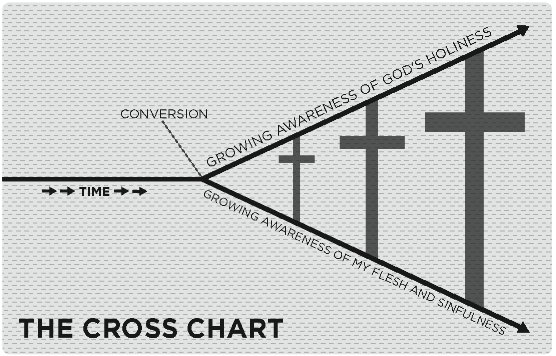
Therefore, God uses circumstances and the Bible to help us in the downward trajectory illustrated by this chart. A contrary perspective on reality is illustrated by another chart widely published by Protestant organizations:
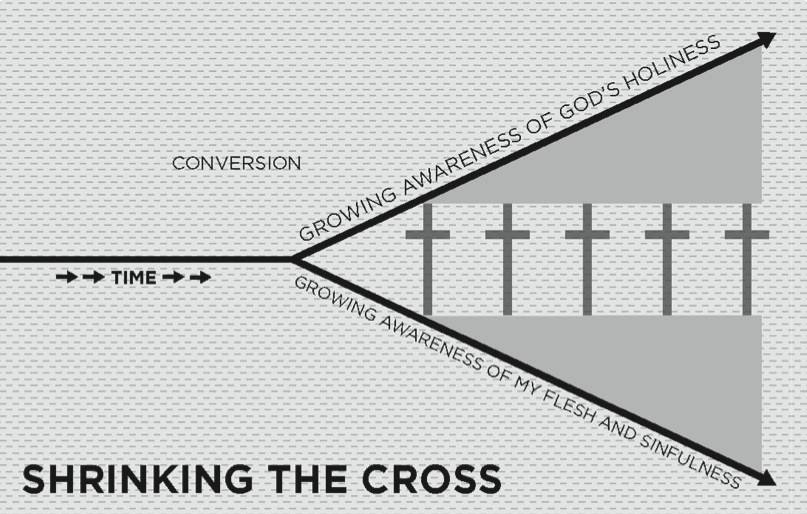
What is behind the popularity of this worldview? Simply, an ability to live a carefree life without fear of unknown circumstances (with the only exception being your eternal destiny). We all know that investing in life can set us up for enhanced disappointments and suffering. This is a worldview that completely separates us from the responsibilities of life and its suffering. Don’t worry, be happy, it’s a just a divine video tape anyway, and what will be, will be. If one of your loved ones dies tragically, don’t sweat it, it’s just part of God’s divine drama prewritten before the foundation of the earth. Besides, God is using this to make the gospel bigger and you smaller. Listen, even Protestants who don’t get this function according to the same worldview: “It’s God’s will.” “I didn’t do it! God did it!” “We are all just sinners saved by grace.” All of these Protestant truisms fit the downward trajectory of the above cross chart.
As far as Biblicism, there is a huge pushback against it. A focal point of the pushback is a book written by Protestant turned Catholic Prof. Christian Smith titled, The Bible Made Impossible: Why Biblicism is Not a Truly Evangelical Reading of Scripture. I must credit the Christian Research Institute with the following review of the book which is endorsed by many evangelical heavyweights such as Rachel Held Evans, and will help us further define Biblicism:
Smith asserts that biblicism is the constellation of ten different assumptions or beliefs: (1) The words of the Bible are identical with God’s words written inerrantly in human language. (2) The Bible represents the totality of God’s will for humanity. (3) The divine will for all issues relevant to Christian life is contained in the Bible. (4) Any reasonable person can correctly understand the plain meaning of the text. (5) The way to understand the Bible is to look at the obvious, literal sense. (6) The Bible can be understood without reliance on creeds, confessions, or historic church traditions. (7) The Bible possesses internal harmony and consistency. (8) The Bible is universally applicable for all Christians. (9) All matters of Christian belief and practice can be learned through inductive Bible study. (10) The Bible is a kind of handbook or textbook for Christian faith and practice.
While some evangelicals may downplay or deny some of these points, Smith suggests as long as you hold to some of these points, you are still a biblicist (pp. 4–5).
Before we address these points for a clearer understanding of what Biblicism is, it shouldn’t surprise us that the only alternative in the book is the Christocentric hermeneutic which is the same thing as the historical-redemptive hermeneutic. It sees the gospel or Jesus in every verse of the Bible as a result of interpreting reality itself through the suffering of the cross. It should be noted that this hermeneutic is crossing over into Catholicism as well.
(1) The words of the Bible are identical with God’s words written inerrantly in human language.
A Biblicist believes no such thing. God used fallible humans to write the Bible over 1600 years in many different languages. Because Christ warned that there would be serious consequences for tampering with God’s word, we can assume many have in fact tampered with it.
The key follows: the Bible is God’s statement on being including metaphysics, epistemology, ethics, and politics. The Bible is not without error in the transmission of these truths, but none of the truths are lost due to God’s oversight and assistance. Included is the way that the Bible was written, or its overall structure of checks and balances. As the “workman” studies to show himself approved, God’s principles become more and more apparent.
(2) The Bible represents the totality of God’s will for humanity.
This point is vague, but one assumes it speaks to the accusation that Biblicists believe the Bible speaks to every detail of life like how to fix our cars etc. While the notion is absurd, the Bible does tell us what kind of car-fixer we should be—not the details of a how-to-manual. The Bible is a manual for how we should love God and others, so while it does not give specific instructions on how to fix our wife’s Toyota, it does convey a principle of love that would prevent us from taking shortcuts on safety issues in order to save money. If it’s our wife’s car, we don’t repair the brake lines with duct tape, etc.
(3) The divine will for all issues relevant to Christian life is contained in the Bible.
This is true, and the reason for the contention is evident: the sole purpose of the Bible should be to show us how wicked we are, not instruction on loving God and others.
(4) Any reasonable person can correctly understand the plain meaning of the text.
True, with the exclusion of the straw man argument that the meaning in every text is always “plain.” The Bible states that individual study is required, and acknowledges that obtaining understanding can be difficult work.
(5) The way to understand the Bible is to look at the obvious, literal sense.
This is true as the primary organizing principle, but gain, the straw man is the assertion that Biblicists believe this is true of every verse.
(6) The Bible can be understood without reliance on creeds, confessions, or historic church traditions.
This is absolutely true because Biblicism rejects spiritual caste systems of all kinds. Teachers are a help, they are a gift to the church for purposes of equipping, NOT an office. But when it gets right down to it, in context of the apostle John addressing the Gnosticism that was wreaking havoc on the 1st century church, he stated, “You have no need for anyone to teach you.” Biblicism is predicated on collective individualism, not group-think overseen by an elite class of those who supposedly possess the “gnosis.”
(7) The Bible possesses internal harmony and consistency.
Absolutely. Again, the complexities of the Bible are used to argue against human reason as a valid epistemology for reasons of selling a redemptive interpretation of all reality.
(8) The Bible is universally applicable for all Christians.
Sure it is. Loving God and others pertains to principles that are universal.
(9) All matters of Christian belief and practice can be learned through inductive Bible study.
In regard to loving God and others, absolutely.
Note the continual distinction being made between love and law. There is a specific reason for that which we will see more of later.
(10) The Bible is a kind of handbook or textbook for Christian faith and practice.
The word “practice” factors in huge here. As previously noted, Protestantism defines salvation as an ability to see/perceive/experience APART from practice. Therefore, the Christocentric approach to interpretation of reality, and consequently the Bible as well, will reject any practice by man to be of any value to God. Therefore, the sole purpose of the Bible is to aid mankind is seeing that all righteousness is an alien righteousness completely outside of man.
So, this is an introduction to Biblicism. In the next session, we will look at the Biblicist gospel, its evaluation of law/gospel, the nature of God, the nature of man, evangelism, and the nature of sin. In the fourth session, we will examine Protestantism and the extreme contrast that it presents. I will conclude this first session with a few more principles of interpretation:
Deuteronomy 29:29 – The secret things belong to the Lord our God, but the things that are revealed belong to us and to our children forever, that we may do all the words of this law.
Deuteronomy 30:11 – For this commandment that I command you today is not too hard for you, neither is it far off. 12 It is not in heaven, that you should say, ‘Who will ascend to heaven for us and bring it to us, that we may hear it and do it?’ 13 Neither is it beyond the sea, that you should say, ‘Who will go over the sea for us and bring it to us, that we may hear it and do it?’ 14 But the word is very near you. It is in your mouth and in your heart, so that you can do it.
Two basic interpretative principles can be drawn from these verses. First, some things we cannot know, but what we can know we are responsible for. Second, we have no need for interpretive mediators between us and God. There is only ONE mediator between God and man—Christ.
Know Your Cuts of Calvinism
Originally published June 2, 2013
1. Total Depravity: Pertains to the saints also.
2. Justification by Faith Alone: Pertains to sanctification also.
3. Mortification and Vivification: Perpetual death and rebirth for living by faith alone in sanctification to maintain justification. The reliving of our baptism “again and again.”
4. Double Imputation: Christ’s passive obedience to the cross for justification, and His active obedience as a substitution for our obedience in sanctification.
5. Deep Repentance (aka Intelligent Repentance): Seeks the death of mortification in re-experiencing our new birth.
6. New Obedience (aka New Fruit): The experience of Christ’s active obedience in sanctification (vivification).
7. The New Birth: Perpetual mortification and vivification.
8. The Objective Gospel: All reality is interpreted through the redemptive works of Christ.
9. Christ for Us: Christ died for our justification, and lived a perfect life for our sanctification.
10. The Imperative Command is Grounded in the Indicative Event: Biblical commands show forth what Christ has accomplished for us and what we are unable to do in sanctification. Works are experienced only as they flow from the indicative event of the gospel.
11. Neo-Nomianism (New Law, aka New Legalism): The belief that we can please God by obeying the law in sanctification.
12. Progressive Sanctification: The progression of justification to glorification.
13. Progressive Imputation: Whatever is seen in the gospel narrative and meditated upon is imputed to our sanctification, whether mortification or vivification.
14. The Golden Chain of Salvation: See cut 12.
15. Good Repentance: Repenting of good works.
16. In-Lawed in Christ: Christ fulfilled the law perfectly and imputed it to our sanctification.
17. Redemptive Historical Hermeneutics (the Christocentric Hermeneutic, aka the Apostle’s Hermeneutic): The Bible as historical narrative for the sole purpose of showing forth Christ’s redemptive works.
18. Faith: A neutral entity within us with no intrinsic worth that is able to reflect the object of its focus outside of us. The object of focus can be experienced within, but remains outside of us.
19. The Heart: The residence of evil desires and faith. It can be reoriented (the “reorientation of the heart” or “reorientation of desires”) to reflect Christ via mortification and vivification.
20. Flesh: The world realm where evil is manifested and experienced.
21. Spirit: The Spirit realm where the imputed works of Christ are manifested and experienced (not applied through our actions).
22. Christian Hedonism: Seeks to experience the joy of vivification.
23. Obedience of Faith: New Obedience.
24. Christ in Us: “By faith,” and faith only has substance and reality to the degree of the object it is placed in; i.e., Christ outside of us.
25. Vital Union: Makes experiencing the gospel possible. Makes mortification and vivification possible.
26. Eclipsing the Son (aka the Emphasis Hermeneutic): Focusing on anything other than Christ. Anything that is not seen through a Christocentric prism creates shadows that we live in. The obstacles that create the shadows may be truth, but they aren’t the “best truth.” “They may be good things, but not the best thing.”
27. Sabbath Rest: Sanctification. We are to “rest and feed” on Christ for our Christian life. The primary day this is done is Sunday. Through preaching and the sacraments we “kill” (mortification, or the contemplation of our evil and misery) resulting in vivification throughout the rest of the week.
28. The Subjective Power of the Gospel: The manifestation of the gospel that flows from gospel contemplationism. We never know for certain whether it is a result of our efforts or the Spirit’s work (although the Spirit’s work is always experienced by joy); hence, the power of the objective gospel is subjective (Heidelberg Disputation: Thesis 24).
29. Mortal Sin: Good works by the Christian not attended by fear that they may be of one’s own effort (HD 7).
30. Venial Sin: Good works by the Christian attended with fear (HD 7).
31. Power of the Keys (aka Protestant Absolution): Reformed elders have the authority to bind or loose sin on earth (Calvin Institutes 3.4.12).
32. Redemptive Church Discipline: In all cases to convert one to cuts 1-31. This redeems them to the only one, true faith. This can be a long process, and said person is not free to leave a given church until the elders bind or loose.
33. Preach the Gospel to Yourself: See cuts 1-32.
The Magnum Opus of the Reformation: Martin Luther’s Heidelberg Disputation, Part 7: Martin Luther’s Unveiling of the Bondage of the Will
Listen to, or download audio file.
Welcome truth lovers to Blog Talk radio.com/False Reformation, this is your host Paul M. Dohse Sr. Tonight, part 7 of “The Magnum Opus of the Reformation: Martin Luther’s Heidelberg Disputation, Martin Luther’s Unveiling of the Bondage of the Will.”
Greetings from the Potters House and TANC ministries where we are always eager to serve all of your heterodox needs. Our teaching catalog can be found at tancpublishing.com.
If you would like to add to our lesson or ask a question, call (347) 855-8317. Remember to turn your PC volume down to prevent feedback. If you choose to use Skype to listen to the show, my advice is to just dial direct from your Skype account without using any of the Blogtalk links. 347-855-8317.
Per the usual, we will check in with Susan towards the end of the show and listen to her perspective.
Remember, you may remain anonymous. When I say, “This is your host; you are on the air, what’s your comment or question”—just start talking.
If you would like to comment on our subject tonight, you can also email me at paul@ttanc.com. That’s Tom, Tony, Alice, Nancy, cat, paul@ttanc.com. I have my email monitor right here and can add your thoughts to the lesson without need for you to call in. You can post a question as well.
Tonight, we continue in our sentence by sentence evaluation of the HD [Heidelberg Disputation] after addressing some asides in parts five and six. We hear a lot about Martin Luther’s bondage of the will. Tonight, we are looking at the very conception of Luther’s beliefs on the human will. What we are going to find is that Luther’s explanation of human will derived from his position of mortal and venial sin.
Simply stated, if one believes that every act they perform is mortal sin, even their good works, their life is forgivable. Man must not believe he can do a good work. Let’s use theses 11 and 12 to segue into thesis 13 which is the first unveiling of Luther’s bondage of the will.
Thesis 11: Arrogance cannot be avoided or true hope be present unless the judgment of condemnation is feared in every work.
This is clear from Thesis 4. For it is impossible to trust in God unless one has despaired in all creatures and knows that nothing can profit one without God. Since there is no person who has this pure hope, as we said above, and since we still place some confidence in the creature, it is clear that we must, because of impurity in all things, fear the judgment of God. Thus arrogance must be avoided, not only in the work, but in the inclination also, that is, it must displease us still to have confidence in the creature.
Here is something that I haven’t talked about enough in this series: the Reformers were masters of doublespeak. So far, it is obvious that Luther disavowed any value in regard to human life. Yet, in some sentences, he sort of makes it sound like that the issue is life without God. This isn’t the case at all; this is a strict dichotomy between 100% evil and 100% good with nothing in-between.
In contrast, God makes new creatures of mortal men. This flies in the face of Reformed ideology and all of the theology that flows from it. Note that, like all good Gnostics, Luther saw impurity in “all things.” And of course, that includes mankind.
Hence, as stated in this thesis by Luther, man must not have any confidence in self. In other words, God’s creation of man has no inherent ability. The natural ability to do anything is the glory story. Anything that brings glory to man diminishes God. Listen, as one example, the Puritans didn’t dress like they did for no good reason. To wear something with a little color or style would have been the glory story. By the way, do you want to help people? Know this: EVERYTHING people do they do for a reason. Logic drives action. If you want to help people, find the logic behind the action.
So, Reformed ideology splits reality into a strict either/or dichotomy; it’s either the glory story or the cross story. The glory story, or the story of man, can only bring about arrogance.
Let’s pause here to look at the foundational ideology of the Reformation which deals primarily with metaphysics. Like I said, everything people believe and do flows from their logic, so what is the logic that all of this stuff flows from? This is a very simplified version, but it really boils down to this: God does everything that He does because of His self-love. And because God loves Himself, He created evil as a contrast to His holiness. In other words, evil helps to define His holiness by contrast.
This leads to the essence of state of being, or metaphysics, or why things are, or their state of being, according to the metaphysical narrative. What’s a metaphysical narrative? Simply stated: state of being is a story written by God. Everything that is happening in the world today, right down to what people decide to wear, is predetermined by God in His historical prewritten narrative.
All of this benefits God’s self-love. Everything is for His glory. And according to this story, man thinking that he has freedom of choice on any level is evil, and what is he doing? Right, he is writing his own story. If you think that it was your decision to wear what you wore today, you are writing your own glory story. Either you are writing your own life story, or God is writing your life story. You are either god writing your own reality, or God is writing your realty.
Of course you don’t have freedom of the will—that would be writing your own reality—that would be making yourself God. We can also stop here and talk about how the Bible fits into this. The Bible becomes a prototype or model for interpreting reality according to God’s story which is primarily about redemption. The Bible is therefore a tool for interpreting reality according to the cross story, or God’s prewritten metaphysical narrative. And folks, this is everywhere. This way of using the Bible saturates the institutional church.
An example, one of myriads, is the Bible Mesh study material. Listen carefully to what these guys are saying in this promo for the study:
Notice the constant theme of Bible as story, and everything in the Bible being about Christ; ie., redemption. Notice that the Bible is also “your story” and this study enables you to put yourself in the story. You have heard me talk often about the redemptive historical method of interpreting the Bible and this is what it is. They make the Bible a tool for interpreting all of reality according to Martin Luther’s cross story metaphysics. And frankly, 90% of the evangelicals occupying the pulpit in the institutional church take this approach to the Bible.
Thesis 12: In the sight of God sins are then truly venial when they are feared by men to be mortal.
This becomes sufficiently clear from what has been said. For as much as we accuse ourselves, so much God pardons us, according to the verse, »Confess your misdeed so that you will be justified« (cf. Isa. 43:26), and according to another (Ps. 141:4), »Incline not my heart to any evil, to busy myself with wicked deeds«.
So, if you look at two slides on the program slide show, you see two contemporary illustrations published by the Reformed camp that explain where we have come to this point. The two man chart explains the metaphysics,


and the cross chart explains the application as stated in this thesis by Luther: “For as much as we accuse ourselves, so much God pardons us…” His use of Isaiah 43:26 pretty much puts it in a nutshell: confession of sin leads to ongoing justification which can only be found in the institutional church. If we believe man has no will to choose good, and that everything we do is sin, we qualify to be forgiven for purposes of ongoing justification. It’s not complicated.
Thesis 13: Free will, after the fall, exists in name only, and as long as it does what it is able to do, it commits a mortal sin.
The first part is clear, for the will is captive and subject to sin. Not that it is nothing, but that it is not free except to do evil. According to John 8:34,36, »Every one who commits sin is a slave to sin.« »So if the Son makes you free, you will be free indeed.« Hence St. Augustine says in his book ›The Spirit and the Letter‹: »Free will without grace has the power to do nothing but sin«; and in the second book of ›Against Julian‹, »You call the will free, but in fact it is an enslaved will,« and in many other places.
The second part is clear from what has been said above and from the verse in Hos. 13:9, »Israel, you are bringing misfortune upon yourself, for your salvation is alone with me,« and from similar passages.
Again, we will take note of something Luther was accustomed to in his doublespeak. Though he quotes Augustine saying that the will can do nothing but sin without grace, we know that Luther also believed that the will can do nothing but sin WITH grace. This is just another example of his doublespeak. This seems to be very indicative of Reformed teachers; they sow seeds of doubt that they are stating outrageous ideas, but after a space of time the outrageous, tempered by a contradictory statement, will be accepted through repetition. The doublespeak is a red herring until you are fully indoctrinated.
Luther is stating here that the will is “not free except to do evil.”
Thesis 14: Free will, after the fall, has power to do good only in a passive capacity, but it can always do evil in an active capacity.
An illustration will make the meaning of this thesis clear. Just as a dead man can do something toward life only in his original capacity (in vitam solum subiective), so can he do something toward death in an active manner while he lives. Free will, however, is dead, as demonstrated by the dead whom the Lord has raised up, as the holy teachers of the church say. St. Augustine, moreover, proves this same thesis in his various writings against the Pelagians.
Here is where we will employ some help from one of the leading Reformed scholars on Luther’s theology of the cross. This is from Gerhard O. Forde’s “On Being a Theologian of the Cross” which is a commentary on the HD.
Theses 14 and 15 are an attempt to define a little more closely what sort of ability may be ascribed to the will. If, as we have seen in thesis 13, the will is not nothing and is not forced or determined, and if, as we might say, we are not puppets, how then may the power of the will be described?
Pause.
Stop right there. This is the Reformed, “But of course we are not puppets, so how do we explain this?” But the only logical conclusion to Reformed ideology is that we are in fact puppets. In classic Reformed teaching protocol, the brainwashing technique is to deny the logical conclusion while hoping that you will function according to the very logical conclusion and goal that they are seeking.
Listen, according to their very own redemptive-historical hermeneutic, we are nothing but characters in a narrative. No, no, no, we are not puppets, rather, we are mere characters in a metaphysical narrative who are penciled in. And we have a choice, and this is a paraphrase, “…join the plot of the divine drama that includes your story, or attempt to be your own god and write your own glory story.” That’s it. That’s it in a nutshell.
I have been learning a lot from Susan about Jonathan Edwards, and she has so much data already accumulated that I don’t know whether she is going to be able to find this or not, but she was sharing with me about Edwards’ view of the will. Basically, he believed that before a person performs an action, God puts the thought, idea, will, and decision to act in one’s mind beforehand. This kind of goes hand and hand with Edwards’ belief that God is recreating reality at every moment. So, in essence, everything you do is a recreation of reality when it gets right down to it.
So this is how this works: the Reformed will continue to deny that we are puppets while teaching all of the elements of puppeteering. If you teach all of the elements constantly while never speaking of the logical conclusions, people will eventually function according to the logical conclusions which is what they are after. Functionality is the goal—not understanding. Reformation ideology is vehemently opposed to reason and understanding.
Here is another example: the official Reformed doctrine of already not yet. So classic. Sure, sure, you are already saved, of course you are! But not yet. So you think: “Well, sure, our salvation will be fully realized when we are resurrected. That makes total sense.” Well guess what? You just bought into progressive justification. See how this works? Salvation doesn’t have a beginning and an end. It’s a conception. Conception is a onetime final event that completes its work in an instant. You didn’t exist, now you do—end of story.
Let’s continue with Forde’s quotation.
If the claim is that we are to “do what is in us,” then the question quite naturally follows: What then is in us? What sort of capacity do we have?
Pause. Stop right there. Let me shortly answer that question according to 1John chapter 3 before we move on: God’s seed. God’s DNA. We are literally born of God and have His seed IN us. We are new creatures born of God.
To get at the question Luther here uses a distinction current in his day between what our translation has called a “passive capacity” and an “active capacity.” What does that mean? In its passive capacity the will can do good when it is acted upon from without but not on its own, not in an active capacity. A commonly used physical analogy is water. Water has a passive capacity to be heated, but it can’t heat itself. It has no active capacity to do that.
The example Luther uses in his proof is even more to the point because it deals with death and life. On the one hand, corpses could be said to have a passive capacity for life because they can be raised from the dead. But not, of course, on their own power, not in an active capacity, not even in the slightest. Not even by doing their best! The capacity they have is strictly passive. They can be raised, but only by divine power. On the other hand, it is of course true that while a people live they have the active capacity to do something about life and death. They can take life, either their own or some other, but they can’t create or give life. Yet, that only demonstrates that, after the fall, will in its active capacity can only do evil. Since will after the fall is dead and bound to do deadly sin, it can be rescued only from without, as indicated by the fact that it could not bring life out of death but could only be commanded from without by our Lord.
Thus, the fact that even after the fall the will is not nothing means that there is something there. What is it? It is a strictly passive capacity, not an active one. That means that it can be changed but it will not change itself. To be changed, it will have to be accessed “from without.” But it will take radical action. It will take death and resurrection. So we are again pointed toward the cross.
Here, we have plunged the depths of Martin Luther’s bondage of the will. Man is dead, and death is defined as the waters of mortal sin. The waters of mortal sin are not only what man dwells in, he is those waters. He is passively dead. The only active works he can do is dead works. The material realm is man’s glory story of death. He ebb and flows between dwelling in death and experiencing resurrection resulting from him being acted upon from the outside. Being acted upon is completely determined by God’s decision and good pleasure. The long and short of being saved is merely giving testimony to this fact and seeing it for what it is. Saving faith is giving testimony to what you see only, and not anything that you do.
To think you are not dead is mortal sin that cannot be qualified for forgiveness. And again, do see what these guys do? No, no, we are not puppets, right? A question: what do we know about puppets? Well, we know that they are dead. We know that they cannot do anything until they are acted upon, right? This Gerald Forde guy is just like all of the Reformed; he will deny that he is saying that we are mere puppets, and then will describe our Christian existence as puppetry.
This is what annoys me so deeply about people who listen to these yahoos because, “they say some good things.” Why would anybody spend any time investing in this intellectual dishonesty?
So, what is the biblical view of the will? Romans chapter 6. Before one is saved, they are enslaved to sinful desires and free to do good works. Slavery indicates the type of wages that the slave gets—only wages for death. Unsaved people are also indifferent to the law that they will be ultimately judged by. They do not love God’s law. But, they definitely have a free will to follow their God-given conscience and receive rewards for doing so. A person who lives a good common sense life will of course suffer fewer calamities than the foolish. But in the end, this only means less condemnation.
The saved person also has a free will. They are enslaved to righteousness, but unfortunately free to commit sin. However, they do not receive wages of death because they are no longer under the condemnation of the law. They can only receive wages for life. They are no longer indifferent to the law, but love God’s law and its truth. The chart below may help:
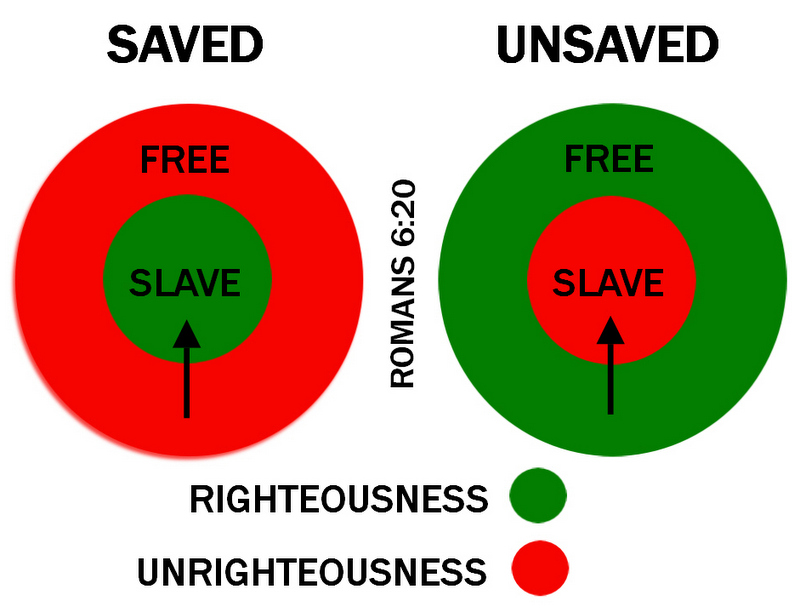
The new birth is a reversal of sin and slavery resulting in a change of direction. No one sins perfectly, and no one loves perfectly. It’s a direction, not perfection. But if you look at the Reformed cross chart again, neither is it a downward direction of sinful perfection resulting in making the cross bigger.
That’s the end of our lesson tonight—let’s go to the phones.
Another Protestant Misnomer: Inerrancy
 This seems to be Protestant misnomer week here at PPT. I am fond of writing about the fact that everything that has ever come out of authentic Protestantism is a lie except for “Jesus Died for Our Sins,” and even that is a half-truth used in the commission of felonious theology.
This does not mean to say that every person who thinks they are a Protestant has no grasp of the truth; no, no, it means to say that they are misinformed and confused enough about true Protestantism to be saved. That’s a good thing, but one’s best life now is to properly understand what they call themselves.
To name a few misnomers that we talk about here at PPT, we have, elder authority, not in the Bible, we have church membership, not in the Bible, we have church discipline, not in the Bible, we have legalism, not in the Bible, we have Christian self-righteousness, not in the Bible, we have the church as the bride of Christ, not in the Bible, we have tithing, not a New Covenant concept; to name just a few. In this post, we will address the whole idea that Protestantism was founded on the inerrancy of Scripture.
This is not true. Not even close.
Protestantism was founded on the Redemptive Historical interpretation of Scripture. Sure, Protestant academia claims Grammatical Historical interpretation, but that is only for the purpose of coming to a Redemptive Historical conclusion; this is a classic example of Protestant doublespeak.
If you call yourself a Protestant, shouldn’t you know how the original Reformers interpreted Scripture? Here is a free booklet that explains all of this in detail; enjoy. It is an ebook that you can view and upload for free. Here is the link: Gospel T. ebook
Good luck in your journey to have your best life now by understanding what you call yourself.
paul
What Your Sanctification Says About Your Justification: Is Your Gospel True or False?
 Originally posted February 27, 2015
“The law is the standard for love, not justification. In all of the aforementioned systems of sanctified justification by works, faith doesn’t work because it can’t lest salvation be lost. In the Christian life faith works because it can for the sake of love without condemnation.”
“Knowing that justification is a settled issue that has nothing to do with the law anyway, the true Christian only sees law-keeping as an opportunity to love. Christians not only have the anthropologic law of conscience written on the heart, the new birth writes the Bible there as well. In other words, we love the law.”
“Obviously, those who must focus on faith alone works in order to remain justified cannot focus on aggressive obedience to the law that defines love.”
What do you believe about salvation? Your Christian life will tell you. Therefore, the parable of the talents in Matthew 25:14-30 should not confuse us. The “wicked” servant was not cast into outer darkness because he didn’t put his talents to work, but rather what he thought it meant to be a servant. In other words, in order to be saved, you need to know what a Christian is. That should be fairly evident.
Do you live your Christian life by “faith alone”? That is a statement in regard to what you believe about salvation, or what happened to justify you, viz, justification.
This is not complicated. Don’t complain that I am making your touchy-feely “simple” gospel a theological treatise. I am sure you concur that some Bible words have to be understood in order to be saved. The Bible splits humanity into two categories: saved and unsaved, i.e., “under law” or “under grace” (Romans 6:14).
“Under law” is the biblical nomenclature for the unregenerate lost. Under law means that sin rules you. Not in a plenary sense, because man’s conscience and fear of punishment from civilian law restrains people. Yet, they are under the condemnation of God’s law and every violation is documented. Unless they are saved, they will be judged according to their works in the final judgment. Though some who followed their conscience more than others will receive a lesser condemnation, it is still eternal separation from God. They are under law, and enslaved to sin. The last judgment DOES NOT determine justification; it ONLY determines the degree of eternal condemnation. It doesn’t determine justification; it only determines the wages of sin.
Moreover, sin uses the condemnation of the law to provoke people to sin. Primarily, sin uses desires to tempt people, but sin’s incentive is the law because it condemns. Sin lives for the purpose of condemning people, and uses desire to get people to sin against God’s law. This leads to present and eternal death. Sin’s desire is to bring death. When the Bible speaks of “the desires of the flesh” it is referring to instances when the flesh is serving the desires of sin.
The flesh can also be used to serve the desires of the Spirit (Romans 12:1). The flesh has NO desires; it is used by the dweller for good or evil purposes. We will either use our bodies to serve the desires of sin or the desires of the Spirit. Of course, people have their own desires, but unfortunately, the unregenerate are guided by the desires of sin. They assume sinful desires are their own desire which is true. In contrast, sinful desires are not part and parcel with the regenerate soul.
Said another way: among the lost, the desires of sin are very much the same desires possessed by the individual who are indifferent to the law of God. A desire for God’s law is absent while their life is continually building a death and condemnation dividend. Some of that dividend is paid in this life until the full wages of death are paid at the final judgment.
Under grace is not void of law. The law (same as “Scripture” or same as “Bible”) has a different relationship to the saved, or those under grace. A literal baptism of the Holy Spirit takes place, as symbolized in water baptism, which puts to death the old person under law and resurrects the new person under grace. The saved person is now a new creature created by the Spirit of God. The person under grace is literally born of God—he/she is God’s literal offspring.
Therefore, the old person is no longer under the condemnation of the law in the same way a dead person cannot be brought under indictment for a crime. Consequently, the motivation for sin is gone. The power of sin is the law’s condemnation that leads to death (1Corintians 15:56, 57). In addition, the person under grace has been given a new heart that loves God’s law and its way of life. The book that could only bring death is now a book that brings life. Either way, it is the Spirit’s law; He uses it to condemn those that are under it, or uses it to sanctify those who are under grace (John 17:17).
THEREFORE, how you see the law determines what you believe about salvation. If you believe that you can somehow obey the law in a way that unwittingly seeks to be justified by law-keeping, you are still under law. If you believe justification is defined by perfect law-keeping, you are still under law. Those who believe this also believe they need a salvation system that filters all their works into a category of faith alone. The Christian life is categorized or departmentalized into works that attempt to be counted for justification and faith alone works that qualify as “living by faith alone.” Do not miss the point that this also includes abstaining from certain things that aren’t necessarily sin as defined by the Bible.
Yes, hypothetically, a person would need to keep the law perfectly to be justified by the law, but that doesn’t make perfect law-keeping the standard for righteousness. If that were the case, the law is a co-life-giver with the Holy Spirit, and a death would not be necessary. We are justified APART from the law—law has NO part in justification. The Bible defines justification, but it’s not a standard of justification (Rom 3:21, Gal 2:19, 4:21). Law-keeping by anyone does not justify.
If one is trusting in a system that fulfills the law for justification, particularly if it calls for not doing something in order that the law is fulfilled in our place, that is works salvation through some kind of intentionality whether passive or active. These kinds of systems are always indicative of being under law rather than under grace. One such system that has several variances calls for doing certain things or not doing certain things on the Sabbath which can be Saturday or Sunday depending on the stripe of system. If you follow the system on the Sabbath, all works done by you during the week are considered to be by faith alone.
In Reformed theology, particularly authentic Calvinism, contemplation on your sin leading to a return to the same gospel that saved you imputes the perfect law-keeping of Christ to your life. Notice that a fulfillment of the law is required to keep you saved, but we do faith alone works in order that Christ’s perfect law-keeping is imputed to our account. The problem here is that a fulfillment of the so-called “righteous demands of the law” is the standard for justification. Hence, clearly, this keeps so-called “Christians” UNDER LAW. In addition, a so-called faith alone work is still a work.
Not so with under grace. We are now free to follow our new desire to obey the law out of love without fear of condemnation. The law is the standard for love, not justification. In all of the aforementioned systems of sanctified justification by works, faith doesn’t work (or love) because it can’t lest salvation be lost. In the Christian life (sanctification) faith works because it can for the sake of love without condemnation (Galatians 5:6).
Knowing that justification is a settled issue that has nothing to do with the law anyway, the true Christian only sees law-keeping as an opportunity to love. Christians not only have the anthropologic law of conscience written on the heart, the new birth writes the Bible there as well. In other words, they love the law. Obviously, those who must focus on faith alone works in order to remain justified cannot focus on aggressive obedience to the law that defines love.
This is exactly what the books of James and 1John are about. Faith is not afraid to work because there is no condemnation. Faith without works is dead, “being alone” (James 2:17 KJV).
Are you in a religious system that propagates faith “alone” in the Christian life? Your faith is not only dead, it speaks to what you believe about justification. You believe justification has a progressive aspect and is not completely finished. Secondly, you believe the law has a stake in justification. Thirdly, your system categorizes works as faith alone works (an oxymoron of sorts) or works that are unfiltered in some way and therefore are efforts to “self-justify.”
If you believe the right gospel, you know that it is impossible to unwittingly partake in an endeavor to justify yourself. It’s a metaphysical impossibility—it’s not in the realm of reality. No false religion teaches that you earn your justification by perfect law-keeping—there is always a system that prescribes sanctified do’s and don’ts that in turn fulfill the law for you, otherwise known as “the traditions of men.”
It’s the fallacy of faith alone works for justification. But any work for justification is justification by works whether doing nothing (abstinence is still doing something), something passive (contemplationism or prayer is also a work) or anything active.
Law and justification are mutually exclusive, and true faith is “faith working through love” (Galatians 5:6). Faith works because there is no fear in love (1John 4:18). Don’t be like the servant who was afraid and hid his talents in the ground. Christ said it best:
“If you love me, keep my commandments.”
paul

 Paul's Passing Thoughts
leave a comment