Christianity and Islam: The Pot Calling the Kettle Black?
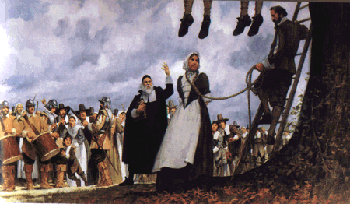
Originally posted March 10, 2014
Many relate to my personal testimony; despite my best efforts, I have been for the most part at odds with church. Julia Duin noted in her book Quitting Church that she has always sensed that something is fundamentally wrong with the Evangelical church.
I wonder if that mysterious fundamental reason has come to light. Note this statement by Al Mohler, arguably the most influential Evangelical of our day:
Niebuhr’s fifth model is where he seems to be pointing us, that is, to Christ the transformer of culture. These are the conversionists, and they are far more hopeful than the dualists. They understand the distinction between Christ and the culture, but they also understand that it is the mission of the church to transform the culture with the claims of Christ. We continually hear this kind of language: “Let’s go out and redeem the culture. Let’s go out and conquer the culture in the name of Christ. Let’s transform every dimension of the culture, whether the media and the arts, or business and finance, and let’s subdue them to the claims of Christ. Let’s have a more Christian military and a more Christian realm of arts.” This leads to a very progressive impulse, one which looks to a better world and a better condition if we will only do this. It promises transformation, hopes for cultural redemption, and leads to Christian activism. (Preaching the Cross: chapter 3, subheading; Niebuhr’s Treatment of Christ and Cutler, Niebuhr’s fifth model).
What a minute. Is this not the exact same vision as Islam? Moreover, do Muslims understand this better than most Christians? When Christian missionaries travel abroad, are they perceived this way whether they know it or not? When we hear of Christian missionaries being murdered or detained for “conspiracy to overthrow the state,” we immediately assume that’s a crock. Well, maybe not when you consider what the Crusades were all about coupled with this contemporary dominion mentality among leading Evangelicals.
Furthermore, Al Mohler is far from being the only one propagating these ideas. This same idea is the theses of Paul David Tripp’s book Broken-Down House. Many examples could be given, but I will not belabor the point past the following notation by blogger Joel Taylor:
While filming a promo in Dubai (UAE) for the new student missions conference, CROSS, John Piper (standing in front of the Burj Khalifa tower) makes this statement:
“And that tower and this city are coming down!”
Was that a wise thing to say while standing on United Arab Emirates soil? I wonder how the Arab people would understand his remark if they saw this?
It probably wouldn’t surprise them. The American church was founded on the Reformation, and many of its European stalwarts had their own standing armies. And ok, we have much spiritual tyranny and a divine right of kings mentality in the church today; ya think? If they muse about bringing down the Burj Khalifa tower what do you think they will do to you if you ask too many questions?
So this explains everything. It’s really not about the gospel. It’s not about making disciples, it’s about globalism. Making “disciples” is not the primary goal, it’s only a small part of a much larger vision. The whole idea that people can only find salvation in the “local church” is the ploy that funds the global vision while Christians believe it’s about the gospel. We are encouraged to bring people to church to get them saved for that very reason. It also brings to mind all of the hoopla about “lone rangers” who are not “under the authority” of a local church.
Do I think this clarifies the mission of home fellowships? Absolutely. Do you want to make disciples? Or do you want to fund world dominion? Christ’s mandate to the assemblies was to make as many disciples as possible before Christ returns. Why? Because He is not calling on Christians to renovate the earth—He is going to come back and blow up the whole thing and start over.
This is a short post, but one that opens up a very wide avenue of considerations. “There is no perfect church”: that’s not the issue; the issue is the fundamental mandate. That’s not merely a question of perfection, but the difference between eternal investment or a complete waste of time and money.
paul
Tchividjian Booted from The Gospel Coalition for Being Too Concise
 Originally posted May 21, 2014
“Tullian Tchividjian is John Calvin. Period.”
Be sure of this: Tullian Tchividjian thoroughly understands Reformed doctrine and its gospel. Tchividjian doesn’t believe one whit different from anybody who writes or speaks for The Gospel Coalition, and they ALL know it.
The problem with TT is that he does not follow the philosopher king script of nuance for the sake of the totally depraved herd that is “not ready” for the true Reformed gospel of justification by faith…plus the dirty little secret of faith alone for both justification and sanctification. It’s like total depravity this, and total depravity that, and “oh, we forgot to mention that includes the saints as well.”
TT is not nuanced enough. In this interview here, it is absolutely clear that this is the reason he was sent packing. Because of him, The Gospel Coalition, T4G, and others have to recruit sanctification gurus Jerry Wragg, Kevin DeYoung, and Mike Fabarez to cleanup his mess and calm the mindless totally depraved zombie sheep. They are tired of cleaning up the messiness of questions raised as a result of TT’s accurate articulation of the Reformed gospel.
There is only one thing better than a rank antinomian, an honest one. Charles Spurgeon once said that Calvinism isn’t a nickname, Calvinism is the gospel. Let me take that a step further for our purposes: Tullian Tchividjian is John Calvin. Period. I will debate anyone out there who has a problem with TT’s Calvinism and will show clearly from the Institutes that TT is spot on. Get over it. Please debate me on this, you will lose.
In my disdain for the Neo-Calvinist movement, a weird respect is floating to the top for the few who know what Calvin really believed and are honest about it. In fact, who else is there other than TT and Joseph Prince? (see here for explanation). How bad is it when I have to admit that I respect these guys because A, they know what they are talking about, and B, they are honest about it? Prince’s life application is beside the point, he understands the Reformed version of justification by faith, and the rest of the story mostly untold.
The two other camps annoy me to no end: those who think there is a difference between New Calvinism and Old Calvinism, and for that matter, Sonship theology as well, and those who know grade-A-well that there is no difference and are lying about it. I have also lost all patience with those who think they can help the spiritually abused while retaining some supposedly respectable remnant of Reformed theology. Name one aspect that passes a grammatical interpretation of Scripture: it’s not there.
So there it is. TT is very important to this ministry because people have to know what they believe before you can convince them. We think followers of TT know what they believe. The rest? It’s really just a massively confused personality cult with a plethora of discernment bloggers adding to the confusion by dissecting all of the symptoms.
Get with the program: it’s either Tullian or something else.
paul
The Calvinist’s Greatest Fear: The Spiritual Peasantry Will Understand Law and Grace
Originally published January 2, 2013
“The two are completely separate; the law is left behind in the former and loved in the latter.”
Susan and I perceive constantly that most Christians don’t understand the difference between justification and sanctification. Said another way, they don’t understand the difference between law and grace. This is by design. Instead of outlawing the Bible like the Popes, the Reformers merely posited the Bible as a catechism that aped their orthodoxy derived from counsels and creeds. I won’t mention names, but prominent evangelical leaders have shared with me personally that they know the general populous of American Christians are theologically illiterate. And again, this is by design. And, most Christians in our day openly admit it, and in some cases are proud of it. The remainder admits they believe that the pastorate is an intermediary between them and what God wants us to understand.
There are a number of problems with this, but primarily, God thinks it’s a bad idea. The Bible is clearly written to Christians in general. And His word cannot be properly understood unless it is read in the context of justification/sanctification. Whatever your opinion of the American church, it is a product of parishioner illiteracy in regard to doctrine; that is certain and indisputable.
Though it takes a lot of study to see some things in simple form, the simple fact of Calvinism (and we are all Calvinists if we are Protestant) is that it makes “under” a verb and not what it is: a preposition. They could get away with this in medieval times because most people didn’t know the difference. In our day, we know the difference, but assume the pastorate has a set of metaphysical eyes given to them by God before the foundation of the world that we don’t have—so our eyes don’t even blink when their interpretations contradict the plain sense of Scripture.
As we have seen in our previous observations from the book of Romans, Christians are UNDER grace and were previously UNDER law. All people born into the world are born into it UNDER the law, and will be judged by it at the end of their lives if they don’t escape it. Christ was the only man ever born under the law that could live by it without sin and was therefore the only man ever born who could die for our sins. We escape the condemnation of the law by believing in what He did to make a way of escape for us. Calling on Christ to save us acknowledges that we all fall short of God’s glory and are therefore in danger of eternal separation from Him.
We are “under” grace, NOT “under” law:
Romans 6:14—For sin will have no dominion over you, since you are not under law but under grace.
The word for “under” here is hupo which is a primary preposition. Calvinism teaches that we are still under the law. This is the main reason that it is a false gospel. Now, they would vehemently deny this in the following way with red faces and veins popping out of their necks:
NONSENSE! We emphatically state constantly that no man is justified by the law unless he can keep it perfectly and we all know that no man can keep the law perfectly. We constantly cite James 2:10 which states that if we break the law at one point—we are guilty of breaking the whole law. HOW DARE YOU SLANDER US IN THIS WAY!!!
This argues the point by making “under” a verb (something we do or don’t do) rather than a position. Therefore, they are not arguing jurisdiction, they are arguing practice in regard to how we are justified. Position is the issue, not what we do; i.e., keeping the law or not keeping the law, or doing this/that in this way or the other way etc. Calvinists believe our position stays the same; therefore, what we do becomes critical. In fact, what we don’t do keeps us saved; e.g., “You don’t keep the law by keeping the law.”
There are four versions of “Christians” still being “under” the law, or under its jurisdiction. First, antinomianism which teaches that we are still under the law, but God cancelled our obligation to keep it because it promotes grace. Secondly, that we are still under the law, but the Holy Spirit helps us keep it so that we will pass the final judgment. Thirdly, that we are still under the law, but if we perform certain rituals within the church, by authority of the church, our sins are continually forgiven (perpetual pardon in the face of the law). Fourthly, we are still under the law, but Jesus keeps it for us while we continually contemplate His saving works in the Scriptures. This is the Reformed view. And of course—it’s no less a false gospel than the former three.
This is verified by their interpretation of Galatians 2:20—this exposes their heresy:
I have been crucified with Christ. It is no longer I who live, but Christ who lives in me. And the life I now live in the flesh I live by faith in the Son of God, who loved me and gave himself for me.
We supposedly remain spiritually dead, which as they know is clearly synonymous with being under the law in Scripture. So, Galatians 2:20 is interpreted as being applicable to our Christian life. We don’t live in our Christian life, we are still spiritually dead, but the living Christ within us keeps the law for us so that the “ground of our justification will be Christ in the final judgment.” Calvinists believe that we are not under the law in regard to the idea that we don’t keep it in our Christian life to be justified, Christ keeps it for us. Hence, “under” is a verb issue rather than a position issue. What we do becomes critical, not where we are positionally. Therefore, Calvinism makes our Christian life (sanctification) by faith alone as a way to maintain our just standing for the final judgment. Only problem is, we are still fulfilling a requirement of the law in cooperation with Christ—this is the problem of salvation being a verb issue rather than a preposition issue. If the law no longer has jurisdiction over us FOR JUSTIFICATION, who keeps it or doesn’t keep it is irrelevant FOR JUSTIFICATION.
Then what is Paul talking about in Galatians 2:20? He is talking about justification; not sanctification, this should be evident. Consider the context:
Galatians 2:16—yet we know that a person is not justified by works of the law but through faith in Jesus Christ, so we also have believed in Christ Jesus, in order to be justified by faith in Christ and not by works of the law, because by works of the law no one will be justified.
Galatians 2:17—But if, in our endeavor to be justified in Christ, we too were found to be sinners, is Christ then a servant of sin? Certainly not!
Galatians 3:11—Now it is evident that no one is justified before God by the law, for “The righteous shall live by faith.”
Consider verse 21 which immediately follows 2:20:
I do not nullify the grace of God, for if righteousness were through the law, then Christ died for no purpose.
Why do Calvinists apply Galatians 2:20 to sanctification? Because what we do is the issue, not our position, so Christ must obey the law for us. To the contrary, we are justified because the old self that lived in the flesh died with Christ. And when it did, we also died to the law. So, in regard to justification, we can only be justified if the life we lived in the flesh is dead and no longer under the law. Being alive in the flesh equals: being under the law. Now, obviously, our mortal bodies are still alive in one sense in that we are walking around, but in reality the old self is dead and the power of sin and the law are broken. In that sense, we are dead, and justified via the fact that Christ was resurrected for our justification (Romans 4:25). Notice that Paul states that he is dead in regard to his life “in the flesh.” This doesn’t mean that we are also spiritually dead in sanctification. The context of Galatians 2:20 is justification. Hopefully, Romans 6:5-14 will clarify this for you:
5 For if we have been united with him in a death like his, we shall certainly be united with him in a resurrection like his. 6 We know that our old self was crucified with him in order that the body of sin might be brought to nothing, so that we would no longer be enslaved to sin. 7 For one who has died has been set free from sin. 8 Now if we have died with Christ, we believe that we will also live with him. 9 We know that Christ, being raised from the dead, will never die again; death no longer has dominion over him. 10 For the death he died he died to sin, once for all, but the life he lives he lives to God. 11 So you also must consider yourselves dead to sin and alive to God in Christ Jesus.
12 Let not sin therefore reign in your mortal body, to make you obey its passions. 13 Do not present your members to sin as instruments for unrighteousness, but present yourselves to God as those who have been brought from death to life, and your members to God as instruments for righteousness. 14 For sin will have no dominion over you, since you are not under law but under grace.
As we have noted before in our Romans study, being under the law comes part and parcel with being lost and under the power of sin which is provoked by the law. The flesh under the law is like throwing gasoline on a fire (Romans 7:8-11). But notice in Romans 6:5-14 that there is both death and life. This passage in Romans also adds “death” to being under the law and the bondage of sin. Galatians 2:20 only speaks of our death to the law and sin (“Apart from the law, sin lies dead”), not the life we have in sanctification. Romans 5-14 speaks to both because the context includes both sanctification and justification:
13 Do not present your members to sin as instruments for unrighteousness, but present yourselves to God as those who have been brought from death to life, and your members to God as instruments for righteousness. 14 For sin will have no dominion over you, since you are not under law but under grace.
We have been brought from death to life. The life we live in the flesh has had the power and dominion of sin under the law broken because we died with Christ. We are dead and Christ lives for our justification:
Romans 4:23—But the words “it was counted to him” were not written for his sake alone, 24 but for ours also. It will be counted to us who believe in him who raised from the dead Jesus our Lord, 25 who was delivered up for our trespasses and raised for our justification.
In regard to justification and this life we live in the flesh, we are dead, and more importantly, also dead to the law as well, and only Christ is alive, but that doesn’t pertain to sanctification as well. In sanctification, we are alive, and UNDER GRACE. In justification, the old self is dead and no longer under the law. Calvinists believe we remain under the law in sanctification, and being under the law is synonymous with still being spiritually dead. Therefore, we remain dead in sanctification and under the judgment of the law, so the law must be fulfilled for us.
Being under grace is synonymous with being born again, new creatures, informed by the law, not under it (see Galatians 2:19), and lovers of the truth. Obedience to the law is now our means of loving the Lord and showing the world that we love Him. The law is the full counsel of God in regard to family harmony and kingdom living. It informs us on how to be separate from the world. In a word: sanctification. The law in regard to judging our justification has NO jurisdiction over us. We are no longer under it.
The very fact that Calvinists propagate a total depravity of the saints in which bondage to sin is not broken clearly illustrates that the law is still a standard for our justification; we are still under its jurisdiction for our just standing. A cursory perusal of Reformed writings can produce a motherload of citations to establish this fact, but one from Reformed icon G. C. Berkouwer should suffice:
Bavinck too, wrote in connection with the regenerating work of the Spirit: “The regenerate man is no whit different in substance from what He was before his regeneration” (Faith and Sanctification p. 87).
Clearly, this can only mean one thing: the one that is “no whit different” must also remain under the law. His position hasn’t changed, so lest one attempt to be justified by the law, what is done in sanctification becomes paramount in eternal issues as opposed to it being a Divine family matter. The Reformed camp uses the book of Galatians to argue for this when the book actually addresses their specific error. They use the book of Galatians, as mentioned, particularly 2:20, to argue a supposed Pauline position that the Galatians were doing things in their sanctification that was affecting the status of their just standing. Again, the Reformed crowd makes what we do in sanctification the issue, not our position which biblically proposes that nothing done in sanctification can affect justification. The Reformed use of Galatians to argue this propagates a fusion of justification and sanctification which makes the law the standard for justification from salvation to glorification.
However, the book of Galatians is the antithesis of such as it shows a clear dichotomy between justification/sanctification and the application of the law in each. In justification: NO application. In sanctification: obedience. In regard to no law in justification, but the law informing our sanctification, consider Galatians 2:19:
For through the law I died to the law, so that I might live to God.
We have also noted in our Romans study:
But now the righteousness of God has been manifested apart from the law, although the Law and the Prophets bear witness to it—
We are justified apart from the law, but we would not know anything about these issues if not informed by the “Law and the prophets.” Furthermore, after belaboring the point about their being no law in justification, in both Romans and Galatians Paul makes his point by asking “What saith the Scriptures?” (Romans 4:3 and Galatians 4:30). And the absolute classic point on this is Galatians 4:21:
Tell me, you who desire to be under the law, do you not listen to the law?
There is no law in justification, but the law informs our obedience in Sanctification. Scriptural examples are myriad, but consider Galatians 5:2-7:
2 Look: I, Paul, say to you that if you accept circumcision, Christ will be of no advantage to you. 3 I testify again to every man who accepts circumcision that he is obligated to keep the whole law. 4 You are severed from Christ, you who would be justified by the law; you have fallen away from grace. 5 For through the Spirit, by faith, we ourselves eagerly wait for the hope of righteousness. 6 For in Christ Jesus neither circumcision nor uncircumcision counts for anything, but only faith working through love.
7 You were running well. Who hindered you from obeying the truth?
Verses 2 through 6 are about justification by faith alone apart from the law. Verse 7 concerns sanctification—running and obeying which we are free to do aggressively without fear of it affecting our justification. The two are completely separate; the law is left behind in the former and loved in the latter. I once heard a Reformed pastor fuming from the pulpit over a statement that he heard at a conference: “He said that the law leads us to Christ, and then Christ leads us back to Moses. THAT’S BLASPHEME!!!”
No it isn’t. When the law was increased through Moses, it had a dual purpose: to increase sin in order to show those under the law their need for salvation, and as can be ascertained by many other texts, for the saved to better glorify God:
Romans 5:20—The law was brought in so that the trespass might increase. But where sin increased, grace increased all the more,
Galatians 3:19—Why then the law? It was because of transgressions….
paul
Mom Wants to Know: Why I Don’t Like Mike Huckabee (and Other Adorable People)
Originally published February 10, 2014
I am very busy and need to combine eight posts into one which is not difficult because it’s all related. I need to write about Mike Huckabee, Joni Eareckson Tada, Boz Tchividjian, K-Love, stuff happens theology, plumbing, Communism, and of course John Calvin, but not necessarily in that order.
Let’s start with a conversation that occurred over at my mom’s house about former Governor Mike Huckabee. Susan and I were over at her house overseeing the repair of her furnace. My study of medieval religion has given me a robust appreciation in regard to American ingenuity and technology. A working furnace is critical for someone my mom’s age in sub-zero weather. The furnace was repaired by a competent young man within hours of us calling, and let me add that he also laughed at my jokes.
Plumbing
When all was accomplished, Susan and I said farewell to mom and then received a call on my cellphone about four miles from her house; she reported a funny hissing sound in the kitchen. We returned, and concluded that a frozen water pipe had broken under the kitchen floor. This was totally unrelated to the furnace repair. There we were, the day well spent, and a broken water pipe shooting out gallons of water by the minute underneath the shallow crawl space of the kitchen.
Another competent repair man to the rescue, even at that hour? Maybe, but my mom is long retired and lives on a limited income. I went down to the basement and turned off the main water supply to the house and also observed the following: much cost was spared in installing shutoff valves, but the kitchen was an isolated run of two copper pipes easily accessible before entering the long and shallow crawl space under the kitchen. It became apparent that those two pipes could be sealed off and the rest of the house would have water until the broken pipe was fixed. The trade of a dishwasher and one faucet for flushing toilets etc. in the rest of the house would be a good trade indeed.
I have some past limited background in plumbing, so Susan and I drove to the nearest Lowes to buy sand paper, a propane torch, two copper end-caps, solder, flux, a small brush, a hack saw, and inner pipe brush. Then we talked to a delightful young man that informed me that American plumbing had indeed changed since fifteen years ago when I was dabbling in it here and there as a builder. He informed us that we would only need two “push fittings” and a mini pipe cutter, and about five minutes.
“Uh, let me get this straight. I just cut the pipe, and push this thing on the end of it, and I am done? ‘Right.’”
Now visualize me looking at the guy like he is the Lowes version of John Calvin as he explained how the simple contraption worked. Remember those weaved tubes that we used to put on our friends’ finger when we were kids back in the days of extreme political incorrectness? The tightness of the device around the finger increased with pull. It was the initiation ceremony of choice for all neighborhood club houses. In this case, the pipe is the finger and the water pressure is the sadistic adolescent.
Huckabee
All of this is why I don’t like Mike Huckabee. After the plumbing repair, we hung around awhile and watched the Mike Huckabee show on the Fox News channel. I informed mom and Susan that I don’t like the guy. Like many, they were astounded that anyone of Christian stripe could dislike that cornball.
“Why don’t you like Huckabee?!”
I really didn’t have an answer at the time. But I thought about it all night and realized that the answer was right under my nose the whole time—so I hereby write.
Tada
Huckabee had the mega storied Joni Eareckson Tada on his show. Both of these people are impressive and adorable. Tada has been a paraplegic since her teen years, but her life accomplishments are over the top. Both are the epitome of American pie and conservative Christianity. The reason Huckabee had Tada on his show was to discuss the “Academy’s rescinding of its Oscar nomination for ‘Best Original Song,’ which appeared in the inspirational American colonial epic, ‘Alone Yet Not Alone,’ when it was discovered that the composer, Bruce Broughton, had sent a short email bringing the song to the attention of Oscar voters.” Tada was the vocalist.
Christians en masse stand in awe of Tada, and Huckabee added to her mystique with his mainstream Christian appeal. And this is the problem with Huckabee: he doesn’t get it. Huckabee is the poster child for the Christian metaphysical treadmill. Tada is very much a part of the New Calvinism movement which is a return to authentic Reformation ideology.
Communism
It is nothing more or less than Communism dressed in Bible verses. This is where the Huck doesn’t get it; as a political/religious conservative, he is representative of many in Christianity who allow their principles to fornicate with contrary ideology. This leads to a never ending endeavor to change society while unwittingly giving credence to the very ideologies that are the source of the problem.
In the same show, Huckabee, prior to Tada’s segment, criticized the opening ceremonies at this year’s winter Olympics in Moscow which promoted the virtues of Communism. He commented that Lenin’s murderous legacy was conveniently left out. Meanwhile, in the next segment, here comes Joni Eareckson Tada who represents a return to John Calvin purism. Granted, Tada’s extensive education came from seminaries that don’t teach the significance of how philosophy progressed through history and how that applies to the doctrine she embraces. Long story short, this leads to a contradictory motif in her own life as she benefits from an array of technological advances that has made much of her success possible (more on that later), but the larger point is that Reformation theology and Communism came from the exact same ideological source along with its presuppositions concerning mankind.
Hence, Huckabee partakes in the same hypocrisy that he criticizes. The Reformers were NO LESS murdering despots than Lenin—that’s conspicuous history plain and simple. In fact, in most cases, Lenin had people shot in the head while the Reformers wouldn’t have tolerated such a quick and painless departure by those whom they disagreed with. Huckabee is the epitome of the well-polished American do-gooder that refuses to come to terms with the fact that the Pilgrims, the Puritans, and the Reformers are not part of the ideology that made America; they are in fact part and parcel with Communist ideology. Putin needs ratings no less than Huckabee does.
The progression of philosophy and how it affects humanity is magnified in the differences between America and Russia. Huckabee, again, in the same show, pointed to the poor quality of life in Russia that is hindering the Olympics. What he doesn’t realize is that it would be much worse if it wasn’t for America. You have to have technology to eventually destroy the Great Satan, but if Russia ever succeeds, technology goes bye-bye, and the mass graves become filled with the Joni Eareckson Tada’s of the world because they can’t “contribute to the greater good of the group.” This is why Russia’s technology will never rival that of American ingenuity: Communists see technology as a necessary evil, Americans see technology as a means to accomplish good.
Really, this can be summarized in the living contradiction that is Joni Eareckson Tada. While promoting Luther’s worm theology and making one statement by God to the apostle Paul the whole enchilada, she continually pontificates, “God’s power always shows up best in weakness.” Communism asserts that the masses are hapless and incompetent; Reformation theology asserts that man defaces the glory of God through his own accomplishments. Both share the same presuppositions in regard to mankind. Tada points to her disability as set against her accomplishments as proof of Reformed doctrine while completely dismissing God’s use of technology invented by those who in many cases could care less about God. Tada has a lot of education in regard to what others told her is in the Calvin Institutes, and conveniently missing are Calvin’s vast discussions of Plato and Aristotle. I dare say that the Reformation had more to do with those two men than “justification by faith alone.”
And by the way, the Reformation wasn’t about that either; it was about cutting man completely out of the salvation process because of Plato’s philosophical presuppositions concerning mankind. This later morphed into Gnosticism.
Stuff Happens Theology
Can we summarize this dilemma with T-shirt theology? “S— Happens.” No, stuff doesn’t just happen (there is a logic that drives everything). And that’s how Huckabee functions because of his metaphysics: stuff happens and you have to relentlessly address that stuff until all of the stuff has been refuted. No, you have to stop fornicating with the logic that creates the stuff. The apostle Paul stated it this way: “A little leaven leavens the whole lump.” If Huckabee wants unleavened bread, he needs to take some culinary philosophy classes. And if you don’t like what you learn, stop criticizing the Communists for editing history.
And by the way, what scares the bejeebers out of me is that the average Communist on the street understands these issues as opposed to American Christians. They know exactly why their country stinks; because mankind and life stinks. Get with the caste program or it will stink even worse. It’s about the best world hospice care possible. The fray between Americanism and Communism really began when the Pilgrims landed at Plymouth Rock. That’s where the rewriting of history for us began as well; “Pilgrim” is a soft term for “Puritan.” These are people who saw the likes of Benjamin Franklin as troublers who stir up the anger of the gods with their big ideas. Now they have to use those same ideas to put an end to the egregious idea that man has worth. That’s Joni Eareckson Tada metaphysics.
Hence, supposedly, technology doesn’t enable us to do more ministry. It would have been better to replace my mother’s furnace with a wood burning stove. It would have been better if my mother would have had to write me a letter about the broken water pipe instead of calling me on my cellphone. See, if we were like the Russians, we wouldn’t need plumbing anyway. For Tada, technology is a necessary evil to spread the word that we all suck. If she thinks that is an absurd evaluation of her metaphysics, she should stop promoting men who believe just that in no uncertain terms. She would know this if her reality wasn’t completely formed by the likes of John MacArthur Jr.
The Republican Party and Mike Huckabee in particular need to wake up to a new reality: New Calvinism has made the American church the New Communist Party. Again, stuff doesn’t just happen; there is a reason why many well-known New Calvinist pastors voted for Obama. Sure, they don’t agree with his stance on abortion and other issues, but there is agreement on the bigger issue at hand: mankind needs the best hospice care possible; unfortunate collateral damage can be dealt with when Calvinism is back in bed with the state. This is why the institutional church is the institutional church and partakes in many things institutional like movie production, formal education etc., etc., ect. The state gave it birth, and it will always gravitate back to its mother. This is why Christ’s assembly was never an institution.
The Boz
Let’s continue now with stuff happens theology and the adorable Boz Tchividjian aka the Boz. The Boz is another impressive guy. How can we criticize the Boz? For crying out loud, he left his station as a district attorney who prosecuted child abusers to start G.R.A.C.E, an acronym for, Godly Response to Abuse in the Christian Environment. The Boz bemoans “the continued culture of silence and protection [for child abusers] in American Evangelicalism.” This is a reality—stuff happens. No, stuff doesn’t just happen. Read the history for yourself. Seriously, people have actually written this ministry and stated, “Evangelicalism is beginning to look like Catholicism in regard to child abuse.” This is stuff happens theology.
Catholicism was founded on Platonism, and Protestantism came from Catholicism, and never left it. Augustine, an avowed Neo-Platonist, is both the father of Reformed theology and a Doctor of Grace in the Catholic Church. Later, Baptists became Protestants when the issue of infant baptism became a “secondary” issue. Apparently, after all of the Anabaptists of the home church variety were executed by a joint effort of Catholics and Protestants, the institutional breed of Baptist was accepted. After all, they paid the tithe tax. In regard to Catholics and their bastard children, there is no heresy more egregious than tax evasion. Evangelicalism became a necessary addition to Protestantism when people could no longer be compelled by force to attend church and tithe.
Again, we criticize the Communists for propaganda, but yet colonial America was a Puritan theocracy that executed people for being theologically incorrect and jailed people for not attending church and tithing. The Puritans were the first to bring slaves to America at Jamestown. The American Revolution was a pushback against colonial tyranny. While the Boz seeks to rectify the child abuse stuff in “Evangelicalism,” he holds fast to the same presuppositions concerning mankind and the divine right of kings that flows from it. He wants to rid “Evangelicalism” of the behavior, but continues to fornicate with the ideology that produces it.
This ministry, which understands Reformed ideology, has therefore continually stated that G.R.A.C.E. cannot help victims of child abuse in the church. This is because the Boz, like all of those in a Calvinist mindset, sees all of humanity as being in the same boat. Peruse if you will all of the G.R.A.C.E . literature, I was not able to find the word “justice” anywhere. And yet, didn’t the Boz come from a justice system? Though God himself demands justice for the maltreated, Calvinism holds justice in contempt because it assumes humanity deserves NOTHING more than eternity in hell.
I have written extensively on the problem of dealing with abuse in the church with Reformed ideology. The difference is the mindset that puts as much value on one life as it does all of life versus collectivism which sees the individual as expendable for the benefit of the group. This is known as collectivism. This is a big player in the Reformation’s Platonist roots. This is about philosophical metaphysics—not the Bible. While the Boz deplores the behavior of child abuse, his remedy requires that the victim and the abuser both recognize that we are all just “sinners saved by grace.” In at least one sense, he believes that the abusers would repent if the victims would admit that they are no better than their abusers. Example: while the Wartburg Watch blog portends to be an advocacy for the spiritual abused, they partner with Pastor Wade Burleson, a Calvinist, who suggested that abuse would be greatly reduced if the church was not guilty of failing to pray for abusers. Here we have yet another example of attempting to bake unleavened bread while adding leaven to the dough.
Furthermore, discernment blogs, like the Boz, have a common goal of purifying the institutional church. This gets right back to collectivism which is always dependent on the state. Plato’s Republic was about the best hospice care for humanity: government must own man and truth so that humanity can be as comfortable as possible while dying. To the contrary, Christ said He came to give eternal life and life more abundantly in the here and now. And the Christian has no fight with those who believe in a limited government that assures humanity’s right to freedom and the pursuit of happiness. This is closer to the priesthood of believers that devalues church as an institution. This is why the New Testament church was primarily home based before being driven underground in oppressive countries by necessity. To the contrary, the American church functions primarily in institutional venues: higher learning; corporate expression; missionary organizations; political organizations; and even movie making. Discipleship and citizenship to the glory of God is barely on the radar screen.
Therefore, the institutional church will always be one step away from a liaison with state. The institution is what the institution does—it collects taxes and tithes, and doesn’t much care for those who don’t contribute to the group.
Yes, all of the above is why I was able to predict the inevitable outcome of G.R.A.C.E.’s involvement in the Bob Jones University abuse scandal months beforehand. It’s a Reformed institution investigating a Reformed institution. Don’t be fooled by the good cop bad cop routine. They are all cops when it is all said and done. BJU’s final sentence of their statement in regard to firing G.R.A.C.E. after the smoke was clear says it all:
We grieve with those who have suffered abuse in their past, and we desire to minister the grace of Christ to them. Our prayer for the abused is that God will be their refuge and strength.
Yes, they ministered G.R.A.C.E. to them alright, and that message is loud and clear lest the discernment bloggers and victims cannot yet see it:
Justice isn’t the issue; who in the hell do you think you are? You think you deserve justice? If you had a smidgen of spirituality you would seek refuge in God and not the justice of men! How dare you threaten the institution wherein salvation is found because you will not accept the will of God! You were raped, big deal! Jesus hung on the cross for your sins! You are the unmerciful servant who received forgiveness but will not forgive!
K-Love
…is a radio station that plays contemporary Gnostic Christian music. Here is what my missionary son in law posted on Facebook a couple of days ago:
We have been listening to the newest Christian music on K-Love as we travel and I am noticing an odd trend: there are several songs that ask for God to break someone or make them lonely with the expected result of being a better person. Having been broken and very lonely a couple times in life I am pretty sure they are not really aware of what they are asking for. You don’t have to be broken in order to listen to God’s voice and indeed if you learn to listen to His voice you will not break or be broken even when you do face difficult times.
It’s not odd really, but is part of the whole all reality than can be perceived with the five senses (which of course includes us) is evil and only the invisible spirit realm is good metaphysics dressed up in Bible verses. We have to understand the ideology that drives all of this stuff and stop focusing on the stuff. It explains the madness behind the music, why a pastor would vote for Obama, why someone like Tada endowed with all sorts of technical power and influence would glory in her “weakness” while being far more empowered than most Americans, and for that matter, why a Buddhist monk would set himself on fire just to make a statement.
John Calvin
…is the epicenter of all that is going on in Christianity right now, and the key to understanding the significance of Calvin and his cultural impact has little to do with the Bible and everything to do with the fact that his ideology is the premise that drives a lot of stuff across the spectrum of life and society. Focusing on the stuff will only delay the inevitable. And per the usual, people will continue to focus on the stuff, because stuff happens, and we like to talk about it—it’s like rubber necking to get the best view that we can of a traffic accident—it’s like flirting with the voluptuous vampiress that just might bite our necks and suck all of our blood. There is no thrill in solutions like traffic safety or a silver bullet.
And what would Mike Huckabee talk about on his show? But others have a choice; we don’t have to strive in baking unleavened bread while allowing leaven. We don’t have to give mere platitudes to the suffering…
we can set them free with real truth, and be a blessing in our own little corner of the world. And when you stand before Jesus, as we all will, it’s better that way. Jesus said that whatever we do for the least of the little ones we do unto Him. With Jesus, love is about the individual—not the collective good.
paul
Calvinists: Going to Hell and Proud of It
 I hear it often, but I think this is the first time I have really parked on it and pondered; this whole thing with Calvinists being proud of the fact that they will “stand in the final judgment with no righteousness of their own.”
PPT logged a comment yesterday from “Frank” that once again proffers this idea with all of the delight of a newborn’s arrival into the world. This is why we should in no wise be surprised that an Adventist theologian rediscovered the real Protestant gospel in 1970 which is predicated on this idea.
The SDA gospel focuses on being able to “stand in the final judgment.” So, the “Christian” life focuses on that; the endeavor of sanctification is to prepare for this one final judgment. For years, the mainline SDA take followed: beginning salvation takes care of past sin, and then the new “believer” labors with the Holy Spirit to become good enough to stand in the final judgment. Some substitution by Christ to achieve perfectionism was involved, but it required the best efforts possible by “believers” in order to warrant Christ topping off the difference with His own righteousness. The doctrine, known as the “investigative judgment” is extremely complex and downright confusing, but what I have stated here is the gist:
While the investigative judgment is going forward in heaven, while the sins of penitent believers are being removed from the sanctuary, there is to be a special work of purification, of putting away of sin, among God’s people upon earth.
Those who are living upon the earth when the intercession of Christ shall cease in the sanctuary above are to stand in the sight of a holy God without a mediator. Their robes must be spotless, their characters must be purified from sin by the blood of sprinkling. Through the grace of God and their own diligent effort they must be conquerors in the battle with evil.
Ellen White ~ The Great Controversy, chapter 24.
The understandable angst among the SDA faithful peaked in the 1950’s which spawned the Progressive Adventist movement. One of the major players in that movement was an Adventist theologian named Robert Brinsmead. Due to his intellectual prowess, he was able to plow through the writings of the Reformers and understand what their take was on the final judgment. Not only that, Brinsmead was, and I assume still is, a master communicator of ideas.
The message he brought to the SDA faithful follows: one is able to stand in the final judgment if they live their Christian life by the same gospel that saved them; i.e., by faith alone. If you do that, Christ will continue to cover you with His righteousness. If you disavow any righteousness of your own, and believe in being covered by the alien righteousness of Christ as depicted in the wearing of a white robe, you will be able to stand in the judgment.
So, let’s be clear: formally, the SDA as a whole advocated a do your best to keep the law and if you do that well enough Christ will completely cleanse you and declare you righteous. Then you will be able to stand in the judgment. What is the problem with that other than its fundamental falsehood? The SDA faithful had no way of knowing until the final judgment whether or not they did that well enough to warrant Christ’s complete cleansing.
Brinsmead traded that for what the Reformers advocated: rather than partaking in the heavy burden of law keeping, if one only lives by faith alone apart from the law, Christ will stand in the judgment for us. The one who lives their Christian life by faith alone will stand in the judgment covered by the righteousness of Christ apart from any righteousness of their own.
This spawned the Awakening movement which turned the SDA completely on its head. But not only that, it also spawned a return to the authentic Reformation gospel by evangelicals worldwide who had drifted away from it through a more literal interpretation of the Bible because literal interpretation is intuitive. In other words, that’s our natural bent.
The Reformers saw the Bible as a tool for continually returning to the same gospel that saved us by faith alone in order to keep oneself covered by the righteousness of Christ, and therefore making one able to stand in the final judgment.
A literal interpretation of the Bible suggests that God’s people are to work in sanctification, or the Christian life. That’s a problem because the Reformers saw the Christian life as the progression of salvation to a final salvation determined at a one, final judgment. Therefore, biblical imperatives must be interpreted in their “gospel context,” viz, God commands us to do things in order to show us we are not able to obey perfectly. Hence, many of the Reformed in our day suggest that a literal interpretation of the Bible is tantamount to works righteousness.
Again, let’s pause for some clarification: The SDA and the Reformers BOTH saw the Christian life as part of salvation culminating in a final determinative judgment. Both define justification, the state required to be saved, as an ability to keep the law perfectly. Both believe that a means of obtaining a perfect law-keeping as something accredited to our account for standing in the final judgment is paramount. The SDA believed that best effort law-keeping resulted in Christ topping off our account at the judgment. The Reformers believed that effortless living by faith alone resulted in being covered by the righteousness of Christ alone at the judgment. For example, John Calvin believed that the Christian life is the Old Testament Sabbath rest.
Luther described the believer’s “triumphant” declaration to God at the final judgment as, we have NO righteousness but Christ’s. This motif was once again echoed by Frank on PPT.
But there is only one problem; the Bible is absolutely clear that ALL of those who will supposedly bark triumphantly at that judgment are already damned by virtue of the fact that they are standing at that judgment. That judgment is called the “second death” in Scripture; all who stand there are already damned. Yet, Calvinists constantly boast that they will stand in that judgment.
Revelation 20:4 – Then I saw thrones, and seated on them were those to whom the authority to judge was committed. Also I saw the souls of those who had been beheaded for the testimony of Jesus and for the word of God, and those who had not worshiped the beast or its image and had not received its mark on their foreheads or their hands. They came to life and reigned with Christ for a thousand years. 5 The rest of the dead did not come to life until the thousand years were ended. This is the first resurrection. 6 Blessed and holy is the one who shares in the first resurrection! Over such the second death has no power, but they will be priests of God and of Christ, and they will reign with him for a thousand years.
7 And when the thousand years are ended, Satan will be released from his prison 8 and will come out to deceive the nations that are at the four corners of the earth, Gog and Magog, to gather them for battle; their number is like the sand of the sea. 9 And they marched up over the broad plain of the earth and surrounded the camp of the saints and the beloved city, but fire came down from heaven and consumed them, 10 and the devil who had deceived them was thrown into the lake of fire and sulfur where the beast and the false prophet were, and they will be tormented day and night forever and ever.
11 Then I saw a great white throne and him who was seated on it. From his presence earth and sky fled away, and no place was found for them. 12 And I saw the dead, great and small, standing before the throne, and books were opened. Then another book was opened, which is the book of life. And the dead were judged by what was written in the books, according to what they had done. 13 And the sea gave up the dead who were in it, Death and Hades gave up the dead who were in them, and they were judged, each one of them, according to what they had done. 14 Then Death and Hades were thrown into the lake of fire. This is the second death, the lake of fire. 15 And if anyone’s name was not found written in the book of life, he was thrown into the lake of fire.
In the Bible, there are multiple resurrections and judgments. Believers, who are already deemed righteous because they are in fact righteous, will be judged for rewards, not righteousness, because they are already righteous. They are resurrected to determine rewards, not righteousness. In the passage cited here, it is obvious that these are two different resurrections and two different judgments. One judgment has multiple thrones, while the other only has one throne and one judge. The latter judgment is the second death, and those who partake in the first resurrection are blessed. And, the latter judgment is identified as the one Calvinists say they will attend because it judges righteousness, and Calvinists, generally speaking, advocate a one judgment only position. Said another way, this is the only judgment they could possibly be talking about because there is only one according to them.
Why do they advocate a one judgment only when there is obviously more than one? Well, because that matches their gospel of beginning salvation, progressive salvation, and final salvation. It also matches the idea that perfect law-keeping is the required standard for being saved. If salvation is a settled issue that takes place for each individual in a moment of time, why would there be a need to finalize salvation at any other time? Also, there is only a future need to judge righteousness if perfect law-keeping remains the standard for Christians. If perfect law-keeping is not a determinative standard for Christians, the judge at the final judgment is without a law in which to judge righteousness. The judgment is without any law to judge.
In contrast, this is the case with the true gospel: the believer is made righteous through the new birth, and the law is ended for righteousness. The new birth is a gift, but like any gift, once you receive it, it belongs to you. This whole “righteousness of our own” business is a red herring. It’s like looking at someone living and besmirching them for believing they have a life of their own because they were born. We are righteous because we have the seed of God within our very being because of the new birth (1Jn 3:9). We still sin because the flesh is weak while our righteous soul is willing. It is sin against our Father, not our righteousness because Christ ended the law for that purpose.
This happened through the new birth. We were once under the law and its power to condemn us. Because we were unregenerate, sin within us used the law to provoke us to sin. When we died with Christ, it was like the death of a spouse—we are no longer obligated to that marriage covenant (law).
Or do you not know, brothers—for I am speaking to those who know the law—that the law is binding on a person only as long as he lives? 2 For a married woman is bound by law to her husband while he lives, but if her husband dies she is released from the law of marriage. 3 Accordingly, she will be called an adulteress if she lives with another man while her husband is alive. But if her husband dies, she is free from that law, and if she marries another man she is not an adulteress.
4 Likewise, my brothers, you also have died to the law through the body of Christ, so that you may belong to another, to him who has been raised from the dead, in order that we may bear fruit for God. 5 For while we were living in the flesh, our sinful passions, aroused by the law, were at work in our members to bear fruit for death. 6 But now we are released from the law, having died to that which held us captive, so that we serve in the new way of the Spirit and not in the old way of the written code (Romans 7).
So, we now “serve” in the “new way of the Spirit.” What’s that? That’s sanctification which is the use of Scripture to love God and others (Jn 17:17, Rom 8:4, Rom 8:7, Matt 4:4, Ps 1:1-6, Ps 119). Perfect law-keeping is not the standard for being justified—there is no law in justification, we are justified apart from the law (Rom 3:21). It would be futile for real Christians to stand in a judgment where Calvinists are present, the law they will be judged by doesn’t pertain to us:
Romans 3:19 – Now we know that whatever the law says it speaks to those who are under the law, so that every mouth may be stopped, and the whole world may be held accountable to God. 20 For by works of the law no human being will be justified in his sight, since through the law comes knowledge of sin.
Romans 4:15 – For the law brings wrath, but where there is no law there is no transgression.
Calvinists say it’s alright to still be under the law because Jesus keeps the law for us if we live by faith alone, and that is the definition of being under grace: we are under grace if we live by faith alone and the perfect obedience of Christ is imputed to our account. But that’s being under law and under grace at the same time; the Bible is clear that we are either under one or the other (Rom 6:14). Calvinism advocates the idea that the unregenerate are only under law, but are under both law and grace if they are saved. Hence, this is why they cannot advocate separate judgments, but only one. If under law and under grace are separate, any judgment regarding law for the believer is an anomaly regardless of who keeps it—the question of perfect law-keeping is the reason for the judgment in the first place.
This is why in fact there is a separate resurrection for the saved: because their judgment concerns rewards, not a just standing that has already been determined. This is why Jesus called it the “resurrection of the just” because they are already just, only their rewards need to be determined:
Luke 14:12 – He said also to the man who had invited him, “When you give a dinner or a banquet, do not invite your friends or your brothers[b] or your relatives or rich neighbors, lest they also invite you in return and you be repaid. 13 But when you give a feast, invite the poor, the crippled, the lame, the blind, 14 and you will be blessed, because they cannot repay you. For you will be repaid at the resurrection of the just.”
Salvation is earned by no one—it is a gift, but rewards are earned by those who are born again. In fact, God would be unjust not to reward them for what they have earned:
Hebrews 6:10 – For God is not unjust so as to overlook your work and the love that you have shown for his name in serving the saints, as you still do.
If Calvinists are under grace and not under law, why do they need Jesus to keep the law for them? The only possible reason that they could need Jesus to keep the law for them is if they are still under law. This is why they find themselves at a one final judgment that is the “second death.” That is where they will be judged by a law that has “nothing to say” to the born again.
One can only surmise that when they triumphantly claim that they have no righteousness of their own, God will respond with something like…
“You were never born of me, and those born of me are righteous even as I am righteous. My Son died to end the law for condemnation so that you could obey the law in order to love me and your neighbors. You see me as a hard god that reaps where I have not sown, and now present to me the same gospel that I originally gave. You are a lazy wicked servant and confess that you have no love towards me or others. Now your fear of being righteous is your condemnation.”
paul

 Paul's Passing Thoughts
leave a comment