Like Jared, Like Josh: The Protestant Herd Expects Different Outcomes from the Same State of Being
 Jared Fogle had it all. Through fluke circumstances, he became the “Subway Guy” which resulted in a net worth of around 15 million dollars. He was also willing to risk all of that because of a desire that is seriously illegal. In the face of what he had to lose, he could not say no to his desire for sex with adolescents.
Those remotely familiar with the Bible are not surprised by this. The Bible teaches that sin makes its appeal through desires, and to one degree or another, the unregenerate are enslaved to those desires. The Bible is also clear: believers have sinful desires, but because they are born again, they are able to say no to those desires. In addition, the Christian is able to put sinful desires to death or at least reduce them to a mild nuisance.
Because the believer undergoes a spiritual baptism that puts the old self to death in exchange for a new life in Christ, desires are not able to impose a suffocating full court press upon them; ignorance of God’s word notwithstanding. In contrast, we find that some unbelievers cannot go to sleep at night until they fulfill their evil lust (Proverbs 4:16). The Bible also documents several instances where individuals seek to fulfill their lusts in the face of certain death. Certainly, today’s headlines are full of such examples. This also brings to mind Andy’s Bible study from last Tuesday, and how “self-control” was part of the apostle Paul’s gospel presentation. Now we know why. Self-control is part and parcel with being saved. For the true Christian, the ability to say no is present, and learning how to say no to sinful desires is an ongoing process:
Titus 2:11 – For the grace of God that bringeth salvation hath appeared to all men, 12Teaching us that, denying ungodliness and worldly lusts, we should live soberly, righteously, and godly, in this present world (KJV).
1Thessalonians 4:3 – For this is the will of God, your sanctification: that you abstain from sexual immorality; 4that each one of you know how to control his own body in holiness and honor, 5not in the passion of lust like the Gentiles who do not know God (ESV).
This ministry is fond of talking about the two kinds of people in the world: under law, and under grace. Those under law are enslaved to sinful desires that vary in type and degree from one person to another, are provoked to sin by the law, and will be judged by the law. Those under grace are not enslaved to particular evil desires, are provoked to righteousness by the law, and will not be judged/condemned by the law. These are two different states of being.
However, what most Protestants are unaware of is the fact that Reformation soteriology denied a change of being for the “believer.” Salvation only enables a person to SEE reality differently without actually being transformed into a new creature. In other words, salvation is a different experience, but not a new state of being. Therefore, the Protestant gospel calls for an imputation of righteousness to the “believer” that is not their own because the “believer” does not change in regard to being. This is known as the doctrine of “double imputation.”
Hence, the “believer” is still enslaved to sinful desires. Yet, Protestants become perplexed, confused, and dismayed by events like that of Josh Duggar. Actually, the Protestant herd put a pretty good spin of Duggar’s last episode, but the latest revelation that he was subscribed to two Ashley Madison accounts is a Rhonda Rousey smack down; game completely over.
Of course, citing an example like Duggar is making a case that there is lots of sand at the beach. Judging by the fruit, Protestantism is a decadent religion that has found cover with religious common decency over the years. Nevertheless, common decency is giving way to what is hidden and provoked by a return to the authentic Protestant gospel of medieval times via the New Calvinist movement. Apart from what is on the news, this ministry has received many emails about what goes on among New Calvinist leaders, not excluding things like wife swapping.
And why is this? It’s the doctrine. Under law is under law…it is what it is, and behavior is always the result of doctrine/logic…always. Jared like Josh, because they are both under law.
paul
The Essence of Gnosticism and Why the Proof is NOT in the Pudding
 Originally published September 2, 2014
“To emphasize the shadows is to emphasize life itself.”
There is one proof that today’s church is saturated with Gnosticism, other than the tyranny that comes with it. For the most part, when you listen to any given message taught to Christians, you will notice that a neutral or third option is missing. It’s an either/or worldview. The essence of Gnosticism is known as “dualism.” All knowledge is either good or evil. In the case of Protestantism, it’s Luther’s cross story or glory story: the knowledge of good and evil; sound familiar? All reality falls into two categories only: it’s EITHER about you, OR it’s about the cross.
“_______…is not necessarily a bad thing (fill in the shadow element), it’s just not the best thing.” Yes my friend, why do you emphasize the shadows when it is only the Son that gives life? In Protestantism, “Son.” In Platonism, “Sun.” For both: shadows = life and the material realm. To emphasize the shadows is to emphasize life itself.
Shadows are true. Plato never said that shadows don’t exist—he just deemed them useless for true knowledge. The virtuous person does not live in the shadows, he/she lives according to the true,good, and beautiful aka Plato’s trinity. The shadows, viz, life and whatever may be going on, is irrelevant to the wellbeing experience of the true, good, and beautiful. In the same way, good Protestants are deemed happy regardless of their circumstances; it is well with our soul.
If ISIS raises their flag above the White House—it is well with our soul.
If there is a pedophile in our church—it is well with our soul.
“Justice!” you say? If you want self-justice, you are just as guilty as the one who followed his self-desire. Come now, use this preordained opportunity to be the bigger person, to show forth the cross of self-denial. If you deny yourself justice, you are showing forth the gospel to the one who should have denied himself the fulfillment of his self-desire. We must “bring grace to the situation.” We must “show forth the gospel.” We must show forth the self-death of the cross.
All of these things are just shadows after all. And to the Gnostic, whether an atheist or a good Protestant, the biggest shadow of all is capitalism. The profound spell of Plato is that he appeals to the social scientist and the religionist alike. Self-concept is the waters of the shadow world that we swim in. To the degree that we empty self and live solely for the sake of community, our individual soul is transformed. To the degree that individuals are transformed, society is transformed. Atheists and Protestants must not fuss; here now, hold hands and say, “ahhhmen.” After all, we all want the same thing: community wellbeing.
One is greatly mistaken if they point to the woes of societies living in the rotten fruits of Eastern mysticism as a contention. Those people are deemed virtuous because they are content in the shadows. If everyone would follow their example, the world would be balanced and the true, good, and beautiful would be manifested. The only reason that countries are poor is because capitalism’s greed takes from some and gives to others, and the earth is therefore unbalanced. The only way to a balanced, unified earth is collective self-death. This is where the liberal Democrat and the Neo-Calvinist both walk in the way of Martin Luther’s cross story.
Hence, the likes of ISIS is an unfortunate example of those who are a bit over-zealous. But they understand the importance of devaluing the life of the individual—they are just a bit extreme in demonstrating that truth. They are misguided, but yeah, if only the capitalist understood their child-like faith.
Bad results are no pudding test. Capitalism isn’t the cure, it’s the cause. This is where the contrast between Christ who said, “the poor will always be with you,” and the dominion theology of the Neo-Calvinist and the liberal democrat alike should strike terror in our hearts.
paul
Calvinism and the Problem with Perfection
 Originally published November 7, 2013
Augustine, Luther, and Calvin were first and foremost Platonists. They integrated the Bible with Platonism. Plato’s theory of forms posits the idea of two worlds; the mutable material world of illusion where reality can only be partially known, and another world where the immutable objective true forms exist. This material world is a shadow world; everything is shadows of the true forms. Therefore, man can only interpret and experience this world subjectively. The tendency is to interpret reality by observing the shadows. To the degree that mankind thinks the material world is reality according to the five senses, subjectivity and chaos will abound.
Therefore, Plato’s ethic was to improve the subjective experience of this life by accessing the true forms through ideas and mathematics—things that transcend the five senses (he believed math was an unchangeable rule and therefore not part of the shadow world). He believed that those who have the capability and willingness to bring more understanding of the objective into the subjective to be an elite minority. These were Plato’s philosopher kings whom he thought should rule society in order to decrease chaos as much as possible. Without philosopher kings, the world would be awash in a sea of subjectivity, everyone living by their own subjective presuppositions based on the shadows of this world. Hence, the arch enemy of the Platonic ideal is individualism.
Plato’s world of true objective forms was his trinity of the true, good, and beautiful. Experiencing the pure form of goodness in this world is impossible—only a shadow of good can be experienced subjectively. Plato’s social engineering has a doctrine, and to the degree that doctrine is applied, a higher quality of subjective existence occurs.
The Reformers put a slightly different twist on this construct. There is no doctrine to apply, only an orthodoxy that focuses on seeing and experiencing. Their version of Plato’s philosopher kings are pastors who possess the power of the keys. Orthodoxy is mediated truth determined by “Divines,” and passed down to the masses for the purpose of experiencing the objective power of the gospel subjectively. The Reformers made the true forms “the gospel,” and reality itself the gospel, ie., the work and personhood of Jesus Christ in particular.
Therefore, in the same way Plato envisioned a society that experiences the power of the true forms subjectively through ideas and immutable disciplines like mathematics, the Reformers sought a heightened subjective experience through a deeper and deeper knowledge of their own true, good, and beautiful—the gospel. And more specifically, instead of the gateway of understanding being reason, ideas, and immutable disciplines, they made the gospel itself the interpretive prism. So: life, history, the Bible, ie., everything, is a tool for experiencing true reality (the gospel) in a higher quality subjectivity. The Bible and all life events are a gospel hermeneutic. Salvation itself is the interpretive prism. All of reality is about redemption. Salvation itself is the universal hermeneutic.
But both constructs have this in common: Pure goodness and perfection cannot exist objectively in the material world. This is where Calvinism and Platonism kiss. The Bible only agrees with this if it is a “gospel narrative.” But if it is God’s full orbed philosophical statement to all men to be interpreted grammatically and exegetically, contradictions abound. To wit, if man possesses goodness and the ability to interpret reality objectively, Platonism and its Reformed children are found wanting. If Reformation orthodoxy is not evaluated biblically with the very theses of its own orthodoxy as a hermeneutic, even more wantonness is found.
The Apostles rejected Platonism because they believed goodness and perfection could indeed be found in this material world. There is no question of the quality of goodness inside of man that enables mankind to interpret reality objectively, the quantity of goodness notwithstanding. In contrast, a dominate theme in the Calvin Institutes is the idea that no person lost or saved can perform a good work. Like Plato’s geometric hermeneutics, the Reformers believed the Law lends understanding to man’s inability to do good because eternal perfection is the standard. The best of man’s works are tainted with sin to some degree, and therefore imperfect. Even if man could perform one perfect work, one sin makes mankind a violator of the whole law. The Reformers were adamant that no person could do any good work whether saved or lost.
Why all the fuss over this point? Why was Calvin dogmatic about this idea to the point of annoyance? Because he was first and foremost a Platonist. The idea that a pure form of good could be found within mankind was metaphysical heresy. Because such contradicts every page of the Bible, the Reformers’ Platonist theology was made the hermeneutic as well. Instead of the interpretation method producing the theology, they made the theology the method of interpretation. If all of reality is redemptive, it must be interpreted the same way.
For the Platonist, the coming of Jesus Christ in the flesh poses a huge problem. He is the truth. He came to the material world in a material body. Platonism became Gnosticism and wreaked havoc on the 1st century church. Notice how the first sentences of 1John are a direct pushback against the Gnosticism of that day:
1John 1:1 – That which was from the beginning, which we have heard, which we have seen with our eyes, which we looked upon and have touched with our hands, concerning the word of life— 2 the life was made manifest, and we have seen it, and testify to it and proclaim to you the eternal life, which was with the Father and was made manifest to us— 3 that which we have seen and heard we proclaim also to you, so that you too may have fellowship with us; and indeed our fellowship is with the Father and with his Son Jesus Christ. 4 And we are writing these things so that our joy may be complete.
Christ is the true, good, and beautiful, and He was touched, felt, seen, heard, and understood. Game over. This is the paramount melding of Plato’s two worlds resulting in a plenary decimation of his philosophy. Nevertheless, Calvin et al got around that by keeping mankind in a subjective realm while making the material world a gospel hermeneutic. Reality still cannot be understood unless it is interpreted by the gospel—everything else is shadows.
Martin Luther took Plato’s two worlds and made them two stories: our own subjective story, a self “glory story” that leads to a labyrinth of subjectivism, or the “cross story” which is the objective gospel. Luther made Plato’s two worlds two stories, but still, they are two realms: one objective and one subjective. In the final analysis mankind is still incompetent, and void of any good whether saved or lost.
Whether the Reformed gospel or Platonism, the infusion of objective goodness is the heresy. Man cannot have any righteousness in and of himself, whether lost or saved. The pushback against this idea can be seen throughout the New Testament. A few examples follow:
1John 2:4 – Whoever says “I know him” but does not keep his commandments is a liar, and the truth is not in him, 5 but whoever keeps his word, in him truly the love of God is perfected.
1John 2:20 – But you have been anointed by the Holy One, and you all have knowledge.21 I write to you, not because you do not know the truth, but because you know it, and because no lie is of the truth.
1John 2:26 – I write these things to you about those who are trying to deceive you. 27 But the anointing that you received from him abides in you, and you have no need that anyone should teach you. But as his anointing teaches you about everything, and is true, and is no lie—just as it has taught you, abide in him.
1John 2:29 – If you know that he is righteous, you may be sure that everyone who practices righteousness has been born of him.
1John 3:2 – Beloved, we are God’s children now, and what we will be has not yet appeared; but we know that when he appears[a] we shall be like him, because we shall see him as he is. 3 And everyone who thus hopes in him purifies himself as he is pure. 4 Everyone who makes a practice of sinning also practices lawlessness; sin is lawlessness. 5 You know that he appeared in order to take away sins, and in him there is no sin. 6 No one who abides in him keeps on sinning; no one who keeps on sinning has either seen him or known him. 7 Little children, let no one deceive you. Whoever practices righteousness is righteous, as he is righteous.
Romans 15:14 – I myself am satisfied about you, my brothers, that you yourselves are full of goodness, filled with all knowledge and able to instruct one another.
Christians can know goodness, and perform righteousness objectively. This speaks to the quality of the righteousness when it is performed—it is perfect and acceptable to God. We are not limited to a mere subjective experience in regard to righteousness. When we are resurrected, the quantity thereafter will be 100%, but our present righteousness is acceptable to God when it is performed by us. If it is accepted by God, it is perfect.
Even the unregenerate know good, and can perform it. The works of the law are written on their hearts, and their consciences either accuse or excuse them (Romans 2:12-15). Though enslaved to unrighteousness, they are free to perform righteousness (Romans 6:20). The very goodness of God can be understood from observing creation as well (Romans 1:20).
The only way the Reformers can make all goodness outside of man is to make the Bible a salvation hermeneutic. It is the only way they could integrate the Bible with their Platonist philosophy.
paul
The Nature of God
 I believe incredibly exciting times await God’s people as they break free from the Protestant Orthodoxy Dark Ages. The key will be the realization that God wrote the Bible for the average individual. We have an example of this regarding the nature of God; a subject thought to be too deep for the average disciple.
Our only head is Christ who teaches all, and the idea of being taught assumes the ability to understand. God’s people need to simply let the words in the Bible say what they plainly say, and we are individually responsible for doing so. One must free their minds from the tyranny of orthodoxy and journey into the Bible with their own God-given mind, and they will be responsible to God alone for doing so.
What then does the Bible teach us about God’s nature? The Bible states that God is love:
Beloved, let us love one another, for love is from God, and whoever loves has been born of God and knows God. Anyone who does not love does not know God, because God is love.
So we have come to know and to believe the love that God has for us. God is love, and whoever abides in love abides in God, and God abides in him.
Obtaining God’s Love
Protestant orthodoxy has a peculiar teaching known as the “vital union.” According to Reformed tradition, we maintain this vital union of “Christ in us and us in Christ” by “preaching the gospel to ourselves.” This is done by searching for sin in our lives so that we can return to the cross for forgiveness resulting in increased salvation. The following chart publicized by several Reformed organizations illustrates the process:
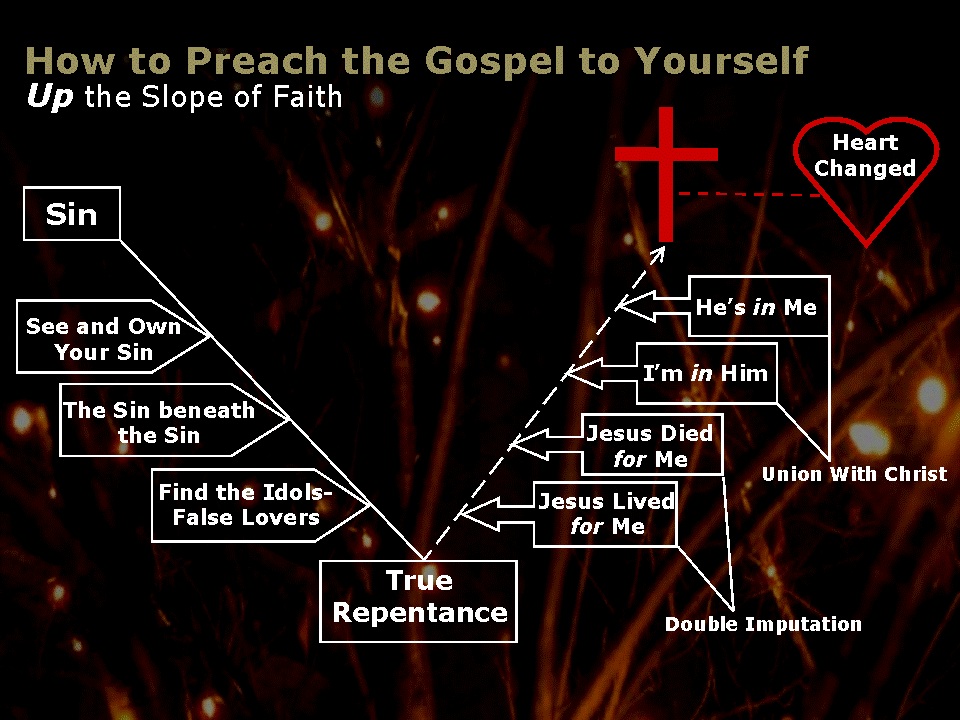
In case you think this is a “biblical” process for best results in growing as a disciple expressed in the illustration by “Heart Changed,” think again as illustrated by another chart published by several Reformed organizations as well:

In this chart, what is growing? Us, or our “salvation”? Many Reformed teachers in our day are fond of telling us how to “keep ourselves in the love of God” by “preaching the gospel to ourselves every day.” In fact, if we change, the following chart from the same camp shows the consequences:

…our salvation gets smaller! In contrast, we obtain God’s love once, and for all time, by believing in His Son, and experience assurance of that love but walking according to our new being.
Little children, let us not love in word or talk but in deed and in truth. By this we shall know that we are of the truth and reassure our heart before him…
But according to Protestant orthodoxy, if we make every effort to love God and others instead making every effort to find more and more sin in our lives, the gospel effect in our lives is diminished.
The Nature of God
How we obtain the love of God as prescribed by Protestant orthodoxy flows from its tenets regarding the nature of God. Primarily, God is defined as sovereign. Rather than sovereignty being an aspect of God’s nature, it is made to be the primary organizing principle—not love. This is an important distinction for those who take part in the exodus from Protestant darkness; will God’s nature be defined by a grammatical and exegetical interpretation of Scripture, or an interpretation based on orthodoxy?
Clearly, the Bible states that God is love. So, how does the Bible define love? Let’s see:
1Corinthians 13:1 – If I speak in the tongues of men and of angels, but have not love, I am a noisy gong or a clanging cymbal. 2 And if I have prophetic powers, and understand all mysteries and all knowledge, and if I have all faith, so as to remove mountains, but have not love, I am nothing. 3 If I give away all I have, and if I deliver up my body to be burned, but have not love, I gain nothing.
4 Love is patient and kind; love does not envy or boast; it is not arrogant 5 or rude. It does not insist on its own way; it is not irritable or resentful; 6 it does not rejoice at wrongdoing, but rejoices with the truth. 7 Love bears all things, believes all things, hopes all things, endures all things.
8 Love never ends. As for prophecies, they will pass away; as for tongues, they will cease; as for knowledge, it will pass away. 9 For we know in part and we prophesy in part, 10 but when the perfect comes, the partial will pass away. 11 When I was a child, I spoke like a child, I thought like a child, I reasoned like a child. When I became a man, I gave up childish ways. 12 For now we see in a mirror dimly, but then face to face. Now I know in part; then I shall know fully, even as I have been fully known.
13 So now faith, hope, and love abide, these three; but the greatest of these is love.
The so-called Reformed gospel of sovereignty calls for the total inability of man to love God even after their definition of conversion. One well known Reformed theologian wrote a book titled One Way Love. This staple Protestant belief is defined in the doctrine of double imputation which calls for the imputation of Christ’s alien righteousness to be imputed to our lives apart from anything we do other than preaching the gospel to ourselves. Much is made of living the Christian life by faith alone in order to maintain our “just standing.”
What it boils down to is God creating evil for His own glory. Whether you consider the teachings of Martin Luther or John Calvin, the founding fathers of Protestantism, this is an irrefutable fact. Luther taught that God created mankind with a passive will; in other words, a will that can only act if acted upon from an outside source. This testifies to God’s nature as defined by sovereignty. Hence, certain people are predetermined to suffer for eternity. In regard to this, John Calvin stated,
[God] arranges all things by his sovereign counsel, in such a way that individuals are born, who are doomed from the womb to certain death, and are to glorify him by their destruction.
~Institutes 3.23.6
I again ask how is it that the fall of Adam involves so many nations with their infant children in eternal death without remedy, unless it so seemed meet to God?…The decree, I admit, is dreadful; and yet it is impossible to deny that God foreknew what the end of man was to be before he made him, and foreknew, because he had so ordained by his decree.
~Institutes 3.23.7
This is contrary to love which is the true nature of God, being “kind,” and “Love does no wrong to a neighbor; therefore love is the fulfilling of the law.” The Reformed even make it a point to say that God did no wrong by creating man in an evil state because the end cause is God’s glory. If God brings good out of something evil, in the final analysis it is good because the end is good. It is also said that God created evil to make good better. However, that still does not dispose of the kindness issue. Love CANNOT be unkind to ANYONE.
Furthermore, it does not seek its own way, and you can insert “its own glory” in that list as well. Moreover, love does not rejoice in evil for any outcome, and always rejoices in truth and not the temporary demise of truth for some kind of better outcome. That notion is absurd.
In the final analysis, one of God’s attributes is sovereignty, but sovereignty is not the organizing principle of his nature because his nature is love.
paul
Bible Prophesy is Directly Linked to Assurance of Salvation: Part One
 One of the many Protestant myths that we hear often is that Bible prophesy, otherwise known as eschatology, is “secondary” truth. Yes, having a definitive understanding of its corpus which is about 25% of Scripture is optional.
Among the many disturbing insinuations in regard to this mentality is the idea that God prophesies about things that we can’t really understand. In other words, God is glorified by telling us things we can’t understand to prove some kind of point whatever that might be.
Not unlike many other Protestant mentalities, this particular one is warned against in Scriptures, and to the contrary promises blessings for those who study prophesy which assumes possible understanding.
One of the blessings of studying Bible prophecy and having a proper understanding of it is assurance of salvation. Much could be discussed on this wise, but the focus of this post will be the number of resurrections and judgments.
A Humble Faith is Confused and Uncertain?
There are many confused Protestants in the land because supposedly, being confused gives glory to God. One of myriad examples is a book written by Puritan wannabe Russ Kennedy of Clearcreek Chapel in Springboro, Ohio titled “Perplexity.” The primary thesis of the book is about how unanswered questions are a form of worship. But this is typical: the Bible states that God is not a god of confusion, but Protestant orthodoxy can always be counted on to set the Bible straight. My point here is that there are many Protestants that believe the Bible teaches about multiple resurrections and judgments, But that’s NOT Protestantism. Most Protestants do not know what a Protestant is…which of course in not commendable.
At any rate, confusion never walks with surety.
Justification by Faith: One Resurrection; One Judgment
What is Protestant orthodoxy on this matter? Answer: one resurrection and one judgment immediately following. And why does this matter? It matters because this view of eschatology is tied directly to the Protestant position on justification; or in other words, the essential doctrine of Protestantism known as justification by faith.
In that doctrine of salvation (soteriology), there is no assurance of salvation until your salvation is confirmed at the one final judgment at the end of the ages. In that one final judgment, God “separates the sheep from the goats.” This is the judgment of the nations and NOT the great white throne judgment, but articulating the differences is not the subject of this particular post; our subject is justification by faith and its necessary eschatology that supports its authentic soteriology.
Orthodoxy: Obedient Faith Not OSAS
Most Protestants also believe that once saved always saved (OSAS) is Protestant orthodoxy, but this is something else you can add to the long (very long) list of things that Protestants think Protestants believe. Protestant orthodoxy holds to salvation as a process. It is the idea that the process has a beginning point, a progression, and a final confirmation. A good snapshot of this is how Protestant orthodoxy interprets Philippians 2:12,13.
Therefore, my beloved, as you have always obeyed, so now, not only as in my presence but much more in my absence, work out your own salvation with fear and trembling, for it is God who works in you, both to will and to work for his good pleasure.
First, “obeyed” is the Protestant “obedient faith” or “obedience of faith.” What’s that? It is the idea that Christians only perform one act of obedience, living by faith…alone. How do you live by faith alone? It’s a good question because our culture defines faith as purely mental. Therefore, how do we “live” actively by faith alone? As homo sapiens, we not only sit around and think—we do things.
The answer is in… “work out your own salvation with fear and trembling.” Here, orthodoxy interprets “salvation” as justification, or the saving of the soul by Divine decree. Therefore, salvation needs to be worked out through faith alone.
“The Imperative Command is Grounded in the Indicative Event”
Also, and this is a BIG also, our working out of our salvation by faith alone, or faith-alone work, should be motivated by the supposed fact that “Christians” remain under the condemnation of the law, and should live in constant fear of condemnation which motivates us to live by faith alone lest we fall into “works righteousness [justification].” Because justification is seen as a process, and its end acquired by faith alone, one must not “jump directly from the command to an act of obedience.” Instead, everything we do must be “grounded in the historical Christ event” via faith alone, or by faith-alone works. This is how orthodoxy categorizes works in the Christian life: works, or a “righteousness of our own,” jumps from the command to obedience which is not of faith while faith-alone works operates on all obedience being grounded in the cross event.
In our Heidelberg Disputation series, mainline Protestant evangelical Phil Johnson is cited in regard to orthodoxy’s very definition of faith: it is returning to the same historical Christ event that saved us over and over again. By doing this, the righteousness of Christ is imputed to our Christian life (sanctification, or a process of increased setting apart for God’s purposes), and the justification process continues to move forward. This is important to note because said imputation continues to satisfy the law, and remember, our primary motivation is fear of condemnation from being under law.
So, to clarify, our primary faith-alone work is to continually return to the same gospel that saved us, otherwise known as “preaching the gospel to ourselves” in order to keep the law satisfied. A perfect law-keeping is imputed to us as we live by faith alone in “what Jesus has done, not anything we do.”
The Preeminence of the Law in Protestant Soteriology
Let’s tally all of this up in regard to the subject: Protestant orthodoxy makes law preeminent in salvation, and there is only one judgment that deals with the law; the great white throne judgment at the end of the ages. Orthodoxy rejects any judgment that excludes the condemnation of the law. Their gospel calls for a judgment that confirms those who “live by the gospel” well enough to be covered by Christ’s fulfillment of the law through His perfect law-keeping.
Judgments for rewards apart from the law and its condemnation are rejected by orthodoxy. The reward for living by faith-alone well enough is salvation. Because we are saved by faith alone, we must begin by faith alone, live by faith alone, and will be judged according to how well we did that. When we stand AT the judgment, if God only sees the works of Christ and not anything we did, we will “stand IN the judgment.”
Though Christ is said to have preeminence among Protestants, that’s only because Christ paid the penalty of sin under the law, and supposedly fulfilled its demands in our stead. The law is what really has preeminence in Protestant orthodoxy.
And this is why only one judgment is accepted; because all other judgments are for reward APART from the law’s condemnation.
What Saves a Protestant at the Judgment?
In the rest of Philippians 2:12,13 we read, “for it is God who works in you, both to will and to work for his good pleasure.” If you have been following our Heidelberg Disputation series, you know that authentic Protestantism interprets this through Martin Luther’s bondage of the will. Luther believed that man was created with a passive will. Like water, it is only active when it is acted upon from outside of itself. Water doesn’t move unless gravity pushes it—it doesn’t change temperature unless the environment acts upon it from the outside. Likewise, the Christian does not work, he/she only has the will to act if acted upon from the outside. God is the only one who has an active will, and He created man with a passive will.
Luther framed this in context of death. According to Luther, death is not a nonexistent state, but merely a passive state. The dead exist, but they are in bondage to passivity unless acted upon. Luther also believed that this is illustrative of the Christian life. Christians are still dead in trespasses and sin, and only perform good works when acted upon from the outside by God. This is in fact central to the Protestant ideology that drives its soteriology.
Conclusion
Assurance of salvation cannot be a reality in authentic Protestantism because surety removes the condemnation of the law regardless of anything we do. The goal is not the obedience of love, but the so-called obedience of faith that satisfies the “righteous demands of the law.” If we live by faith alone, the obedience of Christ will be imputed to us. This belief is what saves the Christian at the final judgement.
In part two, we will examine what Philippians 2:12,13 is really stating, and its relationship to eschatology. Moreover, we will examine why Christians can have doubtless assurance of salvation accordingly.
paul

 Paul's Passing Thoughts
leave a comment