Six Characteristics of the Protestant Anti-Gospel
- Progressive Justification. The Protestant Reformation turned every aspect of the true gospel completely upside down. “Justification by faith” is really justification by faith alone in sanctification (the Christian life). What they call “sanctification” is the progression of justification to a final justification.
- Dualism. It deems the flesh (body/members) as inherently evil and something that cannot be indwelled by holiness. The contemporary expression of that is the centrality of the objective gospel outside of us. This is based on Martin Luther’s alien righteousness. Therefore, the new birth must be denied along with any personal holiness associated with it. All righteousness must remain completely outside of the believer.
- Law as Justification’s Standard. The Reformers made law the standard for justification (see the Calvin Institutes 3.14.9-11). Therefore, the law has a single dimension and can only judge/condemn. This keeps “Christians” under law (instead of under grace) which is the very definition of a lost person. In contrast, law and justification are mutually exclusive.
- Redefinition of the New Birth. The Reformers made the new birth a change of realm rather than a literal transformation of the person. The “believer” is given the ability to “see” the kingdom, but not participate in its good works.
- Lovelessness. The ability of the Christian to love is circumvented because the law is only a standard for justification and must be kept perfectly to obtain any merit. The Christian is not free to use the law to love without fear of condemnation because the law can’t be kept perfectly by mortals. Hence, any loving act by a Christian cannot have merit.
- Two Seeds Instead of One. Since law is the standard for justification according to the Reformers, if fulfilled, it is a second seed that can give life (Gal 3:16). So, the promise was not only to Abraham and his offspring, but also to the law.
An Open Letter to the Board of Trustees of Southern Seminary

Originally posted January 2, 2014
Paul M. Dohse
TTANC L.L.C.
PO Box 583
Xenia, Ohio 45385
To Dr. Walter Price and the Board of Trustees of Southern Seminary:
Gentlemen,
It is no surprise that truth is of low value in our day; the apostle Paul informed Timothy that in the latter days people would not tolerate sound doctrine, and we are in those days. Hence, there are no expectations in regard to this letter, but nevertheless, it is a duty to proclaim the truth.
Southern Seminary now offers academic credits for attending seminars at conferences sponsored by various organizations connected with the present-day resurgence of authentic Calvinism. Though the traditions of men and antinomianism was of primary concern as stated by Christ during His earthly ministry, the evangelical academia of our day follows the crowds in wholesale acceptance of any doctrinal name brand that sells.
This blitzkrieg of resurgent conferences targets youth specifically. The resurgence seeks to turn a whole generation of youth to this doctrine. This represents the future of the American church. Evangelicals, and its academia in particular, seem indifferent to the gravity of future accountability attached to this reality.
Our organization researches the Calvin Institutes, and the trustees of Southern Seminary would do well in following our example rather than the opinions of men like Albert Mohler. Calvin’s gospel, as stated in the Institutes, is a call to keep ourselves saved through the practice of antinomianism, and has a distinctive Gnostic application. It is works salvation by Christ plus antinomianism, and reduces obedience to only experiencing the imputation of Christ’s perfect obedience to the Christian life. An example of this would be on page 215 in How People Change (2006), a book written by Paul David Tripp, speaker at the recent Cross Conference endorsed by Southern Seminary. He states the following:
When we think, desire, speak, or act in a right way, it isn’t time to pat ourselves on the back or cross it off our To Do List. Each time we do what is right, we are experiencing what Christ has supplied for us. In Chapter 11, we introduced some of the fruit Christ produces. We will expand the discussion here.
Calvin, as well as Luther, believed that all reality is interpreted through the works of Christ in the gospel, or the “objective” gospel and the imputation of those works are experienced “subjectively” in order to remove our works from sanctification. Hence, “the subjective power of an objective gospel” and other such mantras often heard among evangelicals today. This necessitates, in a manner of speaking, interpreting every verse in the Bible as a justification verse; i.e. “Biblical Theology,” a buzz word at Southern. This way of interpreting the Bible was introduced by Christian mystic Geerhardus Vos circa 1938.
Calvin also redefined the new birth as an experience of perpetual rebirth in order to keep ourselves saved by the same gospel that originally saved us. So, the new birth is not a one-time event, it is a perpetual cycle of the same repentance and new birth experience that originally saved us—that’s why we must “preach the gospel to ourselves every day.” This is the doctrine of mortification and vivification. It is part of Calvin’s systematic theology. This is factually indisputable. The Christian life focuses on our total depravity and repentance only, leading to the experience of vivification, or a joyful experience.
Therein, the human “heart” is redefined as something that is transformed only by its increased ability to experience vivification. This is why John Piper states that joy is essential to the Christian life; if vivification is not being experienced; perpetual rebirth is not taking place:
The pursuit of joy in God is not optional. It is not an ‘extra’ that a person might grow into after he comes to faith. Until your heart has hit upon this pursuit, your ‘faith’ cannot please God. It is not saving faith (Desiring God: p. 69).
Likewise, Southern Baptist Paul Washer states the following:
This cycle simply repeats itself throughout the Christian life. As the years pass, the Christian sees more of God and more of self, resulting in a greater and deeper brokenness. Yet, all the while, the Christian’s joy grows in equal measure because he is privy to greater and greater revelations of the love, grace, and mercy of God in the person and work of Christ. Not only this, but a greater interchange occurs in that the Christian learns to rest less and less in his own performance and more and more in the perfect work of Christ. Thus, his joy is not only increased, but it also becomes more consistent and stable (Paul Washer: The Gospel Call and True Conversion; Part 1, Chapter 1, heading – The Essential Characteristics Of Genuine Repentance, subheading – Continuing and Deepening Work of Repentance).
The new birth is redefined as a “cycle” rather than a one-time event like our physical birth. It is redefined as a perpetual rebirth experience as we focus on our saintly total depravity. We are only righteous positionally; regeneration is a mere experience of Christ’s perfect obedience to the law. This not only keeps Christians under law, but inadvertently calls for a rejoicing in our own supposed total depravity.
This is why authentic Calvinism dies a social death within Christianity every 100 years or so. God’s people eventually catch on to the fact that it is a false gospel. Lighter forms of it survive the rejection while maintaining the label. We are presently within the fifth resurgence since Calvin’s Geneva, and the trustees of Southern are mindless participants accordingly.
We had the wonderful privilege of meeting many, many young people at the recent Cross Conference where you promoted this false gospel. We realize that there will only be a remnant that loves the truth enough to reject this latest academic novelty. But this is a generation of young people capable of great things, and smart enough to know that they only need God Himself to accomplish His mission. We believe that American Christianity has become a mission field in and of itself; namely, YOUR resurgence movement, a movement that bears your name, and we are seeking to reach that remnant of God that loves His truth. This is our duty and calling. A gospel promoting a justification that is not finished cannot save.
Meanwhile, as stated by the apostle Paul, let those who teach another gospel be accursed whether they be angels or men of renown.
Because only truth saves and sanctifies,
Paul M. Dohse
John 17:17
Matthew 4:4
Jonathan Edwards: The Homeboy of Eastern Mysticism
A prerequisite for Gnostic Watch Weekly 10/31/2014:

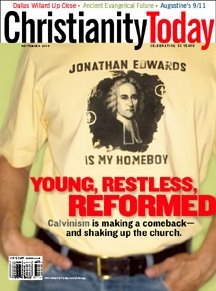
Materials for discussion:
http://en.wikipedia.org/wiki/Idealism
Comment thread: https://paulspassingthoughts.com/2014/10/24/tweet-tweet-authority/
LOL! John Piper Would Only Change “One Thing” About John Calvin
Originally published May 14, 2012
….and by the way, we are all totally depraved; so you know, stuff happens.
In this video, Piper forgets a lot of history about Calvin. Listen to the short clip, and then read the following excerpt from a church historian. Listen, I’m really busy today, but it’s ok, I know the smartness/intelligence of my readers; they are not going to take Piper’s word that ONE of the people Calvin had murdered taught false doctrine about the Trinity. Remember, New Calvinists believe that emphasizing the other two members of the Trinity as much as Jesus is misguided “emphasis” and therefore a false gospel (please don’t make me dig up the Michael Horton quote on that one).
In preparation for TTANC volume 2, I am studying the teachings of theologians who contended against Calvin in his day. Very interesting, seems that some of them had a problem with Calvin’s view of the relationship between sanctification and justification. Sound familiar?
Furthermore, Piper states that the melding of church and state didn’t serve the Puritan legacy well. Oh really? This ministry is inundated with information that I unfortunately don’t have time to pursue regarding consolidated attempts by the New Calvinist movement to get in bed with the government. Trust me, they would luuuuuuuvvvvvv to silence their critics through law enforcement—starting with bloggers. In fact, the present cases on this are not that hard to find: lawsuits; outrageous defamation of character; bogus church discipline; blackmail; coercion border-lining on outright kidnapping ; etc. On the last one, I know of an actual case right now and am working with the situation. The New Calvinist church is holding an individual hostage (in regard to remaining under their authority via church membership) because of what the person knows about the church. They “have something” on the individual and are using it to control them. Which, by the way, is a criminal act according to the state law where the church is located.
Piper is right about one thing: job one for the founding fathers of America was to make sure the church did not get back in bed with the government on this side of the pond. Particularly, churches of the Reformed type, which were barely less forgiving than Rome towards those who disagreed with them. Also like Rome, the Reformers were a little uncomfortable with the free reasoning of mankind in religious issues. Consider this soundbite from Martin Luther:
“Reason is the Devil’s greatest whore; by nature and manner of being she is a noxious whore; she is a prostitute, the Devil’s appointed whore; whore eaten by scab and leprosy who ought to be trodden under foot and destroyed, she and her wisdom… Throw dung in her face to make her ugly. She is and she ought to be drowned in baptism… She would deserve, the wretch, to be banished to the filthiest place in the house, to the closets.”
—Martin Luther, Works, Erlangen Edition v. 16, pp. 142-148.
“Reason is the greatest enemy that faith has; it never comes to the aid of spiritual things, but—more frequently than not—struggles against the divine Word, treating with contempt all that emanates from God.”
—Martin Luther, Table Talks in 1569.
“Heretics are not to be disputed with, but to be condemned unheard, and whilst they perish by fire, the faithful ought to pursue the evil to its source, and bathe their heads in the blood of the Catholic bishops, and of the Pope, who is the devil in disguise.”
—Martin Luther, Table Talks (as quoted in Religious History: An Inquiry by M. Searle Bates, p. 156).
In other words, Luther would not have thought much of the “NOBLE” Bereans. And again, Piper is right because the founding fathers of America were a product of the Enlightenment era. I’m thinkin’ they didn’t agree with Luther’s attitude toward free thought; unless of course, it was Reformed, and preferably Augustinain, a forefather of Gnosticism.
As the Institutes of the Christian Religion greatly influenced the theology of the Reformation, Calvin’s Ecclesiastical Ordinances greatly affected the structure of many Reformed churches and their relation to the community. One major element of the Ecclesiastical Ordinances was the Consistory, the central church governing apparatus, composed of ministers and elders. Its purpose was to maintain ecclesiastical discipline and theological orthodoxy, but when the social community of the city is identical to the church community, the result is that ecclesiastical discipline and religious heterodoxy have social implications. Very quickly church offenses become civil offenses or at least offenses with civil consequences, as the medieval Church came to see.
The Consistory oversaw the conduct of the believers-citizens of Geneva down to the minutest detail, intervening with disciplinary measures such as public rebuke and excommunication. But because the civil and the ecclesiastical authority were so closely intertwined, condemnation by the Consistory could lead to civil punishments such as public fines and even exile and execution. People were brought before the Consistory for every sort of offense, including petty ones such as singing jingles critical of Calvin, card playing, dancing, and laughing during a sermon. The Consistory also sent out members to each parish to look for transgressors, who, if discovered, were tried by the Consistory. Every household was visited annually, before Easter, to ascertain the status of prospective communicants. If Geneva was the “Rome of the Reformation,” the Consistory was its Inquisition and Calvin its Pope.
Geneva under Calvin’s influence controlled its citizens’ lives, including their private lives, well beyond what the medieval Church did. The individual Christian in the Church of Geneva was “free” to interpret the Bible for himself, provided he interpreted it exactly as Calvin did.
Was Calvin a “dictator”? Surely not in the conventional sense. He held no elected office, nor did he exercise direct political power in Geneva. He was mainly a pastor, not a politician. And yet we mustn’t go as far as some of Calvin’s supporters, who say he was “simply” a pastor. He possessed tremendous influence in the political community, well beyond that of a mere civic leader. And that influence translated directly into civil law strictures and punishments. Geneva was not an absolute State, in the modern sense, but neither was it a free state, except perhaps for those who already accepted its rigid norms of conduct.
A prime example of Calvin’s influence in Geneva is the case of Pierre Ameaux, a member of the city council, who had criticized Calvin as a preacher of false doctrine. The council told Ameaux to retract his statement, but Calvin wanted a harsher punishment. Ameaux was forced to go through town dressed only in a shirt, with a torch in hand.
Ameaux’ fate was a mere embarrassment; the embryonic freethinker Jacques Gruet was executed for criticizing Calvin, for blasphemy and for protesting the stringent demands of Calvin’s Geneva. He was tortured and beheaded. Calvin also got Jerome Bolsec banished for the Frenchman’s disagreement with Calvin regarding predestination, thus proving that, while Geneva was a haven for Protestants throughout Europe who agreed with Calvin, it could be oppressive for those who did not.
But the most celebrated case is that of Michael Sevetus, who didn’t get off as lightly as Bolsec. The Spanish physician-writer took it upon himself to reformulate the doctrine of the Trinity in what were essentially Gnostic categories. But Sevetus made the mistake of sending Calvin an advance copy, which led, by a rather Byzantine route, to Calvin tipping off the Catholic magistrates in Vienna that the heretical Sevetus was practicing medicine in their city. That brought the apparatus of the Inquisition down on him. Sevetus managed to escape and wound up, in all places, Geneva, en route to Naples. Calvin had him arrested, tried and sentenced to death. As an act of mercy, Calvin requested that Sevetus be beheaded, instead of burned, but in this case Calvin’s request was not honored (http://goo.gl/1Y1u5) [sic].
Calvinism: The Root of All Evil in the American Church
 Originally posted August 21,2013
Show me the Money.
Why has New Calvinism taken the American church by storm? Because the American church was already primed for it. Before authentic Calvinism was rediscovered by a Seventh-Day Adventist in 1969, America was, and always has been half-pregnant with the Puritan form of Calvin’s Geneva.
Calvinism makes everything about justification while excluding sanctification for a very simple reason: control. If justification is a finished work, and all that is at stake is eternal rewards in heaven, the church would not be nearly the institution that it is today. Why is there big money in religion? Why is there a church every two miles in America with a 500,000 dollar annual budget? Why did 3,000,000 people show up on a beach to see the new Pope? Why does the Catholic Church have so much power? Because salvation is big business my friend. If salvation is found in an institution, it will all but rule the world.
Plain and simple: the Reformers taught that the same forgiveness for sin that saved you needs to be continually sought out to maintain salvation (justification), and that forgiveness can only be found in the Protestant church. Sola Fide indeed, there is no money in sanctification; the big bucks are in justification. From a worldly perspective, Christ had a horrible business plan:
Go therefore and make disciples of all nations, baptizing them in the name of the Father and of the Son and of the Holy Spirit, teaching them to observe all that I have commanded you. And behold, I am with you always, to the end of the age.
There is no money or power in making disciples; the money is in making saved people and requiring them to be faithful to the institution in order to stay saved. In business, we call that RMR (reoccurring monthly revenue).
A finished justification and focus on discipleship empowers the individual, not the institution. Who the Master is—is a settled issue and the focus is preparing for His return by making maximum use of the individual talents given by grace. But when keeping our justification is the focus, individual responsibility to the Master is relegated to the closets. Come now, let’s be honest, how many Christians in the American church even know what their spiritual gifts are? How often do we see church “services” where we “encourage each other unto good works” as opposed to being there to “receive more Jesus.”
The parable of the talents is teaching about a servant who sought to only give back to the Master what he had originally received. And that is exactly what the Reformers promoted. Calvin et al believed that sanctification replaced the Old Testament Sabbath. We will make it to heaven if we “rest” in our salvation.
Enter a conversation I had with a brother not but two days ago:
Ya know Paul, this New Calvinism stuff is supposedly so great, but I have been a member of this church for ten years now, and what? Maybe five people have been saved in that time.
Exactly. Let’s face another fact, people aren’t being saved, if anything, they are just being shuffled around or convinced they were never saved to begin with. The reason for this is simple: Christ said to let our good works shine before men so that our Father in heaven would be glorified. That concept was anathema to Calvin. The fact that sanctification is a Sabbath rest should speak for itself.
The double myth of Arminianism.
Arminianism is another Protestant myth. It centers on the election debate, a doctrine that Calvinists don’t even believe to begin with. The Arminian/Calvinist debate is a double myth. Start thinking for crying out loud, what power and control would there be in election? There is no money in election either. Election portends a settled eternal destiny. If there is election, what do we need the institutional church for? “Election” only gets you into the race for “final justification,” but the race must be run in the church so that you can get your perpetual forgiveness that keeps you in the race. My friend, always follow the money. Always.
While arguing for free will versus total depravity, Arminians have always functioned like Calvinists. Since the Pilgrims Puritans landed on our Eastern shores, we have had Calvinism Lager and Calvinism Light. Arminianism is closet Calvinism. Both devalue sanctification. Calvinism completely rejects sanctification as “subjective justification.” Arminians give tacit recognition to sanctification while completely rejecting it by the way they function. The lager form proudly shows forth Calvin’s doctrine of ecclesiastical justification while Arminians live by John Calvin bumper stickers:
We are all just sinners saved by grace.
This is Calvin’s view of Christians remaining totally depraved while receiving justification in the present-continuance tense.
Just this week, I saw the following John Calvin bumper stickers posted by people who would vehemently deny that they are Calvinists:

This is based on Calvin’s Redemptive Historical hermeneutic and Luther’s Cross Story epistemology. The idea is that the Bible was not written for the purpose of grammatical exegesis, but rather to contemplate the redemptive narrative only leading to subjective, perpetual justification that is necessary to achieve “final justification.” Knowing the Bible factually is Luther’s Glory Story, knowing the Author is Luther’s Cross Story. In other words, every verse in the Bible is about justification and not wisdom for sanctification, the proverbial, “living by lists” and “do’s and don’ts.”
And….

Right, because sanctification is “subjective justification.” Any concern with our outward behavior is, as Calvinist hack Dr. Michael Horton states it, “trying to BE the gospel rather than preaching the gospel.” This fosters the very thing that makes Christianity contemptible to the world—preaching the gospel and not living it. It is the Sabbatical sanctification fostered by John Calvin himself and promoted by Arminians wholesale.
Calminianism is the real reality.
Sanctification?
So ok, the Bible has much to say about justification by faith alone, but where is this standalone subject of sanctification that is a different matter of Christian living altogether? One place among many would be 1Thessalonians 4:3ff:
3 For this is the will of God, your sanctification: that you abstain from sexual immorality; 4 that each one of you know how to control his own body in holiness and honor, 5 not in the passion of lust like the Gentiles who do not know God;
Obviously, sanctification is all about KNOWing HOW to control our bodies. And even more obvious is the fact that justification has nothing to do with that at all. And also obvious is the fact that the two aforementioned Calminian metaphysical bumber stickers totally reject this biblical definition. Let’s have another moment of honesty. How many Christians know more about controlling their body today than they did yesterday? And does that affect how the world sees us, and God?
Fusion and dichotomy.
Sanctification is a continued endeavor to learn more and more how to control our bodies from the Scriptures. Calvinism rejects that as the Glory Story. A focus on controlling our own bodies makes life about us and “eclipses the Son.” It fuses justification and sanctification together while dichotomizing anthropology. The opposite should be true in regard to both categories. Calminianism is an upside down Christian life.
Anthropological concepts; i.e., what makes people tick, are deemed pragmatic and unspiritual. Rather than seeing these subjects as wisdom where Christians ought to be outdoing the world, they are rejected as “living by lists” and “living by do’s and don’ts.” I like what one pastor had to say about those truisms:
They are telling us the following: “Don’t live by do’s and Don’ts.”
A prime example is something that everyone is born with: a conscience. The only Psychiatrist in history that really had a track record of helping people was O. Hobart Mowrer. The main thrust of his therapy was an emphasis on keeping a clear conscience. He believed that most mental illness was caused by a guilty conscience. He cured people by insisting that they deal with unresolved issues of guilt. Mowrer, once the President of the APA along with a long list of distinguished awards and appointments, wrote The Crisis in Psychiatry and Religion. The book rejected the medical model of Psychology and fustigated Christianity for relegating the care of the “mentally ill” to Freudian Psychology. Mowrer was not a Christian.
Nevertheless, he is the one who most inspired the father of the contemporary biblical counseling movement, Dr. Jay E. Adams, who applied Mowrer’s practical approach to biblical counseling. Adams did this because he observed Mowrer’s astounding results while doing an internship with him in the summer of 1965.
This only makes sense. The apostle Paul instructed Christians to “keep a clear conscience before God.” The Bible has much to say about the subject of conscience. Christians should use the Bible to be wiser in all areas of human practicality and should excel at it far beyond those who live in the world. Let’s have another honesty moment: how many sermons do we hear on the importance of practicality in the Christian life? Subjects such as, planning, accountability, etc. Unfortunately, these biblical subjects are dichotomized from the “spiritual” and deemed pragmatic.
At the same time, justification and sanctification are fused together in an effort to live out a Sabbatical sanctification; i.e., sanctification by faith alone. This is nothing new, James rejected the concept in his epistle to the 12 tribes of Israel that made up the apostolic church. It is also a Gnostic concept that sees the material as evil and only the spiritual as good. Therefore, since anthropology is part of the material realm, any practicality thereof cannot benefit the spiritual. Supposedly.
Another concept, along with conscience, is that of habituation. Through discipline, habit patterns can be formed that lead to change, ask anyone who has been in the military. People who inter the military come out as changed people. Because of our Protestant heritage and conditioning, these concepts seem grotesquely pragmatic. But according to the Bible, we are to make use of them.
Sanctification is a many-faceted colaboring with the Holy Spirit, and the Spirit’s power is unleashed through wisdom and obedience (James 1:25). We must know assuredly that justification is a finished work, and absolutely nothing that we do in sanctification can affect it for better or worse. This is what purifies our motives in our love for Christ in sanctification. “If you love me, keep my commandments” has absolutely nothing to do with our justification. It’s for love only, not a working for justification. We are thankful for our justification, but that thankfulness doesn’t save us or keep us saved. Only Christ saves—the new creature now loves Christ because that’s who he/she is. Christ’s love made it possible for us to love Him in sanctification, but nothing in sanctification keeps us saved. Sanctification looks not for a “final justification,” but readies itself for the Master’s return and longs to hear the words, “Well done faithful servant!”
When I was a young boy, I often lived with my grandparents during the summer. My grandfather was a real-life John Wayne type. He worked as a construction foreman for a large company. And he was my hero. Before he left for work in the morning, I would sheepishly await for him to depart before beginning a flurry of tasks around their small farm. I would always have the tasks done well before his arrival home and waited at the end of the drive to hear his truck’s humming wheels come down State Route 125. I would then take him around the property and show him the finished tasks. His smile and compliments were my reward. These are tasks that I didn’t have to do; our love for each other was always something totally different from those tasks. I knew assuredly that he would love me whether I did those tasks or not because I was his grandson—his pride and joy. Some idea that the withholding of serving him in order to elevate the reality of his love for me would have been a ridiculous notion.
Justification and sanctification must be separate. Anthropology and the spiritual must be fused. Our bodies must be controlled and set apart for good works. This will lead to the showing forth of our good works and the glorification of the Father leading to salvation for others, not sheep redistribution.
Spiritual abuse and disdain for justice.
A devaluing of our own holiness for fear that it will eclipse the holiness of God, coupled with salvation being sought in the institutionalized Calminian church, has led to the same indecencies seen in the mother of the Reformers; the Roman Catholic Church. Rome has never repented of its abject thirst for blood, and the fruit does not fall far from the tree.
The family split for the time being, but the Reformers never departed from Rome’s ecclesiastical justification found through absolution by church leaders. When this is the case, any vehicle going to heaven will suffice for heaven’s sake alone. The institution will never be threatened for the sake of the few. To the leaders, their existence and power is threatened, to the parishioners, their salvation is threatened. The institution must be preserved.
This is no new thing, in the minds of the Jewish leaders; Jesus Christ was sacrificed to preserve the Jewish religious system. If even Christ Himself was expendable in this mentality, what will be of the molested and raped? Besides, we are all just sinners saved by grace anyway, right? Is justice therefore anywhere on the radar screen in this discussion? Hardly. Besides, the raped and spiritually abused should be thankful because what they deserve is hell anyway, right? Once this is understood, the landscape we see today in the American church should be no surprise whatsoever.
What is the answer?
The church is a sanctified body and not an institution for final justification. We are in the business of making disciples and not keeping people justified by faith alone in sanctification. The sanctified body doesn’t justify, it is God who justifies. Men must stop worshiping at the altar of ecclesiastical justification. Justification is free to us and finished, sanctification isn’t. Sanctification is where we show our love to the savior as servants, not leaches. Evil men like Paul David Tripp who posit the idea that the Christian’s whole duty is to “rest and feed” and wait for “new and surprising fruit” because Christians only “experience” fruit and don’t participate in it must be rejected with extreme prejudice. Their evil seed was spawned in 1970, but they have been in firm control of the American church for 25 years while proclaiming each year a “resurgence.” What do we have to show for it?
It is time for men and women to recognize their calling, their new birth, their indwelling counselor, their gifts, and the authority of Christ and His word alone. There is NO traceable lineage back to the apostolic church like the genealogy documents burned by Titus. Murdering mystic despots have no claim on any authority of the church.
Godly authority is continued wherever a spirit-filled Christian picks up a Bible and obeys its words. A church is a sanctified, obedient fellowship, not a justified institution drunk with its own visions of grandeur.
paul

 Paul's Passing Thoughts
leave a comment