
Our Justification Crisis, Perseverance, and Assurance: Part 2
Live Streamed every Sunday @ 7pm from freebereans.blogspot.com
CLICK ON TO ENLARGE

CLICK ON TO ENLARGE

CLICK ON TO ENLARGE

CLICK ON TO ENLARGE
Last week we looked at the nature of the present-day justification crises. Tonight we will look at the relationship between justification, perseverance, and assurance of salvation. This is another topical subject related to the book of Romans that we are adding to our verse by verse study. I have interjected this study because of the rampant confusion related to perseverance and the Christian. Granted, there are verses in the Bible that seem to indicate that Christians have to persevere in their faith to obtain a “final justification.”
If there is anything about election that would endear detractors at all, it is the idea that our justification was determined before the creation of the world, and therefore, there is nothing we or anyone else can do in sanctification to mess that up. Once saved, always saved. Traditionally, Calvinists have been primarily associated with this election idea. The idea makes people uneasy, but at least you get assurance of salvation in the deal. Or do you?
In our endeavor to understand the paramount subject of justification, Calvinism and Reformed doctrine in general must be dealt with. Why? Because as the lazy-thinking church slumbered, Calvinists have established a doctrinal foundation. They own the history. They own the seminaries. They own the publishing companies. They own the debate. They are accepted out of hand as the ones who know. This is what they do—they attempt to create a reality that yields the results that they want. And in our day, they have nearly succeeded. If not for the internet, this would be a done deal.
Many assumptions prevail: total depravity only pertains to the unregenerate. Faith alone (sola fide) only pertains to justification. Christ alone (solus Christus) doesn’t literally mean “Christ alone” to the exclusion of the other Trinity members. Scripture alone (Sola scriptura): instruction for life and godliness, or a meta-narrative for gospel contemplationism? And now we find that election doesn’t really mean “election” per se. Now we find that election justifies you, if you are chosen, but you have to persevere in order to obtain “final justification.”
And this idea is split up into two authentic Calvinism camps. In one camp, the Christian must persevere in sanctification by faith alone with his/her primary nemesis being the temptation to “obey in our own efforts.” “Effort” is the essence of works salvation. Augustine and Calvin both taught that the Sabbath rest was sanctification specifically. Because salvation is a “golden chain” where justification starts, and progresses in the middle towards final justification, we must maintain our justification in the same way that it began at the beginning of the chain. By faith alone. This is the double imputation crowd. Christ’s passive obedience to the cross secured our justification, His active obedience to the law while He lived on earth is imputed to our sanctification as long as we live by faith alone in sanctification. To the contrary, biblical double imputation is the imputation of God the Father’s righteousness to us apart from the law by faith in Christ alone, and the imputation of our sin to Christ. The imputation of Christ’s perfect obedience to the law being imputed to our sanctification to finish justification is NOT righteousness apart from the law.
Now the other camp. They reject Reformed double imputation, but their view of election is also an initial justification that must be maintained by our perseverance. In this case, a general faithfulness to the New Covenant. Note the following comments I received on my blog from a knowledgeable Reformed teacher from this camp:
I think it is clear from Scripture that salvation (election, calling, justification, glorification) cannot be lost. But justification can be initially entered into via faith alone, but we must then remain faithful. This was the error of the Jews, they thought that because they had entered a right standing (justification) with God, they were good to go…. All who have been elected unto mercy will persevere unto salvation, but Scripture makes it clear that there will be some who enter into or begin a relationship with God (justification, a right standing), but who fall away, commit apostasy, are severed from Christ, do not bear fruit, soil their garments, are excommunicated, etc. Another way to say this is that they lose their justification.
Justification is necessary for salvation, but the initial possession of justification does not mean that one will be saved in the end. He must endure….Sure there is – the New Covenant. And our faithfulness to this law will certainly be judged. This is why Paul teaches a gospel of righteousness, self-control and judgment in Acts 25 (or 24?)…. Back to your first statement – there is a standard: it is called the New Covenant. We now have cleansing (forgiveness, justification) through faith in Christ, but just like the Jews, we must also maintain that righteousness by virtue of faithfulness to the moral law – which, by the way, has been the same since Adam and Eve. Furthermore, under the new covenant, it is the Church (the Body of Christ) that is the focus of this covenant. We are enslaved to God, we are bound to the law of the Spirit, the law of Christ, etc. We have all kinds of instruction in Scripture about how to keep the law of God and what to do when we break it.
The key is the covenant community, however. There is no justification outside of the visible, local church…. All who have been elected unto mercy will persevere unto salvation, but Scripture makes it clear that there will be some who enter into or begin a relationship with God (justification, a right standing), but who fall away, commit apostasy, are severed from Christ, do not bear fruit, soil their garments, are excommunicated, etc. Another way to say this is that they lose their justification.
Justification is necessary for salvation, but the initial possession of justification does not mean that one will be saved in the end. He must endure.
Here was one of my responses that I think is the crux of my contention:
The problem is a standard for faithfulness maintaining justification. Those who are justified are no longer under any standard/law that judges whether or not they are justified. The justified live BY the law as a pattern of life, but not FOR justification. We are justified “apart from the law” and it is impossible for us to sin in the eyes of justification because apart from the law, “sin lies dead.”
That’s the problem. There is no standard or way to judge faithfulness in regard to justification because we are no longer “under the law.”
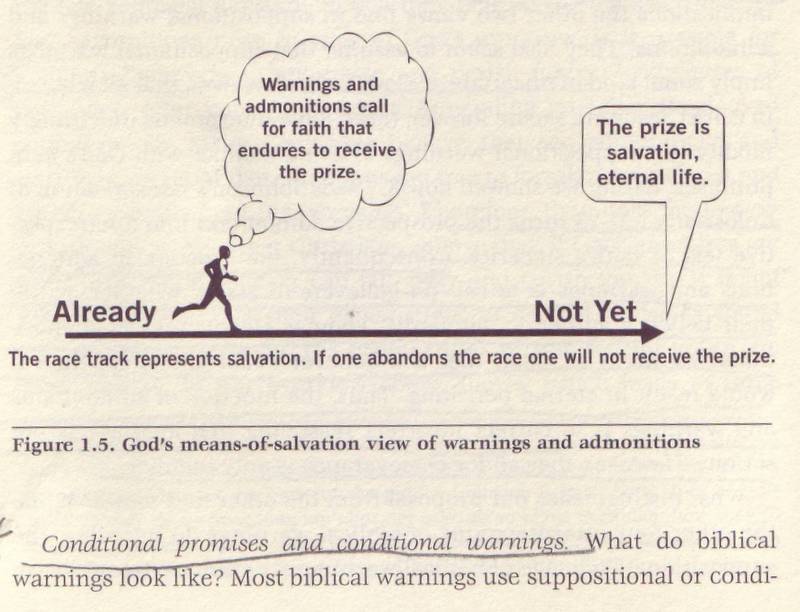
This view by camp B is specifically called, mutable justification. So, these are the two authentic Calvinist camps: Reformed double imputation and mutable justification. Both of these ideas are referred to the reformed motto, already-but not yet. Here is yet another assumption, that this is a Reformed paradox. Not so, “already” is initial justification; “not yet” is perseverance. This is why Calvinism is predicated on lack of assurance. The following is an illustration from the Reformed book, The Race Set Before Us p. 40:
CLICK ON TO ENLARGE
Now, let me begin by saying that election must be completely reevaluated because most of the thinking in regard to it has come from Reformed orthodoxy. That makes election according to the Reformers extremely suspect, especially since it is not really election to begin with. And trust me, for six years, I have been dealing with the justification issue and its relationship to the law and have not had time to reevaluate the metaphysics of election, and I know, much to the consternation of many of PPT’s (blog) readers. But I want to begin our evaluation of justification’s relationship to perseverance and assurance by beginning with what we do know about election. We have addressed the reality of the present-day foundation that dominates the church; now let’s look at this biblically.
What do we know today, here at the Potter’s House, about election? First, we know its purpose. Its purpose is to completely remove works from justification:
Romans 9:11 – though they were not yet born and had done nothing either good or bad—in order that God’s purpose of election might continue, not because of works but because of him who calls— 12 she was told, “The older will serve the younger.” 13 As it is written, “Jacob I loved, but Esau I hated.”
This couldn’t be clearer: God’s purpose in election is to remove all of our works from justification and make it dependent on the “call.” By the way, though I haven’t revisited the metaphysical questions of election yet, I do reject, on the basis of Scripture, that the call equals fatalistic determinism. Now, I don’t know how that fact is going to play out when I revisit this, but to date, I know that much. This brings us to the second thing that we know about election. In the following text, election is referred to as the call:
Romans 8:30 – And those whom he predestined he also called, and those whom he called he also justified, and those whom he justified he also glorified.
Stop right there. Here is where we drive a stake. If we can’t take this at face value, neither can we take John 3:16 at face value. The two things we know about election is that it has two purposes: one, to eliminate all works in justification; therefore, perseverance must be excluded from justification because perseverance has to be judged by a standard. To meet that standard is a work. Perseverance must be severed from justification completely. Secondly, election is for assurance of salvation. Election is the bedrock of our assurance. Paul makes this clear in the next verses immediately following:
31 What then shall we say to these things? If God is for us, who can be against us? 32 He who did not spare his own Son but gave him up for us all, how will he not also with him graciously give us all things? 33 Who shall bring any charge against God’s elect? It is God who justifies. 34 Who is to condemn? Christ Jesus is the one who died—more than that, who was raised—who is at the right hand of God, who indeed is interceding for us. 35 Who shall separate us from the love of Christ? Shall tribulation, or distress, or persecution, or famine, or nakedness, or danger, or sword? 36 As it is written,
“For your sake we are being killed all the day long; we are regarded as sheep to be slaughtered.”
37 No, in all these things we are more than conquerors through him who loved us. 38 For I am sure that neither death nor life, nor angels nor rulers, nor things present nor things to come, nor powers, 39 nor height nor depth, nor anything else in all creation, will be able to separate us from the love of God in Christ Jesus our Lord.
Now, how can glorification be spoken of in the past tense? Because it is a finished issue. It is guaranteed. In addition, the philosophers among us can probably be a help here, but I assume there is no beginning and end in eternity. This calling took place before creation. So does this mean there was never a time when we weren’t elected? That would be an interesting discussion for the philosophers among us. But sanctification is not in Romans 8:30 because sanctification has no connection to justification. Justification results in glorification. The two are inseparable because the calling guarantees glorification.
Romans 11: 29 – For the gifts and the calling of God are irrevocable.
John 6:35 – Jesus said to them, “I am the bread of life; whoever comes to me shall not hunger, and whoever believes in me shall never thirst. 36 But I said to you that you have seen me and yet do not believe. 37 All that the Father gives me will come to me, and whoever comes to me I will never cast out. 38 For I have come down from heaven, not to do my own will but the will of him who sent me. 39 And this is the will of him who sent me, that I should lose nothing of all that he has given me, but raise it up on the last day. 40 For this is the will of my Father, that everyone who looks on the Son and believes in him should have eternal life, and I will raise him up on the last day.”
Verses that seem to indicate a necessary perseverance by the believer to the obvious hindrance of assurance must be interpreted in light of Romans 8:30 and 9:11-13. These verses are definitive. Furthermore, 1John 5:13 states unequivocally that we can presently know that we have eternal life. If final justification awaits a confirmation in the future as a result of our perseverance, this is ambiguous at best. Though we are born again, our ultimate confidence, our sure confidence, is in God. Moreover, the New Covenant is a one-way covenant that does not depend on anything we do. We enjoy the benefits of the covenant as heirs, but all the riches of the inheritance are because of the testator, not our contribution to that covenant. The Old Covenant was the will; the New Covenant is the inheritance upon the death of the testator, Jesus Christ. The fullness of the inheritance will be realized at the new heavens and new earth.
There are many, many, conditional promises in the Bible, for example, EPH 6:1-3, but The Promise, the Abrahamic Covenant that is built by all the other covenants, is UNCONDITIONAL. God put Abraham in a deep sleep and consummated the covenant himself. The thief on the cross contributed nothing to his election. He only believed, and was assured by God Himself that he would be in heaven that day. Not because of anything he did, there was no perseverance to be had by him—he could only hang there with the hope he had been given by God’s promise.
So what is going on with all of the verses in the Bible that seem to indicate a requirement on our part to persevere in order to obtain a supposed “final justification”? You can consider Romans 8:30 and 9:11-13 point one, and the following point 2: perseverance is stated throughout Scripture as a characteristic of salvation, but not a condition. We are engaged in warfare, and the friends of God and the enemies of God are evident. During the tribulation period as now, the side you are on is manifest. We are not justified by anything we do, but we can be called justified by what we do. Our actions justify our justification. We have a good example of this in the book of James:
James 2:14 – What good is it, my brothers, if someone says he has faith but does not have works? Can that faith save him? 15 If a brother or sister is poorly clothed and lacking in daily food, 16 and one of you says to them, “Go in peace, be warmed and filled,” without giving them the things needed for the body, what good is that? 17 So also faith by itself, if it does not have works, is dead.
18 But someone will say, “You have faith and I have works.” Show me your faith apart from your works, and I will show you my faith by my works. 19 You believe that God is one; you do well. Even the demons believe—and shudder! 20 Do you want to be shown, you foolish person, that faith apart from works is useless? 21 Was not Abraham our father justified by works when he offered up his son Isaac on the altar? 22 You see that faith was active along with his works, and faith was completed by his works; 23 and the Scripture was fulfilled that says, “Abraham believed God, and it was counted to him as righteousness”—and he was called a friend of God. 24 You see that a person is justified by works and not by faith alone. 25 And in the same way was not also Rahab the prostitute justified by works when she received the messengers and sent them out by another way? 26 For as the body apart from the spirit is dead, so also faith apart from works is dead.
This isn’t that complicated. Saving faith justifies us, and is alive: therefore, works result that per se, justify us, or show that we are justified. Rahab wasn’t justified by what she did, her actions revealed the fact that she was justified. This is also the Bible’s way of making a strong statement about Christians acting like Christians. Stating that we are justified by what we do is using an obvious contradiction to get our attention: behavior is so intrinsically connected to the new birth that for all practical purposes you can say one is justified by what they do. This is the point James is making. And I think that point is made throughout Scripture:
Romans 2:13 – For the hearers of the law be not just with God, but the doers of the law shall be made just (Wycliffe Bible).
You can’t read the book of Romans and think for a second that Paul is talking about being justified by the law. The point is made here: obedience justifies the claim that we are justified. Likewise, those who are justified persevere as a characteristic of the justified; the perseverance does not make them justified. It’s our character resulting in practice, not our position. All such verses can be read in that way.
This is the third point concerning assurance: practice gives assurance. No text gives this more clarity than 2Peter 1:5-11:
3 According as his divine power hath given unto us all things that pertain unto life and godliness, through the knowledge of him that hath called us to glory and virtue: 4 Whereby are given unto us exceeding great and precious promises: that by these ye might be partakers of the divine nature, having escaped the corruption that is in the world through lust. 5 And beside this, giving all diligence, add to your faith virtue; and to virtue knowledge; 6 And to knowledge temperance; and to temperance patience; and to patience godliness; 7 And to godliness brotherly kindness; and to brotherly kindness charity. 8 For if these things be in you, and abound, they make you that ye shall neither be barren nor unfruitful in the knowledge of our Lord Jesus Christ. 9 But he that lacketh these things is blind, and cannot see afar off, and hath forgotten that he was purged from his old sins.
10 Wherefore the rather, brethren, give diligence to make your calling and election sure: for if ye do these things, ye shall never fall: 11 For so an entrance shall be ministered unto you abundantly into the everlasting kingdom of our Lord and Saviour Jesus Christ (KJV).
Obviously, Peter isn’t talking about solidifying our election through works; he is talking about making our election sure to ourselves through obedience. This is also the major theme of 1John. Verse ten strikes a contrast between it and verses eight and nine. We can forget that we have been purged from our sins and heaven can become a distant reality. Also note that there is a quality of entry into heaven (v.11). Some translations refer to a “rich” entry into heaven. Verse ten refers to falling into deep sin. This is a picture of someone who is unsure of their standing with God. We can’t work for our justification, but we can certainly work for our assurance. Peter calls for “diligence” in this regard. One of the elements he mentions that needs to be added to our faith is “patience.” This has the idea of “endurance” and “perseverance.” The three words are used interchangeably throughout Scripture. The reward for our perseverance is assurance—not salvation.
I would like to close with some charts. The following two are from last week and illustrate what we have discussed in general.
CLICK ON TO ENLARGE
CLICK ON TO ENLARGE
The next one is from page 24 of False Reformation:

Justification is a one-time declaration. Salvation is a little different. At salvation we receive all of the blessings and power of heaven. As we appropriate that power through obedience in sanctification the reality and power of our salvation is experienced. This gives assurance, and shows others that we are justified. In that regard we are justified by our works.
Addendum:
We have discussed many reasons why we believe that Christians will not stand in a final judgment to determine final justification. We reject the idea that justification has a beginning, process, and end (aka, justification, “progressive sanctification” and final justification confirmed at a final judgment). We find that at the final judgment, books are opened and the “dead” are judged from the books according to what they have done (REV 20:11-14). Being “under the law,” we assume that they are judged according to the law. Everyone at this judgment has died. This is NOT so with the OTHER judgment that seems to be primarily a judgment for rewards.
We believe that Christians will not be judged by the law in a final judgment. It is very possible that our sins were once recorded in those books, but were blotted out when we gave our lives to Christ:
Isaiah 43:25 – I, I am he who blots out your transgressions for my own sake, and I will not remember your sins.
Many texts document the fact that God will not remember the sins of the redeemed (a few: HEB 8:12, 10:17, JER 31:34, Micah 7: 19 ISA 44:22, Acts 3:19, PS 103:12) . As the apostle Paul said, “love does not keep a record of wrong.” At one judgment, Christ states, “depart from me….I never knew you.” “Knew” probably refers to the fact that He never loved them as a kingdom heir. At the final judgment, there is obviously a record of sin. But of particular interest is the blotting out statements. Again, this probably refers to the idea that our sins were once recorded in those books, but were blotted out when we were saved. Similar language is used to refer to those who are blotted out from the book of life:
Psalm 69:28 – Let them be blotted out of the book of the living; let them not be enrolled among the righteous.
A Scriptural study of the books is critical to understanding justification and the grace of God. How many of us have been taught this subject in-depth? Let me give you some framework as a result of some residual study I have done. There appears to be books where all of the sins of mankind are recorded, and the book of life in which all who are born into the world are recorded. A cursory observation seems to point to the idea that the saved are blotted out of the books that record sin, and not blotted out of the book of life. It is also possible that some are never recorded in the book of life even though they walk the earth at some point. The Lamb’s book of life may also be a separate book. Christ promised the saved would never be blotted out of the book of life (one among many: REV 3:5).
The Potter’s House: Calvinism’s View of the Law Driven by Platonist Metaphysics

We Are Declared Righteous, and We Are Righteous
I had planned to continue in Romans 10 and 11 tonight as we are looking at those two chapters as one unit beginning in 10:1 and ending at 11:26 with a doxology following. But a combination of events has prompted me to share something very important tonight. Lord willing, we will finish our study on justification from the book of Romans within the next two weeks and begin studying more in the area of sanctification, or Christian living.
Last week, I wrote an article announcing that the Potter’s House is now an organized church. I have also been very busy because of the upcoming conference—so busy that I almost didn’t recognize the craziness that was going on. Paul’s Passing Thoughts blog is not a blog that usually evokes a lot of comments, but out of nowhere, it seemed that Calvinist crackpots where converging on the blog from every direction. I finally stopped to take a look at what was going on. That post in particular drew more than 60 comments (with an additional 30 related comments posted on other articles) in a couple of days with no end in sight—I finally closed the comments down.
But with the research Susan has been doing for the conference in the back of my mind, a particular comment on the blog hit me right between the eyes—truly a light bulb moment. It just made it all come together for me and supplied a clear vision moving forward for the Potter’s House. First, let me display the Reformed illustration that will be the thesis of all three of my sessions at the conference:
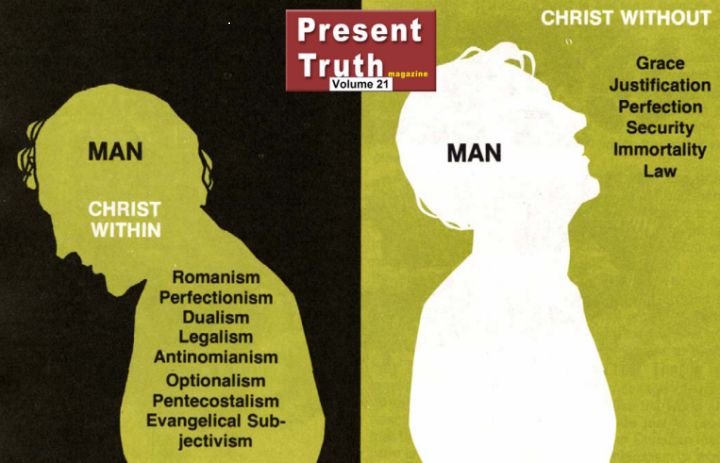
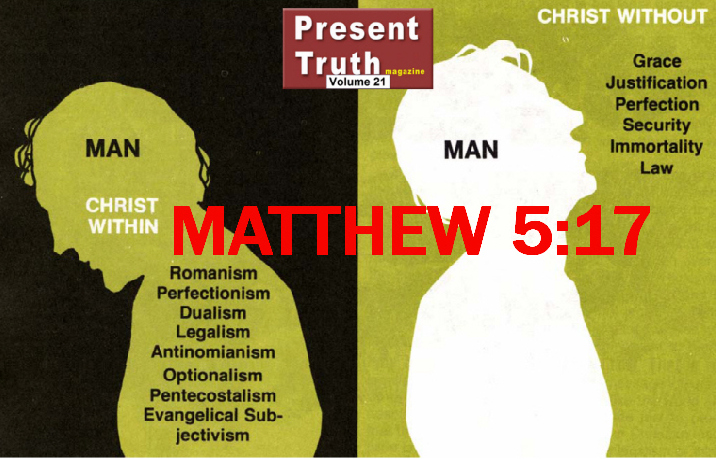
This is a Reformed illustration of the official Reformation gospel, the centrality of the objective gospel outside of us. Here is what Susan’s research has made clear to me: this is nothing more or less than a Platonist construct; period. This is predicated on the idea that matter is inherently evil and only spirit is the true, good, and the beautiful which is Plato’s trinity. That’s what this is. Man, being part of the material world, cannot have grace or goodness within him. And I quote:
When the ground of justification moves from Christ outside of us to the work of Christ inside of us, the gospel (and the human soul) is imperiled. It is an upside down gospel.
~ John Piper
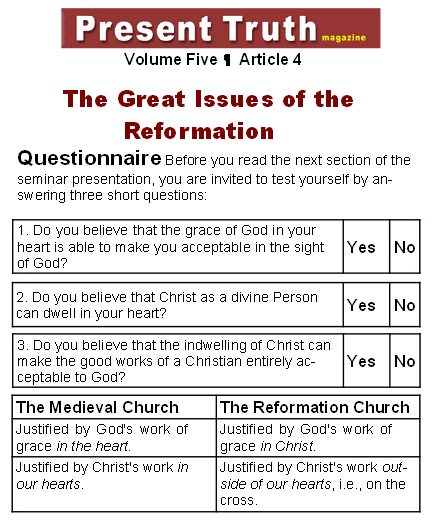
In our time we are awash in a “Sea of Subjectivism,” as one magazine put it over twenty years ago [see left man in illustration]. Let me explain. In 1972 a publication known as Present Truth published the results of a survey with a five-point questionnaire which dealt with the most basic issues between the medieval church and the Reformation. Polling showed 95 per cent of the “Jesus People” were decidedly medieval and anti-Reformation in their doctrinal thinking about the gospel. Among church-going Protestants they found ratings nearly as high.
~ John H. Armstrong
And here is an excerpt from the exact article Armstrong spoke of:
Whether the Medieval church believed the new birth aided us in finishing our justification is not the point. The point is that sanctification does not finish justification and the two or totally separate, but more on that later. I now want to address the aforementioned comment on Paul’s Passing Thoughts blog:
Perhaps you could give me an example of a Calvinist teaching that matter is evil in and of itself. What you say about law is true regarding Calvinists and Paul’s teaching except that Calvinists do believe that Jesus satisfied the Law’s righteous requirements so that the believer stands justified before the Law.
And this was my answer to the comment:
You just stated it yourself. Calvinists believe Jesus had to fulfill the law for us and not in us because we are of matter and not Spirit. Paul taught that the new birth enabled the righteous requirements of the law to be fulfilled in us in sanctification–and the law is abolished in regard to justification.
Of course, this is a direct reference to Matthew 5:17;
“Do not think that I have come to abolish the Law or the Prophets; I have not come to abolish them but to fulfill them.
THIS IS IT RIGHT HERE. The Calvinist interpretation of this passage equals the same as the two-man illustration. This has to be interpreted as Christ fulfilling the law for us while not abolishing it for justification. Abolishment pertains to justification; i.e., Christ didn’t come to abolish the law in regard to justification, and fulfillment is completely of Christ for that purpose. Because of the fundamental idea that the true, the good, and the beautiful cannot be united with evil and create good, this MUST be their view of law. It is of necessity within that construct.
But this is where interpreting the Bible in context of justification and sanctification is absolutely critical. Is Matthew 5:17 regarding justification or sanctification? Unless this distinction is made, the Bible contradicts itself. How so? Because in fact, the apostle Paul stated that Christ came to “end” the law:
Romans 10:4 – For Christ is the end of the law for righteousness to everyone who believes.
When one believes, they are no longer “under the law” ….for justification. In regard to justification, the law is abolished—it is no longer a standard for our justification:
Romans 3:19 – Now we know that whatever the law says it speaks to those who are under the law, so that every mouth may be stopped, and the whole world may be held accountable to God. 20 For by works of the law no human being will be justified in his sight, since through the law comes knowledge of sin. 21 But now the righteousness of God has been manifested apart from the law, although the Law and the Prophets bear witness to it— 22 the righteousness of God through faith in Jesus Christ for all who believe.
Romans 5:13 – for sin indeed was in the world before the law was given, but sin is not counted where there is no law.
So what was Christ saying when He said He didn’t come to abolish the law, but rather to fulfill it? He was talking about sanctification which by the way is the subject of the Sermon on the Mount. Justification by faith alone is nowhere to found in that sermon. The sermon is about how the Christian builds their life on a rock. So, in what way did Christ say He was going to fulfill the law? Let’s see:
Romans 8:3 – For God has done what the law, weakened by the flesh, could not do. By sending his own Son in the likeness of sinful flesh and for sin, he condemned sin in the flesh, 4 in order that the righteous requirement of the law might be fulfilled in us, who walk not according to the flesh but according to the Spirit. 5 For those who live according to the flesh set their minds on the things of the flesh, but those who live according to the Spirit set their minds on the things of the Spirit. 6 For to set the mind on the flesh is death, but to set the mind on the Spirit is life and peace. 7 For the mind that is set on the flesh is hostile to God, for it does not submit to God’s law; indeed, it cannot. 8 Those who are in the flesh cannot please God.
Christ came and died on the cross to release us from the law so that the law could be fulfilled in us….for sanctification. Another way of looking at this is that he came and died on the cross to destroy the works of the devil in us:
1John 3:8 – Whoever makes a practice of sinning is of the devil, for the devil has been sinning from the beginning. The reason the Son of God appeared was to destroy the works of the devil. 9 No one born of God makes a practice of sinning, for God’s seed abides in him, and he cannot keep on sinning because he has been born of God. 10 By this it is evident who are the children of God, and who are the children of the devil: whoever does not practice righteousness is not of God, nor is the one who does not love his brother.
Living a life of sin denies the very reason Christ went the cross. Ephesians gives us a good example of how this is applied:
Ephesians 4:19 – They have become callous and have given themselves up to sensuality, greedy to practice every kind of impurity. 20 But that is not the way you learned Christ!— 21 assuming that you have heard about him and were taught in him, as the truth is in Jesus, 22 to put off your old self, which belongs to your former manner of life and is corrupt through deceitful desires, 23 and to be renewed in the spirit of your minds, 24 and to put on the new self, created after the likeness of God in true righteousness and holiness.
By practicing righteousness (put on) we please God, love Christ, and fulfill the righteousness of the law in His service. By putting off the old us we serve Christ by destroying the works of the devil. But if obeying the law perfectly to maintain our just standing is the case, we are obviously out of the loop. Moreover, it combines the good with mortality which is anathema in the Platonist construct. Hence, in Calvinism, the law must remain as a standard to maintain a just standing. That makes righteousness within mortality impossible. This is the crux of the issue. True righteousness operating in imperfection is a metaphysical impossibility to the Platonist. But God has accomplished it by putting to death the mortal body we dwell in, abolishing the law for our justification, imputing our sin to Christ, and imputing His righteousness to us apart from the law. The old us died with Christ and cannot be judged, and the righteous seed of God dwells within us.
Let’s examine some of the answers to this that I received by Calvinists on the blog:
No, I was asking for an example of a Calvinist teaching that matter is evil in and of itself. Where does any Calvinist teach that Jesus had to fulfill the law for us because we are matter and not spirit? Now I even have questions about your statement that Paul taught that law is abolished in regard to justification. Where does he ever say the law is abolished in regard to justification?
In regard to the latter, we have answered that question. Paul stated plainly that we are justified APART from the law in many places. In regard to the former, it is like a wife-beater demanding to be shown in the Bible where it states specifically that he cannot beat his wife. It’s ludicrous. The principle can be seen in Calvinism’s “T” in T.U.L.I.P: total depravity. Look, I could once again cite the Calvin Institutes to make this point, but I think the following tweet from Tullian Tchividjian should suffice:
This mentality mimics Calvin precisely. Hence, my answer:
Calvin rejected the idea that any saint has ever done one righteous deed that pleased God (CI 3.14.9-11). Was he speaking of flesh or spirit? And if both are depraved, why would it make a difference?
I got this in reply:
Even those who believe in total depravity (whether in a regenerate or unregenerate state—most Calvinists would not subscribe to the idea that believers continue to be totally depraved in the same sense as are the unregenerate) do not believe the body is evil in and of itself.
And my reply:
In regard to you: we are all totally depraved, but not in the same way, and it doesn’t mean our bodies are inherently evil. Right. Typical Calvinist double speaking nonsense–you will not be wasting any more of my time. Post if you will, and get your jollies doing it–but they will not see the light of day here.
No matter what verbiage Calvinists use and what they seem to say, they must be brought back to the two-man illustration to give an account. In our day, the New Calvinist problem is a return of the exact same Gnosticism (which came from Platonism) that wreaked havoc on the first century church. This can be seen throughout the New Testament. New Calvinists like Paul David Tripp and CJ Mahaney call Christians, “enemies of God,” “God ignoring,” “we hate God,” etc., while the apostles stated the exact opposite:
Romans 15:14 – I myself am satisfied about you, my brothers, that you yourselves are full of goodness, filled with all knowledge and able to instruct one another.
The book of 1John is peppered with rebuttals that reflect a contention against the exact same things that the New Calvinists teach in our day. That is because John was contending against Gnosticism and that’s what the New Calvinists are. This will be clearly demonstrated at this year’s conference historically, doctrinally, and practically.
Therefore, the clear vision for the Potter’s House moving forward is a strong assertion that we are not only declared righteous, we are righteous. Our primary goals are aggressive sanctification in all areas of life, emphasis on doctrinal and theological training, and making disciples by teaching them all that the Lord commanded.
Because only truth sanctifies.
The Potter’s House 2/10/2013: The Gospel According to Moses; Part 1

 Yesterday, I was invited to teach at Church of the Messiah which is a Christian movement that seeks to rediscover our Judeo-Christian roots. Since we are deeply invested in the subject of law and gospel right now via the book of Romans I thought it would be a good supplement.
The more we study through the Scriptures we realize that there is little difference between the Old Testament and New Testament. Believers of Old looked toward the cross; we look back to the cross. The ministry of the Holy Spirit is fundamentally the same. I think the primary variance is marked by the inclusion of the Gentiles into the commonwealth of Israel. But at any rate, believers of Old understood all of the salvific implications of Messiah’s arrival:
Luke 2:22 – And when the time came for their purification according to the Law of Moses, they brought him up to Jerusalem to present him to the Lord 23 (as it is written in the Law of the Lord, “Every male who first opens the womb shall be called holy to the Lord”) 24 and to offer a sacrifice according to what is said in the Law of the Lord, “a pair of turtledoves, or two young pigeons.” 25 Now there was a man in Jerusalem, whose name was Simeon, and this man was righteous and devout, waiting for the consolation of Israel, and the Holy Spirit was upon him. 26 And it had been revealed to him by the Holy Spirit that he would not see death before he had seen the Lord’s Christ. 27 And he came in the Spirit into the temple, and when the parents brought in the child Jesus, to do for him according to the custom of the Law, 28 he took him up in his arms and blessed God and said,
29 “Lord, now you are letting your servant depart in peace, according to your word; 30 for my eyes have seen your salvation 31 that you have prepared in the presence of all peoples, 32 a light for revelation to the Gentiles, and for glory to your people Israel.” 33 And his father and his mother marveled at what was said about him. 34 And Simeon blessed them and said to Mary his mother, “Behold, this child is appointed for the fall and rising of many in Israel, and for a sign that is opposed 35 (and a sword will pierce through your own soul also), so that thoughts from many hearts may be revealed.”
36 And there was a prophetess, Anna, the daughter of Phanuel, of the tribe of Asher. She was advanced in years, having lived with her husband seven years from when she was a virgin, 37 and then as a widow until she was eighty-four. She did not depart from the temple, worshiping with fasting and prayer night and day. 38 And coming up at that very hour she began to give thanks to God and to speak of him to all who were waiting for the redemption of Jerusalem.
Christ chastised Nicodemus for not comprehending the new birth which is normally thought of as a New Testament element of salvation:
John 3:1 – Now there was a man of the Pharisees named Nicodemus, a ruler of the Jews. 2 This man came to Jesus by night and said to him, “Rabbi, we know that you are a teacher come from God, for no one can do these signs that you do unless God is with him.” 3 Jesus answered him, “Truly, truly, I say to you, unless one is born again he cannot see the kingdom of God.” 4 Nicodemus said to him, “How can a man be born when he is old? Can he enter a second time into his mother’s womb and be born?” 5 Jesus answered, “Truly, truly, I say to you, unless one is born of water and the Spirit, he cannot enter the kingdom of God. 6 That which is born of the flesh is flesh, and that which is born of the Spirit is spirit. 7 Do not marvel that I said to you, ‘You must be born again.’ 8 The wind blows where it wishes, and you hear its sound, but you do not know where it comes from or where it goes. So it is with everyone who is born of the Spirit.”
9 Nicodemus said to him, “How can these things be?” 10 Jesus answered him, “Are you the teacher of Israel and yet you do not understand these things? 11 Truly, truly, I say to you, we speak of what we know, and bear witness to what we have seen, but you do not receive our testimony. 12 If I have told you earthly things and you do not believe, how can you believe if I tell you heavenly things? 13 No one has ascended into heaven except he who descended from heaven, the Son of Man. 14 And as Moses lifted up the serpent in the wilderness, so must the Son of Man be lifted up, 15 that whoever believes in him may have eternal life.
Also, when we look at Old Testament covenants, we must be careful to give diligent study because it seems that many of them are relevant now and will continue to be:
Ephesians 2:11 – Therefore remember that at one time you Gentiles in the flesh, called “the uncircumcision” by what is called the circumcision, which is made in the flesh by hands— 12 remember that you were at that time separated from Christ, alienated from the commonwealth of Israel and strangers to the covenants of promise, having no hope and without God in the world. 13 But now in Christ Jesus you who once were far off have been brought near by the blood of Christ.
Notice that “covenants” is in the plural and the Gentiles were alien to these covenants. Also note that they are called “covenants of promise.” The covenants are still in place until the promise attached to any given covenant is fulfilled.
Exodus 19-24 was used by the apostle Peter to write his first letter. How different is the Sinai event from the fundamental principles of the New Testament gospel? Not much. As we shall see, the relationship of obedience, law, death, and resurrection is no different.
I ask you to now take note of our first illustration that we will be utilizing:

Israel arrives at Mt. Sinai three lunar moons after leaving Egypt (three months). Between Egypt and Sinai, it was the Lord’s flight school:
Exodus 19:4 – You yourselves have seen what I did to the Egyptians, and how I bore you on eagles’ wings and brought you to myself.
This is a reference to how eagles teach their young to fly. They drop them from a great height and then fly under them before they hit the ground, and the events leading up to Sinai look very much like that.
When Israel arrives, God calls Moses up to the mountain; there, He proposes a covenant:
Exodus 19:5 – Now therefore, if you will indeed obey my voice and keep my covenant, you shall be my treasured possession among all peoples, for all the earth is mine; 6 and you shall be to me a kingdom of priests and a holy nation. These are the words that you shall speak to the people of Israel.”
The covenant is based on three things: obedience, kingdom of priests, and holy nation. At some point this happens—God gets what He wants. We know this because that’s what we are right now according to Peter:
1Peter 2:9 – But you are a chosen race, a royal priesthood, a holy nation, a people for his own possession, that you may proclaim the excellencies of him who called you out of darkness into his marvelous light. 10 Once you were not a people, but now you are God’s people; once you had not received mercy, but now you have received mercy.
This is very likely a direct reference to Exodus 19:5 by Peter. More than likely, this is consummated at Sinai and has always been reality. Therefore, we begin to see inappropriate dichotomies between the Old and New Testaments.
Moses then returns and informs the people that God wants to make a covenant with them. Interestingly, they agree to commit to whatever covenant God draws up. The key word here is commitment. The Israelites didn’t do anything to earn the right to enter into a covenant with God; rather, they committed to trust him: “we will do” is future tense. Even the writers of the Jewish midrash recognize that it is a matter of trust (The Jewish Study Bible: Jewish Publication Society; Oxford University Press 2004, p.162). This reminds of how Christ often called people to salvation: “Follow me.” Following doesn’t save you; the commitment to follow saves you. Trust is also belief.
When the people agree to the covenant, God calls for three days of consecration and sends Moses back down to lead the people in preparation for His arrival and the covenant ceremony. God’s form of theophany terrifies the people, and God recites the Book of the Covenant to Moses which includes the Decalogue (the Ten Commandments). The Decalogue is probably a sort of table of contents for the Book of the Covenant. The Book of the Covenant, though not precisely, seems to follow the Decalogue’s line of thought.
Once Moses receives the covenant, he rehearses it to the people. This brings us to our next illustration:
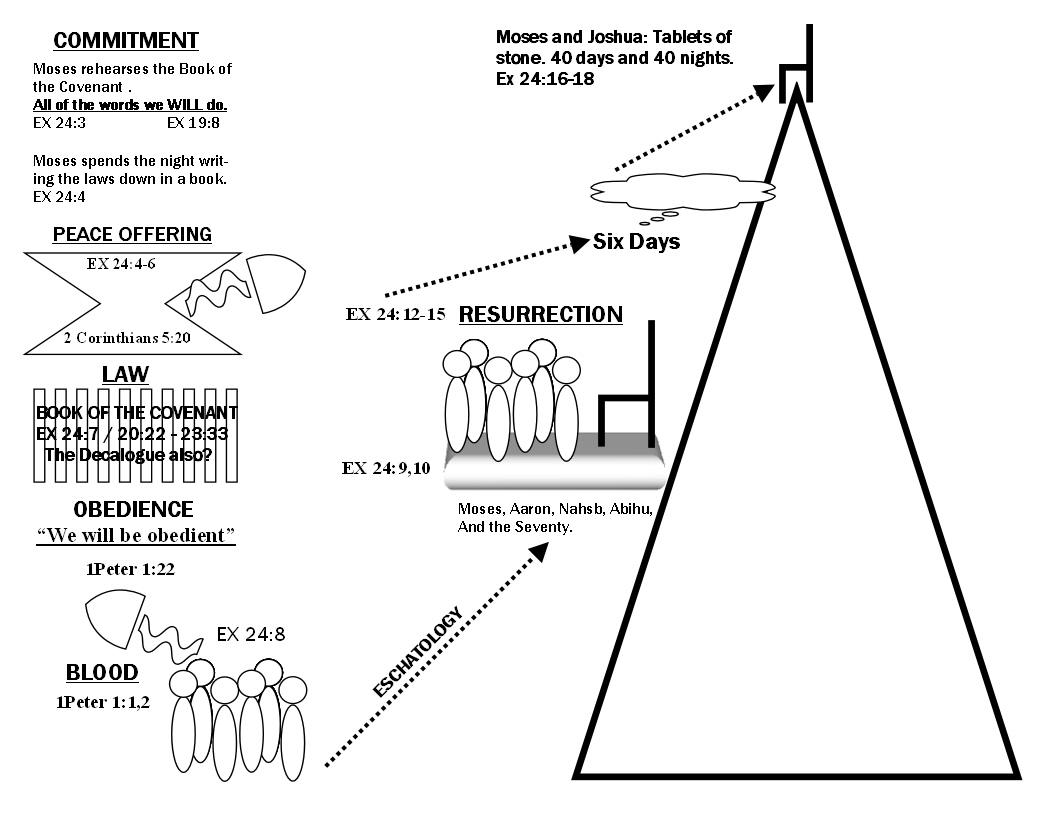
Interesting: Moses doesn’t take time to write it all down in a book until the people agree to the details. He then begins early the next morning in preparation for the ceremony. He has young men slaughter the appropriate sacrifices and throws some blood on the alter while procuring the rest in basins. But the ceremony begins with a peace offering—this is key. The fact that we were enemies makes the call to be reconciled with God paramount and is the theme of many gospel presentations in the New Testament. Our ministry is one of reconciliation:
2 Corinthians 5:18 – All this is from God, who through Christ reconciled us to himself and gave us the ministry of reconciliation; 19 that is, in Christ God was reconciling the world to himself, not counting their trespasses against them, and entrusting to us the message of reconciliation. 20 Therefore, we are ambassadors for Christ, God making his appeal through us. We implore you on behalf of Christ, be reconciled to God. 21 For our sake he made him to be sin who knew no sin, so that in him we might become the righteousness of God.
Ephesians 2:15 – by abolishing the law of commandments expressed in ordinances, that he might create in himself one new man in place of the two, so making peace, 16 and might reconcile us both to God in one body through the cross, thereby killing the hostility. 17 And he came and preached peace to you who were far off and peace to those who were near.
So far, we have two critical elements to include in our gospel presentations: trust (commitment: “follow me”), and reconciliation (peace with God).
Moses then read the Book of the Covenant which would be Exodus 20:22-23:33. When the people once again agreed to obey, he threw the remainder of the blood on them. Again, at this point, no law from the Book of the Covenant has yet been obeyed, but the commitment to do so resulted in the sprinkling of blood. Peter makes a direct reference to this as well:
1Peter 1:22 – Having purified your souls by your obedience to the truth for a sincere brotherly love, love one another earnestly from a pure heart,
The Israelites were purified by obedience—that’s what brought the covering of blood. And this is a critical third element to any gospel: obedience—the willingness to obey “truth.” The Book of the Covenant, like the rest of God’s canon is “truth.” And only truth sanctifies:
John 17:17 – Sanctify them in the truth; your word is truth.
A commitment to the truth saves (2Thessalonians 2:10), the law then informs our sanctification. But “I will obey” brings the blood. Trust, reconciliation, obedience. Not necessarily in that order. In the application of the blood of Christ, the old self dies with Christ and is no longer enslaved to sin, but is now enslaved to the law by nature (Romans 7:25). We are enslaved to the law by nature because of the new birth made possible by Christ’s resurrection. We are endowed with the same power that raised Him from the dead (Ephesians 1:19, 20). Once again, 1Peter 1:1, 2 is a direct reference to this Old Testament passage:
To those who are elect exiles of the Dispersion in Pontus, Galatia, Cappadocia, Asia, and Bithynia, 2 according to the foreknowledge of God the Father, in the sanctification of the Spirit, for obedience to Jesus Christ and for sprinkling with his blood: May grace and peace be multiplied to you.
Moses and the other pre-designated individuals go up the mountain to meet God after the ceremony. The scene is inescapably eschatological. Eating a meal with God during this encounter points to the marriage supper of the Lamb in my book. In regard to the cup that symbolizes the new covenant in His blood, Christ said He would not drink of it again until that supper in His kingdom. The remembrance was instituted at what is commonly known as the last supper (Mark 14:22-25).
Not only does Matthew 4:4 and 2Timothy 3:16 state that ALL Scripture is efficacious, some estimate that 25% of the Bible is eschatological. And as we have seen in our Romans series, eschatology is gospel. The paramount questions on this wise are, how many resurrections, and how many judgments? The answers to these questions should match our gospel and thus reveal it. Being mindful of what we have learned in Romans, you can relate this to the third illustration:
Peter’s gospel emphasis is seen in the Sinai event. And our gospel should always include trust, commitment, reconciliation, obedience, and the death, burial, and resurrection demonstrated in Christ’s blood. Christ’s obedience to the cross should also be explained in relationship to our death and freedom from the law as well as our enslavement by nature to law through the new birth that endowed us with the Spirit’s resurrection power.
paul


 Paul's Passing Thoughts
leave a comment