Acts Lesson 37
Archives: ttanc.com

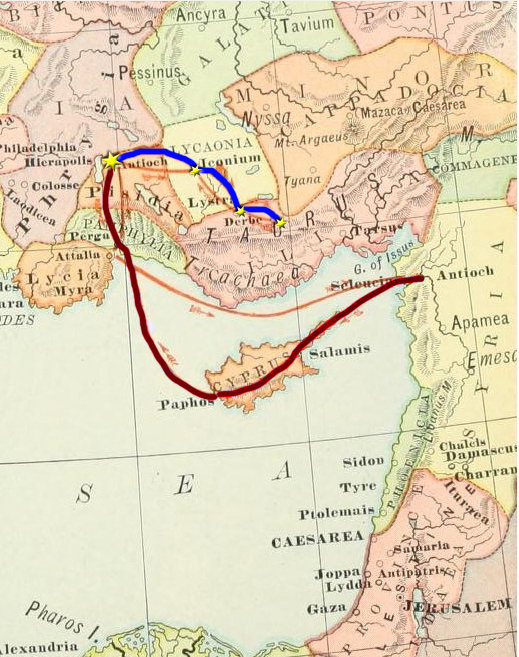
Tonight’s Text – Acts 14:8-20
Brief review
- Lame man of Lystra
- Similarities with the lame man of Acts 3
Lame from birth
In a public place
His healing draws attention
- A resident of Lystra
- There to hear Paul and Barnabas teach
- Perception of faith
- The people misunderstand the miracle
- Astonishment similar to the people in Jerusalem
- Wrongly attribute the source of power
- Gods in the form of men
Barnabas à Jupiter
Paul à Mercury
- Rending of the clothes
Jewish tradition
– For mourning
– For deep regret or grief
- Paul calls them to turn from “vanities”
ματαιως (ma-tai-ohs) – empty, without purpose
- And turn to
– The Living God
– The Creator
– The One Who is Longsuffering
– The One Who has revealed Himself
- Unable to get the people to stop.
The Jealous Jews
- From Antioch and Iconium
- Are these the same ones from the synagogues?
– Already looking for Paul and Barnabas.
– Discover the uproar.
– Provoke the crowd to action
- Concluding thoughts for consideration
– Jews’ rejection of gospel
– Reaction in Lystra to the miracle
– Jews’ jealousy
John 8:34-36: The Connection Between Christ and Paul’s Letter to the Romans

NOTES (not a transcript):
Words mean things. Christians should be careful that they know what words mean in the biblical sense. Protestants misunderstand the biblical definitions of many key words; really, almost all of them. This is because orthodoxy has redefined all of them. The more we see the proper definitions of key biblical words, the more we see a beautiful continuity in the truth that gives us life, and life more abundantly.
John 8:34-36 is part of what Jesus said in a debate with the religious leaders of that day, and is not only the crux of salvation, but Pauline soteriology to a “T.” Let’s look at it:
John 8:34 – Jesus answered them, “Truly, truly, I say to you, everyone who practices sin is a slave to sin. 35 The slave does not remain in the house forever; the son remains forever. 36 So if the Son sets you free, you will be free indeed (ESV).
Verse 34 is a theme that Jesus focuses on in the surrounding text. Nothing that we do can make us righteous, but what we do shows who we are. Why? Because we are new creatures; we are born from above. Jesus emphasizes fruits, but the apostle Paul articulates the doctrine in his letters. What Jesus states here, and what Paul states in his epistles, is exactly the same.
The key words we must understand are: sin; son; Son; slave, and free. The word “practice” in the ESV is a good translation because it denotes the idea of a life pattern. Perfection is not in mind here. The Principle is described by Paul in Romans:
Romans 6:20 – For when you were slaves of sin, you were free in regard to righteousness. 21 But what fruit were you getting at that time from the things of which you are now ashamed? For the end of those things is death. 22 But now that you have been set free from sin and have become slaves of God, the fruit you get leads to sanctification and its end, eternal life. 23 For the wages of sin is death, but the free gift of God is eternal life in Christ Jesus our Lord.
The new birth is a reversal of slavery and freedom leading to a different life direction. Though an unbeliever is free to righteousness, ultimately, he/she is indifferent to the freedom of God’s truth. Certainly, an unbeliever can do righteous works because the works of God’s law are written upon the heart (Rom 2:14).
I will also agree with the ESV differentiating between “son” in verse 35 and “Son” in verse 36 via capitalization. The son in verse 35 is not the same Son in verse 36. Verse 35 speaks of the sonship of a son to the master of the house. The slave (bond servant) is not part of the family and has an uncertain length of occupancy while the son of the master will always be the master’s son.
“Slave” has three meanings here: slave to a master; slave to a law, and a slave to death. Let’s look at the first one: it is a slave to a particular master; sin. Throughout the whole Bible, sin is defined as a master.
Romans 6:17 – But thanks be to God, that you who were once slaves of sin have become obedient from the heart to the standard of teaching to which you were committed,
Genesis 4:5 – So Cain was very angry, and his face fell. 6 The Lord said to Cain, “Why are you angry, and why has your face fallen? 7 If you do well, will you not be accepted? And if you do not do well, sin is crouching at the door. Its desire is for you, but you must rule over it.”
Sin is an entity that desires to rule over humanity, and primarily utilizes desire to do so.
James 1:14 – But each person is tempted when he is lured and enticed by his own desire. 15 Then desire when it has conceived gives birth to sin, and sin when it is fully grown brings forth death.
Romans 6:12 – Let not sin therefore reign in your mortal body, to make you obey its passions. 13 Do not present your members to sin as instruments for unrighteousness, but present yourselves to God as those who have been brought from death to life, and your members to God as instruments for righteousness. 14 For sin will have no dominion over you, since you are not under law but under grace.
The contrary master is righteousness, and this is to whom the son is enslaved. The Son has set the household slave free to be enslaved to righteousness as the son of the master.
Romans 6:18 – and, having been set free from sin, have become slaves of righteousness.
This is also slavery to a law. Sin has its own law (Scripture). This is a law appointed to the Sin slave master by God. Only this law can define sin. No sin has been committed that is not imputed to this law and recorded as a violation against it. Sin designs its desires to refute the law. Sin uses the law of God to provoke people to sin through contrary desires.
Romans 7:5 – For while we were living in the flesh, our sinful passions, aroused by the law, were at work in our members to bear fruit for death.
Romans 7:8 – But sin, seizing an opportunity through the commandment, produced in me all kinds of covetousness.
The Son came to die on the cross to make slaves into sons. He did this by ending the law and its condemnation. Sin can no longer condemn us.
1Corinthians 15:56 – The sting of death is sin, and the power of sin is the law. 57 But thanks be to God, who gives us the victory through our Lord Jesus Christ. 58 Therefore, my beloved brothers, be steadfast, immovable, always abounding in the work of the Lord, knowing that in the Lord your labor is not in vain.
The Son came to end the law, that is, the law of sin and death (Rom 8:2), so that sin can no longer condemn us through the law.
Romans 10:4 – For Christ is the end of the law for righteousness to everyone who believes.
Romans 5:13 – for sin indeed was in the world before the law was given, but sin is not counted where there is no law.
Romans 7:8 – …For apart from the law, sin lies dead.
Therefore, those who sin are under the law (“everyone who practices sin is a slave to sin”), but Christ came to end the law, so a son cannot sin against the law. He is now under grace and NOT under law:
Romans 6:14 – For sin will have no dominion over you, since you are not under law but under grace.
God lent His law to sin as a covenant that would imprison all sins committed therein. It’s like a will written to all unbelievers. All sins are imputed to it until faith comes, and the inheritance is eternal life.
Galatians 3:21 – Is the law then contrary to the promises of God? Certainly not! For if a law had been given that could give life, then righteousness would indeed be by the law. 22 But the Scripture imprisoned everything under sin, so that the promise by faith in Jesus Christ might be given to those who believe. 23 Now before faith came, we were held captive under the law, imprisoned until the coming faith would be revealed. 24 So then, the law was our guardian until Christ came, in order that we might be justified by faith. 25 But now that faith has come, we are no longer under a guardian, 26 for in Christ Jesus you are all sons of God, through faith.
Hebrews 9:15 – Therefore he is the mediator of a new covenant, so that those who are called may receive the promised eternal inheritance, since a death has occurred that redeems them from the transgressions committed under the first covenant. 16 For where a will is involved, the death of the one who made it must be established. 17 For a will takes effect only at death, since it is not in force as long as the one who made it is alive. 18 Therefore not even the first covenant was inaugurated without blood.
This is where a slave becomes a son, in order to be set free from the master who has owned him since birth (Rom 7:14). Like Christ, a death must occur to free the son from the old covenant that imprisons sin, death, and condemnation.
Romans 7:1 – Or do you not know, brothers—for I am speaking to those who know the law—that the law is binding on a person only as long as he lives? 2 For a married woman is bound by law to her husband while he lives, but if her husband dies she is released from the law of marriage. 3 Accordingly, she will be called an adulteress if she lives with another man while her husband is alive. But if her husband dies, she is free from that law, and if she marries another man she is not an adulteress.
Romans 7:4 – Likewise, my brothers, you also have died to the law through the body of Christ, so that you may belong to another, to him who has been raised from the dead, in order that we may bear fruit for God. 5 For while we were living in the flesh, our sinful passions, aroused by the law, were at work in our members to bear fruit for death. 6 But now we are released from the law, having died to that which held us captive, so that we serve in the new way of the Spirit and not in the old way of the written code.
The son is now free without fear of condemnation to obey the law of the Spirit of life (Rom 8:2). Christ fulfilled the Old Covenant law of sin and death by paying the wages of sin—death, and was raised from the dead in order to conquer death as well. There is no law to condemn us, and no wage of sin to be paid. We have been bought with this price from the Sin master, and now belong to Master Righteousness.
1Corintians 6:20 – for you were bought with a price. So glorify God in your body.
Being sons, purchased by the Son, and under grace, we are now free to fulfill the law of the Spirit of life by obeying Christ the righteous one:
Romans 8:1 – There is therefore now no condemnation for those who are in Christ Jesus. 2 For the law of the Spirit of life has set you free in Christ Jesus from the law of sin and death. 3 For God has done what the law, weakened by the flesh, could not do. By sending his own Son in the likeness of sinful flesh and for sin, he condemned sin in the flesh, 4 in order that the righteous requirement of the law might be fulfilled in us, who walk not according to the flesh but according to the Spirit. 5 For those who live according to the flesh set their minds on the things of the flesh, but those who live according to the Spirit set their minds on the things of the Spirit. 6 For to set the mind on the flesh is death, but to set the mind on the Spirit is life and peace. 7 For the mind that is set on the flesh is hostile to God, for it does not submit to God’s law; indeed, it cannot. 8 Those who are in the flesh cannot please God.
The Book of Acts Lesson 36
Tuesday Night Bible Study
September 9, 2014
Study of the Book of Acts
Tonight’s Text – Acts 13:48 – 14:7 Brief review
– The word was published διαφερω – “dee-ah-fer-oh” To carry through
Compare with – Acts 13:6-8 – Acts 6:9-12 – Matthew 27:16-20
– Paul and Barnabas expelled – εχβαλλω – “ek-ball-oh” – to throw out – intensity
– A practice of devout Jews – Symbolic gesture of derision towards Gentiles – Used by Jesus to mock the religious elite – Gesture of judgment upon the Jews
III. Spirit-filled disciples of Antioch
πληροω – “play-ro-oh” – To make replete; to cram – Imperfect tense indicates an ongoing occurrence. – Compare with Galatians 5:13-16
– Bold speaking – Signs and wonders
– Violent impulses exercising violence stoning encouraged
|
Notes: |
14 Basic Fundamentals of the True Gospel
1. Justification
Used synonymously with “righteousness.” It is the declaration and imputation of righteousness to the believer. This is the very righteousness of God. This is also the salvation of the soul. God NEVER declares anyone righteous unless He makes them righteous. This is not a position only, the person is actually made righteous.
2. The New Birth
Normally, sanctification would be discussed next, but it is important to understand how we are truly righteous—yet we still fall short of God’s standards in this life. The new birth takes place in time when we believe, and is a spiritual reality which lacks the experiential evidence we would expect, yet the Bible is explicit about what takes place. Our old spiritual self dies a literal death “with Christ,” and we are born again with an incorruptible seed. This is pictured in water baptism. We are new creatures. We do NOT have two natures, we only have one nature.
3. Flesh
It is the human body. It is not inherently evil, what God created that was good originally became weak in the fall, like creation, but is not inherently evil. This is why we are actually righteous, but fall short of God’s glory: “The spirit is willing, but the flesh is weak.”
4. Sin
Sin was found in Lucifer, an angel created by God. It is described in the Bible as a master. Sin masters those who are not saved, but is hindered by the conscience God created in every being. God also wrote His character traits on the hearts of all people because we are born in His image. Unbelievers are not completely mastered by sin because they are born in God’s image. Unfortunately, unbelievers often confuse the image of God with their own righteousness.
When a believer sins, it is a violation of the Bible, but is considered to be sin against God and His family, directly or indirectly, by bringing shame on God’s name. For the unbeliever, violation of the law leads to eternal condemnation while sin for the believer can lead to chastisement and loss of reward.
5. Sanctification
It means to be set apart for God’s purposes. The gospel is really a call to kingdom living. Escape from eternal judgment is a positive by-product. See Andy Young’s TANC 2014 sessions on sanctification.
6. Kingdom
The earth is presently ruled by Satan. It is the kingdom of darkness. God’s kingdom is NOT on earth nor is the earth being gradually transformed from one kingdom realm to another via the collective Christocentric psyche of the church. We are ambassadors of God’s heavenly kingdom. Christ will return, destroy Satan’s kingdom, and set up His own. Christians are to make as many disciples as possible until that day. The church has no task in bringing forth God’s kingdom on earth. We display the will of the kingdom, and call people to it, but have NO task in bringing it to earth.
7. Hell
Hell was not created for man, but for Satan and the demons who were never offered salvation. A loving God sends no one to hell, people merely choose what kingdom they want to belong to. The gospel is a call to escape the earthly kingdom and its slavery to sin, and be transformed into God’s kingdom of light.
8. The Bible
“Law,” “scripture,” “holy writ,” “the law and the prophets,” “the word,” “the law,” etc., are all interchangeable terms for the closed canon of scripture. The Bible is God’s law and wisdom for life and godliness. It is also a full-orbed metaphysical treatise. It defines reality.
9. The Law of Sin and Death
It’s the Bible’s relationship to unbelievers. It describes how the unbeliever will be judged in the last day for every violation of conscience.
10. The Law of the Spirit of Life
It describes the believer’s relationship to the Bible. The transformed heart of the believer now desires to obey God, is no longer enslaved to sin, and cannot be condemned by the law. The Bible is a manual for our kingdom citizenship.
11. Judgment
There are two: one of condemnation for those who chose the kingdom of darkness, known as the Great White Throne Judgment, and a separate one for eternal rewards known as the Bema Judgment.
12. Redemption
This is the other salvation. It is the redemption of the body at resurrection. This salvation is often confused with justification, or the salvation of the soul.
13. Justice
Justice is of paramount importance to God and He is angered when it is not practiced by people whether lost or saved. Fairness matters to God.
14. Rest
The Christian life is NOT a rest. John Calvin believed sanctification is the New Testament version of the Old Testament Sabbath rest. Because Protestantism only sees ONE application of the law, to judge/condemn, Christians must supposedly rest while Jesus fulfills the law for us.
Unwittingly, this defines Christians as “under law.” Who keeps the law is irrelevant, it can’t give life, and it can’t justify. Protestants must wrongly assert this because they reject the two applications of the law and make it strictly for condemnation only. In contrast, Christians can use the law lawfully because it can no longer condemn them. In Protestantism, the condemnation of the law is not removed for the Christian.
The Potter’s House: Law and Grace; Romans Chapter 4
 Originally published January 2, 2013
We now come to chapter four in our study of Romans. Thus far, Paul has emphasized that all men, whether Jew or Gentile, are saved by faith alone. This salvation is a revelation of God’s righteousness, and is imputed to us when we believe in Jesus Christ. We have learned that the gospel is the full counsel of God which of course includes the death burial, and resurrection of Christ. We have learned that Paul was very concerned with a spiritual caste system that would render the Gentiles as second-class citizens in the church. Though the church is uniquely Jewish, God shows no partiality in regard to race and gives the various gifts of salvation to all men freely.
What we have in the book of Romans is a radical dichotomy between justification and sanctification; or said another way, salvation and its imputed righteousness set against the Christian life as kingdom citizens living on earth as aliens and ambassadors. However, there is NO dichotomy between law and gospel. Why? Because both are the full counsel of God. In the Bible, “law,” “truth,” “gospel,” “Scriptures,” “holy writ,” “the law and the prophets,” and other terms are used interchangeably to speak of the closed canon of God’s full counsel for life and godliness. Christ as well as Paul made it absolutely clear: man lives by every word that proceeds from God and ALL Scripture is profitable to make the servant of God complete in every good work.
Now listen: though the life application of some Scripture changes with time and circumstances, it still remains that all Scripture informs us in regard to our walk with God in the way we pray, think, and act. We do not stone rebellious children in our day. Nay, when we have a rebellious teen in the church, we do not gather the congregation together and stone him/her to death. With that said, does the fact that God at one time instructed the Jews to do so inform us in regard to many applications for teen rebellion in our day? Absolutely. Oh my, the contemporary applications in our day are almost endless. Not only that, Old Testament ritual and symbolism offers a built-in protective hermeneutic for the Scriptures as a whole. What do I mean by that? Well, you can mess with words, but symbolism is very difficult to mess with. If it’s a lampstand, it’s hard to change that to a Honda Civic. Right?
Paul delves into a paramount truth for Christians in the book of Romans: The relationship of the law to the unsaved verses the saved. And here it is: the lost are UNDER the law, and the saved are UNDER grace, but informed by the law. Let me repeat that: the lost are UNDER the law, and the saved are UNDER grace, but informed by the law. And we can see this right in the same neighborhood of the text that we are in.
Romans 3:21—But now the righteousness of God has been manifested apart from the law, although the Law and the Prophets bear witness to it—
That verse pretty much says it all. We are justified apart from the law, and as we will see, Paul means totally apart from the law. But we are informed by it. Paul states in Romans 3:28:
For we hold that one is justified by faith apart from works of the law.
Now note what he states after a few verses following in Romans 4:3,
For what does the Scripture say?
Paul strives to make the point in this letter that law is not even on the radar screen in regard to justification. And this is extremely important to know in our day for many teach that law is on the justification radar screen and therefore Christ must keep the law for us in order to maintain our justification. Not so, there is no law to keep in regard to justification—a righteousness APART from the law, the very righteousness of God has been imputed to our account in full. Paul even writes (and this is very radical) that Christians are sinless in regard to justification because there is no law in justification to judge us:
Romans 7:1—Or do you not know, brothers—for I am speaking to those who know the law—that the law is binding on a person only as long as he lives?
Romans 7:6—But now we are released from the law, having died to that which held us captive….(v.8) Apart from the law, sin lies dead.
Now, the law can judge our sin in our Christian life, but that can’t touch the fact that we are “washed.” Therefore, in sanctification, we only need to wash our feet to maintain a healthy family relationship with our Father God and Brother, the Lord Jesus Christ. Turn with me and let’s look at this in John 13:1-11:
Now before the Feast of the Passover, when Jesus knew that his hour had come to depart out of this world to the Father, having loved his own who were in the world, he loved them to the end. 2 During supper, when the devil had already put it into the heart of Judas Iscariot, Simon’s son, to betray him, 3 Jesus, knowing that the Father had given all things into his hands, and that he had come from God and was going back to God, 4 rose from supper. He laid aside his outer garments, and taking a towel, tied it around his waist. 5 Then he poured water into a basin and began to wash the disciples’ feet and to wipe them with the towel that was wrapped around him. 6 He came to Simon Peter, who said to him, “Lord, do you wash my feet?” 7 Jesus answered him, “What I am doing you do not understand now, but afterward you will understand.” 8 Peter said to him, “You shall never wash my feet.” Jesus answered him, “If I do not wash you, you have no share with me.” 9 Simon Peter said to him, “Lord, not my feet only but also my hands and my head!” 10 Jesus said to him, “The one who has bathed does not need to wash, except for his feet, but is completely clean. And you are clean, but not every one of you.” 11 For he knew who was to betray him; that was why he said, “Not all of you are clean.”
Clearly, “washing” refers to salvation, and differs from needing the lesser washing of the feet. The example is set against the unregenerate betrayer among them. Note that Jesus said that even though we needed to wash our feet, we are still “completely clean.” My, my, what a strong contrast to much of the teachings in our day; i.e., the idea of “deep repentance” that is the same repentance that saved us and keeps us saved—as long as we are in a Reformed church where such forgiveness is available. (more…)

 Paul's Passing Thoughts
leave a comment