


Susan Dohse on Plato, Augustine, Calvin, and the Reformation
 TANC 2013 Conference on Gospel Discernment and Spiritual Tyranny
Transcript: Susan D. Dohse MEd.
Plato
I’m Susan Dohse. I’m married to Paul Dohse for two years, and it has been an adventure. My role in this year’s conference has changed. This year I became Paul’s research assistant. The pay stinks, but the fringe benefits are really nice. Unlike last year when I spoke from personal experience, which though difficult and emotional at times, was easier than this year’s assignment. This year I was asked to step outside my preschool box and share what I’ve learned through not personal experience but personal study and research. And I am thankful for the World Wide Web, computers, and the Internet even though I fuss and say unkind things to the computer, I am thankful that the Lord created those on the eighth day. If I had to find answers to the questions that I had in the old-fashioned way, by using the card catalog and the Dewey Decimal system, I wouldn’t be here this morning. I would still be at the library roaming the stacks. My role in this year’s conference is to share my research. My goal though is to provoke you to think. What I want to share is only an introduction. It’s not even a scratch on the surface of what there is to know about these historical figures. It’s up to you though to continue the research project. So you do have an assignment. I want you to think of me as just a grain of sand, an irritant in the oyster that over time though yields a pearl.
Matthew 7:24-27, Jesus is speaking here. “Therefore, whosoever hears these sayings of mine and does them, I will liken him unto a wise man who built his house upon a rock. And when the rains descended and the floods came and the winds blew and beat upon that house, it fell not, for it was founded upon a rock. And everyone that hears these sayings of mine and does them not shall be likened then to a foolish man who built his house upon the sand, and the rains descended and the floods came and the winds blew and beat upon that house, and great was the fall of it.”
The foundation of thought that I want to illustrate is built upon a historical figure that I just knew initially in a Jeopardy quiz show fashion, you know. Student of Socrates, Greek philosopher, The Republic. Who is Plato? Well, if I were to ask you to tell me something that you know or you’ve been taught about this man, I’m certain I would get classic textbook answers. Greek philosopher, student of Socrates, established the first university called The Academy, wrote The Republic, I would give you credit for being correct. For over 2,500 years, Plato has been studied, admired, modified, personalized, and deified. He has been described as a great thinker, lover of wisdom, a crusader against error, and an enemy of falsehood. Well, after reading hundreds of pages about him, I cannot help but agree that he was a man of great intelligence. He was a mathematical genius, an advocate of education. In your list of trivia facts, would you also include pagan, polytheist, crusader against individuality, founder of communistic, socialistic, and Darwinian evolutionary thought, enemy of God, hero of the reformers?
Born in 427 BC, the son of noble and wealthy Athenian parents with the blood of ancient kings of Attica flowing through his veins. It was this status in life that gave him the way and the means to pursue his quests. Unlike others of his day, he didn’t have to earn a living and go to school at night or hold two jobs to pay for his education. He was of the ruling class of Athens, a privileged elite.
At the age of 20, Plato came to Socrates and asked to be his pupil. And Socrates saw before him a handsome youth, broad shoulders of an athlete, a noble brow of a philosopher, the limpid eyes of a poet. Those aren’t my descriptive terms. This is how Socrates described him. Socrates accepted him as a student, and this became the beginning of a tender and an intimate relationship that lasted until Socrates’ death. The respect and admiration of the student for his teacher was profound and lasting.
Well, after Socrates was executed, Plato and the other disciples of Socrates took to the world, and they traveled the ancient world. Now whether of fear that they would be arrested and also executed because of their association with Socrates or because they wanted to be foreign exchange students is not really well documented. Plato went to Cyrene where Theodorus instructed him in mathematics. He went to southern Italy where he studied the science of numbers under three of the most learned doctors of the Pythagorean mathematical system of his day, went to Egypt to receive instruction from those learned doctors and priests of that ancient land. Some records say he visited Persia, Babylonia, and even India. So he returns to Athens and establishes his Academy, the first university in Europe where he taught until the age of 81.
So up until his return to Athens, we can say letter P for professional student, P for pagan polytheist. Plato regarded the sun, moon, stars, and planets as the visible gods. These heavenly bodies do not come into beings and then pass away. Plato attributed divine souls to the sun, moon, stars, and planets because they followed that intelligible course through the sky. He also held [SOUNDS LIKE] the invisible gods, the gods of the civilized life where the king was Zeus. These gods care about humans. They’re aware of whether we are good or evil. Though invisible, they can reveal them themselves when they want to. They are not standards of justice, beauty, truth, and goodness, but they were living beings who have the perfect knowledge of those standards. Plato wrote, “I do believe that there are gods, and that in a far higher sense than that which any of my accusers believe in them.”
P for platonic wisdom which unites with methodology. P for philosopher ruler. Plato referred to himself as a philosopher ruler. He stressed the importance of living the life of a philosopher by worshipping ideas. The search of ideas, the appreciation of ideas, the participation of the ideas—that’s the life of a philosopher, and that’s what he taught, and that’s what he believed. So the life of Plato was a tireless quest for those ideas. His life is a sustained effort to live by those ideas and to teach others to do so.
P, political scientist, his political philosophy was explained in his writing The Republic. The ideal state, he says, should be divided into three classes of citizens, and each class has its own particular duty to be performed and a special virtue to be developed. The lower class, the laborers and the artisans, their immediate task, acquire skill. The second class, that’s the warriors, and they’re given the opportunity to develop courage and fortitude at their stage of evolution. And the ruling class, those are those men who have learned how to govern themselves and are therefore fit to govern others. I quote from Plato, “Unless philosophers become rulers or rulers become true and thorough students of philosophy, there will be no end to the troubles of the state and humanity.” When each state concentrates upon its own duty and virtue, there will be a well-balanced and harmonious state in which all of the citizens will work, but not for the interest of self but for the common good of the whole. The state will be in charge of production and that sphere of physical goods and life. (more…)
American Clergy Brilliance: “The Gospel of Jesus Christ: An Evangelical Celebration”

“Look, think about this; even an adolescent Sunday school student can see it: if the righteousness of God is revealed apart from the law (Romans 3:21), why would Christ need to keep it for our justification? For crying out loud, what does ‘apart’ mean?”
My theses for this year’s TANC conference highlights the fact that the Reformers taught from a totally different reality than a normative reality that draws logical conclusions from the arrangement of verbs, nouns, prepositions, adjectives, conjunctions, etc. taken at face value. The Reformers created their own metaphysical premise for interpreting reality. The authentic Reformed gospel is predicated on a contra reality. This is one of four reasons that the authentic Reformed gospel experiences a social death periodically throughout church history, and then periodic resurgence movements like the one we are presently in via New Calvinism. There have been five of these resurgence movements sense Calvin’s theocracy in Geneva. They will be documented in volume two of The Truth About New Calvinism. As Christians read their Bibles, they are naturally drawn away from the authentic Reformed gospel because the human tendency is to interpret reality from the normative perspective. They become uncomfortable with the contradictions. However, as each resurgence dies a social death, Protestant traditions of men continue to be a significant part of what emerges from the ashes. A Reformed hybrid emerges that apes the anemic sanctification spawned by Reformed thought. This lays the ground work for the resurgences that follow. Protestantism, historically, oscillates between the weak sanctification of the hybrid and the despotic resurgence movements that temporarily replace the hybrid. Basically, the vicious cycle must be stopped if revival is going to be possible. God sanctifies with truth, not the traditions of men. Part and parcel is a dumbed-down Christianity saturated with the traditions of Reformed men—primarily dead ones. Men of old that are deemed geniuses are often mindless Kool-Aid drinking followers of John Calvin and his ugly stepchildren, the murdering despotic Puritans. Part of the Protestant tradition that carries on is the big “O,” ORTHODOXY. A synonym for “truth” in American churchianity, it is really the repackaging of truth interpreted by the Protestant elite for consumption by the unenlightened masses. The American church follows the tradition of Protestantism when the arrogant, elitist who’s who of evangelicalism come together and publish declarations, i.e., the confessions and creeds of traditional Reformed thought. A recent example of this is the third edition of The Gospel of Jesus Christ: An Evangelical Celebration (1994, 1997, 1999) signed and/or endorsed by, for example, the following: John Ankerberg, Kay Arthur, Tony Evans, Jerry Falwell, Bill Hybels, David Jeremiah, D. James Kennedy, Max Lucado, Woodrow Kroll, Tim & Beverly LaHaye, Erwin Lutzer, Bill McCartney, Luis Palau, Pat Robertson, Ronald Sider, Charles Stanley, John Stott, Joseph Stowell, Chuck Swindoll, Bruce Wilkinson, Ravi Zacharias, Jack Hayford, Steven Strang, John MacArthur Jr., RC Sproul, Charles Colson, Bill Bright, and JI Packer. Only problem is, the document denies the new birth and describes Christians as being under the law as opposed to being under grace. In other words, the authentic gospel of the Reformation. First, the document speaks from the perspective of the authentic Reformed gospel that only recognizes the possibility of a linear gospel, ie., the “golden chain of salvation.” Because sanctification is the links of a chain that stretches from justification to glorification, the links must stay intact by the same gospel that saved us. Hence, grace cannot be inside of the believer because that makes him/her a participant in the completion of justification. Justification is only a finished work if we live among the sanctification links in the same way we were saved—by faith alone. The Reformers only recognized this reality, and judged all other gospels from the same reality. Grace is either infused within the believer, making him/her a participant in finishing justification, or grace remains completely outside of the believer. The alternative that sanctification is completely separate, a parallel gospel, is not considered to be a possible reality. Accordingly, note the following statement in said GEC document:
We deny that we are justified by the righteousness of Christ infused into us or by any righteousness that is thought to inhere within us.
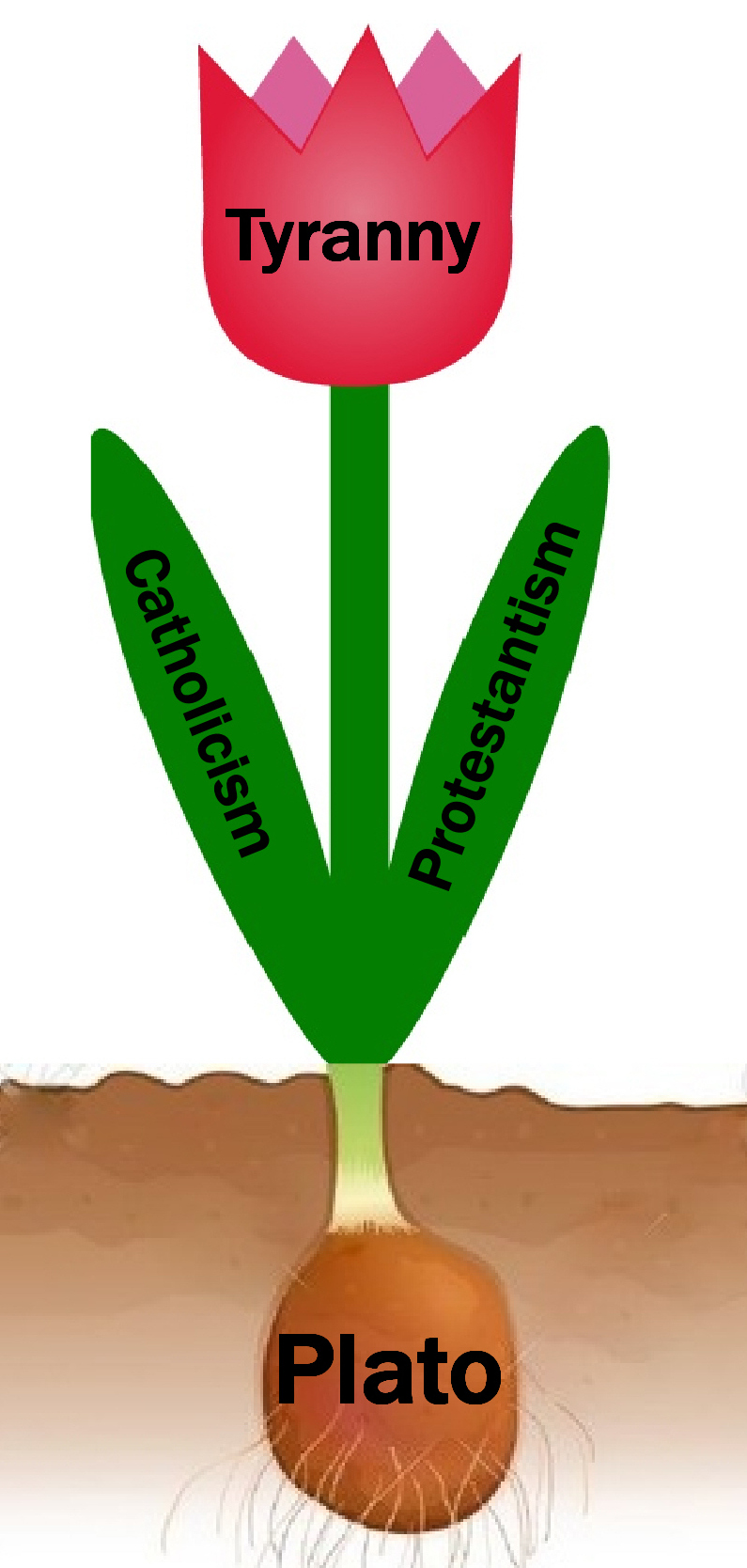
The Reformers believed that ALL grace and righteousness must remain OUTSIDE of the believer or it by default made him/her a participant in the completion of justification. They got around the mass of prepositions throughout Scripture that clearly state that grace is within us by utilizing the emphasis hermeneutic (the redemptive historical hermeneutic). This hermeneutic is a Gnostic concept derived from Plato’s theory of forms. I will delve into this in detail during my second session at this year’s TANC conference. Granted, many of the signers probably didn’t, and still don’t understand what the Reformers believed, and I believe other signers such as RC Sproul deliberately play on that confusion. Secondly, the doctrine propagates the Reformed mainstay of Christ’s perfect obedience to the law being imputed to our sanctification so that “sanctification is not the ‘ground’ of our justification.” See the chain thing going on there? Our enablement in sanctification necessarily makes sanctification the GROUND of our justification because sanctification finishes justification. It’s a “chain.” Here is what the document states:
God’s justification of those who trust in him, according to the Gospel, is a decisive transition, here and now, from a state of condemnation and wrath because of their sins to one of acceptance and favor by virtue of Jesus’ flawless obedience culminating in his voluntary sin-bearing death.
And….
We affirm that Christ’s saving work included both his life and his death on our behalf (Gal. 3:13). We declare that faith in the perfect obedience of Christ by which he fulfilled all the demands of the Law of God on our behalf is essential to the Gospel. We deny that our salvation was achieved merely or exclusively by the death of Christ without reference to his life of perfect righteousness.
Look, think about this; even an adolescent Sunday school student can see it: if the righteousness of God is revealed apart from the law (Romans 3:21), why would Christ need to keep it for our justification? For crying out loud, what does ‘apart’ mean? Worse yet is the idea that this perfect obedience is imputed to our sanctification if we live our Christian lives by faith alone because sanctification is a progressive process that finishes justification. James refuted this idea in no certain terms, which is why the Reformers questioned its rightful place in the New Testament canon. Moreover, this idea keeps Christians “under the law,” which is the biblical designation for the unregenerate. I don’t know much about the theologian William R. Newell, but with that disclaimer, I will say that I agree with his opinion in regard to this issue:
The fatal result of this terrible error is to leave The Law as claimant over those in Christ: for, “Law has dominion over a man as long as he liveth” (7.1). Unless you are able to believe in your very heart that you died with Christ, that your old man was crucified with Him, and that you were buried, and that your history before God in Adam the first came to an utter end at Calvary, you will never get free from the claims of Law upon your conscience (William R. Newell: Verse by Verse Commentary on Romans).
Hence, the law remains a claimant over the believer at any point where he/she stops living their life by faith alone in the same gospel that saved them rather than belief in the new birth followed by the death of the old us that died with Christ and is no longer under the law. We must now fear that our obedience in sanctification is making the law the “ground” of our justification. Likewise, Calvin stated the following: Another principal part of our reconciliation with God was that man, who had lost himself by his disobedience, should by way of remedy oppose to it obedience, satisfy the justice of God, and pay the penalty of sin. Editor’s note: For our redemption, Christ kept the Law for us and died upon the Cross. By this, Christ obtained forgiveness of sins for us (Calvin on the Mediator: Chapel Library press, 2009). This is also known as “vicarious law-keeping.” A definition of vicarious is:
Adjective Experienced in the imagination through the feelings or actions of another person: “vicarious pleasure.” Acting or done for another: “a vicarious atonement”.
Christians need to stop following men in general, and Reformed men in particular. God only sanctifies with truth, and Reformed doctrine does not save or sanctify accordingly. It calls for a salvation by law-keeping and who keeps it is not the issue. The law as a standard for justification is the issue. It also denies the different relationship of the law to believers as opposed to unbelievers: the law provokes the former to righteousness, and provokes the latter to sin. It skews the very biblical definition of the regenerate.
paul
Here We Go Again: “The Church”
 In the video below which promotes a book on the subject, we have another example of this whole idea that God will bless America if “the church” is running the show. I wrote a post on this yesterday and defined what is meant by “the church.” In the video, this very term is used: “the church.” The key to America returning to greatness is “G-o-d, not G-o-v.,” via “the church.”
What is the assumptive presupposition? That, and this even coming from Rush Limbaugh of all people, some “concept of God” is key to strong leadership. What does this assume? It assumes what we swim in daily: God is not concerned with particulars. God is not concerned with the particulars of the Big T, truth.
Get out of bed, get dressed, put your hands over your eyes, walk a couple of steps into the day, and look, and there you will find an example. On Facebook the other day I saw a conversation among women who belong to “the church,” in this case Baptists and Methodists, clamoring about getting a group together to hear Beth Moore speak in Cincinnati, Ohio. Never mind that she flaunts her Eastern mysticism in broad daylight, she is a well-spoken, feel-good expositor that is part of “the church.” Her outfits are also to die for. ‘Nuff said.
This makes the case that mankind is helplessly enslaved to the concept of church state which is founded in the ancient doctrine of the knowledge of good and evil. It is the belief that creation is fundamentally evil and only the invisible is good. Moreover, the invisible is a subjective complex knowledge that takes a spiritual journey that should include everyone, and as many “gifted” teachers as possible. Faith in general, and “Christianity” in particular is a journey in pursuit of the gnosis. All who are on this journey are good and closest to the gnosis that brings wellbeing (utopia), those who are not part of “the church” are confused and cannot discern anything of the gnosis. They are not “spiritually discerning.” They are helplessly enslaved to material absolutes.
This is exactly how “the church” functions. It is an institutional church state wannabe. It is an institution that groans and weeps for the realization of Plato’s Republic. It moans and weeps for philosopher kings to save us from the abyss of people governing themselves.
It took mankind something like 10,000 years to break free from this tyranny and the historical demarcation was the American Revolution. The reason American ideology works so well when properly applied is because it has a biblical metaphysical premise: creation became weak, not inherently evil.
In addition, mankind in general can know things—mankind in general can know reality. Secondly, every person born into the world is responsible to God personally, and God speaks to every human being individually in a way that every person can understand. In other words, people are created free and culpable before God alone for the sum and substance of their own lives. The sole purpose of government is to insure that freedom for each and every person born into the world.
The framers of the American Constitution held that these principles were “self-evident.” Some were Christians, most were deists, some were agnostic if not outright atheist, the principle of individualism versus collectivism was the driving force—NOT where the principle came from! All of them agreed on the principle and the role of government and cared little about where the others thought the principle came from. What we see today is an emphasis on the source, not the principle. And this is the fly in the ointment: some “concept of God” can be interpreted in a variety of ways; in every case, enter tyranny.
Hence, “the church” is a purely Platonist concept propagated by the big three of the Protestant Reformation: Augustine, Luther, and Calvin. A cursory observation of history reveals that all three were murdering despots. Most Christians, really all save a few, are helpless to know the difference because world philosophy is “worldly knowledge.” So, if the premise of what you really believe is unnecessary knowledge, the philosopher kings of “the church” can lead you around like a dog on a leash.
Want an example? Wherever you are, just remove your hands from over your eyes and look.
paul

 Paul's Passing Thoughts
leave a comment