Calvinists: An Evil Augustinian Legacy and Proud of It
 Originally published January 16, 2013
Calvinist John Piper, and many other Calvinists as well, often quote St. Augustine and openly call him the father of Reformation doctrine. Augustine was a Catholic til the end, Luther’s doctrinal mentor, and was quoted by Calvin more than 400 times in his Institutes of the Christian Religion. It is not only common knowledge that Augustine was a neo-Platonist, we find the following in many church history books:
“Augustine, the Roman Catholic philosopher & apologist, declared prostitution as a necessary evil and soon thereafter the church had 100,000 prostitutes employed.”
Augustine was the Catholic “Doctor of Grace” and the undisputed father of the Reformation gospel. One of the many evils propagated with Church authority was safe-haven from civil prosecution when indulgences were paid to the church. In many cases, the indulgences could be paid in advance of committing a crime. The following describes the fees/pardon for each crime:
“The Catholic church under Pope John the 22nd,(1244-1334) established [the] practice of selling indulgences. Pope Leo X (1475-1521) published the list of indulgences.
Robbing a church —– $2.25
Burning a house ——- $2.75
Killing a layman ——- $1.75
Forgery and lying…….$2.00
Eating meat in Lent….$2.75
Ravishing a virgin…….$2.00
Striking a priest ……….$2.75
Robbery ………………….$3.00
Priest keeping a mistress…$2.25
Murder of parents or wife….$2.50
Absolution of all crimes…..$12.00″
Really, we should have a very easy ministry. We should only need, “By their fruits you will know them,” and “A little leaven leavens the whole lump,” and Wikipedia.
1. Judge them by what they say and do.
2. It doesn’t take much of what they teach to destroy a whole church.
3. Read Wikipedia, and then see number one and two.
As easy as one, two, three.
But oh well, it is what it is, so we carry on.
paul
Like John Street, Like Stuart Scott: A Celebration of Mystic Despotism

Will Speak at Clearcreek Chapel’s 2015 “Family Enrichment” weekend.
 “Hence, and don’t miss this, justice is not the point. The concept of justice and fairness digresses from Reformed Calvinistic dualism.”
“….six months after Luther’s 95 Theses launched the Reformation, the true magnum opus of the Reformation was written, his Heidelberg Disputation to the Augustinian Order. The document reflects Luther’s utter Platonist disdain for humanity.”
“Now, let’s take this information and evaluate why Scott et al are completely indifferent to suffering and injustice.”
Once again, Stuart Scott will break bread with the elders at Clearcreek Chapel (Springboro, Ohio) as he is the featured speaker at this year’s “Family Enrichment” Conference. Clearcreek Chapel having a family enrichment conference is like the Nazis sponsoring an endowment for Judaism. It’s a mockery; the Chapel has ravaged innumerable families and Christian lives since its orchestrated takeover by Russ Kennedy and aided by former Clearcreek elder Greg Cook. Cook brought in a group from another Baptist church which included present Clearcreek elders Chad Bresson and Dr. Dale Evans.
Their attempted takeover of the church they left failed, but their endeavor at the Chapel succeeded—the spiritual carnage notwithstanding. Cook, as director of Clearcreek’s counseling program, was giving wives the green light to divorce husbands who had “ruined the family finances” while he himself was just under $200,000.00 in due and owing debt. It is unclear as to whether this revelation led to his stepping down as an elder, or not. Probably not since hypocrisy is a requirement for eldership in our day.
Other present Clearcreek elders have been forced to step down in the past, but have been reinstated; specifically, Mark Schindler who was re-baptized after his prior eldership. Apparently, not being sanctified by justification was the prior cause of his disgrace. Whatever it was specifically, his wife gave testimony that she never considered divorce and was determined to make the marriage work. It’s a pity that such wifely resolve that saved Schindler’s marriage is not encouraged among wives in the counseling rooms of the Chapel in this day. But one must remember that such resolve is only honorable in regard to saving the marriages of New Calvinist philosopher kings.
It all seems insane until you realize that people act from their logic. Why would Scott give credence to such a camp? Why would he ignore the pleadings of the oppressed? Why is he, like all New Calvinists, utterly indifferent to justice? We get a clue from his book The Exemplary Husband on page 72. He states the following:
God uses everything in our lives for His perfecting (growing) purposes (Romans 8:28-29; James 1:2-4). As we learned earlier, our growth as Christians toward Christ-likeness is a life-long process, often referred to as sanctification. Because God is so intent on sanctifying us, we know that He will certainly use our most important human relationships to do this.
Right. As I have worn out multiple keyboards emphasizing here on PPT, New Calvinism is a dualist philosophy. Let’s go over this again. Below is THEIR illustration, NOT mine:

Note first that regardless of their verbiage, they don’t believe we really grow, it’s the cross (what it represents) that grows. That’s obviously job one. The endeavor thereof requires a primary focus on two goals and two goals only: a deeper and deeper UNDERSTANDING of our sinfulness, and absolutely nothing else, as set against God’s holiness. Part and parcel with this is also the idea of worthlessness on our part.
The cross represents bigger and bigger salvation which must be manifested more and more until the day when our “final justification” is “revealed.” This occurs as we are sanctified the same way we are saved, by partaking in the realizing of our sinful worthlessness before God and His holiness. The more we understand the difference between the two, the more our salvation is manifested. We don’t change, only the greatness of our salvation changes in order to glorify God. Of course, this obviously redefines the new birth and denies it.
As propagated in the satanic treatise “How People Change” by Paul David Tripp, ALL tragic and sinful events in life serve the bottom of the cross chart, and ALL good that occurs in our lives serves the top of the chart. As we contemplate the gospel narrative, the goodness of God is manifested which contributes to more understanding at the top of the chart. Goodness is not our fruit, its God’s fruit only for the purpose of aiding us in understanding His goodness—not ours. Hence, and don’t miss this, justice is not the point. The concept of justice and fairness digresses from Reformed Calvinistic dualism.
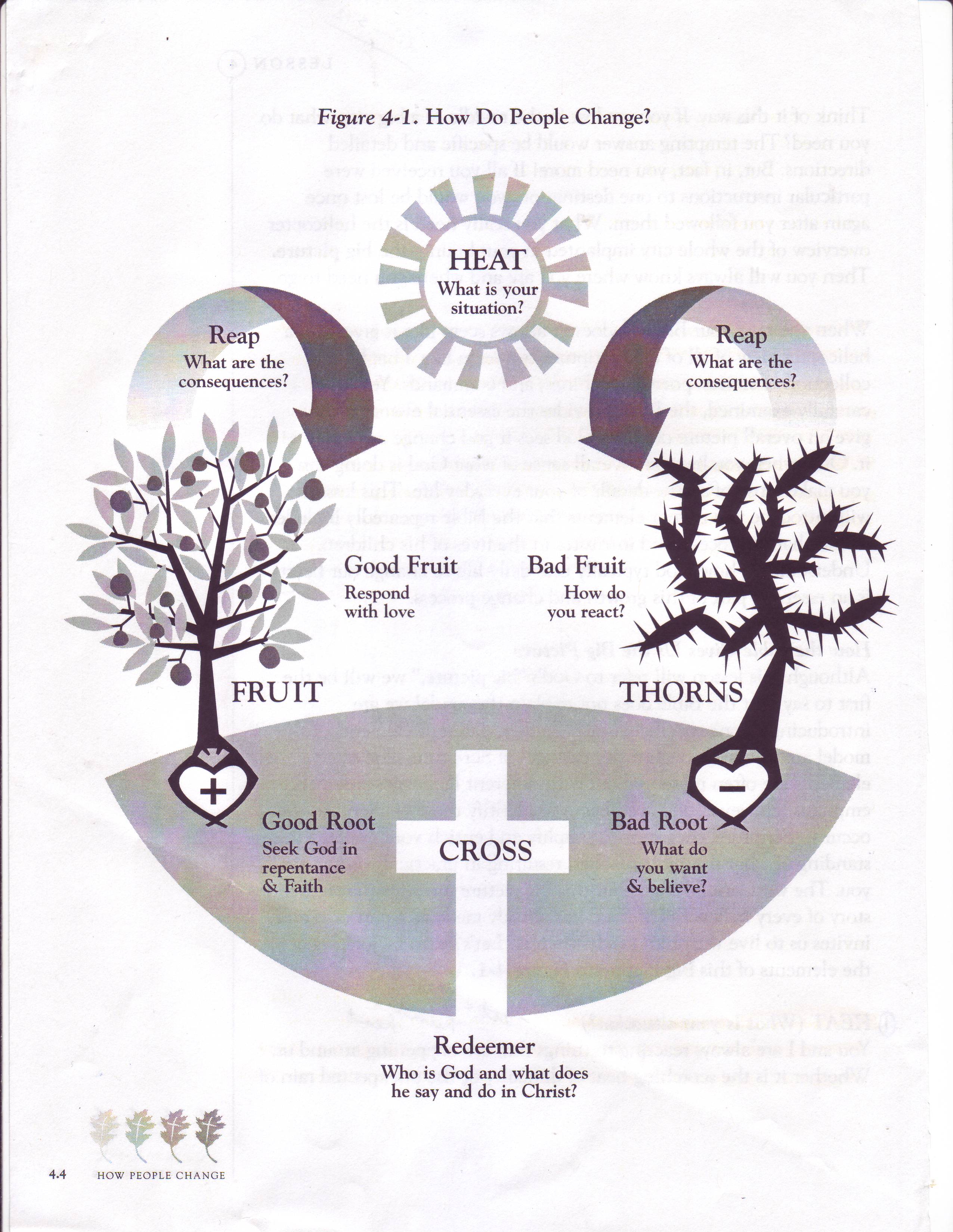
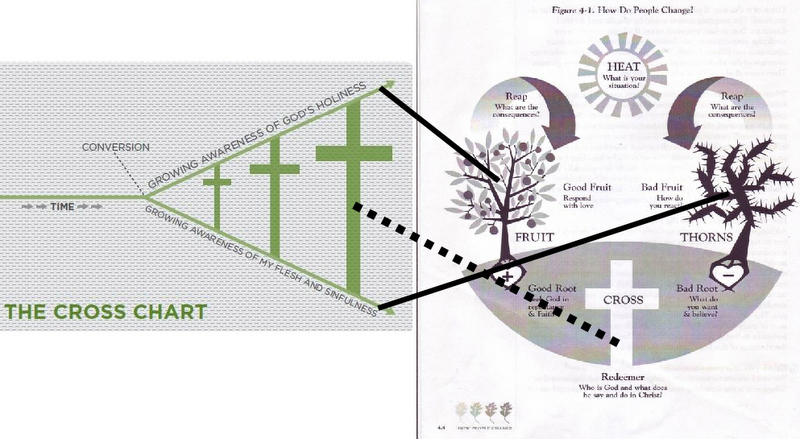
The next point is that in the neo-Calvinist gospel schema, the Scriptures serve as a Cross narrative to help us see this dualism in a clearer way. In the mind of the neo-Calvinist, the Scriptures do not define what is right and fair; the Scriptures define Luther’s “cross story.” Here is what the vast majority of Christians do not understand: six months after Luther’s 95 Theses launched the Reformation, the true magnum opus of the Reformation was written, his Heidelberg Disputation to the Augustinian Order. The document reflects Luther’s utter Platonist disdain for humanity.
In Luther’s Disputation, all reality must be seen through the cross story; i.e., the cross illustration at hand here, and ALL else is the “glory story” or anything at all to do with us—our glory, not the cross story that makes God bigger and mankind smaller. To any degree that we are in the equation, the cross story is diminished.
Now, let’s take this information and evaluate why Scott et al are completely indifferent to suffering and injustice. What did the Clearcreek elders do that is wrong? Nothing because the purpose of the Bible is not to judge the authority of Reformed elders, it is to show forth the cross story, not our story, and injustice is an Us Story kind of thing. Have former parishioners at Clearcreek suffered unjustly at the hands of the elders? Well, that’s a good thing! That suffering shows us the bottom of the chart. And besides, “justice”? If we got what we all deserved, there wouldn’t be any grace! Is this like Paul’s protest in Romans against propagating more evil that grace may abound? Yes, I think so. To the contrary in the minds of neo-Calvinists, we should bow down and thank God for bringing such abuse into our lives.
This is the gospel construct that rules the majority of biblical counseling in our day and is taking over the church in this country. It is a Platonist world view that set Europe on fire for hundreds of years with unspeakable horrors. And it is a story that is playing at a local church near you.
And this weekend, Stuart Scott brings his version of the show to Springboro, Ohio. A celebration of suffering in the name of Christ. But I have news for Scott: the sins of the Clearcreek elders does not cause grace to abound. And his appearance there has nothing to do with grace or love.
If there are any parishioners at Clearcreek (who may be reading this) who are presently there against their will for fear of public humiliation or things revealed in counseling —in your desperation, don’t slip Scott a note—he’s one of them.
paul
Book Review: Facing Up To John Immel’s “Blight In The Vineyard”
 Originally published June 19, 2012
Barb Orlowski, D.Min, and author of ChurchExiters.com states the following in an introduction to said blog:
Every year dedicated Christian people leave churches because of spiritual abuse [this is epidemic in our day]. What factors contribute to dedicated and active believers in Christ leaving their churches and becoming exiting statistics? The stories of people who left their home church because of a negative and hurtful experience [more often they are shown the front door] paint a picture of a widespread occurrence, which beckons consideration by church leaders and church congregants alike.
John Immel saw the picture that Dr. Orlowski describes and even experienced it firsthand. I don’t know what his experience was exactly, and he doesn’t know much about mine either; as he said to me over dinner: “I think we are both past that now.” Which brings me to something else Orlowski wrote in a recent article:
The church should lead the way in uncovering any of these dark behaviors. The local church has an opportunity to be part of the solution and not part of the problem regarding these covert and dysfunctional issues in the church today.
As more people understand what spiritual abuse is and what it is not, then there can be an army of people who are able to help in clarifying many of the confusing topics that get intertangled with this issue (Dr. Barb Orlowski: What Spiritual Abuse Is and Is Not).
I dare say that John Immel has seen the picture (which is hard to miss in our day), considered it, and discovered the root cause. He has also articulated the cause/root in a way that invokes a Monopoly-like motto: “Do not pass understanding; do not collect 200 issues.” Now all that’s left is to educate and raise the army.
Immel has clarified the issue in Blight In The Vineyard: Exposing the Roots, Myths, and Emotional Torment of Spiritual Tyranny (2011 Presage Publishing). Therefore, the solution is easy: promote education that will lead to a rejection of the root cause. Yes, it can be complicated, but it can also be simple; when you follow and support certain philosophies, either “wittingly” or unwittingly— bad things happen. A certain philosophy, or maybe better said, idea, has always spawned the same results from the conception of Western culture. A counter idea has always yielded dramatically different results deemed favorable by those disposed towards happiness. I have come to believe that America was founded on the counter idea. Consider what Immel writes in the introduction to Blight In The Vineyard:
Blogs made it possible for people to compare notes and connect dots. Suddenly, the pixelated events result into high definition and the picture shows a breathtaking consistency. The stories contain striking uniformity in pastoral conversations and actions. They contain profound similarities in the emotional, spiritual, and psychological pain of those who have suffered.
That set me to thinking. How was it possible that from state to state, even country to country, people could recount similar life events with stunningly consistent conversations, outcomes, and backlash? What ideas could produce such underlying fear, anxiety, and spiritual frustration? What ironclad logic could cause masses of people to act out similar conduct that produces such invasive outcomes? What thoughts that lurk under the titles of authority would lead average men to believe they wield unchecked control over people’s lives? How could a denomination reproduce such unswerving reproducibility?
Many today ask the same questions. A reader of my blog named Charles posed the same question this way:
Have noticed this for a great many years, and my wife and I always wondered…. “What text book on abusing the sheep are all these guys reading from,” because they all acted the same.
Right here in this review we see some of what Charles is referring to. Orlowski, Immel, and Charles have never met, but note the similarities in their descriptions and even use of the same words. Nevertheless, here is where I depart for a spell and will return a little later. My perspective has been radically changed by Immel’s book and interacting with him in the arena of ideas. In fact, I have made his book required reading in the Dohse household, and have already led family devotions based on the book’s major theme. I now share my perspective based on additional study/research prompted by Immel’s assertions.
The least common denominator is the debate over the competency of man verses the incompetency of man. I believe the basic philosophy of Plato is vastly relevant to this debate. Plato saw man as utterly incompetent save those who understood that reality must be ascertained by means other than the senses. In other words, reality, goodness, and truth could not be surmised by observation of matter. He believed that the few who are able to see reality should rule over the ignorant masses who are enslaved to mere shadows/forms of the truth. Remember also that Plato lived in a culture inhabited primarily by slaves who served the elite. Some historians estimate that 90% of the Greek citizenship during the time of Plato were slaves.
It is my contention that Augustine (a Catholic Saint) integrated Plato’s ideas with theology and more specifically, Neo-Platonism which later spawned multiple forms of Gnosticism that plagued the 1st century church. The most notable Reformers were followers of Augustine, but the backbone of their theology was the underlying assumption that man was utterly incompetent whether regenerate or unregenerate. I believe that Augustine merely exchanged Plato’s concept of reality with “gospel.” Hence, today we have the elitist gatekeepers of the gospel ruling over the totally depraved.
Now we can return to Charles, and my reply to his comment:
Charles,
John Immel answers that question in his book, “Blight In The Vineyard.” It’s a philosophy that yields natural results, so it’s like they all read from the same playbook. The basic philosophy sees freedom of ideas as a danger to civilization and the church. Initially, many buy into it for fear of chaos, but the results are always bad according to history. Ideas are very powerful, and almost always tempt the individual to act upon them. Freedom to interpret reality is a kissing cousin to freedom of ideas.
The ideas that rule the day also rule the world. Hence, the Reformation was really a spat between Rome and the Reformers about who was going to control the ideas. Both Rome and the Reformers believed that one’s freedom to interpret reality was nothing that should be tried at home by the common people. When man is seen as utterly incompetent to contribute to his own destiny, love as determinism is the only solution. Visit any of the spiritual abuse expose blogs–the trouble started when people questioned doctrine, or even spoke in way that would enable others to think for themselves. Immel uses happenings at SGM [a denomination of Reformed Charismatics] to illustrate how this philosophy plays out naturally in real life.
Later, John Immel contributed some thoughts to Charles’ comment:
Charles… I think the answer to the question is … yes, they are reading from the same book. Pastors the world over are pulling from the same intellectual traditions. They don’t pastor in a vacuum. They pastor with the whole history of Christianity hanging in their heads like a fog.
Very few people want to reinvent the peanut butter and jelly sandwich. Or maybe better said very few people have the ability to challenge peanut butter and jelly orthodoxy, so they tend to review what has always been said, and emulate those foggy ideas.
While very, very few people consider themselves Calvinists… (or even know what he really preached, or practiced) with striking consistency they accept many of the Calvinist assumptions, which is to say they accept Augustinian presumptions about life, and spirituality what God intended the “gospel” to mean.
I have said this in many places… for all of Protestantism’s presumption that they are the authentic real version of Christianity that Catholicism screwed up…. at the end of the day, post Reformation Christian doctrine is metaphysically Catholic, which is to say we are foundationally committed to Augustine’s presumptions.
The ‘abuse’ is merely the logical outcomes of those foundations. The reason we are circling back around the tyranny of the ages, is because for the first time in American history, our doctrinal thinkers (en mass) without any hesitation, with full ‘moral’ clarity, are advocating the historic ideas that justified the tyranny.
So yes… they are all reading from the same book…
Today’s church can stop spiritual tyranny. But it will require agreement on the root cause. And the root cause is Reformed theology. Wherever and whenever it has been tried, despotism and despair has followed: in Calvin’s Geneva; in Colonial Calvinism; in Confederate Calvinism; in the empty promises of the SDA 1888 conference and the Awakening Movement of the 70’s; and finally, in the present-day Neo-Calvinism Resurgence—a sectarian beast resurrected by the Reformed theological dream team of the Australian Forum.
Just like its non-religious philosophical counterparts, classic Calvinists (the original article as opposed to my “sanctified Calvinists” and Immel’s “convenient Calvinism”) think it’s a good idea that has never been done the right way. The philosophy of determinism, fatalism, and the incompetence of the common man is foisted upon the unregenerate by irreligious despots, and by Reformed elders among the saved.
Immel’s book puts feet on these generalizations. The solution is to shun the philosophy; bad things happen when bad philosophy is followed. And through education, we can raise up Orlowski’s army.
Whether Geneva Calvinism, Colonial Calvinism, Confederate Calvinism, SDA Calvinism, or Neo-Calvinism, it always has, and always will die a social death due to its gangrenous despotism. We can hasten its rightful death in our day, and prevent future rediscovery movements with the present-day “picture” following. We can give others another way to follow…
…If we can face up to the blight in the vineyard.
Paul M. Dohse
Author: The Truth About New Calvinism: Its History, Doctrine, and Character
Franklin Graham’s Cluelessness Concerning American Culture is Indicative of Most Evangelicals
 Secular bad; Christian good. How did Christians come to think this way? And why are they willing to pay people like Franklin Graham so much money to protect us from the secular boogey man? Graham, like the vast majority of evangelicals, gets his information from other people. No people group can pass superstition and folklore from generation to generation like evangelicals and their information networks established by seminaries and local churches. Truly, the evangelical brain trust of our day must marvel that they can continue to get away with this in an information age. Nevertheless, the likes of evangelical superstar Dr. Albert Mohler often bemoan the evils of internet access. All of this is a long version of saying I think Protestants are brainwashed.
This post is about the Protestant mainstay of secular evil; Christian good. It was once again shoved in my face, as it is daily, and this time by an article in Decision magazine typed by Franklin Graham. The article was picked up and summarized by Michael Chapman @ cnsnews.com:
Reverend Franklin Graham, son of world renowned evangelical preacher Billy Graham, said that America is increasingly embracing a “culture of death” that echoes what has occurred in Europe, and which stems from a “sinful, godless worldview that rejects Christ.”
A further problem in America, he added, is that “Christianity is constantly under siege from the halls of government and education, which seek to suppress any public expressions of faith.”
“In places like Europe, where Christianity has been in decline as the deceptive forces of secularism and materialism have spread across the continent, it’s not surprising to find the practice of euthanasia so entrenched,” said Rev. Graham in a commentary for the January issue of Decision magazine. “Earlier this year, Belgium became the first country in the world to allow child euthanasia with no age limit.”
“I’m concerned that America is not far behind,” said Rev. Graham, who heads the Billy Graham Evangelical Association. “The euthanasia movement—disguised now as ‘death with dignity’—is gaining ground in a number of states. And for every 1,000 live births in the United States, 219 pregnancies end with a murdered child, through abortion.”
“I don’t think there’s any doubt that this rise in the culture of death in our own country coincides with the embrace of an immoral, sinful, godless worldview that rejects Christ,” he said. “Christianity is constantly under siege from the halls of government and education, which seek to suppress any public expressions of faith.”
Sigh. Ok, let’s take this a paragraph at a time. We like to say that America was founded by Christians who fled Europe for religious freedom, right? That’s the foundational premise of the American Protestant myth. First, the Pilgrims were Puritans who were Calvinists who were also Augustinians like Luther who were Platonists. So let’s clear that up to start with. Secondly, they didn’t come here for religious freedom—they came here to start their own socialist theocracy based on Plato’s The Republic. Thirdly, the foundation of their Protestant orthodoxy was/is death.
So, if Graham wants to say America was founded on European Christianity, he cannot also say that “America is increasingly embracing a ‘culture of death.’” Excuse me, the foundational document of the Protestant Reformation in regard to doctrine was the Heidelberg Disputation written by Martin Luther. It is a doctrine of death. In fact, Luther stated in the document that all true knowledge must be obtained by suffering. And being a Platonist, he rejected the idea that the common man can reason because of his addiction to the material realm. Luther merely made Christ Plato’s trinity; the true, good, and beautiful, and made the suffering of the cross the epistemology to obtain wisdom from the invisible realm. Luther’s “theologian of the cross” is Plato’s philosopher king.
Ok, so Graham also states that America is becoming more and more like Europe in this regard; well, ya think? That’s where it came from. Duh! And…
America is increasingly embracing a “culture of death” that echoes what has occurred in Europe, and which stems from a “sinful, godless worldview that rejects Christ.”
No, no, no. The Pilgrims, who were Puritans, who were Calvinists, and also Lutherans, who were Augustinians, who were followers of Plato, who was the father of Western socialism, made death the Christocentric epistemology of the church—it was by no means a rejection of Jesus, or at least their version of Him. This is why an instrument of death, the cross, is the regnant icon of the Protestant church.
The next statement by Graham lends opportunity for further clarification.
A further problem in America, he added, is that “Christianity is constantly under siege from the halls of government and education, which seek to suppress any public expressions of faith.”
“In places like Europe, where Christianity has been in decline as the deceptive forces of secularism and materialism have spread across the continent, it’s not surprising to find the practice of euthanasia so entrenched,”
“Christianity,” viz, Protestantism, has been in decline in Europe, um, where it started, and we are becoming like them, and guess what? The authentic version of Protestantism displayed in New Calvinism straight from the Heidelberg Disputation has been all but totally running the show in American evangelicalism for twenty years. Graham needs to look in the mirror if he wants to see the real problem.
And to further clarify, America was founded on political secularism—NOT European Protestantism. Excuse me, but the American colonies were originally socialist theocracies on steroids. Many of our founding fathers were motivated to act by the Puritan tyranny they experienced growing up. For the first time in human history, a government was formed that separated force from faith. The American Revolution was against European tyranny, but that same tyranny expressed itself in colonial Puritanism which was also tied to Europe politically in many cases. Ten years after the American Revolution, the Puritans tried to weasel their way back into control and James Madison had a total conniption fit over it. Keeping Platonist mystic despots out of government was what the American Revolution was all about. The Puritans were part of American history as enemies, not friends of freedom.
And this statement by Graham reveals the unfortunate and mostly unknown DNA in every Protestant:
…the deceptive forces of secularism and materialism have spread across the continent, it’s not surprising to find the practice of euthanasia so entrenched,”
The deceptive forces of secularism and materialism? Note how secularism is deemed as inherently evil. If it’s not Protestant, it’s evil. Be sure of this my friends: this idea is rooted in ancient dualism that deems the material (or “materialism”) as evil and invisible as good. It is also one of the philosophical pillars of Platonism and Gnosticism which wreaked havoc on the apostolic church.
Furthermore, we must remember that Protestantism was clearly founded on anti-reason which put the Puritans at odds with the founding fathers. Yes, many of the founding fathers were good Christians, but they were Christians who emerged from the Enlightenment Era. They were (not all) Biblicists who rejected dualism and also embraced empirical reason. This is where the discussion falls egregiously short when we discuss the Christianity that this country was founded on: Plato or Aristotle? If you think you can understand and partake in American cultural discussion without understanding these philosophies, you’re sadly mistaken. And please, don’t be like Graham—keep your mouth shut because you don’t know what you are talking about.
If you want to finally get a grip on these realities, I refer you to the university level lectures that John Immel has done in the 2012, 2013, and 2014 TANC conferences. This is world philosophy as it relates to contemporary American Christianity. We offer his lectures online for free, and trust me; this is an education that you would pay thousands of dollars for at a Christian college, and most of it would be orthodox myth to boot.
As Christians, we don’t think enough about what is exactly meant by “secularism,” and how it supposedly distorts our worldview. Also, when talking-orthodox-heads use the word “materialism” we should not assume they are talking entirely about hedonist money-lust; and moreover, when they subtly connect materialism to the “American dream” it should ignite fear of the socialist god within us. Dissing the American dream without qualification is presently in vogue among the New Calvinists who control at least 90% of American evangelicalism.
This is why atheism is on the rise bigtime in America. American Christianity is now totally defined by the Puritan ethic which disavows the material world expressed in quality of life and the average person’s ability to reason. Without the iron fist of a sanctified central government, chaos will supposedly ensue. For the Puritans who really understood what they were about, musings of self-governance was the epitome of folly and arrogance. The New Calvinist movement has successfully defined Christianity in this way resulting in a cultural pushback that rejects a reason-hating god who demands that all knowledge come through suffering. As a Christian thinker, I often seek dialogue with atheists, but find that I am rejected out of hand in every case. Why? Because “Christian” has become synonymous with spiritual oligarchy, and perhaps rightfully so, for what well-known Christian fails to speak well of the Puritans?
In addition to what is cited in this post from Graham’s editorial, one may ask Graham: why wouldn’t secular governments push back against the Neo-Puritan movement expressed in New Calvinism? Their dominion theology is well documented. By their own pronouncement they seek to dominate the world!!! Constantly we hear Mike Huckabee et al espousing the need for “Christian government” coupled with events like New Calvinist John Piper in Dubai proclaiming that Christianity is going to bring down the Burj Khalifa tower!
Really, am I here right now? Secular government is pushing back against a semblance of theocratic Puritan resurgence? Ya think?
Lastly, what about the fruits of death culture that Graham is speaking of? Throughout history, the bulk of death culture has always come from collectivism. What’s that? It starts with the idea that man cannot reason. And by the way, dear Christian, you can wuv somebody with your entire faith-filled intellectual thimble until the cows come home, but if they catch wind that you think they are unable to interpret reality—see ya—you’re history.
Since man is unable to reason and needs those with the gnosis to rule over the masses for the collective good, man is not only perceived as property of the state whether the state is religious or otherwise, man’s worth is defined by his ability to contribute to the greater societal good. In other words, to sing the praises of Puritanism while fustigating the evils of death culture is an oxymoron. Either way, whether secular or Protestant, both feed the death culture. Protestants don’t like voluntary exit strategies because who’s to say you won’t become one of them in the future; atheists simply have no hope because the only Christianity they see is jihad with some sugar on top.
Graham et al remind me of race-baiters like Al Sharpton. With Al, the boogey man is the white man; with Graham the boogey man is the secular materialist out to destroy his definition of Christianity. However, in regard to Graham, I think most of his mentality in this regard comes from ignorance, for many others like John Piper and Al Mohler—not so much.
In the same way liberals think we should ask, “Why do terrorists hate us,” Christians should ask why we are deemed a threat to secular society. We don’t need to ask the terrorists that; we know they believe that Sharia law is the key to world peace. But an answer to our question to those evil material secularists might be revealed in a snippet of Graham’s editorial not cited above:
Life is short. Eternity is long. Do not tarry for you do not know when you will die. Choose sin and you will face eternal damnation, said Rev. Graham. But choose God and you will gain eternal life.
This also applies to our institutions, our laws, our society. “Wherever Christianity flourishes, there is a vibrant culture of life, not death,” said the reverend. “When the precepts of the Christian faith are faithfully taught and followed, there is an abundance of selfless, sacrificial living and giving.”
Do you hear the intellectuals running away as fast as they possibly can? You should. Protestant theocracies have a track record of a “vibrant culture of life”? Oh my, are you kidding me?
Let me explain something. Not long after the Renaissance, Platonism split into a secular expression that later became Marxism. Until then, collectivism was primarily a religious animal. From there, remnants of collectivism have always defined political underpinnings one way or the other. In contemporary America, we bemoan the nanny state mentality found primarily in the Democratic Party. Self-governance? They don’t even think we can choose the right way to wipe ourselves or buy lightbulbs. Often we ask when they make absurd statements, “Do they think we are stupid?” Well, not exactly, it’s just that they don’t think you can properly interpret realty.
Likewise, does Graham think we are stupid? And does he really think we can reach the lost with statements like this that are first degree felonies against reality in broad daylight?
Ya, follow us, believe in Jesus, our idea of a “vibrant culture of life” is Calvin’s Geneva and the Salem Witch Trials. John Piper even went to Geneva to proclaim the next phase of his ministry. During the promotion, he proclaimed the coming of Calvin’s Geneva as “Post Tenebras Lux”—“After Darkness… Light.” Geneva was an early version of communism that just didn’t work, and it didn’t work for colonial America ether.
Yes, trust Franklin, these contradictions only seem outrageous because you don’t comprehend reality—let Graham et al do the thinking for you. Stop supporting abortion and the like—burning witches is much better. “Besides, even though we think the Puritans were absolutely wonderful, if you put us in power, we won’t be like them in every regard. Really, we promise.”
Any takers?
paul
World Philosophy, Politics, and Christianity: John Immel, TANC 2014; Sessions 1-3
SESSION ONE
JOHN IMMEL: I know that people online can’t see this, but this is – luckily, you guys can see this. So about three weeks after the conference last year, I get an e-mail from Paul, Paul Dohse, the organizer of this conference. And the title of the e-mail is “Thoughts?” In the body of the e-mail it says, “See attached jpeg.” That’s it. So I read this and I can’t for the life of me figure out what he’s talking about. So I write to Paul back and I say, “Paul, can you explain this?” Now you have all heard Paul speak. So it is at no end of irony that Paul’s e-mails are notoriously short to the point of cryptic. There are no rabbit trails in Paul’s e-mails. So I write on the reply, “I have no idea what you want from me here.” So finally, Paul writes me back and he says – is this hot? Is this a little too hot?
PAUL DOHSE: A little, yeah.
JOHN IMMEL: Can you turn it down just a touch? Check, check, check? Does that work?
PAUL DOHSE: That’s better.
JOHN IMMEL: That’s a whole better? Okay, good. All right, so he writes me back and he says, the idea – now mind you, with this in mind, this is Paul’s response. “The idea that freedom of man is practically a pipedream because he is enslaved to his own desires spiritually, hence, at the very least indifferent to political freedom on a social level.” So, here’s his question. “So will the New Calvinist Movement cause political indifference in American society among Christians?” And I’m like, “Oh, I get it.” So then I go back to this. And for those of you online, you can’t see this. But this guy, Mark Ray, I get to use the cool pointer now. Mark Ray here, I don’t know who he is, don’t care, don’t matter. He says right here, “It is ordained in the eternal constitution of things that men of intemperate minds cannot be free. Their passions forge their fetters.” And this is when I finally understood what Paul’s after. And he’s interested in me commenting on the impact of New Calvinism on American culture, what it’s trying to do.
Now, of course, he, this Mark Ray, is actually quoting a guy by the name of Edmund Burke. You can look him up. He’s not really an enigmatic character. But Edmund Burke held the fundamental assumption about human existence, and this quote ultimately that the nature of man requires that man can only be governed by a totalitarian government, that the function of government is human restraint. So anyway, Paul is asking me to weigh in on this particular issue. And my response was, yes. I’ll summarize. Yes, this is exactly what the Neo-Calvinist movement is willing to do. Now my e-mail response to Paul was about 500 words. I gave a detailed explanation, and it turns out – well, I gave that explanation. I won’t tell you what I said. And so then, I send them off to Paul, and Paul says to me, “This would be a perfect progression from this year to next year. This could be your 2014 thesis for next year’s conference.” So this is exactly what we’re going talk about, the Edmund Burke comment and its specific impact on the progression of American thought, where we are. Now of course the flyer says that I’m going to talk about National Socialist Germany. That is true. We are going to talk about that.
But before I get too much farther into this, I guess I do need to make some introductions. My name is John Immel. I like to introduce myself this way. I am no one from nowhere. And the important thing about this is that there is a general trend and a general move within Christianity. The assumption being that if you’re standing behind a pulpit that you bear some form of authority, and that the expectation is that whatever I say, you have some obligation to accept. I reject that as a fundamental premise. I’m not here as a representative of authority. I am here to present to you ideas and the most powerful arguments that I can bring to you. And your part of this conversation, and it is a conversation, is for you to bring your highest and best rational self to this engagement. I’m going to make the most powerful argument I can, and I want you to engage your brain and to think and to analyze and to find out what is correct, what is true. And if I’ve done my job well, you will end up agreeing with me because I believe I hold right ideas. But here is how this works. If you can find a flaw on what I said, then you have the ability to say ,”Hey, John. Now here I think is an adjustment.” And if you make a powerful argument, if you make a good argument, and I apply my rational individuality to that, I go, “You know what? That’s true.”
Now having said that, I did write a book. I wrote a book, this book, called Blight in the Vineyard: Exposing the Roots, Myths, and Emotional Torments of Spiritual Tyranny. You can buy this online at amazon.com. It’s $23.99 online. If you like what I say in the conference, those of you who are watching online, if you like what I say, you’re going to find more of the same in here. Now I will say this. I wrote this, and I’ll get into this just a little bit more here in the moment. I wrote this using a modern denomination called Sovereign Grace Ministries as my anecdote. But the book is not about Sovereign Grace Ministries specifically. The book is about how the ideas embedded in what we’re going to talk about shaped this specific ministry. So I talk about a who so we can talk about a what. And the what are the ideas that are behind it. And in particular, the Neo-Calvinist, the new resurgent movement of Calvinism in the United States.
Now it is a little dated because when I wrote this, most of the major players, and those of you familiar within evangelical Christianity certainly will have heard names like CJ Mahaney, Brent Detwiler, Joshua Harris. These were all people at the top of the uber super apostles, whatever they want to call themselves now. There’s been a split within that denomination, and so that current history is not reflected in the book, but it actually doesn’t matter because the book is not about the personalities or the organization of that denomination. The book is about how the ideas were used to create this denomination in Sovereign Grace Ministries and ultimately how that causes them to act within that denomination. So you’ll still get the same things even though like I said it’s historically dated.
So this conference, this specific conference represents the culmination of about – at least 20 years of thinking for me. And to give you a sense of scope, which is what I think I do best, I think I give people the framework best. I need to actually talk about me personally a little bit. I got born again when I was 15. So my exposure to Christianity is going on 30 years. Now I got born again and became immediately a part of a brethren church in Eaton, Ohio, actually not too far from where we are now. And my introduction to Christianity was dramatic. I’m confident there are people that can tell you about my life during my high school career. But I took Christianity seriously, and I invested in Christianity. I invested in what I believe to be the truth with absolute commitment. So by the time I was 18, I was fully invested and fully committed to Christianity, modern American Christianity. Now I’m going to make a distinction here. (more…)

 Paul's Passing Thoughts
leave a comment