Hi, My Name is Amy—I’m a Sinner
 The opening line of an author under the tab, “about” propagating “gospel-centered” theology (ie., antinomianism, Sonship Theology, New Calvinism, Gospel contemplation) reminds me of the infamous introductions at AA meetings: “Hi, my name is Bob—I’m an alcoholic ‘Hi Bob.’” Amy Engle, the author of A Voice Crying Out blog (apparently because we are desperate rather than those who are much more than conquers through Jesus Christ) states it this way: “I’m Amy. I was born in sin. In sin, my mother conceived me. I have broken every law of GOD and I deserve the full extend of His just wrath against me.” Hi Amy.
I take this approach because after continual hounding by readers and my wife, I have finally seen it. What? Our sinfulness has become reason for boasting in order to make much of God and his grace—not us. Think about it: what is really the difference between that and making much of sin “so that grace may abound”? And if all we talk about is our sin in order to lift God up, It is hard for me to believe that actual sin acts would be seen as any big deal. In fact, seems like they would serve to deepen such convictions. The one that causes Susan to harp (because she is an angel) is what she experienced in her own life. She was saved at an early age and took following the Lord in obedience seriously. Growing up, she suffered through testimony after testimony of converts harping about how sinful they were before Christ saved them. When she was a young girl at youth camp, where such testimonies sing more than the birds, she sought counseling because she wondered if she was ever sinful enough to be saved. After all, take Amy’s testimony for example, she has “broken every law of God.” Woe, I’m not even goin’ there.
This does seem bizarre when you think about it. When I was a young boy, I lived for awhile with my grandparents. My grandfather was my hero and I loved him with all of my heart. I sought to always please him. Before he left for work, he would always assign tasks for me to complete around the small farm they had. I would always do them and more. Around the time for him to come home, I would always meet him in the driveway because I couldn’t wait to show him all that I had done. “Look Grandpa, see what I have done? And look, I did this too!” His beaming approval was my reward. Does it not remind you of the parable of the talents? “look Lord, you gave me five talents and I made five more!” On the other hand, I loathed it when I misbehaved and my grandfather had to punish me. It was by no means anything I wanted to talk about—they were considered bad memories for both of us. But it would seem that the New Calvinist version of the same parable would be a boasting about how evil we were; and apparently expecting Christ to say, “Well done faithful servant.”
My wife and visitors here are right; this is a glorifying of evil. Along with this is the New Calvinist glorifying of helplessness, even though we “can do all things through Him who strengthens us.” God strengthens us, absolutely, but we still “do,” and we should do it well. Like many New Calvinists, A praying skeleton is Engle’s internet graviator (the last time I remember seeing her comments on another blog). Apparently, nothing but a voice crying out because as Paul David Tripp says of Christians: “When you are dead you can’t do anything.” If you are a Christian, you have been given talents. What’s your strategy for when the Master of the house returns for an accounting? Your call.
paul
Deja vu
“I may be told, in reply, that no one of course means to disparage ‘works’ as an essential part of a holy life. It would be well, however, to make this more plain than many seem to make it in these days.”
~JC Ryle








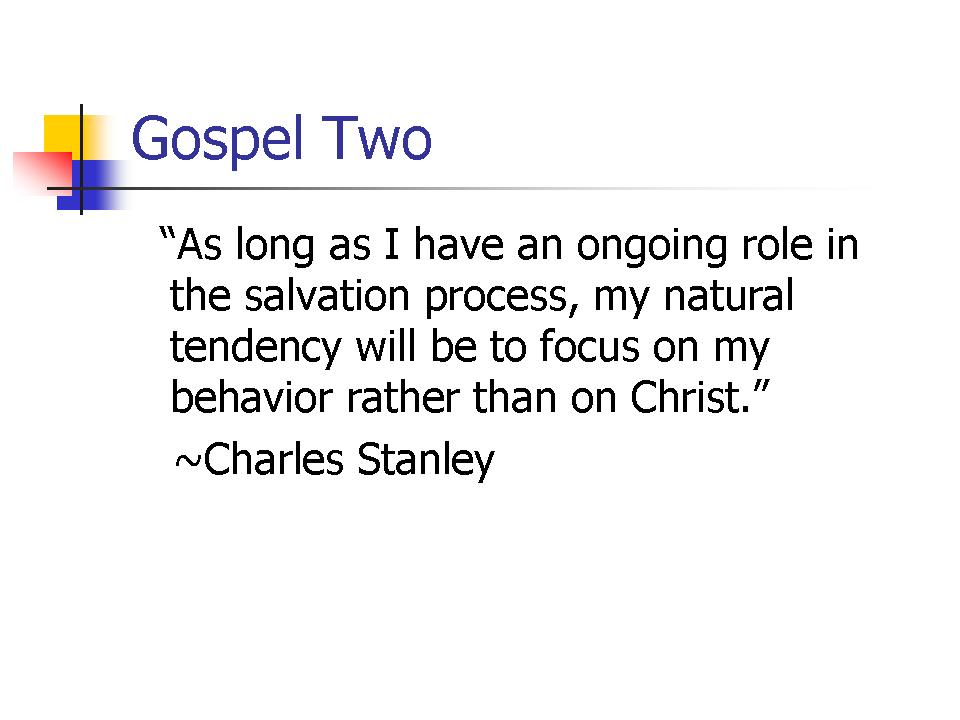






By Request: A Summary Of The New Calvinist Genealogy Chart; Part 1 / Introduction
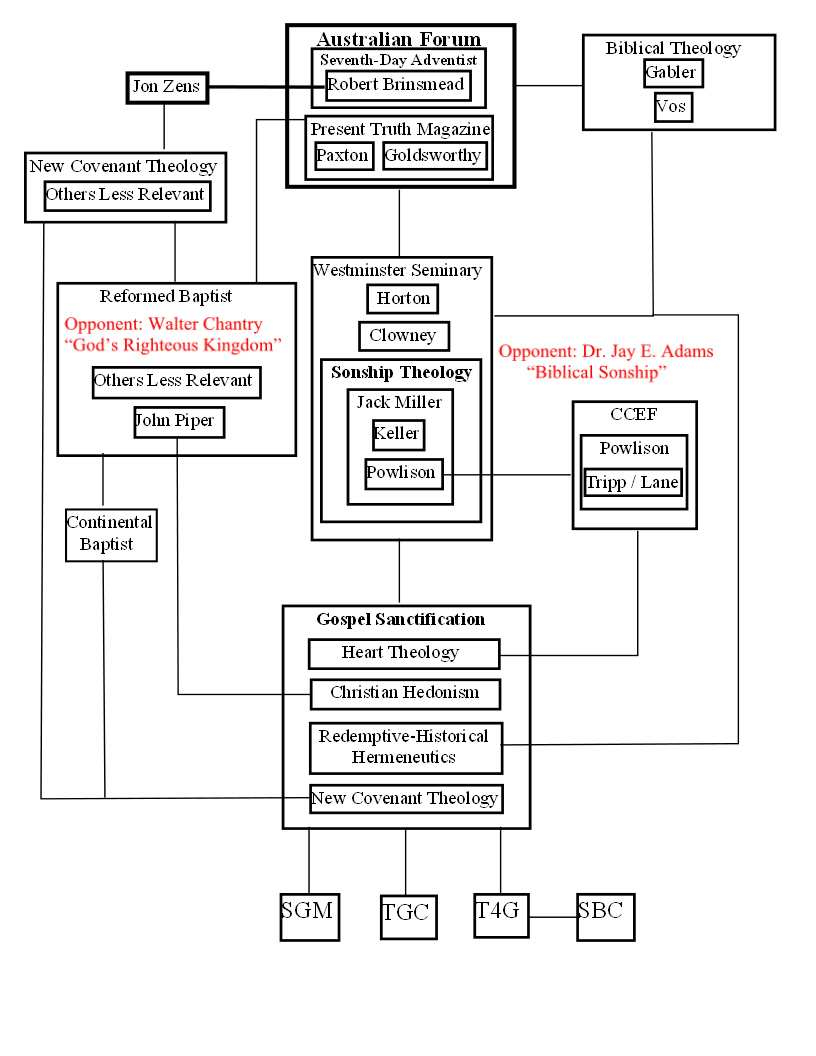 The contemporary history of New Calvinism begins with Robert Brinsmead and Jon Zens. They are the fathers of New Calvinism. Between my interview with Brinsmead and an informal document written by Zens I found on the internet—this is apparent. Brinsmead started a project called the Australian Forum (he wanted me to note that it was one of many projects that focused on certain subjects) that sought to articulate a gospel-centered sanctification into a unified, consistent systematic theology. One of the major considerations was a focus on covenant theology in relationship to this endeavor. Jon Zens is the father of New Covenant Theology, but it is clear that Brinsmead had a major influence in the formulation of that doctrine. All of this took place in the 70’s. So, New Calvinism has been around for about 35 years in various forms. It is primarily based on the Forum’s centrality of the objective gospel (COG). COG is the very heart of New Calvinism. Though NC has many different expressions, this doctrine is the heartbeat that drives it.
The Forum was having a significant impact on two spheres of Christianity in the 70’s and early 80’s; namely, Reformed Baptist and Westminster Seminary. Zens was a Reformed Baptist and also a student at Westminster. Zens taught a Sunday School class where his ideas on New Testament ethics were being presented, and Westminster students attended those studies. Michael Horton was infatuated with the Forum’s teachings, and COG can be seen in many of his teachings throughout his career. Keep in mind, the Forum’s magazine, Present Truth, and later, Verdict, according to Zens, had the largest readership among all Evangelical publications at that time. Apparently, Zens was initially introduced to the Forum by receiving Present Truth while he was a student at Westminster, and eventually formed a close relationship with Brinsmead. Also, G. Goldsworthy’s involvement in the Forum as one the AF three is one of the interesting the top is the same as the bottom in the genealogy chart. Till this day, the Goldsworthy Trilogy is a mainstay of New Calvinism’s Gospel Theology. Again, at the very heart of Goldsworthy’s Trilogy is COG. Goldsworthy was close to Brinsmead, and Brinsmead learned his Hebrew skills from Goldsworthy.
Zens, with the help of several men who are now the who’s who of New Covenant Theology while Zens is in the background (probably because of his connections with Brinsmead), attempted to propagate the doctrine, yet unnamed, via the Baptist Reformation Review . Zens received a very zealous contention from other Reformed Baptist such as Walter Chantry. At that time, Brinsmead wrote several articles defending Zens’ doctrine in the BRR. According to Zens:
“A sort of (unintended) [I doubt that] culmination occurred in the Spring, 1981, BRR. There were lengthy review articles of Walt Chantry’s God’s Righteous Kingdom [a book Chantry wrote to contend against COG, though he saw it as neo-antinomianism, which is also a correct assertion] and Robert Brinsmead’s Judged by the Gospel: A Review of Adventism. The dynamic N.T. approach to law and gospel [“NT approach to law and gospel” is a present-day NC mantra] was stated forcefully by RDB:
‘[Paul’s] appeals on how to live are made on the basis of what God has done for us in Christ. It is in view of God’s gospel mercies that we are to present our lives as a living sacrifice to God (Rom.12:1-3) . . . . Paul virtually never appeals to the law – ‘Thou shalt not.’ When he demands certain behavior of the church, he appeals instead to the holy history of Christ . . . and from that stand point then makes his ethical appeal.’”
Note here, and this is very important: the Forum’s the imperative command is grounded in the indicative event can be seen in Brinsmead’s statement cited by Zens above, which is a pillar of Gospel Sanctification till this day, and originated in COG doctrine by the AF. Chantry and others effectively beat COG within an inch of its life, and the doctrine, coined by Zens one year later as “New Covenant Theology” (in 1981), continued on in a meager existence among Continental Baptist. Most likely, John Piper was introduced to COG among Reformed Baptist and was probably well aware of the controversy. The wherewithal of his injection of Christian Hedonism into the movement is sketchy at this time and needs extensive investigation which I will do Lord willing.
Meanwhile, COG was finding new life at Westminster Seminary. In fact, Brinsmead and the Forum met with the Westminster faculty in the I think early 80’s, I will add references to this summary later. Brinsmead remembers little about the meeting other than he noted that the faculty served pork to him and the other forum members which he suspected was deliberate due to the Forum’s connection with Adventism. I informed him that it was deliberate because they were incited to do so by Jay Adams (a faculty member at the time) who was not a happy camper that the meeting took place. Brinsmead stated that one individual present at the meeting seemed to be an “elder statesman” of Westminster. I’m guessing it was Edmund Clowney.
At this point, COG, as the face of the AF disappears, leaving behind its remnants with Continental Baptist because Robert Brinsmead departed from orthodox Christianity all together. But the heart of COG incited a new movement begun by Westminster professor John “Jack” Miller called “Sonship Theology.” Again, COG met stiff resistance in Presbyterian circles under the new name of Sonship. Leading the charge was Dr. Jay Adams who also knew Jack Miller personally. His contention against Sonship is well documented in his book, “Biblical Sonship: An Evaluation Of The Sonship Discipleship Course.” Unfortunately, the book is out of print. One may well note: Some big dogs of the present-day New Calvinists movement; specifically, Tim Keller and David Powlison, were disciples of Jack Miller and his Sonship program. Tim Keller’s propagation of Sonship is well known and documented. At a conference conducted at John Piper’s church while Piper was on sabbatical, Powlison specifically cited Miller as his “mentor” and ridiculed Adams for criticizing Miller while failing to mention that the “criticism” was in the form of a book—which I am sure slipped his mind. Miller is the one who coined the phrase often aped by Jerry Bridges: “We must preach the gospel to ourselves everyday.” Funny, while an elder at a reformed church in the mid-nineties, I heard Jerry Bridges say that without realizing what a profound effect that little phrase would have on my life ten years later.
But with COG again under heavy fire and the Sonship coat of arms being shot full of holes, “Sonship” was replaced with “gospel,” ie., “gospel-driven” this, and “gospel-centered” that. The movement was now underground, but steadily growing while avoiding labels like the plague. Take note: for almost ten years between 2000 and 2009, the movement was nameless. The name “New Calvinism” is very recent and was attached because movements that become massive cannot avoid a label. Meanwhile, David Powlison had been busy for a number of years integrating Jack Miller’s form of COG into “biblical counseling” through his Dynamics of Biblical Change which became the basis for biblical counseling at Westminser Seminary. Hence, different players were at work making COG relevant to different areas of Christian theology and life that were important to them in making COG work. Brinsmead conceived the primary foundation (with other Reformed elements not unique with him—what he called “jewels” that contributed to what was important to him) and helped Zens formulate the covenant theology. Goldsworthy integrated COG into hermeneutics and eschatology with a little bit of Gabler and Vos mixed in for good measure. Piper contributed to the experience / emotional aspect, and Powlison was paramount in his contribution to the life application part; otherwise, COG would be more vulnerable to its unbiblical passivity in the sanctification process.
Unbeknown to many in the biblical counseling movement, the integration of COG into biblical counseling, primarily in David Powlison’s Theology of the Heart that came out of Westminster’s DBC, was at the core of tensions between NANC and CCEF, the counseling wing of Westminster Seminary (other than the integration of Psychology as well, but COG deserves infamous merit there as well). Eventually, CCEF’s influence totally infected NANC with the disease, and NANC advocates act as if the cupbearer, upon realizing he has tested a deadly cup, should use his last words to compliment the superb taste of the drink. Eventually, disciples of David Powlison; Paul David Trip and Timothy Lane, wrote a book that articulated COG’s supposed life application in the book, How People Change. The centrality of the objective gospel (COG) and all of its elements are glaringly obvious in the book—almost as if it was written by Robert Brinsmead himself.
Starting in, or about 2004, Christians began to realize something was wrong, but because the movement had no label, other than, “gospel” (and who is going to diss the “gospel”?), many simply just remained confused as to what this was all about. However, I was in a unique situation at the time. I was in a church that was on the cutting edge of the movement for many reasons. In NANC’s glory days, this church was a training center for biblical counselors. The church was eventually infected by COG via CCEF’s influence over NANC, and Reformed Baptists who joined the same afoermentioned church who were of the Jon Zens persuasion. Once I knew something didn’t smell right, I spent several months researching and interacting with the elders of that church. Their story, which of course I didn’t buy, was that COG has been historically true all along, and a Reformation was afoot. Eventually, after hundreds of hours of conversation / debate with these elders and my own research, I named the movement “Gospel Sanctification” and started a blog called the “Berean Call” which later became PPT. Initially, I thought the movement was confined to those group of elders (who are all men drunk with visions of grandeur), and they were trying to formulate a system that made Heart Theology, Christian Hedonism, NCT, and redemptive-historical hermeneutics work together as a unified theology. Four years later, I came to realize that they were a mere reflection of a total package.
About a year ago, I received a book from an individual whom I suspect knew that there was a connection between Gospel Sanctification and Sonship Theology, but wanted me to see it for myself. The connection was immediately seen in the first 100 words of Adams’ book. After much more research, it looked like Jack Miller was the father of Gospel Sanctification, but I was haunted by a few things. GS seemed to need NCT’s view of the law to function without contradiction. Also, all elements of Sonship and the historical connections were easy to match with GS, but NCT theology seemed to be dropped in out of nowhere. Of course, it didn’t surprise me that the elders of the church I was a member of or CCEF never uttered the name, “Sonship” because that would supply Christians with an interpretive prism that could expose them. Then, several months later, by accident, I stumbled upon an article that mentioned the Australian Forum and how it had a profound effect on the theological mindset of Michael Horton. That prompted me to say to myself, “Oh really?” “What is the Australian Forum?” Well, the rest is history.
Future parts will put veneer on the framework posted here, but any clarifying questions are welcome.
paul
Rick Holland’s “Uneclipsing The Son,” Part 1: John MacArthur Comes Completely Out of the Closet
“This is the road now traveled by MacArthur: unlike his preaching of the past, but like other Gospel Sanctification advocates, his preaching will now raise more questions than are answered….”
“I am unmoved by MacArthur’s self-delusions and his musings concerning the ever-morphing neo-Calvinist novelties of our day. Peter said that though he and others witnessed the miracles of that age—the testimony of Scripture is more sure, and Gospel Sanctification does not align with the plain sense of Holy writ.”
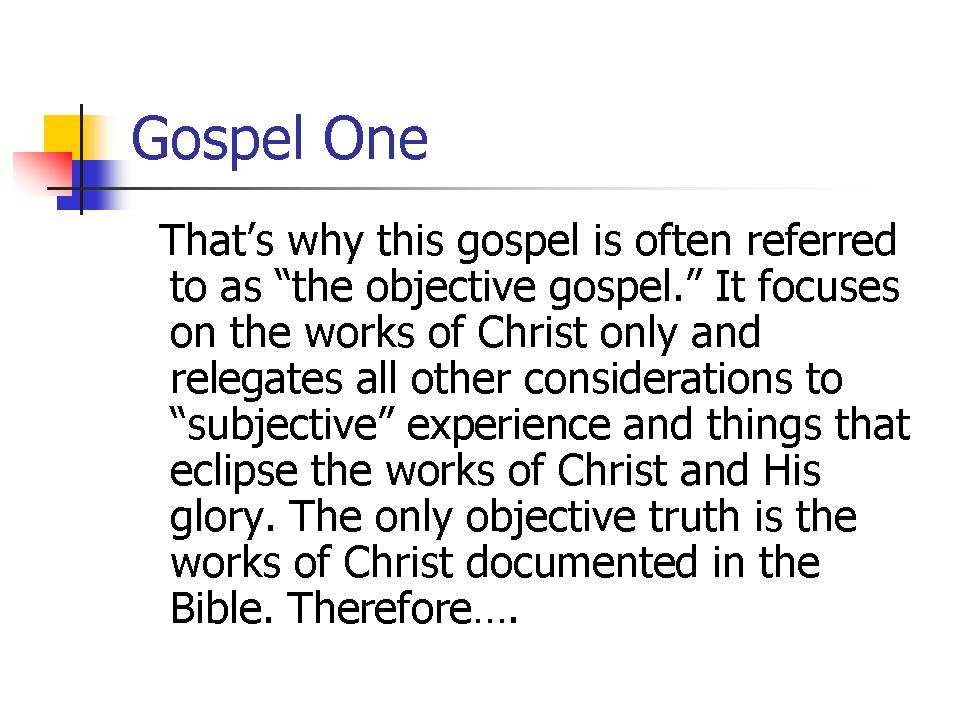
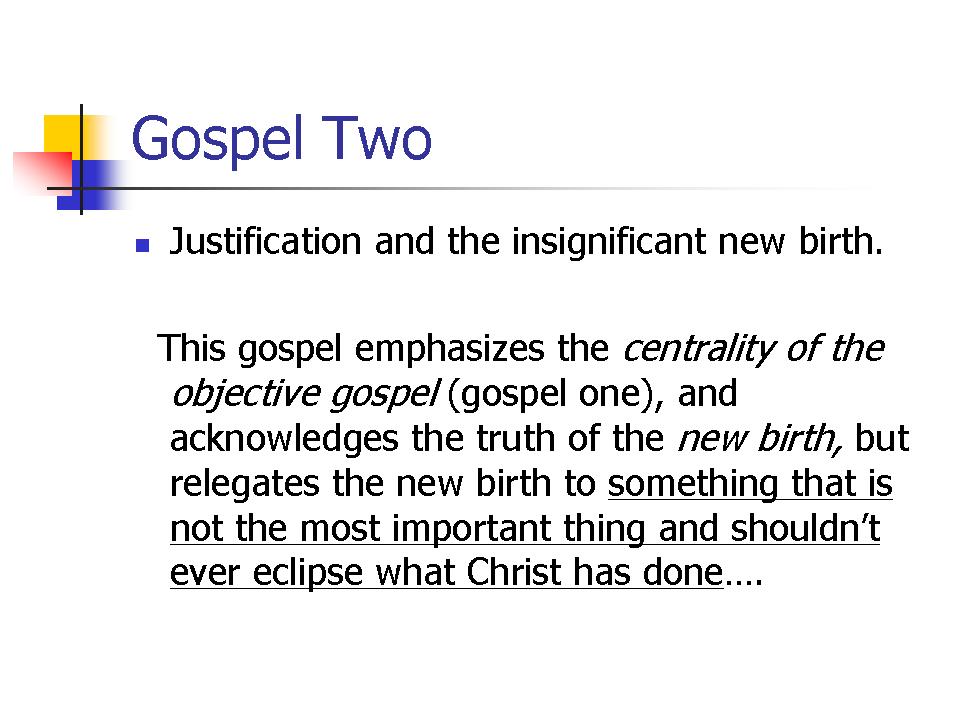
“Also, note that he says that we don’t even want to eclipse Christ ‘partially.’ This is like the Forum’s centrality of the objective gospel which led them to relegate the new birth to a position of insignificance because it involves a focus on us (subjective), and away from Christ / gospel (objective), and therefore ‘eclipses Christ.’”
July 6, 2011 is a day that will live in infamy for the rest of my life. I’m not kidding. My copy of “Uneclipsing The Son” by Rick Holland arrived two days ago and was on my desk. Susan came and sat in a chair by my desk, observed the book, picked it up, and started reading to me the forward written by John MacArthur Jr. My worst fears were realized. MacArthur’s forward to the book is a clear, concise, mini-treatise that promotes Gospel Sanctification in no uncertain terms. He is now totally out of the closet. As the name, “Gospel Sanctification” indicates, we are supposedly sanctified by the same gospel that saved us. In other words, our spiritual growth flows from a contemplation on Christ’s personhood (whatever that means exactly) and His works. Therefore, the sole purpose of the Scriptures is to gain a deeper and deeper knowledge of Christ and His works with everything else in Scripture being a mere picture or description of what Christ has fulfilled for us. One might say that it is a hyper-Calvinistic view of monergism in justification that is also projected onto sanctification. So, if one carries the doctrine to its logical conclusion, the primary, if not sole duty in the Christian life is meditating on Christ and His works which results in the Holy Spirit elevating us to higher and higher levels of sanctification. In fact, MacArthur all but writes exactly that in the forward to Holland’s book.
First, Some Historical Background
This is not the first time in church history that contemplative spirituality using the gospel as the object has been propagated. However, what makes Gospel Sanctification unique is its unified systematic theology. Gospel Sanctification has a theory regarding a favorable method of interpreting the Scriptures, a supposed practical application, an explanation of how it is experienced emotionally, its own eschatology, and a covenant theology. More than likely, Gospel Sanctification as we know it today was conceived by Robert Brinsmead and his Australian Forum project. The clear mandate of that project was to systematize a theology that was gospel-centered sanctification. One of the concepts created by the project was the centrality of the objective gospel. It went so far as to indicate that all reality is interpreted through the gospel (objective), and anything given more priority than the gospel (subjective) was to “eclipse the Son.” The Forum’s writings are saturated with descriptions of various woes that come from “eclipsing” Christ and the gospel. Robert Brinsmead worked closely with Jon Zens (the father of New Covenant Theology) in developing the same kind of theology for a supposed biblical view of law/gospel or “New Testament ethics.” The result was New Covenant Theology and Zens tried to propagate the Theology in Reformed Baptist circles. It was met with fierce resistance, and the movement was relegated to a meager group presently known as the Continental Baptist.
However, the idea found new life through another venue where Forum doctrines were being tossed around via the fact that Zens was a student there, and Michael Horton was greatly influenced by Forum ideas—Westminster Seminary. Primarily, a professor of theology there named Jack Miller took the same ideas and formulated a doctrine known as Sonship Theology. Again, the movement was met with fierce opposition, this time in Presbyterian circles. The Sonship label was then dropped and replaced with “gospel,” ie., gospel-centered this, and gospel-driven that. This led Baptist and Presbyterian protestors to believe that the movement was all but dead for the past ten years. But really, the movement was growing covertly under the guise of the gospel nomenclature, and has recently emerged as New Calvinism—a gargantuan movement including church networks, missionary alliances, cooperative training conferences, and “biblical” counseling organizations. The doctrine is overrunning the contemporary church like a giant tsunami and its proponents claim that it is a second Reformation.
In fact, I would probably be conceding myself, thinking, “Everyone else, and now MacArthur? It must be me—I’m missing something on this,” if not for a few souls like Walter Chantry and Dr. Jay Adams. In 1999, Adams published a book to refute Sonship Theology in the same way that Walter Chantry published a book in 1980 to refute Jon Zens’ views (and essentially that of the Forum as well). One year later Zens coined the phrase, “New Covenant Theology.” One of many obvious connections that can be seen in all of this is the fact that two major players in the New Calvinist movement, Tim Keller and David Powlison, were disciples of Jack Miller who coined the phrase: “We must preach the gospel to ourselves everyday” which is an often-heard mantra within the movement. Another connection is the popularity of “The Goldsworthy Trilogy (Gospel and Kingdom; Gospel and Wisdom; The Gospel in Revelation)” within the New Calvinist movement—written by Graeme Goldsworthy who was one of three major participants in the Australian Forum project along with Geoffrey Paxton and Robert Brinsmead. This speaks to the likeminded beliefs regarding the gospel shared by the Forum and New Calvinist. I strongly suspect Holland’s book will bear more of the same.
On the back cover of Holland’s book, we read this statement in bold print: “Christ, The Son Of God, Has Been Eclipsed, And We’ve Made Ourselves At Home In This New Normal.” Nothing could be farther from the truth. Since the 1950’s the church has been inundated with a hyper-grace mentality. This first gospel wave with a lack of emphasis on discipleship paved the way for Gospel Sanctification. Jay Adams started the true contemporary Reformation in 1970 with his book, “Competent to Counsel” which had a very strong emphasis on discipleship and true biblical counseling. Adams often comments that during that time as he traveled about and spoke, Christians seemed to be surprised that they could actually “do something in their walk with God.” The “normal” in Christianity today is a profound ignorance regarding the sufficiency of Scripture and how to apply it to life in our walk with God. Christ hasn’t been eclipsed—we think He does it all for us. What has been eclipsed is what Jesus says—not who He is. Furthermore, Adams has suffered some significant persecution for his attempt to emphasize doing in the Christian life, especially from the New Calvinist counseling culture and David Powlison who was offended by the book Adams wrote to refute Sonship Theology. New Calvinist like Powlison describe the real contemporary Reformation via Adams (in regard to being used by God) as the “first generation of biblical counseling” in the same way that Luther’s Reformation was first generation. But now, the New Calvinist counseling culture is supposedly part of the second Reformation through the discovery of Gospel Sanctification. Of course, the notion is preposterous and takes arrogance to a new level that has never before been seen.
John MacArthur’s Coming Out
MacArthur’s forward is fraught with blatant error and contemplative spirituality in the form of Gospel Sanctification. MacArthur begins his forward with the following:
“As Christians we have one message to declare: ‘Jesus Christ, and Him crucified’( I Corinthians 2:2). ‘For we do not preach ourselves but Christ Jesus as Lord, and ourselves as your slaves for Jesus’ sake’ ( 2 Corinthians 4:5; cf. I Corinthians 2:2; Galatians 6:14).”
Gospel Sanctification follows the way of many other false doctrines throughout church history; specifically, the eclipsing of other members of the Trinity by overemphasizing one over the others. Jehovah’s Witnesses overemphasize the Father. Charismatics overemphasize the Holy Spirit, etc. Christ Himself, in His mandate to the church, said to baptize in the name of all Three. The Father elects; the Son atones, and the Spirit sanctifies—but we are to only preach Christ? Christ’s emphasis on the Father in regard to salvation saturates the Gospels, especially in the book of John:
John 6:44
“No one can come to me unless the Father who sent me draws him, and I will raise him up at the last day.
John 6:65
He went on to say, “This is why I told you that no one can come to me unless the Father has enabled him.”
Christ instructed us to pray to the Father, and according to the apostle Paul:
“Now when it says that ‘everything’ has been put under him, it is clear that this does not include God himself, who put everything under Christ. When he has done this, then the Son himself will be made subject to him who put everything under him, so that God may be all in all” (1Cor. 15:27,28).
MacArthur continues:
“Rick Holland understands that truth. This book is an insightful, convicting reminder that no one and nothing other than Christ deserves to be the central theme of the tidings we as Christians proclaim—not only to one another and to the world, but also in the private meditations of our own hearts.”
No one, or no thing, “deserves” to be the central theme of our private devotions? This follows the Gospel Sanctification tenet that we shouldn’t seek to be instructed from the Scriptures (ie., seeking to know how to love our wives in a way that pleases God, etc). If we meditate on Christ and His works (the gospel), all that Christ commands will happen naturally. Supposedly. I can only assume NO one and NO thing means exactly what the sentence states. But again, it begs the question: “He doesn’t mean to exclude God from that statement, right? Also note the GS teaching that our message is the same for justification AND sanctification: “….nothing other than Christ deserves to be the central theme of the tidings we as Christians proclaim—not only to one another and to the world, but also in the private meditations of our own hearts.”
MacArthur:
“Christ is the perfect image of God (Hebrews 1); the theme of Scripture (Luke 24); the author of salvation (Hebrews 12:2); the one proper object of saving faith (Romans 10:9-10); and the goal of our sanctification (Romans 8:2). No wonder Scripture describes the amazing growth-strategy of the early church in these terms: “They ceased not to teach and preach Jesus Christ” (Acts 5:42). That is the only blueprint for church ministry that has any sanction from Scripture.”
Not exactly. The early church also went about preaching “the good news of the kingdom of God”:
Acts 1:3
After his suffering, he showed himself to these men and gave many convincing proofs that he was alive. He appeared to them over a period of forty days and spoke about the kingdom of God.
And what did that teaching by Christ also entail?:
Acts 1:6
So when they met together, they asked him, “Lord, are you at this time going to restore the kingdom to Israel?”
And….:
Acts 14:22
strengthening the disciples and encouraging them to remain true to the faith. “We must go through many hardships to enter the kingdom of God,” they said.
Acts 19:8
Paul entered the synagogue and spoke boldly there for three months, arguing persuasively about the kingdom of God.
Acts 20:25
“Now I know that none of you among whom I have gone about preaching the kingdom will ever see me again.
Also, in other passages, Christ, and the kingdom of God seem to be separate subjects within the gospel:
Acts 8:12
But when they believed Philip as he preached the good news of the kingdom of God and the name of Jesus Christ, they were baptized, both men and women.
Acts 28:23
They arranged to meet Paul on a certain day, and came in even larger numbers to the place where he was staying. From morning till evening he explained and declared to them the kingdom of God and tried to convince them about Jesus from the Law of Moses and from the Prophets.
Acts 28:31
Boldly and without hindrance he preached the kingdom of God and taught about the Lord Jesus Christ.
Obviously, to the first-century church, “the gospel” included the whole picture of the Trinities saving work.
MacArthur:
“The pastor who makes anything or anyone other than Christ the focus of his message is actually hindering the sanctification of the flock. Second Corinthians 3:18 describes in simple terms how God conforms us to the image of His Son: ‘And we all, with unveiled face, beholding the glory of the Lord, are being transformed into the same image from one degree of glory to another’ (emphasis added). We don’t ‘see’ Christ literally and physically, of course (I Peter 1:8). But His glory is on full display in the Word of God, and it is every minister’s duty to make that glory known above all other subjects.”
To this point in the forward in Holland’s book, MacArthur is using all of the proof texts typically used by Gospel Sanctification proponents. But in regard to 2Cor. 3:18, the correlation between gazing or “beholding the glory of the Lord” and spiritual growth has no direct correlation to being the only facilitator thereof. Such a direct cause and effect correlation is assumed. Besides, Macarthur is being disingenuous by quoting the ESV here because all other translations include the word “glass” or “mirror” with difficulty in ascertaining whether we are looking at Christ’s glory in a mirror, or “reflecting” His glory as in a mirror. Either way, mirrors of that day were polished metal and did not have the perfect reflection like modern mirrors made of class. This creates difficulty for those who want to use this text to show that our primary duty is to gaze on Christ’s glory rather than an understanding of what He’s teaching for the purpose of obedience. However, MacArthur continues to expound on this point with his paramount coming out of the closet statement in the following excerpt:
“As believers gaze at the glory of their Lord—looking clearly, enduringly, and deeply into the majesty of His person and work—true sanctification takes place as the Holy Spirit takes that believer whose heart is fixed on Christ and elevates him from one level of glory to the next. This is the ever-increasing reality of progressive sanctification; it happens not because believers wish it or want it or work for it in their own energy, but because the glory of Christ captures their hearts and minds. We are transformed by that glory and we begin to reflect it more and more brightly the more clearly we see it. That’s why the true heart and soul of every pastor’s duty is pointing the flock to Christ, the Great Shepherd.”
In these last two excerpts mentioned, we see MacArthur aping the GS belief that all of Scripture is about Christ and Christ must be seen in every passage. As Jay Adams aptly points out, several books in the Bible do not have Christ as their central theme and plainly say so; for instance, Jude initially intended to write about our common salvation, but instead was led to write an exhortation to contend for pure doctrine. In this statement, MacArthur continues to use 2Cor. 3:18 to make the following point: “As believers gaze at the glory of their Lord—looking clearly, enduringly, and deeply into the majesty of His person and work—true sanctification takes place as the Holy Spirit takes that believer whose heart is fixed on Christ and elevates him from one level of glory to the next.” How do you look “clearly”; “enduringly,” and “deeply” by “see[ing] through a glass, darkly” (1Cor. 13:12) which depicts the mirrors of those days? Christ’s instruction on how we become a house that will withstand the storms of life is plainly stated in Matthew 7:24-27, we hear His words and put those words into practice.
In classic Gospel Sanctification form, MacArthur also implements the either / or hermeneutic in this statement: “This is the ever-increasing reality of progressive sanctification; it happens not because believers wish it or want it or work for it in their own energy, but because the glory of Christ captures their hearts and minds.” Here we go again with this serving Christ by our own efforts stuff ( when Peter said, “Make every effort to add to your faith…., “ who’s effort was he talking about?!). If we are to exert effort in the sanctification process, which I’m sure MacArthur would concede, how would we know if it is our own effort or that of the Holy Spirit? And why can’t it be both? Why does it have to be either all of us or all of the Spirit? GS advocates have to create a whole theology just to deal with that question, and it’s called Christian Hedonism which is John Piper’s contribution to the movement. This is the road now traveled by MacArthur: unlike his preaching of the past, but like other Gospel Sanctification advocates, his preaching will now raise more questions than are answered; like, “what do you mean when you say that real servitude to Christ will have nothing to do with my own desires? If I am a new creature—are my desires not changed?” Depending on how far MacArthur decides to go with all of this—the answer would be “no” because GS doctrine holds t a total depravity of the saints. The logical conclusion is that Christ does it all for us as a result of contemplating the gospel. In order to say that without saying it, GS proponents have to work hard (presumably in their own efforts) to make it all fit together.
MacArthur:
“After more than four decades of pastoral ministry, I am still constantly amazed at the power of Christ-centered preaching. It’s the reason I love preaching in the gospels. But I discovered long ago that the glory of Christ dominates Romans, Galatians, Colossians, Hebrews, Revelation—and the rest of Scripture as well. Focusing on that theme has led my own soul and our congregation to a fuller, richer knowledge of Christ—loving Him, worshipping Him, serving Him and yearning for the day when we shall be like Him, having seen Him in His glory (I John 3:2).
Our prayer is that of Paul: ‘that I may know Him!’ (Philippians 3:10). The apostle knew Him well as Savior and Lord (having been privileged to be the last person ever to see the resurrected Christ face to face, according to I Corinthians 15:8)—but never could Paul plumb the rich, sweet depths of the glories of Christ, the inexhaustible, infinite Treasure.”
I am unmoved by MacArthur’s self-delusions and his musings concerning the ever-morphing neo-Calvinist novelties of our day. Peter said that though he and others witnessed the miracles of that age—the testimony of Scripture is more sure, and Gospel Sanctification does not align with the plain sense of Holy writ.
MacArthur:
“Far from allowing Christ to be eclipsed—even partially—by any other object or affection, every believer should pursue with relentless zeal the ‘full knowledge of the glory of God’ provided by a fervent concentration ‘on the face of Christ’ (2 Corinthians 4:6).”
In context, 2Cor. 4:6 refers to those who don’t recognize Christ as Savior in comparison to those who do, and does not prescribe John Piper’s “beholding as a way of becoming.” Christ’s prescription for loving Him is plain in John 14:15,16; we are to obey what he commands with the HELP of the Holy Spirit. The Holy Spirit HELPS us—He doesn’t obey for us by replacing our “own” efforts with something else as a result of contemplation on nebulous concepts concerning the personhood of Christ. Such nonsense has led to all kinds of mystic speculations by New Calvinist; such as, the supposed truth that Christ experienced a suffering in darkness while in Mary’s womb as part of the atonement. Soon, MacArthur will be espousing such speculation from the pulpit if he doesn’t repent and return to orthodoxy. Also, note that he says that we don’t even want to eclipse Christ “partially.” This is like the Forum’s centrality of the objective gospel which led them to relegate the new birth to a position of insignificance because it involves a focus on us (subjective), and away from Christ / gospel (objective), and therefore “eclipses Christ.” And unlike the MacArthur of the past, we just have more questions to ask: “How do we partially eclipse Christ? So, other than Christ, what can we talk about? And will it partially eclipse Christ or not?”
In all of this, one should consider what the focus of Peter’s message was to the church when he knew his time of departure was near (2Peter. Ch.1). He plainly said that there was one thing that he wanted them to remember so that their calling and election would be sure. He said he wanted to constantly put them in remembrance of this theme so they wouldn’t forget after he was gone. What was that message? As glorious as it is, was it a laser focus on the personhood of Christ to the exclusion of all else? No, it was a focus on the saints “making every effort” to add certain things to their faith. If contemplation on the personhood of Christ is singularly paramount to spiritual growth, how could Peter possibly say what he did?
This is certain: The apostle Paul said that even if he or an angel came preaching another gospel—reject it, and trust me, MacArthur is no apostle Paul, and I will not follow Gospel Sanctification—even if I am the last person on earth not to do so.
paul

 Paul's Passing Thoughts
5 comments