By Request: A Summary Of The New Calvinist Genealogy Chart; Part 1 / Introduction
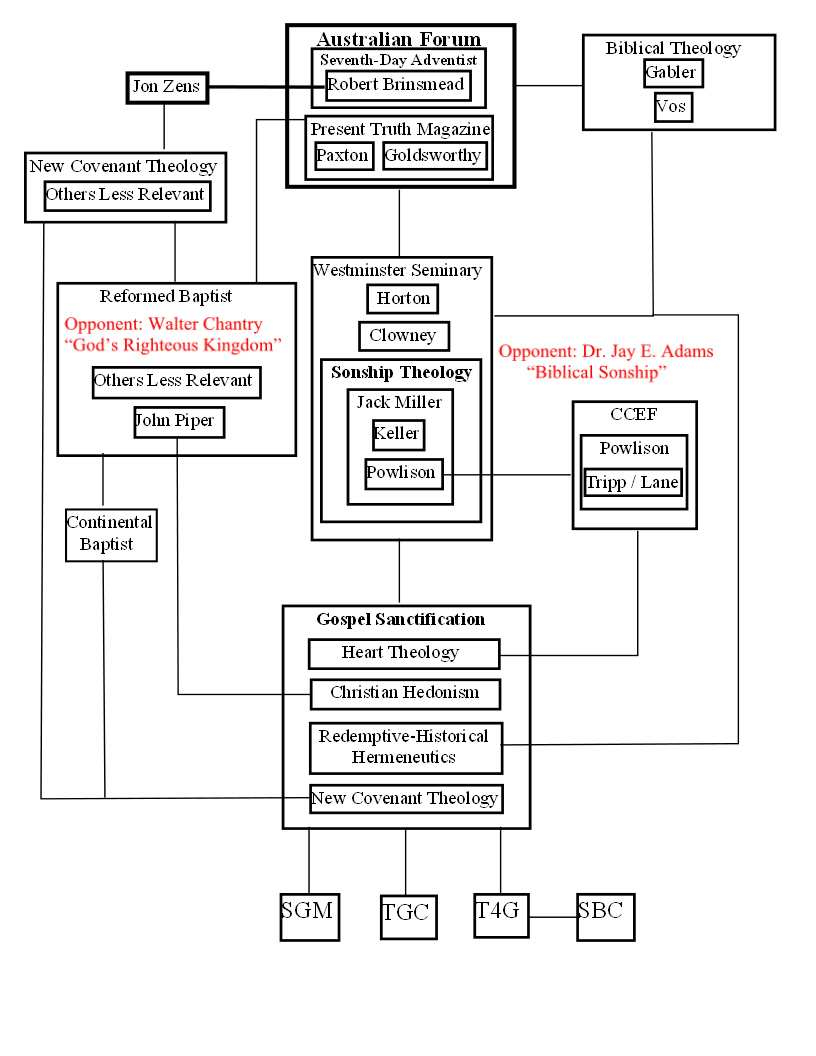 The contemporary history of New Calvinism begins with Robert Brinsmead and Jon Zens. They are the fathers of New Calvinism. Between my interview with Brinsmead and an informal document written by Zens I found on the internet—this is apparent. Brinsmead started a project called the Australian Forum (he wanted me to note that it was one of many projects that focused on certain subjects) that sought to articulate a gospel-centered sanctification into a unified, consistent systematic theology. One of the major considerations was a focus on covenant theology in relationship to this endeavor. Jon Zens is the father of New Covenant Theology, but it is clear that Brinsmead had a major influence in the formulation of that doctrine. All of this took place in the 70’s. So, New Calvinism has been around for about 35 years in various forms. It is primarily based on the Forum’s centrality of the objective gospel (COG). COG is the very heart of New Calvinism. Though NC has many different expressions, this doctrine is the heartbeat that drives it.
The Forum was having a significant impact on two spheres of Christianity in the 70’s and early 80’s; namely, Reformed Baptist and Westminster Seminary. Zens was a Reformed Baptist and also a student at Westminster. Zens taught a Sunday School class where his ideas on New Testament ethics were being presented, and Westminster students attended those studies. Michael Horton was infatuated with the Forum’s teachings, and COG can be seen in many of his teachings throughout his career. Keep in mind, the Forum’s magazine, Present Truth, and later, Verdict, according to Zens, had the largest readership among all Evangelical publications at that time. Apparently, Zens was initially introduced to the Forum by receiving Present Truth while he was a student at Westminster, and eventually formed a close relationship with Brinsmead. Also, G. Goldsworthy’s involvement in the Forum as one the AF three is one of the interesting the top is the same as the bottom in the genealogy chart. Till this day, the Goldsworthy Trilogy is a mainstay of New Calvinism’s Gospel Theology. Again, at the very heart of Goldsworthy’s Trilogy is COG. Goldsworthy was close to Brinsmead, and Brinsmead learned his Hebrew skills from Goldsworthy.
Zens, with the help of several men who are now the who’s who of New Covenant Theology while Zens is in the background (probably because of his connections with Brinsmead), attempted to propagate the doctrine, yet unnamed, via the Baptist Reformation Review . Zens received a very zealous contention from other Reformed Baptist such as Walter Chantry. At that time, Brinsmead wrote several articles defending Zens’ doctrine in the BRR. According to Zens:
“A sort of (unintended) [I doubt that] culmination occurred in the Spring, 1981, BRR. There were lengthy review articles of Walt Chantry’s God’s Righteous Kingdom [a book Chantry wrote to contend against COG, though he saw it as neo-antinomianism, which is also a correct assertion] and Robert Brinsmead’s Judged by the Gospel: A Review of Adventism. The dynamic N.T. approach to law and gospel [“NT approach to law and gospel” is a present-day NC mantra] was stated forcefully by RDB:
‘[Paul’s] appeals on how to live are made on the basis of what God has done for us in Christ. It is in view of God’s gospel mercies that we are to present our lives as a living sacrifice to God (Rom.12:1-3) . . . . Paul virtually never appeals to the law – ‘Thou shalt not.’ When he demands certain behavior of the church, he appeals instead to the holy history of Christ . . . and from that stand point then makes his ethical appeal.’”
Note here, and this is very important: the Forum’s the imperative command is grounded in the indicative event can be seen in Brinsmead’s statement cited by Zens above, which is a pillar of Gospel Sanctification till this day, and originated in COG doctrine by the AF. Chantry and others effectively beat COG within an inch of its life, and the doctrine, coined by Zens one year later as “New Covenant Theology” (in 1981), continued on in a meager existence among Continental Baptist. Most likely, John Piper was introduced to COG among Reformed Baptist and was probably well aware of the controversy. The wherewithal of his injection of Christian Hedonism into the movement is sketchy at this time and needs extensive investigation which I will do Lord willing.
Meanwhile, COG was finding new life at Westminster Seminary. In fact, Brinsmead and the Forum met with the Westminster faculty in the I think early 80’s, I will add references to this summary later. Brinsmead remembers little about the meeting other than he noted that the faculty served pork to him and the other forum members which he suspected was deliberate due to the Forum’s connection with Adventism. I informed him that it was deliberate because they were incited to do so by Jay Adams (a faculty member at the time) who was not a happy camper that the meeting took place. Brinsmead stated that one individual present at the meeting seemed to be an “elder statesman” of Westminster. I’m guessing it was Edmund Clowney.
At this point, COG, as the face of the AF disappears, leaving behind its remnants with Continental Baptist because Robert Brinsmead departed from orthodox Christianity all together. But the heart of COG incited a new movement begun by Westminster professor John “Jack” Miller called “Sonship Theology.” Again, COG met stiff resistance in Presbyterian circles under the new name of Sonship. Leading the charge was Dr. Jay Adams who also knew Jack Miller personally. His contention against Sonship is well documented in his book, “Biblical Sonship: An Evaluation Of The Sonship Discipleship Course.” Unfortunately, the book is out of print. One may well note: Some big dogs of the present-day New Calvinists movement; specifically, Tim Keller and David Powlison, were disciples of Jack Miller and his Sonship program. Tim Keller’s propagation of Sonship is well known and documented. At a conference conducted at John Piper’s church while Piper was on sabbatical, Powlison specifically cited Miller as his “mentor” and ridiculed Adams for criticizing Miller while failing to mention that the “criticism” was in the form of a book—which I am sure slipped his mind. Miller is the one who coined the phrase often aped by Jerry Bridges: “We must preach the gospel to ourselves everyday.” Funny, while an elder at a reformed church in the mid-nineties, I heard Jerry Bridges say that without realizing what a profound effect that little phrase would have on my life ten years later.
But with COG again under heavy fire and the Sonship coat of arms being shot full of holes, “Sonship” was replaced with “gospel,” ie., “gospel-driven” this, and “gospel-centered” that. The movement was now underground, but steadily growing while avoiding labels like the plague. Take note: for almost ten years between 2000 and 2009, the movement was nameless. The name “New Calvinism” is very recent and was attached because movements that become massive cannot avoid a label. Meanwhile, David Powlison had been busy for a number of years integrating Jack Miller’s form of COG into “biblical counseling” through his Dynamics of Biblical Change which became the basis for biblical counseling at Westminser Seminary. Hence, different players were at work making COG relevant to different areas of Christian theology and life that were important to them in making COG work. Brinsmead conceived the primary foundation (with other Reformed elements not unique with him—what he called “jewels” that contributed to what was important to him) and helped Zens formulate the covenant theology. Goldsworthy integrated COG into hermeneutics and eschatology with a little bit of Gabler and Vos mixed in for good measure. Piper contributed to the experience / emotional aspect, and Powlison was paramount in his contribution to the life application part; otherwise, COG would be more vulnerable to its unbiblical passivity in the sanctification process.
Unbeknown to many in the biblical counseling movement, the integration of COG into biblical counseling, primarily in David Powlison’s Theology of the Heart that came out of Westminster’s DBC, was at the core of tensions between NANC and CCEF, the counseling wing of Westminster Seminary (other than the integration of Psychology as well, but COG deserves infamous merit there as well). Eventually, CCEF’s influence totally infected NANC with the disease, and NANC advocates act as if the cupbearer, upon realizing he has tested a deadly cup, should use his last words to compliment the superb taste of the drink. Eventually, disciples of David Powlison; Paul David Trip and Timothy Lane, wrote a book that articulated COG’s supposed life application in the book, How People Change. The centrality of the objective gospel (COG) and all of its elements are glaringly obvious in the book—almost as if it was written by Robert Brinsmead himself.
Starting in, or about 2004, Christians began to realize something was wrong, but because the movement had no label, other than, “gospel” (and who is going to diss the “gospel”?), many simply just remained confused as to what this was all about. However, I was in a unique situation at the time. I was in a church that was on the cutting edge of the movement for many reasons. In NANC’s glory days, this church was a training center for biblical counselors. The church was eventually infected by COG via CCEF’s influence over NANC, and Reformed Baptists who joined the same afoermentioned church who were of the Jon Zens persuasion. Once I knew something didn’t smell right, I spent several months researching and interacting with the elders of that church. Their story, which of course I didn’t buy, was that COG has been historically true all along, and a Reformation was afoot. Eventually, after hundreds of hours of conversation / debate with these elders and my own research, I named the movement “Gospel Sanctification” and started a blog called the “Berean Call” which later became PPT. Initially, I thought the movement was confined to those group of elders (who are all men drunk with visions of grandeur), and they were trying to formulate a system that made Heart Theology, Christian Hedonism, NCT, and redemptive-historical hermeneutics work together as a unified theology. Four years later, I came to realize that they were a mere reflection of a total package.
About a year ago, I received a book from an individual whom I suspect knew that there was a connection between Gospel Sanctification and Sonship Theology, but wanted me to see it for myself. The connection was immediately seen in the first 100 words of Adams’ book. After much more research, it looked like Jack Miller was the father of Gospel Sanctification, but I was haunted by a few things. GS seemed to need NCT’s view of the law to function without contradiction. Also, all elements of Sonship and the historical connections were easy to match with GS, but NCT theology seemed to be dropped in out of nowhere. Of course, it didn’t surprise me that the elders of the church I was a member of or CCEF never uttered the name, “Sonship” because that would supply Christians with an interpretive prism that could expose them. Then, several months later, by accident, I stumbled upon an article that mentioned the Australian Forum and how it had a profound effect on the theological mindset of Michael Horton. That prompted me to say to myself, “Oh really?” “What is the Australian Forum?” Well, the rest is history.
Future parts will put veneer on the framework posted here, but any clarifying questions are welcome.
paul
Clearcreek Chapel’s “All in the Family”
 “I gathered up jewels that others here and there had mined, and just put it together in a way that seemed clear and important to me. If I could, it would be easier to reply that I had copied the package from somewhere in particular, but I am not able to do that. What I was on about impacted others and sharpened others up – like Paxton and Goldsworthy – and Jons [as confirmed later: Jon Zens] and a guy called Edward Fudge and others along the way.” ~ Robert Brinsmead
Clearcreek Chapel in Springboro, Ohio is a good representation of the kinship between all of the elements in our genealogy chart ( http://wp.me/pmd7S-K7 ). One of the joys of this ministry is reconnecting family members with long-lost relatives. It is intriguing to see how remnants of the genealogy chart are all gathered at the bottom—thirty-something years later, but with family members like Robert Brinsmead and Jon Zens (the original patriarchs) missing. Heartbreaking.
Not only that, credit is not being given where credit is due; for example, Jack Miller’s Sonship Theology, which pumped new life into the centrality of the objective gospel (aka Gospel Sanctification and New Covenant Theology) after it received a brutal beating from Walter Chantry and others on the left side of the chart, is never mentioned at T4G, TGC, and SGM gatherings, even though the primary disciples of Jack Miller (Tim Keller and David Powlison) are major players in those movements. Could it be because the Sonship label was shot full of holes by Jay Adams and Chad Van Dixhoorn on the right side of the chart? It would really do my heart good to see the Sonship label proudly displayed at the 2012 T4G. I mean, we’re talking family here.
Though I will be writing about many of these bottom-of-the chart family reunions, Clearcreek Chapel is an excellent specimen. The “elder” in charge of their “adult education” is Christian radio personality Chad Bresson, who authors a blog dedicated to Geerhardus Vos. Bresson is a member of the Earth Stove Society which promotes New Covenant Theology. Bresson has recently posted a lengthy article on eighty elements of New Covenant Theology followed by four articles on the writings of Graeme Goldsworthy. Also, a post by Bresson that articulates how New Calvinists interpret the Bible using a lengthy excerpt from the writings of Robert Brinsmead drew a lot of heat from some readers: http://goo.gl/qbeS4 .
Bresson was a recent speaker at the John Bunyan Convention which is a yearly conference that fictitiously uses the name of Bunyan to promote New Covenant Theology (NCT). This year’s conference included two primary figures of NCT, Fred Zaspel and John Reisinger. The conference was held at Reformed Baptist Church in Lewisburg, PA and I have not ascertained whether or not it is a Continental Baptist church which are a small fellowship of NCT churches that split from Reformed Baptist circles over the NCT issue. The debate that fueled the split was primarily between the father of NCT, Jon Zens, and Walter Chantry. Reformed Baptist protestants staunchly proclaimed NCT to be Antinomianism and were not the least bit apologetic about the accusation. Jon Zens is now in the background, probably because of his close association with the likable, but controversial Robert Brinsmead.
While Bresson shows Clearcreek’s kinship with Jon Zens, Brinsmead, and Goldsworthy, the Chapel leadership as a group focuses heavily on David Powlison’s Theology of the Heart ( http://goo.gl/8UnBe ) and John Piper’s Christian Hedonism. In fact, the pastor of Clearcreek is a well known rabid follower of John Piper. It is my understanding that Piper’s Christian Hedonism is presented yearly in the adult Sunday school class. Paul David Tripp is a frequent speaker there and the Chapel was one of the pilot churches that “tested” Tripp’s book How People Change, which is based on Powlison’s Dynamics of Biblical Change.
The common thread that ties all of the family members together is the Australian Forum’s centrality of the objective gospel (COG). This core thread (COG) was primarily developed by Brinsmead and Zens. Though it includes what Brinsmead describes (in our interview) as a collection of jewels, there is no doubt that Brinsmead and Zens formulated the basic systematic theology that makes its present-day life possible. In regard to any such system prior to the Forum, Brinsmead stated: “I gathered up jewels that others here and there had mined, and just put it together in a way that seemed clear and important to me. If I could, it would be easier to reply that I had copied the package from somewhere in particular, but I am not able to do that. What I was on about impacted others and sharpened others up – like Paxton and Goldsworthy – and Jons [as confirmed later: Jon Zens] and a guy called Edward Fudge and others along the way.”
COG states that all spiritual growth comes from contemplating the gospel outside of us. Any truth that is placed in the same priority at any given time is said to eclipse Christ. Inside considerations (the inner us [subjective]) would be included, which relegates the new birth to a position of insignificance—paving the way for the total depravity of the saints, “The same gospel that saved you also sanctifies you,” and “we must preach the gospel to ourselves everyday” (coined by Jack Miller and aped excessively by Jerry Bridges). As this foundational thread (system) has weaved through contemporary church history, it has been endowed with an explanation of how it is experienced (Christian Hedonism); how it applies to life (Heart Theology); its view of covenants (New Covenant Theology); and an interpretive model that enables outcomes that fit together logically (The Goldsworthy Trilogy [research on how the Dutch Reformed movement and Vos may have influenced Goldsworty is still pending]).
In an introduction to a Christian Hedonism class at Clearcreek Chapel, Chad Bresson said, “This is what makes us unique.” While one wonders why the goal is to be unique, we all can agree that it’s family that makes it all so special.
paul
The Significance of Kevin DeYoung’s Top Ten
“However, it is my hope that [DeYoung] will realize that as we grow spiritually using everything in our ‘sanctification tool belt,’ that we become increasingly aware of what we have been saved from, and hence, a deeper appreciation of our original salvation.”
“One can only pray that DeYoung will free himself completely from the insanity that creates such questions.”
“Whenever New Calvinist followers feel guilty, they don’t check their Holy Spirit tool belt; they are rather taught to contemplate the gospel that saved them.”
Kevin DeYoung, hereafter, “Special K” (SK), recently wrote a third post
( http://shar.es/HeU1Q ) clarifying his position on sanctification. SK wrote a prior post
( http://shar.es/HeU3w ) which was a capitulation to Tullian Tchividjian who responded to his first post on the same subject. In the second post, SK listed ten interpretive questions that he is considering while on a sabbatical for the purpose of writing a book on sanctification. The significance of these ten questions should not be missed. Those ten questions strike at the heart of New Calvinism, and it would seem that in light of his latest post, he has answered those questions in a way that is not favorable to New Calvinism. In fact, it almost seems like the latest post is in your face when compared to his response to Tchividjian’s “pushback” regarding his first post which only hinted of orthodoxy to begin with. The significance of these ten questions is the following:
1. Can the justified believer please God with his obedience?
SK didn’t pull these questions out of the clouds. This question has to be asked because New Calvinist (NC) teach that God cannot be anymore pleased with us than He already is in Jesus Christ (that’s true in regard to justification). The “justified” believer, as opposed to simply, “believer” is not worded that way for no reason. Supposedly, to admit that there is something we can do to please God as believers is to take away from the sufficiency of Christ’s atonement. Also, remember that the core beliefs of New Calvinism came from the Australian Forum, and their doctrine is primarily driven by the centrality of the objective gospel. In other words, the gospel is something outside of us, not inside (subjective). Inside considerations (like anything we would do [subjective]) cannot “eclipse” anything Christ has done (note: Rick Holland’s “Uneclipsing The Son” will soon be available for purchase).
2. Is the justified believer displeasing to God in some way when he sins?
This question is simply the other side of number one. New Calvinist teach that God cannot be displeased with us anymore than he can be displeased with Christ, and for the same reasons that we cannot do anything to gain more favor with God than we already have in Christ. Again, it’s not about us (subjective) and how the supposed displeasure of God would make us feel (subjective). SK seems to have answered this question for himself in the third post: “But God also motivates us by a sense of duty, by gratitude, by threats, by promises, and by the fear of the Lord.” And by the way, to NC, this statement is barely less than blaspheme.
3. Is unbelief the root of every sin? Or is it pride? Or idolatry? Should we even both
trying to find a root sin?
Obviously, SK is questioning one of the four major tenets of NC: Theology of the Heart. This theology was added to NC via Sonship Theology and David Powlison’s Dynamics of Biblical Change which was articulated in Paul Tripp’s “How People Change”
What Jonah knew and believed about God is what caused him to rebel. He knew God was a merciful God and would probably save the Ninevites, whom Jonah hated. That’s why he didn’t want to go there. In Jonah’s case, it was attitude, bad thinking, and a refusal to obey, not unbelief. It is evident in the book that Jonah had tremendous faith in God. But NC must make all issues in sanctification the same as justification which is primarily by faith only; so, it stands to reason that they have to make all sin issues in sanctification a belief issue. The NC position on this question is no better defended than in Tripp’s book. SK needs to read “How People Change” followed by the Donn Arms book review of HPC ( http://wp.me/pmd7S-EC ).
4. How are justification and sanctification related?
I think this question is now rightly, for the most part, answered by SK’s third post. I only take exception to a few statements thereof, but here is one: “Are we sanctified by remembering our justification? Yes.” SK is saying that contemplating our justification is still a viable way to grow spiritually, but he is presenting it as another tool “in our tool belt” rather than the only discipline from which all other duties flow (Dr. Peter Masters’ contention regarding Piper). However, it is my hope that SK will realize that as we grow spiritually using everything in our sanctification tool belt, that we become increasingly aware of what we have been saved from, and hence, a deeper appreciation of our original salvation.
5. Can we obey God?
This speaks to the NC doctrine of the total depravity of the saints. Again, most definitely, this originated with the Australian Forum who denied the new birth, or being born again. Michael Horton also denies the significance of the new birth and takes his cue from the Forum on that issue.
6. Can we feel confident about our obedience, not in a justifying way but that we
have done as we were commanded?
This clearly speaks to the NC belief that obedience in sanctification is synonymous with an attempt to be justified. Hence, asked another way: “Is the totally depraved believer really able to obey and know that it is legitimate obedience that pleases God?” One can only pray that DeYoung will free himself completely from the insanity that creates such questions.
7. How does Scripture motivate us to obedience?
By describing the tools in our tool belt, not the NC belief that the Bible is only a tool for contemplating the gospel.
8. Are most Christians too hard on themselves (thinking they are filthy scum when
they actually walk with the Lord in a way that pleases him)?
No Kevin. Many Christians are walking in violation of their conscience because of what New Calvinism teaches. Whenever New Calvinist followers feel guilty, they don’t check their Holy Spirit tool belt, they are rather taught to contemplate the gospel that saved them. My brother—please flee—perhaps there is not too much blood on your hands.
9. Or are most Christians too easy on themselves (thinking nothing of holiness
and content with little progress in godliness)?
Of course they are! They are taught that they cannot be a part of the progress!
10. What is the role of union with Christ in sanctification? And how do union with
Christ and sanctification relate to justification?
It’s the antithesis of the Forum’s view that formed New Calvinism: “The centrality of the objective gospel.”
paul
Gospel Sanctification and Sonship’s Gospel-Driven Genealogy, Part 6A: Horton’s Kinship With the Australian Forum Can be Seen in Frame’s Review
Let me continue to voice my appreciation for the information sent by readers; that’s what this network ministry is all about— cooperation in sharing information about New Calvinism / Gospel Sanctification / Sonship Theology which are all the same thing, and hereafter: NCGSS. Information sent yesterday is the subject of this post.
This particular series is exploring the possibility that New Calvinism was born from the Australian Forum. A working hypothesis chart can be viewed in part 2 of this series
( http://wp.me/pmd7S-Gm ); Horton’s place in the theoretical history can be seen on the chart. One thing thus far is certain: the doctrines are identical. Furthermore, both movements show the same motives, and both claim to have returned to Reformed / Puritan doctrine—this is the same dominate theme / staple of both movements. Also, there is reason to believe that New Covenant Theology was conceived from Jon Zens’ association with the Forum, and he also shared their desire to find middle ground between difficult doctrines.
As I noted previously, the Australian Forum Three were Robert Brinsmead, G. Paxton, and G. Goldsworthy. Brinsmead was excommunicated from the Seventh-Day Adventist Church (SDA) which was founded by Ellen G. White. Though Brinsmead and the Forum were trying to reform SDA, the Australian Forum (hereafter AF) endorsed much of Ellen White’s teachings. In fact, Paxton was infatuated with Adventist theology and lost a teaching position because of his association with the AF. Paxton and Brinsmead also shared a rabid distaste for Charismatic theology (they would not be pleased with New Calvinism’s inclusion of Charismatics). Goldsworthy’s motives for being involved with the AF are yet unclear, but the fact that he is oftentimes quoted by New Calvinist (hereafter NC) is no accident.
The subject of this post is John Frame’s review of Michael Horton’s “Christless Christianity” sent to me by a reader. The review is full of painstaking discernment. This kind of discipline in sorting through the mystical theological world of Michael Horton is very commendable. Frame also mentions what I call Horton’s Kerryisms: “I was for it before I was against it.” Or, “I know I said ‘A,’ but let me clarify so you poor spiritual peasants don’t misunderstand my theological brilliance: I only said ‘A’ in a manner of speaking, unless you agree with ‘A.’ If you agree, I really said it, but if you disagree, I was only saying ‘A’ in a manner of speaking.”
As I was reading Frames’ review—I saw AF footprints everywhere. I will be pointing to that relationship, using Frames review while mentioning other residual issues related to NC.
Frame opens his review this way:
The title of this book is alarming, certainly by design. But the subtitle is even more so. Does it mean that the whole American church (all traditions, denominations, locations) is committed to an “alternative Gospel?” Or is it that, though part of the American church upholds the true, biblical gospel, there is within that church a movement (evidently a significant movement) to the contrary?
John, Horton is what we call a New Calvinist. They hold to the doctrine of Gospel Sanctification. As implied by the title, we are supposedly sanctified by the same gospel that saved us. In other words, we are sanctified by justification, and the contemplation thereof. As John Piper says, “beholding as a way of becoming.” John: yes! Yes! Yes! They believe anything short of monergistic substitutionary sanctification is a false gospel. That’s why Horton’s ministry is named “Modern Reformation.” Listen very carefully to Piper’s “6 Minute Gospel” video on the internet as he calls for Evangelicals everywhere who believe in our efforts in sanctification to be saved from works salvation. It’s why Tullian Tchividjian said the following:
“As I’ve said before, I once assumed (along with the vast majority of professing Christians) that the gospel was simply what non-Christians must believe in order to be saved, while afterward we advance to deeper theological waters. But I’ve come to realize that the gospel isn’t the first step in a stairway of truths, but more like the hub in a wheel of truth. As Tim Keller explains it, the gospel isn’t simply the ABCs of Christianity, but the A-through-Z. The gospel doesn’t just ignite the Christian life; it’s the fuel that keeps Christians going every day.”
These guys believe that God is using them to reform another Dark Age of distinctions between justification and sanctification. They are also very resentful—they believe that Evangelicalism has sold the church a bill of goods about salvation. This attitude can be seen in the many hostile ministry takeovers playing out across this country (of which are finally being spoken of by Ovadal, Hamilton, and others). A good example is Coral Ridge. This mentality is also identical to that of the AF Three. A good thumbnail of this doctrine / mentality can be read in Horton’s Christless Christianity:
“Where we land on these issues is perhaps the most significant factor in how we approach our own faith and practice and communicate it to the world. If not only the unregenerate but the regenerate are always dependent at every moment on the free grace of God disclosed in the gospel, then nothing can raise those who are spiritually dead or continually give life to Christ’s flock but the Spirit working through the gospel. When this happens (not just once, but every time we encounter the gospel afresh), the Spirit progressively transforms us into Christ’s image. Start with Christ (that is, the gospel) and you get sanctification in the bargain; begin with Christ and move on to something else, and you lose both.”
NO ONE has yet demanded that Horton explain this statement. And this is fact: any statement made by NC proponents that seems to contradict this statement is just that—seemingly at odds. Furthermore, in many NC Reformed Baptist churches, they practice what is called “Redemptive Church Disciple.” When a parishioner is caught in a sin, the discipline doesn’t address the sin, it focuses on the supposed fundamental problem of how the “vast majority” of evangelicals understand the gospel. Therefore, the discipline focuses on “redemption.” The sin is supposedly a mere symptom of a false gospel. Hence, the discipline focuses on converting the individual from orthodox Evangelicalism to Gospel Sanctification. The discipline goes from step to step as the victim refuses to “repent” from synergistic sanctification to a monergistic substitutionary form. Moreover, as unsuspecting evangelical married couples join Reformed churches; one spouse in a marriage may come to believe the doctrine while the other spouse doesn’t. The marriage is then deemed a mixed marriage (believer / unbeliever) by the NC leadership. I have firsthand knowledge of this, and it is one of many in regard to the dirty little secrets of NC.
What are these subtle distortions? Evidently, what Horton is concerned with is an emphasis. The metaphors of “looking away from” Christ and putting something else on “center stage” have to do with the emphasis we put on Christ.
Right. Horton got this from the AF. Though Horton or the AF affirm many tenets of orthodoxy, they also say that the tenets are irrelevant for all practical purposes. Why? Because they eclipse Christ. To talk about it is to NOT talk about Christ; therefore, “it” is error. So, truthful orthodoxy is true as long as you don’t talk about it—unless you talk about “it” in it’s Christocentric context or it’s gospel context, Or it’s context in regard to justification, or it’s context in regard to what Jesus did—not anything we do. Likewise, that is how the movement denies that we are the subjects of biblical imperatives—because “the imperative command is grounded in the indicative event.”
This is also how the AF and Horton both deny the “new birth,” or the belief that Christians are born again despite what is plainly stated in Scripture. Unless the new birth can be framed in a Christocentric context that completely eliminates us from consideration—it’s error. As long as you don’t talk about it—it’s truth, so if anyone calls them on it—they simply say that “emphasis” is the issue, not a denial of the new birth. Let me further elaborate. I wrote the following in part 4:
“This post is about NCGSS’s total depravity of the saints—and AF’s denial of the new birth. Obviously, spiritually dead saints (as Paul Tripp teaches), and born again Christianity is a contradiction. In Present Truth Magazine (the official journal of AF doctrine), archives volume 37, article 4, Paxton (one of the AF Three) penned the article entitled “The False Gospel of the New Birth.” Present Truth had a large readership among Reformed Baptist in the seventies, and many voiced their displeasure at the article…. Take note: Goldsworthy, one of the AF Three and the golden boy of NCGSS hermeneutics, affirmed his agreement with Paxton by footnoting the article in “Obituary for the Old Testament.”:
‘Bultmann’s existential gospel led him inevitably to a negative view of the Old Testament. And the new-birth oriented ‘Jesus-in-my-heart’ gospel of evangelicals has destroyed the Old Testament just as effectively as has nineteenth-century liberalism.1’”
The footnote in the same article is the following:
1 See Geoffrey J. Paxton, ‘The False Gospel of the New Birth,’ Present Truth Magazine 7, no.3 (June 1978): 17-22.
Let me save a bunch of ink here. The premise of Paxton’s article is that since the new birth isn’t as important as focusing on Christ’s works in the gospel—the new birth is therefore not relevant. Again, it’s either / or, which characterizes and saturates NCGSS teachings. While Paxton writes, ‘We [“we” being the AF Three] are not saying that the typical evangelical approach to the new birth is an outright denial of the truth….’ he then continues to write, ‘Rather, it is the corruption of the ultimate truth. It confuses a good effect with the best cause. It puts a good fruit in place of the best root. Many who do this are good people whose Christian status and integrity we do not question. But that is the alarming thing about the newbirth craze.’”
So, the new birth is false because, “it is the corruption of the ultimate truth. It confuses a good effect with the best cause. It puts a good fruit in place of the best root.” Therefore, unless the new birth is taught without considering saintly ramifications, it eclipses Christ and becomes a false doctrine. Horton reflected this exact same maniacal approach to the new birth in: “In the Face of God.” I will now compare Paxton’s summary quote from the aforementioned article and a quote from Horton in the book I just mentioned:
Paxton: “It robs Christ of His glory by putting the Spirit’s work in the believer above
and therefore against what Christ has done for the believer in His doing and dying.”
Horton: “Is the ‘Good News’ no longer Christ’s doing and dying, but our own’ Spirit-filled’ life?”
The above discussion casts some light on another theme of this book, one which Horton develops in many of his writings. Horton often emphasizes his view that the gospel focuses (again, note the relative term) on the “outer” rather than the “inner,” what happens outside of us, rather than what happens within us, the objective rather than the subjective. He quotes Goldsworthy,
“The pivotal point of turning in evangelical thinking which demands close attention is the change that has taken place from the Protestant emphasis on the objective facts of the gospel in history, to the medieval emphasis on the inner life. The evangelical who sees the inward transforming work of the Spirit as the key element of Christianity will soon lose contact with the historic faith and the historic gospel “(152).
Again, Horton gets this from the AF. And therefore, the quote by Goldsworthy, one of the AF Three, should come as no surprise. The AF wrote no less than 103 articles on this subject. Here is one excerpt:
“The tendency of human nature is to make the subjective aspect of Christianity the focal point of concern. This is what happened in the early church. It lost sight of the great Pauline message of justification by God’s work outside of man. Even in the teachings of the fathers of the post-apostolic church, the objective truth of justification by faith held no prominent place. More and more the church began to focus on the experience of sanctification. Indeed, justification came to be looked upon only as an initiating step at the beginning of the Christian’s life; the mighty Pauline truth about justification was subordinated to what was thought to be the higher blessing of sanctification. The focus of attention was away from the gospel to the fruit of the gospel, away from Christ’s experience to Christian experience, away from the objective to the subjective.”
This second excerpt shows why this subject was core to the AF doctrine:
“The medieval thought was man-centered, experience-centered, and subjective. The Reformation thought was Christ-centered, cross-centered, and objective.”
In these two statements from the AF—we see one of the core elements that NCGSS proponents believe connects them to the Reformation. Arrogantly, they believe that Pauline doctrine on justification was lost twice: once following the Apostolic Age; and again after the Reformation ignited by Martin Luther. Let there be no doubt—New Calvinist believe that they are the cutting edge of the second Reformation in Redemptive History, and they are taking no prisoners.
paul

 Paul's Passing Thoughts
leave a comment