Bible Prophesy is Directly Linked to Assurance of Salvation: Part One
 One of the many Protestant myths that we hear often is that Bible prophesy, otherwise known as eschatology, is “secondary” truth. Yes, having a definitive understanding of its corpus which is about 25% of Scripture is optional.
Among the many disturbing insinuations in regard to this mentality is the idea that God prophesies about things that we can’t really understand. In other words, God is glorified by telling us things we can’t understand to prove some kind of point whatever that might be.
Not unlike many other Protestant mentalities, this particular one is warned against in Scriptures, and to the contrary promises blessings for those who study prophesy which assumes possible understanding.
One of the blessings of studying Bible prophecy and having a proper understanding of it is assurance of salvation. Much could be discussed on this wise, but the focus of this post will be the number of resurrections and judgments.
A Humble Faith is Confused and Uncertain?
There are many confused Protestants in the land because supposedly, being confused gives glory to God. One of myriad examples is a book written by Puritan wannabe Russ Kennedy of Clearcreek Chapel in Springboro, Ohio titled “Perplexity.” The primary thesis of the book is about how unanswered questions are a form of worship. But this is typical: the Bible states that God is not a god of confusion, but Protestant orthodoxy can always be counted on to set the Bible straight. My point here is that there are many Protestants that believe the Bible teaches about multiple resurrections and judgments, But that’s NOT Protestantism. Most Protestants do not know what a Protestant is…which of course in not commendable.
At any rate, confusion never walks with surety.
Justification by Faith: One Resurrection; One Judgment
What is Protestant orthodoxy on this matter? Answer: one resurrection and one judgment immediately following. And why does this matter? It matters because this view of eschatology is tied directly to the Protestant position on justification; or in other words, the essential doctrine of Protestantism known as justification by faith.
In that doctrine of salvation (soteriology), there is no assurance of salvation until your salvation is confirmed at the one final judgment at the end of the ages. In that one final judgment, God “separates the sheep from the goats.” This is the judgment of the nations and NOT the great white throne judgment, but articulating the differences is not the subject of this particular post; our subject is justification by faith and its necessary eschatology that supports its authentic soteriology.
Orthodoxy: Obedient Faith Not OSAS
Most Protestants also believe that once saved always saved (OSAS) is Protestant orthodoxy, but this is something else you can add to the long (very long) list of things that Protestants think Protestants believe. Protestant orthodoxy holds to salvation as a process. It is the idea that the process has a beginning point, a progression, and a final confirmation. A good snapshot of this is how Protestant orthodoxy interprets Philippians 2:12,13.
Therefore, my beloved, as you have always obeyed, so now, not only as in my presence but much more in my absence, work out your own salvation with fear and trembling, for it is God who works in you, both to will and to work for his good pleasure.
First, “obeyed” is the Protestant “obedient faith” or “obedience of faith.” What’s that? It is the idea that Christians only perform one act of obedience, living by faith…alone. How do you live by faith alone? It’s a good question because our culture defines faith as purely mental. Therefore, how do we “live” actively by faith alone? As homo sapiens, we not only sit around and think—we do things.
The answer is in… “work out your own salvation with fear and trembling.” Here, orthodoxy interprets “salvation” as justification, or the saving of the soul by Divine decree. Therefore, salvation needs to be worked out through faith alone.
“The Imperative Command is Grounded in the Indicative Event”
Also, and this is a BIG also, our working out of our salvation by faith alone, or faith-alone work, should be motivated by the supposed fact that “Christians” remain under the condemnation of the law, and should live in constant fear of condemnation which motivates us to live by faith alone lest we fall into “works righteousness [justification].” Because justification is seen as a process, and its end acquired by faith alone, one must not “jump directly from the command to an act of obedience.” Instead, everything we do must be “grounded in the historical Christ event” via faith alone, or by faith-alone works. This is how orthodoxy categorizes works in the Christian life: works, or a “righteousness of our own,” jumps from the command to obedience which is not of faith while faith-alone works operates on all obedience being grounded in the cross event.
In our Heidelberg Disputation series, mainline Protestant evangelical Phil Johnson is cited in regard to orthodoxy’s very definition of faith: it is returning to the same historical Christ event that saved us over and over again. By doing this, the righteousness of Christ is imputed to our Christian life (sanctification, or a process of increased setting apart for God’s purposes), and the justification process continues to move forward. This is important to note because said imputation continues to satisfy the law, and remember, our primary motivation is fear of condemnation from being under law.
So, to clarify, our primary faith-alone work is to continually return to the same gospel that saved us, otherwise known as “preaching the gospel to ourselves” in order to keep the law satisfied. A perfect law-keeping is imputed to us as we live by faith alone in “what Jesus has done, not anything we do.”
The Preeminence of the Law in Protestant Soteriology
Let’s tally all of this up in regard to the subject: Protestant orthodoxy makes law preeminent in salvation, and there is only one judgment that deals with the law; the great white throne judgment at the end of the ages. Orthodoxy rejects any judgment that excludes the condemnation of the law. Their gospel calls for a judgment that confirms those who “live by the gospel” well enough to be covered by Christ’s fulfillment of the law through His perfect law-keeping.
Judgments for rewards apart from the law and its condemnation are rejected by orthodoxy. The reward for living by faith-alone well enough is salvation. Because we are saved by faith alone, we must begin by faith alone, live by faith alone, and will be judged according to how well we did that. When we stand AT the judgment, if God only sees the works of Christ and not anything we did, we will “stand IN the judgment.”
Though Christ is said to have preeminence among Protestants, that’s only because Christ paid the penalty of sin under the law, and supposedly fulfilled its demands in our stead. The law is what really has preeminence in Protestant orthodoxy.
And this is why only one judgment is accepted; because all other judgments are for reward APART from the law’s condemnation.
What Saves a Protestant at the Judgment?
In the rest of Philippians 2:12,13 we read, “for it is God who works in you, both to will and to work for his good pleasure.” If you have been following our Heidelberg Disputation series, you know that authentic Protestantism interprets this through Martin Luther’s bondage of the will. Luther believed that man was created with a passive will. Like water, it is only active when it is acted upon from outside of itself. Water doesn’t move unless gravity pushes it—it doesn’t change temperature unless the environment acts upon it from the outside. Likewise, the Christian does not work, he/she only has the will to act if acted upon from the outside. God is the only one who has an active will, and He created man with a passive will.
Luther framed this in context of death. According to Luther, death is not a nonexistent state, but merely a passive state. The dead exist, but they are in bondage to passivity unless acted upon. Luther also believed that this is illustrative of the Christian life. Christians are still dead in trespasses and sin, and only perform good works when acted upon from the outside by God. This is in fact central to the Protestant ideology that drives its soteriology.
Conclusion
Assurance of salvation cannot be a reality in authentic Protestantism because surety removes the condemnation of the law regardless of anything we do. The goal is not the obedience of love, but the so-called obedience of faith that satisfies the “righteous demands of the law.” If we live by faith alone, the obedience of Christ will be imputed to us. This belief is what saves the Christian at the final judgement.
In part two, we will examine what Philippians 2:12,13 is really stating, and its relationship to eschatology. Moreover, we will examine why Christians can have doubtless assurance of salvation accordingly.
paul
The Protestant Twisting of 1John: A Clarification, Part 1
Listen to audio or download audio file.
Welcome to Blogtalk Radio False Reformation this is your host Paul M. Dohse Sr. Tonight, we are going to attack and unravel interpretive abuses of 1John, particularly 1John 1:9 and 2:1. There is only one other text twisted for ill use more than these two verses, and that would be Galatians 2:20 and 3:1-3. Later, In part 2, I will toss in an exegesis of those verses as a bonus.
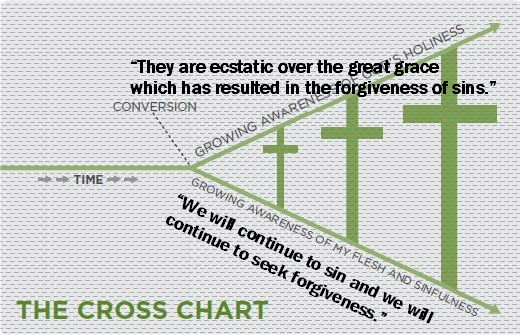
There may be a lot of different religions and even more denominations, but for all practical purposes they all have one thing in common: this whole idea that salvation is a process with a beginning and an end. This makes salvation a process that includes our present life.
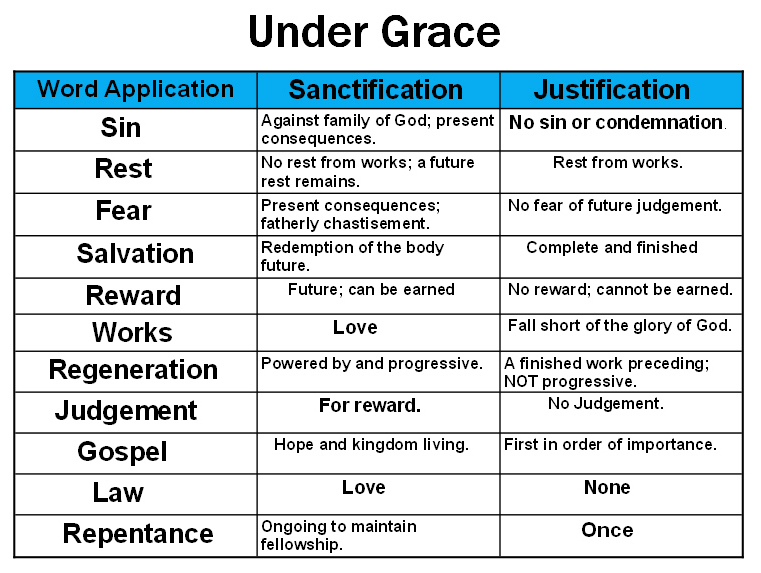
So, the argumentation between religions and denominations involves the correct way of getting from point A to point B. But there is no point A and point B. When you believe God unto salvation, you get the complete package and the salvation part of your life is finished. It is an instantaneous quickening of the Spirit that transports you from one kingdom to another, from one master to another, from being under law to being under grace, from the old person to the new person, and from darkness to light. You don’t become a servant of righteousness on the installment plan, and you don’t become a kingdom citizen on an installment plan.
How is 1John used to argue for a progressive salvation, and what is John really saying in his epistle? That’s what we are discussing tonight. If you would like to add to our lesson or ask a question, call (347) 855-8317. We will check in with Susan towards the end of the show and listen to her perspective. If you would like to comment on our subject tonight, you can also email me at paul@ttanc.com. That’s Tom, Tony, Alice, Nancy, cat, paul@ttanc.com. I have my email monitor right here and can add your thoughts to the show.
Way back at the beginning of this ministry, I had this nailed down. If salvation is a process, and eternal life as opposed to eternal punishment is at stake, the Christian life is really a minefield. The focus isn’t being the best kingdom citizen; the focus is making sure you don’t mess up your salvation. The focus is salvation, not discipleship. The focus is fear of judgement, not love.
I realize many Christians hold to OSAS, once saved always saved, but the problem is how they are led by pastors trained in seminaries deeply grounded in Protestant tradition. That tradition looks to the institutional church as the primary way of getting God’s people from point A to point B in regard to their salvation. Whether OSAS or not, they are led to do the same things week in and week out. Be here at this time or that time; stand up; sing; sit down; listen to announcements; stand up; sing; sit down; listen to the special music presentation; put your tithe in the plate; listen to the sermon (always about the gospel just in case there are lost people present, wink, wink); stand up; sing “Just As I Am” until someone walks the isle so you can stop singing “Just As I Am”; pray; be dismissed; be cordial to people and tell them how much you love them; go home, and come back next week and do it again.
Why? Because all of that ritualism “imparts grace” and enables us to “grow in grace.” It enables us to “grow up in our salvation.” After all, discipleship is the “growing part of our salvation.” We have all said it, but salvation doesn’t grow. While believing in OSAS, most parishioners are led by pastors who believe in progressive salvation/justification which was clearly the foundational premise of Protestantism with the progression being overseen by the Protestant institutional church.
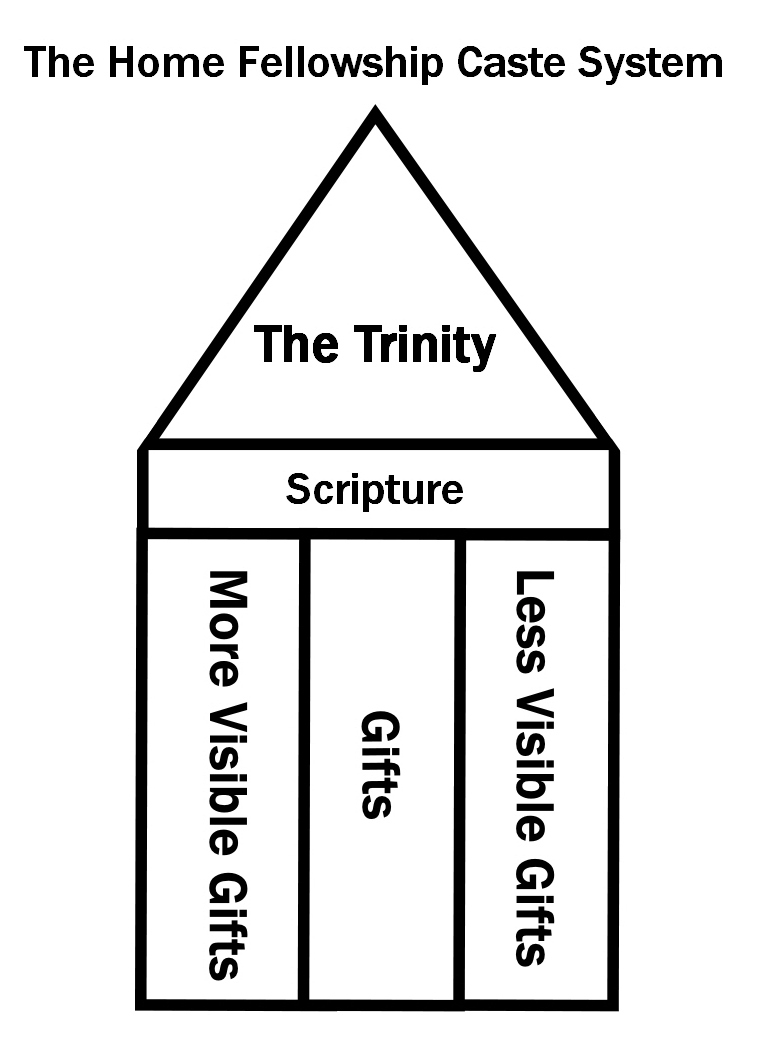
Moreover, let’s face it; while believing in OSAS, there is only one reason people put up with all of the nonsense and drama of the institutional church—OSAS means that if someone leaves the institutional church, they were never saved to begin with. Right? In other words, they function according to the idea that they are led by. It’s OSAS as long as you are “faithful” to the institution. Then each church has its own little “faithfulness” caste system. Those who show up for all of the services are the “core members” that run the church. Those “less faithful” that only come on Sunday mornings are a lower class of member in the caste system.
You have the pastors, staff and deacons, then the “faithful” that attend all of the services and tithe at least 10%, the “casual” attenders that tithe, and then the bottom of the caste strata, even lower than the serfs, the putrid “nonmembers.”
Whether Calvin or Luther, the two icons of Protestantism, these beliefs follow after the doctrine they established for the Protestant institutional church. Access to the institutional church was through water baptism, and the critical need according to the Reformers for formal church membership follows: as Christians, forgiveness for present and future sins can only be found in the institutional church, and those sins condemn us. Forgiveness for all sins does not occur at salvation, but only for past sins. Water baptism initiates us into church membership where forgiveness for present and future sins can be obtained through the sacraments; ie., “gospel preaching,” the Lord’s Table, and anything else deemed as acts of faithfulness to the institutional church not to exclude tithing by any means. Calvin states this explicitly in his institutes, 4.15.1.
All in all, you can say that in Protestantism, the status of sin does not change for the believer—it still condemns requiring perpetual resalvation for every sin committed.
Therefore, 1John 1:9 and 2:1 is interpreted in this light: “If we confess our sins, he is faithful and just to forgive us our sins and to cleanse us from all unrighteousness” (1:9). “My little children, I am writing these things to you so that you may not sin. But if anyone does sin, we have an advocate with the Father, Jesus Christ the righteous” (2:1).
These verses seem to bolster the authentic Protestant position on justification. Confession of sin in our Christian lives keeps us saved. And if we confess our sins, Jesus is up in heaven as our advocate with the Father continuing His work as a propitiation for our sins.
The problem is that this interpretation stands in stark contrast to what other Scriptures state about justification. Biblically, sin has a different classification after salvation—it can’t condemn; it can bring chastisement and present consequences, but it can’t condemn—its ability to condemn has been taken away. Hence, there is no need to have some institution that prevents future condemnation.
Nevertheless, it is easy to understand why the institutional church not only gets a pass on outrageous behavior, but the money keeps pouring in. What will people pay for their salvation and décor that glorifies the institution that saves them? Apparently, no price or compromise is too large. One can also appreciate the fear of so-called excommunication because the institutional church is the only place where one can receive continued forgiveness for present and future sins.
Before I move on, I will solidify my present point. Romans 8:1 states that there is presently NO condemnation for those who are in Christ. In Contrast, Calvin stated that “even saints cannot perform one work which, if judged on its own merits, is not deserving of condemnation” (CI 3.14.9, last sentence). Obviously, the focus is going to be avoiding condemnation, not our freedom to pursue aggressive love in discipleship.
So what are these verses in 1John really saying? Let’s begin to unpack that using the historical grammatical approach to interpretation as opposed to the traditional Protestant means of interpretation, the historical redemptive method. Since Protestantism sees salvation as a process, “redemptive” means that the Bible must be approached with a redemptive prism; ie., the Bible is about salvation. Clearly, this is eisegesis; going to the Bible with a presupposition.
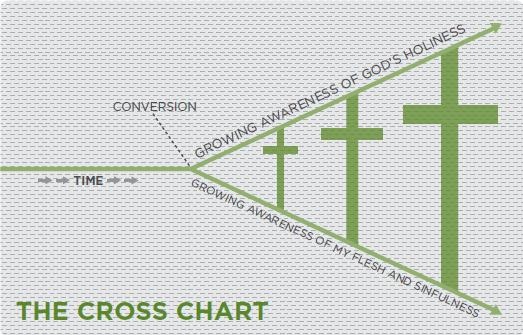
In regard to the history part, this is the belief that history is an unfolding drama about salvation. Hence, all of reality is interpreted through salvation. All of history and the Bible continually reveals the one two-fold redemptive truth/reality: the sinfulness of man and the holiness of God. Salvation begins when we see or understand this reality, and the experience of that reality increases until final salvation.
In contrast, the historical grammatical method uses historical facts to bring more meaning to the text, and all truth is determined by what can be concluded by the grammar—this is known as exegesis. All meaning and truth comes out of the text without anything being read into the text except conclusions from other texts.
In fact, Protestant tradition holds to the idea that a historical grammatical approach to the Scriptures invariably leads to works salvation. Protestant tradition insists that the Scriptures must be interpreted through the prism of total depravity. In this year’s TANC conference, this is what I am going to be hitting on. Christians, save a few, have no idea that Protestant pastors that are leading them view reality in a totally different way than most parishioners. And this is why church looks like it does. And there is no salvaging it—it’s a completely broken system.
So, if you interpret said verses in 1John redemptively, it fits right into their narrative, right? You have to continue to repent for new sins in your Christian life in order to not be condemned and to keep your salvation. A good old fashioned Baptist lady who I am sure would hold OSAS stated this to my wife Susan in the grocery store a couple weeks ago. When Susan asked her why Christians need to go forward during alter calls, she answered, “they have sin that needs to be forgiven.” Well, why can’t they get that forgiveness by praying at home? You ought to see the reaction Susan and I get when we suggest her mother was saved even though not a member of a church.
Protestantism and all of its offshoots including the Baptists is nothing more or less than functioning Calvinism. Election isn’t the point, progressive salvation is the point. Protestants think salvation grows—salvation doesn’t grow—you are either forgiven once and for all time or you aren’t. Look, if you are going to stay in the institutional church, it makes absolutely no difference where you go. Please, stop driving 15 miles to the Baptist church when there is a Catholic Church right across the street—it’s a shameful waste of gas. It’s all progressive justification.
In contrast, we have to see 1John in its exegetical historical context. It must be interpreted according to what was going on during the time that prompted this letter. And what was that?
John was pushing back against the number-one nemesis of the assemblies during that time: Gnosticism. Now, there were many, many different veins of Gnosticism during that time, but like denominationalism, there are basics that are fundamentally the same. Denominationalism quibbles about how to get from point A to point B, but it is all progressive salvation.
When you understand the basics of Gnosticism, it is easy to see that John’s first epistle is a point by point rebuttal of Gnosticism, and NOT the proffering of progressive justification. Protestants can bicker with Catholics all they want to about how to get from point A to point B, but again, it’s all progressive justification. If it’s a religious institution, it’s selling final salvation, PERIOD.
If we follow John’s arguments in this epistle, it also apes the fundamental basics of Gnosticism, and that’s what we are going to do:
1John 1:1 – That which was from the beginning, which we have heard, which we have seen with our eyes, which we have looked upon, and our hands have handled, of the Word of life; 2 (For the life was manifested, and we have seen it, and bear witness, and shew unto you that eternal life, which was with the Father, and was manifested unto us;) 3 That which we have seen and heard declare we unto you, that ye also may have fellowship with us: and truly our fellowship is with the Father, and with his Son Jesus Christ. 4 And these things write we unto you, that your joy may be full. [KJV].
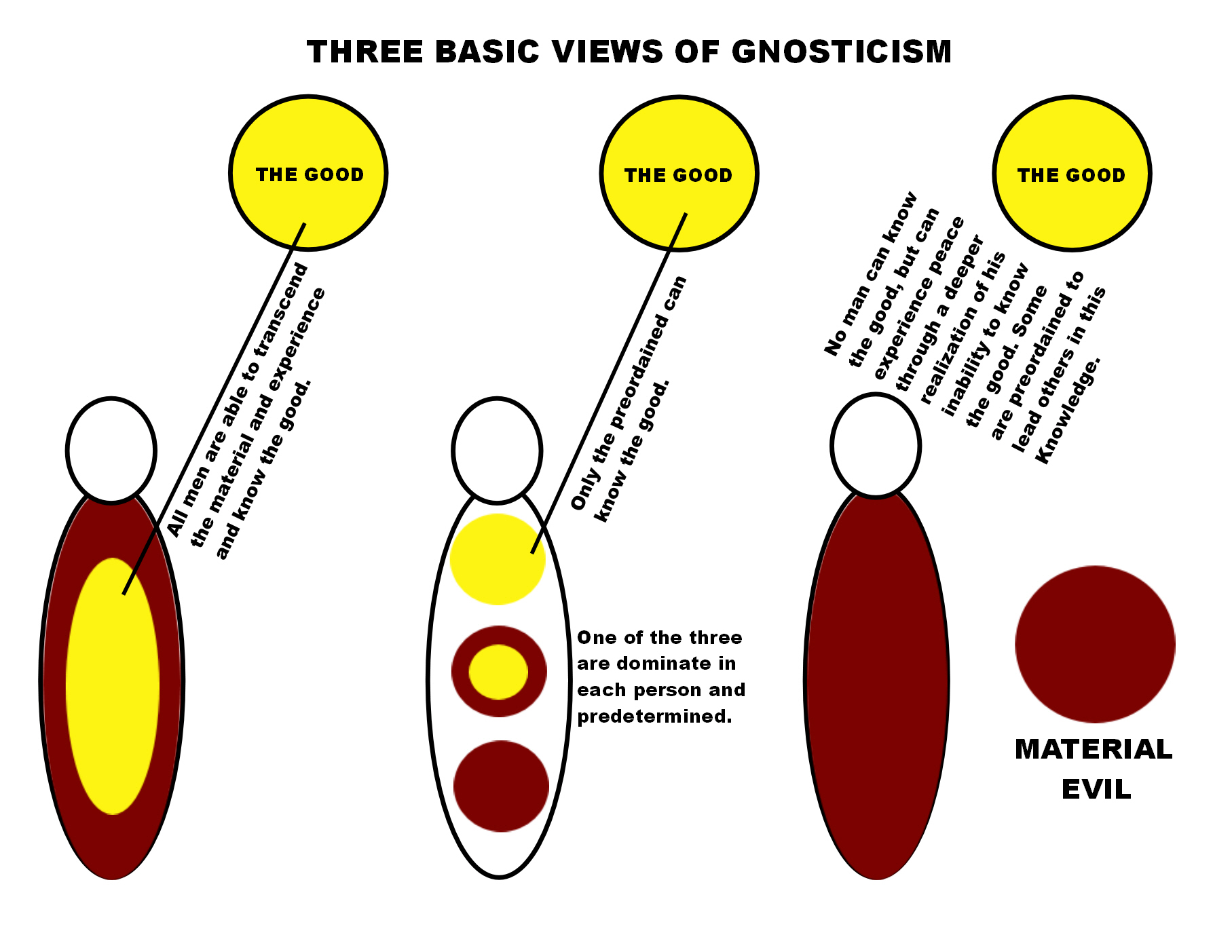
The Gnostics taught that it really wasn’t the spiritual Christ that died on the cross. Gnosticism holds to the idea that material is evil and only the invisible spiritual world is good. Gnosticism rejected the idea that the spiritual realm, or godhood can be one with the material. You must understand: the biblical concept of Godman is a direct affront to the foundation of all false religions, or the knowledge of good and evil. It is the idea that true knowledge cannot be one with the material. Knowledge is good, material is evil and is only a shadow of true knowledge. Knowledge of the material is enslaved and dependent on the five senses.
Now, stop right there. Let me simplify this for you. All false religion flows from the religion of the knowledge of good and evil presented to Eve in the garden. This is also the first sentence of the Calvin Institutes and all of the Calvin Institutes flow from the foundation of 1.1.1., first sentence, viz, ALL wisdom is the knowledge of man and the knowledge of God; man is inherently evil and God is inherently good.
Also, the first sentence of the Calvin Institutes is the primary theses of Luther’s Heidelberg Disputation which is the Magnum Opus of the Reformation. All fundamentals found in contemporary evangelicalism can be found in the Heidelberg Disputation and flow from it. Calvin’s Institutes further articulated the former. In contemporary evangelicalism, we hear constantly that true biblical knowledge is “the knowledge of our own sinfulness as set against God’s holiness.” This is also the pronounced fundamental foundation of the contemporary biblical counseling movement as constantly stated publically in no uncertain terms.
Why am I interjecting this? Because even though much of our knowledge concerning first century Gnosticism comes from the writings of the early church fathers and while they railed against Gnosticism, they themselves were also Gnostics. However, in the process of railing against Gnosticism, they confirm unequivocally that John’s letter addressed the Gnosticism of their day; it just wasn’t the Gnosticism that they preferred.
And by the way, according to some church fathers, John was addressing a Gnostic named Cerinthus who was a contemporary of John and a personal nemesis.
Cerinthus was a gnostic and to some, an early Christian, who was prominent as a heresiarch in the view of the early Church Fathers. Contrary to proto-orthodox Christianity, Cerinthus’s school followed the Jewish law, used the Gospel according to the Hebrews, denied that the Supreme God had made the physical world, and denied the divinity of Jesus. In Cerinthus’ interpretation, the Christ came to Jesus at baptism, guided him in his ministry, but left him at the crucifixion.
He taught that Jesus would establish a thousand-year reign of sensuous pleasure after the Second Coming but before the General Resurrection, a view that was declared heretical by the Council of Nicaea. Cerinthus used a version of the gospel of Matthew as scripture.
Cerinthus taught at a time when Christianity’s relation to Judaism and to Greek philosophy had not yet been clearly defined. In his association with the Jewish law and his modest assessment of Jesus, he was similar to the Ebionites and to other Jewish Christians. In defining the world’s creator as the demiurge, he emulated Platonic philosophy and anticipated the Gnostics.
Early Christian tradition describes Cerinthus as a contemporary to and opponent of John the Evangelist, who may have written the First Epistle of John and the Second Epistle of John to warn the less mature in faith and doctrine about the changes he was making to the original gospel. All that is known about Cerinthus comes from the writing of his theological opponents (Wikipedia).
At any rate, the teachings of Cerinthus follow the basic fundamentals of 1st century Gnosticism of which there were two schools of thought unchanged from the cradle of society: intuitive knowledge within versus knowledge outside of man. While both schools held to the strict dichotomy of material being evil and the invisible good, and true knowledge being beyond the five senses, they disagreed on where that knowledge is found and whether or not it is intuitive among all men, or a select few preordained by nature or some supreme being.
Cerinthus followed the philosophical school of Idealism which holds to the belief that the one cosmic mind has an intuitive connection within every individual. Finding that knowledge is often a complex mind-numbing epistemology, but curiously, Luther and Calvin had their own angle that built on the Neo-Platonic teachings of St. Augustine.
This Gnostic bent actually allowed for Christ to be human, or at least some form of humanity. Apparently, God became exasperated with man’s penchant for trying to gain knowledge through the material world, and said in essence, “Ok, since you like to think you can know something and try to gain knowledge through the things that are seen, I am going to send my Son to die on the physical cross, and now all knowledge will only be gained through suffering—there mankind, take that!” This is the essence of the Heidelberg Disputation which is a philosophical treatise, not a theological one by any stretch of the imagination. Luther states plainly in the document that ALL knowledge is hidden in the suffering of the cross. Anyone who thinks they can understand Protestantism without a good grasp of world philosophy is sadly misguided. It is one of the historical necessities of historical grammatical hermeneutics.
Hence, in the Gnostic Protestant construct, Christ and His gospel is the only true objective knowledge and is outside of man. Man is not to seek any knowledge within himself, but all knowledge must be sought outside of him in contemplation of the gospel. All of reality is interpreted by the suffering of the cross. The cross is the epistemology from the material to the invisible, or from the evil to the good.
In contrast, other schools believe the epistemology is intuitive within all men because all men have a spiritual being separate from their material being, and the spiritual part of man is nonmaterial and therefore SINLESS. The material body of man is evil because it is material, but his invisible being is good and has a connection to the cosmic spiritual world that must be cultivated by transcending the material. This was key to the drug culture of the 60’s as LSD trips enabled the individual to transcend the five senses and see into the invisible spiritual world. Supposedly.
Other schools of thought believed that even though all men have a material and spiritual aspect, the spiritual anthropology has classifications in regard to who is able to see true knowledge and who isn’t as determined by the cosmos or cosmic mind; ie., determinism. And consequently, if utopia is to ever be achieved, those with the ability to see knowledge must rule over those who have the inability to transcend the material and are enslaved to it. How do you reason with people hopelessly enslaved to the material? They either understand that they can’t know reality and get with the program, or you kill them.
According to the Reformers, utopia is achieved by understanding that all reality is interpreted through the cross of redemption. This concept was established by Luther’s Heidelberg Disputation and is known as being a “theologian of the cross.” Theologians of the cross are able to know the “cross story,” or interpret reality through the cross, and all others are enslaved to the “glory story” or the story of man. This is the dichotomy of the knowledge of good and evil, or material versus spiritual.
Furthermore, the Reformers believed that the new birth entailed the gift of outward seeing only. All goodness remains outside of man. This is the pious distinction they claim over their fellow Gnostics. Unlike Cerinthus, who would be the modern equivalence of existentialism, no good can be in man, because that does not limit knowledge to suffering and the cross. Even though the early church fathers believed that material is evil and only the invisible is good like all ancient Gnostics, they labeled those heretics who believed that the invisible spirit within man was a connection to the good. That was heresy in their minds. And if you really understand what John Piper et al believe in our day, NOTHING HAS CHANGED.
The true Christians of that day had a different metaphysical take: the material realm is NOT evil, it’s weak. Something that is weak can still be good. The born again Christian struggles with sin because he/she is weak, not because the material realm is inherently evil. Christ really did come adorned in humanity in every since of the meaning because the material is not evil. This understanding of being fits together with the true gospel.
But what Cerinthus et al was teaching speaks directly to what John wrote in his first epistle, and we have addressed some of it in John’s introduction. John, in essence, said the following: Christ was 100% humanity and 100% God. We saw Him, we heard Him, we touched Him, we saw Him die on the cross, there isn’t two Christs, there is only one.
What Cerinthus et al taught explains everything John wrote in this epistle and why he wrote it. It not only explains why John wrote what he wrote in 1:9 and 2:1, it sheds light on why John wrote what he wrote in the rest of the book as well.
And that is what we will look at next week. We will do a point by point fly over of 1John while interpreting it according to this historical context of Gnosticism. John will address the definition of sin in contrast, the definition of knowledge and truth in contrast, the definition of the true gospel in context, the definition of love and hate in contrast, and the definition of the new birth in contrast.
See you next week.



What is the Race of Faith? Justification or Sanctification? Or Both? A Biblical Evaluation: Introduction
“Do you not know that in a race all the runners run, but only one receives the prize? So run that you may obtain it.”
~1Corinthians 9:24
One can focus on all of the white noise of denominationalism, but most either proclaim or unwittingly function according to the idea that salvation is a process instead of an instantaneous and complete transformation. In fact, any example to the contrary is nowhere to be found among religious institutions. The institutional church, or simply “Church,” is founded on the idea that salvation is a process; it has a beginning and an end.
If salvation is a process with a beginning and an end, the Christian life must be treated as a salvation process. Hence, you are saved by salvation, you continue to be saved by salvation, and there is a final salvation. Therefore, the Christian life isn’t so much about holy living, but salvation. Who will deny the salvation centrality of the church since the Reformation? “Make[ing] disciples” (Matt 28:19) is understood as learning more and more about salvation, not Christian living. After all, salvation is still in process. We hear it constantly: “Sanctification is the growing part of salvation.” Does salvation grow?
If a different direction is to be taken in order to please the Holy Spirit resulting in His unleashing of heavenly power, it must be started outside of the church because the church is not going to give up on a 500-year tradition. Said another way: the church is not going to admit it has been wrong for 500 years. If the case is made here, nothing can be done about it within the church.
The theses of this series is fairly basic: salvation is a gift, but there are rewards for Christian living. A gift is not a reward because a reward is earned. Because the focus of the church (this includes all stripes of Catholicism and Protestantism) has been salvation, and salvation is a process, the race of faith is the process. God began the process, and we are involved in the process which is a race ending in the reward of final salvation.
Be sure of this: ALL church denominations represent differing beliefs on the proper way to run the race and thereby receive the reward of salvation. And granted, there are many Scripture texts that seem to say just that, but it is the contention of this series that those texts seem to say that due to the church’s narrow salvation-centered approach to the Bible. The aversion to a studied theology among the laity is therefore prevalent. It is a tradition and way of life. No person should become incredulous at the suggestion that theology is even disdained among the laity. Reason is nothing more than demonic musings, and blind faith pure as the wind-driven snow.
But what are the consequences? Is there danger in seeing salvation as a reward? Or is the danger in the freedom of once saved always saved (OSAS)? Is there some kind of guardrail that keeps Christians from wanton libertinism that is both gift and reward, or is the confusion due to the omittance of theological training among the church’s laity?
This series will approach these questions from the viewpoint of Scriptures that call for perseverance. These same texts are used by many to make the case for perseverance in salvation for the purpose of receiving the reward of final salvation.
One such biblical text is 1John 1:7-9. That is where we will start in part one.
Once Justified, Perfectly Justified – For Those Who Claim a Believer Can Lose His Salvation or Become Unjustified
From Alex A. Guggenheim of The Pedestrian Christian:
Introduction
I often wonder if those who assert a believer in Christ as Savior – someone who has been justified– take the time to examine exactly what they are claiming with regard to all we receive in our salvation. Many of the dismissals in adjudicating that we can lose our salvation are absent of the due diligence inherently necessary for such arguments pertaining to how all which is consummated the moment we believe and are saved, is terminated when we, somehow, have our eternal life vanquished, only to be rehabilitated when one returns to salvation, possibly many times (some say this is accomplished through repentance and absolution and others through getting “saved again” or re-believing and so on, there is a myriad of theological formulas for the reconstitution of one’s salvation out there). Read more

 Paul's Passing Thoughts
leave a comment