Does the Law Really Lead People to Christ by Revealing Sin?
Originally posted on Paul’s Passing Thoughts:
The insanely celebrated return to our Reformed roots teaches the following about the law:
We are unable to keep the law perfectly. And since a perfect keeping of the law is the standard for righteousness required to live with God forever, our inability to keep the law perfectly leads us to Christ who must keep/fulfill it for us. As Christians, we continue to use the law in this way to “preach the gospel to ourselves.” The more we use the law to show our innate sinfulness, the more we experience “vivification” (a joyful, perpetual rebirth).
The bogus idea that perfect law-keeping is justification’s standard aside, the most popular text that supposedly supports this idea is Galatians 3:24 –
So then, the law was our guardian until Christ came, in order that we might be justified by faith.
The Calvinist Grand Quandary
 “At any rate, the very attempt by Calvinists to evangelize places them in a twofold grand quandary that requires the abandonment of rudimentary logic.”
“But in contrast, if God’s choice over our choice is the crux of the gospel, that crux must be explained in order for the presentation itself to be a true gospel.”
At the 2008 T4G conference, John MacArthur Jr. officially came out of the closet as a bonafide New Calvinist. He did this because he was convinced by John Piper and others that New Calvinism is Old Calvinism. MacArthur signed up because it’s true, and he was unwilling to reject Reformation tradition. Apparently, only other-than Anglo Saxon can be deceived en masse.
MacArthur’s keynote address was titled, The Sinner Neither Able Nor Willing: The Doctrine of Absolute Inability. MacArthur was converted from his Lordship Salvation escapades of the late 80’s by the New Calvinist camp. According to a pastor I knew at the time, Michael Horton and others challenged MacArthur to rethink the controversy he had started. The result is MacArthur still affirming Lordship, but as a manifestation rather than actions of new creaturehood. I recently completed a series explaining all of the confused controversy in regard to the Lordship Salvation issue.
At any rate, the very attempt by Calvinists to evangelize places them in a twofold grand quandary that requires the abandonment of rudimentary logic.
I have written before about the Gospel of Sovereignty. Any ability at all on the part of mankind is a slight against God’s sovereignty. This is the hypothesis of MacArthur’s aforementioned messages. Hence, the “good news” is man’s “absolute” inability and God’s sovereignty. MacArthur’s primary text was John 3:1-8…
Now there was a man of the Pharisees named Nicodemus, a ruler of the Jews. 2 This man came to Jesus by night and said to him, “Rabbi, we know that you are a teacher come from God, for no one can do these signs that you do unless God is with him.” 3 Jesus answered him, “Truly, truly, I say to you, unless one is born again he cannot see the kingdom of God.” 4 Nicodemus said to him, “How can a man be born when he is old? Can he enter a second time into his mother’s womb and be born?” 5 Jesus answered, “Truly, truly, I say to you, unless one is born of water and the Spirit, he cannot enter the kingdom of God. 6 That which is born of the flesh is flesh, and that which is born of the Spirit is spirit. 7 Do not marvel that I said to you, ‘You must be born again.’ 8 The wind blows where it wishes, and you hear its sound, but you do not know where it comes from or where it goes. So it is with everyone who is born of the Spirit.”
MacArthur stated during his messages that when the gospel is presented we must make it clear that people can only do one thing in response to the gospel: ask for salvation, and then wait to see if the wind blows or not. So, it is not a decision, often maligned in Reformed circles as “decisionism,” or a choice. Either suggests ability on the part of the individual to make a decision for God or to choose God; ability and God’s sovereignty are mutually exclusive. If man can choose, or make a decision, God ceases to be God.
This qualifies a fair challenge to all Calvinists: “Do you make it absolutely clear in your gospel presentation that people have no ability to choose God?” If they do not do this, if this is not qualified, they are presenting a false gospel by their own definition. Why? The truthfulness of their gospel must be verified by the certainty that the individual does not assume they have a choice or can make a decision.
Most Calvinists get around this by replying that people are being called on to believe only, not make a decision or a choice. However, it also stands to reason that belief itself is a choice. When we are presented with a proposition, we DECIDE to believe it or not believe it. In all fairness, according to their own definitions, Calvinists must make this distinction clear in their gospel presentation. Let’s face it; few do if they evangelize at all. In fact, when Calvinists are cornered with this question, they immediately start acting like a toddler who needs to use the bathroom. Basically, they know that the lack of this distinction in their actual gospel presentation is telling. Their presentation is supposedly purified by the absence of information.
On another wise, Calvinists are also admitting that they are asking for a mere mental assent to acknowledging that God saves people. The Bible states that part and parcel with belief is the acceptance that God exists and is a rewarder of those who seek Him. Obviously, among the unbelieving, there are those who reject the existence of God altogether, and those who believe in His existence, but don’t want anything to do with Him. Is the wind only blowing halfway in those cases? Are there three different wind advisories? None, moderate, and gale force? Furthermore, if people have no ability to choose, is a decision to choose Buddha over Allah made for them? The logic seems to be that man can indeed choose, but will only choose other gods unless God intervenes—if they understand that they have no ability to choose.
If we give this whole construct merit to this point, we further find that the definition of faith must be a mere mental accent to the facts of the gospel with an intentional non-response; any response must be from the blowing wind. MacArthur stated in the same messages that we know Nicodemus was saved because “the wind blew” referring to his righteous actions.
Hence, if the Calvinist gospel is not false by their own definition, it must be presented as follows:
“God saves people, and you may be one of them and you may not be one of them, but if you are able to choose, God is not sovereign, and you are trusting in your own ability to choose.”
Unwittingly, some Calvinists say it is alright if people initially think they are able to choose, but later understand that it wasn’t their choice. So, it is alright if they initially trust in their decision in order to receive the gift of salvation from God, but later realize this was not the case at all. So at what point were they really saved? And would not sooner be better than later? Why not tell them from the get-go? This implies a cult-like procedure that misrepresents the truth, and then slowly indoctrinates the individual to a just standing. Others suggest that the evangelist should never state that it is their decision, but rather cite Scriptures that imply such—that way, apparently, it is the Holy Spirit lying instead of you. But nevertheless, what the individual believes about choice is uncertain unless clarified.
In the final analysis, everyone but the recipient of the gospel knows they have no real choice, but thinking they have a choice might be necessary to get them into the kingdom. But in contrast, if God’s choice over our choice is the crux of the gospel, that crux must be explained in order for the presentation itself to be a true gospel.
Add to this the definition of “believe” in the Bible. In the Bible, “believe” is never defined as a mere mental assent to the facts of the gospel; it also involves a commitment to kingdom living. More than not, it was the “gospel of the kingdom” that was preached by Christ and the apostles. As I explained in the Lordship series, it is impossible for the execution of the commitment to save you because justification and sanctification are completely separate. But clearly, a response to the gospel must include a decision to leave life A for life B. The follow-through doesn’t save you, the decision saves you. Because of the weakness of the flesh, love for God’s ways will vary in application, but you are not only choosing a savior; He is also Lord.
Consequently, Calvinists insist that repentance be left out of the gospel presentation for this reason—it calls on the individual to choose a different way. In the book of Acts, Christianity is referred to as “The Way” in several places. This is more information that must be excluded from the Calvinist gospel in order to make it true by their own definition. Therefore, in order for their gospel to be truthfully presented by their own definition…
“God saves people. If He saved you, you will live differently. The wind will blow, but it’s not your choice, do you believe this? And by the way, don’t change your life to prove to yourself God saved you, that’s fruit stapling. If you believe, that’s great, but now you must wait to see if the wind blows. The Christian life is a Sabbath rest.”
Anything less than this in a Calvinist gospel presentation is a false gospel by their own definition.
And let us not forget, in Calvinist post salvation status, the wind keeps on blowing, or not. It is undeniable that Calvin himself believed in three classes of people: the non-elect, the called, and those who persevere. Said another way: no wind at all, those who are temporarily enlightened (the wind stops), and the ones who get a steady wind to the end.
There is only one way Calvinism can be feasible; logic must be completely divorced from the Bible.
paul
John Piper Continuationism, and Preaching the Gospel to Yourself
One of the more valuable lessons taught to us here at TANC was during our first conference in 2012. John Immel demonstrated historically and philosophically that people always believe what they believe and do what they do for a reason, and that reason is logic—logic drives behavior. Find the logic—find the reason for the behavior, or belief.
At the time, I was in good graces with Old Calvinists because I had published The Truth About New Calvinism: Volume One, exposing the dastardly evils of the Neo-Calvinist movement which was supposedly an aberration of Reformed soteriology. They threatened to boycott the conference because Immel hadn’t been vetted by them. At the time, the decision to tell them to hang it on their beaks was based on principle alone while unaware I was trading orthodoxy for knowledge that really gets down to why church looks like it does in our day.
So, why do bosom buddies John MacArthur and John Piper differ on Cessationism (first century miracles ceased after they served their purpose)? MacArthur is very inconsistent because he started out as a grammarian interpreter of the Scriptures. Later, circa 1994, John Piper et al convinced him that New Calvinism was authentic Reformed soteriology, and I don’t think MacArthur was willing to reject the Protestant narrative wholesale. If you understand how the Reformers interpreted reality, you understand how taking the Scriptures at face value is going to cause the mass confusion that we see today.
Hence, one example among many: MacArthur’s dispensationalism is going to drive many New Calvinists nuts because one of the pillars of Platonism follows; truth is immutable. Regardless of what the Bible plainly states literally, viz, that God has used different economies to bring about His will, the Reformers insisted that the Bible had to be reconciled to the great thinkers of old. That would be Plato and company. This is by no means ambiguous history. MacArthur’s unwillingness to reject Protestant tradition makes him what he is: one of the most confused pastors to occupy the pulpit in our day. He can be defined as one who interprets reality using two contrary epistemologies: grammatical and redemptive. This is indicative of most Protestant pastors who must try to interpret truth with two contrary epistemologies in order to hang on to Protestant tradition. This is the very reason for the confused mess that we see in the institutional church. For this reason, the institutional church is intellectually bankrupt.
This ministry is benefiting greatly from information sent to us. A reader sent me a video of John Piper being interviewed at a conference in London. In regard to how Piper answered a question, the reader wanted to know if his answer was related to the whole, We must preach the gospel to ourselves every day. Answer: yes. And, I believe I have learned something new in regard to Piper being a Continuationist. In his answer, Piper put together Galatians 3:2 and 3:5 to make the case that we are sanctified by the same gospel that saved us. Because the Christian life is supposedly powered by the finished work of justification, Christians must return to the gospel daily in order to be sanctified.
However, take serious note: to the Reformed crowd who know what they are talking about, this isn’t semantics about the best way to be sanctified, this is stating that we must keep ourselves saved by faith alone in Christian living. If we “move on to something else” other than the same gospel that saved us, we “lose both” justification and sanctification. Get this into your head: they make epistemology a salvific matter. Many Calvinists like Paul David Tripp have stated that a literal interpretation of Scripture is equal to works salvation.
In the Conference Q and A, Piper notes verse 2…
Let me ask you only this: Did you receive the Spirit by works of the law or by hearing with faith? 3 Are you so foolish? Having begun by the Spirit, are you now being perfected by the flesh?
Then he connects it to verse 5…
Does he who supplies the Spirit to you and works miracles among you do so by works of the law, or by hearing with faith—
Piper uses the adjoining of these two verses to make the case that the Holy Spirit only continues to work in our lives after salvation via the same way we were saved (by faith alone). In other words, Piper makes this verse an issue of sanctification, and not the context: justification. But, to make this point, he must concede that miracles are also a continuing part of His works when people live by faith alone in their Christian lives. This is a good indication of why he is a Continuationist.
It also bolsters the Reformed view of obedience as realm manifestation. Obviously, miracles result when God manipulates the laws of normality; in the same way, the works of Christ can be imputed to us without us actually doing the work. It’s just a lesser miracle. Christians are to live by faith alone and assume that any good works we do are wrought by the Holy Spirit and not us. Martin Luther was very specific about this in the Heidelberg Disputation. For the Christian to think himself able to do a good work is a “mortal sin.” The Christian life is to be lived by experiencing justification subjectively. As long as we “attend good works with fear” of accreditation, our good works are only “venial” and perpetually covered by Christ’s death. This is the Reformed formula for living our lives by faith alone. This is nothing new, and is the exact same thing that James railed against in his epistle to the 12 dispersed tribes.
Paul was making the point that justification is completely out of the control of those who choose to believe. Man didn’t seek out God and collaborate with Him on reconciliation. Man didn’t call for peace negotiations. God pursues man, corners him, and presents the plan and the terms. If man accepts, the Holy Spirit quickens him or her. Even when man believes and accepts the terms, he/she cannot rebirth themselves any more than they can wrought miracles on their own like the Holy Spirit does—they can only believe.
That was Paul’s point; justification is completely apart from the law of sin and death. The Galatians were being taught that keeping a dumbed down version of the law of sin and death kept them saved. Paul said NO, if you want to justify yourself by keeping the law of sin and death, you must keep all of the law perfectly. He added that circumcision did not matter (justification by keeping the ritualistic parts of the law), but only faith working through love (obedience to the law of the Spirit of life).
paul
Stop Saying That Jesus’ Righteousness Is Imputed to US Because it’s NOT True
 Christians ought to speak the truth and not throw around spiritual bumper stickers that are not true. Jesus’ righteousness is not imputed to us. Actually, the statement is a false gospel.
First, it’s Calvinism. Are you a Calvinist? If not, just stop saying that Jesus’ righteousness is imputed to us. It was God the Father’s righteousness that is imputed to us, not Christ’s. Does it really make that much difference? Yes, it makes a huge difference.
For the very much most part, the Bible attributes our righteousness to God the Father, a few verses could be cited to imply Jesus’ righteousness is imputed to us, but the arguments are weak. Nevertheless, why are we not emphasizing what the Bible clearly emphasizes and instead emphasizing the righteousness of Christ being imputed to us?
The reason is because the contrary emphasis is tied to the false gospel of Protestantism which hinges its gospel on the idea that Christ came to fulfill the law rather than end it. Fulfillment verses ending is the difference between a true gospel and a false gospel.
So, fulfillment posits the idea that Christ not only came to die for our sins, but also had to live a perfect life so His perfect obedience to the law could be imputed to us as well. This turns the true gospel completely upside down and rejects the new birth. The power of sin is death and condemnation, and any violation of the law is sin—that’s why Christ came to end that law, not fulfill it. There is no life in that law even if Christ did fulfill it, and if He did fulfill it for our justification, there is not one seed, but two. Christ came to end that law, there is therefore no condemnation for us and the power of death is broken.
I say “that” law, and not “the” law because there are two laws. John Calvin and his heretic buddies only recognized one law, and that is a huge problem. Yes, it is one law as far as the same words, but with two different relationships to life and death. For the unbeliever, it is “the law of sin and death,” for the believer, it is “the law of the Spirit of life.” When the Bible talks about fulfillment of the law, it is talking about the fulfillment of the law of the Spirit of life “through us” (Rom 8:4).
Also keep in mind that the law couldn’t be completely fulfilled to begin with because of future unfulfilled prophecy. Not only that, when Christ said He came to fulfill the law, the New Testament had not even been written, and most of it, actually all of it, was written after His ascension. Keep in mind that there is unfulfilled Bible prophecy in the Old Testament as well.
Here is where we get into a huge problem: the idea that there is one law and the atonement is two-fold; His death for sin, and obedience to the law by Christ because the one law of sin and death is the standard for righteousness. Think about this, if there is one law, the law of sin and death, and it is the standard of righteousness, then the perfect demands of that law must continue to be satisfied in order to keep us saved. That’s the crux of Protestant heresy—a one law that must be perpetually satisfied in order to keep us saved.
But when we believe, we are no longer under that law because it is ended for us. We are no longer “under law,” but “under grace.” That means that we are now under the law of the Spirit of life. When we sin, we cannot be condemned, but unfortunately, we grieve the Holy Spirt who has sealed us until the day that our bodies are redeemed.
This is where it is necessary for the Reformed heretics to say that Jesus’ righteousness (obedience) is perpetually applied to the law of sin and death in our stead. That law is not ended, it must be perpetually satisfied for us. This is what those heretics are talking about when they verbalize the truism, “Jesus 100% for us.” This keeps “Christians” under law and not under grace in regard to justification. Sanctification fulfills the law of the Spirit of life and is completely separate from Justification. This is why Protestantism calls for a sanctification by faith alone; if we live by faith alone in sanctification, the same way we were justified (“We must preach the gospel to ourselves every day”), the perfect obedience of Jesus will continue to satisfy the law of sin and death in our stead.
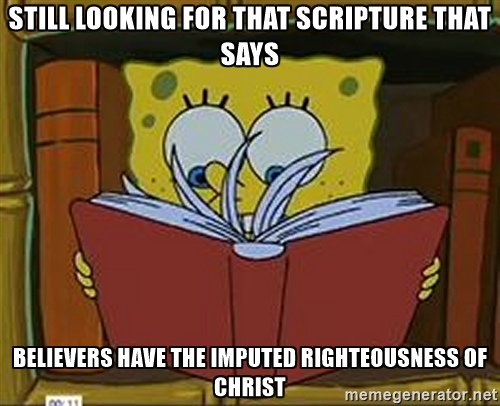 The contra Reformation gospel frees the Christian to aggressively obey God in sanctification because the only possible motivation is love because the other law is ended and has nothing to do with our justification. That is a finished work that has nothing to do with our Christian life. We are free to aggressively love without fear instead of being afraid that we are not properly living by faith alone which supposedly circumvents the satisfaction of the law via Jesus.
Learn to interpret your Bible accordingly: “Is this a justification verse, or a sanctification verse, and which law is being addressed?”
paul
Does the Law Really Lead People to Christ by Revealing Sin Only?
 The insanely celebrated return to our Reformed roots teaches the following about the law:
We are unable to keep the law perfectly. And since a perfect keeping of the law is the standard for righteousness required to live with God forever, our inability to keep the law perfectly leads us to Christ who must keep/fulfill it for us. As Christians, we continue to use the law in this way to “preach the gospel to ourselves.” The more we use the law to show our innate sinfulness, the more we experience “vivification” (a joyful, perpetual rebirth).
The bogus idea that perfect law-keeping is justification’s standard aside, the most popular text that supposedly supports this idea is Galatians 3:24 –
So then, the law was our guardian until Christ came, in order that we might be justified by faith.
To make that verse work, “guardian” (paidagōgos) is often translated as “tutor.” That’s a stretch. The word is better translated “protector”:
Among the Greeks and the Romans the name was applied to trustworthy slaves who were charged with the duty of supervising the life and morals of boys belonging to the better class. The boys were not allowed so much as to step out of the house without them before arriving at the age of manhood (Strong’s Dictionary).
Furthermore, the Reformed gospel teaches that the law is used by the Christian for this same purpose in our Christian walk—to continually lead us closer and closer to Christ by showing forth sin. This blatantly contradicts the context of the passage:
Galatians 3:25 – But now that faith has come, we are no longer [added] under a guardian,
Reformed doctrine clearly teaches that Christians are still under the law’s purpose to show us a deeper and deeper need for Christ and His grace as we see our own sinfulness in a deeper and deeper way. In other words, for Christians, God’s word still has a redemptive purpose. This is the basis for Historic Redemptive hermeneutics. However, even in regard to the lost, the showing forth of sin is only one purpose for the law, but far from being the only one.
Primarily, the law shows forth life. This is by far the primary theme of law throughout the Scriptures. The law shows forth the wisdom of God, and the wellbeing (blessings) of those who follow it. The law is also framed in the context of promise much more than it is judgment.
This gets into the major crux of the Reformed false gospel; the fusion of justification and sanctification concepts. The blessings of law-keeping can be experienced by unbelievers and believers alike, but such cannot obtain eternal life. The point is that the law shows forth life as much as it does death. It shows both. Again, this is a constant theme throughout the Scriptures. Who will deny that unbelievers will have a higher quality of life to the degree that they follow God’s law? No, it can’t gain salvation for them, but the law brings horizontal blessings by virtue of its wisdom.
Point in case:
1Peter 3:1 – Likewise, wives, be subject to your own husbands, so that even if some do not obey the word, they may be won without a word by the conduct of their wives, 2 when they see your respectful and pure conduct.
In this passage, the husband is not won over by the wife demonstrating how sinful we are and our subsequent need for Christ; she is showing forth the blessings of being a believer. These are blessings that he is also experiencing because the home is sanctified by her presence:
1Corinthians 7:14 – For the unbelieving husband is made holy because of his wife, and the unbelieving wife is made holy because of her husband. Otherwise your children would be unclean, but as it is, they are holy. 15 But if the unbelieving partner separates, let it be so. In such cases the brother or sister is not enslaved. God has called you to peace. 16 For how do you know, wife, whether you will save your husband? Or how do you know, husband, whether you will save your wife?
So, there is a sense in which the unbelieving spouse is blessed by the believing one. The law not only shows forth sin, but also shows forth life. The latter is the way the law leads people to Christ just as much as the former.
paul

 Paul's Passing Thoughts
3 comments