No, I Did Not Sin!
“Did you sin today?”
We hear this one a lot. What do you say to that?
As a believer, this is what I say:
“No, actually I didn’t!”
Not only does it really torque them off, but it is a metaphysical truth! As far as my justification is concerned, not only did I not sin, but I CANNOT sin! My justification made my old man dead to the law, and there is now no law to condemn me. That was John’s point in 1 John 3:9,
“Whosoever is born of God DOTH NOT COMMIT SIN; for his seed remaineth in him: and he CANNOT sin, because he is born of God.”
Once we are on the other side of justification, any “sin” we may commit is really just a failure to show love. It is failing to use the law to show love to God and others. This DOES NOT CONDEMN (Romans 8:1), but it does welcome God’s chastisement as a father would correct an erring child.
But this is what happens when the religious establishment fails to make that distinction: EVERY sin becomes a condemning sin requiring some perpetual reapplication of Jesus’ “atonement” and obedience to the law (progressive justification). Is there any wonder then why “Christians” live in constant fear of not having assurance of salvation?!
Andy
Fulfilling the Law
Does Jesus continuously fulfill the righteous requirements of the law on our behalf?
NO! That is protestant orthodoxy.
So how is the law fulfilled?
“That the righteousness of the law might be fulfilled in US, who walk not after the flesh, but after the Spirit.” ~ Romans 8:4
How is the righteousness of the law fulfilled in believers?
“Owe no man any thing, but to love one another: for he that loveth another hath fulfilled the law.” ~ Romans 13:8
“For all the law is fulfilled in one word, even in this; Thou shalt love thy neighbour as thyself.” ~ Galatians 5:14
We fulfill the law when we show love to God and to others!
“Jesus said unto him, Thou shalt love the Lord thy God with all thy heart, and with all thy soul, and with all thy mind. This is the first and great commandment. And the second is like unto it, Thou shalt love thy neighbour as thyself. On these two commandments hang all the law and the prophets.” ~ Matthew 22:37-40
This is possible for believers because the law’s condemnation has been ended!
“There is therefore now no condemnation to them which are in Christ Jesus, who walk not after the flesh, but after the Spirit. For the law of the Spirit of life in Christ Jesus hath made me free from the law of sin and death.” ~ Romans 8:1-2
My Reply to Linda: Yes, I Am a Christian, But Not Sure You Are
 I am presently in the process of eliminating my personal Face Book account. A ministry account will be maintained for the TANC blog, Paul’s Passing Thoughts .com, and overseen by Pearl the PPT moderator. I recommend people befriend that account if they want to stay connected to our ministry.
The reason is simple: I no longer have patience for the evangelical regurgitation of orthodox talking points. Protestants don’t own their own faith that they have seen in the Bible with their own study. What they think they see and understand is what Protestant academics have told them, including the idea that they have authority to tell them what to believe. So, what is wrong with church? Church is wrong with church because it is predicated on a false gospel. That’s right, the Protestant Reformation was a false reformation founded on a false gospel. And this is why Dr. James White and others have refused to debate me publicly; the Protestant gospel as stated in its orthodoxy is the biblical definition of a lost person…under law as opposed to under grace.
Martin Luther and John Calvin et al proffered a gospel that is under law, but that is supposedly OK because Jesus keeps/kept the law for us and that obedience is imputed to our Christian status. This is a perpetual covering of sin, or sometimes referred to as “atonement,” but not an ENDING of sin that requires no further justification. Hence, we must “preach the gospel to ourselves every day” to “keep ourselves in the love of God” (CJ Mahaney) etc. White and others know that this is a simple matter of theological math, and do not intend to address it until enough people catch on. The only case they can make presently is for a historical-redemptive interpretation of Scripture that interprets every verse as a justification verse. Sanctification is defined as progressive justification via Protestant talking points.
So, while in the process of eliminating my personal Face Book account, I noticed a comment to me by a “Linda.” It follows:
“Are you a Christian Paul? And secondly do you believe that the Bible is the inspired Word of God? That would be my two questions for you. Romans says, ‘There is none righteous, no not one.’ That includes you and me. This doesn’t mean that we never do a kind act or good deed. It means that we don’t and can’t do enough of them to be declared ‘RIGHTEOUS’ by God. We could never do enough good deeds and kind acts to get us into heaven. Therefore we need the righteousness of Christ imputed unto us in order to go to heaven. God imputes this kind of righteousness to those who believe and accept HIS son Jesus and his shed blood as atonement for their sins and their UNrighteousness. We are part of God’s family by adoption. Nothing can make us righteous enough to go to heaven. The righteousness that is applied to our never dying soul can only come from Christ. The ‘part and parcel’ of our own being is puny compared with what God demands. In one place in scripture our puny ‘part and parcel’ is described as ‘filthy rags.’ So our own human effort at righteousness is from our flesh. Our flesh is not saved from sin and unrighteousness. Only our soul is. We are not capable of learning and loving enough to be declared righteous enough for heaven. We could learn and love enough to help another person with a kind act or good deed. But that does not fit our soul for heaven. I don’t understand your third question……’Christ imputing sin’ ????”
Her comment was in reply to previous comments made in regard to a post. She was replying to a comment I made regarding her initial comment. Her initial comment follows, and afterward my reply:
“I am a never dying soul whom Christ died and rose for, approved of by God because I have HIS righteousness. Just by learning and loving we are different. Better means ‘improved in some way.’ Not hard questions for me.”
“Linda, where does the Bible say you have the righteousness of Christ? That’s the first question. The second: Are we only approved of God because we ONLY have the righteousness of Christ and none of our own? What about the new birth? If we are literally born of God and now part of His lineage, would that not make us righteous? Do you mean to say that we have a righteousness LIKE Christ’s because we are a member of the same family, or ONLY His righteousness and none that is part and parcel with our own being? Are we truly righteous, or only declared righteous? Third question: was Christ’s role in salvation an imputation of sin AND righteousness, or just sin? On the one hand, you seem to state that we only have the righteousness of Christ, but on the other, you say we learn and love. How exactly do we learn and love if we ourselves are not righteous people? So, I am not trying to be a jerk here, I am simply resolute that Christians should have a clear definition of who they are. Yes, I know exactly what the Reformers believed about our identity, but I would like to see your clarification.”
This is the extreme Protestant cognitive dissonance resulting in the train wreck we call “church” that I no longer have patience for. People who are serious about following Christ need to take their true gospel and leave the institutional church for home fellowship networks. The institutional church is part and parcel with the authority that demands a denial of the obvious. Authority has replaced truth. Nevertheless, I do believe evangelicals will have to eventually address their under law gospel.
I will make this as simple as possible as I am weary of addressing it. Much, much, thanks to Andy Young who is helping to carry the water on this as well. Linda’s response is pretty much the Protestant gospel talking points that we hear often, and pregnant with cognitive dissonance. All in all, her answers to my questions are, “NO.” Please start by noting that. This is where we discuss another disservice the Reformers performed: adding chapters and verses to the Bible. This circumvents the need to read all of Scripture in context. You can form a theological argument by using John Immel’s pet peeve: Scripture stacking. Basically, Linda is using the same verses to argue for the same Protestant talking points that she has received from Protestant academics. As a result, if one examines her statements, the blatant contradictions are stunning.
Where to start? ALL of our works are filthy rags (Isiah 64:6), yet, we can do some stuff that is good? So, “all” doesn’t really mean “all”? Per the usual, Protestants profess a double false gospel because they don’t rightly understand the gospel taught by the father of the Reformation, Martin Luther. In fact, Luther taught that EVERY deed of man is evil, even those that appear good because man’s “good” deeds always have a flawed motive. Calvin taught the same. Hence, if one believes that we can do a good deed, that is “mortal sin” and cannot be forgiven by the church. But, if one believes that every work we do, even works that appear good, are actually evil, all of our sin can be forgiven by revisiting the same gospel that saved us, and that revisitation is only valid under the auspices and oversight of the clergy. This is Luther, this is Calvin, this is the Protestant gospel. I have documented this backwards and forwards as those who follow TANC Ministries know.
Now, for the Protestant part of this that Linda got right, and in fact a mainstay of Protestantism, but still a false gospel. Luther and Calvin orthodoxy already condemns her to hell, but they would agree with her making the law the standard for justification. Biblically, there is NO law in justification. The Bible testifies about justification, but law and justification are mutually exclusive. It doesn’t matter who keeps the law, there is no law in justification. What determines justification is the new birth. The law is strictly for love in the Christian life. Again, the law informs us about justification, and here is the information: law is not the standard for justification, the new birth is. The apostle Paul wrote the epistle of Galatians to make this very point. Again, I predict that folks are going to start catching on to this in the future and the who’s who of evangelicalism are going to have to make a defense; good luck to them as that attempt will be interesting. The Protestant under-law-gospel, also stated by Linda, has Christ fulfilling God’s “demands” in our stead when God’s only demand regarding justification is that we be born again.
In order to make the law the standard for justification, the Reformers resorted to Saint Augustine’s Neo-Platonism, which later became Gnosticism and wreaked havoc on the first century church. We see this in Linda’s talking points about “the flesh.” ALL of our works come from where? Right, the flesh which, like the Reformers, she deems as inherently evil. That’s Gnosticism. The Bible teaches that our bodies, or members, are “weak” not inherently evil. When the Bible speaks of the “desires of the flesh” and the “deeds of the flesh,” that speaks of when our members are used for sinful purposes. Obviously, if Linda would stop long enough to read her own Bible with her own understanding given to her by God, she would see that our body, or “flesh,” can also be used for holy purposes (Romans 12:1 among many other passages). And, what is more obvious than the fact that our bodies are declared to be the temple of God? Actually, a word study reveals that the Holy of Holies is being referred to.
This brings us to Linda’s Protestant confusion in regard to the difference between salvation and redemption. The former is the saving of the soul, the latter is the saving of the mortal body which can be used for evil or good depending on which desires we are obeying. Christians, through the new birth, have the ability to obey the desires of the Spirit stated in the Bible and the ability to say “no” to evil desires that remain part of the body’s weakness and mortality. Because Christ ended the law through the new birth, sin has been stripped of its ability to enslave and condemn. If Christ obeys the law for us, we are still under it and enslaved to sin. The old us that died with Christ violated the whole law with every sin; the new us that was raised with Christ fulfills the whole law with one act of love. Christ didn’t come to obey the law for us—He came to END the law. Christ didn’t come to cover our sin—He came to END our sin.
A book could be written here, but time won’t allow it; nevertheless, let’s address Linda’s confusion, typical among Protestants, in regard to gift and reward. We cannot birth ourselves, but we can obtain the baptism of the Spirit by faith alone in “the promise” (see Galatians chapter 3). Once the gift is received, it is ours to utilize by loving God and others. Exercising the gift is not taking credit for the gift. The Bible states that God would be unjust to forget our good works and service to the saints (Hebrews 6:10). “Unjust”? Yes, because as those literally born of Him (1John chapter 3), and literally a part of His literal family, our reward is due us as siblings working for the Father. As a slave to the former master, we could only earn death wages—now we can earn true reward. Read the Parable of the Talents and see what the outcome is for those who fear and want to give God back only what was given and nothing more. It shows a fundamental misunderstanding of the new birth.
As a policy, I don’t judge the salvation of others. I believe that there are Protestants who are confused enough about Protestantism to be saved. So, yes Linda, I am saved, but I find your assurance that you are saved indicative of your confusion. Protestant orthodoxy CLEARLY states that the motor of sanctification moving justification forward is doubt of salvation because being under condemnation is part and parcel with being under law…the standard for justification according to Protestantism. In Calvin’s words, if “Christians” are not still under condemnation, what further need is there for Christ and His righteousness?
So Linda, I am saved, but I recommend that you start thinking for yourself. All of the Protestant academics you trust will not stand in your stead at the judgment. You will be standing there alone.
And you better have more than a covering with sin underneath it, you better be a literal child of God before Him.
paul
The Good News About God
 God is good news. This is perhaps the simplest distinction between Biblicism and Protestantism; Biblicists believe that the gospel, or the good news about God is good news to everyone. It believes that the offer of salvation is a valid offer. It believes that the gift is offered to everyone. This speaks to the pejorative claim that Biblicists are unreasonable wooden literalists; indeed, we believe that words mean things. We believe that “news” informs someone of something that they didn’t know previously, and that God is a good reporter tending towards full disclosure; it isn’t good news to some and bad news to others. How is predetermined eternal suffering for the glory of God good news? How can a promise be a promise to you if you have no way of knowing if the promise is actually for you or not? Biblicists assume different word choices from a God that is not a God of confusion. Biblicists believe words mean things; Protestants don’t, and even say so in no uncertain terms! (Note Rick Holland’s heading on page 39 of Uneclipsing The Son: “When Bad Grammar Makes Good Theology”).
In these sessions, the term “Protestant” refers to the authentic doctrine of the Protestant Reformation. The fact that many have strayed from the original article is noted, but what Protestant gives a waiver to a Buddhist that doesn’t believe everything Buddha believed? It’s still Buddhism.
Consider an apple tree. Apple trees do not produce peaches. However, nor are the branches or the fruit exactly the same. The branches differ, and the apples vary in size and color, but it is still an apple tree. Biblicism is an altogether different tree.
Before we examine the Biblicist gospel, let me take you to the book of Genesis to illustrate the aforementioned elements of Biblicism.
Genesis 1:1 – In the beginning, God created the heavens and the earth. 2 The earth was without form and void, and darkness was over the face of the deep. And the Spirit of God was hovering over the face of the waters.
3 And God said, “Let there be light,” and there was light. 4 And God saw that the light was good. And God separated the light from the darkness. 5 God called the light Day, and the darkness he called Night. And there was evening and there was morning, the first day.
All kinds of hay is made with these opening statements from God’s word; if this creation account is really about the gospel, or symbolic of it, then outrageous presuppositions can be assimilated into the thinking of people without plainly stating the thesis. If you believe that the creation account is about the gospel, you also concede that God preordained the fall of man, created evil (darkness), and goodness, (light). And in fact, as I think will be ascertained from Susan’s sessions, this very belief, that God created evil and preordained the fall of man for his own glory, is very much a part of Protestant tradition.
There is no doubt that many of the biblical authors used the creation account for metaphors, but that does not speak to the primary purpose or point of the passage. The idea that this creation account is about the gospel is an assumption, and Biblicism chooses conclusions that are plainly stated over assumption in all cases. This is an account of the “first day” of creation and how God brought that about. The rightness of this epistemology can also be seen in the same passage:
God called the light Day, and the darkness he called Night.
Hence, from the very beginning, we see that reality is defined by what it is called through using words. If the meaning and science of words are not concrete, reality cannot be known. If this is a metaphysical statement concerning the gospel and good and evil, why wouldn’t God simply state that accordingly?
As far as words interpreting reality, God involved Adam in the process:
Genesis 2:19 – Now out of the ground the Lord God had formed every beast of the field and every bird of the heavens and brought them to the man to see what he would call them. And whatever the man called every living creature, that was its name.
Don’t misunderstand, things don’t cease to exist because they are not named, but there is no way to define existence without words, at least not in our reality, and therefore, the unnamed thing has no meaning. Remember also that people can be manipulated into doing absolutely anything if they are convinced by others that certain words mean certain things.
The definitions of words define reality in the minds of people. Those who control the definitions control what and how people think, and thus control their actions as well. Some call this “propaganda.”
Symbolism is the most often-used communication technique to convince people that certain words mean things they don’t mean. This is very subtle and effective; if creation represents the gospel, then obviously God anticipated the fall of man because it was part of His intended will for mankind.
But mankind did fall, and the recorded account in Genesis gives us insight into the nature of God, the nature of man, the nature of Sin, the gospel, evangelism, and the Caste religion.
This shouldn’t surprise us, but the serpent approached Eve with a religion. Well, really, THE religion. If this approach worked, and it did, why would there be a deviation from the original article? Sure, applications will differ, but the basic principles remain the same; it’s a tree of kind. What is it?
Genesis 3:1 – Now the serpent was more crafty than any other beast of the field that the Lord God had made.
He said to the woman, “Did God actually say, ‘You shall not eat of any tree in the garden’?” 2 And the woman said to the serpent, “We may eat of the fruit of the trees in the garden, 3 but God said, ‘You shall not eat of the fruit of the tree that is in the midst of the garden, neither shall you touch it, lest you die.’” 4 But the serpent said to the woman, “You will not surely die. 5 For God knows that when you eat of it your eyes will be opened, and you will be like God, knowing good and evil.” 6 So when the woman saw that the tree was good for food, and that it was a delight to the eyes, and that the tree was to be desired to make one wise, she took of its fruit and ate, and she also gave some to her husband who was with her, and he ate. 7 Then the eyes of both were opened, and they knew that they were naked. And they sewed fig leaves together and made themselves loincloths.
Let’s focus on the obvious here. The Religion has four basic principles, and the second point is less obvious, but valid: for the most part, ALL religious and political ideologies flow from this religion. Mankind was absolutely hell-bent on functioning by this premise until the Enlightenment Era. Here are the four basic principles of the Caste religion:
1. There is spiritual knowledge that is separate from material knowledge; the knowledge of good and evil.
2. Mankind is unable to comprehend the spiritual; he is enslaved to the material world.
3. Mediators are needed between God and man to understand the spiritual knowledge and apply it to the material realm for the overall well-being of mankind.
4. These mediators are divinely gifted by God and preordained.
The first three points can clearly be seen in Genesis 3:1ff. “Hey Eve, there is a whole body of wisdom that God is keeping from you, and you need me to mediate that wisdom between you and God because I am superior to you and therefore qualified to do so.”
Notice the communication techniques used by the serpent to deceive Eve: he changed the definition of words; “No, no, Eve, you misunderstand what God said, he didn’t mean that you will literally die.” And she ate, and guess what? She didn’t drop dead. The serpent changed the definition of the word, “death” as God meant it in that context, and nothing has ever changed accordingly. When we allow mediators between ourselves and God, we are trusting them to define words for us because we supposedly can’t understand God. Take note: when men speak of “subordinate truth,” this is set against the superior truth that only they and God understand, and we call that “orthodoxy.” When Biblicists are criticized for thinking we do not need creeds and confessions, that ought to make cold chills run up our spine. Creeds, confessions, and counsels are nothing more than mediators penning bedtime stories for the great unwashed who are childlike in their ability to understand realty. Consider this illustration once again:

What is this? Right, the knowledge of good and evil. Right? Let me show you something else:
Our wisdom, insofar as it ought to be deemed true and solid wisdom, consists almost entirely of two parts: the knowledge of God and ourselves.
That’s the very first sentence of the Calvin Institutes. If only God is good, and mankind is totally depraved, how is this not the knowledge of good and evil as the premiere epistemology of all metaphysics? It’s the knowledge of good and evil mediated by those preordained by God for the well-being of society at large. This religion brought death in the garden, and created elitist caste systems that dictate life from the family unit to offices of governors and kings.
We saw it in high school, and we even see it in the Republican primary. The elitist party hacks are beside themselves that the great unwashed are being duped by Donald Trump, but instead of asking “why?” and looking in the mirror, it is chalked up to the total depravity of the masses. Therefore, the party elitists must neutralize Trump in order to save the great unwashed masses from themselves. Though Trump continues to lead the pack in the polls by double digits, he is summarily dismissed by political pundits. One cannot by any means separate this from an elitist mentality that dismisses the discernment of the voters.
SIN: THE BIBLICAL DEFINITION
Something else can be learned here about the nature of sin. What is the biblical definition of sin? It is defined as a master, or slave master. Sin is defined as a separate entity that seeks to enslave.
Genesis 4:5 – So Cain was very angry, and his face fell. 6 The Lord said to Cain, “Why are you angry, and why has your face fallen? 7 If you do well, will you not be accepted? And if you do not do well, sin is crouching at the door. Its desire is for you, but you must rule over it.”
In what can be considered the first detailed account of a gospel presentation and that by God Himself, sin is identified as something that has desire, and that desire is to rule over others. God tells Cain that he must instead rule over sin. We also find that sin makes its appeal through desire:
Genesis 3:6 – So when the woman saw that the tree was good for food, and that it was a delight to the eyes, and that the tree was to be desired to make one wise, she took of its fruit and ate, and she also gave some to her husband who was with her, and he ate.
James 1:13 – Let no one say when he is tempted, “I am being tempted by God,” for God cannot be tempted with evil, and he himself tempts no one. 14 But each person is tempted when he is lured and enticed by his own desire. 15 Then desire when it has conceived gives birth to sin, and sin when it is fully grown brings forth death.
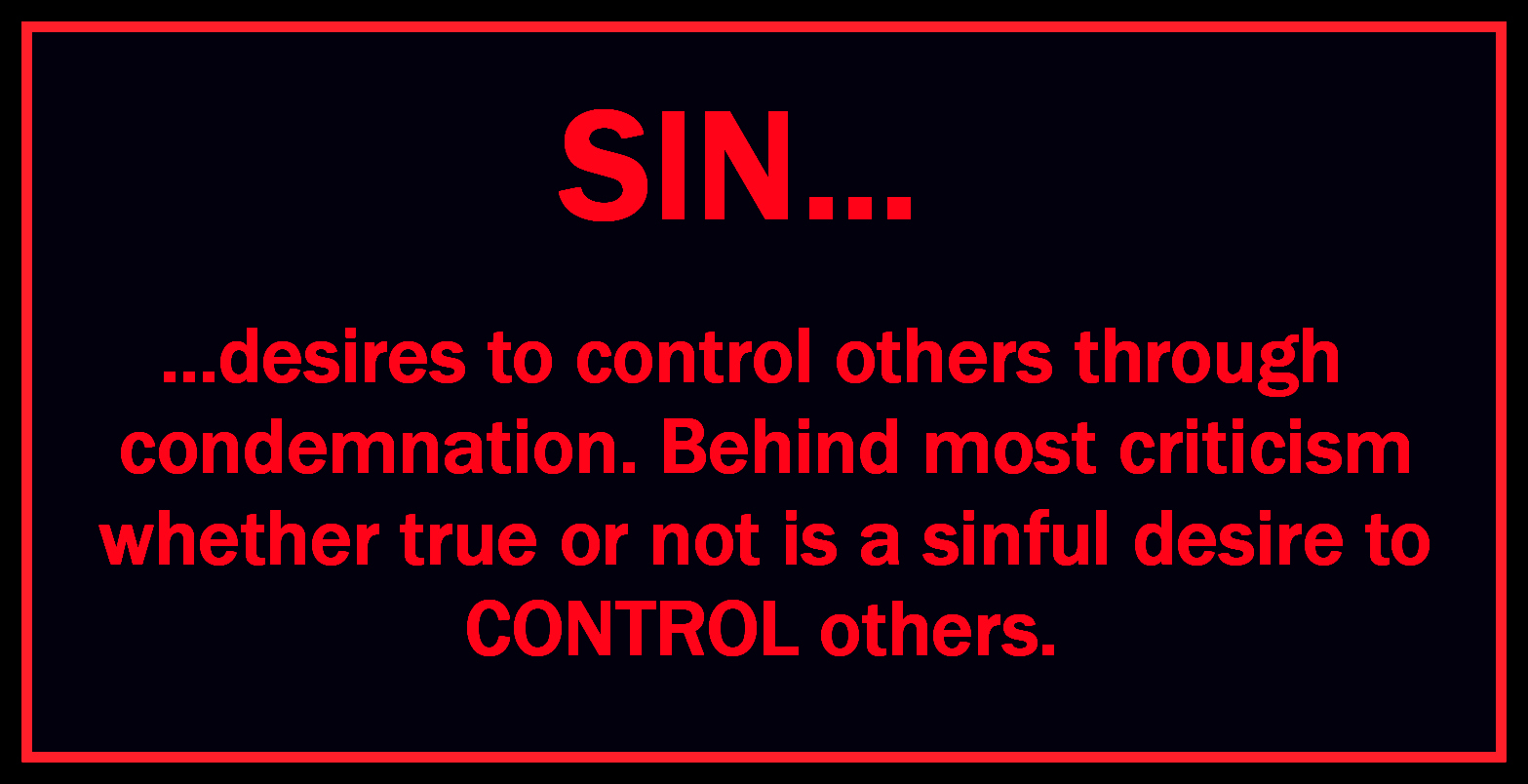
This is a fundamental definition of sin that is an important building block for additional understanding: it is a slave master that desires to rule over others and makes its appeal through desires, or “sinful desires.” The results of sin are types of death experienced throughout life leading to ultimate death. Sin is also empowered by its ability to condemn:
1Corinthians 15:56 – The sting of death is sin, and the power of sin is the law. 57 But thanks be to God, who gives us the victory through our Lord Jesus Christ.
When we get into the subject of law/gospel in part 3 of this session, the correlation between law and condemnation will be explained, but for now, the main point is that sin is empowered by its ability to condemn. It’s a master who desires to rule over people and bring many faceted deaths into their lives, and makes its appeal through the desires of others. It is empowered by the condemnation that results. In one way, sin rules over people by paralyzing them with guilt and fear.
We see this in the garden. After Adam and Eve sin, they hide from God because they are afraid of God’s condemnation.
Genesis 3:9 – But the Lord God called to the man and said to him, “Where are you?” 10 And he said, “I heard the sound of you in the garden, and I was afraid, because I was naked, and I hid myself.” 11 He said, “Who told you that you were naked? Have you eaten of the tree of which I commanded you not to eat?”
Sin and fear of condemnation go together. This also speaks to evangelism and free will. Protestants love to make much of “No man seeks after God” (Rom 3:11). But this is not because man is totally depraved and has no inkling towards God whatever. Man does not seek God because he fears condemnation. Obviously, when Adam and Eve sinned, they did not immediately seek out God for a solution. Instead, they hid from God because they were afraid of His condemnation. This is why man does not seek God, he is afraid—not because he is totally depraved.
In addition, we see the essence of evangelism from the very beginning: God seeks out man with the remedy for sin. Just because God is the one who is proactive does not mean man has no ability to make a choice when confronted by God. Adam and Eve had no ability to come up with a plan that would fix the fall. Obviously, God is the only one who could remedy the problem. Man’s inability is in regard to proposing a plan of reconciliation with God, not an inability to accept the gift of salvation through a plan devised by God when offered.
Blog TalkRadio Podcast, Session 2: Challenging Doctrinal Presuppositions of Orthodoxy
The Protestant Twisting of 1John, Part 4 – A Clarification: Gospel and Obedience
 Originally published April 20, 2015
Listen to audio or download audio file.
Welcome to Blogtalk Radio False Reformation this is your host Paul M. Dohse Sr. Tonight, part 4 of “The Protestant Twisting of 1John: A Clarification.” If you would like to add to our lesson or ask a question, call (347) 855-8317. Remember to turn your PC volume down to prevent feedback. Per the usual, we will check in with Susan towards the end of the show and listen to her perspective.
If you would like to comment on our subject tonight, you can also email me at paul@ttanc.com. That’s Tom, Tony, Alice, Nancy, cat, paul@ttanc.com. I have my email monitor right here and can add your thoughts to the lesson without need for you to call in.
Initially, I wanted to just address 1John 1:9 in a thorough way to debunk this whole Protestant idea that we keep ourselves saved by returning to the same gospel that saved us. And, the way we reutilize the same gospel that saved us is a continued repentance for “present sin.” It’s this whole idea that Jesus died for our past sins, but we must ask forgiveness for known present sin in order to keep ourselves saved. When we do that, it’s a reapplication of Jesus’ death for present sin. Hence, 1John 1:9.
But it doesn’t stop there in Protestant soteriology. They then concern themselves with the question of true righteousness. If our sins are forgiven, that keeps us out of hell, but it doesn’t make us truly righteous. What to do? So here is what they came up with: Jesus came to die for our forgiveness, past and present IF we return to the same gospel that saved us by faith alone, but He also came to keep the law perfectly so that His perfect obedience could be imputed to “Christian” life. The Reformed call this “double imputation.”
And it turns the true biblical gospel completely upside down. First, it makes the law the standard for justification. There is no law in justification, we are justified APART from the law. Why would Christ obey the law for us when justification is apart from the law? Then what is the standard for righteousness? NOT the law, but rather God’s righteousness. What’s that? For one, and primarily, it’s the new birth. For us, the standard of righteousness is being a child of God. Being the offspring of God is what makes us righteous. Kinship, not law.
Secondly, we are not justified by the law, no matter who keeps it—who keeps it is not the point, the law itself is the point, because there is no law that can give life. Only the new birth gives life (Galatians 3:21).
Thirdly, double imputation is obviously a covering for sin with the righteousness of Christ and not an ENDING of sin. Our sins are not “taken away” they are only covered. “Christianity” is about living a life of faith only to maintain a covering for sin. Therefore, we are not the ones really obeying, and therefore, we are not the ones performing love either.
And boy does this notion land us right where we are at in 1John. I have invested so much in the untwisting of 1John 1:9 in this series, that I thought, “I might as well finish the book out and make it our 1John commentary.” And so it is.
This is our theses: the new birth creates us anew into people who love the truth, and therefore practice oblove. That’s a new word that I made up. What is the definition of oblove? It’s the combination of the words “love” and “obedience.” Biblically, you cannot separate these two words, they are synonymous. The law is the Bible, and it is a book of condemnation to the unsaved and a beloved love manual for those born again. This is also why our sins are not covered, they are taken away (1John 3:5). Christ came to take away sin, not cover it.
You know, many go to church and sing the hymns, and many listen to Christian radio and raise their hands in praise while stopped at red lights, but a lot of that good Protestant music is just really bad theology that imperils the soul and stops far short of inciting the curiosity of the unsaved. One example is a beautiful song by Steve Camp titled, “He Covers Me.” But again, the premise of the song is that our sins are covered and not ended.
You know, there is a quiet revolution going on in Christianity. Christian husbands are beginning to stand up and assume their rightful role as spiritual leaders. This necessarily means leaving the institutional church which deliberately seeks to emasculate the men among us. One thing that I hear back is that fathers are beginning to stand silent and not sing traditional songs that are deviations from the truth. Good for them. I even hear back that their children ask, “Daddy, why aren’t you singing?” And they tell them why. Undoubtedly, children and wives will get way more out of these types of examples rather than 365 different versions of the same gospel that saved us.
“Why is it that all we ever hear about in the church is the gospel?” Because we have to keep returning to the same gospel that saved us to keep ourselves saved, and by the way, the only place that this continued atonement is valid is in the institutional church. Sure, Protestants will deny salvation by church membership; they will rather become indignant and state that salvation is only found in the gospel. However, the fact remains that they also believe that authority to preach the gospel is vested in the institutional church.
If our sins are only covered, the focus of the Christian life is to keep ourselves covered, not obedience because now obedience is defined by law-keeping. We have been trained mentally to think of obedience as something demanded by the law. This makes the law a co-life-giver with God. At least in one regard, the idea of one God connects with this idea. There is only one life-giver (Galatians 3:10-21).
I strongly suspect that when the Bible talks about God being one, it in no way includes the context of the Trinity. It’s interesting to note that in context of Galatians 3:10-21, the point is that the law is not a coequal with God—there is only one God.
1John 3:1 – See what kind of love the Father has given to us, that we should be called children of God; and so we are. The reason why the world does not know us is that it did not know him. 2 Beloved, we are God’s children now, and what we will be has not yet appeared; but we know that when he appears we shall be like him, because we shall see him as he is. 3 And everyone who thus hopes in him purifies himself as he is pure.
4 Everyone who makes a practice of sinning also practices lawlessness; sin is lawlessness. 5 You know that he appeared in order to take away sins, and in him there is no sin. 6 No one who abides in him keeps on sinning; no one who keeps on sinning has either seen him or known him. 7 Little children, let no one deceive you. Whoever practices righteousness is righteous, as he is righteous. 8 Whoever makes a practice of sinning is of the devil, for the devil has been sinning from the beginning. The reason the Son of God appeared was to destroy the works of the devil. 9 No one born of God makes a practice of sinning, for God’s seed abides in him, and he cannot keep on sinning because he has been born of God. 10 By this it is evident who are the children of God, and who are the children of the devil: whoever does not practice righteousness is not of God, nor is the one who does not love his brother.
11 For this is the message that you have heard from the beginning, that we should love one another. 12 We should not be like Cain, who was of the evil one and murdered his brother. And why did he murder him? Because his own deeds were evil and his brother’s righteous. 13 Do not be surprised, brothers, that the world hates you. 14 We know that we have passed out of death into life, because we love the brothers. Whoever does not love abides in death. 15 Everyone who hates his brother is a murderer, and you know that no murderer has eternal life abiding in him.
16 By this we know love, that he laid down his life for us, and we ought to lay down our lives for the brothers. 17 But if anyone has the world’s goods and sees his brother in need, yet closes his heart against him, how does God’s love abide in him? 18 Little children, let us not love in word or talk but in deed and in truth.
19 By this we shall know that we are of the truth and reassure our heart before him; 20 for whenever our heart condemns us, God is greater than our heart, and he knows everything. 21 Beloved, if our heart does not condemn us, we have confidence before God; 22 and whatever we ask we receive from him, because we keep his commandments and do what pleases him. 23 And this is his commandment, that we believe in the name of his Son Jesus Christ and love one another, just as he has commanded us. 24 Whoever keeps his commandments abides in God, and God in him. And by this we know that he abides in us, by the Spirit whom he has given us.
The law is not the standard for justification; it is the standard for our love, obedience, and submission. If there is a standard for justification at all, it would simply be defined by the new birth. We are justified by virtue of being in God’s family. The first man was a created being. God did not decide to save man by restoring a covenant of works, or restoring man’s image created in the likeness of God, or to restore paradise lost. He decided to save man by making him His literal family. The gospel isn’t about restoring things; it’s about making all things new. This defines you as pure, albeit in mortality. Nevertheless, being born of God in mortality results in the inevitable morphing into more and more purity:
See what kind of love the Father has given to us, that we should be called children of God; and so we are. The reason why the world does not know us is that it did not know him. 2 Beloved, we are God’s children now, and what we will be has not yet appeared; but we know that when he appears we shall be like him, because we shall see him as he is. 3 And everyone who thus hopes in him purifies himself as he is pure.
Let’s ask an interpretive question here. What did Jesus mean when He told John the Baptist that His baptism by John would fulfill all righteousness? I think it fulfilled all righteousness by representing the literal new birth, or Spirit baptism. Though we still reside in mortal bodies, the decision to be saved is a decision to follow Christ in baptism, or a decision to be born again. That’s the gospel. That’s what the gospel is.
Romans 6:1 – What shall we say then? Are we to continue in sin that grace may abound? 2 By no means! How can we who died to sin still live in it? 3 Do you not know that all of us who have been baptized into Christ Jesus were baptized into his death? 4 We were buried therefore with him by baptism into death, in order that, just as Christ was raised from the dead by the glory of the Father, we too might walk in newness of life.
5 For if we have been united with him in a death like his, we shall certainly be united with him in a resurrection like his. 6 We know that our old self was crucified with him in order that the body of sin might be brought to nothing, so that we would no longer be enslaved to sin. 7 For one who has died has been set free from sin. 8 Now if we have died with Christ, we believe that we will also live with him. 9 We know that Christ, being raised from the dead, will never die again; death no longer has dominion over him. 10 For the death he died he died to sin, once for all, but the life he lives he lives to God. 11 So you also must consider yourselves dead to sin and alive to God in Christ Jesus.
12 Let not sin therefore reign in your mortal body, to make you obey its passions. 13 Do not present your members to sin as instruments for unrighteousness, but present yourselves to God as those who have been brought from death to life, and your members to God as instruments for righteousness. 14 For sin will have no dominion over you, since you are not under law but under grace.
The more you study the apostle John, the more you will see the apostle Paul. Romans 6 is key here. The perfection of the law is not the standard for righteousness, passing from life to death is the standard. Though we still sin, we are dead to sin. Being deemed righteous in our present state is defined by a reversal of slavery leading to a new direction in life. Romans 6 explains, as we shall see, 1John 3. The literal new birth, in essence reverses slavery (Romans 6:20). This also debunks the whole Reformed total depravity song and dance. Before the baptism of the Spirit that comes by believing on Christ, the unregenerate are free to do good, but enslaved to the law of sin and death (Romans 8:2).
Being under the curse of the law is both a forensic statement and a state of being. It is true, while under law, a perfect keeping of the law is demanded. But this is key: when it gets right down to it, unbelievers are indifferent to the Bible or the law of God. And remember, the law and the Bible are the same thing. Man is capable of doing good, and in fact does do good, but because he/she has no love for God’s truth, and in fact are indifferent to it, life decisions lead to many-faceted forms of death, and ultimately, eternal death. Unbelievers that live according to conscience will suffer a lesser punishment in this life and the life to come.
Believers can in fact make life and death decisions, but are inclined towards obeying the law because of the new birth. Clearly, the Bible states that there is a reversal of slavery. The believer is enslaved to righteousness, but unfortunately free to sin. But according to Paul, a believer can stupidly enslave themselves to certain sins by obeying the desire that the sin produces. The believer is no longer enslaved to sin, but can be ignorant of this fact. And keep in mind, Protestantism is predicated on the idea that we are still enslaved to sin as believers which goes part and parcel with still being under the law and law continuing to be the standard for justification.
Listen, here is why the home fellowship movement is going to eventually take off: the alternative is Protestantism which defines the believer according to how the Bible defines an unbeliever. Eventually, people are going to figure out that they have been proudly proclaiming themselves as unregenerate in the name of Christ.
Lastly, this is defined by the fact that believers have the freedom to present their bodies as living sacrifices, or in other words, present their members for holy purposes that please God. The body is not inherently evil because it is part of the material world. Whether saved or unsaved, the body can be used for good purposes. However, in the case of an unbeliever, good behavior doesn’t lead to life more abundantly, it just leads to lesser punishment and a more bearable eternal state. For the unbeliever, good behavior merely leads to less death. For the believer, obedient love leads to more life.
Now with all of this in mind, let’s read further in 1John Chapter 3:
4 Everyone who makes a practice of sinning also practices lawlessness; sin is lawlessness. 5 You know that he appeared in order to take away sins, and in him there is no sin. 6 No one who abides in him keeps on sinning; no one who keeps on sinning has either seen him or known him. 7 Little children, let no one deceive you. Whoever practices righteousness is righteous, as he is righteous. 8 Whoever makes a practice of sinning is of the devil, for the devil has been sinning from the beginning. The reason the Son of God appeared was to destroy the works of the devil. 9 No one born of God makes a practice of sinning, for God’s seed abides in him, and he cannot keep on sinning because he has been born of God. 10 By this it is evident who are the children of God, and who are the children of the devil: whoever does not practice righteousness is not of God, nor is the one who does not love his brother.
John wrote what he wrote in 1John 3 because of what Paul wrote in Romans 6—it’s saying the same thing. Obeying the law isn’t the issue, a “commitment” to obey the law isn’t the issue, the reality of the new birth is the issue.
1Corinthians 15:1- Now I would remind you, brothers, of the gospel I preached to you, which you received, in which you stand, 2 and by which you are being saved, if you hold fast to the word I preached to you—unless you believed in vain.
3For I delivered to you as of first importance what I also received: that Christ died for our sins in accordance with the Scriptures, 4 that he was buried, that he was raised on the third day in accordance with the Scriptures, 5 and that he appeared to Cephas, then to the twelve. 6 Then he appeared to more than five hundred brothers at one time, most of whom are still alive, though some have fallen asleep.
This is, as Paul called it, the gospel of “first importance” or literally “the gospel of first order of importance.” There is way more behind this than a mental ascent to the facts of the gospel. You have to believe that this first happened to Christ in order to believe that it really happened to you spiritually. Repentance is a change of mind in regard to many things concerning your life and the life of Christ.
By the way, there was an evangelical movement for a while that emphasized the new birth. It peaked in the 70’s and was considered to be the most egregious of all false gospels. The Australian Forum, the think tank that gave birth to the present-day return to authentic Reformed soteriology, actually published an article titled, “The False Gospel of the New Birth.”
John continues in chapter 3 to explain one of the characteristics of being born again, love. But let me insert this, and this is VERY important: the characteristics of the new birth are framed in what the Bible refers to as “abiding.” If God’s seed “abides in” us (1John 3:9), other things also abide in us: the fact that we abide in Him also; the truth abides in us; we know the truth; we love the truth; we love fellow Christians; we do not practice sin, but rather practice righteousness as a life direction and pattern; we love God’s law; we submit to need; we obey; we seek to please God; we have a hunger for learning more of God’s word, and many more can be listed.
Let’s read more of John 3 with this in mind:
11 For this is the message that you have heard from the beginning, that we should love one another. 12 We should not be like Cain, who was of the evil one and murdered his brother. And why did he murder him? Because his own deeds were evil and his brother’s righteous. 13 Do not be surprised, brothers, that the world hates you. 14 We know that we have passed out of death into life, because we love the brothers. Whoever does not love abides in death. 15 Everyone who hates his brother is a murderer, and you know that no murderer has eternal life abiding in him.
16 By this we know love, that he laid down his life for us, and we ought to lay down our lives for the brothers. 17 But if anyone has the world’s goods and sees his brother in need, yet closes his heart against him, how does God’s love abide in him? 18 Little children, let us not love in word or talk but in deed and in truth.
See, the order in which John discusses these things is in no wise disconnected. We need to start thinking about “obedience” in reference to love and the new birth. Really, the Christian life is about love. But listen, any love that flows from you starts with a love for truth. Also, please take note of a more biblical definition of love: love is a submission to need—that’s love. When the Scriptures tell women to submit to their husbands, that’s just another way of telling wives to love their husbands. When the Bible tells men to love their wives, it’s simply telling men to submit to their needs. Look at 1John 3:17 again. How does benevolence get parachuted into that body of text out of nowhere? John goes from discussing murder to meeting financial need; it seems like he is all over the map, but not really.
Lastly, working out the new birth with love leads to assurance.
19 By this we shall know that we are of the truth and reassure our heart before him; 20 for whenever our heart condemns us, God is greater than our heart, and he knows everything. 21 Beloved, if our heart does not condemn us, we have confidence before God; 22 and whatever we ask we receive from him, because we keep his commandments and do what pleases him. 23 And this is his commandment, that we believe in the name of his Son Jesus Christ and love one another, just as he has commanded us. 24 Whoever keeps his commandments abides in God, and God in him. And by this we know that he abides in us, by the Spirit whom he has given us.
Assurance of salvation comes through working out our new birth in fear and trembling. Assurance of salvation is grounded in the ending of the law because the old us died with Christ resulting in no condemnation, while our new relationship to the law leads us in love and life. Now listen, even a casual student of the Bible can begin to hang Bible verses all over this framework.
Next week, we will build on this as we go into chapter 4—let’s go to the phones.

 Paul's Passing Thoughts
2 comments