Paul Dohse: The Gospel of Biblicism – 2015 TANC Conference: Session 3
The following is an excerpt of the transcript from Paul Dohse’s 3rd session at the 2015 TANC Conference on Gospel Discernment and Spiritual Tyranny.
Biblicism does not reject mystery, or paradox, but always approaches the latter with extreme skepticism. Biblicists consider paradox guilty until proven innocent. God is not a God of confusion, but be sure of this: the paradox card is more times than not a license for a mystery that only the spiritual elite understand—those who have the rule over you.
If the promise and the gift are verbally offered to all people, but the offer is not legitimate for all, that makes the use of these words completely illogical. Though the issue of election will not be explored in this series, the basic wrongness of Protestants who propagate so-called “sovereign grace” must call their deterministic gospel into question. Those who have the basic gospel completely wrong cannot be trusted with the rest of the story.
However, the fact that salvation is a promise and a gift will be key to exposing the false gospel of Protestantism in simple terms. The Bible defines the gospel with these specific words for good reason – words mean things.
What is the Gospel?
1Corinthians 15:3 – For I delivered to you as of first importance what I also received: that Christ died for our sins in accordance with the Scriptures, 4 that he was buried, that he was raised on the third day in accordance with the Scriptures, 5 and that he appeared to Cephas, then to the twelve. 6 Then he appeared to more than five hundred brothers at one time, most of whom are still alive, though some have fallen asleep.
These are the facts of the gospel, but in Paul’s statement much more is assumed rightly because of other texts that further define what is being stated here in 1Cor 15:3-6. Obviously, no one is saved by a mere believing of the facts concerning the gospel. As James wrote, the devils believe also and do tremble in regard to their future condemnation. The facts do need to be believed, but what saves is the following of Christ in these facts. In other words, it’s not a mere believing of the facts, but also the belief of what the results of believing are, and a desire to want that for yourself.
You believe the promise, and the gift, and you want the gift for yourself. The gift is the baptism of the Spirit, and believing in the transaction that takes place. It’s believing the promise and “receiving” the gift.
Romans 6:1 – What shall we say then? Are we to continue in sin that grace may abound? 2 By no means! How can we who died to sin still live in it? 3 Do you not know that all of us who have been baptized into Christ Jesus were baptized into his death? 4 We were buried therefore with him by baptism into death, in order that, just as Christ was raised from the dead by the glory of the Father, we too might walk in newness of life.
5 For if we have been united with him in a death like his, we shall certainly be united with him in a resurrection like his. 6 We know that our old self[a] was crucified with him in order that the body of sin might be brought to nothing, so that we would no longer be enslaved to sin. 7 For one who has died has been set free from sin. 8 Now if we have died with Christ, we believe that we will also live with him. 9 We know that Christ, being raised from the dead, will never die again; death no longer has dominion over him. 10 For the death he died he died to sin, once for all, but the life he lives he lives to God. 11 So you also must consider yourselves dead to sin and alive to God in Christ Jesus.
12 Let not sin therefore reign in your mortal body, to make you obey its passions. 13 Do not present your members to sin as instruments for unrighteousness, but present yourselves to God as those who have been brought from death to life, and your members to God as instruments for righteousness. 14 For sin will have no dominion over you, since you are not under law but under grace.
It’s amazing that the unsaved understand this in their own way. It’s just a fact that the unsaved understand the gospel intuitively better than the vast majority of Protestants. Most unsaved people know that salvation involves the loss of who they presently are in exchange for a new life that is in the wind so to speak. This is what Christ was telling Nicodemus as recorded in John 3 and why Nicodemus came to Him under cover of darkness—Christ was a threat to the present life he knew. The fact that Christ told him that he must be born again which would result in a new, and completely unpredictable life correlates with the fact that Nicodemus came to Him under cover of darkness. Nicodemus was afraid of losing his present life, and therefore, Christ addressed the issue forthwith.
“Just believe” and “faith alone” minus the new birth is a Protestant hallmark. It boils down to a mere glorified assent to the facts of the gospel. It is not the losing of present life in order to find the new one. It is not repentance, i.e., a turning from the old life and following Christ in literal death and resurrection. Water baptism is a public confession that you understand this. Now many will protest that we are doing something to be saved other than believe; we are “following” Christ. But it is a decision, not some work of following. The Spirit does the baptizing, not us. We are saved by wanting that for our life and accepting the gift that is offered.
But likewise with any gift, once it is given, the receiver owns it. It is now up to us to work out our own salvation with fear and trembling (Phil 2:12,13). Here, “salvation” refers to redemption (the saving of the body, Rom 7:24, 8:23), not the saving of the soul, and work/fear refers to the new Christian person and life, not our onetime new birth. The Christian life is a process; the new birth is a onetime event. Before we were saved, our fear regarded condemnation. Now our fear regards chastisement and sin that leads to unnecessary deaths (consequences for sin). There is no work FOR salvation, but there is a work IN the Christian life, specifically, a work of love (Gal 5:6).
On the flipside, even though there is not a work FOR salvation (justification), there is a work IN being unsaved that has a specific wage paid by a specific master. We met him in the previous session, the sin master. This is how the Bible frames this: there are two masters who pay two different wages: one pays wages for death, and the other pays wages for life. ALL people in the world are earning one or the other in varying degrees. Either group can do bad or good works (Rom 6:20), but one can only be credited for death, and the other can only be credited for life. These are two different wages paid by two different masters.
These two groups, lost and saved, are under two different laws that determine their wages. The lost who belong to the sin master are “under law” and its condemnation, the law of sin and death. Those under this law can only bear fruits of death. In contrast, those purchased by Christ (“you have been bought with a price” 1Cor 6:20, 7:23) can only bear fruits for life. They are identified as “under grace,” or under the law of the Spirit of life (Rom 6:14, 8:20).
Romans 6:15 – What then? Are we to sin because we are not under law but under grace? By no means! 16 Do you not know that if you present yourselves to anyone as obedient slaves, you are slaves of the one whom you obey, either of sin, which leads to death, or of obedience, which leads to righteousness? 17 But thanks be to God, that you who were once slaves of sin have become obedient from the heart to the standard of teaching to which you were committed, 18 and, having been set free from sin, have become slaves of righteousness. 19 I am speaking in human terms, because of your natural limitations. For just as you once presented your members as slaves to impurity and to lawlessness leading to more lawlessness, so now present your members as slaves to righteousness leading to sanctification.
20 For when you were slaves of sin, you were free in regard to righteousness. 21 But what fruit were you getting at that time from the things of which you are now ashamed? For the end of those things is death. 22 But now that you have been set free from sin and have become slaves of God, the fruit you get leads to sanctification and its end, eternal life. 23 For the wages of sin is death, but the free gift of God is eternal life in Christ Jesus our Lord.
This is why Christ came to end the law (Rom 10:4). The law that He ended is the law of sin and death. EVERYONE born into the world is under the law of sin and death and condemnation. This is how we know Christ died for everyone ever born into the world. He also purchased mankind from the sin master; eternal life is the promise, new birth is the gift (if received by faith) resulting in freedom from condemnation and the fruits of death. The believer now “upholds” the law he/she is free to serve: the law of the Spirit of life also known as the “law of Christ” and the “law of liberty.” Salvation is a free gift, but the Christian life is a work that can earn rewards.
Hebrews 6:10 – For God is not unjust so as to overlook your work and the love that you have shown for his name in serving the saints, as you still do.
God would be unjust to forget you labor of love in sanctification because you are earning rewards, and there is no fear in regard to condemnation because that concerns judgement:
1John 4:18 -There is no fear in love, but perfect [mature] love casts out fear. For fear has to do with punishment, and whoever fears has not been perfected in love. [Because they fear condemnation].
This is what is critical about the new birth, or the baptism of the Spirit. The old man that was under the law of sin and death died with Christ, and is now free to “serve another” through being resurrected with Christ:
Watch all of Paul’s 3rd session below.

Second Epistle of Andy to “Trevor”
Some time ago I relayed the account of a Facebook interaction I had with an individual I called “Trevor”. Trevor is a young man in his early twenties. I’ve had the privilege of having long conversations with him regarding theology and Biblical matters in general. Trevor goes to a local church and has made a profession of faith, so giving him the benefit of the doubt (since it is not my place to make a judgment otherwise) I regard him as a brother in Christ.
Last Friday, Trevor and I got into another discussion, this time about the Law and how it pertains to believers. Since he was pressed for time and our conversation was growing increasingly in depth, Trevor asked if he could pose some specific questions via a Facebook message to which I could then compose a more in-depth reply. What follows is my response to Trevor. His questions are included in the body of the response in bold italics. I hope that you find it edifying!
What is Love?
“Love (agape) suffereth long, and is kind; love (agape) envieth not; love (agape) vaunteth not itself, is not puffed up, doth not behave itself unseemly, seeketh not her own, is not easily provoked, thinketh no evil; rejoiceth not in iniquity, but rejoiceth in the truth; beareth all things, believeth all things, hopeth all things, endureth all things. Love (agape) never faileth:”
~ 1 Corinthians 13:4-8
This passage of scripture is one of the most well-know sections of the Bible. It is most often referred to as the great love chapter, and often the chapter is used in the context of marriage. And while it certainly has application to married couples, the apostle Paul had a much larger context in mind when he began his treatise.
The context actually begins in chapter 12 and extends through chapter 14 of 1 Corinthians. Paul was addressing a specific problem in the assemblies in Corinth and the province of Achaia. The issue was with regard to spiritual gifts among believers, and there were those who regarded certain gifts as more important or of higher esteem than others. More specifically, the Corinthians viewed tongues as the most important gift, and so if you didn’t speak in tongues, then you were considered a lower-class of believer. As a result, everyone wanted to speak in tongues. In 1 Corinthians 12:31 he said you earnestly covet the best gifts (or what they thought were the best). But Paul rebuked them by showing them that this was not loving behavior. This is what prompts the apostle to launch into his in-depth dissertation on the definition and characteristics of love. Let’s consider each one of these characteristics in detail.
“Suffereth long”
μακροθυμει (mak-roth-oo-my) – To be long-spirited. Forbearing or patient. Love hangs in there for the long run.
“Is kind”
χρηστευνεται (chray-styoo-neh-tie) – Derived from the word χρηομαι (chray-oh-my), having to do with the hand in a sense where one is furnishing that which is needed. “Lending a hand”. To show oneself useful. Acting useful. Benevolent. Love does what is needed for another’s benefit.
“Envieth not”
ου ζηλοι (oo dzay-loy) – “oo” being the negative particle meaning “no” or “not”. “Dzay-loy” is derived from the word which means “heat”. To be boiling with heat. Zeal in an unfavorable sense. “Hot headed”; petulant. Love does not behave like a petulant child who doesn’t get his way.
“Vaunteth not itself”
ου περπερευεται (per-per-you-eh-tie) – The prefix “peri” has the meaning of going beyond or further. The double use of “per” in this word gives emphasis of going farther beyond what is necessary, which is what a braggart does. Giving oneself more honor than one should; elevating oneself. Love does not boast, brag, or elevate itself.
“Is not puffed up”
ου φυσιουται (foo-see-oo-tie) – From the root word φυω (foo-oh) meaning to swell up or grow. To inflate or puff up. Used figuratively, to become proud. Love is not proud.
“Doth not behave itself unseemly”
ουκ ασχημονει (ah-schay-mo-nie) – A compound word with the negative particle “a” meaning “no” or “without” and a derivative of two closely related words; εχω (ech-oh) which means to possess some ability, and σχημα (schay-ma) which is some figure, form, or pattern. Literally, it means not being able to possess its form. If someone is behaving in a manner that is considered indecent, he is not behaving the way one would expect him to. Love behaves in a way that would be congruent with what one should expect of love.
“Seeketh not her own”
ου ζητει τα εαυτης (“oo dzay-tie ta heh-ow-tays) – Literally, “not seek of herself”. The key word in this expression is ζητει (dzay-tie), and it has the idea of plotting or making a plan. But it is also used as a “Hebraism” (a Jewish idiom or figure of speech) to indicate worship to God. Either meaning has application. Love does not plan for its own self-interest. Love does not worship itself.
“Is not easily provoked”
ου παροξυνεται (par-ox-oo-na-tie) – A compound word from the prefix παρα (para), meaning along or beside, and οξυς (ox-zoos) meaning keen or sharp or swift. Literally, to sharpen beside. To make “on edge”. If someone is “on edge” they are irritated or frustrated. Love does not become frustrated quickly. Think about how this is related to the first quality of “suffering long”.
“Thinketh no evil”
ου λογιζεται το κακον (oo log-idz-eh-tie to ka-kon). The key word in this expression is λογιζεται (log-id-zeh-tie), and it means to take an inventory. Love does not take an inventory of evil. Or as Paul Dohse says, “don’t keep a sin list.”
Rejoiceth not in iniquity
ου χαιρει επι τη αδικια (oo chai-rie epi tay ah-di-kee-ah) – The word αδικια (ah-di-kee-ah) is a compound word from the negative particle “a” meaning “no” or “without”, and the word δικη (dee-kay) meaning right or just. So this expression literally means “not cheerful about unjustness.” Love does not show joy over unrighteousness.
“Rejoiceth in the truth”
συγχαιρει δε τη αληθεια (soon-chai-rie deh tay a-lay-thie-ah) – The word for truth is interesting. It is a compound word from a negative particle “a” meaning “no” or “without”, and the word “lathano” which means “to lie hidden” or “to be ignorant”. Truth in this sense is literally that which is no longer hidden, or something revealed. Truth is the opposite of ignorance. But notice now that the word “rejoice” translated here has the prefix “soon” before it. The prefix “soon” means “together”. In this one statement, we are to understand that two things are joyful; love AND truth. Each are dependent upon the other. Love shares a joyful symbiotic relationship with truth.
Paul sums up his dissertation on love with four concluding statements.
“Beareth all things”
παντα στεγει (pan-ta steh-geh-ee) – Literally, “to roof over”, that is, “to cover with silence”. In other words, to keep quiet about something. Think about how this relates to “suffering long” and “not taking an inventory of evil”. Love does not bring up past wrongs. It is all-enduring.
“Believeth all things”
παντα πιστευει (pan-ta pis-tyoo-eh-ee) – To have faith in someone or something. To have faith in someone means that you assume the best about them. Love does not automatically think the worst about others. It is all-believing.
“Hopeth all things”
παντα ελπιζει (pan-ta el-pid-zie) – To anticipate with joyful expectation. The Greek word for “hope” does not describe a wishful sort of thinking. It is a looking forward to with absolute certainty, like a child anticipates Christmas morning. He knows it’s going to happen. Love anticipates with certainty the best from others. It is all-expecting.
“Endureth all things”
παντα υπομενει (pan-ta hoo-poh-meh-nie) – A compound word from the prefix “hupo”, meaning “under” and the word “meno”, meaning “to stay or remain”. Literally, “to remain under”. The implications here are both one of submission but also one of support. Love remains supporting even when it has been wronged. It is all-supporting
Something you should notice about chapter 13 is that there is a distinct change in the literary style. To this point, Paul’s style has been logical and conversational. But Paul’s Hebrew cultural influence becomes apparent in chapter 13 as he switches to a very poetic style. One of the most defining characteristics of Hebrew poetry is parallelism. This can be seen in Psalms, where the writer expresses a thought and then restates that same though another way in the next line. The thoughts can either be comparative or contrasting. Paul uses a more complex form of parallelism called inverse parallelism, and you can see it here in 1 Corinthians 13:7. The relationship between these four aspects of love looks like this:
If you go back and consider the commentary we just discussed on each expression, you should notice how closely the inner two characteristics are related and how closely the outer two are related. Another way to see this inverse parallelism is like this:
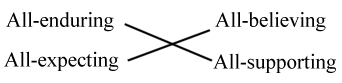
Paul uses parallelism as a poetic way to express his thoughts by restating the same idea in a different way in order to make his point understood. If you look closely at the definitions you will see that the ideas of “bearing” and “enduring” are very much the same thought. Love does not bring up past wrongs (all-bearing/enduring); it remains supporting even when it has been wronged (all-enduring/supporting). It endures those wrongs. Likewise, the ideas of “believing” and “hoping” are also very much the same thought. Love does not automatically think the worst (all-believing), but it anticipates the best with certainty (all-hoping/expecting).
In fact, if you go back and consider the first 8 characteristics of love in verses 4 through 6, they are also arranged in a much larger and even more complex inverse parallelism construct, where one is related to eight, two is related to seven, three is related to six, and four is related to five. Here is a summary of all the characteristics of love just discussed. To help you better see the parallelism just described, I have grouped them accordingly.
Love hangs in there for the long run.
Love does what is needed for another’s benefit.
Love does not behave like a petulant child who doesn’t get his way.
Love does not boast, brag, or elevate itself.
Love is not proud.
Love behaves in a way that would be congruent with what one should expect of love.
Love does not plan for its own self-interest; it does not worship itself
Love does not become frustrated quickly.
Love does not take an inventory of evil.
Love does not show joy over unrighteousness.
Love shares a joyful symbiotic relationship with truth.
Love does not bring up past wrongs. It is all-enduring.
Love does not automatically think the worst about others. It is all-believing.
Love anticipates with certainty the best from others. It is all-expecting.
Love remains supporting even when it has been wronged. It is all-supporting.
Love will never let another down!
Paul’s final statement on love in verse 8 has no parallel line of though with it, but rather it becomes the opening statement to a series of contrasts which we won’t discuss here. Nevertheless, it is still a characteristic of love worth considering.
“Never faileth”
ουδεποτε εκπιπτει (oo-deh-poh-teh ek-pip-tie) – The word for “faileth” is a compound word from the prefix “ek”, meaning “out of” and the word “pipto”, meaning “to fall”, literally or figuratively. In this sense, it does not describe something that comes to an end, but rather something that no longer measures up to a perceived standard of excellence. Love will never let another down.
Think about how these characteristics apply to the use of spiritual gifts among believers. The purpose of gifts is for the mutual edification of the Body of Christ so that each of us may be properly equipped to tell others the good news of the Kingdom. If we are distracted being envious or jealous over each others’ gift or preoccupied over petty disputes or offences toward each other, then we have disqualified ourselves from serving our Father in the mandate He has given us as ambassadors.
Furthermore, think about how love is the antithesis of control. Love does not change behavior by controlling another. It persuades. If we are preoccupied trying to control others, we are not loving them. I am reminded again of the second greatest commandment; love thy neighbor as thyself. Have you ever noticed that it doesn’t say love your neighbor MORE than yourself? No man hates himself. In fact, we are pretty good at loving ourselves. God’s word says to love others JUST AS MUCH AS you love yourself! This means, treat another the same way you want to be treated. That is the definition of love.
Andy
A Definitive Biblical Statement on Law and Gospel for Home Fellowships
Originally published April 24, 2015
TANC Ministries, 2015
Whatever form of Protestantism you are talking about, and Calvinism in particular, its Achilles’ heel is the law. Protestantism cannot pass the true gospel test because of its position on law, and this is not hard to understand.
Andy Young, an associate of TANC ministries, said something in last year’s 2014 conference that is probably true for the most part: “The law is for sanctification.” Right, because the law is in no wise for justification. We are justified apart from the law (Romans 3:21) and “apart” means exactly that. The fact that the law will judge people in the end is a separate issue altogether.
The apostle Paul makes all of this easy to understand in Galatians chapter 3. But first, let’s use that same chapter to establish what we mean by the word “law.” The word is used interchangeably with many other words, including “gospel”, to refer to the Bible. So, Andy was merely saying that the Bible is for sanctification, or in other words, Christian living. Andy was talking in context of sanctification for the Bible has no stake in justification, and again, the fact that the Bible will judge people in the end is another issue. Yes, the Bible defines justification (Rom 3:21, Gal 4:21); yes, the Bible testifies to the truths regarding justification, but the law does not justify.
Note the following from Galatians 3:
21 Is the law then contrary to the promises of God? Certainly not! For if a law had been given that could give life, then righteousness would indeed be by the law. 22 But the Scripture imprisoned everything under sin, so that the promise by faith in Jesus Christ might be given to those who believe.
Notice that Paul uses the word “law” and “Scripture” interchangeably. The law, “holy writ,” “the word,” “the gospel,” “the Scriptures,” “the law and the prophets,” etc. are all terms that refer to the Bible which is a full orbed statement by God regarding Himself, mankind, and reality. Statements like this: “We are not bound by the law, or else we’d have to live under every aspect of the law including not wearing blended fabrics and not eating shrimp and bacon” reveal a fundamental ignorance in regard to what the law is.
Protestantism falls on this one basic principle: law is the standard for righteousness. This makes the salvific work of Christ two-fold: He died to pay the penalty for our sins, and came to fulfill the law for us in order to make us righteous. That’s gross heresy. That’s an egregious false gospel. Hence, you have two kinds of Protestants: one camp that understands the position and professes it, and the other camp who also confesses it, but has not thought out the ramifications. This includes Baptists, Methodists, and many others. Baptists parted ways with the Reformers on baptism, but have never repented of making the law justification’s standard.
Yes, Jesus said that He came to fulfill the law and to not end it, but then we have the apostle Paul writing that Christ in fact did come to end the law, so does the Bible contradict itself? By no means.
Here is the problem: by design, Protestants don’t interpret the Bible in context of sanctification and justification, and again, that is by design. Why? Because Protestantism is founded on the idea that sanctification is merely the progression of justification. This also goes hand in glove with the idea that the law is justification’s standard. Hence, the law must continue to be fulfilled perfectly to keep the saints justified. This results in the confused theological train wreck we call Protestantism.
When the law must be continually fulfilled perfectly as a standard for justification, the law cannot be used for love because now you have fused love and justification together. This is why churches lack love; the maintaining of justification and love are confused. In the Bible, love is absolutely synonymous with obedience. Unfortunately, Protestantism makes obedience a justification issue. Obedience is not a justification issue—it’s a love issue. That’s why there is so much love-bombing in your churches; true love is stifled because it is confused with justification. The vacuum is then filled with empty words and programs. People are in bondage to the law in Jesus’ name and their pain is medicated by praise bands, personality cults, and the splendor of institutional temples.
The fulfillment of the law in Jesus’ name is a huge problem—there is no law in justification regardless of who keeps it. Who keeps it is not the issue, the law is the issue. Here is the theses of Paul’s argument in Galatians 3: Only God can give life through faith alone in the promise. What is the promise? It was a promise made to Abraham and Christ that Israel and the Gentiles would be blessed with eternal life, and that Christ would be resurrected by the power of the Holy Spirit in order to make that possible:
Galatians 3:15 – To give a human example, brothers: even with a man-made covenant, no one annuls it or adds to it once it has been ratified. 16 Now the promises were made to Abraham and to his offspring. It does not say, “And to offsprings,” referring to many, but referring to one, “And to your offspring,” who is Christ. 17 This is what I mean: the law, which came 430 years afterward, does not annul a covenant previously ratified by God, so as to make the promise void. 18 For if the inheritance comes by the law, it no longer comes by promise; but God gave it to Abraham by a promise.
So in other words, if Christ came to also fulfill the law, the Promise is fulfilled by law, and not God’s promise made to Abraham. By the way, this term, “the promise” is a major biblical term referring to the gospel. In regard to justification, Christ came for one reason: to end the curse of the law:
Galatians 3:10 – For all who rely on works of the law are under a curse; for it is written, “Cursed be everyone who does not abide by all things written in the Book of the Law, and do them.” 11 Now it is evident that no one is justified before God by the law, for “The righteous shall live by faith.” 12 But the law is not of faith, rather “The one who does them shall live by them.” 13 Christ redeemed us from the curse of the law by becoming a curse for us—for it is written, “Cursed is everyone who is hanged on a tree”— 14 so that in Christ Jesus the blessing of Abraham might come to the Gentiles, so that we might receive the promised Spirit through faith.
If we still rely on the works of the law, we are under a curse; again, it doesn’t matter who keeps it. Paul spent most of his ministry trying to hammer this point home. Here, he makes it clear that the law was not part of the original promise, and once a covenant has been ratified, nothing can change it. If Christ fulfilled the law in our stead, that is clearly an addition to the original covenant of promise—that’s Paul’s specific point.
But now Protestants once again protest that the key is a perfect fulfillment of the law which only curses those who cannot keep it perfectly. Christ’s perfect obedience to the law is then imputed to us. In light of this chapter in Galatians, this position is fraught with problems. Clearly, it’s still an addition to the original covenant. Also key is who the promise is made to; ie., the descendants of Abraham which include the Gentiles, and Christ Himself. Paul emphasizes that there is only ONE seed (verse 16). Why?
“Seed” is key. The Greek word refers to offspring. Christ was part of Abraham’s lineage, and is only ONE seed—there is not more than one seed. Christ died to end the curse of the law by dying to pay the penalty of sin, and then waited (in a manner of speaking) in the grave for the promise that was also made to Him: “the promised Spirit.” The Spirit raised Christ from the grave:
Romans 8:11 – If the Spirit of him who raised Jesus from the dead dwells in you, he who raised Christ Jesus from the dead will also give life to your mortal bodies through his Spirit who dwells in you.
Ephesians 1:19 – and what is the immeasurable greatness of his power toward us who believe, according to the working of his great might 20 that he worked in Christ when he raised him from the dead and seated him at his right hand in the heavenly places,…
The promised Spirit is major here. This is the new birth. This promise of the Spirit accomplished three universe-shaking objectives: it enabled mankind to follow Christ in literal death and resurrection, baptized Jews and Gentiles into one body, or family of God, cancelled judgement and condemnation, and set God’s children free to aggressively love.
The idea that Christ fulfilled the law in order to satisfy justification usurps the Spirit’s role in the promise. God elected the means of salvation, Christ died, and the Spirit baptizes. God initiated salvation, Christ paid the penalty for sin, and the Spirit regenerates. We are not justified by the law, we are justified by the new birth:
Romans 4:20 – No distrust made him waver concerning the promise of God, but he grew strong in his faith as he gave glory to God, 21 fully convinced that God was able to do what he had promised. 22 That is why his faith was “counted to him as righteousness.” 23 But the words “it was counted to him” were not written for his sake alone, 24 but for ours also. It will be counted to us who believe in him who raised from the dead Jesus our Lord, 25 who was delivered up for our trespasses and raised for our justification. (ESV 2001).
Galatians 3:1 – O thoughtless Galatians, who did bewitch you, not to obey the truth — before whose eyes Jesus Christ was described before among you crucified?
2 this only do I wish to learn from you — by works of law the Spirit did ye receive, or by the hearing of faith? 3 so thoughtless are ye! having begun in the Spirit, now in the flesh do ye end? (YLT).
Notice the idea of completion reflected by the Greek and properly translated by the YLT. We don’t receive the Spirit and His work on the installment plan when we believe; the new birth is a complete work. Hence, the new birth, or the Spirit’s baptism is what makes us righteous or justified, not the law.
Again, God set forth the plan of salvation: Christ died to end the law, and the Spirit regenerates us and helps us in our progression of holiness. We are born of the Spirit and resurrected as holy babies born of God, and grow up in holiness (1Peter 2:2). The baptism of the Spirit is therefore twofold:
Romans 6:1 – What shall we say then? Are we to continue in sin that grace may abound? 2 By no means! How can we who died to sin still live in it? 3 Do you not know that all of us who have been baptized into Christ Jesus were baptized into his death? 4 We were buried therefore with him by baptism into death, in order that, just as Christ was raised from the dead by the glory of the Father, we too might walk in newness of life.
5 For if we have been united with him in a death like his, we shall certainly be united with him in a resurrection like his. 6 We know that our old self was crucified with him in order that the body of sin might be brought to nothing, so that we would no longer be enslaved to sin. 7 For one who has died has been set free from sin. 8 Now if we have died with Christ, we believe that we will also live with him. 9 We know that Christ, being raised from the dead, will never die again; death no longer has dominion over him. 10 For the death he died he died to sin, once for all, but the life he lives he lives to God. 11 So you also must consider yourselves dead to sin and alive to God in Christ Jesus.
Romans 7:1 – Or do you not know, brothers—for I am speaking to those who know the law—that the law is binding on a person only as long as he lives? 2 For a married woman is bound by law to her husband while he lives, but if her husband dies she is released from the law of marriage. 3 Accordingly, she will be called an adulteress if she lives with another man while her husband is alive. But if her husband dies, she is free from that law, and if she marries another man she is not an adulteress.
4 Likewise, my brothers, you also have died to the law through the body of Christ, so that you may belong to another, to him who has been raised from the dead, in order that we may bear fruit for God. 5 For while we were living in the flesh, our sinful passions, aroused by the law, were at work in our members to bear fruit for death. 6 But now we are released from the law, having died to that which held us captive, so that we serve in the new way of the Spirit and not in the old way of the written code.
Colossians 2:8 – See to it that no one takes you captive by philosophy and empty deceit, according to human tradition, according to the elemental spirits[a] of the world, and not according to Christ. 9 For in him the whole fullness of deity dwells bodily, 10 and you have been filled in him, who is the head of all rule and authority. 11 In him also you were circumcised with a circumcision made without hands, by putting off the body of the flesh, by the circumcision of Christ, 12 having been buried with him in baptism, in which you were also raised with him through faith in the powerful working of God, who raised him from the dead. 13 And you, who were dead in your trespasses and the uncircumcision of your flesh, God made alive together with him, having forgiven us all our trespasses, 14 by canceling the record of debt that stood against us with its legal demands. This he set aside, nailing it to the cross. 15 He disarmed the rulers and authorities and put them to open shame, by triumphing over them in him.
Why would Christ fulfil the law and then die to end it? Why would Christ’s perfect obedience to law be imputed to us when it is no longer valid? Why would Christ fulfil the law for those who die with Him and are no longer under that law? Why would Christ fulfil a law that has nothing to say to us? (Romans 3:19). When Paul states, “For all who rely on works of the law are under a curse” (verse 10), that means any works of the law period, not just what we perform, but any works of the law period. The covenant of promise WAS NOT RATIFIED BY THE LAW THAT CAME 430 YEARS LATER. What could possibly be more evident? If Jesus kept the law perfectly as part of the gospel, that still ratifies the original covenant of promise.
But all of this is not even Paul’s primary argument. His primary argument is that only the Spirit can give life. His argument is that only the resurrection of the new birth gives life. If the law has any part in justification, then the law can give life and there is more than one seed. Consequently, only God can give life and now there is a co-life-giver. That’s Paul’s argument exactly.
11 Now it is evident that no one is justified before God by the law, for “The righteous shall live by faith.” 12 But the law is not of faith, rather “The one who does them shall live by them.”
Life, justification, faith alone in the promise, and the new birth are all mutually inclusive while the law and justification are mutually exclusive—that’s exactly what the apostle Paul is saying.
Also, if law has anything to do with justification at all, we inherit eternal life by being born again into God’s family by the fulfillment of the law and NOT promise:
18 For if the inheritance comes by the law, it no longer comes by promise; but God gave it to Abraham by a promise.
Someone may argue, “But Jesus keeps the law perfectly!” So what of it? It’s still inheritance by the law and not promise. Again, and again, the original covenant was not ratified by Jesus’ perfect law-keeping. Here is what we must come to grips with: Protestantism is predicated on a juvenile perception of law and gospel.
16 Now the promises were made to Abraham and to his offspring. It does not say, “And to offsprings,” referring to many, but referring to one, “And to your offspring,” who is Christ.
20 Now an intermediary implies more than one, but God is one.
21 Is the law then contrary to the promises of God? Certainly not! For if a law had been given that could give life, then righteousness would indeed be by the law.
As an aside while on the subject of covenants: this whole idea of Jesus fulfilling the law plugs into the ever popular Covenant theology. This is the idea that Christ came to obey the law perfectly in order to restore the original and supposed covenant of works with Adam. But the Covenant of Promise was not made with Adam, it was made with Abraham. Compounding this glaring error is the citation of Genesis 3:15 to make a connection between Adam’s disobedience and Christ’s obedience to the law. But in that verse, it is the serpent that is being addressed and not Adam. Usually, when you make a covenant with someone, as with Abraham, it’s made with the person you are talking to. In essence, it claims that God made a covenant with the serpent.
Regardless of all of the splendor and glory affiliated with religious academia, it is found wanting in embarrassing proportions. The laity must stop listening to these people and start reading the Bible for themselves.
But with all of this said, “Why then the law?”(verse 19). However, which law is Paul referring to when he presents this anticipated question in verse 19? There are two laws: one known as, “the written code” (Colossians 2:14), “the law of sin and death” (Romans 8:2), “the law of sin” (Romans 7:23), simply “the law” in many places, “the letter” (2Cor 3:6), “ministry of death” (2Cor 3:7), “ministry of condemnation” (2Cor 3:9), “the record of debt” (Col 2:14), and “the first covenant” (Hebrews 8;13).
The second is known as: “the law of the Spirit of life” (Romans 8:2), “the law of my mind” (Romans 7:23), “the law of liberty” (James 1:25), “the law of Christ” (Galatians 6:2), and because love fulfills the whole law (Romans 13:8-10), it can be rightly called “the law of love.”
In verse 19, Paul is referring to the first law. It only condemns and judges, but that’s not its only function by far.
19 Why then the law? It was added because of transgressions, until the offspring should come to whom the promise had been made, and it was put in place through angels by an intermediary. 20 Now an intermediary implies more than one, but God is one.
21 Is the law then contrary to the promises of God? Certainly not! For if a law had been given that could give life, then righteousness would indeed be by the law. 22 But the Scripture imprisoned everything under sin, so that the promise by faith in Jesus Christ might be given to those who believe.
23 Now before faith came, we were held captive under the law, imprisoned until the coming faith would be revealed. 24 So then, the law was our guardian until Christ came, in order that we might be justified by faith. 25 But now that faith has come, we are no longer under a guardian, 26 for in Christ Jesus you are all sons of God, through faith. 27 For as many of you as were baptized into Christ have put on Christ. 28 There is neither Jew nor Greek, there is neither slave nor free, there is no male and female, for you are all one in Christ Jesus. 29 And if you are Christ’s, then you are Abraham’s offspring, heirs according to promise.
What’s this saying? First, it’s saying that the first law has no function for believers after Christ died on the cross to END the law. And Christ did come to end the law of sin and death. Christ didn’t come to merely cover sin with His own righteousness, He came to end sin by ending the law (Romans 3:19,20, 4:15, 5:13, 7:6,8, 10:4, 1Tim 1:9, Gal 2:19).
Secondly, the first law covered believers until Christ died on the cross. The first law was an atonement for sin; all of the sins of Old Testament believers were imputed to that law, and then it was ended by Christ. The person who believes on Christ dies in baptism, and is no longer under the law that he/she sinned against (Romans 7:1ff). This would also include believers who were deceased at the time.
In regard to Old Testament believers that were dead during the time of Christ’s ministry on earth, Old Testament believers were captive under the law until Christ died to end the law. Therefore, they were in Sheol/Abraham’s bosom/Paradise/Hades. When Christ died, He went there and preached to the captives and took the thief on the cross with Him. When the Spirit resurrected Him, He also resurrected those in Sheol and set the captives free. They and their sins were held captive by the law until Christ died to end it. Remember, King David said, “For you will not abandon my soul to Sheol, or let your holy one see corruption” (Psalm 16:10). As a testimony, Christ sent many of them to walk around Jerusalem. Texts that help sum up all of these points are Ephesians 4:7-10 which also references Psalm 68:18, Luke 16:22, Matthew 27:51-53, and Colossians 2:13-15.
Thirdly, the first law still has a function in the scheme of things. The old covenant of the law is passing away, but is not ended for the unbelieving. “Under grace” did not end “under law” (Romans 6:14). The first law still holds sin captive because all sin is against the law (1John 3:4). Yes, for those who don’t repent, the law will judge them in the end. To the degree that they violate the law, they will be punished eternally.
But there is a sense in which the first law also serves a purpose of covering as it formally did for those under grace. When a person is saved and born again, they die and are no longer culpable to the law—the law is also ended for them at that time. Their sins are taken away and cast as far as the east is from the west. Again, Christ did not come to cover sin, he came to take sin away. The first law is grace in waiting. All sin is imputed to it, and it stands ready to be ended for each and every person who chooses to follow Christ in death and resurrection.
Now, what about the other law—the law of the Spirit of life? Let there be no doubt, there is a law that is under grace. It is the law of love. We have been released from the condemnation of the first law, and are now free to aggressively serve the law of Christ:
Romans 7:4 – Likewise, my brothers, you also have died to the law through the body of Christ, so that you may belong to another, to him who has been raised from the dead, in order that we may bear fruit for God.
In the same way that one sin formally violated the whole law (James 2:10), one act of love fulfills the law of Christ (Gal 5:14, Rom 13:10). Love covers a multitude of sin (1Peter 4:8). We are sanctified with the word of truth (John 17:17). The Christian life is faith WORKING through the obedience of love (Gal 5:6), and love is synonymous with obedience (John 14:15).
If a professing Christian is not truly bearing fruit for God as an expression of true love for truth, God, and others, he/she has a flawed view of the law’s relationship to the gospel.
What is sapping the power of Christianity in our day is misguided fear. When the ending of sin is confused with the idea of covering, excessive introspection ensues for fear that we are not living by a convoluted Protestant system of faith-alone works so that the perfect obedience of Christ will continue to be imputed to our Christian life.
In contrast, there is no longer any condemnation for those in Christ and fear has to do with judgement (Rom 8:30, 1Jn 4:16-19). Those mature in love cast away fear. They are free from the condemnation of the law and free to serve Christ in aggressive love.
Who will deny that the overwhelming preoccupation of Protestants is sin and not love while any appearance of good works is held suspect? Where there is not freedom to love without fearful introspection, love will not thrive.

 Paul's Passing Thoughts
leave a comment