By Request: A Summary Of The New Calvinist Genealogy Chart; Part 1 / Introduction
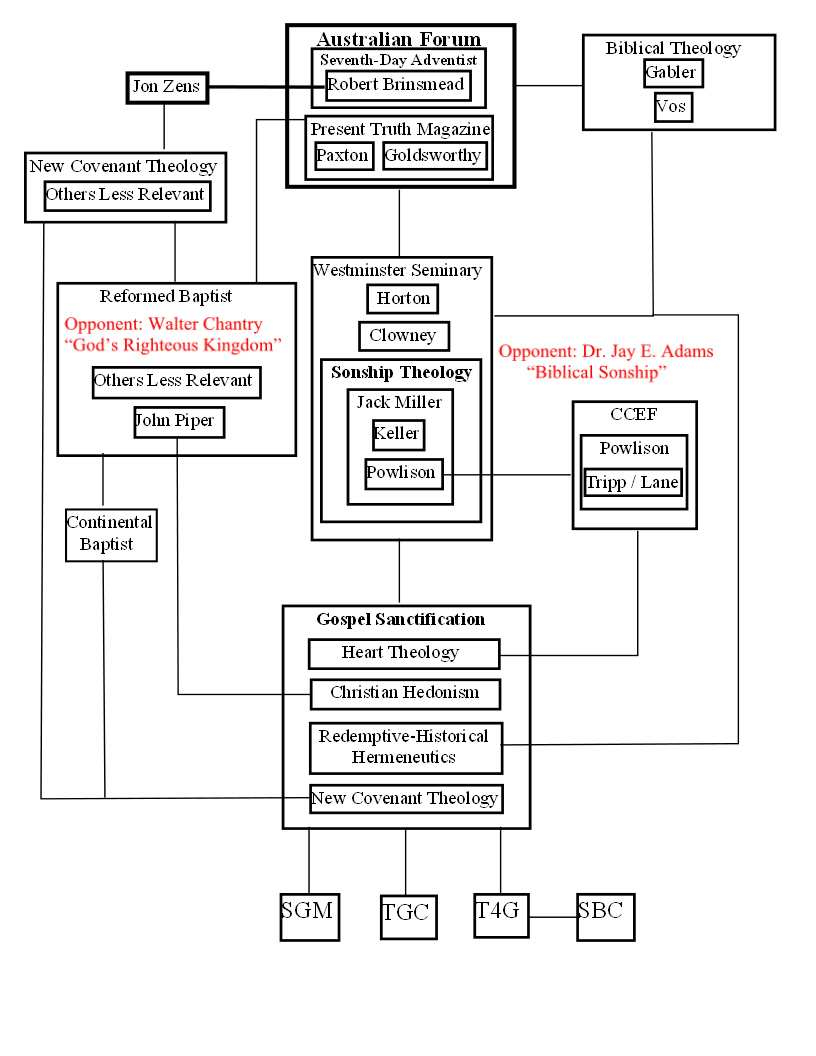 The contemporary history of New Calvinism begins with Robert Brinsmead and Jon Zens. They are the fathers of New Calvinism. Between my interview with Brinsmead and an informal document written by Zens I found on the internet—this is apparent. Brinsmead started a project called the Australian Forum (he wanted me to note that it was one of many projects that focused on certain subjects) that sought to articulate a gospel-centered sanctification into a unified, consistent systematic theology. One of the major considerations was a focus on covenant theology in relationship to this endeavor. Jon Zens is the father of New Covenant Theology, but it is clear that Brinsmead had a major influence in the formulation of that doctrine. All of this took place in the 70’s. So, New Calvinism has been around for about 35 years in various forms. It is primarily based on the Forum’s centrality of the objective gospel (COG). COG is the very heart of New Calvinism. Though NC has many different expressions, this doctrine is the heartbeat that drives it.
The Forum was having a significant impact on two spheres of Christianity in the 70’s and early 80’s; namely, Reformed Baptist and Westminster Seminary. Zens was a Reformed Baptist and also a student at Westminster. Zens taught a Sunday School class where his ideas on New Testament ethics were being presented, and Westminster students attended those studies. Michael Horton was infatuated with the Forum’s teachings, and COG can be seen in many of his teachings throughout his career. Keep in mind, the Forum’s magazine, Present Truth, and later, Verdict, according to Zens, had the largest readership among all Evangelical publications at that time. Apparently, Zens was initially introduced to the Forum by receiving Present Truth while he was a student at Westminster, and eventually formed a close relationship with Brinsmead. Also, G. Goldsworthy’s involvement in the Forum as one the AF three is one of the interesting the top is the same as the bottom in the genealogy chart. Till this day, the Goldsworthy Trilogy is a mainstay of New Calvinism’s Gospel Theology. Again, at the very heart of Goldsworthy’s Trilogy is COG. Goldsworthy was close to Brinsmead, and Brinsmead learned his Hebrew skills from Goldsworthy.
Zens, with the help of several men who are now the who’s who of New Covenant Theology while Zens is in the background (probably because of his connections with Brinsmead), attempted to propagate the doctrine, yet unnamed, via the Baptist Reformation Review . Zens received a very zealous contention from other Reformed Baptist such as Walter Chantry. At that time, Brinsmead wrote several articles defending Zens’ doctrine in the BRR. According to Zens:
“A sort of (unintended) [I doubt that] culmination occurred in the Spring, 1981, BRR. There were lengthy review articles of Walt Chantry’s God’s Righteous Kingdom [a book Chantry wrote to contend against COG, though he saw it as neo-antinomianism, which is also a correct assertion] and Robert Brinsmead’s Judged by the Gospel: A Review of Adventism. The dynamic N.T. approach to law and gospel [“NT approach to law and gospel” is a present-day NC mantra] was stated forcefully by RDB:
‘[Paul’s] appeals on how to live are made on the basis of what God has done for us in Christ. It is in view of God’s gospel mercies that we are to present our lives as a living sacrifice to God (Rom.12:1-3) . . . . Paul virtually never appeals to the law – ‘Thou shalt not.’ When he demands certain behavior of the church, he appeals instead to the holy history of Christ . . . and from that stand point then makes his ethical appeal.’”
Note here, and this is very important: the Forum’s the imperative command is grounded in the indicative event can be seen in Brinsmead’s statement cited by Zens above, which is a pillar of Gospel Sanctification till this day, and originated in COG doctrine by the AF. Chantry and others effectively beat COG within an inch of its life, and the doctrine, coined by Zens one year later as “New Covenant Theology” (in 1981), continued on in a meager existence among Continental Baptist. Most likely, John Piper was introduced to COG among Reformed Baptist and was probably well aware of the controversy. The wherewithal of his injection of Christian Hedonism into the movement is sketchy at this time and needs extensive investigation which I will do Lord willing.
Meanwhile, COG was finding new life at Westminster Seminary. In fact, Brinsmead and the Forum met with the Westminster faculty in the I think early 80’s, I will add references to this summary later. Brinsmead remembers little about the meeting other than he noted that the faculty served pork to him and the other forum members which he suspected was deliberate due to the Forum’s connection with Adventism. I informed him that it was deliberate because they were incited to do so by Jay Adams (a faculty member at the time) who was not a happy camper that the meeting took place. Brinsmead stated that one individual present at the meeting seemed to be an “elder statesman” of Westminster. I’m guessing it was Edmund Clowney.
At this point, COG, as the face of the AF disappears, leaving behind its remnants with Continental Baptist because Robert Brinsmead departed from orthodox Christianity all together. But the heart of COG incited a new movement begun by Westminster professor John “Jack” Miller called “Sonship Theology.” Again, COG met stiff resistance in Presbyterian circles under the new name of Sonship. Leading the charge was Dr. Jay Adams who also knew Jack Miller personally. His contention against Sonship is well documented in his book, “Biblical Sonship: An Evaluation Of The Sonship Discipleship Course.” Unfortunately, the book is out of print. One may well note: Some big dogs of the present-day New Calvinists movement; specifically, Tim Keller and David Powlison, were disciples of Jack Miller and his Sonship program. Tim Keller’s propagation of Sonship is well known and documented. At a conference conducted at John Piper’s church while Piper was on sabbatical, Powlison specifically cited Miller as his “mentor” and ridiculed Adams for criticizing Miller while failing to mention that the “criticism” was in the form of a book—which I am sure slipped his mind. Miller is the one who coined the phrase often aped by Jerry Bridges: “We must preach the gospel to ourselves everyday.” Funny, while an elder at a reformed church in the mid-nineties, I heard Jerry Bridges say that without realizing what a profound effect that little phrase would have on my life ten years later.
But with COG again under heavy fire and the Sonship coat of arms being shot full of holes, “Sonship” was replaced with “gospel,” ie., “gospel-driven” this, and “gospel-centered” that. The movement was now underground, but steadily growing while avoiding labels like the plague. Take note: for almost ten years between 2000 and 2009, the movement was nameless. The name “New Calvinism” is very recent and was attached because movements that become massive cannot avoid a label. Meanwhile, David Powlison had been busy for a number of years integrating Jack Miller’s form of COG into “biblical counseling” through his Dynamics of Biblical Change which became the basis for biblical counseling at Westminser Seminary. Hence, different players were at work making COG relevant to different areas of Christian theology and life that were important to them in making COG work. Brinsmead conceived the primary foundation (with other Reformed elements not unique with him—what he called “jewels” that contributed to what was important to him) and helped Zens formulate the covenant theology. Goldsworthy integrated COG into hermeneutics and eschatology with a little bit of Gabler and Vos mixed in for good measure. Piper contributed to the experience / emotional aspect, and Powlison was paramount in his contribution to the life application part; otherwise, COG would be more vulnerable to its unbiblical passivity in the sanctification process.
Unbeknown to many in the biblical counseling movement, the integration of COG into biblical counseling, primarily in David Powlison’s Theology of the Heart that came out of Westminster’s DBC, was at the core of tensions between NANC and CCEF, the counseling wing of Westminster Seminary (other than the integration of Psychology as well, but COG deserves infamous merit there as well). Eventually, CCEF’s influence totally infected NANC with the disease, and NANC advocates act as if the cupbearer, upon realizing he has tested a deadly cup, should use his last words to compliment the superb taste of the drink. Eventually, disciples of David Powlison; Paul David Trip and Timothy Lane, wrote a book that articulated COG’s supposed life application in the book, How People Change. The centrality of the objective gospel (COG) and all of its elements are glaringly obvious in the book—almost as if it was written by Robert Brinsmead himself.
Starting in, or about 2004, Christians began to realize something was wrong, but because the movement had no label, other than, “gospel” (and who is going to diss the “gospel”?), many simply just remained confused as to what this was all about. However, I was in a unique situation at the time. I was in a church that was on the cutting edge of the movement for many reasons. In NANC’s glory days, this church was a training center for biblical counselors. The church was eventually infected by COG via CCEF’s influence over NANC, and Reformed Baptists who joined the same afoermentioned church who were of the Jon Zens persuasion. Once I knew something didn’t smell right, I spent several months researching and interacting with the elders of that church. Their story, which of course I didn’t buy, was that COG has been historically true all along, and a Reformation was afoot. Eventually, after hundreds of hours of conversation / debate with these elders and my own research, I named the movement “Gospel Sanctification” and started a blog called the “Berean Call” which later became PPT. Initially, I thought the movement was confined to those group of elders (who are all men drunk with visions of grandeur), and they were trying to formulate a system that made Heart Theology, Christian Hedonism, NCT, and redemptive-historical hermeneutics work together as a unified theology. Four years later, I came to realize that they were a mere reflection of a total package.
About a year ago, I received a book from an individual whom I suspect knew that there was a connection between Gospel Sanctification and Sonship Theology, but wanted me to see it for myself. The connection was immediately seen in the first 100 words of Adams’ book. After much more research, it looked like Jack Miller was the father of Gospel Sanctification, but I was haunted by a few things. GS seemed to need NCT’s view of the law to function without contradiction. Also, all elements of Sonship and the historical connections were easy to match with GS, but NCT theology seemed to be dropped in out of nowhere. Of course, it didn’t surprise me that the elders of the church I was a member of or CCEF never uttered the name, “Sonship” because that would supply Christians with an interpretive prism that could expose them. Then, several months later, by accident, I stumbled upon an article that mentioned the Australian Forum and how it had a profound effect on the theological mindset of Michael Horton. That prompted me to say to myself, “Oh really?” “What is the Australian Forum?” Well, the rest is history.
Future parts will put veneer on the framework posted here, but any clarifying questions are welcome.
paul
Why I Doubt The “Old Covenant” Has Been Completely Eradicated At This Time
 Certainly, the covenants are a complex issue and one should always be open and teachable accordingly, but though the New Covenant is definitely superior to the old, even to the point of its glory being insignificant because of the glory of the new, I can’t buy into an ending to the old covenant and all of its attributes altogether prior to the Lord’s return. The following is my eight reasons why:
1. Because the “OC” includes the law. And the “law” includes all Scripture (Matt. 5:18). Two choices there: Law of Moses, or “law” as all of Scripture. Either way, nothing passes away till all is accomplished.
2. When Paul speaks of the OC’s uselessness and its ministry of death, I think this is in regard to justification and not sanctification. If the OC has no more use, what is Paul’s point in Ephesians 6:1-3?
3. As an aside for additional thought: I know “Decalogue” is not a biblical term, but is “Old Covenant” a biblical term? I can’t find that specific term anywhere in the Bible. We have to be careful that language not used in the Bible doesn’t suggest ideas that aren’t in the Bible. For instance, “church” which suggests a special and particular distinction between the Gentiles and the Jews. And “legalism” which suggests that there is an abuse of the law that is separate from anti-law. All abuses of the law are against the law. I don’t think I am belaboring a mute point here because many foul doctrines are afoot due to a distinction between the so-called “ten commandments” and the rest of the law as if the fact that there are ten is some kind of monumental purpose intended by God to set it apart from the rest of Scripture. Just because there are ten. I’m not buying that. The Hebrew writer referred to a “first covenant.” John referred to an “old commandment.” So, if we are going to refer to it, let’s refer to it in biblical language: the “first covenant” (which of course raises some questions at that point). With all of that said, this may be a simple case of missing that term in Scripture, but I’m still looking.
4. I am uncomfortable with a grammatical tense contradiction between total eradication and total replacement verses what Paul and the Hebrew writer say: they seem to be saying that the OC is in the process of passing away, rather than being totally eradicated. Kenneth Wuest’s expanded translation presents those passages in that tone as well.
5. Jeremiah said the NC is specifically a covenant with Israel, and implies that the consummation is future. I mean, I’m just saying; not everybody from the least to the greatest knows the Lord right now. There is no need for anybody to be taught about the Lord at this present time? Paul writes in 1Cor. 13 that only love will endure, but knowledge will pass away in the future. What knowledge is he talking about? NCT teaches that the “old law” has been replaced with the law of Christ, or the single law of love. That seems to be what Paul is saying in 1Cor. 13, except it’s future.
6. And hearkening back to my third point, “OC” implies that there is only one significant covenant other than the New Covenant. The term “OC” carries that implication with it, but nothing is farther from the truth: there are many other covenants in the OT. Are they eradicated as well?
7. All of the OT covenants had “promises.” The “OC” is certainly no exception. The “OC” also had “blessings and cursings.” If those are not still valid, what do you do with James 1:25 and Ephesians 6:1-3?
8. Because the OC is part of “All Scripture” (2Tim.3:16) and “every word that comes from the mouth of God” (Matt. 4:4). We still live by it and it is still profitable that the man of God will be equipped for every good work. “All” means “all” and “every” means “every.”

New Calvinism’s Gospel Sanctification Hasn’t Fooled Everybody
The following letter received by PPT is indicative of why we’re here. Not everybody is buying into this doctrine, but when it comes to getting answers—good luck. Also noted in the reader’s letter is the fact that many know something’s not right about the doctrine, but, “Where else is there to go?” This is the result of two factors: New Calvinist churches deliberately instill that mentality into their people because the movement is cultish, and in fact, this movement has all but totally infested Christianity. As the reader indicates: “And she is right…there is no church here in (a large US city) that does not have the infiltration of these doctrines.” The following letter is published with permission. The reader begins with a quote pulled from a PPT post:
“In fact, I would probably be conceding myself, thinking, ‘Everyone else, and now MacArthur? It must be me—I’m missing something on this,’ if not for a few souls like Walter Chantry and Dr. Jay Adams.”
Your comment above was also my thoughts for along time. I have been researching, and sending emails to various Pastors (omitted), wanting to know: “Exactly what is the New Calvinism?” I knew it had ties to “Sonship Theology” and NPP and Vision Forum, but I could not pull it all together and find the common denominator, that is until I found your blog by typing in “Jerry Bridges and Sonship Theology” into Google.
I started to think that I was what I have been accused of being, “unloving” “attacking my own”, “having evil intent”, etc., etc. I have so much to say and share with you in the bittersweet understandings of the knowledge of just what those teachings are; how they lead to a life devoid of joy and assurance in our hope and faith in Jesus Christ [exactly what New Calvinism promises to the contrary: go figure]; and the sadness of knowing my friends who have denounced fellowship with me are still under the influence to the doctrines mentioned. However, as one of those friends mentioned to me when I was warning her of those doctrines in the church she still attends (it is under the leadership umbrella of SGM), “Where else is there to go?” And she is right…there is no church here in (a large US city) that does not have the infiltration of these doctrines.
It is hard to point out the problems, without also providing the solutions.
I know now that at least I am not alone in thinking as I have been. Thank you, so very much for the time and effort you put into your blog!! I also thank your wife, who obviously is your best encourager! What a blessing!
Thank You!
Blessings,
(Omitted)
~Be clothed in the Lord, and wear Him well!
Francis Chan Not Sure That Hell Is Eternal Suffering
The Bible’s clear message of eternal torment for those who reject Christ poses a problem for New Calvinism’s doctrine of Gospel Sanctification. The most troubling aspect of GS is how John Piper’s contribution to the doctrine (Christian Hedonism) effects the all important presentation of the gospel. The need of repentance is not included for fear that the hearer would think that “they could do something to be saved.” Piper believes that gospel presentations must only include a description of the gospel as a treasure to be desired, and as such, saving faith will always be earmarked by joy. Likewise, Michael Horton describes any participation by us in the salvation process as “just more bad news” instead of good news. Hence, a call to repentance or a call to escape hell may cause a hearer to accept the gospel with wrong motives, making it unclear as to whether God was really at work in the decision.
So, the dilemma: should we include things that the Bible talks about in gospel presentations or not? And if not, what is the purpose for such information in the Christian life? Frankly, this is the problem with all false doctrines—proponents spend most of their time coming up with new explanations and answering hard questions. Who can deny that New Calvinism is constantly morphing?
But secondly, hell also brings up the whole issue of accepting what God says whether we like it or not. In other words, the whole concept of being obedient to the truth, but not liking it, and even having a distaste for it. However, also knowing that our distaste is due to our lack of understanding from God’s righteous perspective. This is obedience to the truth without the joy which runs afoul of Piper’s Christian Hedonism. According to one of Piper’s favorite illustrations to make this point: If there is no joy in the duty of kissing our wife, the duty is stripped of its moral value. Or, would we bring our wife flowers and tell her that we did it out of mere duty? Therefore, supposedly, we can fool our wife but we can’t fool God—He knows that our duty is without moral value.
Missed in these supposedly profound illustrations is how real life really works. Getting my wife flowers may be an inconvenience because I am under the gun to finish a project, but after I die to self and get her the flowers, I am thrilled because of how happy she is to receive the flowers. My initial denial of self does not strip the deed of its moral value just because the self-denial didn’t initially feel good. And in regard to escaping hell being a motivation for one to give their life to Christ, I like what a pastor friend of mine said about that: “If someone gives their life to Christ to escape hell—that tells me they knew they deserved to go there.”
Moreover, that’s why in their endeavor to make round theological pegs fit in square holes, GS advocates like Francis Chan have to ignore the literal plain sense of Scripture. In an interview with Christianity Today conducted by Mark Galli regarding Francis Chan’s book Erasing Hell (which is supposedly a rebuttal to Rob Bell’s recent book), Chan proclaimed himself “agnostic” in regard to believing that hell is eternal torment. Here is how Galli framed the question:
“In your book you seem agnostic as to whether hell is a conscious eternal torment or annihilation.”
Chan answered this way:
“That was one of the things I was a little surprised by: the language [uh, you mean God’s language?]. I would definitely have to say that if I leaned a certain direction I would lean toward the conscious torment that’s eternal. But I couldn’t say I’m sure of that, because there are some passages that really seem to emphasize a destruction. And then I look in history and find that’s not really a strange view. There are some good, godly men—and maybe even the majority—that seem to take the annihilation view [so what? They are men—not Scripture]. I was surprised because all I was brought up with was conscious torment. And I see that. I see that in Scripture and I would lean more that way but, I’m not ready to say okay I know it’s this one. So say here Here are a couple of views.’ I don’t even remember if I wrote that I lean towards that, but maybe it comes across.”
This brings to mind the rank hypocrisy of New Calvinists that mock Joel Olsteen for this same kind of double-minded pontification while praising Chan for being “one of the greatest Christian thinkers of our age.” Though many verses could be cited, I think this chilling passage from the book of Revelation speaks clearly in regard to the issue:
“’If anyone worships the beast and his image and receives his mark on the forehead or on the hand, he, too, will drink of the wine of God’s fury, which has been poured full strength into the cup of his wrath. He will be tormented with burning sulfur in the presence of the holy angels and of the Lamb. And the smoke of their torment rises for ever and ever. There is no rest day or night for those who worship the beast and his image, or for anyone who receives the mark of his name.’ This calls for patient endurance on the part of the saints who obey God’s commandments and remain faithful to Jesus.”
Sometimes obedience isn’t joyful at all. I have relatives who are dear to me that aren’t saved. The thought of them going out into eternity, and into eternal torment, is beyond horrifying. But yet, I stand on Psalm 145:17 which states that God is righteous in all of His ways. It’s a trust in God, a resolve to stand on Scripture regardless of how it makes me feel. This is an issue of obeying truth rather than strong feelings about truth. Feelings cannot dictate what our doctrine is—this is a recipe for disaster. Furthermore, in the same issue, Chan eludes to other issues about hell that throws a monkey wrench into GS:
“I think there is also some misunderstanding on degrees of punishment. I do see Jesus saying that judgment is going to be worse for some, like the rewards are going to be better for some. But that might be a slight issue.”
Chan sees it in Scripture (so he’s for it), “But that might be a slight issue” (but he might be against it before he is for it). This is a huge problem for GS doctrine because it assumes God recognizes human merit in some way—even among the lost. Galli’s subtitle is also telling: “Why ‘Erasing Hell’ was his most difficult book, how ‘Love Wins’ prompted repentance, and whether ‘Believe in Jesus or you’ll go to hell’ is good news.” So, should hell be in our gospel presentations? And if not, since the same gospel that saved us also sanctifies us, what is information about hell all about?
New Calvinism is nothing more than a novelties empire full of all kinds of misfits vying for book sales, popularity power, and if CJ Mahaney’s recent fall is any indication—glorious greenbacks. It’s a sideshow of rebels like Bell pushing the envelope too far while others try to clean up the mess in various and sundry ways to keep the empire’s cash cow alive. Piper, who at times creates controversy by who he invites to conferences, excommunicated Bell with a tweet, while Chan told Galli that Bell’s book was bad, but had good things in it, but bad things too, but also led him to repent for certain sins in his (Chan’s) life. And yes, it has error, but the kind of error that makes us think, which is good error—right?
paul

 Paul's Passing Thoughts
leave a comment