Absolutely Critical to Effective Ministry: Knowing the Two Realities of Protestantism
 If we are to accomplish anything in contemporary Christianity, we must begin to live by a basic hard-fast rule: our actions must be guided by the knowledge that there are two realities in contemporary Christianity; grammatical-historical and redemptive-historical.
These are usually discussed as methods of Bible interpretation, but they are really much more than that according to Protestant tradition. These are two different ways of interpreting reality itself.
We will begin by defining the redemptive-historical interpretation of reality along with this caution: one of the most powerful influences that this view of reality has is the dismissal of its basic premise as mere mysticism held by fringe elements of Protestantism. Those who dismiss it out-of-hand then proceed to function by its tenets unawares. The who’s who of Protestantism care little that the masses understand this ideology, just so they function by it.
In fact, Protestant leaders assume most parishioners are unable to grasp its tenets. Therefore, redemptive-historical reality must be explained in a way that will enable congregants to apply it to their lives and function a certain way within church culture. Redemptive-historical reality is primarily the crux of Protestant orthodoxy and its spiritual caste system.
In mythology, we often link the bizarre narratives to the philosophy itself, but that’s a mistake. Roman, Greek, and Babylonian culture was not developed by superstitious idiots. What we fail to understand is the narratives are stories that convey principles to the spiritual underlings so they can apply principles of higher knowledge to their lives. They cannot understand the higher knowledge, but those who can need to tell the underlings how to live in order to obtain the best possible society.
“Orthodoxy” can be likened to mythological narratives that teach those of lesser spiritual understanding how they should live, but they are based on well thought out metaphysical (state of being) systems of knowledge. We shouldn’t be surprised that what seems to be superstition has ruled the greatest empires on earth. This is because the core ideology is always a succinct system of thought that is greatly underestimated. The ancient philosophers were not idiots. Democritus (circa 400 BC) was the originator of atomic theory. The sophist class of philosophers were the first to apply philosophy to sociology in an in-depth way (circa 500 BC). ALL present-day psychologies are founded on the basic theories of that day. For example, the basic ideology that drives the theory of rehabilitation in our modern-day prison systems came from Socrates.
Let’s now define redemptive-historical reality. I will be using a quote from Graeme Goldsworthy who is considered to be the contemporary father of redemptive-historical hermeneutics:
If the story is true, Jesus Christ is the interpretative key to every fact in the universe and, of course, the Bible is one such fact. He is thus the hermeneutic principle that applies first to the Bible as the ground for understanding, and also to the whole of reality (Graeme Goldsworthy: Gospel-centered Hermeneutics; p.48).
This is a pretty straight forward statement and accurately depicts what Protestantism is really founded on; not a theology per se, but a way to interpret reality itself. How in the world does one interpret all of reality through the one person Jesus Christ? You MUST understand: Martin Luther articulated the answer in the foundational treatise of Protestantism, the Heidelberg Disputation.
The Heidelberg Disputation is a concise systematic ideology that explains how all of reality is to be interpreted through redemption, or if you will, the man of redemption, Jesus Christ. Again, the power of this ideology is a dismissal of it out-of-hand by those who proceed to sit under its “theology.” The theology of the metaphysics redefines biblical terms, and uses them to lead the masses into a functioning Christocentric view of reality.
We will not plunge the depths of the Heidelberg Disputation in this writing, but the principles will be outlined and their inevitable functionality among Christians. Before we move forward, let’s examine additional statements that confirm this approach among Christians. This testimony was given in a recent email to me:
An old acquaintance of ours (Presbyterian as they get) has said more times than I can remember something like this: “Every verse in the Bible, from Genesis 1 through Revelation, is talking about Jesus.” Years ago that sounded so intellectual, holy; today it sounds like hogwash. I mean, are we really expected to believe that the passages talking about incestuous rape are talking about Jesus? Come on, really?
Well, as ridiculous as it sounds, the answer is, “yes.” Many function according to the theology that is predicated on this foundational interpretive method for not only the Bible, but reality itself.
Pause: keep in mind that those who function according to this interpretation of reality without understanding its premise will reflect back the resulting interpretation of Scripture. They repeat pulpit talking points without ever investigating the source of them, or the logical conclusions of the talking points. Sometimes, such people are referred to as “useful idiots.” But again we need to be cautious: people who blindly follow others do not do so for the sake of following blindly—they are functioning according to some sort of ideology that leads to the blind following.

Let’s look at some more examples from proponents of New Covenant Theology:
New Covenant Theology insists on the priority of Jesus Christ over all things, including history, revelation, and redemption. New Covenant Theology presumes a Christocentricity to the understanding and meaning of all reality (1st tenet of NCT according to the Earth Stove Society, a NCT think tank).
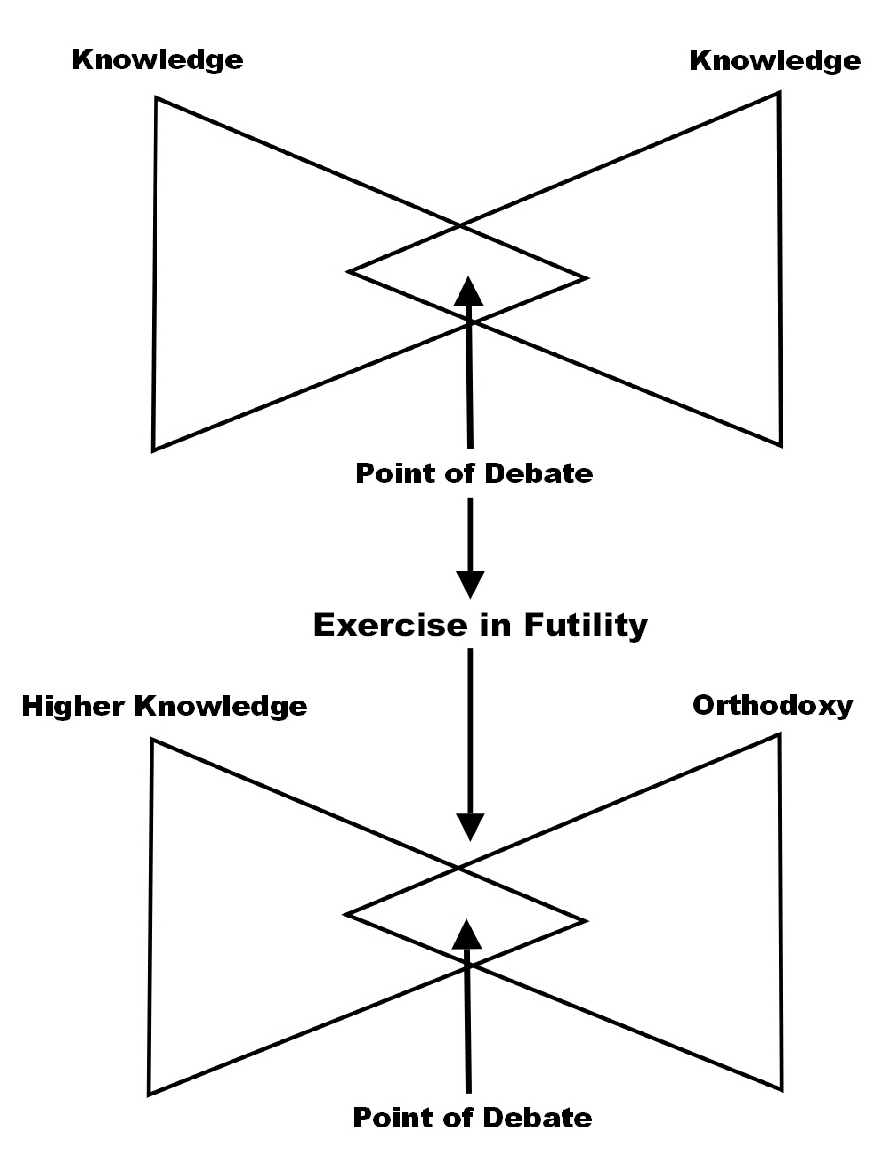
Not much ambiguity in that statement. Pretty clear on its face except for how one would apply it to real life. Again, many might scratch their head in regard to that statement, but proceed to let the theological orthodoxy that flows from it shape their life and thinking. At the point of debate with such people, their orthodoxed talking points will reflect the metaphysical premise. They will absolutely not be swayed in their thinking because they concede that they cannot understand the higher knowledge, and the authority of the higher knowledge is part of the orthodoxy.
Pause: I used to be involved in a ministry that evangelized Jehovah Witnesses. Debating the Bible with them led nowhere because their orthodoxy reinterprets all biblical terms and phraseology. When Christ is referred to, it is assumed that their presuppositions regarding Christ are the same, and they are not. Instead, we challenged their orthodoxy, i.e., the Watchtower publication. Likewise, let me reveal a concluding theme of this study: never debate the Bible with a Protestant; instead, bring their authority into question. Refuse to discuss anything else for it will be futile for reasons yet to be examined.
Let’s look at another statement from the New Covenant Theology camp:
At this time, resist the temptation to utilize subsequent passages to validate the meaning or to move out from the immediate context. Remembering that all exegesis must finally be a Christocentric exegesis.
Look for Christ even if He isn’t there directly. It is better to see Christ in a text even if He isn’t, than to miss Him where He is (The Biblical Theological Study Center: A Christo-Presuppositional Approach to the Entire Scriptures; Max Strange. Online source: http://goo.gl/5sGjP).
The question quickly becomes, “How can you see Jesus in every verse in the Bible?” This is where the Bible becomes a “meta-narrative.” That can mean, “grand narrative,” but in this case it means “metaphysical narrative.” The Bible is a narrative, or story that depicts redemptive reality. You will get confused unless you understand that the theory also posits the inclusion of multi-purpose perspectives into the metaphysical story (a story that depicts true reality). The text grammar doesn’t determine the perspective resulting in a particular objective outcome, but the assumed outcome determines the perspective. So, can “passages talking about incestuous rape” say something about redemption? Of course. In this example, the passage is not talking about Jesus specifically, but denotes why His redemptive works are needed. In some way, according to the prism, the verse always speaks of Jesus and His redemptive works.
This approach to interpreting reality (state of being, or metaphysics), what we call epistemology, plugs into the basic ancient philosophy of total inability. This proffers the idea that man cannot know or comprehend reality. The metaphysic follows: man dwells in a realm apart from true reality that he cannot comprehend. Secondly, somehow, usually via a theory of predeterminism, there are a select few that can ascertain truths from the other realm. Usually, the delineation of the realms is the material versus invisible with mankind residing in the material realm.
The Reformers recognized a reality that man functions in, but deemed it “subjective,” or shadowy. Focusing on this shadowy realm leads to despair. In the aforementioned foundational document of Protestantism, Luther contended that man’s material realm only feeds “the glory story,” or the story of man.
In Luther’s construct, ALL reality is interpreted through two stories: the glory story (the story of man), and the cross story (the story of redemption). Giving any credence to the material world or the belief that man can know the material world empirically only contributes to the story of man and his glory. Yes, man functions in this world, but it does not possess any objective wisdom that can bring true wellbeing. Only an ever-clearer understanding of the cross story can bring wellbeing.
What then is the cross story specifically? It is twofold: it is the holiness of God as set against the sinfulness of man. This is the only objective truth and reality that can bring wellbeing. The goal is a deeper and deeper understanding of how inept we are in every category of life as set against the glory and holiness of God.
Pause for main point: according to this philosophy, the sole purpose of the Bible is to lead us in seeing the cross story with more and more clarity. To the extent that we do that, we will have wellbeing. AND, to the extent that each individual lives according to the cross story, the wellbeing of society as a whole will increase. When Reformed folks talk about “transforming society with the gospel,” this is exactly what they are talking about. To the extent that the populous embraces the doctrine of inability, society will be transformed.
One reason for lauding this epistemology is unified agreement on interpretation. If every verse is about Jesus, there is no division in opinions. Secondly on this point, it gives Christianity a pass on defending inerrancy; e.g., narratives are not meant to be technical systems of theology that require consistency in logic. Thirdly on this point, if some sort of Christocentric conclusion is drawn from the text—it can’t be wrong. If the interpretation of the text somehow demeans man and exalts God, error is impossible.
Before we address the grammatical-historical approach to interpreting reality, let me add some thoughts to the redemptive-historical perspective. This perspective now dominates the institutional church. Just yesterday, I participated in a conversation on a social media site in which the following statement was made about Proverbs chapter 8:
The Old Testament reveals shadows of what Jesus Christ will be in the New Covenant. I can easily say that wisdom personified in Proverbs 8 is Jesus Christ.
If one reads Proverbs 8, the assertion that it is about Christ is beyond presumptuous at best. It is a complete rejection of the plain sense of the grammar; even in lieu of the personification being in the female gender.
Also, these two perspectives on reality are a salvific issue with the Reformed. A denial of total inability equates with the grammatical-historical view of reality which is supposedly an attempt by man to glorify himself by writing his own story. By believing that you can understand reality, you are in essence making yourself God.
The most common question is the issue of biblical imperatives that are clearly directed at mankind. This assumes that man is able to obey because grammatically, the commands are directed at him with a demand for obedience. But again, addressing these commands with the presupposition of total inability that equates with the redemptive-historical prism, the commands are supposedly meant to deliberately frustrate man and “drive him to despair of self-righteousness.”
The Reformed continually concede that the Bible states things in grammatical form, but that is always followed with the proper “gospel context” according to the redemptive-historical interpretation of reality. The classic example is this quotation from Neo-Calvinist Paul David Tripp:
….and the Bible does call us to change the way we think about things. But this approach again omits the person and work of Christ as Savior. Instead, it reduces our relationship to Christ to “think his thoughts” and “act the way Jesus would act.” (How People Change 2006, p.27).
Notice that Tripp concedes that the Bible calls us to do things according to the grammatical context, but goes on to say that is a denial of the gospel (omits the work of Christ as savior). On page 26 of the same book, Tripp calls obedience to the word of God a “behavioral approach” that “separates the commands of Scripture from their Christ-centered gospel context.”
Lastly before we move on, when one is able to wrap their minds around the redemptive-historical approach to interpreting reality, it will be recognized that this approach now saturates the Protestant institutional church.
What is the grammatical-historical approach to interpreting reality? As with the other prism, I am not going to elaborate on the “historical” part except to say that the redemptive-historical hermeneutic makes history part of the prewritten gospel narrative. History is simply the redemptive story playing out as scripted by God.
The political commentator Rush Limbaugh often notes that “words mean things.” This is a good working definition of grammatical-historical interpretation; it draws conclusions from a technical evaluation of the words in a sentence whether spoken or written. The many categories of language that give meaning are considered also, which speaks to the “historical” part of the term. Does the sentence mean the same thing today that it meant then? For instance a sentence written in 1940 might say, “Bob is gay.” History informs us of the meaning in that day: Bob is happy. Today that means Bob is a homosexual. The etymology of words and many other factors weigh-in, but all have this in common: they are empirical tools.
This interpretive method also assumes mankind is able to comprehend the realty he dwells in according to empirical observation and can draw conclusions on his own. Man has ability.
Pause: how did Luther get away with denying that mankind had any kind of ability at all? He chalked-it-up to man’s self-perceived ability that can accomplish things in the material world. These accomplishments are of no worth and only accomplish one thing and one thing only: they serve man’s lust to glorify himself. Luther believed that satisfaction from accomplishment was nothing more than sinful pride. To Luther, the only redeeming thing about the world was that heaven manifested its works on earth according to God’s sovereign will. If man lives life subjectively and professes that his evil “good” works cannot be distinguished from heavenly manifestations “experienced subjectively,” that is venial sin that can be forgiven. In accordance with authentic Reformed tradition, Luther believed the following: the belief that any man, including Christians, can perform a good work is mortal sin.
Therefore, the Reformed often define wisdom/knowledge according to two categories: “worldly knowledge” and “wisdom from above.” Sure, man can obtain worldly knowledge that improves his circumstances, but it is all prideful according to Luther. Wouldn’t this approach propagate a lot of death and misery due to a lack of science? Yes, but that was exactly Luther’s point. Many are perplexed by the embracing of ideologies that result in third world cultures, but those who are perplexed make the point for those in the other camp: what is the perplexity of the detractors? Answer: they are perplexed that other people do not lust after materialism as they do. Hence, third world cultures are often seen as being virtuous by the Reformed.
This is why Luther introduced suffering as a hermeneutic that interprets reality. There is true wisdom in the cross story because according to Luther, “all wisdom is hidden in suffering.” According to Luther, many reject this interpretation of reality and dub it the “foolishness of the cross.” Luther also stated that men call the good evil (suffering), and evil good (anything that prevents suffering). This is why Luther called reason an “ugly whore who should have dung rubbed in her face.”
The grammatical-historical perspective of reality assumes man can interpret his own reality, and the material world is not inherently evil. Believers and unbelievers share common realities that are simply practical and not evil.
Here is the challenge: to bring biblical knowledge to bear on grammatical-historical reality when the prevailing view of Protestantism has been the redemptive prism for hundreds of years.
But there is good news as well: the grammatical prism is what man utilizes intuitively. People assume they can interpret their own reality. Of course, the Reformed see this as the very problem.
Does this mean that grammatical-historical Christians should evangelize the lost world and forgo debate with Protestants? Yes it does, because it is a futile endeavor. You are trying to reach people who define reality itself differently. Protestants are redemptive-historical religionists.

The Protestant Twisting of 1John: A Clarification, Part 5 – Law, Gospel, and Love
Listen to show audio or download audio file.
Welcome to Blogtalk Radio False Reformation this is your host Paul M. Dohse Sr. Tonight, part 5 of “The Protestant Twisting of 1John: A Clarification.” If you would like to add to our lesson or ask a question, call (347) 855-8317. Remember to turn your PC volume down to prevent feedback. Per the usual, we will check in with Susan towards the end of the show and listen to her perspective.
If you would like to comment on our subject tonight, you can also email me at paul@ttanc.com. That’s Tom, Tony, Alice, Nancy, cat, paul@ttanc.com. I have my email monitor right here and can add your thoughts to the lesson without need for you to call in.
This is our final segment on 1John, and next week we will be doing a book review on “How People Change” by Paul David Tripp. I will be doing an overview of each of the 16 chapters in the book according to the theses of each chapter, and then will explain how the different points of each chapter fit together to form a particular doctrine. All in all, the book represents a pretty impressive application of Reformed mysticism.
Then, the following week, starting on May 8th, I think the time has come to do an in-depth evaluation of the Heidelberg Disputation. Martin Luther’s 95 Theses launched the Reformation, but all Reformed doctrines flow from the Heidelberg Disputation. Though very subtle, our present church culture is saturated with a collectivist doctrine of death, and I want to show exactly where this culture of death came from. We will be evaluating the Heidelberg Disputation theses by theses. How many Baptists know anything about the Heidelberg Disputation? Few, if any, yet the foundation of evangelicalism flows from this document.
Last week, I got away from our Gnostic theme and showed a correlation between John’s theology and that of the apostle Paul. The focus was the new birth, which Gnosticism denies. The historical backdrop is John’s pushback against Gnosticism which denies that people change. The Gnostics of that day believed that the material realm is evil and the spiritual realm is pure.
The goal is wellbeing that comes from getting beyond the five senses in order to gain knowledge. The particular vein of Gnosticism that John was contending against believed that sin only occurs in the body, and man’s spirit has never sinned per se. As a result, God’s people were being taught that what they did in the body was insignificant, and man didn’t need to deal with sin. Gaining spiritual knowledge for their own wellbeing was the key to having a happy life.
They denied that Christ really came as a man and was God’s Son. They taught that there were two Christ’s; one born of men and a Christ that was a spiritual avatar of sorts.
At any rate, the doctrine denied Christ’s deity, that He came to die for sin, and that mankind needed forgiveness for sin. Consequently, it also denied the new birth. In the same way Protestantism obviously denies that people change, redefine the new birth as an ability to perceive realm manifestation, and have their own unique distortion of the Trinity. When it gets right down to it, authentic Protestantism posits the Father and the Spirit as shadows of Christ.
Therefore, in chapter 3, John focuses on the new birth and why it changes us. But the dominate theme of the book, especially chapters 4 and 5, concentrates on love. Why is that? Because love in action should be the primary focus of Christians. Instead, what is the primary focus of Protestantism? Right; sin, sin, sin, sin, sin. Yes, our focus must be keeping our sins covered by the perfect righteousness of Jesus. Every song you sing, every sermon you hear is about how glorious Jesus is as set against our wretched vile selves. It boils down to praising our ability to see how rotten we are in the name of Jesus.
Look, 1Corinthians 13:6 defines love as something that doesn’t rejoice in evil, but clearly, Protestants rejoice in “grace,” that is, seeing our evil as set against the holiness of God. Like the Gnosticism that John was dealing with, Protestantism turns love completely upside down. That’s the problem we want to solve tonight.
In the first parts of this series, we focused on the Gnostic backdrop, but last week, we brought in the teachings of Paul to better understand what John was writing, and that’s what we are going to do tonight.
Why does Protestantism, like Gnosticism, circumvent love, and what can we do about it? Let’s first consider what 1John states about love:
1John 4:7 – Beloved, let us love one another, for love is from God, and whoever loves has been born of God and knows God. 8 Anyone who does not love does not know God, because God is love.
1John 5:1 – Everyone who believes that Jesus is the Christ has been born of God, and everyone who loves the Father loves whoever has been born of him. 2 By this we know that we love the children of God, when we love God and obey his commandments. 3 For this is the love of God, that we keep his commandments.
Do you see the huge problem with focusing on sin and not love? And I don’t mean God’s love for us because we are such vile sinners, I mean our love towards God and others. Note what somebody sent the blog this week which is indicative of what we hear constantly in the church. They heard this on K-Love Christian radio:
Who am I, that the Lord of all the earth
Would care to know my name,
Would care to feel my hurt?
Who am I, that the Bright and Morning Star
Would choose to light the way
For my ever wandering heart?
Not because of who I am
But because of what You’ve done.
Not because of what I’ve done
But because of who You are.
I am a flower quickly fading,
Here today and gone tomorrow.
A wave tossed in the ocean.
A vapor in the wind.
Still You hear me when I’m calling.
Lord, You catch me when I’m falling.
And You’ve told me who I am.
I am Yours, I am Yours.
This is what we hear incessantly in the church. Where is the focus on our love towards others and God? In order to return to the right focus on love, we need the right theology, so let’s get to it.
Whatever form of Protestantism you are talking about, and Calvinism in particular, its Achilles’ heel is the law. Protestantism cannot pass the true gospel test because of its position on law, and this is not hard to understand.
Andy Young, an associate of TANC ministries, said something in last year’s 2014 conference that is probably true for the most part: “The law is for sanctification.” Right, because the law is in no wise for justification. We are justified apart from the law (Romans 3:21) and “apart” means exactly that. The fact that the law will judge people in the end is a separate issue altogether.
The apostle Paul makes all of this easy to understand in Galatians chapter 3. But first, let’s use that same chapter to establish what we mean by the word, “law.” The word is used interchangeably with many other words, including, “gospel” to refer to the Bible. So, Andy was merely saying that the Bible is for sanctification, or in other words, Christian living. Andy was talking in context of sanctification for the Bible has no stake in justification, and again, the fact that the Bible will judge people in the end is another issue. Yes, the Bible defines justification (Rom 3:21, Gal 4:21); yes, the Bible testifies to the truths regarding justification, but the law does not justify.
Note the following from Galatians 3:
21 Is the law then contrary to the promises of God? Certainly not! For if a law had been given that could give life, then righteousness would indeed be by the law. 22 But the Scripture imprisoned everything under sin, so that the promise by faith in Jesus Christ might be given to those who believe.
Notice that Paul uses the word “law” and “Scripture” interchangeably. The law, “holy writ,” “the word,” “the gospel,” “the Scriptures,” “the law and the prophets,” etc. are all terms that refer to the Bible which is a full orbed statement by God regarding Himself, mankind, and reality. Statements like this: “We are not bound by the law, or else we’d have to live under every aspect of the law including not wearing blended fabrics and not eating shrimp and bacon” reveal a fundamental ignorance in regard to what the law is.
Protestantism falls on this one basic principle: law is the standard for righteousness. This makes the salvific work of Christ two-fold: He died to pay the penalty for our sins, and came to fulfill the law for us in order to make us righteous. That’s gross heresy. That’s an egregious false gospel. Hence, you have two kinds of Protestants: one camp that understands the position and professes it, and the other camp who also confesses it, but has not thought out the ramifications. This includes Baptists, Methodists, and many others. Baptists parted ways with the Reformers on baptism, but have never repented of making the law justification’s standard.
Yes, Jesus said that He came to fulfill the law and to not end it, but then we have the apostle Paul writing that Christ in fact did come to end the law, so does the Bible contradict itself? By no means.
Here is the problem: by design, Protestants don’t interpret the Bible in context of sanctification and justification, and again, that is by design. Why? Because Protestantism is founded on the idea that sanctification is merely the progression of justification. This also goes hand in glove with the idea that the law is justification’s standard. Hence, the law must continue to be fulfilled perfectly to keep the saints justified. This results in the confused theological train wreck we call Protestantism.
When the law must be continually fulfilled perfectly as a standard for justification, the law cannot be used for love because now you have fused love and justification together. This is why churches lack love; the maintaining of justification and love are confused. In the Bible, love is absolutely synonymous with obedience. Unfortunately, Protestantism makes obedience a justification issue. Obedience is not a justification issue—it’s a love issue. That’s why there is so much love-bombing in churches; true love is stifled because it is confused with justification. The vacuum is then filled with empty words and programs. People are in bondage to the law in Jesus’ name and their pain is medicated by praise bands, personality cults, and the splendor of institutional temples.
The fulfillment of the law in Jesus’ name is a huge problem—there is no law in justification regardless of who keeps it. Who keeps it is not the issue, the law is the issue. Here is the theses of Paul’s argument in Galatians 3: Only God can give life through faith alone in the promise. What is the promise? It was a promise made to Abraham and Christ that Israel and the Gentiles would be blessed with eternal life, and that Christ would be resurrected by the power of the Holy Spirit in order to make that possible:
Galatians 3:15 – To give a human example, brothers: even with a man-made covenant, no one annuls it or adds to it once it has been ratified. 16 Now the promises were made to Abraham and to his offspring. It does not say, “And to offsprings,” referring to many, but referring to one, “And to your offspring,” who is Christ. 17 This is what I mean: the law, which came 430 years afterward, does not annul a covenant previously ratified by God, so as to make the promise void. 18 For if the inheritance comes by the law, it no longer comes by promise; but God gave it to Abraham by a promise.
So in other words, if Christ came to also fulfill the law, the Promise is fulfilled by law, and not God’s promise made to Abraham. By the way, this term, “the promise” is a major biblical term referring to the gospel. In regard to justification, Christ came for one reason: to end the curse of the law:
Galatians 3:10 – For all who rely on works of the law are under a curse; for it is written, “Cursed be everyone who does not abide by all things written in the Book of the Law, and do them.” 11 Now it is evident that no one is justified before God by the law, for “The righteous shall live by faith.” 12 But the law is not of faith, rather “The one who does them shall live by them.” 13 Christ redeemed us from the curse of the law by becoming a curse for us—for it is written, “Cursed is everyone who is hanged on a tree”— 14 so that in Christ Jesus the blessing of Abraham might come to the Gentiles, so that we might receive the promised Spirit through faith.
If we still rely on the works of the law, we are under a curse; again, it doesn’t matter who keeps it. Paul spent most of his ministry trying to hammer this point home. Here, he makes it clear that the law was not part of the original promise, and once a covenant has been ratified, nothing can change it. If Christ fulfilled the law in our stead, that is clearly an addition to the original covenant of promise—that’s Paul’s specific point.
But now Protestants once again protest that the key is a perfect fulfillment of the law which only curses those who cannot keep it perfectly. Christ’s perfect obedience to the law is then imputed to us. In light of this chapter in Galatians, this position is fraught with problems. Clearly, it’s still an addition to the original covenant. Also, key is who the promise is made to; ie., the descendants of Abraham which include the Gentiles, and Christ Himself. Paul emphasizes that there is only ONE seed (verse 16). Why?
“Seed” is key. The Greek word refers to offspring. Christ was part of Abraham’s lineage, and is only ONE seed—there is not more than one seed. Christ died to end the curse of the law by dying to pay the penalty of sin, and then waited (in a manner of speaking) in the grave for the promise that was also made to Him: “the promised Spirit.” The Spirit raised Christ from the grave:
Romans 8:11 – If the Spirit of him who raised Jesus from the dead dwells in you, he who raised Christ Jesus from the dead will also give life to your mortal bodies through his Spirit who dwells in you.
Ephesians 1:19 – and what is the immeasurable greatness of his power toward us who believe, according to the working of his great might 20 that he worked in Christ when he raised him from the dead and seated him at his right hand in the heavenly places,
The promised Spirit is major here. This is the new birth. This promise of the Spirit accomplished three universe-shaking objectives: it enabled mankind to follow Christ in literal death and resurrection, baptized Jews and Gentiles into one body, or family of God, cancelled judgement and condemnation, and set God’s children free to aggressively love.
The idea that Christ fulfilled the law in order to satisfy justification usurps the Spirit’s role in the promise. God elected the means of salvation, Christ died, and the Spirit baptizes. God initiated salvation, Christ paid the penalty for sin, and the Spirit regenerates. We are not justified by the law, we are justified by the new birth:
Romans 4:20 – No distrust made him waver concerning the promise of God, but he grew strong in his faith as he gave glory to God, 21 fully convinced that God was able to do what he had promised. 22 That is why his faith was “counted to him as righteousness.” 23 But the words “it was counted to him” were not written for his sake alone, 24 but for ours also. It will be counted to us who believe in him who raised from the dead Jesus our Lord, 25 who was delivered up for our trespasses and raised for our justification. (ESV 2001).
Galatians 3:1 – O thoughtless Galatians, who did bewitch you, not to obey the truth — before whose eyes Jesus Christ was described before among you crucified? 2 this only do I wish to learn from you — by works of law the Spirit did ye receive, or by the hearing of faith? 3 so thoughtless are ye! having begun in the Spirit, now in the flesh do ye end? (YLT).
Notice the idea of completion reflected by the Greek and properly translated by the YLT. We don’t receive the Spirit and His work on the installment plan when we believe; the new birth is a complete work. Hence, the new birth, or the Spirit’s baptism is what makes us righteous or justified, not the law.
Again, God set forth the plan of salvation, Christ died to end the law, and the Spirit regenerates us and helps us in our progression of holiness. We are born of the Spirit and resurrected as holy babies born of God, and grow up in holiness (1Peter 2:2). The baptism of the Spirit is therefore twofold:
Romans 6:1 – What shall we say then? Are we to continue in sin that grace may abound? 2 By no means! How can we who died to sin still live in it? 3 Do you not know that all of us who have been baptized into Christ Jesus were baptized into his death? 4 We were buried therefore with him by baptism into death, in order that, just as Christ was raised from the dead by the glory of the Father, we too might walk in newness of life.
5 For if we have been united with him in a death like his, we shall certainly be united with him in a resurrection like his. 6 We know that our old self was crucified with him in order that the body of sin might be brought to nothing, so that we would no longer be enslaved to sin. 7 For one who has died has been set free from sin. 8 Now if we have died with Christ, we believe that we will also live with him. 9 We know that Christ, being raised from the dead, will never die again; death no longer has dominion over him. 10 For the death he died he died to sin, once for all, but the life he lives he lives to God. 11 So you also must consider yourselves dead to sin and alive to God in Christ Jesus.
Romans 7:1 – Or do you not know, brothers—for I am speaking to those who know the law—that the law is binding on a person only as long as he lives? 2 For a married woman is bound by law to her husband while he lives, but if her husband dies she is released from the law of marriage. 3 Accordingly, she will be called an adulteress if she lives with another man while her husband is alive. But if her husband dies, she is free from that law, and if she marries another man she is not an adulteress.
4 Likewise, my brothers, you also have died to the law through the body of Christ, so that you may belong to another, to him who has been raised from the dead, in order that we may bear fruit for God. 5 For while we were living in the flesh, our sinful passions, aroused by the law, were at work in our members to bear fruit for death. 6 But now we are released from the law, having died to that which held us captive, so that we serve in the new way of the Spirit and not in the old way of the written code.
Colossians 2:8 – See to it that no one takes you captive by philosophy and empty deceit, according to human tradition, according to the elemental spirits of the world, and not according to Christ. 9 For in him the whole fullness of deity dwells bodily, 10 and you have been filled in him, who is the head of all rule and authority. 11 In him also you were circumcised with a circumcision made without hands, by putting off the body of the flesh, by the circumcision of Christ, 12 having been buried with him in baptism, in which you were also raised with him through faith in the powerful working of God, who raised him from the dead. 13 And you, who were dead in your trespasses and the uncircumcision of your flesh, God made alive together with him, having forgiven us all our trespasses, 14 by canceling the record of debt that stood against us with its legal demands. This he set aside, nailing it to the cross. 15 He disarmed the rulers and authorities and put them to open shame, by triumphing over them in him.
Why would Christ fulfil the law and then die to end it? Why would Christ’s perfect obedience to law be imputed to us when it is no longer valid? Why would Christ fulfil the law for those who die with Him and are no longer under that law? Why would Christ fulfil a law that has nothing to say to us? (Romans 3:19). When Paul states, “For all who rely on works of the law are under a curse” (verse 10), that means any works of the law period, not just what we perform, but any works of the law period. The covenant of promise WAS NOT RATIFIED BY THE LAW THAT CAME 430 YEARS LATER. What could possibly be more evident? If Jesus kept the law perfectly as part of the gospel, that still ratifies the original covenant of promise.
But all of this is not even Paul’s primary argument. His primary argument is that only the Spirit can give life. His argument is that only the resurrection of the new birth gives life. If the law has any part in justification; the law can give life and there is more than one seed. Consequently, only God can give life and now there is a co-life-giver. That’s Paul’s argument exactly.
11 Now it is evident that no one is justified before God by the law, for “The righteous shall live by faith.” 12 But the law is not of faith, rather “The one who does them shall live by them.”
Life, justification, faith alone in the promise, and the new birth are all mutually inclusive while the law and justification are mutually exclusive—that’s exactly what the apostle Paul is saying.
Also, if law has anything to do with justification at all, we inherit eternal life by being born again into God’s family by the fulfillment of the law and NOT promise:
18 For if the inheritance comes by the law, it no longer comes by promise; but God gave it to Abraham by a promise.
Someone may argue, “But Jesus keeps the law perfectly!” So what of it? It’s still inheritance by the law and not promise. Again, and again; the original covenant was not ratified by Jesus’ perfect law-keeping. Here is what we must come to grips with: Protestantism is predicated on a juvenile perception of law and gospel.
16 Now the promises were made to Abraham and to his offspring. It does not say, “And to offsprings,” referring to many, but referring to one, “And to your offspring,” who is Christ.
20 Now an intermediary implies more than one, but God is one.
21 Is the law then contrary to the promises of God? Certainly not! For if a law had been given that could give life, then righteousness would indeed be by the law.
As an aside while on the subject of covenants: this whole idea of Jesus fulfilling the law plugs into the ever popular Covenant theology. This is the idea that Christ came to obey the law perfectly in order to restore the original and supposed covenant of works with Adam. But the Covenant of Promise was not made with Adam, it was made with Abraham. Compounding this glaring error is the citation of Genesis 3:15 to make a connection between Adam’s disobedience and Christ’s obedience to the law. But in that verse, it is the serpent that is being addressed and not Adam. Usually, when you make a covenant with someone, as with Abraham, it’s made with the person you are talking to. In essence, it claims that God made a covenant with the serpent.
Regardless of all of the splendor and glory affiliated with religious academia, it is found wanting in embarrassing proportions. The laity must stop listening to these people and start reading the Bible for themselves.
But with all of this said, “Why then the law?”(verse 19). However, which law is Paul referring to when he presents this anticipated question in verse 19? There are two laws: one known as, “the written code” (Colossians 2:14), “the law of sin and death” (Romans 8:2), “the law of sin” (Romans 7:23), simply “the law” in many places, “the letter” (2Cor 3:6), “ministry of death” (2Cor 3:7), “ministry of condemnation” (2Cor 3:9), “the record of debt” (Col 2:14), and “the first covenant” (Hebrews 8:13).
The second is known as: “the law of the Spirit of life” (Romans 8:2), “the law of my mind” (Romans 7:23), “the law of liberty” (James 1:25), “the law of Christ” (Galatians 6:2), and because love fulfills the whole law (Romans 13:8-10), it can be rightly called “the law of love.”
In verse 19, Paul is referring to the first law. It only condemns and judges, but that’s not its only function by far.
19 Why then the law? It was added because of transgressions, until the offspring should come to whom the promise had been made, and it was put in place through angels by an intermediary. 20 Now an intermediary implies more than one, but God is one.
21 Is the law then contrary to the promises of God? Certainly not! For if a law had been given that could give life, then righteousness would indeed be by the law. 22 But the Scripture imprisoned everything under sin, so that the promise by faith in Jesus Christ might be given to those who believe.
23 Now before faith came, we were held captive under the law, imprisoned until the coming faith would be revealed. 24 So then, the law was our guardian until Christ came, in order that we might be justified by faith. 25 But now that faith has come, we are no longer under a guardian, 26 for in Christ Jesus you are all sons of God, through faith. 27 For as many of you as were baptized into Christ have put on Christ. 28 There is neither Jew nor Greek, there is neither slave nor free, there is no male and female, for you are all one in Christ Jesus. 29 And if you are Christ’s, then you are Abraham’s offspring, heirs according to promise.
What’s this saying? First, it’s saying that the first law has no function for believers after Christ died on the cross to END the law. And Christ did come to end the law of sin and death. Christ didn’t come to merely cover sin with His own righteousness, He came to end sin by ending the law (Romans 3:19,20, 4:15, 5:13, 7:6,8, 10:4, 1Tim 1:9, Gal 2:19).
Secondly, the first law covered believers until Christ died on the cross. The first law was an atonement for sin; all of the sins of Old Testament believers were imputed to that law, and then it was ended by Christ. The person who believes on Christ dies in baptism, and is no longer under the law that he/she sinned against (Romans 7:1ff). This would also include believers who were deceased at the time.
In regard to Old Testament believers that were dead during the time of Christ’s ministry on earth, Old Testament believers were captive under the law until Christ died to end the law. Therefore, they were in Sheol/Abraham’s bosom/Paradise/Hades. When Christ died, He went there and preached to the captives and took the thief on the cross with Him. When the Spirit resurrected Him, He also resurrected those in Sheol and set the captives free. They and their sins were held captive by the law until Christ died to end it. Remember, King David said, “For you will not abandon my soul to Sheol, or let your holy one see corruption” (Psalm 16:10). As a testimony, Christ sent many of them to walk around Jerusalem. Texts that help sum up all of these points are Ephesians 4:7-10 which also references Psalm 68:18, Luke 16:22, Matthew 27:51-53, and Colossians 2:13-15.
Thirdly, the first law still has a function in the scheme of things. The old covenant of the law is passing away, but is not ended for the unbelieving. “Under grace” did not end “under law” (Romans 6:14). The first law still holds sin captive because all sin is against the law (1John 3:4). Yes, for those who don’t repent, the law will judge them in the end. To the degree that they violate the law, they will be punished eternally.
But there is a sense in which the first law also serves a purpose of covering as it formally did for those under grace. When a person is saved and born again, they die and are no longer culpable to the law—the law is also ended for them at that time. Their sins are taken away and cast as far as the east is from the west. Again, Christ did not come to cover sin, he came to take sin away. The first law is grace in waiting. All sin is imputed to it, and it stands ready to be ended for each and every person who chooses to follow Christ in death and resurrection.
Now, what about the other law—the law of the Spirit of life? Let there be no doubt, there is a law that is under grace. It is the law of love. We have been released from the condemnation of the first law, and are now free to aggressively serve the law of Christ:
Romans 7:4 – Likewise, my brothers, you also have died to the law through the body of Christ, so that you may belong to another, to him who has been raised from the dead, in order that we may bear fruit for God.
In the same way that one sin formally violated the whole law (James 2:10), one act of love fulfills the law of Christ (Gal 5:14, Rom 13:10). Love covers a multitude of sin (1Peter 4:8). We are sanctified with the word of truth (John 17:17). The Christian life is faith WORKING through the obedience of love (Gal 5:6), and love is synonymous with obedience (John 14:15).
If a professing Christian is not truly bearing fruit for God as an expression of true love for truth, God, and others, he/she has a flawed view of the law’s relationship to the gospel.
What is sapping the power of Christianity in our day is misguided fear. When the ending of sin is confused with the idea of covering, excessive introspection ensues for fear that we are not living by a convoluted Protestant system of faith-alone works so that the perfect obedience of Christ will continue to be imputed to our Christian life.
In contrast, there is no longer any condemnation for those in Christ and fear has to do with judgement (Rom 8:30, 1Jn 4:16-19). Those mature in love cast away fear. They are free from the condemnation of the law and free to serve Christ in aggressive love.
Who will deny that the overwhelming preoccupation of Protestants is sin and not love while any appearance of good works are held suspect? Where there is not freedom to love without fearful introspection, love will not thrive.
Let’s go to the phones.
The Heart/Flesh Debate
Originally published May 12, 2011
~ Penned and researched by Brian Jonson, West Chester, Ohio
Heart Versus Flesh
There are hundreds of passages that use the term “heart” to describe the seat of human emotion, intelligence, morality, volition and religious life in general. However, most often, “heart” is used in Scripture as an idiom for the mind.
There is also present in scripture the heart of the unredeemed and the heart of the redeemed. Oftentimes the characteristics of the unredeemed heart are applied to the redeemed. I believe this is a critical error. The chart below shows the context of the unredeemed versus the redeemed and how the term “heart” is applied. It is by no means exhaustive, but certainly is representative of all passages. Notice, the application of the description of the unredeemed heart is never applied to the redeemed.
Characteristics of the Heart of the Saved and Lost
Unredeemed |
Redeemed |
| Ge 6:5 – Then the LORD saw that the wickedness of man was great on the earth, and that every intent of the thoughts of his heart was only evil continually.
Ge 6:6 – The LORD was sorry that He had made man on the earth, and He was grieved in His heart. Ge 8:21 – The LORD smelled the soothing aroma ; and the LORD said to Himself, “I will never * again curse the ground on account of man, for the intent of man’s heart is evil from his youth; and I will never again destroy every living thing, as I have done. Ex 4:21- The LORD said to Moses, “When you go back to Egypt see that you perform before Pharaoh all the wonders which I have put in your power; but I will harden his heart so that he will not let the people go. De 5:29 – ‘Oh that they had such a heart in them, that they would fear Me and keep all My commandments always *, that it may be well with them and with their sons forever! De 8:14 – then your heart will become proud and you will forget the LORD your God who brought you out from the land of Egypt, out of the house of slavery. 1Sa 7:3 – Then Samuel spoke to all the house of Israel, saying, “If you return to the LORD with all your heart, remove the foreign gods and the Ashtaroth from among you and direct your hearts to the LORD and serve Him alone; and He will deliver you from the hand of the Philistines.” 2Ch 12:14 – He did evil because he did not set his heart to seek the LORD. 2Ch 25:2 – He did right in the sight of the LORD, yet not with a whole heart. 2Ch 26:16 – But when he became strong, his heart was so proud that he acted corruptly, and he was unfaithful to the LORD his God, for he entered the temple of the LORD to burn incense on the altar of incense. Ps 73:1 – Surely God is good to Israel, To those who are pure in heart ! Ps 78:8 – And not be like their fathers, A stubborn and rebellious generation, A generation that did not prepare its heart And whose spirit was not faithful to God. Jer 5:23 – ‘But this people has a stubborn and rebellious heart; They have turned aside and departed. Jer 17:9 – “The heart is more deceitful than all else And is desperately sick; Who can understand it? Eze 14:4 – “Therefore speak to them and tell them, ‘Thus says the Lord GOD, “Any man of the house of Israel who sets up his idols in his heart, puts right before his face the stumbling block of his iniquity, and then comes to the prophet, I the LORD will be brought to give him an answer in the matter in view of the multitude of his idols, Eze 20:16 – because they rejected My ordinances, and as for My statutes, they did not walk in them; they even profaned My sabbaths, for their heart continually went after their idols. Mr 7:21 – “For from within, out of the heart of men, proceed the evil thoughts, fornications, thefts, murders, adulteries, Lu 6:45 – “The good man out of the good treasure of his heart brings forth what is good; and the evil man out of the evil treasure brings forth what is evil; for his mouth speaks from that which fills his heart. Ac 8:21 – “You have no part or portion in this matter, for your heart is not right before God. Ro 1:21 – For even though they knew God, they did not honor Him as God or give thanks, but they became futile in their speculations, and their foolish heart was darkened. Ro 2:5 – But because of your stubbornness and unrepentant heart you are storing up wrath for yourself in the day of wrath and revelation of the righteous judgment of God, Eph 4:18 – being darkened in their understanding, excluded from the life of God because of the ignorance that is in them, because of the hardness of their heart;
|
Ge 20:5 – “Did he not himself say to me, ‘She is my sister’? And she herself said, ‘He is my brother.’ In the integrity of my heart and the innocence of my hands I have done this.”
Ge 20:6 – Then God said to him in the dream, “Yes, I know that in the integrity of your heart you have done this, and I also kept you from sinning against Me; therefore * I did not let you touch her. 2Ch 16:9 – “For the eyes of the LORD move to and fro throughout the earth that He may strongly support those whose heart is completely His. You have acted foolishly in this. Indeed, from now on you will surely have wars.” Ps 7:10 – My shield is with God, Who saves the upright in heart. Ps 66:18 – If I regard wickedness in my heart, The Lord will not hear; Ps 73:1 – Surely God is good to Israel, To those who are pure in heart! Ps 86:12 – I will give thanks to You, O Lord my God, with all my heart, And will glorify Your name forever. Jer 24:7 – ‘I will give them a heart to know Me, for I am the LORD; and they will be My people , and I will be their God, for they will return to Me with their whole heart. Jer 31:33 – “But this is the covenant which I will make with the house of Israel after those days,” declares the LORD, “I will put My law within them and on their heart I will write it; and I will be their God, and they shall be My people . Jer 32:39 – and I will give them one heart and one way, that they may fear Me always *, for their own good and for the good of their children after them. Eze 11:19 – “And I will give them one heart, and put a new spirit within them. And I will take the heart of stone out of their flesh and give them a heart of flesh, Eze 36:26 – “Moreover, I will give you a new heart and put a new spirit within you; and I will remove the heart of stone from your flesh and give you a heart of flesh. Mt 5:8 – “Blessed are the pure in heart, for they shall see God. Mt 12:34 – “You brood of vipers, how can you, being evil, speak what is good ? For the mouth speaks out of that which fills the heart. Mt 15:18 – “But the things that proceed out of the mouth come from the heart, and those defile the man. Lu 6:45 – “The good man out of the good treasure of his heart brings forth what is good; and the evil man out of the evil treasure brings forth what is evil; for his mouth speaks from that which fills his heart. Ro 2:29 – But he is a Jew who is one inwardly; and circumcision is that which is of the heart, by the Spirit, not by the letter; and his praise is not from men, but from God. Ro 6:17 – – But thanks be to God that though you were slaves of sin, you became obedient from the heart to that form of teaching to which you were committed, Heb 10:22 – let us draw near with a sincere heart in full assurance of faith, having our hearts sprinkled clean from an evil conscience and our bodies washed with pure water. 1Pe 1:22 – Since you have in obedience to the truth purified your souls for a sincere love of the brethren, fervently love one another from the heart, 1Jo 3:21 – Beloved, if our heart does not condemn us, we have confidence before God; Addendum: Hebrews 10:22 – let us draw near to God with a sincere heart and with the full assurance that faith brings, having our hearts sprinkled to cleanse us from a guilty conscience and having our bodies washed with pure water. |
As you look at the references above, you’ll easily see that the Bible never applies the ugly characteristics of an unregenerate heart to a redeemed person. Why then, should we? God has renewed the heart of a believer and it is unbiblical to accuse the Body of Christ of having hearts that are unregenerated.
Where then, is the battle? The Bible teaches that the battle against sin is in the flesh, NOT the heart. Notice, please:
Mt 26:41
Keep watching and praying that you may not enter into temptation; the spirit is willing, but the flesh is weak.
Jesus is speaking to a redeemed person. He shows them that the danger is in the flesh, not the heart (perhaps synonymous with spirit in this passage).
Ro 7:5
For while we were in the flesh, the sinful passions, which were aroused by the Law, were at work in the members of our body to bear fruit for death.
Paul teaches here that our sinful passions are from the flesh.
Ro 7:18
For I know that nothing good dwells in me, that is, in my flesh; for the willing is present in me, but the doing of the good is not.
A critical passage! We know the Bible teaches that our flesh was not redeemed at salvation and, in fact, awaits the glorification described so clearly in 1 Corinthians 15. Therefore, we have a “redeemed heart” incarcerated in “unredeemed flesh.” This is exactly why we struggle. Notice:
Ro 7:14
For we know that the Law is spiritual, but I am of flesh, sold into bondage to sin.
Ro 7:25
Thanks be to God through Jesus Christ our Lord ! So then, on the one hand I myself with my mind am serving the law of God, but on the other, with my flesh the law of sin.
Ro 8:3
For what the Law could not do, weak as it was through the flesh, God did: sending His own Son in the likeness of sinful flesh and as an offering for sin, He condemned sin in the flesh,
Ro 8:4
so that the requirement of the Law might be fulfilled in us, who do not walk according to the flesh but according to the Spirit.
Ro 8:5
For those who are according to the flesh set their minds on the things of the flesh, but those who are according to the Spirit, the things of the Spirit.
Ro 8:6
For the mind set on the flesh is death, but the mind set on the Spirit is life and peace,
Ro 8:7
because the mind set on the flesh is hostile toward God; for it does not subject itself to the law of God, for it is not even able to do so,
Ro 8:8
and those who are in the flesh cannot * please God.
Ro 8:9
However, you are not in the flesh but in the Spirit, if indeed the Spirit of God dwells in you. But if anyone does not have the Spirit of Christ, he does not belong to Him.
Ro 8:12
So then, brethren, we are under obligation, not to the flesh, to live according to the flesh —
Ro 8:13
for if you are living according to the flesh, you must die; but if by the Spirit you are putting to death the deeds of the body, you will live.
The heart is not mentioned anywhere in this key teaching. Romans 6 through 8 contain the key teaching on our struggle against sin. And, it is clear; the struggle is centered on the flesh, not the heart.
Further evidence of this:
Ro 13:14
But put on the Lord Jesus Christ, and make no provision for the flesh in regard to its lusts.
1Co 3:1
And I, brethren, could not speak to you as to spiritual men, but as to men of flesh, as to infants in Christ.
How do we cleanse ourselves and appear holy before the Lord?
2Co 7:1
Therefore, having these promises, beloved, let us cleanse ourselves from all defilement of flesh and spirit, perfecting holiness in the fear of God.
Ga 5:13
For you were called to freedom, brethren; only do not turn your freedom into an opportunity for the flesh, but through love serve one another.
Ga 5:16
But I say, walk by the Spirit, and you will not carry out the desire of the flesh.
Ga 5:17
For the flesh sets its desire against the Spirit, and the Spirit against the flesh; for these are in opposition to one another, so that you may not do the things that you please.
Ga 5:19
Now the deeds of the flesh are evident, which are: immorality, impurity, sensuality,
Ga 5:24
Now those who belong to Christ Jesus have crucified the flesh with its passions and desires.
Ga 6:8
For the one who sows to his own flesh will from the flesh reap corruption, but the one who sows to the Spirit will from the Spirit reap eternal life.

New Calvinist Terms/Phraseology

Glossary of Gospel Sanctification Terms
_______________________
“Finally, I must deprecate, and I do it in love, the use of uncouth and new-fangled terms and phrases in teaching sanctification. I plead that a movement in favor of holiness cannot be advanced by new-coined phraseology, or by disproportioned and one-sided statements–or by overstraining and isolating particular texts–or by exalting one truth at the expense of another– or by allegorizing and accommodating texts, and squeezing out of them meanings which the Holy Spirit never put in them”
~ JC Ryle
Apostle’s hermeneutic: A supposed pattern of interpretation used by the apostles that replicates redemptive-historical hermeneutics. However, despite numerous challenges from various writers, NCT proponents have never been able to articulate it.
Christian hedonism: Invented by John Piper in 1980. He believes people are completely driven by their desires. Therefore, change the desires and you change the person. Piper believes we can only change our desires by meditating on the gospel as seen in the Bible, with a goal of making Christ our deepest desire. Therefore, a Christian hedonist is one who seeks pleasure in God. He also believes that biblical imperatives only serve to make us dependent on Christ and cherish Him more (because they show us what Christ has done for us, rather than anything we are supposed to do) – we are powerless to keep the Law. He cites Romans 6:17 to make this point, and believes Christians are still “enslaved” to sin (pages 31, 32, essay, pages 89-98).
Deep repentance: Repenting of idols in the heart which are discovered by identifying the desires that they (the idols) produce. The idols can be discovered by asking ourselves “X-Ray questions.” Repenting of the idols (after we discover them) “empties the heart” which leads to us being filled with Christ. This is followed by automatic, joyful obedience because Christ is obeying for us (pages 30, 201).
Good repentance: Repenting of good works, or anything we try to do in “our own efforts” as opposed to yielding to Christ and allowing Him to obey for us. Paul Tripp says this will result in “new and surprising fruit.” Tim Keller teaches that repenting of good works is also necessary for an authentic conversion.
Heart theology: The study and theories of how we discover idols in our heart (essay, pages 145-148).
In-lawed in Christ: The Law is completely fulfilled in Christ because He obeyed it perfectly. Therefore, we have no need to obey it, nor does it have any role in sanctification.
Imperative command is grounded in the indicative event: All biblical imperatives illustrate the work of Christ, not anything God expects us to do. As Paul Tripp states it: All biblical commands must be seen in their “gospel context”(essay, pages 82-86).
Imputed active obedience of Christ: Christ’s perfect life imputed His obedience to us so we wouldn’t have to obey to be justified in sanctification (since there is no difference between the two according to GS proponents). This is also called monergistic substitutionary sanctification
(see new obedience ).
Intelligent Repentance: Another term for deep repentance.
New Calvinism: The expression of New Covenant Theology (NCT) and all of its tenets; heart Theology, gospel sanctification, Christian hedonism, and the redemptive-historical hermeneutic.
New Covenant Theology: Conceived in, or about 1980. The belief that the New Covenant abrogated all aspects of the Old, including, and especially, the Law. The New Covenant replaced the Law with a single “higher law of love”(page 56).
New Legalism: Synergistic sanctification. Any attempt to apply the word of God “in our own efforts.”
New obedience: The result of deep repentance – Christ obeys for us. We know that it is not us obeying in “our own efforts” because when it is Christ obeying through us, the obedience will always be experienced with a willing, joyful spirit, or Christian hedonism (pages 31,194).
Progressive sanctification: Ongoing justification, which isn’t a one time act, but is continually applied to us as needed. Some advocates of NCT acknowledge a daily “re-saving.” Paul Tripp says that Christians need a “daily rescue,” and cites Romans 7: 24 (essay, pages 124-129).
Redemptive church discipline: A redemptive process (rather than a process for resolving conflict between Christians) to eradicate sin in general. It is often used to convert individuals to monergistic sanctification. In many churches, this process has been assimilated into their counseling programs (essays; pages 159-172).
Redemptive-historical hermeneutics: Invented by the liberal theologian Johann Philipp in the 17th century and further developed by Geerhardus Vos. It makes NCT possible by supplying a prism that will always yield redemptive concepts from the text (essay, pages 177-183).
Reorientation of the heart: Replacing idols with right desires. This happens when we repent of idols discovered through interpreting desires, and replacing them with lofty visions of the gospel and Christ, which produces godly desire instead of idols which produce evil desires (page
146).
Rich typology: It’s so rich, that it doesn’t read like typology, but rather seems to be literal, being so rich. Example; “Israel” doesn’t really mean “Israel,” but is always a reference to Christ. God’s word really doesn’t mean “word,” or “Law,” but is also 100% synonymous with “the person of Christ who personifies the Law.”
What does that look like? If your leaders start using this phraseology, again, it’s a red flag. It’s an attempt to eradicate the implication that Christians are supposed to participate in the verb world. Instead of: “what should we do?” It’s: “what does that look like when Jesus is doing it for us?”
What did you want? The most utilized interpretive question among the X-ray questions used to find idols in the heart.
Word pictures: If your pastor starts using this phraseology, it’s a red flag. The insinuation is that the Bible writers were writing a gospel narrative / novel / story rather than a document containing specific ideas / instruction to be drawn from the text by evaluating grammatical construction and historical context.
X-ray Questions: Interpretive questions used to identify idols of the heart.

 Paul's Passing Thoughts
leave a comment