Authentic Protestantism (aka “New Calvinism”) is Totally Debunked by 2Peter 1:1-15
This is a revised version of an article originally published on January 16, 2012
 2 Peter 1:1-14 contradicts almost all of the major tenets of authentic Protestantism: Christocentric salvation; Christocentric interpretation; double imputation; Christocentric sanctification; the total depravity of the saints; sanctification by faith alone; the imperative command is grounded in the indicative event; assurance based on gospel contemplationism; sanctification is not “in our OWN efforts”; the apostolic gospel.
Christocentric Salvation
“Simeon Peter, a servant and apostle of Jesus Christ, to those who have obtained a faith of equal standing with ours by the righteousness of our God and Savior Jesus Christ” (v1).
Salvation is not Christocentric. Peter states that we obtained our faith by God the Father AND Jesus Christ.
Christocentric Interpretation
“May grace and peace be multiplied to you in the knowledge of God and of Jesus our Lord” (v2).
The benefits of salvation are multiplied by the knowledge of both the Father and the Son. Of course, this knowledge can only come from the Scriptures. Obviously, knowledge of both is required for the multiplication of grace and peace. One may also note that when Peter restates this truth in verse 3, he only mentions the one “who called us” which of course is God the Father.
Double Imputation
“The imputed righteousness of Christ” is an often heard slogan among reformed. But it is the righteousness of God that was imputed to us by the New Birth when we believed in Christ (see v1). The believer is righteous because he is God’s literal offspring. Christ lived a perfect life as a man because of who He is (the Son of God), not for the purpose of imputing obedience to us as part of the atonement in sanctification.
Christocentric Sanctification
“His divine power has granted to us all things that pertain to life and godliness, through the knowledge of him who called us to his own glory and excellence” (v3).
Again, God the Father is the member of the Trinity who called us. Knowledge pertaining to the Father is efficacious in sanctification.
The Total Depravity of the Saints
“His divine power has granted to us all things that pertain to life and godliness, through the knowledge of him who called us to his own glory and excellence, 4 by which he has granted to us his precious and very great promises, so that through them you may become partakers of the divine nature, having escaped from the corruption that is in the world because of sinful desire” (v3,4).
“Partakers” is: koinōnos from koinos; a sharer, that is, associate: – companion, fellowship, partaker, partner. Koinos means: common, that is, (literally) shared by all or several and is derived from a primary preposition denoting union; with or together, that is, by association, companionship, process, resemblance, possession, instrumentality, addition, etc.: – beside, with. In compounds it has similar applications, including completeness.
Sanctification by Faith Alone
“For this very reason, make every effort to add to your faith goodness; and to goodness, knowledge; 6 and to knowledge, self-control; and to self-control, perseverance; and to perseverance, godliness; 7 and to godliness, brotherly kindness; and to brotherly kindness, love” (v 5,6,7).
Obviously, if sanctification is by faith alone, Peter wouldn’t tell us to ADD anything to it.
The Imperative Command is Grounded in the Indicative Event
“For if you possess these qualities in increasing measure, they will keep you from being ineffective and unproductive in your knowledge of our Lord Jesus Christ. 9 But if anyone does not have them, he is nearsighted and blind, and has forgotten that he has been cleansed from his past sins. 10 Therefore, my brothers, be all the more eager to make your calling and election sure. For if you do these things, you will never fall, 11 and you will receive a rich welcome into the eternal kingdom of our Lord and Savior Jesus Christ” (v8,9,10,11).
Glorification (and one could argue assurance as well) is an indicative act, but in these verses, it is contingent and preceded by imperatives. Peter uses the conjunction “if” three times to conjoin imperatives preceding the indicative.
Assurance Based on Gospel Contemplationism
One of the more hideous teachings of the Reformation is that guilt is indicative of not understanding grace. Therefore, saints will not be told to take biblically prescribed action to relieve guilt, but will be told to further contemplate the gospel. There is barely anything more powerful in the Christian life than full assurance of salvation, and Peter tells us in no uncertain terms how to obtain it: aggressively adding certain things to our faith.
Sanctification is not “in our OWN efforts.”
Authentic Protestantism, by default, disavows our effort in sanctification by continually utilizing the either/or hermeneutic: it’s either all our effort, or all of Christ. Though we can do nothing without Christ, Peter makes it clear that peace and assurance will not take place if we do not “make every effort” (ESV).
The Apostolic Gospel
“So I will always remind you of these things, even though you know them and are firmly established in the truth you now have. 13 I think it is right to refresh your memory as long as I live in the tent of this body, 14 because I know that I will soon put it aside, as our Lord Jesus Christ has made clear to me. 15 And I will make every effort to see that after my departure you will always be able to remember these things” (v12,13,14,15).
Think about it. It had been revealed to Peter that his departure was near, so his ministry was focused on what he thought was the most important thing that they needed to be continually reminded of. Where is, “The same gospel that saves us sanctifies us”? Where is, “We must preach the gospel to ourselves every day”? Where is, “Beholding the face of Christ as a way of becoming”?
paul
The “Cross Story” and Sanctified Rape in the Church
Originally published January 31, 2013
 “Be sure of it: this is how Calvinists think; this is their worldview.”
“Don’t misunderstand: the problem of ‘victim mentality’ is not even on the radar screen—they have removed the word “victim” from their metaphysical dictionary.”
“Justice necessarily implies victim. Victim necessarily implies worth. All three are conspirators with the glory story.”
Martin Luther had more on his mind than silly Popes when he nailed his 95 Theses to the front door of All Saints’ Church in Wittenberg, Germany. That protest launched the Reformation, but six months later Luther presented the systematic theology of the Reformation to the Augustinian Order in Heidelberg. Luther’s Heidelberg Disputation laid the foundation, and John Calvin later articulated and applied its basic principles to the full spectrum of life in his Institutes of the Christian Religion.
The Cross Story and the Glory Story
Luther’s cross story, or theology of the cross is the crux of the Heidelberg Disputation and introduced in the first sentence of the Calvin Institutes:
Our wisdom, insofar as it ought to be deemed true and solid wisdom, consists almost entirely of two parts: the knowledge of God and of ourselves.
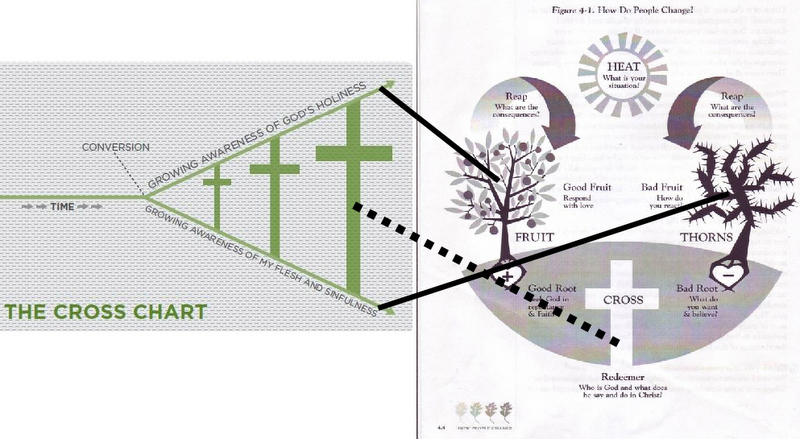
That’s Luther’s theology of the cross: a deeper and deeper knowledge of our putrid humanity as set against God’s holiness. And NOTHING in-between. All of creation, all events, and all reality contribute to deeper knowledge of one of these two, and then both as a deeper knowledge of each gives more understanding to the other; knowledge of both, and the experience of both. Hence, every blessing, including our good works which are done by the Holy Spirit to begin with, lends more understanding of God’s glory. Every evil event, sin, and tragedy lends deeper understanding in regard to our total depravity and worthlessness. But of course your mother is dying of cancer; I am amazed that God would give anyone as many years as He has given her. Who are we to think we deserve even one year of life? And what a wonderful opportunity for her to suffer the way Jesus suffered for us!
This is the cross story. See the illustration below. This is a contemporary depiction from that camp—this is their assessment:

Anything else at all that gives any credit to humanity—Christian or non-Christian is the “glory story.” That would be our glory specifically, and not Christ’s. To the degree that humanity is considered, the glory of Christ is “ECLIPSED.” This is the theses of a book written by John MacArthur associate Rick Holland: Uneclipsing The Son. Everything is perceived as speaking through one of these two perspectives. ANYTHING coming from what is perceived as the “glory story” is summarily dismissed. Be sure of it: this is how Calvinists think. This is their worldview.
In one of the former Resolved Conferences sponsored by John MacArthur and Holland, in one of his messages, Holland extols a letter written to Puritan Christopher Love by his wife as he awaited execution. Holland forgot to mention to those listening that Love was executed for espionage against the English government while letting the audience assume he was executed for loftier spiritual-like reasons. The following is excerpts from the letter:
O that the Lord would keep thee from having one troubled thought for thy relations. I desire freely to give thee up into thy Father’s hands, and not only look upon it as a crown of glory for thee to die for Christ, but as an honor to me that I should have a husband to leave for Christ…. I dare not speak to thee, nor have a thought within my own heart of my own unspeakable loss, but wholly keep my eye fixed upon thy inexpressible and inconceivable gain. Thou leavest but a sinful, mortal wife to be everlastingly married to the Lord of glory…. Thou dost but leave earth for heaven and changest a prison for a palace. And if natural affections should begin to arise, I hope that the spirit of grace that is within thee will quell them, knowing that all things here below are but dung and dross in comparison of those things that are above. I know thou keepest thine eye fixed on the hope of glory, which makes thy feet trample on the loss of earth.
Justice? That implies that humanity has some sort of value. That implies that life itself has some sort of value. That implies that humanity should be protected through threat of punishment. That’s the glory story. Therefore, Calvin stated the following:
Those who, as in the presence of God, inquire seriously into the true standard of righteousness, will certainly find that all the works of men, if estimated by their own worth, are nothing but vileness and pollution, that what is commonly deemed justice is with God mere iniquity; what is deemed integrity is pollution; what is deemed glory is ignominy (CI 3.12.4).
Death by Biblical Counseling
The church must face up to a sobering reality in our day. The vast majority of biblical counseling that goes on in our day is based on this construct—you will be counseled from the perspective of the cross story, and anything that smacks of the glory story will be snubbed. You are not a victim. There is no such thing as a victim. Christ was the only true victim in all of history. Don’t misunderstand: the problem of “victim mentality” is not even on the radar screen—they have removed the word “victim” from their metaphysical dictionary. “Victim” is part of the glory story; Christ as the only victim is the cross story. I am not a victim. That’s impossible because my sin nailed Christ to the cross. Thank you oh Lord that I was raped. Thank you for this opportunity to suffer for you. Thank you for the strength to forgive the one who raped me in the same way you forgave me. What a wonderful opportunity to show forth your gospel!
Hence, when the leaders of a Reformed church came to inform parents that a young man in that church had molested their toddler, this was the opening statement:
Today, we have before us an opportunity to forgive.
The parents were then counseled to not contact the authorities. Those who do are often brought up on church discipline. Justice necessarily implies victim. Victim necessarily implies worth. All three are conspirators with the glory story. And be not deceived: this is the logic that drives Reformed organizations that are supposed to be mediators in the church; specifically, Peacemaker Ministries and G.R.A.C.E. A major player in the Biblical Counseling Movement is Paul David Tripp. In 2006, he wrote a book that articulates the horizontal application of Luther’s theology of the cross: “How people Change.” Of course, the title is a lie; if he really believed people change, that would be the glory story. Notice also that it is, “How People Change” and not, “How Christians Change.” That’s because this bunch see no difference in the transforming power of the new birth and ordinary Christ-rejecting people.
In the book, Tripp, like all who propagate Luther’s theology of the cross, posits the Bible as a “big picture” narrative of our redemptive life. The Bible is a mere tool for one thing only: leading us more and more into the cross story and away from the glory story. This is accomplished by using the Bible to enter into the cross narrative and thereby seeing our preordained part in the “big picture” narrative of redemptive history. Though Tripp is not forthright about it in the book, this is known as the Redemptive Historical Hermeneutic. By seeing our life through the cross story, we are empowered to live life for God’s glory. This is done by seeing ALL circumstances in life (Heat) as preordained in order to show our sinfulness (Thorns) and God’s goodness (Fruit) for the purposes of having a deeper understanding of both resulting in spiritual wellbeing. In other words, all of life’s circumstances are designed to give us a deeper understanding of the cross story: God’s holiness, and our sinfulness. I have taken his primary visual illustration from the book and drawn lines to the cross story illustration to demonstrate the relationship (click on image to enlarge):
Understanding this lends insight to Tripp citations on the Peacekeepers Ministries website:
Paul Trip wrote a great post over at The Gospel Coalition blog all about the need for pastors to pursue a culture of forgiveness in their ministry. Pastors (and anyone serving Christ) have a choice:
“You can choose for disappointment to become distance, for affection to become dislike, and for a ministry partnership to morph into a search for an escape. You can taste the sad harvest of relational détente that so many church staffs live in, or you can plant better seeds and celebrate a much better harvest. The harvest of forgiveness, rooted in God’s forgiveness of you, is the kind of ministry relationship everyone wants.”
Then he describes three ways forgiveness can shape your ministry. I’ve listed them, but you can read how he explains them in detail.
“1. Forgiveness stimulates appreciation and affection.
2. Forgiveness produces patience.
3. Forgiveness is the fertile soil in which unity in relationships grows.”
He closes with this exhortation:
“So we learn to make war, but no longer with one another. Together we battle the one Enemy who is after us and our ministries. As we do this, we all become thankful that grace has freed us from the war with one another that we used to be so good at making.”
And concerning another author, they also stated:
Last week, Steve Cornell at The Gospel Coalition blog posted some really great insight into the difference between forgiveness and reconciliation. They also offered up some excellent and biblically sound steps in dealing with a situation where an offending party is hesitant to reconcile.
Here he summarizes a key distinction:
“It’s possible to forgive someone without offering immediate reconciliation. It’s possible for forgiveness to occur in the context of one’s relationship with God apart from contact with her offender. But reconciliation is focused on restoring broken relationships. And where trust is deeply broken, restoration is a process—sometimes, a lengthy one”…. His ten guidelines for those hesitant to reconcile are rooted in scripture and, I think, incredibly helpful.
1. Be honest about your motives.
2. Be humble in your attitude.
3. Be prayerful about the one who hurt you.
4. Be willing to admit ways you might have contributed to the problem.
5. Be honest with the offender.
6. Be objective about your hesitancy.
7. Be clear about the guidelines for restoration.
8. Be alert to Satan’s schemes.
9. Be mindful of God’s control.
10. Be realistic about the process.
Notice the overall blurring of distinction between the offended and offender with the subject of forgiveness.
The Cross-centered Anti-justice Pandemic is No longer Exclusively a Reformed Thing
Apart from Calvinism, the redemptive historical cross-centered approach is crossing denominational lines en masse. We at TANC see doctrines that were born of Luther’s theology of the cross in non-Reformed circles constantly; specifically, heart theology (deep repentance), exclusive interpretation of the Scriptures through a redemptive prism, Gospel Sanctification, and John Piper’s Christian hedonism. And we also see the same results. It is not beyond the pale for a pastor who has raped a parishioner to be the one counseling the victim sinner. You know, the “sinner saved by grace.”
God is a God of justice, and throughout the Scriptures He demands that we be people of justice. He demands that we come to the defense of the victim. I close with fitting words from church historian John Immel:
And this is the challenge. This is the challenge that I have as a man who is passionate about thinking: to inspire people to engage in complex ideas that drive tyranny. So here’s my challenge to those who are listening.
Do not be seduced into believing that righteousness is retreat from the world.
Do not be seduced into believing that spirituality is defined by weakness and that timid caution for fear of committing potential error is a reason to be quiet.
Do not be intimidated by vague, hazy threats of failure.
Do not let yourself believe that faith is a license to irrationality. I’m going to say that again to you. This is good. Do not let yourself believe that faith is a license to irrationality.
Do not mistake the simple nature of God’s love for a justification for simple-mindedness.
Do not deceive yourself with the polite notion that you are above the fray, that your right to believe is sufficient to the cause of righteousness. There is no more stunning conceit.
Do not pretend that your unwillingness to argue is the validation of truth.
Know this: Virtue in a vacuum is like the proverbial sound in the forest–irrelevant without a witness. Character is no private deed. To retreat is nothing more than a man closing his eyes and shutting his mouth to injustice.
Virtues are not estimates to be lofted gently against evil.
Virtues are not to be withheld from view in the name of grace.
Virtues are not to be politely swallowed in humble realization that we are all just sinners anyway.
Love is not a moral blank check against the endless tide of indulgent action.
Love is not blind to the cause and effect of reality.
Love is not indifference to plunder and injustice and servitude.
The time is now, you men of private virtue, to emerge from your fortress of solitude and demonstrate that you are worthy of a life that bears your name. The time is now, you men of private virtue, to answer Mick Jagger and all the nihilists that insist we are living on the edge and we cannot help but fall. It is time for you men of private virtue to take up the cause of human existence and think.
~TANC 2012 Conference on Gospel Discernment and Spiritual Tyranny: John Immel; session 1, “Assumptions + Logic = Action.”
paul

When is Enough, Enough? It’s Time for Churchless Christianity

Let me begin this post by noting this week’s Protestant rock star that got caught with both hands in the cookie jar: Darren Patrick. Like Tullian Tchividjian, after preaching anti-moralism for years to the sounds of “amen” coming from masses of adoring followers, he was forced to resign for a “historical pattern of sin.” Is there anything more confused than a Protestant? At least Catholics know what they believe and their doctrine is reasonably consistent though wrong.
Also, note the cause of Patrick’s demise: “historical pattern of sin.” That means everybody in the upper caste system knew for years, but keeping Patrick in the limelight became bad for business. In the case of Mark Driscoll, his tyranny was common knowledge for years; yet the supposed reason for his termination. We will probably never know the real reason he was thrown under the bus, pun intended. While Protestants vehemently deny their serial man-following, the demise of these leaders invariably results in the collapse of the ministry empires founded on their names.
And again, while extolling the total depravity of the saints and demanding a “lifestyle of repentance” from the herd, ministries seek to cover-up the sins of their patron gods like in the case of RC Sproul Jr. A well-known friend of RC Sproul Sr., John MacArthur Jr., once demanded that Stuart Scott resign as pastor because Scott’s emancipated children were misbehaving. This is why Scott is now plying his biblical counseling snake oil trade in Louisville KY rather than California. But of course, we will hear no similar demand from MacArthur in regard to the iconic RC Sproul Sr. Why? Because like all Protestant popes, MacArthur is a serial hypocrite.
Well, enough of that as there is only one thing that could ever rival the number of these instances in the Protestant church; the sands of the seas and oceans. If you doubt that, spend a day surfing the discernment blogs.
This brings us to a worthy thought: the problem with Bible interpretation is not its supposed depth and mystery, but rather its utter simplicity. Bless your heart, are you confused by “all of them-there big theological words”? Jesus tried to make it very easy for everyone; even those who are lazy thinkers: “By their fruits you will know them.” Got that? How hard is this? At what point do you ask yourself what the real problem is in all of this?
Which brings us to the main point of this post. I am writing this post about a trending Protestant event; this is a criterion that I abandoned some time ago because evil in the Protestant church is no longer newsworthy. However, though we tire of the business-as-usual evil reported on the local news, at times, there is an eruption of evil that really gets our attention.
Yes, this week, one such eruption of evil occurred at the bi-annual T4G (Together for Gospel Contemplationism) “pastors” conference in Louisville KY. CJ Mahaney, who has been under fire for the exact same leadership sins as those aforementioned, was a keynote speaker at the event. The caste overseers have seen fit to salvage him for whatever their reasons are, but belaboring the double standard would be a gross overstatement.
And of course, Protestant evil rarely yields at the local news level: the not-so-circumstantial evidence points to the fact that CJ Mahaney was complicit in covering up multiple instances of child rape. Apparently, the victims have an attorney that is the last person you would ever want coming after you legally and the litigation is ongoing.
Whatever happened to an elder being “beyond reproach”? Here at PPT, the following fact is a broken record, but here we go again: the Protestant Reformation denied a grammatical interpretation of the Bible. Sure, grammatical interpretation is used in sentences that lead to a metaphysical redemptive outcome which these snake oil salesmen fail to mention while picking your intellectual pockets, but this is why they don’t see their decision to invite Mahaney as any kind of biblical anomaly whatsoever. Few of their followers have any idea how these guys actually interpret reality itself. There is a reason why they act in direct contradiction to a grammatical interpretation of the Bible, time, after time, after time. It’s simple; that’s not the way they interpret the Bible…or reality.
Let’s pause for a moment to consider the good people in the Protestant church. Seriously, they are little different from the clueless lot that supported Nazism by default. “You mean Hitler really meant what he said when he said it? And when he did what he did, my assumptions about the appearance thereof of were mistaken? Someone who seemed so together could really be that evil?” Yup.
Whatever the assumptions are in regard to what the T4G gang were thinking when they invited Mahaney, let’s look at what they actually did. Inviting Mahaney is one thing, but Dr. Albert Mohler actually mocked the rape victims. He used his intellectualism and humor to do so subtly, but the points were not hard to miss. In light of the quality of attorney and zeal in seeking Mahaney’s head, this displays a stunning level of arrogance on Mohler’s part. I mean, for example, how many national sports titles have been lost by trash talk that ginned up the competition’s resolve? So, in light of the tenacity already displayed by the victims’ legal team, Molher scoffs because he places confidence in the power of the evangelical industrial complex paid for by the good well-meaning Protestant herd. Remember, this guy is President of Southern Theological Seminary; the flagship seminary of the largest Protestant denomination in the world.
The Protestant herd is complicit in the evil. A good example is John Owen’s pathetic protest in regard to the Protestant church-state executing “heretics” before the American Revolution came along: “If state physicians think otherwise, I say no more, but I am not of the college.” Gee whiz, I bet those on death row awaiting execution by the Protestant church-state really appreciated that uncompromising attaboy from Owen. At any rate, it is an apt example of the same mentality coming from the Protestant herd who think they are saved by church membership and thereby putting themselves under the “authority of godly men.”
Telling on this wise is video recorded of the SNAP (Survivors Network of those Abused by Priests [or Protestant popes]) protest at this year’s T4G. The organization had requested that Mahaney be removed from the speaking schedule. In the video, thousands can be seen walking past the protestors with complete indifference.
Ironically, the theme of this year’s T4G conference was “We Are Protestant: The Reformation at 500” highlighting the Protestant protest against the Catholic Church which also excels in covering up child rape. In spite of Pope Francis’ hardcore rhetoric, the cover-ups and reinstatement of rapist priests continue unabated (SNAP continues to document case, after case, after case). And regardless of this, the Catholic Church is presently experiencing historical growth in numbers.
How can this be? It’s not the least bit complicated; it’s all about salvation via the church institution. Whether organizations like SNAP or discernment blogs, the goal is to save the salvific institution because that’s our only way to heaven. But one must ask: how can the T4G popes ignore a plea like this one with cold indifference? Because those confronting T4G have no idea what Protestantism is really about. If it seems like the Protestant popes have some sort of other-than-normal view of reality—it’s because they do.
Even if one finds a “good church,” separation from directly or indirectly supporting the overall evangelical institution is impossible. Besides, more than anything, the root problem is the institutionalization of Christ’s body that began in the 4th century and became the Catholic Church. Protestants can call themselves “protestants” all day long, but in the final analysis, the Reformation was just a continuation of the same old pagan-state caste system that monopolized world history until the American Revolution.
Despite the outcry for hundreds of years it’s business as usual in the Catholic Church, and as Protestantism continues to bring its true roots more into focus, it will catch up with the monster that birthed it…Roman Catholicism. The fruits of child rape are the same because they both believe in the same caste logic. Theological debate between the two is just bickering among reprobates who dress well.
Go to church if you will, but obviously, if something bad happens, you are totally on your own and without recourse. It has now come to the point where Protestant leaders are openly mocking rape victims. Trust me, others will receive even more disdain. In addition, why would it be acceptable for these things to be taking place as long as it doesn’t happen to you? And why are you funding it?
But God was way ahead of the curve in regard to all of this drama. He left us a true model for Christian fellowship in the New Testament. Everything after that is church history full of religious wars and unspeakable brutality. This is unacceptable; Christ made His expectations clear in letters to seven assemblies (Revelation).
That’s why it is time for churchless Christianity.
paul
Calvinism: The Root of All Evil in the American Church
Originally published August 21, 2013
“A devaluing of our own holiness for fear that it will eclipse the holiness of God, coupled with salvation being sought in the institutionalized…church, has led to the same indecencies seen in the mother of the Reformers; the Roman Catholic Church….Besides, the raped and spiritually abused should be thankful because what they deserve is hell anyway, right?”
Show me the Money.
Why has New Calvinism taken the American church by storm? Because the American church was already primed for it. Before authentic Calvinism was rediscovered by a Seventh-Day Adventist in 1969, America was, and always has been half-pregnant with the Puritan form of Calvin’s Geneva.
Calvinism makes everything about justification while excluding sanctification for a very simple reason: control. If justification is a finished work, and all that is at stake is eternal rewards in heaven, the church would not be nearly the institution that it is today. Why is there big money in religion? Why is there a church every two miles in America with a 500,000 dollar annual budget? Why did 3,000,000 people show up on a beach to see the new Pope? Why does the Catholic Church have so much power? Because salvation is big business my friend. If salvation is found in an institution, it will all but rule the world.
Plain and simple: the Reformers taught that the same forgiveness for sin that saved you needs to be continually sought out to maintain salvation (justification), and that forgiveness can only be found in the Protestant church. Sola Fide indeed, there is no money in sanctification; the big bucks are in justification. From a worldly perspective, Christ had a horrible business plan:
Go therefore and make disciples of all nations, baptizing them in the name of the Father and of the Son and of the Holy Spirit, teaching them to observe all that I have commanded you. And behold, I am with you always, to the end of the age.
There is no money or power in making disciples; the money is in making saved people and requiring them to be faithful to the institution in order to stay saved. In business, we call that RMR (reoccurring monthly revenue).
A finished justification and focus on discipleship empowers the individual, not the institution. Who the Master is—is a settled issue and the focus is preparing for His return by making maximum use of the individual talents given by grace. But when keeping our justification is the focus, individual responsibility to the Master is relegated to the closets. Come now, let’s be honest, how many Christians in the American church even know what their spiritual gifts are? How often do we see church “services” where we “encourage each other unto good works” as opposed to being there to “receive more Jesus.”
The Parable of the Talents is teaching about a servant who sought to only give back to the Master what he had originally received. And that is exactly what the Reformers promoted. Calvin et al believed that sanctification replaced the Old Testament Sabbath. We will make it to heaven if we “rest” in our salvation.
Enter a conversation I had with a brother not but two days ago:
Ya know Paul, this New Calvinism stuff is supposedly so great, but I have been a member of this church for ten years now, and what? Maybe five people have been saved in that time.
Exactly. Let’s face another fact, people aren’t being saved, if anything, they are just being shuffled around or convinced they were never saved to begin with. The reason for this is simple: Christ said to let our good works shine before men so that our Father in heaven would be glorified. That concept was anathema to Calvin. The fact that sanctification is a Sabbath rest should speak for itself.
The double myth of Arminianism.
Arminianism is another Protestant myth. It centers on the election debate, a doctrine that Calvinists don’t even believe to begin with. The Arminian/Calvinist debate is a double myth. Start thinking for crying out loud, what power and control would there be in election? There is no money in election either. Election portends a settled eternal destiny. If there is election, what do we need the institutional church for? “Election” only gets you into the race for “final justification,” but the race must be run in the church so that you can get your perpetual forgiveness that keeps you in the race. My friend, always follow the money. Always.
While arguing for free will versus total depravity, Arminians have always functioned like Calvinists. Since the Pilgrims Puritans landed on our Eastern shores, we have had Calvinism Lager and Calvinism Light. Arminianism is closet Calvinism. Both devalue sanctification. Calvinism completely rejects sanctification as “subjective justification.” Arminians give tacit recognition to sanctification while completely rejecting it by the way they function. The lager form proudly shows forth Calvin’s doctrine of ecclesiastical justification while Arminians live by John Calvin bumper stickers:
We are all just sinners saved by grace.
This is Calvin’s view of Christians remaining totally depraved while receiving justification in the present-continuance tense.
Just this week, I saw the following John Calvin bumper stickers posted by people who would vehemently deny that they are Calvinists:

This is based on Calvin’s Redemptive Historical hermeneutic and Luther’s Cross Story epistemology. The idea is that the Bible was not written for the purpose of grammatical exegesis, but rather to contemplate the redemptive narrative only leading to subjective, perpetual justification that is necessary to achieve “final justification.” Knowing the Bible factually is Luther’s Glory Story, knowing the Author is Luther’s Cross Story. In other words, every verse in the Bible is about justification and not wisdom for sanctification, the proverbial, “living by lists” and “do’s and don’ts.”
And….

Right, because sanctification is “subjective justification.” Any concern with our outward behavior is, as Calvinist hack Dr. Michael Horton states it, “trying to BE the gospel rather than preaching the gospel.” This fosters the very thing that makes Christianity contemptible to the world—preaching the gospel and not living it. It is the Sabbatical sanctification fostered by John Calvin himself and promoted by Arminians wholesale.
Calminianism is the real reality.
Sanctification?
So ok, the Bible has much to say about justification by faith alone, but where is this standalone subject of sanctification that is a different matter of Christian living altogether? One place among many would be 1Thessalonians 4:3ff:
3 For this is the will of God, your sanctification: that you abstain from sexual immorality; 4 that each one of you know how to control his own body in holiness and honor, 5 not in the passion of lust like the Gentiles who do not know God;
Obviously, sanctification is all about KNOWing HOW to control our bodies. And even more obvious is the fact that justification has nothing to do with that at all. And also obvious is the fact that the two aforementioned Calminian metaphysical bumber stickers totally reject this biblical definition. Let’s have another moment of honesty. How many Christians know more about controlling their body today than they did yesterday? And does that affect how the world sees us, and God?
Fusion and dichotomy.
Sanctification is a continued endeavor to learn more and more how to control our bodies from the Scriptures. Calvinism rejects that as the Glory Story. A focus on controlling our own bodies makes life about us and “eclipses the Son.” It fuses justification and sanctification together while dichotomizing anthropology. The opposite should be true in regard to both categories. Calminianism is an upside down Christian life.
Anthropological concepts; i.e., what makes people tick, are deemed pragmatic and unspiritual. Rather than seeing these subjects as wisdom where Christians ought to be outdoing the world, they are rejected as “living by lists” and “living by do’s and don’ts.” I like what one pastor had to say about those truisms:
They are telling us the following: “Don’t live by do’s and Don’ts.”
A prime example is something that everyone is born with: a conscience. The only Psychiatrist in history that really had a track record of helping people was O. Hobart Mowrer. The main thrust of his therapy was an emphasis on keeping a clear conscience. He believed that most mental illness was caused by a guilty conscience. He cured people by insisting that they deal with unresolved issues of guilt. Mowrer, once the President of the APA along with a long list of distinguished awards and appointments, wrote The Crisis in Psychiatry and Religion. The book rejected the medical model of Psychology and fustigated Christianity for relegating the care of the “mentally ill” to Freudian Psychology. Mowrer was not a Christian.
Nevertheless, he is the one who most inspired the father of the contemporary biblical counseling movement, Dr. Jay E. Adams, who applied Mowrer’s practical approach to biblical counseling. Adams did this because he observed Mowrer’s astounding results while doing an internship with him in the summer of 1965.
This only makes sense. The apostle Paul instructed Christians to “keep a clear conscience before God.” The Bible has much to say about the subject of conscience. Christians should use the Bible to be wiser in all areas of human practicality and should excel at it far beyond those who live in the world. Let’s have another honesty moment: how many sermons do we hear on the importance of practicality in the Christian life? Subjects such as, planning, accountability, etc. Unfortunately, these biblical subjects are dichotomized from the “spiritual” and deemed pragmatic.
At the same time, justification and sanctification are fused together in an effort to live out a Sabbatical sanctification; i.e., sanctification by faith alone. This is nothing new, James rejected the concept in his epistle to the 12 tribes of Israel that made up the apostolic church. It is also a Gnostic concept that sees the material as evil and only the spiritual as good. Therefore, since anthropology is part of the material realm, any practicality thereof cannot benefit the spiritual. Supposedly.
Another concept, along with conscience, is that of habituation. Through discipline, habit patterns can be formed that lead to change, ask anyone who has been in the military. People who inter the military come out as changed people. Because of our Protestant heritage and conditioning, these concepts seem grotesquely pragmatic. But according to the Bible, we are to make use of them.
Sanctification is a many-faceted colaboring with the Holy Spirit, and the Spirit’s power is unleashed through wisdom and obedience (James 1:25). We must know assuredly that justification is a finished work, and absolutely nothing that we do in sanctification can affect it for better or worse. This is what purifies our motives in our love for Christ in sanctification. “If you love me, keep my commandments” has absolutely nothing to do with our justification. It’s for love only, not a working for justification. We are thankful for our justification, but that thankfulness doesn’t save us or keep us saved. Only Christ saves—the new creature now loves Christ because that’s who he/she is. Christ’s love made it possible for us to love Him in sanctification, but nothing in sanctification keeps us saved. Sanctification looks not for a “final justification,” but readies itself for the Master’s return and longs to hear the words, “Well done faithful servant!”
When I was a young boy, I often lived with my grandparents during the summer. My grandfather was a real-life John Wayne type. He worked as a construction foreman for a large company. And he was my hero. Before he left for work in the morning, I would sheepishly await for him to depart before beginning a flurry of tasks around their small farm. I would always have the tasks done well before his arrival home and waited at the end of the drive to hear his truck’s humming wheels come down State Route 125. I would then take him around the property and show him the finished tasks. His smile and compliments were my reward. These are tasks that I didn’t have to do; our love for each other was always something totally different from those tasks. I knew assuredly that he would love me whether I did those tasks or not because I was his grandson—his pride and joy. Some idea that the withholding of serving him in order to elevate the reality of his love for me would have been a ridiculous notion.
Justification and sanctification must be separate. Anthropology and the spiritual must be fused. Our bodies must be controlled and set apart for good works. This will lead to the showing forth of our good works and the glorification of the Father leading to salvation for others, not sheep redistribution.
Spiritual abuse and disdain for justice.
A devaluing of our own holiness for fear that it will eclipse the holiness of God, coupled with salvation being sought in the institutionalized Calminian church, has led to the same indecencies seen in the mother of the Reformers; the Roman Catholic Church. Rome has never repented of its abject thirst for blood, and the fruit does not fall far from the tree.
The family split for the time being, but the Reformers never departed from Rome’s ecclesiastical justification found through absolution by church leaders. When this is the case, any vehicle going to heaven will suffice for heaven’s sake alone. The institution will never be threatened for the sake of the few. To the leaders, their existence and power is threatened, to the parishioners, their salvation is threatened. The institution must be preserved.
This is no new thing, in the minds of the Jewish leaders; Jesus Christ was sacrificed to preserve the Jewish religious system. If even Christ Himself was expendable in this mentality, what will be of the molested and raped? Besides, we are all just sinners saved by grace anyway, right? Is justice therefore anywhere on the radar screen in this discussion? Hardly. Besides, the raped and spiritually abused should be thankful because what they deserve is hell anyway, right? Once this is understood, the landscape we see today in the American church should be no surprise whatsoever.
What is the answer?
The church is a sanctified body and not an institution for final justification. We are in the business of making disciples and not keeping people justified by faith alone in sanctification. The sanctified body doesn’t justify, it is God who justifies. Men must stop worshiping at the altar of ecclesiastical justification. Justification is free to us and finished, sanctification isn’t. Sanctification is where we show our love to the savior as servants, not leaches. Evil men like Paul David Tripp who posit the idea that the Christian’s whole duty is to “rest and feed” and wait for “new and surprising fruit” because Christians only “experience” fruit and don’t participate in it must be rejected with extreme prejudice. Their evil seed was spawned in 1970, but they have been in firm control of the American church for 25 years while proclaiming each year a “resurgence.” What do we have to show for it?
It is time for men and women to recognize their calling, their new birth, their indwelling counselor, their gifts, and the authority of Christ and His word alone. There is NO traceable lineage back to the apostolic church like the genealogy documents burned by Titus. Murdering mystic despots have no claim on any authority of the church.
Godly authority is continued wherever a spirit-filled Christian picks up a Bible and obeys its words. A church is a sanctified, obedient fellowship, not a justified institution drunk with its own visions of grandeur.
paul

 Paul's Passing Thoughts
2 comments