The Heavenly B-52s Can Save American Christianity From Its Present Dark Age
 Originally posted February 11, 2013
We must remember that the Dark Ages were a European thing. And we must remember that Greco-Roman philosophy was the source and then it was turbocharged with the integration of European style religiosity. European religion has always been grounded in Plato’s disdain for humanity. Hence, one philosopher stated well that faith and force together are the destroyers of the modern world. One of the most notable historians of our time, K.R. Popper, fingered Plato specifically in regard to the logic that has wreaked havoc on Western culture through Communism, Islam, Catholicism, and Reformed theology. Augustine, one of the fathers of the Reformation, called Plato a pre-Christian Christian, and the juggernaut of faith and force was thus born.
And primarily, American religion was imported from Europe via the Puritans who were a European style religious political sect. They wanted to create a theocracy of their own in the new world. That’s the “religious freedom” they sought in America—a political one. Ironically, this importation of a European pandemic is romanticized by the Thanksgiving holiday. Somehow, deep in our evangelical American psyche, we think the Puritans could have led us to the religious utopia that we all lust for. And in fact, deep in our evangelical psyches, we think the war still rages between our Puritan foundations and the evils of Enlightenment philosophy. And if Enlightenment philosophy would surrender, all would be well and the heavenly Jerusalem would finally come down to Earth.
Nothing could be further from the truth. Enlightenment thought, even with its many abhorrent shortcomings, launched America to unprecedented greatness as a nation because of three basic principles that God agrees with: man is free; man is capable; and man is responsible for the sum and substance of his own life before God. Men “small and great” will all stand before God. Plato’s philosopher kings do not stand before God in our stead regardless of the priestly garb that the Reformers have adorned them with.
In the movie Moneyball, based on a true story, the General Manager of the Oakland A’s baseball team set all time league records with a meager budget and has-been players by breaking tradition with the ways big league teams have always been built. The player’s manager of the team was against the plan, and was a constant hindrance to its implementation. But when the Oakland A’s became the talk of the sports world because of the plan, the player’s manager got all of the credit. In the same way, the manager of American Christianity, the one of 95 Theses fame, Martin Luther, is given credit for America’s greatness. God has blessed America because of the Puritan missionary children that he spawned. Their roots are the lifeblood of America. We were “founded on their Christian principles.” This is a significant departure from reality.
Luther despised reason. He believed that reasoning was a dangerous stunt that the unenlightened masses shouldn’t try at home. And because they are not capable, they have to be protected from themselves; hence, neither are they free. To the degree that we are free the world is in a spree. Man must be saved from himself; by force if necessary, and for the good of the world. Martin Luther to the rescue. Stalin to the rescue. Muhammad to the rescue. The Moral Majority to the rescue. And on every Thanksgiving Day, deep, deep in our American psyche, a small still voice cries out: “Oh but for the Puritans! What could we be?” It’s all the same logic. You can dress it up in different doctrines, but it’s all the same. Logic comes in many doctrinal forms—both secular and religious.
The founding fathers of this country were children of the Enlightenment era. Until America popped up on the history radar screen, force and faith was the big league tradition. Our founding fathers proposed something different: government as the protector of man’s right to be free, capable, and responsible. And a government that served at the pleasure of the people to do so. It is a testimony to the power that is displayed when merely three ideas from God are implemented in our realty. Three ideas from God made America the envy of all world history. In the end, the motif that any child can perceive in the book of Revelation will fill the world with blood up to the horse’s bridles: force and faith. To what is said here, the proffers of force and faith, the Reformed of our day, answer in all of their Puritan glory, “I beg your pardon! Jesus Christ should be the envy of the world!” But which Jesus Christ? The Puritan Jesus Christ? And enlightened minds want to know: “Are we free to decide that for ourselves?” And: “Are we capable of even knowing that?” We fear that the answer to both of these questions is, “No.” And that is why giving you power in our lives at any level is a really bad idea.
Hence, To the degree that the Reformed Dark Age feigns, darkness in the American church does rein. And we are in that Dark Age. It came in essence as logic stowed away in the Mayflower’s diseased European rats bringing the same plague with it. I could drag out all of the apocalyptic data and its many faceted manifestations, but a recent televised top of the hour newscast introduction will suffice:
Here we go again, another sex scandal in the Evangelical church.
You notice they said, “Evangelical” and not “Catholic.” Anybody that knows the facts knows that sexual abuse and the subsequent cover-ups are just as prevalent in the Protestant Evangelical Church as it is in the Catholic Church. The scandals are the same, and the silence among clergy is the same, along with the same disregard for victims. Different doctrines—same logic—same results. Logic always has an endgame; there are many different doctrines that can get you there.
But the American Dark Age takes on a different appearance than the open fires of European religious wars and unspeakable terrors for it is tempered with freedom, capability, and responsibility. In the same way that God’s spies found refuge with a harlot, the American church has been saved from itself by Enlightenment thought. The result has been Reformed Light, and the carnage has been greatly limited. The European Reformers believed that children should be seen and not heard; American Reformed Light allows their children to play in a sandbox. Children are happier when they have a sandbox to play in, and they can form all kinds of ideas in what they make in the sand. But when it is time for dinner, it’s also time to put our little buckets and shovels away, run to the dinner bell, and obey mommy and daddy. They protect us from truth that can cause division because we are unable to handle truth, and they make truth a storybook that we can understand. They read it to us at night, and we are much comforted. We can pretend in the backyard, and we feel safe because mommy is watching from the kitchen window.
But the children of Reformed Light do not grow up. For certain, the American church is every bit like grown adults playing in a sandbox. The real Reformers now come forward and scoff at the pathetic sight, and say they are the answer. Yes, not playing with ideas at all must be the answer. Adults in a sandbox is not the problem, the sandbox is the problem. Sandboxes tempt people to play with truth. The Reformers to the rescue—those half breed Semi-Pelagian parents be damned.
Children in adult bodies will always rape, hate, pillage and steal. It is what it is: spiritually, they were born slaves, born incapable, and born irresponsible. Reformed theology is a bus of misfits, but all believe that it is the only bus going to heaven—the bus of faith alone in Puritan sanctification. All kinds are on the bus, but the tie that binds is womb to the tomb total depravity.
Some do not persevere in accepting their total depravity and the total depravity of others. Some do not trust God’s anointed to get the bus of misfits to heaven, so an Inquisition is needed. The European Reformers used the gallows and the burning stake (if the victim was lucky), brainwashing, and orthodoxy. The American Reformers can use brainwashing and orthodoxy, but because of the founding fathers, the American Reformers must replace the gallows and burning stake with character assassination, authority to condemn eternally, and false criminality. And all of the aforementioned paints the portrait of the present-day American Dark Age in the church. There is a little metal plate on the bottom of the spectacular painting hanging in the gallery of human history, and it reads:
Here we go again.
The Bible is written for mass consumption. All Bible books, save a few, were written to assemblies and not leadership. God has also written his word on the hearts of every person ever born into the world (Romans 2:14). We are all responsible before God, free to obey Him or not Obey Him, and obviously, must exercise our minds for understanding. We also live in the information age; so, if man was without excuse in the days of the apostolic church (Romans 2:1) we are certainly without excuse today.
Nations, particularly the USA, have used heavy bombers to drop propaganda leaflets on cities before an invasion or in an attempt to turn the population at large against the enemy leadership. Each bomb usually weighs about 250 lbs. and rains about 60,000 leaflets on a given area. During the Iraq/US war, leaflet bombings resulted in the mass surrender of Iraqi soldiers. In the same way, regardless of what’s going on in the world, God has a message of truth for every person. Invariably, it is man’s responsibility to do what God wants him to do in any given situation.
God has given the truth to all men, and only the truth will set us free. We need to pick up and read the leaflet and surrender to the Chief Shepherd. The Reformation is responsible for this present Dark Age in the American church. It is a doctrine that must be rejected with prejudice, and we must disdain anything that has touched its filthy garments.
A little leaven leavens the whole lump.
paul
Is Calvinism the Same Kind of False Gospel that Plagued the Hebrews?
Originally published December 6, 2013
Calvinism is the “golden chain of salvation.” Justification by faith alone, one of the five solas, means that we are justified by faith alone, but Calvin taught that justification is a PROCESS that extends from when we were saved until final justification at the resurrection where the sons of God will be “made manifest.” This is opposed to seeing justification as a finished work, a onetime factual declaration. We are practically just because we are regenerated by the Holy Spirit via the new birth which is also a onetime final work. A birth is a onetime event.
However, if you see justification as a PROCESS from salvation to glorification, the Christian life must be lived by…what? Right, faith alone. This is just another dirty little secret behind the Reformed bumper sticker. Justification by faith alone also means sanctification by faith alone. And since justification is not a onetime finished work, we can never be worthy of not needing justification; hence, total depravity also pertains to the saints—another devil in the detail of a Reformed bumper sticker.
Furthermore, if justification is a process, we need to stay in that process till the end, right? How? Well, the same way we have always been justified, by faith and repentance alone for justification. If we are in the justification process, we need to live by the same repentance and faith that saved us—alone. This is how Calvin stated it:
Moreover, the message of free reconciliation with God is not promulgated for one or two days, but is declared to be perpetual in the Church (2 Cor. 5:18, 19). Hence believers have not even to the end of life any other righteousness than that which is there described. Christ ever remains a Mediator to reconcile the Father to us, and there is a perpetual efficacy in his death—viz. ablution, satisfaction, expiation;
Hence, it stands to reason that new sins separate us from justification, and the perpetual need for Christ’s mediation is needed:
…by new sins we continually separate ourselves, as far as we can, from the grace of God… Thus it is, that all the saints have need of the daily forgiveness of sins; for this alone keeps us in the family of God.
Calvinists call this “deep repentance.” So, the Christian life, according to Calvinism, focuses on a “lifestyle of repentance and faith” (Paul David Tripp).
Now consider Hebrews 6:1-6. The Hebrew writer seems to be introducing this same idea of revisiting the doctrine of our original salvation rather than moving on to something else:
Therefore leaving the principles of the doctrine of Christ, let us go on unto perfection; not laying again the foundation of repentance from dead works, and of faith toward God, 2 Of the doctrine of baptisms, and of laying on of hands, and of resurrection of the dead, and of eternal judgment. 3 And this will we do, if God permit.
The Hebrew writer says to not lay again the “foundation” of faith and repentance. This is in direct contradiction to Calvinism and its “lifestyle of faith and repentance” within the PROCESS of justification. But what the Hebrew writer says after that is even more interesting:
4 For it is impossible for those who were once enlightened, and have tasted of the heavenly gift, and were made partakers of the Holy Ghost, 5 And have tasted the good word of God, and the powers of the world to come, 6 If they shall fall away, to renew them again unto repentance; seeing they crucify to themselves the Son of God afresh, and put him to an open shame.
Note: the Hebrew writer is saying that it is impossible to return to the same repentance that saved us. Again, this is in direct contradiction to Calvinism. Also, Calvinism teaches that when one re-repents (mortification), they experience “vivification.” The specific Reformed theological term is mortification and vivification. Vivification can certainly be classified as a “heavenly gift… and the powers of the world to come.” New Calvinists refer to it as a “treasure trove of joy” (John Piper). It is “living out our baptism” (Michael Horton). But the Hebrew writer is clearly saying: that is impossible if one falls into a state where the same repentance that saved us is needed again. This is a contradiction to mortification and vivification.
And lastly, even if it were possible: “seeing they crucify to themselves the Son of God afresh, and put him to an open shame.” Remember, Calvin said that the death of Christ continues to be a mediation and perpetual ablution (washing).
Is Calvinism a return to the same heresy that plagued the Hebrews? It sure looks like it.
paul
Why Calvinists Need to be Saved
You can click on screen shots to enlarge, and then use back arrow to return to post.
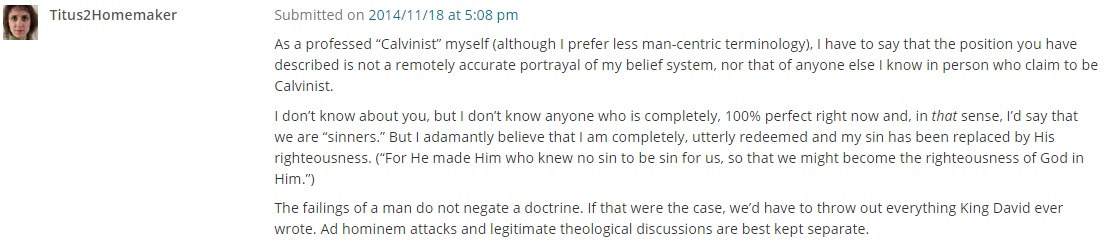
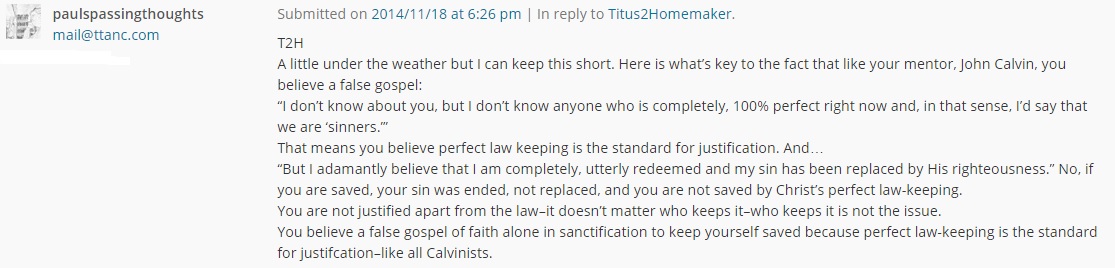








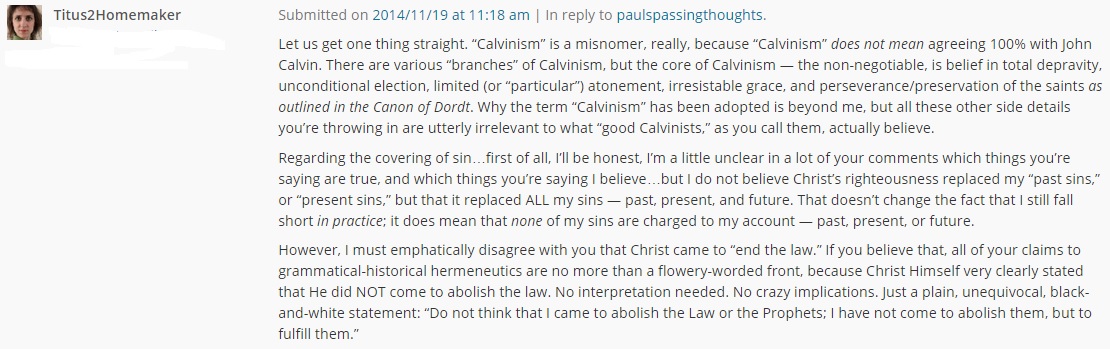

Calvin: Christians Must Keep Their Salvation by Pursuing Perpetual Forgiveness in the “Church”
Originally published August 14, 2013
“Why does American Protestantism have such weak sanctification? Calvin taught that the apostle Paul went from house to house preaching about the same gospel that saved us rather than teaching the full counsel of God, that’s why.”
I can see clearly now; it all finally makes sense. As a young Scriptural zealot, many things in the Protestant church confused me. I was the Baptist stripe of Protestant. And kudos to church historian John Immel, he is right; there is always a logic behind an action.
Why so much emphasis on the same gospel that saved us? Why were we constantly calling on people to be saved in the church? Why don’t we have any more answers to life’s difficult problems than the world? Why so much fuss over the buildings? Why is the Lord’s Table such an uppity pious affair when it seems to have been inaugurated during a casual dinner? Why have I always struggled to be wowed by that “ordinance”? Why all the crosses all over the place? On the church, in the church, around people’s necks. Geez. And why is the same bad behavior that is in the Catholic Church also in the Protestant church?
Fact is, American religion was founded on the Pilgrims who are not very often called what they really were: Calvinistic Puritans armed with the first Bible to ever arrive on American soil; The Geneva Bible which was John Calvin’s commentary on the Bible.
Talk abounds concerning the foremost figures of the Reformation, John Calvin and Martin Luther. Many opinions abound, but everybody agrees that they are the fathers of the Protestant Reformation and spiritual heroes. They are the George Washington and James Madison of our faith.
New Calvinism is a return to the purest form of the Reformation found in the John Calvin Institutes of the Christian Religion. And there is a reason New Calvinism is taking over Protestantism by storm: Protestantism originally came from Calvinism and is well primed to be retrofitted with the original. Forget doctrine, that’s the same thing as football fans talking about stats. It’s interesting, but it doesn’t matter, the game is played on the field. Calvinism is a tradition that has little to do with the election versus freewill issue as well, that’s just a family quarrel about which sibling gets to use the bathroom next. There are two kinds of Protestants in the world: staunch doctrinal Calvinists and those who function like Calvinists. Today, that translates into New Calvinists and everybody else that’s left. New Calvinists strive to continually define the logic that drives their actions; everyone else is just coasting on the basics, but are well primed to step over to the wild side.
Why is this? We find some answers in the Calvin Institutes; specifically, 4.1.21,22. Therein we read:
Wherefore, our initiation into the fellowship of the church is, by the symbol of ablution, to teach us that we have no admission into the family of God, unless by his goodness our impurities are previously washed away (20).
Nor by remission of sins does the Lord only once for all elect and admit us into the Church, but by the same means he preserves and defends us in it. For what would it avail us to receive a pardon of which we were afterwards to have no use? That the mercy of the Lord would be vain and delusive if only granted once, all the godly can bear witness; for there is none who is not conscious, during his whole life, of many infirmities which stand in need of divine mercy. And truly it is not without cause that the Lord promises this gift specially to his own household, nor in vain that he orders the same message of reconciliation to be daily delivered to them.
This is a startling statement for any Christian paying attention. But it is also a grand example of talking about stats; i.e., Christ died once, for all of our sins and that is imputed, in totality one time, at our conversion for all past and future sins, versus how Protestants really function: a weekly focus on the gospel. Why? That’s how we keep our salvation, that’s why. New Calvinists say, “amen.” Baptists protest, but that’s how they function. I have watched it for 30+ years.
Calvin continues:
On the other hand, the Lord has called his people to eternal salvation, and therefore they ought to consider that pardon for their sins is always ready. Hence let us surely hold that if we are admitted and ingrafted into the body of the Church, the forgiveness of sins has been bestowed, and is daily bestowed on us, in divine liberality, through the intervention of Christ’s merits, and the sanctification of the Spirit.
22. To impart this blessing to us, the keys have been given to the Church (Mt. 16:19; 18:18). For when Christ gave the command to the apostles, and conferred the power of forgiving sins, he not merely intended that they should loose the sins of those who should be converted from impiety to the faith of Christ; but, moreover, that they should perpetually perform this office among believers. This Paul teaches, when he says that the embassy of reconciliation has been committed to the ministers of the Church, that they may ever and anon in the name of Christ exhort the people to be reconciled to God (2 Cor. 5:20). Therefore, in the communion of saints our sins are constantly forgiven by the ministry of the Church, when presbyters or bishops, to whom the office has been committed, confirm pious consciences, in the hope of pardon and forgiveness by the promises of the gospel, and that as well in public as in private, as the case requires. For there are many who, from their infirmity, stand in need of special pacification, and Paul declares that he testified of the grace of Christ not only in the public assembly, but from house to house, reminding each individually of the doctrine of salvation (Acts 20:20, 21). Three things are here to be observed. First, Whatever be the holiness which the children of God possess, it is always under the condition, that so long as they dwell in a mortal body, they cannot stand before God without forgiveness of sins. Secondly, This benefit is so peculiar to the Church, that we cannot enjoy it unless we continue in the communion of the Church. Thirdly, It is dispensed to us by the ministers and pastors of the Church, either in the preaching of the Gospel or the administration of the Sacraments, and herein is especially manifested the power of the keys, which the Lord has bestowed on the company of the faithful. Accordingly, let each of us consider it to be his duty to seek forgiveness of sins only where the Lord has placed it. Of the public reconciliation which relates to discipline, we shall speak at the proper place.
Why so much emphasis on the same gospel that saved us? Because it keeps saving us. Why so much fuss about buildings? Those are the temples where we find our need for perpetual salvation and forgiveness for sins that would circumvent our justification. Why are pastors put on a pedestal and allowed to rape, pillage, and steal? In them we have our absolution. Why so much fuss about the Lord’s Table and quarreling over real wine or grape juice? There is additional salvation in the sacraments. Why all of the crosses? Same thing: more gospel; more salvation. Why do we sweep scandal under the rug? It is a threat to the institution, and that’s where we find our salvation. Why does American Protestantism have such weak sanctification? Calvin taught that the apostle Paul went from house to house preaching about the same gospel that saved us rather than teaching the full counsel of God, that’s why.
Calvin’s statement about being “engrafted” into the “church” is interesting. The Potter’s House has just adopted Remnant Theology as opposed to Covenant Theology, New Covenant Theology, or Dispensationism. Are we engrafted into a “church” or an “olive tree”? In Romans 9-11, what does that olive tree symbolize? Something to think about.
John Immel is right, action is always driven by logic. In our present day, doctrine is getting lip service while Calvin’s logic is driving the actions. That is why nothing going on in the church makes any sense right now.
And I doubt it ever will until God’s people come out from among them.
paul

 Paul's Passing Thoughts
leave a comment