Why Home Fellowships Can Help Abused Women and the Institutional Church Cannot

In our vision for a return to the way Judeo-Christian assemblies were done for about the first 300 years, let’s look at why home fellowships can help abused women and the institutional church cannot.
I would like to use this article as a catalyst for argumentation. The article was posted (author is not clearly stated) by Anna Wood who co-authored a book with Jeff Crippen, a Reformed pastor. The book can be found here.
The post is titled, What domestic abuse victims need from the church. My contention is that abused women cannot get what they need from “the church” as demonstrated over and over and over again. In fact, clearly, as also demonstrated over and over and over again as well, the institutional church adds to the abuse and becomes a co-abuser.
Why is this? The article offers a perspective from which to answer. This issue also speaks to the differences between home fellowships and the institutional church, hereafter “the church.” In an institution, it is easy to sign on the dotted line, give at the office, and pretend. Pastors can bark from Calvin’s Geneva pulpit all they want to; all folks have to say is, “Hey, I am a member in good standing, and as often heard, humble and incompetent—it’s not my gift and I am not qualified.” Likewise, in said article, the author’s call to “get involved” is going nowhere in the church in case anyone hasn’t noticed.
To the contrary, home fellowships are comprised of people who are sick of playing church, are weary of being mere spectators, and are not looking to walk into an arena with hungry lions, but know it could lead to that. They are also confident in the Spirit-filled laity and recognize where 500 years of academic popeism has brought us. In addition, they have a literal view of reality versus the functional dualism that drives orthodoxy. What am I saying? I am saying that home fellowships have a radically different worldview than orthodoxy and this will lead to aggressive participation in all kinds of needs.
Let me further this point by using the article at hand:
Statistics say that one out of four women in the United States experience domestic abuse of some form in their lifetime. Men can also be victims of domestic abuse. When those who have suffered are members of the Lord’s church, the faithful among them have an obligation to help them. And, if we know of someone in the community who is being abused, I also believe we have an obligation to help if we can. When, for whatever reason, we shy away from this obligation, either through ignorance or willful refusal to get involved, we lay waste to the Gospel we claim to believe. Christians are called to defend the oppressed yet when it comes to domestic violence, so few do.
What abuse victims need from their fellow Christians is pretty simple and straightforward. We need you to be Jesus to us. Do what He would do, say what He would say, were He the One ministering to us. Isn’t that what we all need from each other, anyway? Christians are called to stand in the place of Christ here on the earth and be His representative and do the works He would do. To fail in this is to fail in serving Christ.
Whoa, what a minute here! This is entirely unrealistic because of the message constantly drilled into the heads of Protestants. We are “all just sinners saved by grace.” We are, according to one prominent evangelical, “enemies of God.” According to yet another, “we hate God.” On the one hand, it is constantly drilled into the heads of those in the church that “when you are dead, you can do nothing,” but on the other hand we really think that parishioners shouldn’t think twice about getting involved in a domestic abuse situation?
First of all, getting involved in domestic violence is not “pretty simple.” Actually, it can get you killed by someone who doesn’t much appreciate your intervention. Moreover, getting the facts and evaluating the situation biblically is far from simple. Now couple that with the constant total depravity of the saints mantra heard in the church and it is little wonder that few will get involved in domestic abuse needs. The completely upside down worldview of the church makes laity involvement in domestic abuse nothing more than a pipe dream.
And, “Christians are called to defend the oppressed yet when it comes to domestic violence, so few do.” This complaint is not only a mere symptom, but is not even a symptom of the real problem. Congregants not only fail to defend the oppressed, they either turn a blind eye or defend the defender of the abusers—the church. Ever heard of SGM? Ever heard of ABWE? Ever heard of the SBC? In case you haven’t noticed, they are not only still in business, but business is booming! Why? Because regardless of what happens in the church, it is the only ticket to heaven. “What? so billions of people should go to hell because some bad things happen in the church that is made up of sinners? Well, get a grip—where there are people, there is sin!” That is in quotations because this is exactly what we hear in response to a “cry for justice.”
So far, if you are keeping notes, we have two reasons the church cannot help abused women: 1. The total depravity of the saints resulting in a few “experts” attempting to minister to a massive throng 2. Salvation is found in the institution, and therefore the institution will be defended at all cost. Better that a few suffer by themselves rather than all of humanity being sent to hell.
Before we move on to the next points, a little more clarification: why does the church defend abusers? It starts with its worldview. Without going into a lot of detail, we must first recognize that Calvin and Luther are the church’s heroes, and then recognize what their “theology of the cross” was all about. This is a philosophy that interprets all reality via the suffering of the cross. As Luther stated, “all wisdom is hidden in suffering.” Luther, as well as Calvin, split reality into two epistemologies: the cross story and the glory story. Only preordained leaders can lead the great unwashed masses in the cross story—only the preordained can save humanity from the story of man, or the glory story. As Al Mohler once said, “pastors are preordained to save God’s people from ignorance.”
 However, theologians of the cross and the spiritual peasantry have something in common: we are all just sinners saved by grace. So, everything going on in the material realm is fairly insignificant—it’s just the same old sin and dance anyway. But by the same token, theologians of the cross are preordained of God and invaluable. And besides, many are icons of the institution that keep the money rolling in. Sure, you can reject this theory and opt for another one, but in the process you will drive yourself nuts trying to figure out why ABWE defended and protected Donn Ketcham until the bitter end.
Need another example among myriads? What about Jack Hyles? The guy was a mafia don dressed in Bible verses and is still a spiritual hero among many Baptists. David Hyles, Jack’s son, was also a well-respected pastor in the church who had affairs with at least 19 women and is a suspect in an unsolved murder. Yet, to the best of my knowledge to date, David Hyles is still invited to speak at Baptist conferences/churches and receives robust ovations. Jack Hyles remained in the pulpit until his death in 2001 and was succeeded by his son in law Jack Schaap who is presently in prison for statutory rape. Jack Hyles is notorious for his quip, “If you didn’t see it, it didn’t happen” and is still revered among many Baptists as the best preacher since the apostle Paul.
The article continues with its list of things abuse victims need from “the church.” But the thesis of this article is that the church is not only unable to supply these things, but becomes a co-abuser. In contrast, the original Christian model for fellowship is well able to help and more likely to do just that.
First on the list is “The Pure Gospel.”
The church long ago got away from the pure gospel. We water it down, mix it up and serve it with a side of fun. No wonder it doesn’t save. It can’t save. It’s poison. We need preachers dedicated to the truth of God’s Word who are willing to stand up and preach that truth without changing it one iota. We need Christians who long after righteousness. When we have that–the pure Gospel preached and lived–we’ll see more Christians helping abuse victims and we’ll see less abusers masquerading as Christians.
Uh, ok, not sure how to add to this. It’s a stunning admission while calling on the same church to do something about the problem it has created. We don’t need “preachers” to do anything. Preachers have been preaching long and hard for thousands of years and the results are evident. We need God’s people to stand up and get back to the first works of home fellowship. The laity waiting on the experts is long traveled and worthless. More of what is beginning to happen needs to happen more and more. Ordinary Spirit-filled Christians are meeting together around the word and fellowship, and seeking God’s face in this whole matter about how church is traditionally practiced. And the fact that the church is grounded in a false gospel is something I addressed in another article posted today and Friday.
Without addressing every single point in the article other than those mentioned already, let me move on to this one:
Someone to care for their needs
Do you know what keeps a lot of abused women and children with their abusers? The lack of money to leave. If a woman is trying to get herself and her children to safety, don’t spend time telling her why she’s wrong, what you think about her decision or trying to talk her out of it. She knows what it’s like to live in abuse and you don’t. Even if she stays, chances are great that she and her children need something or maybe a lot of things. Financial abuse often accompanies other types of abuse. Instead of lecturing, get busy serving and help them.
According to the first-century model, a home fellowship network would be several small groups meeting in several homes in the same geographical area. And because of freedom from massive infrastructure cost and “tithing” versus New Testament giving based on NEED only funds and resources to help the abused would be ample. In fact, I could share an example from our very own home fellowship. We have a young lady living with us, and other people connected to our fellowship contribute financially to her needs. She is fully supported independently from anybody who might be a problem in her life. And when people live with you, trust me, you know the facts and you do a lot of listening. She will be completely self-reliant this month after living with us for about two years.
In regard to a different kind of abuse, a home fellowship network that I know of in Africa operates in the following way: the network assimilates street orphans from Nairobi into their fellowships. There is a leader from the network, equipped with the latest information about funds and availability that goes into Nairobi searching for orphans, and upon finding some, brings them back to the fellowship network where they will have a home, food, protection, and education. Let’s say that our home fellowships are connected with theirs; many of these children could be brought stateside and assimilated into fellowship here as well.
In addition to being freed from the bondage of infrastructure expense, the authority of the church’s clergy is suffocating. Clergy, more times than not, are control freaks obsessed with keeping the herd calm. They are spiritual cowboys constantly concerned with the herd being spooked. This speaks to the rest of the concerns in the post being considered here. More times than not, the laity are kept in the dark concerning the needs of those abused. There is a wall of confidentiality between the church’s “trained” counselors and the parishioners who fund the whole mess. When red flags are raised in regard to how certain situations are handled, we are told that “we should trust the elders who are closest to the situation and know all of the details.” This continually proves to be a recipe for disaster, and elders are granted NO such authority via the Scriptures.
Small groups in private homes offer intimate support and confidentiality from the other home fellowships. It is a perfect balance of intimate care and financial support if needed. All of the different gifts and experiences of Christ’s body are brought to bear on the situation.
Also, we must remember that the home fellowship movement is comprised of people from all walks of life: policemen, mental health professionals, etc., etc. These people or their areas of expertise are not separated from any situation by the professional clergy for inappropriate reasons.
paul
Six Characteristics of the Protestant Anti-Gospel
- Progressive Justification. The Protestant Reformation turned every aspect of the true gospel completely upside down. “Justification by faith” is really justification by faith alone in sanctification (the Christian life). What they call “sanctification” is the progression of justification to a final justification.
- Dualism. It deems the flesh (body/members) as inherently evil and something that cannot be indwelled by holiness. The contemporary expression of that is the centrality of the objective gospel outside of us. This is based on Martin Luther’s alien righteousness. Therefore, the new birth must be denied along with any personal holiness associated with it. All righteousness must remain completely outside of the believer.
- Law as Justification’s Standard. The Reformers made law the standard for justification (see the Calvin Institutes 3.14.9-11). Therefore, the law has a single dimension and can only judge/condemn. This keeps “Christians” under law (instead of under grace) which is the very definition of a lost person. In contrast, law and justification are mutually exclusive.
- Redefinition of the New Birth. The Reformers made the new birth a change of realm rather than a literal transformation of the person. The “believer” is given the ability to “see” the kingdom, but not participate in its good works.
- Lovelessness. The ability of the Christian to love is circumvented because the law is only a standard for justification and must be kept perfectly to obtain any merit. The Christian is not free to use the law to love without fear of condemnation because the law can’t be kept perfectly by mortals. Hence, any loving act by a Christian cannot have merit.
- Two Seeds Instead of One. Since law is the standard for justification according to the Reformers, if fulfilled, it is a second seed that can give life (Gal 3:16). So, the promise was not only to Abraham and his offspring, but also to the law.
Like John Street, Like Stuart Scott: A Celebration of Mystic Despotism

Will Speak at Clearcreek Chapel’s 2015 “Family Enrichment” weekend.
 “Hence, and don’t miss this, justice is not the point. The concept of justice and fairness digresses from Reformed Calvinistic dualism.”
“….six months after Luther’s 95 Theses launched the Reformation, the true magnum opus of the Reformation was written, his Heidelberg Disputation to the Augustinian Order. The document reflects Luther’s utter Platonist disdain for humanity.”
“Now, let’s take this information and evaluate why Scott et al are completely indifferent to suffering and injustice.”
Once again, Stuart Scott will break bread with the elders at Clearcreek Chapel (Springboro, Ohio) as he is the featured speaker at this year’s “Family Enrichment” Conference. Clearcreek Chapel having a family enrichment conference is like the Nazis sponsoring an endowment for Judaism. It’s a mockery; the Chapel has ravaged innumerable families and Christian lives since its orchestrated takeover by Russ Kennedy and aided by former Clearcreek elder Greg Cook. Cook brought in a group from another Baptist church which included present Clearcreek elders Chad Bresson and Dr. Dale Evans.
Their attempted takeover of the church they left failed, but their endeavor at the Chapel succeeded—the spiritual carnage notwithstanding. Cook, as director of Clearcreek’s counseling program, was giving wives the green light to divorce husbands who had “ruined the family finances” while he himself was just under $200,000.00 in due and owing debt. It is unclear as to whether this revelation led to his stepping down as an elder, or not. Probably not since hypocrisy is a requirement for eldership in our day.
Other present Clearcreek elders have been forced to step down in the past, but have been reinstated; specifically, Mark Schindler who was re-baptized after his prior eldership. Apparently, not being sanctified by justification was the prior cause of his disgrace. Whatever it was specifically, his wife gave testimony that she never considered divorce and was determined to make the marriage work. It’s a pity that such wifely resolve that saved Schindler’s marriage is not encouraged among wives in the counseling rooms of the Chapel in this day. But one must remember that such resolve is only honorable in regard to saving the marriages of New Calvinist philosopher kings.
It all seems insane until you realize that people act from their logic. Why would Scott give credence to such a camp? Why would he ignore the pleadings of the oppressed? Why is he, like all New Calvinists, utterly indifferent to justice? We get a clue from his book The Exemplary Husband on page 72. He states the following:
God uses everything in our lives for His perfecting (growing) purposes (Romans 8:28-29; James 1:2-4). As we learned earlier, our growth as Christians toward Christ-likeness is a life-long process, often referred to as sanctification. Because God is so intent on sanctifying us, we know that He will certainly use our most important human relationships to do this.
Right. As I have worn out multiple keyboards emphasizing here on PPT, New Calvinism is a dualist philosophy. Let’s go over this again. Below is THEIR illustration, NOT mine:

Note first that regardless of their verbiage, they don’t believe we really grow, it’s the cross (what it represents) that grows. That’s obviously job one. The endeavor thereof requires a primary focus on two goals and two goals only: a deeper and deeper UNDERSTANDING of our sinfulness, and absolutely nothing else, as set against God’s holiness. Part and parcel with this is also the idea of worthlessness on our part.
The cross represents bigger and bigger salvation which must be manifested more and more until the day when our “final justification” is “revealed.” This occurs as we are sanctified the same way we are saved, by partaking in the realizing of our sinful worthlessness before God and His holiness. The more we understand the difference between the two, the more our salvation is manifested. We don’t change, only the greatness of our salvation changes in order to glorify God. Of course, this obviously redefines the new birth and denies it.
As propagated in the satanic treatise “How People Change” by Paul David Tripp, ALL tragic and sinful events in life serve the bottom of the cross chart, and ALL good that occurs in our lives serves the top of the chart. As we contemplate the gospel narrative, the goodness of God is manifested which contributes to more understanding at the top of the chart. Goodness is not our fruit, its God’s fruit only for the purpose of aiding us in understanding His goodness—not ours. Hence, and don’t miss this, justice is not the point. The concept of justice and fairness digresses from Reformed Calvinistic dualism.
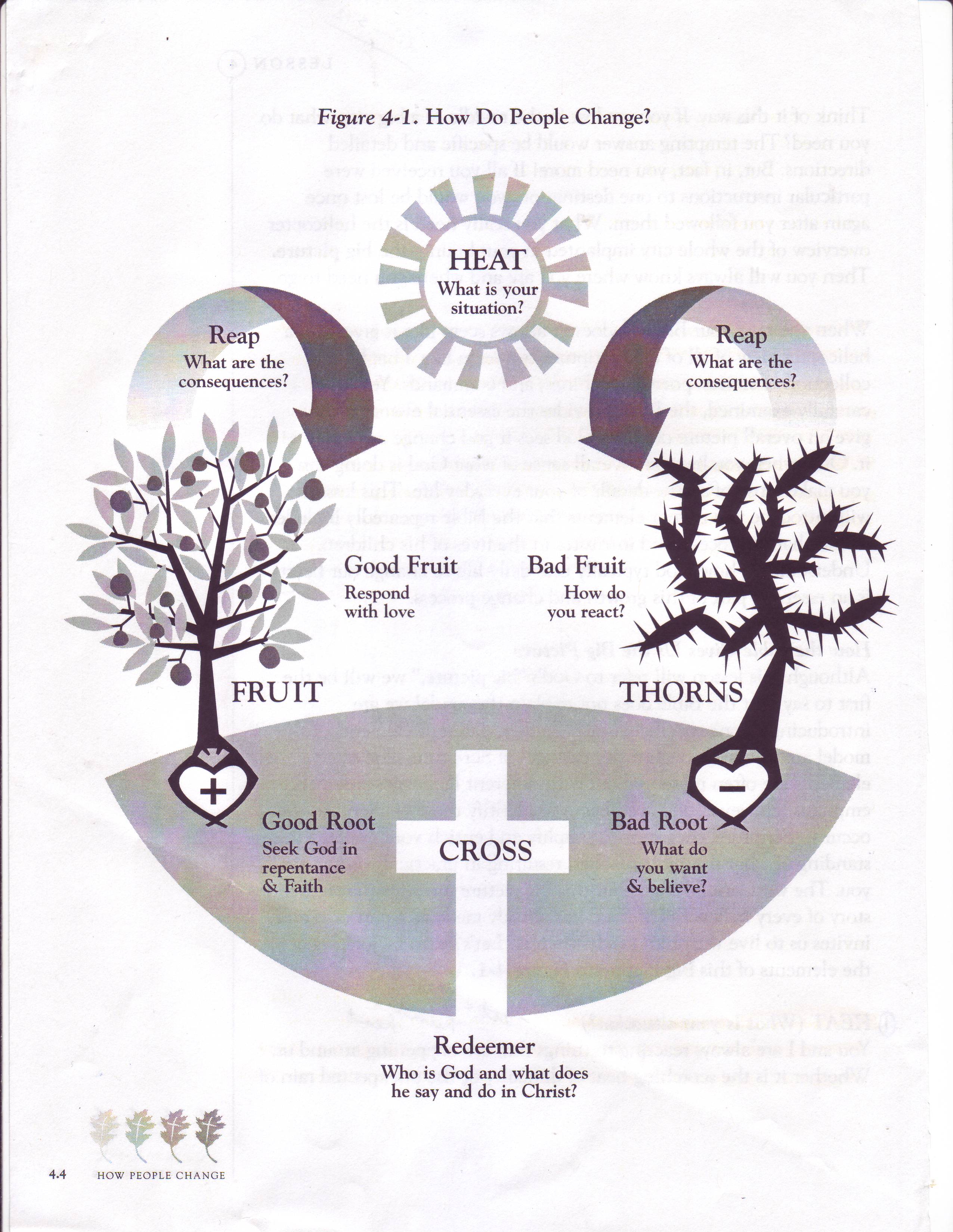
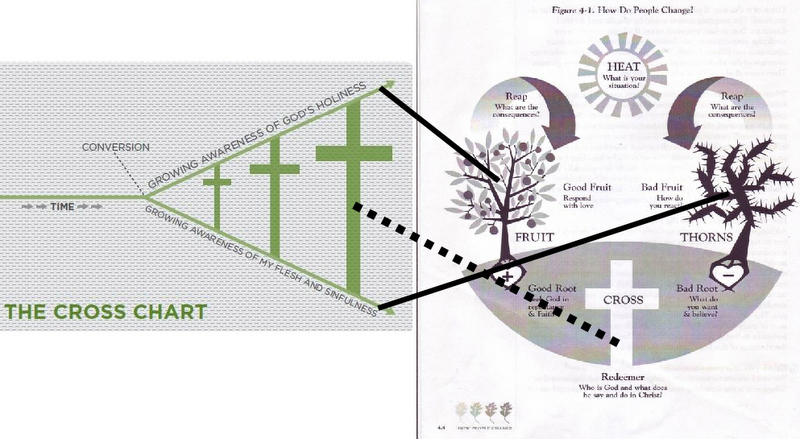
The next point is that in the neo-Calvinist gospel schema, the Scriptures serve as a Cross narrative to help us see this dualism in a clearer way. In the mind of the neo-Calvinist, the Scriptures do not define what is right and fair; the Scriptures define Luther’s “cross story.” Here is what the vast majority of Christians do not understand: six months after Luther’s 95 Theses launched the Reformation, the true magnum opus of the Reformation was written, his Heidelberg Disputation to the Augustinian Order. The document reflects Luther’s utter Platonist disdain for humanity.
In Luther’s Disputation, all reality must be seen through the cross story; i.e., the cross illustration at hand here, and ALL else is the “glory story” or anything at all to do with us—our glory, not the cross story that makes God bigger and mankind smaller. To any degree that we are in the equation, the cross story is diminished.
Now, let’s take this information and evaluate why Scott et al are completely indifferent to suffering and injustice. What did the Clearcreek elders do that is wrong? Nothing because the purpose of the Bible is not to judge the authority of Reformed elders, it is to show forth the cross story, not our story, and injustice is an Us Story kind of thing. Have former parishioners at Clearcreek suffered unjustly at the hands of the elders? Well, that’s a good thing! That suffering shows us the bottom of the chart. And besides, “justice”? If we got what we all deserved, there wouldn’t be any grace! Is this like Paul’s protest in Romans against propagating more evil that grace may abound? Yes, I think so. To the contrary in the minds of neo-Calvinists, we should bow down and thank God for bringing such abuse into our lives.
This is the gospel construct that rules the majority of biblical counseling in our day and is taking over the church in this country. It is a Platonist world view that set Europe on fire for hundreds of years with unspeakable horrors. And it is a story that is playing at a local church near you.
And this weekend, Stuart Scott brings his version of the show to Springboro, Ohio. A celebration of suffering in the name of Christ. But I have news for Scott: the sins of the Clearcreek elders does not cause grace to abound. And his appearance there has nothing to do with grace or love.
If there are any parishioners at Clearcreek (who may be reading this) who are presently there against their will for fear of public humiliation or things revealed in counseling —in your desperation, don’t slip Scott a note—he’s one of them.
paul
Ground Zero: Pope Gregory and New Calvinist Gospel Contemplationism
 Originally published December 13, 2012
“Monks. That’s what we are missing here. Martin Luther. Ever heard of him? He was a monk.”
“In that Disputation, Luther postulates Pope Gregory’s take on the gospel which is the exact same calling card of present-day New Calvinism.”
“Powlison points to Pope Gregory and Augustine as the pioneers of biblical counseling using a ‘Christ-centered,’ ‘full gospel’ approach. And what was that approach?”
Let’s just take one contemporary example: a Presbyterian church that is now a mere shell of what it was; the remains of a war over the arrival of a New Calvinist pastor who exhibited outrageous behavior and leadership style. Today, some parishioners stand dumbfounded that the Presbytery took positive steps to keep said pastor in place.
As TANC, our newly formed think tank that researches Reformed theology continues to journey into church history for answers, the reasons for present-day tyranny in the church become clearer every day. First, it is driven by the gospel that founded the Reformation. Simply put, it is a gospel that does not believe that people change, but are rather called to contemplate the saving works of Christ in order for His righteousness to be manifested in one of two realms. Whether Baptist, Methodist, or whatever, this Reformed seed, the idea that people really don’t change is at the core of their function though they would deny it verbally. The Western church as a whole buys into this basic concept.
Secondly, the basic concept of spiritual elitists ruling over the totally depraved. You know, the they really can’t change crowd. The Reformation clarion call of total depravity—what’s our second clue if we need one? The spiritual is accessed through the chief contemplationists, and since they have the dope directly from God, they should rule over the totally depraved. Look, I have been a Baptist since 1983, and this is how it works. Again, we wouldn’t verbalize that, but to some degree it is true of all Western denominations because we are the children of the Protestant Reformation. What were we protesting? Naughty philosopher kings; past that, not much.
If we don’t change, the church doesn’t either. Think about that. And we wonder why things are a mess. Apparent growth in numbers is being driven by something else other than a true gospel. And the Reformers deny that while pontificating total depravity. It is testimony to the depth of which this Protestant construct has dumbed down the average parishioner; i.e., the totally depraved change. And nobody blinks. The assumption is that total depravity only pertains to the unregenerate, but that’s not the case according to the Reformed gospel and its time for people to start doing the math on that. The “Nones” and the massive exodus from the evangelical church is taking place for a reason.
I’m not ready to declare Pope Gregory the Great the father of the Reformation and present-day New Calvinism just yet, but recent discoveries reveal some things that should be fairly obvious. We aren’t stupid, just trusting, and that needs to end. Christians need to take advantage of the information age and start studying for themselves as the Christian academics of our day refuse to be forthcoming. They didn’t forget to mention that sola fide is also for sanctification. They didn’t forget to mention the total depravity of mankind AND the saints. They didn’t forget to mention that the new birth is a realm and not something that happens in us—it’s deliberate deception because the Reformed gospel is “scandalous.” The totally depraved are not “ready” for what the enlightened class of philosopher kings understand. By the way, many seminary students will testify to the fact that they are told as much by their seminary professors. Seminaries are where you go to be certified for the purpose of ruling over the totally depraved in order to, in Al Mohler’s words, “save them from ignorance.” Sorry, I prefer to let the Bible and Google save me from ignorance. Thank goodness for the Gutenberg press.
Monks. That’s what we are missing here. Martin Luther. Ever heard of him? He was a monk. What is the very premise of monkism? It’s the idea that the spiritual is obtained by contemplationism. And monkism is not unique to the Catholic Church—it is the link from the Catholic Church to the ancient concept of mystic dualism. Though it pans out in various different ways, it’s the idea that matter is evil and spirit is good. In other cases, it holds to the idea that both good and evil are necessary to understand true reality. Good defines evil, and evil defines good. The more you understand both, the more “balance” you have in the universe. Then there is the goal to birth the spiritual into the physical through meditation/contemplationism. Like I said, there are many takes on the basic approach.
Monks believe that the physical or world realm is a distraction from the spiritual realm. In some cases, they believe that all matter is merely a form of the perfect, or spiritual. Hence, monasteries. Traditionally, monasteries have been clearing houses for the dope from God through contemplationism. And since they have the dope, they should rule the totally depraved for their own good. In some spiritual caste systems, the monks rule directly, in others like the Catholic Church, the monks are the Scribes and Prophets for the rulers; i.e., the Popes.
The fact that monkism would be part and parcel to any doctrine formulated by Martin Luther is a no-brainer. Mysticism is simply going to be a significant factor, and so it is with Protestantism. This becomes more apparent when you consider the core four of the Protestant Reformation: Martin Luther, John Calvin, St. Augustine, and Pope Gregory the Great. Luther’s 95 Theses was a protest against naughty Popes, but he was completely onboard with the Catholic caste system. When his 95 Theses resulted in the unexpected societal eruption that took place, he presented a doctrinal disputation to the Augustinian Order in Heidelberg. And don’t miss this:
In that Disputation, Luther postulates Pope Gregory’s take on the gospel which is the exact same calling card of present-day New Calvinism. In theses 27 of his Disputation, Luther states the following:
Thus deeds of mercy are aroused by the works through which he has saved us, as St. Gregory says: »Every act of Christ is instruction for us, indeed, a stimulant.« If his action is in us it lives through faith, for it is exceedingly attractive according to the verse, »Draw me after you, let us make haste« (Song of Sol. 1:4) toward the fragrance »of your anointing oils« (Song of Sol. 1:3), that is, »your works.«
There could not be a more concise statement in regard to the New Calvinist gospel. Deeds in the Christian life come from the same acts in which Christ saved us. Secondly, they are not our acts, but the acts of Christ applied to our Christian lives by faith alone. Thirdly, when the works of Christ are applied to our Christian lives by faith alone, it will always be experienced by the exhilarating emotions of first love—this is the mark of Christ’s active obedience being manifested in the spiritual realm through the totally depraved. We “reflect” the works of Christ by faith alone. Even John MacArthur has bought into this nonsense, claiming that obedience to the Lord is “always sweet, never bitter.” Francis Chan states that it always “feels like love.” And of course, poke John Piper’s rhetoric anywhere and this same monkish mysticism comes oozing out.
Moreover, Luther states this same concept from many different angles in his Disputation, and theses 28 is clearly the premise for John Piper’s Christian Hedonism.
No wonder then that New Calvinists of our day sing the praises of Pope Gregory. Here is what heretic David Powlison stated in an interview with Mark Dever’s 9Marks ministry:
Caring for the soul, which we try [try?] to do in biblical counseling, is not new. Two of the great pioneers in church history would be Augustine and Gregory the Great. Even secular people will credit Augustine’s Confessions as pioneering the idea that there is an inner life. Augustine did an unsurpassed job of tearing apart the various ways in which people’s desires become disordered. Gregory wrote the earliest textbook on pastoral care. He pioneered diverse ways of dealing with a fearful person, a brash and impulsive person, an angry person, an overly passive person. He broke out these different struggles and sought to apply explicitly biblical, Christ-centered medicine—full of Christ, full of grace, full of gospel, and full of the hard call of God’s Word to the challenges of life.
Powlison points to Pope Gregory and Augustine as the pioneers of biblical counseling using a “Christ-centered,” “full gospel” approach. And what was that approach? It was primarily contemplationism and dualism. In fact, Gregory practically saw “doing” as a necessary evil. In Roland Paul Cox’s Masters dissertation, Gregory the Great and His Book Pastoral Care as a Counseling Theory, Cox states the following:
The overall theme in Gregory’s dichotomies is balance. It is possible that this comes from Gregory’s own struggles in balancing his desire for the contemplative life of a monk versus his reluctant, but active, service as ambassador to Constantinople and pope.“The Regula Pastoralis was in large part devoted to describing how to reconcile the two types of life. He came to the conclusion eventually that while the contemplative life was the better and more desirable of the two, the active life was unavoidable, and indeed necessary in order to serve one’s fellow man.…There could be no better exemplar of the two lives than Gregory himself, but he would have been less than human had he not from time to time mourned the fact that so much of his time must be given over to the active at the expense of the contemplative” [Jeffrey Richards, Consul of God : The Life and Times of Gregory the Great (London ; Boston: Routledge & Kegan Paul, 1980), 57.].
Powlison, in true Reformed tradition, invokes the either/or hermeneutic, or the either cross story or glory story hermeneutic of Luther’s Disputation by suggesting that any denial of this “Christ-Centered” approach is a wholesale denial of an “inner life.” In other words, suggesting that doing something should be emphasized as much as contemplationism is paramount to denying that there is an inner life. Such statements by Powlison are indicative of his utter lack of integrity.
In addition, Gregory’s penchant for mystic dualism is seen in the same dissertation:
Gregory’s view of health revolved around balance. In Pastoral Care 34 dichotomies are given. For each one Gregory discusses how either extreme is detrimental. The following are a few examples of Gregory’s dichotomies: poor/rich, joyful/sad, subject/superiors, wise/dull, impudent/timid, impatient/patient, kindly/envious, humble/haughty, obstinate/fickly, and gluttonous/abstemious. Further, Gregory explains how certain traits although they appear to be virtues are in reality a vice. For example, in describing the dichotomy of impatient and patient, Gregory says the following about the patient: “…those who are patient are to be admonished not to grieve in their hearts over what they suffer outwardly. A sacrifice of such great worth which they outwardly offer unimpaired, must not be spoilt by the infection of interior malice. Besides, while their sin of grieving is not observed by man, it is visible under the divine scrutiny, and will become the worse, in proportion as they claim a show of virtue in the sight of men. The patient must, therefore, be told to aim diligently at loving those whom they needs must put up with lest, if love does not wait on patient” [Pastoral Care: pp. 109, 110].
In other words, self-control is a vice. Unless cross-centered love is mystically applied according to Luther’s Disputation (theses 28), the latter evil of self-control is worse than the former sin of being offended since such offences serve to humble us (LHD theses 21).
What goes hand in metaphysical hand in all of this is good ole’ ancient spiritual caste tyranny. As Cox further observes,
Shortly after becoming pope, Gregory wrote Pastoral Care. In addition as pope, he reorganized the administration of the papal states, he maintained papal authority in the face of encroachments from the Patriarch of Constantinople, he established links with the Frankish Kingdoms, and most importantly (for these English writers), he sent a party of monks, led by Augustine, to convert the Anglo-Saxons.
Gregory was very influenced by the Rule of St. Benedict and Benedictine monks who came to Rome after the monastery that St. Benedict founded was burnt. In some letters, Gregory calls his work Pastoral Rule. “There is every reason to assume that Gregory in conceiving the plan for Liber Regulae Pastoralis [Pastoral Rule] intended to provide the secular clergy with a counterpart to this Regula [the Rule of St. Benedict].
….This culture of rulers and emperors also helps explain why Gregory saw Pastoral Care and Pastoral Rule as one in the same. By modern day standards, Gregory would be considered overly authoritarian.
A culture of “rulers and emperors” had precious little to do with it, but rather ancient spiritual caste systems that answered the supposed preordained call of God to control the totally depraved. With the sword if necessary. While many of these systems were based on mythology prior to the 6th century, Plato systematized the idea and gave it scientific dignity. But his trifold theory of soul consisting of king, soldier, and producer called for a sociological counterpart that was a mirror image to fit the need. Sir Karl Raimund Popper, considered the greatest philosopher of the 20th century, fingered Platonism as the primary catalyst for religious and secular tyranny in Western culture. And Plato’s mystic dualism (shadows and forms) added not just a little to the MO of the Reformers. According to church historian John Immel:
Calvin’s Institutes (1530) is the formal systematic institutionalization of Platonist/Augustinian syncretism that refined and conformed to Lutheran thinking and became the doctrinal blueprint for the Reformed Tradition [Blight in the Vineyard: Prestige Publishing 2011].
Christ promised us that He would build His Church and the gates of hell would not prevail against it. The idea that the Reformers rescued His church from the gates of the Roman Catholic Church is both laughable and the biggest hoax ever perpetrated on mankind. The idea that Christ needed, and continues to need the services of Plato’s philosopher kings is arrogance on steroids. Somewhere, God’s church moves forward. Let us shed the Reformed load that hinders and find our place in that true church.
paul

 Paul's Passing Thoughts
3 comments