Are Christians Losing Their Voice in the World Because They are Just Plain Stupid?
 I was born again in 1983, but being saved by God does not automatically fix stupid in the here and now. The first stupid thing I did was to join a Baptist church because, by golly, I was saved and I was going to do this Christian thing the right way. Though a selfish sinner ruled by lust, like all of humanity, I had some good God-given qualities; i.e., I took satisfaction in doing a quality job. I brought that quality with me into my Christian life.
To some degree I am not at fault. How was I to know that Baptists are Protestants? How was I to know that Baptists would teach me the ways of Protestant orthodoxy? How was I to know that the fathers of Protestantism despised reason?
Are Protestants stupid? Sure they are. What other breed of homosapien would invest thousands of dollars to learn extensive knowledge about a religion founded by men who believed mankind to be totally depraved and unable to properly understand reality? Stupid? Maybe “sane” is the better question; who endeavors to earn a PhD in total depravity? Moreover, consider the fact that men who earn these nomenclatures of knowledge that plunges the depths of man’s incompetence are themselves men of renown and respected as knowledgeable about knowing nothing.
Yes, supposedly, according to Calvin and Luther, when Paul told the Corinthians that he knew nothing but Christ and Him crucified, he wasn’t talking about knowledge of other gospels, he was talking about the “foolishness of the cross.” Hence, the world rejects the cross because they believe man can know something of value other than the salvific work of Christ. They therefore see the cross as “foolishness.” Calvin and Luther mocked the thinkers of their day and ridiculed those who proposed that the Earth was round and the solar system was in motion. Their serial killing children, the Puritans, attributed the exploits of Benjamin Franklin to demonic powers. Any knowledge other than the cross is not the “cross story,” it is the “glory story.” The glory of man rather than the glory of God.
The fruit doesn’t fall far from the tree. As a pastor, I saw no need whatsoever to learn any “vain philosophy,” and certainly didn’t learn any in high school or seminary. In both cases, Plato is a touchy subject. The Colonial Puritans were ridiculed for being Platonists by their Aristocratic detractors who were children of the same Enlightenment movement that clearly saved Europe from being a third world country shrouded in superstition. The Puritans founded our public school system. They also founded the Ivy League schools from which all of our seminaries came. These were prodigies of Socrates and Plato who defined true wisdom as knowing nothing.
From that gene pool came the Gnostics who defined the “secret knowledge” in the same way. Basically, they were peddlers of happiness in the midst of knowing nothing: “Eat and drink, for tomorrow we die.” And if you messed up the unity and happiness of the communal group led by those with the gnosis, you died a lot sooner.
So, what in the world philosophy inspired this rant? Some time ago, it came to my attention that an atheist website reposted one of my articles in a favorable light. Even after being awakened to the importance of world philosophy and ideas by church historian John Immel, I was horrified. Certainly, I had to then consider that what Calvinists say about me may be true; am I really an “enemy of the cross”? Worse yet, this is a website that has a global rating of 609 with Alexa, that’s #609 worldwide (Google is #1). This multiplied the horror of my evil deed even more. Certainly, if these atheists liked what I wrote, it was pure evil!
Fearfully, I reread the post in order to come to grips with my horrific folly. Soon the fear turned to utter disbelief. The post pointed to the authoritative wisdom of God in the Scriptures. Huh? I reread it again; why would they promote these ideas on their blog? The post, at least in my estimation, assumed metaphysical interpretation via the Bible. So, I stuck around and read some other articles on the website. Clearly, I perceived more of a problem with stupidity than with God. In fact, I couldn’t find any article that had a problem with God in particular; the consistent theme seemed to be that Christians are anti-reason, and my friends, it is no less a fact that Luther called reason a filthy whore that should have dung rubbed in her face to make her ugly.
Now enter what I perceive going on among contemporary Christian youth in our day, especially after our mission to the Cross Conference in Louisville this past weekend. The youth that were attracted to that conference are thinkers. Granted, they are hindered by Churchianity, but the desire is to be thinkers well equipped for battle in the arena of ideas. That is what draws them to this vein of Calvinism from the T4G camp—it is perceived as being an intellectual Christianity. It’s bogus, but nevertheless, T4G does a good job of selling themselves that way, compliments of hard cash from the working class laity. Hence, this particular group of youth are ripe unto harvest if you make your case. My friends, this is good news.
Now consider the Passion variety of youth (Louie Giglio versus Al Mohler et al). They are where the Louisville group will eventually end up if something isn’t done. The Passion group is quintessential Gnosticism. Louisville really hatched a vision for us, but we are researching in order to ascertain whether or not the Passion crowd is too far gone at this point. Furthermore, the youth we encountered in Louisville are more likely to be heard by those beckoning for Christianity to show itself reasonable. By the way, John Piper is the bridge between the two movements. But with both movements, a transition from less teaching to more experience orientation can be clearly seen.
When it gets right down to it, Western religion and culture is predicated on the debate between Plato and Aristotle. How ironic that the contemporary Calvinists of our day maximize the use of the very technology that their mentors despised. Though they hate Aristotle and the children he bore like Ayn Rand, without them, Al Mohler would be just another Hindu priest adding to the pollution of the Ganges River with cremation grounds. In the same way that those priests proclaim that horribly polluted river a place of purifying, Al Mohler and company are living contradictions.
At any rate, ignorance of these matters has not served Christianity or our society well. Christians do error if they think that they do not have to choose the reality that they will function in. Until Christians can define their reality, they will look stupid and act stupid. The Neo-Calvinist leaders of our day do not want our youth to know that they must make that choice, for if they do not understand the reality that they live in and how it functions intellectually…complete control is imminent.
Our ignorance of these matters is evident because we don’t understand why 900 people would voluntarily stand in line before a giant vat full of flavored poison. This is not complicated: those who interpret realty for others dictate perception. Why was I so horrified that atheists posted my article? Why was I so horrified that they listened?
I still have a lot to learn about how the world works.
paul
The Book of Life: Another Lost Biblical Doctrine
 “Whether Protestants know it or not (that’s you), we all either believe this directly or we function that way. We are all good theologians of the cross. Luther would be proud of all of us. It’s a family tradition… Like Luther, we delight in the ‘simplicity of faith.’ Like Luther, we believe that thinking, reasoning, etc. is a filthy whore who should ‘have dung rubbed in her face to make her ugly’…. Hope of an objective future, and life wisdom, assumes that we are able to think through those things and apply them to our lives. To the Protestant, that is an ugly whore.”
Protestantism, which includes Baptists et al, is dumbed down by ecclesiastical design. On April 25, 1518, Martin Luther declared war on the priesthood of believers and sanctification via his declaration of Reformed theology in Heidelberg, Germany. The 95 Thesis was a moral treatise against Rome six months prior, but the Heidelberg Disputation was the very foundation of Reformed ideology. It called on theologians to interpret all of reality from a dual perspective: the glory story or the cross story.
True theology (the cross story) would look at man as worthless and empty with eyes of faith that can only see outward to the glory of God. This made all reality good as the sum equation of God’s goodness and man’s evil. So, tragedy only reflects man’s worthlessness and his deserved plight and the glorification of God following. The glory story was anything that recognized anything IN man at all. No goodness or grace is infused into man. True theology is a purely outward look, and only looks within to find reason for repentance that then glorifies God (“deep repentance”). Luther believed that man can experience the grace of God, but cannot participate in it. That would be works salvation. Man must empty himself to be saved and remain empty till the final judgment.
Hence, any notion that man could become good through salvation was deemed heretical, and a damning false gospel. In many ways, it was predicated on the Platonist idea that all matter is evil, and that would of course include man. The first sentence of the Calvin Institutes (CI 1.1.1) is based on Luther’s dual construct, and then the rest of the Institutes build a full metaphysical statement on the foundation of that first sentence. Pretty impressive. In that sentence, Calvin states that all wisdom is derived from a knowledge of us and knowledge of God. The two opposites define each other. Both Calvin and Luther were followers of Augustine who was the undisputed first and foremost integrationist in Western culture. Plato integrated Eastern mysticism with Western science, and Augustine integrated Platonism with the Bible. A cursory observation of world history makes this plain.
Therefore, the good Luther/Calvin cross theologian heartily agrees with, “study to show thyself approved, a workman that need not be ashamed.” But in the Protestant construct that redefines sanctification (and actually rejects it totally), what does “study” mean? What does “approved” mean? And what does “workman” mean? The Reformers did not believe anybody is approved. They believed work in sanctification (the Christian life) was equivalent to works salvation. Augustine, Luther, and Calvin believed baptism replaced circumcision, and sanctification replaced the Old Testament Sabbath Rest. Working on the Sabbath would bring death, and in the same way, working in sanctification also brings death (John King: The Complete Bible Commentary Collection of John Calvin; Genesis, Ch.2 sec.3, Ch.17 sec.13. Ibid: The Harmony of the Law, Due. 5:12-15, sec. 15).
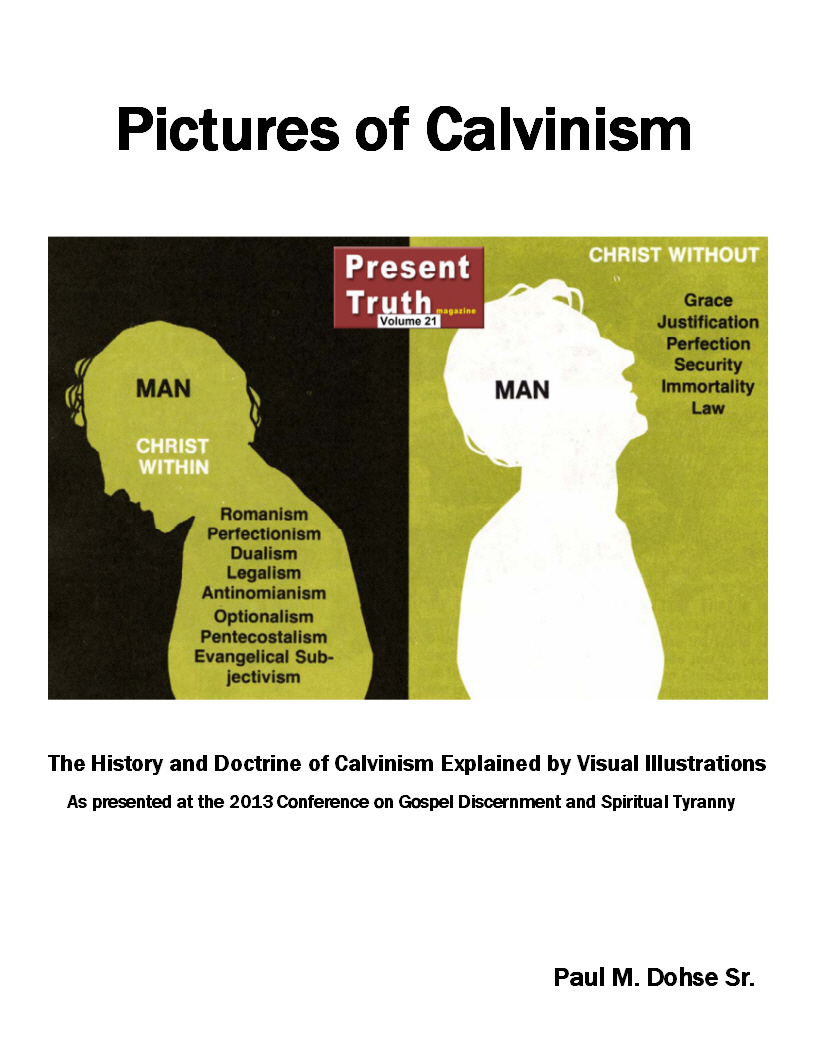
So, “study” is really a focus on what ANY Bible text says about mankind’s wretched, sinful existence as opposed to God’s holiness. When the equation is seen, a steady flow of Christ’s obedience is imputed to our account and we remain justified. These manifestations may, or may not be experienced, but if they are, it is in the realm of the subjective where even the experience cannot be somehow attributed to us. This selfless, daily bearing of the cross and dying to self will lead to joy, but we do not know if this joy is directly linked to a Christ manifestation. The gospel is objective and remains outside of us, but is experienced subjectively. Any inward focus leads to inward subjectivity and as John Piper stated it, “imperils the soul.” See post illustration. It is merely an application of Eastern Mysticism to make sanctification by justification possible.
This is why Luther despised reason and called it a prostitute that should have “dung” rubbed in her face to “make her ugly.” Reason is the glory story. Our ability to reason has to do with an inner ability apart from God. Our “study” is limited to seeing the cross more by a greater and greater realization of our God unlikeness. Our “work” is this study and contentment in the ruin that God has sovereignly placed us in. But of course, “Contentment with godliness is great gain.” That is knowing our own place in the caste system which is sovereignly determined by birth. Supposedly, working hard at being content in our own wretched station of life is not work—it’s faith. Problem is, Luther et al considered that to be saving faith as long as it is practiced in sanctification. You do the math. There is a standard for what isn’t work in sanctification and what is work in sanctification for the purpose of remaining justified.
That is why we argue That justification must be a finished work separate from our Christian life.
But this finally brings me to my point. Whether Protestants know it or not (that’s you), we all either believe this directly or we function that way. We are all good theologians of the cross. Luther would be proud of all of us. It’s a family tradition. Look around, that’s why few Christians know theology or doctrine. In fact, such ignorance in American church culture is a Lutheran badge of honor. Like Luther, we delight in the “simplicity of faith.” Like Luther, we believe that thinking, reasoning, etc. is a filthy whore who should “have dung rubbed in her face to make her ugly.”
Meanwhile, Christians do not know the difference between sanctification and justification, covenants, promises, prophecy, and things like “the book of life.” Why would they? If every verse in the Bible is about how wicked we are as set against God’s holiness, why would we know about those actual BIBLE WORDS. Those aren’t theological words; those are words that are in the Bible.
There is a kind of Christianity in our day that has become extinct. It presumes that if you want to have peace, you have to plan for it. They believe that plan is found in biblical wisdom. Gaining wisdom + planning + applying = peace/happiness. This is opposed to the traditional Christianity of our day that assumes the Bible is not for that purpose. The assumption is that the Bible is a tool for salvific contemplationism that results in subjective manifestations of happiness.
Hope of an objective future, and life wisdom, assumes that we are able to think through those things and apply them to our lives. To the Protestant, that is an ugly whore.
The Book of Life is a massive untapped biblical subject that is a major Segway to additional understanding. For you election buffs, you might be interested in knowing that a cursory study of the subject seems to indicate that EVERYONE born into the world is initially written in the book of life. If that is true, that has major theological implications.
One of the myths about the Reformation is that it made the printed Bible available to the masses. That’s true to a point, but along with increased availability came a distorted purpose in describing its use. This protestant tradition of keeping congregants dumbed down in our day with Lutheran epistemology is exemplified by projects like BibleMesh. These programs find their roots in the Lutheran tradition.
This is why after contemplating the counsel of many different people, I have decided to not screen comments on this blog while I realize that I need a moderator desperately. While the Potter’s House may be a different story, this blog does not seek to protect people from having to stand on their own two cranial hemispheres. People who come here challenge my readers to study new concepts for themselves. The Book of Life issue was in fact brought up by one of those visitors, a doctrine rarely heard of in the church. That’s what inspired this post.
Those who come to the Potter’s House are great thinkers, but yet, the Bible is clear that a local assembly is not an acropolis. There are some who come to PPT that offer strengths that Protestants lack by design: knowledge. It is then up to my readers to show themselves approved.
Moreover, I think the time is nearly upon us when the problem is clearly seen: anti-biblical sanctification. The formal institutionalized church is never going to deal with that because its construct was designed to serve that purpose to begin with. And I don’t think censorship on this blog is a solution by any stretch of the imagination. The solution is to come out from among them while not turning our backs on assembling and fellowshipping with other Christians. An environment where what we learn from the Scriptures is not dictated. A place where we are free to explore EVERYTHING that is in the Scriptures, not just what Luther thought we should know.
Blogs serve to fill that gap until Christians become solution oriented. Leaving church is not the issue, no longer letting control freaks dictate what church is—is the solution, and then acting on it for God’s glory.
paul

Moses Indicts Luther and Calvin on the Reformation’s False Gospel
Fundamentally, there is no difference between Catholicism and Protestantism. Both see salvation as linear. In other words, sanctification finishes justification. The Reformers were hell-bent on seeing salvation as linear—probably because of the Romanism that gave birth to them.
Therefore, the Reformers accused Rome of “infusing grace” into the believer which made them, in the linear gospel construct, a participant in building the road from justification to final justification named Sanctification. Rome’s “infusion of grace” (the new birth) “enabled” believers to participate in the finalization of our just state. Gee whiz, that’s not “justification by faith alone.”
So, the Reformers had to come up with something different: Jesus does all the paving of the road named Sanctification as long as we live our Christian life the same way we were saved; by faith alone. Hence, this required an “alien” righteousness that is in heaven, NOT IN US. A Reformed think tank devised the following illustration to demonstrate this idea:

The true gospel sees justification as a finished work and completely separate from sanctification. We are free to aggressively pursue fruit in sanctification because our justification is a settled issue. The infusion of grace within us does not contribute to the finished work of justification, only the progressive work of sanctification. Sanctification is progressive because it involves us—justification is by God alone and not confined to time, mortality, or any kind of weakness. That’s why it was completed before the foundation of the Earth and guarantees glorification. This is a parallel gospel. Our progress in the Christian life and the completed work of justification are separate.
The Reformers believed in an “objective gospel completely outside of us.” Anything inside of us always leads to subjectivism. Supposedly. This wasn’t even true in the Old Testament. This is what Moses preached to the Israelites:
Deuteronomy 30:11- “For this commandment that I command you today is not too hard for you, neither is it far off. 12 It is not in heaven, that you should say, ‘Who will ascend to heaven for us and bring it to us, that we may hear it and do it?’ 13 Neither is it beyond the sea, that you should say, ‘Who will go over the sea for us and bring it to us, that we may hear it and do it?’ 14 But the word is very near you. It is in your mouth and in your heart, so that you can do it.
Not only did Luther say that keeping the commands is too hard for us to do as believers, he stated that it was impossible. So did Calvin. “It is not in heaven, that you should say, ‘Who will ascend to heaven for us and bring it to us, that we may hear it and do it?’” In fact, that’s exactly what Luther did say: God’s righteousness is an alien righteousness that is in heaven.
And the crux—Moses taught an infused grace: “It is in your mouth and in your heart, so that you can do it.”
Choose ye this day who you will follow, Moses or the Reformed crowd. Moses or Luther? Moses or Calvin? An easy choice for me.
paul
The Potter’s House 12/16/2012: “False Reformation” Published; Romans Study Resumes Next Sunday

I am sooooo glad “False Reformation” is now published. We will resume our study in Romans this Sunday. We will be breaking into chapter 3, and the major theme of this chapter is the law/gospel issue that is addressed in detail throughout False Reformation.
Much of the book was inspired by what I have learned in Romans which has shown me why Calvinism is fundamentally a blatant false gospel. Election/freewill isn’t even the issue at all—a gospel that teaches us to live out our sanctification in an antinomian way in order to keep our salvation is the issue. If you have to do anything to keep your salvation—it’s works—you have to do something to keep it. That includes “resting and feeding.” Even if your “resting” is supposedly not a work—it most certainly is if it’s a condition to keep your salvation.
I look forward to resuming Romans next week, starting in 3:1.
Click on this link for preview of False Reformation: False Reformation PREVIEW
paul


 Paul's Passing Thoughts
3 comments