Eric From Clearcreek Chapel Area Risks Church Discipline to Save Me from “Bitterness”

Eric,
So much ideology is packed into your often-used 5-word Reformed statement: “You are a bitter man.” Like the other Reformed 5-word bumper sticker, “Jesus died for our sins,” it encompasses a whole body of philosophy. The thrust of these statements follows: excluding what doesn’t exist according to the ideology. I am either bitter or not bitter. Why? Because the only cause of bitterness is a lie and doesn’t exist according Reformed ideology: oppression.
There is no such thing as oppression according to Reformed theology, only grace. Grace is defined by the reality of existence that never receives what it fully deserves; therefore, no matter what people do to you, it falls short of what you fully deserve, therefore, all abuse should be received with thankfulness.
Hence, the Reformed definition of a bitter man or woman: one who doesn’t understand grace.
So, what you are saying is that I don’t understand grace. People are either bitter or not bitter–they either understand grace or don’t understand grace. They either understand that the sum total of life is zero making justice a myth or they don’t.
Hence, to put value on life is synonymous with bitterness because justice puts a value on life. Justice restrains those who refuse to treat others as they would want to be treated. According to Reformed philosophy, grace and justice are mutually exclusive and Calvin/Luther both stated that explicitly.
This is fundamentality what put me at odds with the Clearcreek elders though I was a long way from knowing it at the time (by the way, I noticed that your IP address is from Springboro), which is why I am not bitter. I was so blinded by Reformed ideology that it took the full wrath of their fundamental wickedness to wake me from my slumber. I could still be there learning to disassociate myself from reality more and more.
What does that look like? It can be defined by two sons who lost their fathers. When I lost my father whom I led to the Lord one day before his death, I cried out to God in mourning that cannot be described with words proclaiming, “You will take care of him now, you will take care of him now!” By the way, I was informed by elder Devon Berry before I left Clearcreek Chapel that God using me to lead my dad to the Lord, as well as everything else I had done at Clearcreek Chapel for 20 years was “walking in darkness.” Why? Because my worldview does not profess “Perplexity” in knowing anything other than “Christ and Him crucified,” viz, ALL wisdom is hidden in suffering (Luther).
Now let’s compare my worldview with the stoic public testimony of Pastor Rick Wilson’s son at Rick’s funeral: “My dad was a wicked sinner.”
Eric, Eric, Eric, do you really think I am bitter because I can longer hang with you guys? Really? What is the fundamental difference between you and ISIS? Nothing, because the fundamental worldview is exactly the same. In both cases, horizontal justice is a metaphysical concept rejected as true reality. How scary is that?
Eric, I am not bitter towards the Clearcreek caliphate, I am terrified that others will become members there. My duty to warn others about you is a joy, not a bitterness by any means.
But I understand what you are saying: grace and horizontal justice are mutually exclusive making justice a myth. Well, I’m sorry, I disagree, but you seem a little bitter about my bitterness.
And Eric, just a heads up, you could be brought up on church discipline for coming to my blog per the Clearcreek elders, but I won’t tell.
paul

Are Calvinists Saved?
 Originally published October 6, 2012
The begging of the question has a sound Scriptural argument.
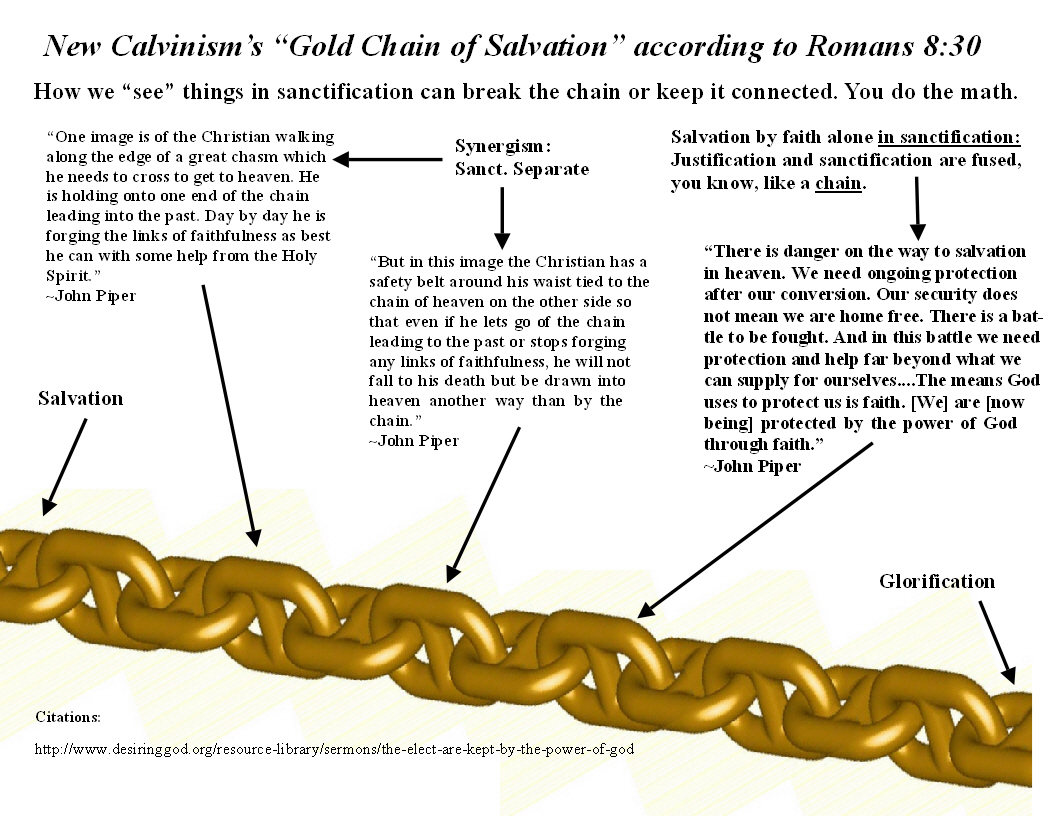
This ministry has made much of the critical importance of separating justification (salvation) and sanctification (growth in holiness, or kingdom living). The Reformed (Calvin/Luther Reformation doctrine/gospel) “never separate, but distinct” doublespeak doesn’t cut it in the arena of truth, and we will see why. “Never separate” =’s false gospel. If you get a little lost in the first part of my argument which gives the lay of the land, don’t worry, when I get into the specific Scriptural argument, it will clear things up and make it all come together for you. It must delight the ghosts of the Reformation that the argument has always been in the arena of freewill verses predestination. It’s the primary thrust of this ministry to change that argument. This isn’t a quibbling about semantics in the mainstream—this is about the truth of the gospel. As New Calvinist Russ Kennedy once thundered from the pulpit in his mousy voice: “Any separation of justification and sanctification is an abomination!” I have often argued from the standpoint of this issue. If sanctification is the middle of the Reformed “golden chain of salvation” then sanctification is part of finishing justification. This means that what happens in sanctification determines whether or not justification is properly finished. What’s a chain? John Piper even preached a message about the eternal importance of our contribution to the “links” in just the right way. In essence, sanctification becomes a spiritual minefield. This is exactly the same thing that the Reformed crowd has always accused Rome of: the fusing together of justification and sanctification. However, as we shall see, they are both guilty of the exact same heresy/false gospel. As we shall see, both teach that sanctification finishes justification. This is a linear gospel (one unified chain from salvation to resurrection (glorification) versus a parallel gospel with salvation on one plane as a finished work before the foundation of the world, and kingdom living that runs parallel with the finished work and reflects the reality of our salvation until glorification. Typical in the linear gospel is the idea that Christ died for all of our past sins, but we must now finish the work (with the Holy Spirit’s help [sanctified works salvation]) until glorification when we are completely transformed into complete holiness. This is the often-heard bemoaning of “Christ PLUS something.” 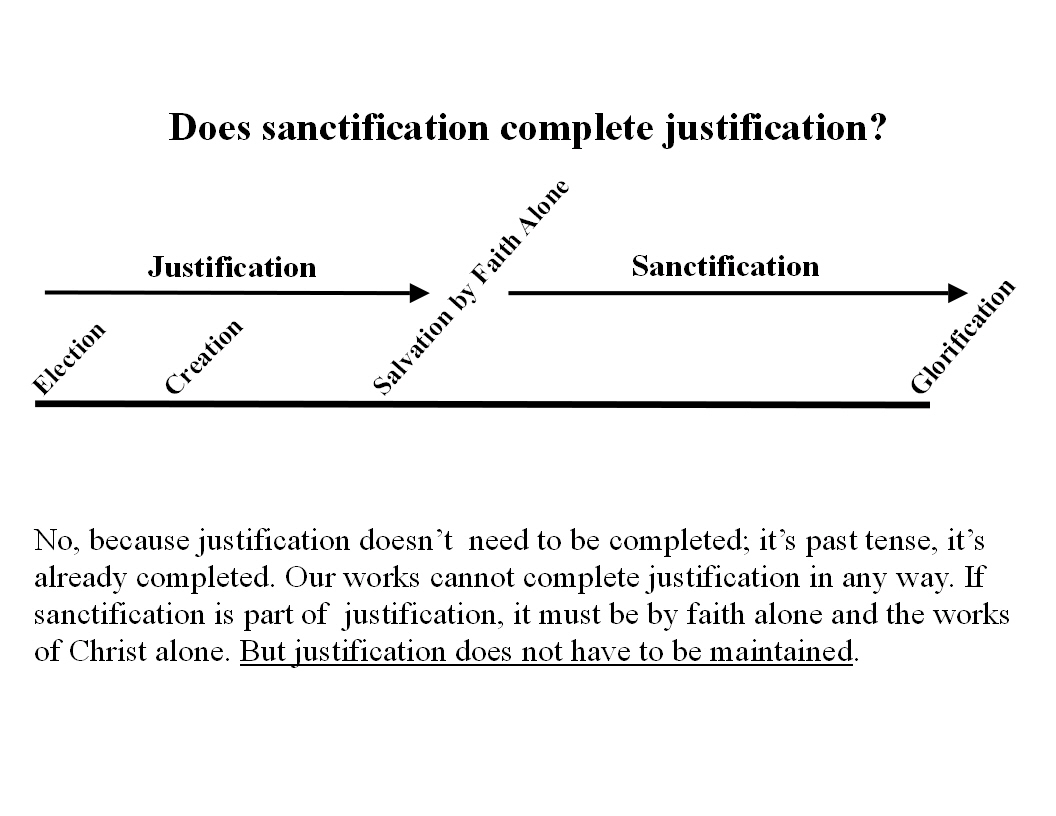 An excellent example is some strains of Freewill Baptists who teach that Christ died for all of our past sins, but with the help of the Holy Spirit, we must confess and repent of every sin we commit until the resurrection, e.g., Christ plus salvation by repentant prayer for sins committed after we are “saved.” My grandparents were saved out of this tradition. When my grandfather asked my grandmother if she thought that God could ever forgive him of all the sins he committed, she answered: “Yes, but you are going to have to pray awful hard!” Praise God that through the ministry of several individuals my grandparents eventually abandoned that gospel for the true one of salvation by faith alone as a finished work. Likewise, Rome teaches that you must let the Catholic Church finish your justification through ritual, e.g., Christ plus Catholic ritual. The Reformation gospel is also Christ plus something else, but the something else is ever-so-subtle. In both cases, sin must be dealt with in sanctification in order for the saint to remain justified until the final judgment. In other words, the righteous standard of justification must be maintained on our behalf. Like all other proponents of a linear gospel, the Reformed crowd contends that anything less than the perfection demanded of the law (“all sin is transgression of the law”) is “legal fiction.” So both Rome and the Reformers agree: justification must be maintained by sanctification, and in the case of the Reformers specifically, they believe that the perfect standard of the law must be maintained until glorification; otherwise, our justification is “legal fiction.” Here is where Reformed subtlety is uncanny: Christ keeps the law for us in sanctification. He maintains the perfect standard. All the fruit of sanctification (obedience/good works) flows from the life He lived on Earth and His death on the cross. Christ plus the works of Christ to finish salvation. “But Paul, what in the world is wrong with that?!” Here is what is wrong with it: works are still required to maintain justification. That is a huge problem, even if it is Christ doing the work. What did the Hebrew writer say about Christ’s work for justification not being complete? And even more subtle is the following Reformed idea: believing that the law is no longer a standard for maintaining justification is antinomianism. Antinomianism =’s legal fiction. Their definition of antinomianism is the removal of the law from justification as the standard for maintaining it. Traditionally, among Biblicists, antinomianism is the removal of the law from sanctification, and herein lays even further steroidal subtlety: the Reformed theologians would refute a removal of the law from sanctification as well, not only because they think justification and sanctification are the same thing, but because its perfect keeping is required to maintain a true declaration of the just that is not “legal fiction.”
  However, the Biblicist believes that the law is a standard for kingdom living and is no longer a standard for justification. Therefore, if we attempt to obey it with the Holy Spirit’s help, and to please/serve the Lord, it can have no bearing on our just state. While the Biblicists think they are therefore joint contenders with the Reformers against antinomianism, such is far from the truth. The Reformed mind believes the Biblicist is either a legalist or an antinomian, or both. The Biblicist is supposedly an antinomian because he/she has removed the law from justification as a just standard, or is a legalist because they think they should strive to keep the law in sanctification. Since sanctification finishes justification’s perfect standard of law keeping, our “own” attempts to keep the law in sanctification is an attempt to finish justification. Hence, what the Biblicist fails to understand is the Reformers belief that Christ must maintain the law for us in sanctification because justification and sanctification are not separate. Anything more or less is supposedly works salvation. On the other hand, because it is vital that Christ obeys the law for us in sanctification, the likes of John Piper and Tullian Tchividjian contend that those who are really preaching the Reformed gospel will indeed be accused of antinomianism. All in all, their position is easy to see if you pay attention. John Piper and many other Calvinists often state that, “Good works are the fruit of justification.” And, “Justification is the root, and sanctification is the fruit.” Well, the average Biblicist then thinks, “Yes, but of course, our salvation makes good works in sanctification possible.” But that’s not what they are saying. If you pay closer attention, they are saying that justification is a tree that produces its own fruit. Justification is the root, and whatever happens in true sanctification is the fruit of the root of the justification tree. Problem is, justification doesn’t grow. Justification is a finished work. What Calvinists refer to as “progressive sanctification” is really the fruit of the root: progressive justification. Another name for this that they throw around is “definitive sanctification.” The word “definitive” refers back to the definite completion of justification.
  Revision: this ministry now rejects the idea that orthodoxy is truth; orthodoxy is the traditions of men. Never in Scripture do we find premise for a body of teaching that explains the teaching. The above illustration is valuable for demonstrating that the fruit of justification is glorification, NOT sanctification. This brings us to the Scriptural argument which begins with a question I asked myself just this morning: “Paul, you are always harping about the crucial importance of the separation of justification and sanctification—a parallel gospel versus a linear one. But where does the Bible say specifically that this is critical?” First, the very definition of a lost person in the Bible is one who is “under the law”:
Romans 3:19 Now we know that whatever the law says it speaks to those who are under the law, so that every mouth may be stopped, and the whole world may be held accountable to God. Romans 6:14 For sin will have no dominion over you, since you are not under law but under grace. Romans 6:15 What then? Are we to sin because we are not under law but under grace? By no means! 1 Corinthians 9:20 To the Jews I became as a Jew, in order to win Jews. To those under the law I became as one under the law (though not being myself under the law) that I might win those under the law. Romans 7:1 Or do you not know, brothers —for I am speaking to those who know the law—that the law is binding on a person only as long as he lives? Romans 7:2 For a married woman is bound by law to her husband while he lives, but if her husband dies she is released from the law of marriage. Romans 7:3 Accordingly, she will be called an adulteress if she lives with another man while her husband is alive. But if her husband dies, she is free from that law, and if she marries another man she is not an adulteress.
The unsaved are “under the law” and will be judged by it in the end. This is the very definition of the unsaved. Calvinists define Christians the same way—we are supposedly still under the law and will be judged by it in the end. That’s why Christ must keep the law for us—because we are still under it. If not this position, why do many in the Reformed tradition hold to the idea that Christ’s perfect obedience is imputed to our sanctification? His death justifies us, and His perfect life sanctifies us. Hence, His death pays the penalty for past sins, and then His perfect life imputed to our sanctification keeps us justified. Why would an imputation to our sanctification be necessary if we are no longer under the law? This is known as the Reformed view of “double imputation” and has been called out as heresy by many respected theologians for this very reason: it implies that Christians are still under the law. In regard to sustaining the law in our stead, why? It has been totally abolished in regard to our just standing:
Romans 3:20 For by works of the law no human being will be justified in his sight, since through the law comes knowledge of sin. Romans 3:21 But now the righteousness of God has been manifested apart from the law, although the Law and the Prophets bear witness to it— Romans 4:15 For the law brings wrath, but where there is no law there is no transgression.
The keeping of the law by anybody DOES NOT do anything to justify mankind:
Romans 3:28 For we hold that one is justified by faith apart from works of the law.
Here is where the separation of justification and sanctification is vital on this first point: we ARE NOT under the law for justification, but rather UPHOLD THE LAW in sanctification. The two must be separate because of the differing relationships to the law:
Romans 3:31 Do we then overthrow the law by this faith? By no means! On the contrary, we uphold the law. Romans 6:15 What then? Are we to sin because we are not under law but under grace? By no means!
Furthermore, if we are still under the law (whether or not Christ obeys it for us to keep us in a just standing), this means we are still under the power of sin. Being under the law and also under its spell to provoke sin in the unregenerate is spoken of as being synonymous in the Bible. Those who are “under the law” are also under the power of sin and enslaved to it:
Romans 7:4 Likewise, my brothers, you also have died to the law through the body of Christ, so that you may belong to another, to him who has been raised from the dead, in order that we may bear fruit for God. Romans 7:5 For while we were living in the flesh, our sinful passions, aroused by the law, were at work in our members to bear fruit for death. Romans 7:6 But now we are released from the law, having died to that which held us captive, so that we serve in the new way of the Spirit and not in the old way of the written code. Romans 7:8 But sin, seizing an opportunity through the commandment, produced in me all kinds of covetousness. For apart from the law, sin lies dead.
If we are still under the law, and will be judged by it, whether or not Christ stands in the judgment for us with His own works, we are still enslaved to sin by virtue of being under the law…. for justification. And Calvinists know this to be true, that’s why they say we are still…. what? Right, even as Christians, “totally depraved.” And, “enemies of God.” Of course, throughout the Bible, Christians are spoken of as being friends of God and no longer His enemies. Our status as enemies of God is stated in the past tense. But the Reformed crew continually state that Christians are vile enemies of God and are enslaved to sin. They realize that this goes hand in hand with being under the law. To the contrary, dying to the law in the death of Christ….for justification—sets us free to be enslaved to the righteousness that is defined by the law. We are dead to the law for justification and alive to obey truth….for sanctification:
Romans 8:2 For the law of the Spirit of life has set you free in Christ Jesus from the law of sin and death. Romans 8:3,4 [emphasis by author] For God has done what the law, weakened by the flesh, could not do. By sending his own Son in the likeness of sinful flesh and for sin, he condemned sin in the flesh,….in order that the righteous requirement of the law might be fulfilled in us, who walk not according to the flesh but according to the Spirit. Romans 8:7 For the mind that is set on the flesh is hostile to God, for it does not submit to God’s law; indeed, it cannot. Romans 9:31 but that Israel who pursued a law that would lead to righteousness did not succeed in reaching that law. John 17:17 Sanctify them in the truth; your word is truth. James 1:25 But the one who looks into the perfect law, the law of liberty, and perseveres, being no hearer who forgets but a doer who acts, he will be blessed in his doing.
So, that is the separation that must be for the true Christian: Justification has no law for which we are judged, and we live by the law of blessings in sanctification. This brings us to another important separation in the two: the judgments. Those under the law and sin will stand in a final judgment which will be according to the law. Again, because Calvinists believe that we are still under the law, albeit that Christ obeyed/obeys it for us, Christians will supposedly stand in the same judgment as the damned who are under the law and enslaved to it. At that time, the children of God, according to Calvinists, will be “made manifest.” But because Christians are not under the law and cannot be judged by it, they will stand in a judgment for rewards and not a judgment that determines a perfect keeping of the law by Christ in our stead. Hence, there will be two different resurrections: one for those under the law and another for those under grace, and two different judgments for the same two groups. One for rewards, and one to determine if those under the law kept it perfectly. The latter judgment doesn’t go well for any standing in it.
Luke 14:12-14 He said also to the man who had invited him, “When you give a dinner or a banquet, do not invite your friends or your brothers or your relatives or rich neighbors, lest they also invite you in return and you be repaid. 13 But when you give a feast, invite the poor, the crippled, the lame, the blind, 14 and you will be blessed, because they cannot repay you. For you will be repaid at the resurrection of the just.” [Notice that this is a resurrection for the “just.” They are already determined to be just before they are resurrected]. 2Corinthians 5:9,10 So whether we are at home or away, we make it our aim to please him. 10 For we must all appear before the judgment seat of Christ, so that each one may receive what is due for what he has done in the body, whether good or evil. 1Corintians 3:11-15 For no one can lay a foundation other than that which is laid, which is Jesus Christ. 12 Now if anyone builds on the foundation with gold, silver, precious stones, wood, hay, straw— 13 each one’s work will become manifest, for the Day will disclose it, because it will be revealed by fire, and the fire will test what sort of work each one has done. 14 If the work that anyone has built on the foundation survives, he will receive a reward. 15 If anyone’s work is burned up, he will suffer loss, though he himself will be saved, but only as through fire. Hebrews 6:10 For God is not unjust so as to overlook your work and the love that you have shown for his name in serving the saints, as you still do. Revelation 20:6 Blessed and holy is the one who shares in the first resurrection! Over such the second death has no power, but they will be priests of God and of Christ, and they will reign with him for a thousand years. Revelation 20:11-15 Then I saw a great white throne and him who was seated on it. From his presence earth and sky fled away, and no place was found for them. 12 And I saw the dead, great and small, standing before the throne, and books were opened. Then another book was opened, which is the book of life. And the dead were judged by what was written in the books, according to what they had done. 13 And the sea gave up the dead who were in it, Death and Hades gave up the dead who were in them, and they were judged, each one of them, according to what they had done. 14 Then Death and Hades were thrown into the lake of fire. This is the second death, the lake of fire. 15 And if anyone’s name was not found written in the book of life, he was thrown into the lake of fire.
Don’t let anyone tell you that eschatology is a “secondary” or “nonessential” consideration. Your eschatology is your gospel. It will state your position regarding whether or not you fuse justification and sanctification together; ie, likening Christians to those under the law.
Yet another vital difference in sanctification and justification is repentance. Repentance for salvation (when you are justified) is different from our repentance in sanctification. Among many in the Reformed tradition where the “same gospel that saved you also sanctifies you,” the repentance is the same. Repentance unto salvation is not a onetime “washing,” but rather a means to continue “in the gospel” through what they call “deep repentance.” Biblicism holds to repentance in sanctification that restores his/her fellowship and communion with God as His children. They would see repentance unto salvation as differing, and only necessary for salvation—a onetime decision to take one’s life in a new direction by following Christ, and believing in his death, burial, and resurrection. Reformed repentance, according to the likes of Paul David Tripp and others is a “daily rescue.” Our original repentance was for rescue, and we need rescue today as much as we needed rescue when we were saved. Again, this indicates their belief that we are still under the curse of the law and need to be continually rescued from it while remaining under the bondage of sin. However, Christ made it clear to Peter (John 13:6-11) that those who have been washed (1Corinthians 6:11, Romans 8:30) do not need another washing. Those who drink of the living water do not thirst again (John 4:13,14). Lastly, though many other separations could be discussed, why saints can be considered just while they still sin at times is of paramount importance. There is no sin in our justification because there is no law, and where there is no law, there is no sin. Though unfortunate, there can be sin in our sanctification because it is totally separate from justification and can’t affect our just standing with God. Basically, all of the aforementioned makes it of necessity to deny the new birth. If we have God’s seed in us, and we do (1John 3:9), that dispels total depravity, and without total depravity, justification and sanctification cannot be fused together. The new birth is a huge problem for Reformed theology. If the old man that was under the law is dead (Romans 7:1ff), and the seed of God is in the saved person, and the sin due to our weakness in the flesh cannot be laid to our account for justification, then our justification is not “legal fiction” because we do not exhibit perfect obedience to the law. This is another grave consideration because Christ said, “You must be born again.” Obviously, despite their denials that they deny the new birth—you can’t be both totally depraved and born again. Reformation doctrine is clearly a false gospel. Its version of justification does not void the law, and denies the new birth while distorting everything in-between. Freewill verses predestination is hardly the issue, the very gospel itself is the issue.
paul
Curing the Protestant Disease of Noanswerosis
 As one crawling out of the present Protestant Dark Age, a focus on sanctification rather than keeping myself saved by not working has revealed a disease that infects all Protestants: Noanswerosis (pronounced no-anser-osis).
This is a word that joins, no—answer—osis. When a Protestant is “saved,” their brain is immediately infected with this disease. In fact, contemporary terms that refer to the Protestant gospel state such explicitly.
The subjective power of an objective gospel.
Or…
The objective gospel.
Or…
The centrality of the objective gospel outside of us.
Or…
Definitive justification experienced subjectively.
What are these terms saying? Well, these are contemporary terms that define the foundational document of the Protestant Reformation: Martin Luther’s Heidelberg Disputation to the Augustinian Order (1518). Luther’s 95 Theses was a moral disputation, his Heidelberg Disputation defined the worldview of the Reformation and was penned about 6 months after the 95 Theses. John Calvin’s Institutes of the Christian Religion further defines Luther’s foundational premise.
What’s the gist of it all? First, God is completely sovereign over everything. Reality is a movie produced and scripted by God. History is a meta-narrative, or metaphysical narrative prewritten by God. Also, this movie (reality) is a 3D movie and requires special glasses in order to see it.
In other words, without the 3D glasses the movie (reality) will be blurred and distorted. And, the 3D glasses are…the gospel. All of reality, according to authentic Reformed ideology, is a gospel story. Seeing yourself in the role of how it all plays out as a mere character in a prewritten play is a matter of faith. If you see yourself as in control of anything, you are making yourself God and attempting to write your own reality.
Therefore, the gospel is the only reality that is…objective. EVERYTHING in life that happens is part of the gospel narrative, or… “his-story” (history).
So, how in the world does this supposedly work in real life? Before we get to that, let’s discuss the immense benefits from seeing reality in this way. Basically, there is no use in getting stressed out about anything because it is just all a prewritten narrative by God that you have no control over. In some sense, more accurately, in a big way, you can step back and separate yourself from what is going on in the world. Don’t worry—be happy. There is no need to get upset about an event, it’s all part of God’s gospel narrative that helps us in seeing reality more clearly.
Stop right there. That’s key. The goal is more seeing. There is a reason for this madness; what else but the primary goal of all philosophies? Happiness or joy or wellbeing or peace or however else you want to frame it. “Faith” is defined as SEEING ONLY. In Luther’s construct, ALL doing is part of the material world and inherently evil. If you can see it, hear it, smell it, taste it, feel it, or DO it—it’s evil, period.
Seeing life more and more as a prewritten narrative that glorifies the gospel that you have no role in leads to more and more wellbeing. Hey, no matter what happens, to God be the glory. Every life event says something about the gospel. Actually, there is a specific interpretive paradigm, or if you will, the 3D glasses: “The holiness of God as set against the sinfulness of man.” Every life event lends more understanding to the depths of our own depravity versus the holiness of God. When something good happens to us “worms crawling upon the earth” (Calvin), that’s grace, that’s astounding mercy. When something bad happens, we are merely getting what we deserve.
That’s life, but what about the Bible? The Bible is an aid in seeing our depravity more and more and God’s holiness more and more. The Bible is the script of the gospel narrative. According to the Reformed academics that really understand Reformed ideology, the Bible is a gospel narrative that displays the fundamental narratives that play out in life. When you read the Bible, it is therefore your story also as seen in narrative archetypes.
So, a life of faith is really about seeing only, all of the doing has been predetermined by God. This is how we live our lives by faith alone; life is seeing and not doing. The doing is ONLY EXPERIENCED.
Now we are getting into how this philosophy actually functions in real life, supposedly that is. Pretty much, go ahead and live out your life… and here it comes… “subjectively.” This is an affirmation that everything you do is evil, even your good works, and you really have no way of knowing whether it is you doing the work or God. Take note: in understanding this philosophy, it is important to distinguish between personal works and what happens in reality. Everything that happens is predetermined by God as part of His prewritten historical narrative. But, how we see or perceive life events determines whether we are living by faith or not. There must be a distinction between actual events and perception.
Bible study, or teaching in general is focused on perception, and then we go about living our lives subjectively. Yes, we make an effort to live life, but in our effort to live life we confess that it is a subjective experience. What does that mean? Luther split subjective life into two categories: venial sin and mortal sin. If we believe that we can do a good work, that’s mortal sin. If we confess that even our good works are evil, that’s venial sin. Life is subjective because when we see our works in the world, we have no way of knowing whether it is God doing the work through us or ourselves doing a work…and you hear this often… “in our own efforts.” All of the incessant moaning you hear in church over “works done in our own efforts” is right out of the Heidelberg Disputation.
The Reformed have three schools of thought in regard to how the subjective life works. Theory one states that the subjective life of faith is a combination of manifestation and our actual works. Manifestation is realm manifestation. This is when the invisible realm births an event in the material realm. It is like the rain. You feel the rain, you experience the rain, but you have no control over the rain. The rain comes from heaven—you didn’t make it rain, you only experience the rain. This school holds to the idea that it is impossible to distinguish between our actual efforts and realm birthing, or realm manifestation. As long as the person believes that everything that he/she does is evil, and anything good that happened came from God—that’s venial sin and will be forgiven IF we confess that our good works are evil. It is a subjective life because we have no way of knowing what our works are and what the Spirit’s works are. We only confess that if anything we experience is actually a good work, we didn’t do it.
The second school is John Calvin’s Sabbath Rest Sanctification paradigm. If all of our works are sanctified by contemplation on the gospel, ie., our sinfulness as set against God’s holiness, we will be less tempted by our “good” works. In other words, we will be less tempted towards mortal sin—the belief that we actually did a good work. This is closely related to the imperative command is grounded in the indicative event. The more we contemplate the gospel, the more we are able to see that anything in our life that appears to be a good work is a work that flows from the gospel event. This is also connected to the Reformed doctrine of double imputation. Christ came to fulfil the law so that His obedience to the law during the time He lived on earth can be imputed to our lives by faith alone. So, if we experience any good work in our life and believe it is a manifestation of Christ’s obedience imputed to us—we are under venial sin and not mortal sin.
Venial sin is forgivable, but we must be faithful to the institutional church and return to the same gospel that saved us in order to receive a reapplication of Christ’s penal substitution and righteous obedience. They use 1John 1:9 and other Scriptures as a proof text for this doctrine. A perpetual return to the same gospel that saved us keeps us in the “vital union” with Christ which is yet another Reformed soteriological doctrine.
The third school emphasizes the Reformed doctrine of mortification and vivification. This doctrine encompasses the other two schools as well. Its contemporary expression is John Piper’s Christian Hedonism. This is also the official Reformed definition of the new birth. The new birth is mortification and vivification. Mortification entails a focus on our sinfulness and wormism. This is the death part of our baptism. This results in resurrection, or vivification. This is the resurrection part of our baptism. As we see the gospel narrative more deeply, we experience the joy of vivification in a deeper and deeper way. Seeing the depths of our sinfulness as set against God’s holiness (mortification) leads to a deeper and deeper experience of joy in our Christian lives (vivification). Hence, the new birth is not a onetime event in the Christians life, the Christian must continually return to the new birth process that leads to the ultimate goal of a joyful Christian life. Question. In the final analysis, is this not a rejoicing in evil that Paul stated as an antithesis of love?
Therefore, believing that the new birth is a onetime event assumes Christians move on to something else other than the gospel which also assumes Christians can do good works. That’s mortal sin. Also, a literal interpretation of the Bible assumes that biblical commands can be obeyed by the believer, that is also mortal sin according to Reformed ideology. This means that a grammatical historical view of the Bible is conducive to mortal sin while the historical redemptive view of Scripture keeps the “believer” under the auspices of forgivable venial sin.
This all translates into a dramatic devaluing of wisdom for living life in an effective way. This is what has been going on for hundreds of years. Obviously, answers are not the point or anywhere in the ballpark of life. Answers are not merely in the back seat—they aren’t even in the car. The only answer for an unfixable life is to be “joyful no matter what your circumstances are.”
This is where Noanswerosis comes from. What are the symptoms? When you counsel someone and give them solid answers from the Scriptures, they just sit there and look at you dumfounded. They will actually depart without acknowledging that the conversation actually happened. As Protestants, we are so accustomed to not having answers that the answers are now paralyzing us. It’s Noanswerosis.
Noanswerosis is caused by believing that having answers is mortal sin and applying the answers will condemn you to hell. Now you better understand where the Bible is coming from. Faith is not just seeing—it’s doing (see James). Happiness does not come from mere seeing—the blessing is IN the doing (James 1:25). Seeing only is a life built upon sand, a life of having answers and applying them is a life built upon a rock.
We have the answers, let’s keep learning and putting what we learn into practice while it is still daylight for the darkness is coming when no man can work.
paul
Why Home Fellowships Can Help Abused Women and the Institutional Church Cannot

In our vision for a return to the way Judeo-Christian assemblies were done for about the first 300 years, let’s look at why home fellowships can help abused women and the institutional church cannot.
I would like to use this article as a catalyst for argumentation. The article was posted (author is not clearly stated) by Anna Wood who co-authored a book with Jeff Crippen, a Reformed pastor. The book can be found here.
The post is titled, What domestic abuse victims need from the church. My contention is that abused women cannot get what they need from “the church” as demonstrated over and over and over again. In fact, clearly, as also demonstrated over and over and over again as well, the institutional church adds to the abuse and becomes a co-abuser.
Why is this? The article offers a perspective from which to answer. This issue also speaks to the differences between home fellowships and the institutional church, hereafter “the church.” In an institution, it is easy to sign on the dotted line, give at the office, and pretend. Pastors can bark from Calvin’s Geneva pulpit all they want to; all folks have to say is, “Hey, I am a member in good standing, and as often heard, humble and incompetent—it’s not my gift and I am not qualified.” Likewise, in said article, the author’s call to “get involved” is going nowhere in the church in case anyone hasn’t noticed.
To the contrary, home fellowships are comprised of people who are sick of playing church, are weary of being mere spectators, and are not looking to walk into an arena with hungry lions, but know it could lead to that. They are also confident in the Spirit-filled laity and recognize where 500 years of academic popeism has brought us. In addition, they have a literal view of reality versus the functional dualism that drives orthodoxy. What am I saying? I am saying that home fellowships have a radically different worldview than orthodoxy and this will lead to aggressive participation in all kinds of needs.
Let me further this point by using the article at hand:
Statistics say that one out of four women in the United States experience domestic abuse of some form in their lifetime. Men can also be victims of domestic abuse. When those who have suffered are members of the Lord’s church, the faithful among them have an obligation to help them. And, if we know of someone in the community who is being abused, I also believe we have an obligation to help if we can. When, for whatever reason, we shy away from this obligation, either through ignorance or willful refusal to get involved, we lay waste to the Gospel we claim to believe. Christians are called to defend the oppressed yet when it comes to domestic violence, so few do.
What abuse victims need from their fellow Christians is pretty simple and straightforward. We need you to be Jesus to us. Do what He would do, say what He would say, were He the One ministering to us. Isn’t that what we all need from each other, anyway? Christians are called to stand in the place of Christ here on the earth and be His representative and do the works He would do. To fail in this is to fail in serving Christ.
Whoa, what a minute here! This is entirely unrealistic because of the message constantly drilled into the heads of Protestants. We are “all just sinners saved by grace.” We are, according to one prominent evangelical, “enemies of God.” According to yet another, “we hate God.” On the one hand, it is constantly drilled into the heads of those in the church that “when you are dead, you can do nothing,” but on the other hand we really think that parishioners shouldn’t think twice about getting involved in a domestic abuse situation?
First of all, getting involved in domestic violence is not “pretty simple.” Actually, it can get you killed by someone who doesn’t much appreciate your intervention. Moreover, getting the facts and evaluating the situation biblically is far from simple. Now couple that with the constant total depravity of the saints mantra heard in the church and it is little wonder that few will get involved in domestic abuse needs. The completely upside down worldview of the church makes laity involvement in domestic abuse nothing more than a pipe dream.
And, “Christians are called to defend the oppressed yet when it comes to domestic violence, so few do.” This complaint is not only a mere symptom, but is not even a symptom of the real problem. Congregants not only fail to defend the oppressed, they either turn a blind eye or defend the defender of the abusers—the church. Ever heard of SGM? Ever heard of ABWE? Ever heard of the SBC? In case you haven’t noticed, they are not only still in business, but business is booming! Why? Because regardless of what happens in the church, it is the only ticket to heaven. “What? so billions of people should go to hell because some bad things happen in the church that is made up of sinners? Well, get a grip—where there are people, there is sin!” That is in quotations because this is exactly what we hear in response to a “cry for justice.”
So far, if you are keeping notes, we have two reasons the church cannot help abused women: 1. The total depravity of the saints resulting in a few “experts” attempting to minister to a massive throng 2. Salvation is found in the institution, and therefore the institution will be defended at all cost. Better that a few suffer by themselves rather than all of humanity being sent to hell.
Before we move on to the next points, a little more clarification: why does the church defend abusers? It starts with its worldview. Without going into a lot of detail, we must first recognize that Calvin and Luther are the church’s heroes, and then recognize what their “theology of the cross” was all about. This is a philosophy that interprets all reality via the suffering of the cross. As Luther stated, “all wisdom is hidden in suffering.” Luther, as well as Calvin, split reality into two epistemologies: the cross story and the glory story. Only preordained leaders can lead the great unwashed masses in the cross story—only the preordained can save humanity from the story of man, or the glory story. As Al Mohler once said, “pastors are preordained to save God’s people from ignorance.”
 However, theologians of the cross and the spiritual peasantry have something in common: we are all just sinners saved by grace. So, everything going on in the material realm is fairly insignificant—it’s just the same old sin and dance anyway. But by the same token, theologians of the cross are preordained of God and invaluable. And besides, many are icons of the institution that keep the money rolling in. Sure, you can reject this theory and opt for another one, but in the process you will drive yourself nuts trying to figure out why ABWE defended and protected Donn Ketcham until the bitter end.
Need another example among myriads? What about Jack Hyles? The guy was a mafia don dressed in Bible verses and is still a spiritual hero among many Baptists. David Hyles, Jack’s son, was also a well-respected pastor in the church who had affairs with at least 19 women and is a suspect in an unsolved murder. Yet, to the best of my knowledge to date, David Hyles is still invited to speak at Baptist conferences/churches and receives robust ovations. Jack Hyles remained in the pulpit until his death in 2001 and was succeeded by his son in law Jack Schaap who is presently in prison for statutory rape. Jack Hyles is notorious for his quip, “If you didn’t see it, it didn’t happen” and is still revered among many Baptists as the best preacher since the apostle Paul.
The article continues with its list of things abuse victims need from “the church.” But the thesis of this article is that the church is not only unable to supply these things, but becomes a co-abuser. In contrast, the original Christian model for fellowship is well able to help and more likely to do just that.
First on the list is “The Pure Gospel.”
The church long ago got away from the pure gospel. We water it down, mix it up and serve it with a side of fun. No wonder it doesn’t save. It can’t save. It’s poison. We need preachers dedicated to the truth of God’s Word who are willing to stand up and preach that truth without changing it one iota. We need Christians who long after righteousness. When we have that–the pure Gospel preached and lived–we’ll see more Christians helping abuse victims and we’ll see less abusers masquerading as Christians.
Uh, ok, not sure how to add to this. It’s a stunning admission while calling on the same church to do something about the problem it has created. We don’t need “preachers” to do anything. Preachers have been preaching long and hard for thousands of years and the results are evident. We need God’s people to stand up and get back to the first works of home fellowship. The laity waiting on the experts is long traveled and worthless. More of what is beginning to happen needs to happen more and more. Ordinary Spirit-filled Christians are meeting together around the word and fellowship, and seeking God’s face in this whole matter about how church is traditionally practiced. And the fact that the church is grounded in a false gospel is something I addressed in another article posted today and Friday.
Without addressing every single point in the article other than those mentioned already, let me move on to this one:
Someone to care for their needs
Do you know what keeps a lot of abused women and children with their abusers? The lack of money to leave. If a woman is trying to get herself and her children to safety, don’t spend time telling her why she’s wrong, what you think about her decision or trying to talk her out of it. She knows what it’s like to live in abuse and you don’t. Even if she stays, chances are great that she and her children need something or maybe a lot of things. Financial abuse often accompanies other types of abuse. Instead of lecturing, get busy serving and help them.
According to the first-century model, a home fellowship network would be several small groups meeting in several homes in the same geographical area. And because of freedom from massive infrastructure cost and “tithing” versus New Testament giving based on NEED only funds and resources to help the abused would be ample. In fact, I could share an example from our very own home fellowship. We have a young lady living with us, and other people connected to our fellowship contribute financially to her needs. She is fully supported independently from anybody who might be a problem in her life. And when people live with you, trust me, you know the facts and you do a lot of listening. She will be completely self-reliant this month after living with us for about two years.
In regard to a different kind of abuse, a home fellowship network that I know of in Africa operates in the following way: the network assimilates street orphans from Nairobi into their fellowships. There is a leader from the network, equipped with the latest information about funds and availability that goes into Nairobi searching for orphans, and upon finding some, brings them back to the fellowship network where they will have a home, food, protection, and education. Let’s say that our home fellowships are connected with theirs; many of these children could be brought stateside and assimilated into fellowship here as well.
In addition to being freed from the bondage of infrastructure expense, the authority of the church’s clergy is suffocating. Clergy, more times than not, are control freaks obsessed with keeping the herd calm. They are spiritual cowboys constantly concerned with the herd being spooked. This speaks to the rest of the concerns in the post being considered here. More times than not, the laity are kept in the dark concerning the needs of those abused. There is a wall of confidentiality between the church’s “trained” counselors and the parishioners who fund the whole mess. When red flags are raised in regard to how certain situations are handled, we are told that “we should trust the elders who are closest to the situation and know all of the details.” This continually proves to be a recipe for disaster, and elders are granted NO such authority via the Scriptures.
Small groups in private homes offer intimate support and confidentiality from the other home fellowships. It is a perfect balance of intimate care and financial support if needed. All of the different gifts and experiences of Christ’s body are brought to bear on the situation.
Also, we must remember that the home fellowship movement is comprised of people from all walks of life: policemen, mental health professionals, etc., etc. These people or their areas of expertise are not separated from any situation by the professional clergy for inappropriate reasons.
paul
Here We Go Again: “The Church”
In the video below which promotes a book on the subject, we have another example of this whole idea that God will bless America if “the church” is running the show. I wrote a post on this yesterday and defined what is meant by “the church.” In the video, this very term is used: “the church.” The key to America returning to greatness is “G-o-d, not G-o-v.,” via “the church.”
What is the assumptive presupposition? That, and this even coming from Rush Limbaugh of all people, some “concept of God” is key to strong leadership. What does this assume? It assumes what we swim in daily: God is not concerned with particulars. God is not concerned with the particulars of the Big T, truth.
Get out of bed, get dressed, put your hands over your eyes, walk a couple of steps into the day, and look, and there you will find an example. On Facebook the other day I saw a conversation among women who belong to “the church,” in this case Baptists and Methodists, clamoring about getting a group together to hear Beth Moore speak in Cincinnati, Ohio. Never mind that she flaunts her Eastern mysticism in broad daylight, she is a well-spoken, feel-good expositor that is part of “the church.” Her outfits are also to die for. ‘Nuff said.
This makes the case that mankind is helplessly enslaved to the concept of church state which is founded in the ancient doctrine of the knowledge of good and evil. It is the belief that creation is fundamentally evil and only the invisible is good. Moreover, the invisible is a subjective complex knowledge that takes a spiritual journey that should include everyone, and as many “gifted” teachers as possible. Faith in general, and “Christianity” in particular is a journey in pursuit of the gnosis. All who are on this journey are good and closest to the gnosis that brings wellbeing (utopia), those who are not part of “the church” are confused and cannot discern anything of the gnosis. They are not “spiritually discerning.” They are helplessly enslaved to material absolutes.
This is exactly how “the church” functions. It is an institutional church state wannabe. It is an institution that groans and weeps for the realization of Plato’s Republic. It moans and weeps for philosopher kings to save us from the abyss of people governing themselves.
It took mankind something like 10,000 years to break free from this tyranny and the historical demarcation was the American Revolution. The reason American ideology works so well when properly applied is because it has a biblical metaphysical premise: creation became weak, not inherently evil.
In addition, mankind in general can know things—mankind in general can know reality. Secondly, every person born into the world is responsible to God personally, and God speaks to every human being individually in a way that every person can understand. In other words, people are created free and culpable before God alone for the sum and substance of their own lives. The sole purpose of government is to insure that freedom for each and every person born into the world.
The framers of the American Constitution held that these principles were “self-evident.” Some were Christians, most were deists, some were agnostic if not outright atheist, the principle of individualism versus collectivism was the driving force—NOT where the principle came from! All of them agreed on the principle and the role of government and cared little about where the others thought the principle came from. What we see today is an emphasis on the source, not the principle. And this is the fly in the ointment: some “concept of God” can be interpreted in a variety of ways; in every case, enter tyranny.
Hence, “the church” is a purely Platonist concept propagated by the big three of the Protestant Reformation: Augustine, Luther, and Calvin. A cursory observation of history reveals that all three were murdering despots. Most Christians, really all save a few, are helpless to know the difference because world philosophy is “worldly knowledge.” So, if the premise of what you really believe is unnecessary knowledge, the philosopher kings of “the church” can lead you around like a dog on a leash.
Want an example? Wherever you are, just remove your hands from over your eyes and look.
paul

 Paul's Passing Thoughts
leave a comment