Loving Ourselves
Does the Bible ever state that to love ourselves is a sin? I don’t believe so. In fact it never even suggests that we are to love others MORE than ourselves. We are to love others AS MUCH AS we love ourselves.
“For no man ever yet hated his own flesh; but nourisheth and cherisheth it…” ~ Ephesians 5:29
“For all the law is fulfilled in one word, even in this; Thou shalt love thy neighbour as thyself.” ~ Galatians 5:14
“If ye fulfil the royal law according to the scripture, ‘Thou shalt love thy neighbour as thyself,’ ye do well:” ~ James 2:8
“Owe no man any thing, but to love one another: for he that loveth another hath fulfilled the law.” ~ Romans 13:8
“But as touching brotherly love ye need not that I write unto you: for ye yourselves are taught of God to love one another.” ~ 1 Thessalonians 4:9
“Ye have heard that it hath been said, ‘Thou shalt love thy neighbour, and hate thine enemy.’ But I say unto you, love your enemies, bless them that curse you, do good to them that hate you, and pray for them which despitefully use you, and persecute you; that ye may be the children of your Father which is in heaven: for he maketh his sun to rise on the evil and on the good, and sendeth rain on the just and on the unjust.” ~ Matthew 5:43-45
“ ‘Master, which is the great commandment in the law?’ Jesus said unto him, ‘Thou shalt love the Lord thy God with all thy heart, and with all thy soul, and with all thy mind. This is the first and great commandment. And the second is like unto it, Thou shalt love thy neighbour as thyself. On these two commandments hang all the law and the prophets.’ ” ~ Matthew 22:36-40
To love yourself is to recognize your own value. If you do not recognize your own worth then you cannot recognize the value of others.
There is application here for just about all of the problems we see in the institutional church. What is the historical orthodoxy? What has been taught about man? The metaphysical premise is man’s depravity. Man is taught that self-loathing is a virtue. Believers have been discouraged from striving for obedience to the law. The law has been replaced with orthodoxy (tradition). This is the definition of anomia; lawlessness. Jesus told the religious leaders of His day that by replacing the law with their traditions that they made the law useless. The result would be that love would grow cold.
This is what such thinking produces. And this is exactly what we are seeing in this day. Is it any wonder? If one is taught that they cannot keep the law because of their own depravity, how can he possibly love himself? Why are there so many cases of divorce, depression, and mental illnesses found in the institutional church? Why do we act shocked when we learn about these sorts of things happening in the institutional church? For the believer, he is taught that an ever-increasing awareness of sin brings about an ever-increasing knowledge of God’s holiness. The Christian life is to be one of dwelling on sinfulness; not on value. How can we expect justice for sexual abuse and other physical or spiritual abuses? If one believes he has no value, how can he possibly love others? Others have no value. Others then are nothing more than objects to be used for one’s own end.
Do you realize that if we spent our time focusing on loving others, we wouldn’t have to worry about breaking any laws? Think about that for a second. When it comes right down to it, isn’t the breaking of any law really a violation of the rights of another? It says, “I don’t value you.” Why don’t we steal? Is it because God said, “thou shalt not steal?” Or is it because we recognize that we would not want our things stolen? This ought to reveal our own sense of self-worth, which flies in the face of religious orthodoxy in direct opposition to the notion of total depravity. And in recognizing this self-worth, we then project that onto others. We recognize the value of others because we recognize our own value. God’s law teaches us that we have value!
Andy
What is Love?
“Love (agape) suffereth long, and is kind; love (agape) envieth not; love (agape) vaunteth not itself, is not puffed up, doth not behave itself unseemly, seeketh not her own, is not easily provoked, thinketh no evil; rejoiceth not in iniquity, but rejoiceth in the truth; beareth all things, believeth all things, hopeth all things, endureth all things. Love (agape) never faileth:”
~ 1 Corinthians 13:4-8
This passage of scripture is one of the most well-know sections of the Bible. It is most often referred to as the great love chapter, and often the chapter is used in the context of marriage. And while it certainly has application to married couples, the apostle Paul had a much larger context in mind when he began his treatise.
The context actually begins in chapter 12 and extends through chapter 14 of 1 Corinthians. Paul was addressing a specific problem in the assemblies in Corinth and the province of Achaia. The issue was with regard to spiritual gifts among believers, and there were those who regarded certain gifts as more important or of higher esteem than others. More specifically, the Corinthians viewed tongues as the most important gift, and so if you didn’t speak in tongues, then you were considered a lower-class of believer. As a result, everyone wanted to speak in tongues. In 1 Corinthians 12:31 he said you earnestly covet the best gifts (or what they thought were the best). But Paul rebuked them by showing them that this was not loving behavior. This is what prompts the apostle to launch into his in-depth dissertation on the definition and characteristics of love. Let’s consider each one of these characteristics in detail.
“Suffereth long”
μακροθυμει (mak-roth-oo-my) – To be long-spirited. Forbearing or patient. Love hangs in there for the long run.
“Is kind”
χρηστευνεται (chray-styoo-neh-tie) – Derived from the word χρηομαι (chray-oh-my), having to do with the hand in a sense where one is furnishing that which is needed. “Lending a hand”. To show oneself useful. Acting useful. Benevolent. Love does what is needed for another’s benefit.
“Envieth not”
ου ζηλοι (oo dzay-loy) – “oo” being the negative particle meaning “no” or “not”. “Dzay-loy” is derived from the word which means “heat”. To be boiling with heat. Zeal in an unfavorable sense. “Hot headed”; petulant. Love does not behave like a petulant child who doesn’t get his way.
“Vaunteth not itself”
ου περπερευεται (per-per-you-eh-tie) – The prefix “peri” has the meaning of going beyond or further. The double use of “per” in this word gives emphasis of going farther beyond what is necessary, which is what a braggart does. Giving oneself more honor than one should; elevating oneself. Love does not boast, brag, or elevate itself.
“Is not puffed up”
ου φυσιουται (foo-see-oo-tie) – From the root word φυω (foo-oh) meaning to swell up or grow. To inflate or puff up. Used figuratively, to become proud. Love is not proud.
“Doth not behave itself unseemly”
ουκ ασχημονει (ah-schay-mo-nie) – A compound word with the negative particle “a” meaning “no” or “without” and a derivative of two closely related words; εχω (ech-oh) which means to possess some ability, and σχημα (schay-ma) which is some figure, form, or pattern. Literally, it means not being able to possess its form. If someone is behaving in a manner that is considered indecent, he is not behaving the way one would expect him to. Love behaves in a way that would be congruent with what one should expect of love.
“Seeketh not her own”
ου ζητει τα εαυτης (“oo dzay-tie ta heh-ow-tays) – Literally, “not seek of herself”. The key word in this expression is ζητει (dzay-tie), and it has the idea of plotting or making a plan. But it is also used as a “Hebraism” (a Jewish idiom or figure of speech) to indicate worship to God. Either meaning has application. Love does not plan for its own self-interest. Love does not worship itself.
“Is not easily provoked”
ου παροξυνεται (par-ox-oo-na-tie) – A compound word from the prefix παρα (para), meaning along or beside, and οξυς (ox-zoos) meaning keen or sharp or swift. Literally, to sharpen beside. To make “on edge”. If someone is “on edge” they are irritated or frustrated. Love does not become frustrated quickly. Think about how this is related to the first quality of “suffering long”.
“Thinketh no evil”
ου λογιζεται το κακον (oo log-idz-eh-tie to ka-kon). The key word in this expression is λογιζεται (log-id-zeh-tie), and it means to take an inventory. Love does not take an inventory of evil. Or as Paul Dohse says, “don’t keep a sin list.”
Rejoiceth not in iniquity
ου χαιρει επι τη αδικια (oo chai-rie epi tay ah-di-kee-ah) – The word αδικια (ah-di-kee-ah) is a compound word from the negative particle “a” meaning “no” or “without”, and the word δικη (dee-kay) meaning right or just. So this expression literally means “not cheerful about unjustness.” Love does not show joy over unrighteousness.
“Rejoiceth in the truth”
συγχαιρει δε τη αληθεια (soon-chai-rie deh tay a-lay-thie-ah) – The word for truth is interesting. It is a compound word from a negative particle “a” meaning “no” or “without”, and the word “lathano” which means “to lie hidden” or “to be ignorant”. Truth in this sense is literally that which is no longer hidden, or something revealed. Truth is the opposite of ignorance. But notice now that the word “rejoice” translated here has the prefix “soon” before it. The prefix “soon” means “together”. In this one statement, we are to understand that two things are joyful; love AND truth. Each are dependent upon the other. Love shares a joyful symbiotic relationship with truth.
Paul sums up his dissertation on love with four concluding statements.
“Beareth all things”
παντα στεγει (pan-ta steh-geh-ee) – Literally, “to roof over”, that is, “to cover with silence”. In other words, to keep quiet about something. Think about how this relates to “suffering long” and “not taking an inventory of evil”. Love does not bring up past wrongs. It is all-enduring.
“Believeth all things”
παντα πιστευει (pan-ta pis-tyoo-eh-ee) – To have faith in someone or something. To have faith in someone means that you assume the best about them. Love does not automatically think the worst about others. It is all-believing.
“Hopeth all things”
παντα ελπιζει (pan-ta el-pid-zie) – To anticipate with joyful expectation. The Greek word for “hope” does not describe a wishful sort of thinking. It is a looking forward to with absolute certainty, like a child anticipates Christmas morning. He knows it’s going to happen. Love anticipates with certainty the best from others. It is all-expecting.
“Endureth all things”
παντα υπομενει (pan-ta hoo-poh-meh-nie) – A compound word from the prefix “hupo”, meaning “under” and the word “meno”, meaning “to stay or remain”. Literally, “to remain under”. The implications here are both one of submission but also one of support. Love remains supporting even when it has been wronged. It is all-supporting
Something you should notice about chapter 13 is that there is a distinct change in the literary style. To this point, Paul’s style has been logical and conversational. But Paul’s Hebrew cultural influence becomes apparent in chapter 13 as he switches to a very poetic style. One of the most defining characteristics of Hebrew poetry is parallelism. This can be seen in Psalms, where the writer expresses a thought and then restates that same though another way in the next line. The thoughts can either be comparative or contrasting. Paul uses a more complex form of parallelism called inverse parallelism, and you can see it here in 1 Corinthians 13:7. The relationship between these four aspects of love looks like this:
If you go back and consider the commentary we just discussed on each expression, you should notice how closely the inner two characteristics are related and how closely the outer two are related. Another way to see this inverse parallelism is like this:
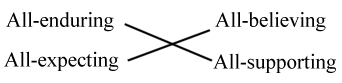
Paul uses parallelism as a poetic way to express his thoughts by restating the same idea in a different way in order to make his point understood. If you look closely at the definitions you will see that the ideas of “bearing” and “enduring” are very much the same thought. Love does not bring up past wrongs (all-bearing/enduring); it remains supporting even when it has been wronged (all-enduring/supporting). It endures those wrongs. Likewise, the ideas of “believing” and “hoping” are also very much the same thought. Love does not automatically think the worst (all-believing), but it anticipates the best with certainty (all-hoping/expecting).
In fact, if you go back and consider the first 8 characteristics of love in verses 4 through 6, they are also arranged in a much larger and even more complex inverse parallelism construct, where one is related to eight, two is related to seven, three is related to six, and four is related to five. Here is a summary of all the characteristics of love just discussed. To help you better see the parallelism just described, I have grouped them accordingly.
Love hangs in there for the long run.
Love does what is needed for another’s benefit.
Love does not behave like a petulant child who doesn’t get his way.
Love does not boast, brag, or elevate itself.
Love is not proud.
Love behaves in a way that would be congruent with what one should expect of love.
Love does not plan for its own self-interest; it does not worship itself
Love does not become frustrated quickly.
Love does not take an inventory of evil.
Love does not show joy over unrighteousness.
Love shares a joyful symbiotic relationship with truth.
Love does not bring up past wrongs. It is all-enduring.
Love does not automatically think the worst about others. It is all-believing.
Love anticipates with certainty the best from others. It is all-expecting.
Love remains supporting even when it has been wronged. It is all-supporting.
Love will never let another down!
Paul’s final statement on love in verse 8 has no parallel line of though with it, but rather it becomes the opening statement to a series of contrasts which we won’t discuss here. Nevertheless, it is still a characteristic of love worth considering.
“Never faileth”
ουδεποτε εκπιπτει (oo-deh-poh-teh ek-pip-tie) – The word for “faileth” is a compound word from the prefix “ek”, meaning “out of” and the word “pipto”, meaning “to fall”, literally or figuratively. In this sense, it does not describe something that comes to an end, but rather something that no longer measures up to a perceived standard of excellence. Love will never let another down.
Think about how these characteristics apply to the use of spiritual gifts among believers. The purpose of gifts is for the mutual edification of the Body of Christ so that each of us may be properly equipped to tell others the good news of the Kingdom. If we are distracted being envious or jealous over each others’ gift or preoccupied over petty disputes or offences toward each other, then we have disqualified ourselves from serving our Father in the mandate He has given us as ambassadors.
Furthermore, think about how love is the antithesis of control. Love does not change behavior by controlling another. It persuades. If we are preoccupied trying to control others, we are not loving them. I am reminded again of the second greatest commandment; love thy neighbor as thyself. Have you ever noticed that it doesn’t say love your neighbor MORE than yourself? No man hates himself. In fact, we are pretty good at loving ourselves. God’s word says to love others JUST AS MUCH AS you love yourself! This means, treat another the same way you want to be treated. That is the definition of love.
Andy
Children as Master Manipulators
 Whether lost or saved, people in general want to know how to do life. Protestantism has forfeited this angle as a way to recommend God because the Reformation was all about interpreting reality through redemption with very little emphasis on wise living. From a commonsense perspective, lost people assume God knows what makes people tick. So, if Christians don’t know how to do life any better than non-Christians, the latter will be little moved by the gospel.
The Reformed actually address this issue straight away. It goes something like this: being a testimony to the world is futile because on our best day we have shortcomings that the world will see. Therefore, the gospel should be about God and not us—we should point to God and not our own testimonies. Well, trust me, the world ain’t buyin’ it.
One of the things that excites me abundantly about the growing exodus away from the wicked false gospel of justification by faith is the rediscovery of kingdom living. That’s the other good news about life more abundantly in the here and now as we move on from the foot of the cross and the gospel of first order. It’s about having a life built upon a rock through the application of God’s wisdom and glorifying Him accordingly. The world understands that we are not perfect; what they take note of is overall quality of life and life patterns.
People will, and do judge us by our children’s behavior. If you are unable to control your 3-year-old, you are a poor representative of the gospel. Christians should be smarter than a 3-year-old.
The fact that young children are utterly self-centered is not altogether a sin issue. They are in total discovery mode. They have been recently introduced to the world with limited intellectual resources. Their perspective is strictly outward. They have NO conscience and NO concept of right or wrong.
More than likely, what they learn about right and wrong as they grow intellectually will inform their consciences which in turn will accuse or excuse their behavior with bad feelings or good feelings. However, for many different reasons and varying circumstances, children will attempt to manipulate others; an art they possess that is normally underestimated in apocalyptic proportions.
This is one of many categories critical to parenting: knowing WHY children do what they do. Once you know why they do it, you can then communicate that knowledge and instruct them in a better way.
In my own living of life, an excellent example was shared with me today, and therefore I type. It is an example of a 5-year-old rendering two grown adults utterly disarmed and standing speechless, hurt, and dumbfounded. That would include me also, because when I heard the testimony, I was also without answer. Hence, we have 5-year-olds standing triumphantly over adult overseers, a scene far from being uncommon.
What’s going on? This kid is good; I had to think about it long and hard before the lightbulb went on. Then, once I figured it out, I had to think about a proper response. Let’s first examine the verbal judo that was used on the parents. It went, in essence, something like this: “I don’t love you. I know some adults that are good parents and you are not. I wish I could live with them instead of you; that’s why I don’t love you.”
This is pure genius. Can you really punish a kid for saying he/she doesn’t love you? Can you really spank a kid for having an “honest” opinion? Through observing life, the child knows the answer is probably, “no.” What’s going on, and what should the response be? What I am saying is that much of parenting should be twofold: discerning of motives and teaching. Unfortunately, some sort of punishment usually takes the place of discernment because discernment is harder than doling out retribution. ALL, I repeat, ALL parenting shortcuts will NOT end well.
Your response doesn’t have to be immediate. Once you discern the situation and the proper response, you can revisit the issue, ie., “Remember when you said this the other day…” One may also use that time to get counsel.
What would my counsel be? First, like all judo, the goal is to control the opponent and that is what is going on in this case. If you think the mere fact that the child has said such a thing indicates a failure on your part, the child has already flipped you over and pinned you to the ground. The child has attempted to disqualify the parent as a worthy parent, and therefore, disqualifying the parent’s right to tell said child what to do. The goal is to control the parent by dismantling the parent’s confidence as a parent. Parents who think they are unworthy parents will be crippled accordingly and much easier to control.
You could start by informing the child that you know what he/she is up to as a response, but in this case, the child’s use of words can be used to teach. By the way, what this child has done is indicative of what Susan and I see when we counsel adults. All of the same manipulation techniques are taken into adulthood and refined. The key is the child’s definition of “love.” This is an opportunity to correct and teach the child what love really is. If the child accepts the counsel, he/she will respond accordingly. Punishment is primarily for a refusal to respond to counsel. The adult’s response might sound like this:
“Love doesn’t do what it does for the purpose of getting something in return. Whether you love me or not, I am going to be the daddy/mommy that you need because I love you. This is why I don’t give you candy or some other reward for obeying—obeying is an act of love that does not obey to get something in return. I try to do everything with you out of love regardless of whether you love me or not. I am not going to stop loving you just because you don’t love me—that’s not love.”
The child must not be allowed to define love in a way that suits an agenda and efforts to control. This is the exact same techniques that adults use. It also has a blackmail angle. If you don’t do what I want you to do, I won’t love you and that will hurt you because I know you love me. Again, this same technique is commonplace in adult marriages. Correcting the child now has a long-term effect in regard to the future. Likewise, as another example, how a child does a chore is indicative as to what kind of adult employee he or she will be.
Primarily, in this case, the child is seeking to control the parent via a self-serving and erroneous definition of love while holding the parent hostage emotionally. The ransom is the child’s love for the parent. The child is also attempting to disqualify the parent as a way of stripping the parent’s authority.
As in most cases, the why must be discerned and the response must be teaching. Punishment is for a refusal to heed wise counsel resulting in blatant rebellion.
paul
Sin, Sin, Sin, Sin, Sin, Sin, Sin, Sin
 Got sin? You do if you are a Protestant, and a lot of it. The “T” in TULIP doesn’t stand for total depravity for no good reason, no pun intended. The only good thing is focusing on the bad thing: your nasty, wicked self.
Sin is a really big deal in Protestantism because we get ourselves into heaven by dwelling on the fact that we are “sinners.” If we can do any good work, if ALL of our works are NOT filthy rags—that’s not living by “faith alone” for our justification. Supposedly, if we think we can do anything good, that’s not living by faith alone in what Jesus has accomplished for us, but rather living in the “confidence of the flesh.”
The foundation of Protestant soteriology is the idea that “Christians” live under the possibility of condemnation and should fear accordingly. Christians remain under the condemnation of the law and remain covered by professing that they can do no good work. By continually returning to the same gospel that saved us for forgiveness of works, both good and bad, the righteousness of Jesus continues to be imputed to us. Hence, “We have no righteousness of our own in salvation or the Christian life.”
In contrast, the emphasis of our Christian lives should be LOVE. We still sin, but it is not sin unto condemnation, but rather sin against our Father as a family matter. We may receive chastisement, but we are in no danger of condemnation. Not so with the Protestant gospel: the “Christian” remains under eternal condemnation and is only covered through faith alone by returning to the same gospel that saved us. This is why Protestantism has always been weak in the area of discipleship. This is why there is an obsession with making saved people rather than disciples. And by the way, the only place we can find continued forgiveness for “sin that removes us from grace” (Calvin/Luther) is under the “authority” of the local church. Go figure.
Even in Baptist churches, pastors bemoan the fact that “10% of the congregants do 90% of the work.” Well, dah, I am surprised that even 10% are doing anything as the focus is keeping oneself saved by focusing on how inept we are.
More and more in counseling, I am telling people to stop focusing so much on sin. Clearly, especially in the Protestant contemporary biblical counseling movement, the specific instruction is to “find the sin beneath the sin” as a means of growing your salvation as if salvation grows to begin with. If our focus is sin- searching as a means of spiritual wellbeing, and good works tempt us to think we did something good (again, Luther/Calvin), what in the world will be the results? Well, look around for yourself—it’s called “the church.”
 A focus on sin will not prevent sin or promote love. If there is something to be gained by finding sin, it will be far from us to fight against it. Why would we cut off our supply of blessings by making the cross smaller? It becomes a supply and demand issue.
The Bible endorses a focus on love, not sin-searching. We are to look for ways to love God and others, not ways to find the “sin beneath the sin” or some endeavor to “peel back the layers of sin.” No doubt, there is a CONTROL conspiracy involved with this supposed method of sanctification as well. Stripping people of an accurate evaluation of self is a very efficient way of controlling them. Being worthy enough to hold others accountable for their own good will not get you into heaven—only returning daily to the same gospel that saved you for a fresh set of downs to get into the salvation end zone.
And what will eventually happen to any marriage if the constant focus is your spouse’s sin? No wonder then that the present-day biblical counseling movement (mostly sponsored by Reformed churches) is overflowing with marriage counseling cases. Week in, and week out, teaching will knock down any notions that either spouse can do any work that is not “filthy rags.” And, the only real sin is not knowing that everything you do is sin; if you don’t know that, you may find yourself in so-called church discipline. We do know this: those who will not accept this premise are deemed “unteachable.”
We have not been given a spirit of fear under the law of sin and death and its condemnation. We, instead, have been given the Holy Spirit and boldness to love God and others without any fear of condemnation.
We are to be enslaved to love—not to a fear of condemnation.
paul

 Paul's Passing Thoughts
2 comments