Religious Tyranny: A Case Study; Introduction and Chapter One
Cover: Religious Tyranny; A Case Study
Preamble
I need another project right now like I need a hole in the head; nevertheless, recent events have impressed upon me the immediate need for this work. As I accomplish each part I will be posting it here on PPT and making all readers part of an editing committee. So, comment here, email me here mail@ttanc.com, and pass judgment on content, grammar, style or whatever else editors do. The compilation will be available in a free ebook or hardcopy book form that can be purchased.
Thank you for your input.
paul
Introduction
“…I have sworn upon the altar of god eternal hostility against every form of tyranny over the mind of man.” – Thomas Jefferson to Dr. Benjamin Rush, September 23, 1801
This book flows not from the winepress of sour grapes, but rather from thankfulness. Whether secular or religious tyranny, these endeavors always yield freedom. Tyranny was a usurper into God’s creation and challenges man’s innate need to be free. Therefore, sin finds itself in a quandary; it is utterly driven by a lust to enslave, but this will eventually drive men to a fight or flight. Tyranny is affliction, but it will always awaken man to his freedom duty. For this, we can be thankful.
This book is an in-depth look into religious tyranny using Clearcreek Chapel in Springboro, Ohio as a case study. However, this case study is a story that reads like most church experiences in our day, and the personal testimonies read the same as well. The information written within will come from the author’s firsthand experience and the testimonies of others, but there is no need to focus on a few people when this is the like testimony of many. Hence, the study will focus on common experiences and not particular individuals.
Most people are saved according to the experience described by the apostle Paul in 1Thessalonians 1:5,
For our gospel came not to you in word only, but also in power, and in the Holy Ghost, and in much assurance; as you know what manner of men we were among you for your sake (KJV).
Yet, most professing Christians doubt their salvation, and furthermore, most professing Christians know there is something fundamentally missing in church; something isn’t right, but they can’t put their finger on it. The present mass exodus from the institutional church is well documented while most people leaving the church don’t know specifically why they are leaving. They are leaving because something is missing, but they are not sure what that something is. The salvation that came with much power and assurance has faded into doubt and indifference.
On the other hand, the church, whether Catholic or Protestant, seems to be supported by many others who are unwavering despite tyranny, illogical contradictions, hypocrisy, and evils not even spoken of in the secular world. How can this be? How can a church like Clearcreek Chapel now embrace beliefs that would have been rejected out of hand with extreme prejudice by the same Chapel parishioners twenty years prior? How can the present leadership behave in a way that would not have been tolerated for a moment twenty years prior by the same people who now embrace it wholeheartedly?
This study proposes to answer all of these questions in no uncertain way, but one final question needs to be answered to complete the study; once the indictment is clarified, what should our response be? What is the solution?
So then, how can we have full assurance of salvation? What is wrong with church? Why is tyranny acceptable? And what should we do about it?
Because only truth sanctifies (John 17:17),
Paul M. Dohse Sr.
Chapter One: The Chapel’s Unique Place in Church History
Clearcreek Chapel in Springboro, Ohio played an important and telling role in contemporary church history. Founded by a young Dr. John D. Street in the latter 1980’s, it sought to be relevant in contemporary culture. Dr. Street often described the church at that time as “ministering to the present culture while wearing bellbottom pants.” Street also patterned the Chapel ministry after his mentor, Pastor John MacArthur Jr.
Dr. Street also made an emerging movement at that time a hallmark of the Chapel ministry; the biblical counseling movement founded by Dr. Jay Adams. The advent of said movement began with Adams’ controversial book, “Competent to Counsel” (1970). The Chapel became a training center for the biblical counseling movement founded by Adams, and in large part a face of the biblical counseling movement.
Adams, a Presbyterian minister, was provoked by his own confession that he was unable to help people with serious problems, and indicted the church as a whole in the same way. What made this indictment painfully obvious was the integration of secular Psychology into religious thought during the 1980s. This integration was a movement that peaked in the 80’s. Help could not be found in the church so people looked for help outside of the church. The biblical counseling movement peaked in the 1990’s and this is when it experienced a true biblical revival, and Clearcreek Chapel was one of the epicenters of that spiritual awakening.
It is now very important to explain what that revival looked like because the implications are profound. This is the first point in beginning to answer the questions presented in the introduction: what’s wrong with church? Why do so many Christians doubt their salvation? Why do so many embrace churches that practice open tyranny? And lastly, what should we do about it?
If most Christians are honest, they see very little progressive change in the people they attend church with. If most Christians are honest, they admit people who are saved from the outside secular world into an enduring life testimony are very few and far in-between. Yet, this was not what was going on at the Chapel during the 90s. In one year (1995) as a result of the biblical counseling focus, twelve people were saved in 1Thessalonians 1:5 fashion and stayed the course. During this time other churches influenced by the Chapel shared the same testimony.
But let’s back up for a moment; Jay Adams’ testimony is startling. As one who came from the elitist hallowed halls of Protestant brain trust, he openly admitted himself that he was clueless in regard to helping people with real life problems. Furthermore, this was his indictment against the church at large as well. We must pause and ponder this fact soberly; after more than 500 years and oceans of Protestant scholarly ink, it was commonly accepted that most ministers were unable to take the word of God and help people with serious problems. There is a very simple answer in regard to why that was the reality and still is, and we will arrive there in due process. But before we move on, it is interesting to note that while the Protestant brain trust openly confessed its inability to help people with deep personal problems, it wailed and screamed in sackcloth and ashes that the void was filled with secular Psychology.
The brainchild of Adams’ biblical counseling construct is even more startling. In beginning his quest for helping people with real problems, he sought out none other than O. Hobart Mowrer, a notable secular Psychiatrist who fathered a kind of responsibility therapy movement championed by the likes of Dr. Phil McGraw and Dr. Laura Schlessinger. Adams wrote in the introduction of Competent To Counsel,
Reading Mowrer’s book The Crisis in Psychiatry and Religion, as I said, was an earth-shaking experience. In this book Mowrer, a noted research psychologist who had been honored with the Presidency of the American Psychological Association for his breakthrough in learning theory, challenged the entire field of psychiatry, declaring it a failure, and sought to refute its fundamental Freudian presuppositions. Boldly he threw down the gauntlet to conservative Christians as well. He asked: “Has Evangelical religion sold its birthright for a mess of psychological pottage?”
In Crisis, Mowrer particularly opposed the Medical Model from which the concept of mental illness was derived. He showed how this model removed responsibility from the counselee. Since one is not considered blameworthy for catching Asian Flu, his family treats him with sympathetic understanding, and others make allowances for him. This is because they know he can’t help his sickness. He was invaded from without. Moreover, he must helplessly rely on experts to help him get well. Mowrer rightly maintained that the Medical Model took away the sense of personal responsibility. As a result, psychotherapy became a search into the past to find others (parents, the church, society, grandmother) on whom to place the blame. Therapy consists of siding against the too-strict Super-ego (conscience) which these culprits have socialized into the poor sick victim.
In contrast, Mowrer antithetically proposed a Moral Model of responsibility. He said that the “patient’s” problems are moral, not medical. He suffers from real guilt, not guilt feelings (false guilt). The basic irregularity is not emotional, but behavioral. He is not a victim of his conscience, but a violator of it. He must stop blaming others and accept responsibility for his own poor behavior. Problems may be solved, not by ventilation of feelings, but rather by confession of sin.
From my protracted involvement with the inmates of the mental institutions at Kankakee and Galesburg, I was convinced that most of them were there, as I said, not because they were sick, but because they were sinful. In counseling sessions, we discovered with astonishing consistency that the main problems people were having were of their own making. Others (grandmother, et al.) were not their problem; they themselves were their own worst enemies. Some had written bad checks, some had become entangled in the consequences of immorality, others had cheated on income tax, and so on. Many had fled to the institution to escape the consequences of their wrongdoing. A number had sought to avoid the responsibility of difficult decisions. We also saw evidence of dramatic recovery when people straightened out these matters. Humanistic as his methods were, Mowrer clearly demonstrated that even his approach could achieve in a few weeks what in many cases psychotherapy had been unable to do in years.
I came home deeply indebted to Mowrer for indirectly driving me to a conclusion that I as a Christian minister should have known all along, namely, that many of the “mentally ill” are people who can be helped by the ministry of God’s Word. I have been trying to do so ever since.
This experience was the breakthrough that launched the biblical counseling movement and its subsequent success. Without Mowrer’s observations, the biblical counseling movement never happens. Nevertheless, Adams then states the following in the same introduction:
Let me append one final word about Mowrer. I want to say clearly, once and for all, that I am not a disciple of Mowrer or William Glasser (a writer in the Mowrer tradition who has become popular recently through the publication of Reality Therapy,a book that has confirmed Mowrer’s contentions in a different context). I stand far off from them. Their systems begin and end with man. Mowrer and Glasser fail to take into consideration man’s basic relationship to God through Christ, neglect God’s law, and know nothing of the power of the Holy Spirit in regeneration and sanctification. Their presuppositional stance must be rejected totally. Christians may thank God that in his providence he has used Mowrer and others to awaken us to the fact that the “mentally ill” can be helped. But Christians must turn to the Scriptures to discover how God (not Mowrer) says to do it.
All concepts, terms and methods used in counseling need to be re-examined biblically. Not one thing can be accepted from the past (or the present) without biblical warrant. Biblical counseling cannot be an imposition of Mowrer’s or Glasser’s views (or mine) upon Scripture. Mowrer and Glasser have shown us that many of the old views were wrong. They have exposed Freud’s opposition to responsibility and have challenged us (if we read their message with Christian eyes) to return to the Bible for our answers. But neither Mowrer nor Glasser has solved the problem of responsibility. The responsibility they advocate is a relative, changing human responsibility; it is a non-Christian responsibility which must be rejected as fully as the irresponsibility of Freud and Rogers. At best, Mowrer’s idea of responsibility is doing what is best for the most. But social mores change; and when pressed as to who is to say what is best, Mowrer falls into a subjectivism which in the end amounts to saying that each individual is his own standard. In other words, there is no standard apart from God’s divinely imposed objective Standard, the Bible. Tweedie is correct, therefore, when he rejects Mowrer’s “projected solution” to the problem of sin as an “acute” disappointment.
During the years that followed, I have been engrossed in the project of developing biblical counseling and have uncovered what I consider to be a number of important scriptural principles. It is amazing to discover how much the Bible has to say about counseling, and how fresh the biblical approach is. The complete trustworthiness of Scripture in dealing with people has been demonstrated. There have been dramatic results, results far more dramatic than those I saw in Illinois.
In light of the entire context stated here, Adams’ paradoxical twist on Mowrer is both stunning and perplexing, but don’t miss the much larger point; Adams’ perspective as documented here is profoundly indicative of what is fundamentally wrong with church. Yes, it is the something that is wrong that few are able to put their finger on. However, we are still in the history stage of our study. In regard to why Clearcreek Chapel is a paramount case study for religious tyranny, we are still laying the historical groundwork.
Chapter Two: The Insurgency
PPT Will Pen an In-Depth Exposé on Clearcreek Chapel
 In the near future, PPT will publish an in-depth exposé on Clearcreek Chapel in Springboro, Ohio. This will include its history and an in-depth profile of past and present elders. Also, its litany of unresolved conflict with many Christian families will be documented in painstaking detail.
This is in response to the constant flow of longstanding emotional suffering flowing out of this “ministry” that refuses to cease or even slow down. Particular attention will be paid to the rabid lust for controlling others practiced by the Clearcreek elders.
And lastly, evangelical organizations, churches, individuals, and pastors who enable their behavior will also be profiled.
This project will surpass any level of in-depth research performed by TANC Ministries since 2009, and will be accompanied by aggressive widespread publication.
The goal is to temper the suffering foisted upon unsuspecting people by Clearcreek Chapel that is constantly brought to our attention by those seeking counsel.
How should such organizations be responded to? That question will be explored as well.
Paul Dohse
TANC Ministries
Government Is Not a Business
In the interest of full disclosure, I do not believe Donald Trump would be a good President.
With that being said, that does not mean I will vote for Hillary. I believe it goes without saying that Hillary Clinton should at most be doing time in prison or at the very least be disqualified as a presidential candidate. However…
In the interest of full disclosure, I believe Trump is just as dangerous as Hillary.
In fact, he may be even more so. At least with Hillary we know what we’re getting. But my own observations have led me to conclude that Trump is a pretender; someone who presents himself to be something he’s not. The Trojan Horse comes to mind (and history shows us just how well that worked out for Troy).
 Nevertheless, I know that there are plenty of people who consider themselves “conservatives” who think that Trump is the answer to our nation’s woes. My aim here is not to convince those people otherwise (although by the end of this article you might be). One factor that people often point to with regard to Trump is this notion that he is a successful businessman. The merits of such a statement are subject to speculation, especially when one considers Trump’s four bankruptcies, his pending litigation with regard to Trump University, his failed business ventures like Trump Steaks, and the fact that he refuses to open his tax records for public scrutiny. But the topic I would like for you to consider is the question of, does being a successful businessman mean you will be a successful President? Or asked another way, should you run a government like you run a business? (Please notice I said “should” and not “can”)
As a small business owner, I am often amazed by the assumptions most people have when it comes to private business. Probably the greatest fallacy that people have is this idea that a business, any business, exists for the sole purpose of providing them (the consumer) with something they need or want. While this is ultimately an end result of business, it is only a secondary purpose at best.
You must first understand that a business is an independent entity. It exists for the sole purpose of providing for the needs and desires of the OWNER, who is also an independent entity. The reason most people don’t get this is because most of us have been conditioned to think that selfishness is evil. But that is not the case. Believe it or not, the Bible even presents selfishness in a positive manner.
“… Thou shalt love thy neighbour as thyself.” ~ Matthew 22:39
“For all the law is fulfilled in one word, even in this; Thou shalt love thy neighbour as thyself.” ~ Galatians 5:14
“For no man ever yet hated his own flesh; but nourisheth and cherisheth it…” ~ Ephesians 5:29
You will notice that the Bible doesn’t tell us to love ourselves LESS than others. It tells us to love others AS MUCH AS we love ourselves. Loving oneself is intrinsic to who we are as individuals. It is not evil to love oneself. It is in fact a necessary part of survival and self-preservation. We are wired in such a way to instinctively seek out those things that will help further our own existence. Ayn Rand called this the “virtue of selfishness”.
In the quest for furthering one’s existence, some people will discover that they are particularly adept at some skill and will then use that skill to produce those things they need to sustain life; farming, building, making clothes, etc. Those who are especially adept discover that they end up with a surplus of production. Rather than letting the surplus go to waste, they seek out others who may have a surplus of their own production – something they the deem necessary for their own existence – and enter into a fair exchange with another individual, value for value. Trade is nothing more than two individuals, each with a surplus of production, entering into a fair exchange of value. And thus, a business enterprise is born.
So you see, any individual engaging in a business venture is doing so in order to meet his own perceived needs. Therefore, those things produced by a business are a product of the business owner; the individual. A business therefore is a representation of the individual; his “self”. It belongs to him because he produced it. And so, because it belongs to him, it is up to the business owner and him alone to decide how to dispose of it, according to that which will best help him to further his means of sustaining his own existence.
A mutual exchange of value for value is the key to every inter-personal relationship throughout the course of our lives. And it is up to each individual to determine what constitutes “fair and equitable”, and if one party does not consider the exchange to be fair, then he is under no obligation to engage in it.
This mutual exchange extends to employees. When the means of production have become too overwhelming for the business owner to handle by himself, rather than reduce production, he may deem it desirable to hire a labor force to expedite production. This brings up another false assumption that people have about business – that businesses exist to create jobs. My response to this is a resounding NO! Businesses are not in the business of producing jobs, they are in the business of production for the benefit of the business owner alone! But when labor becomes necessary to the success of the owner in achieving his ends, he determines wages based on what he decides to be the value of the TASK, NOT the value of the worker. A potential worker can then decide if he wishes to engage in such an exchange (his labor for agreed-upon wages). But it is important to note that neither party compels the other to engage in an exchange that is not deemed mutually beneficial by both.
Because the business owner is motivated by moral self-interest, any power he has is self-appointed. In other words, he can take whatever steps necessary to achieve his ends, which is rooted in furthering his own existence. The only restraint to his power is another self-actualizing individual. His power ends where another begins. His power cannot violate another individual from furthering his existence. One “self” cannot violate another “self”.
From a certain aspect, the individual/business is much like a tyrant. He makes the rules to benefit himself. He has the liberty to dispose of his resources as he sees fit because he is the owner of them (yes, even labor because remember that labor has been “purchased” in exchanged for something of value that has been mutually agreed upon) because he produced them. They are a representation of “self”. He is free to take whatever action he thinks is necessary to achieve his ends of furthering his ability to exist. But such tyranny and pragmatism is tempered by the morality of mutual exchange of value.
These same characteristics apply even if the business is a corporation. While a corporation is in reality a “collective” that consists of a CEO, board of directors, and shareholders, it is technically considered to be a individual entity, much like a “body” is made up of individual “parts” that function as a whole. Therefore, the same truisms that apply to an individual business owner also hold true for a corporation.
But a government (and for argument’s sake, let us assume the U.S. federal government as prescribed by the Constitution) is not a business. A government does not exist for the benefit of itself. A government exists to secure and preserve the RIGHTS of the individual. The “Founding Fathers” understood this when they penned these words in the Declaration of Independence:
“We hold these truths to be self-evident, that all men are created equal, that they are endowed by their Creator with certain unalienable Rights, that among these are Life, Liberty and the pursuit of Happiness.-That to secure these rights, Governments are instituted among Men…”
If there can be said to be any moral justification for government, it is here. We acknowledge that the rights of the individual are endowed to them by virtue of them being individual “self”. That “self” has the right to seek out those things which further its own existence. That government is practical in helping to ensure that such rights are not violated.
So first and foremost, government is not a business because government is not a “self”. If anything, it is a collective appointed by many “selfs” for the express benefit of those “selfs”. Said another way, government is not self-actualizing and it does not exist to serve its own interest, it exists for the express purpose of serving another.
And this brings us to another point, that government only exists by consent. It cannot wield any power without that power first being loaned to it by the consent of those of whom it is to govern. A business needs no consent to exist or wield power any more than an individual needs consent to exercise his power to live. Without consent, however, ANY government is immoral because it presumes to usurp for itself that which does not belong to it.
A third point to consider is that government produces nothing. Let me say that again. Government is a producer of nothing! For government to be a producer it would have to have something of value to offer as a representation “self”, and we have already established that government is not a “self”. And since it is not a “self” and produces nothing, it has nothing to offer in an exchange of value. Unless of course it first confiscates what someone else has produced. Before government can “give” you anything it must first take it from someone else, most often by force. This is the definition of theft.
For these very reasons, by definition and by the proper and moral usage of government, government MUST NOT be run like a business. Any government that attempts to run as such ultimately ends up tyrannical and becomes destructive of the rights of the individual.
Therefore, since government is not a business, the notion that someone would make a good president because he was a good businessman should not even be offered for consideration. I would submit that our federal government has been already been operating like a business (granted, a poorly run business) for far too long. It has been operating for the benefit of itself and those in its collective body instead of operating for the purpose of securing individual rights. Government does not need a different CEO, it needs to operate within the constraints placed upon it by consent of the governed as enumerated by the Constitution.
Is Donald Trump a good businessman? Perhaps. How does he function as a businessman? He spends other people’s money (investors) and then goes bankrupt leaving those investors out to dry. He engages in business ventures that lure in consumers with bait-and-switch tactics. He oversteps the bounds of law in order to achieve his own desired benefit for his business at the expense of others. He uses power, money, and influence to coerce others to do what he wants. Could not the same be said of Hillary? Trump claims he is not a politician, but haven’t politicians engaged in these very same behaviors for decades?
In the end, the argument doesn’t come down to Hillary vs. Trump or whether or not you think Trump is a good businessman or whether or not you think he’s a politician. The argument is first and foremost about the proper role and use of government. The argument is about finding a leader who will be willing to operate under constraint.
Andy
What is Love?
“Love (agape) suffereth long, and is kind; love (agape) envieth not; love (agape) vaunteth not itself, is not puffed up, doth not behave itself unseemly, seeketh not her own, is not easily provoked, thinketh no evil; rejoiceth not in iniquity, but rejoiceth in the truth; beareth all things, believeth all things, hopeth all things, endureth all things. Love (agape) never faileth:”
~ 1 Corinthians 13:4-8
This passage of scripture is one of the most well-know sections of the Bible. It is most often referred to as the great love chapter, and often the chapter is used in the context of marriage. And while it certainly has application to married couples, the apostle Paul had a much larger context in mind when he began his treatise.
The context actually begins in chapter 12 and extends through chapter 14 of 1 Corinthians. Paul was addressing a specific problem in the assemblies in Corinth and the province of Achaia. The issue was with regard to spiritual gifts among believers, and there were those who regarded certain gifts as more important or of higher esteem than others. More specifically, the Corinthians viewed tongues as the most important gift, and so if you didn’t speak in tongues, then you were considered a lower-class of believer. As a result, everyone wanted to speak in tongues. In 1 Corinthians 12:31 he said you earnestly covet the best gifts (or what they thought were the best). But Paul rebuked them by showing them that this was not loving behavior. This is what prompts the apostle to launch into his in-depth dissertation on the definition and characteristics of love. Let’s consider each one of these characteristics in detail.
“Suffereth long”
μακροθυμει (mak-roth-oo-my) – To be long-spirited. Forbearing or patient. Love hangs in there for the long run.
“Is kind”
χρηστευνεται (chray-styoo-neh-tie) – Derived from the word χρηομαι (chray-oh-my), having to do with the hand in a sense where one is furnishing that which is needed. “Lending a hand”. To show oneself useful. Acting useful. Benevolent. Love does what is needed for another’s benefit.
“Envieth not”
ου ζηλοι (oo dzay-loy) – “oo” being the negative particle meaning “no” or “not”. “Dzay-loy” is derived from the word which means “heat”. To be boiling with heat. Zeal in an unfavorable sense. “Hot headed”; petulant. Love does not behave like a petulant child who doesn’t get his way.
“Vaunteth not itself”
ου περπερευεται (per-per-you-eh-tie) – The prefix “peri” has the meaning of going beyond or further. The double use of “per” in this word gives emphasis of going farther beyond what is necessary, which is what a braggart does. Giving oneself more honor than one should; elevating oneself. Love does not boast, brag, or elevate itself.
“Is not puffed up”
ου φυσιουται (foo-see-oo-tie) – From the root word φυω (foo-oh) meaning to swell up or grow. To inflate or puff up. Used figuratively, to become proud. Love is not proud.
“Doth not behave itself unseemly”
ουκ ασχημονει (ah-schay-mo-nie) – A compound word with the negative particle “a” meaning “no” or “without” and a derivative of two closely related words; εχω (ech-oh) which means to possess some ability, and σχημα (schay-ma) which is some figure, form, or pattern. Literally, it means not being able to possess its form. If someone is behaving in a manner that is considered indecent, he is not behaving the way one would expect him to. Love behaves in a way that would be congruent with what one should expect of love.
“Seeketh not her own”
ου ζητει τα εαυτης (“oo dzay-tie ta heh-ow-tays) – Literally, “not seek of herself”. The key word in this expression is ζητει (dzay-tie), and it has the idea of plotting or making a plan. But it is also used as a “Hebraism” (a Jewish idiom or figure of speech) to indicate worship to God. Either meaning has application. Love does not plan for its own self-interest. Love does not worship itself.
“Is not easily provoked”
ου παροξυνεται (par-ox-oo-na-tie) – A compound word from the prefix παρα (para), meaning along or beside, and οξυς (ox-zoos) meaning keen or sharp or swift. Literally, to sharpen beside. To make “on edge”. If someone is “on edge” they are irritated or frustrated. Love does not become frustrated quickly. Think about how this is related to the first quality of “suffering long”.
“Thinketh no evil”
ου λογιζεται το κακον (oo log-idz-eh-tie to ka-kon). The key word in this expression is λογιζεται (log-id-zeh-tie), and it means to take an inventory. Love does not take an inventory of evil. Or as Paul Dohse says, “don’t keep a sin list.”
Rejoiceth not in iniquity
ου χαιρει επι τη αδικια (oo chai-rie epi tay ah-di-kee-ah) – The word αδικια (ah-di-kee-ah) is a compound word from the negative particle “a” meaning “no” or “without”, and the word δικη (dee-kay) meaning right or just. So this expression literally means “not cheerful about unjustness.” Love does not show joy over unrighteousness.
“Rejoiceth in the truth”
συγχαιρει δε τη αληθεια (soon-chai-rie deh tay a-lay-thie-ah) – The word for truth is interesting. It is a compound word from a negative particle “a” meaning “no” or “without”, and the word “lathano” which means “to lie hidden” or “to be ignorant”. Truth in this sense is literally that which is no longer hidden, or something revealed. Truth is the opposite of ignorance. But notice now that the word “rejoice” translated here has the prefix “soon” before it. The prefix “soon” means “together”. In this one statement, we are to understand that two things are joyful; love AND truth. Each are dependent upon the other. Love shares a joyful symbiotic relationship with truth.
Paul sums up his dissertation on love with four concluding statements.
“Beareth all things”
παντα στεγει (pan-ta steh-geh-ee) – Literally, “to roof over”, that is, “to cover with silence”. In other words, to keep quiet about something. Think about how this relates to “suffering long” and “not taking an inventory of evil”. Love does not bring up past wrongs. It is all-enduring.
“Believeth all things”
παντα πιστευει (pan-ta pis-tyoo-eh-ee) – To have faith in someone or something. To have faith in someone means that you assume the best about them. Love does not automatically think the worst about others. It is all-believing.
“Hopeth all things”
παντα ελπιζει (pan-ta el-pid-zie) – To anticipate with joyful expectation. The Greek word for “hope” does not describe a wishful sort of thinking. It is a looking forward to with absolute certainty, like a child anticipates Christmas morning. He knows it’s going to happen. Love anticipates with certainty the best from others. It is all-expecting.
“Endureth all things”
παντα υπομενει (pan-ta hoo-poh-meh-nie) – A compound word from the prefix “hupo”, meaning “under” and the word “meno”, meaning “to stay or remain”. Literally, “to remain under”. The implications here are both one of submission but also one of support. Love remains supporting even when it has been wronged. It is all-supporting
Something you should notice about chapter 13 is that there is a distinct change in the literary style. To this point, Paul’s style has been logical and conversational. But Paul’s Hebrew cultural influence becomes apparent in chapter 13 as he switches to a very poetic style. One of the most defining characteristics of Hebrew poetry is parallelism. This can be seen in Psalms, where the writer expresses a thought and then restates that same though another way in the next line. The thoughts can either be comparative or contrasting. Paul uses a more complex form of parallelism called inverse parallelism, and you can see it here in 1 Corinthians 13:7. The relationship between these four aspects of love looks like this:
If you go back and consider the commentary we just discussed on each expression, you should notice how closely the inner two characteristics are related and how closely the outer two are related. Another way to see this inverse parallelism is like this:
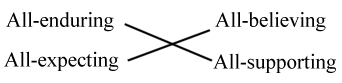
Paul uses parallelism as a poetic way to express his thoughts by restating the same idea in a different way in order to make his point understood. If you look closely at the definitions you will see that the ideas of “bearing” and “enduring” are very much the same thought. Love does not bring up past wrongs (all-bearing/enduring); it remains supporting even when it has been wronged (all-enduring/supporting). It endures those wrongs. Likewise, the ideas of “believing” and “hoping” are also very much the same thought. Love does not automatically think the worst (all-believing), but it anticipates the best with certainty (all-hoping/expecting).
In fact, if you go back and consider the first 8 characteristics of love in verses 4 through 6, they are also arranged in a much larger and even more complex inverse parallelism construct, where one is related to eight, two is related to seven, three is related to six, and four is related to five. Here is a summary of all the characteristics of love just discussed. To help you better see the parallelism just described, I have grouped them accordingly.
Love hangs in there for the long run.
Love does what is needed for another’s benefit.
Love does not behave like a petulant child who doesn’t get his way.
Love does not boast, brag, or elevate itself.
Love is not proud.
Love behaves in a way that would be congruent with what one should expect of love.
Love does not plan for its own self-interest; it does not worship itself
Love does not become frustrated quickly.
Love does not take an inventory of evil.
Love does not show joy over unrighteousness.
Love shares a joyful symbiotic relationship with truth.
Love does not bring up past wrongs. It is all-enduring.
Love does not automatically think the worst about others. It is all-believing.
Love anticipates with certainty the best from others. It is all-expecting.
Love remains supporting even when it has been wronged. It is all-supporting.
Love will never let another down!
Paul’s final statement on love in verse 8 has no parallel line of though with it, but rather it becomes the opening statement to a series of contrasts which we won’t discuss here. Nevertheless, it is still a characteristic of love worth considering.
“Never faileth”
ουδεποτε εκπιπτει (oo-deh-poh-teh ek-pip-tie) – The word for “faileth” is a compound word from the prefix “ek”, meaning “out of” and the word “pipto”, meaning “to fall”, literally or figuratively. In this sense, it does not describe something that comes to an end, but rather something that no longer measures up to a perceived standard of excellence. Love will never let another down.
Think about how these characteristics apply to the use of spiritual gifts among believers. The purpose of gifts is for the mutual edification of the Body of Christ so that each of us may be properly equipped to tell others the good news of the Kingdom. If we are distracted being envious or jealous over each others’ gift or preoccupied over petty disputes or offences toward each other, then we have disqualified ourselves from serving our Father in the mandate He has given us as ambassadors.
Furthermore, think about how love is the antithesis of control. Love does not change behavior by controlling another. It persuades. If we are preoccupied trying to control others, we are not loving them. I am reminded again of the second greatest commandment; love thy neighbor as thyself. Have you ever noticed that it doesn’t say love your neighbor MORE than yourself? No man hates himself. In fact, we are pretty good at loving ourselves. God’s word says to love others JUST AS MUCH AS you love yourself! This means, treat another the same way you want to be treated. That is the definition of love.
Andy
Love
 The idea that forgiveness of damning sin must be perpetual, and the obtaining of this perpetual forgiveness can only be found in the church that came from Rome, which also gave birth to Protestantism, has been from the beginning until now. Protestants only protested Rome’s residual foolishness, not the idea that perpetual salvation is only found in the church. Any objection to this fact is predicated on being misinformed. Church is salvation by church, and even confused churches that deny this are only in remission, but still possess the cancer of progressive justification. And because this is the reality, and regardless of the fact that no institution claims a monopoly on love more than the church, its doctrine of progressive justification makes true biblical love on a grand scale decisively impossible. That is the theses of this chapter.

 Paul's Passing Thoughts
leave a comment