The New Calvinist Takeover of Southwood Presbyterian Church: Part 15; The Fusion of Justification and Sanctification Can Only Lead to Two Things
 “On the flip side, if sanctification is completely separate in operation, Christians can have an aggressive role in it because it has no bearing on the finished work of justification.”
A lot of New Calvinists have visited the Southwood series with the usual barrage of theological jargon that confuses. This is typical: observers trying to ascertain what the issues are walk away confused; so, time to clarify. This doctrine reminds me of the young old lady optical illusion picture. All of the lines, colors, and forms are exactly the same, but depending how you look at it, it’s radically different.

Hence, the discussion of this doctrine verses orthodoxy with justification and sanctification in the balance is not much different. But what is the big deal? This is, as quoted from The Truth About New Calvinism p. 77:
Third, because the believer’s role is reduced to a point that is not according to Scripture, he/she is deprived of the abundant life in a way God wants us to experience it for His glory and the arousing of curiosity from those who don’t have the hope of the gospel.
Fifth: while reductionist theologies seek to reduce the believer’s role to the least common denominator, supposedly to make much of God and little of man, the elements that attempt to make it seem plausible are often complex and mutating. Therefore, instead of majoring on the application of what is learned from Scripture, believers are constantly clamoring about for some new angle that will give them a “deeper understanding” of the gospel that saved them.
Sanctification IS NOT, as many New Calvinists say, “justification in action” because justification is a finished work. If sanctification is “justification in action,” then justification is not FINISHED, it’s still doing something, which means it’s a progressive work towards glorification, or at the very least a maintaining thereof. That’s works salvation if man does any of it (ie., grace/Christ plus works), and antinomianism if Christ does it all in sanctification. In other words, progressive justification (or what is deceptively called “progressive sanctification” by New Calvinists), or the belief that “sanctification is justification in action,” can only result in two things: works salvation or antinomianism. On the flip side, if sanctification is completely separate in operation, Christians can have an aggressive role in it because it has no bearing on the finished work of justification (click on image to enlarge).
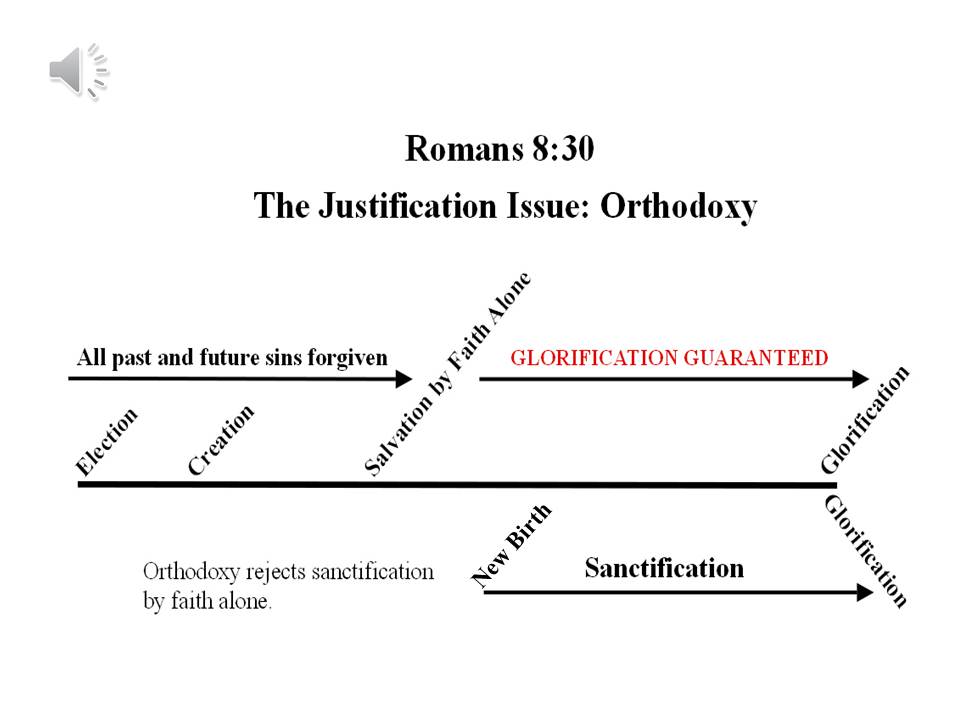
That’s why New Calvinists, in essence, deny the new birth as being an objective recreation that is in us and of us. They believe the new birth is a “formation of Christ” that is displayed through us, but we are still spiritually dead. An actual recreation of our personhood makes it possible to colabor with Christ, and NC don’t like that idea. More on that later, so don’t let it confuse the central issue at this time.
This is the crux of the New Calvinist issue: Brinsmead merely converted Adventist doctrine from works salvation to antinomianism. When Justification is progressive and not a finished work, somebody has to keep the work going, so it’s works salvation. When we do even part of that by keeping the law, that’s Jesus plus works or law-keeping. When Jesus does all of the law-keeping for us (because someone has to keep the process moving forward), we are obviously not obligated to keep the law. In fact, to do so would be to participate in the fruits of justification, which we dare not do (click on image to enlarge).
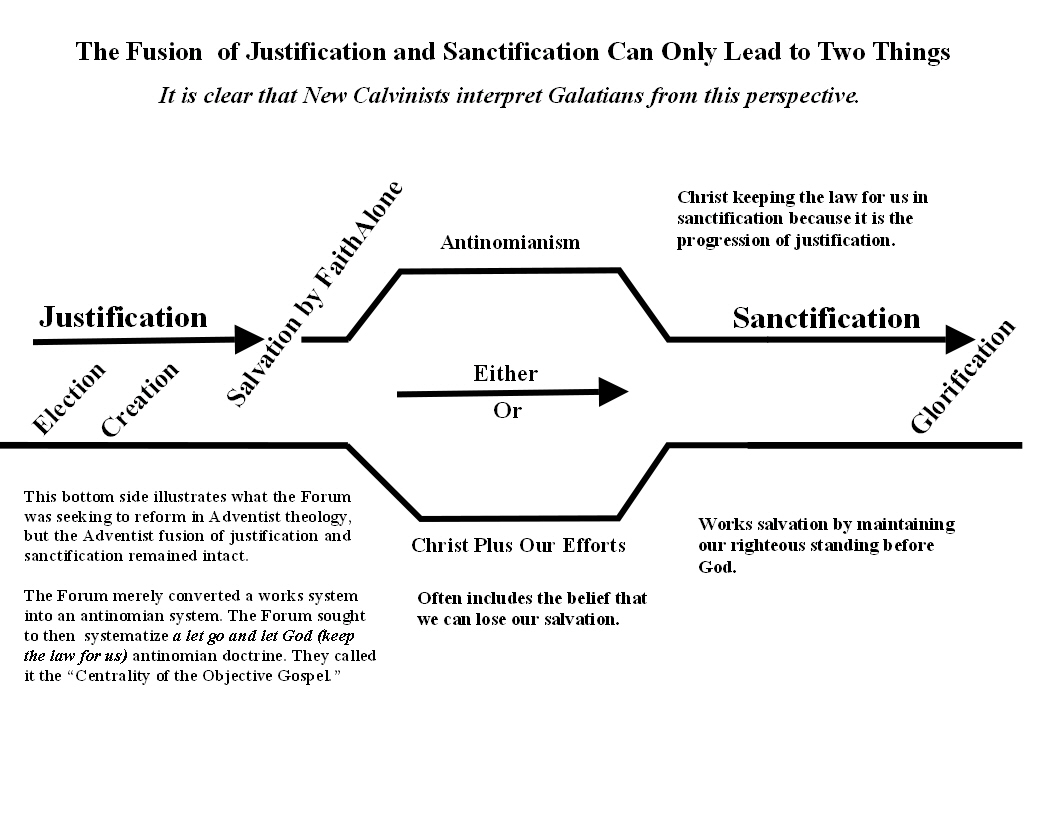
The Forum was seeking to reform Adventist theology, but the Adventist fusion of justification and sanctification remained intact.The Forum merely converted a works system into an antinomian system. The Forum sought to then systematize a let go and let God (keep the law for us) antinomian doctrine. They called it the “Centrality of the Objective Gospel,” and Reformed theologians fell for it, hook, line, and sinker.
In orthodoxy, Christians can aggressively pursue righteousness via the law because we know that it can’t contribute to our justification anyway—it’s IMPOSSIBLE, justification is a finished work. However, can our seeking after righteousness (Matthew 7:24-27) have an effect on how we experience the new birth? Absolutely. One of many aspects of that is seeing God glorified in the eyes of others because of our obedience to the Father. What could feel better? (Matthew 5:16).
paul
The New Calvinist Takeover of Southwood Presbyterian Church: Part 14; Exhibit “A” for Southwood
“Lastly, what is the difference between this doctrine and the ‘wicked, lazy’ servant who hid his talent in the ground, and then returned to the master only what was initially given?”
I was sent a very interesting post by one of my readers the other day. It was a piece written by Southern Baptist pastor Wade Burleson, who I understand as having significant influence in the SBC. The post is entitled, “Therefore, Knowing the Terror of the Lord, We Persuade Men“ (http://www.wadeburleson.org/2011/11/therefore-knowing-terror-of-lord-we.html). The article is an outstanding specimen of New Calvinism and worthy of discussion. Again, if Southwood is taken over by the New Calvinist insurgents, at least everyone will know why it happened. And maybe this post will help by ringing a few bells heard at Southwood.
Like most New Calvinists, especially John Piper, Burleson likes to show his intellectual prowess by mentioning in his profile under Interests that he reads the classical works of the Puritans. Ever tried to read those? Does that make you feel inferior? That’s the idea. Go figure, all New Calvinist leaders read the Puritans and have no trouble understanding that stuff at all. Gee, what’s wrong with us? Burleson’s favorite books are “The Everlasting Love of God To His Elect” by John Gill and “The Life of God in the Soul of Man” by Henry Scougal, the same favorite books of John Piper. Gee, what a coincidence. Burleson’s blog contains 32 recent articles with Piper as the focal point.
However, Burleson is somewhat unique among New Calvinists by showing the New Calvinist kinship to Jon Zens, the father of New Covenant Theology. Most New Calvinists stay aloof from this connection because it enables the possible connecting of dots from the Australian Forum to the present-day movement. Zens also embodies the Adventist flavor of the movement as well. I have been contacted by a discernment ministry which I will not name that is focusing on Zens’ Adventist leanings. Burleson says this about Zens on his blog:
One of my favorite theologians is Jon Zens. Jon edits the quarterly periodical called Searching Together, formerly known as the Baptist Reformation Review. Jon is thoroughly biblical, imminently concerned with the Scriptures …. The best $10.00 you will ever spend is the yearly subscription to Searching Together (http://www.wadeburleson.org/2010/09/searching-together-edited-by-jon-zens.html).
Oh, by the way, Robert Brinsmead wrote several articles in the BRR at Zens’ behest to defend the doctrine they were systematizing, The Centrality of the Objective Gospel against a brutal onslaught by Reformed Baptists. The doctrine ended up splitting a large group of Reformed Baptist in the 80’s resulting in the formation of the Continental Baptists. According to Zens, he changed the name of the Journal to accommodate Adventist readers (The Truth About New Calvinism p. 53).
Now let’s look at the article. It begins this way:
Those who have read Grace and Truth to You for any amount of time know that this author is persuaded the Bible teaches that the eternal rewards of Christians are those rewards–and only those rewards–which are earned by Christ. It is Christ’s obedience to the will and law of the Father that obtains for God’s adopted children our inheritance. It is Christ’s perfect obedience which brings to sinners the Father’s enduring favor and guarantees for us our position as co-heirs with Christ.
Notice: Our rewards as Christians working in sanctification and our salvation as co-heirs with Christ are spoken of as being one and the same by virtue of the missing transition New Calvinist communication technique. If the two are the same as believed by New Calvinists, then their relationship to rewards would obviously be the same as well. And it boils down to this: Presbyterians, as well as Southern Baptists historically believe that salvation is monergistic and sanctification is synergistic, so you fill in the blank. This is a sanctification by faith alone doctrine that orthodoxy has always rejected.
Burleson Continues:
Those who have faith in Christ will never appear at any future judgment of God, or be rewarded for their good behavior. Our sins were judged at the cross, and the behavior for which we are rewarded is Christ’s behavior.
Of course, this contradicts the plain sense of Scripture in many places, but is indicative of New Calvinist doctrine. The logical conclusion of his thesis throughout is that rewards in sanctification are (would be) synonymous with being rewarded with justification. The Australian Forum developed a systematic theology that supposedly enables us to bring the works of Christ to the Father in sanctification and not our own. Here is the Forum’s statement on said doctrine:
We say again, Only those are justified who bring to God a life of perfect obedience to the law of God. This is what faith does—it brings to God the obedience of Jesus Christ. By faith the law is fulfilled and the sinner is justified (The Truth About New Calvinism p.116).
Note that justification must be maintained, and the summation of faith, and the very definition thereof, is continually bringing the works of Christ before the Father and not our own. Burleson echoes the forum in the same article:
Again: We Christians reap what we have not sown. One of the tell-tale signs of the legalist is the inability to totally rest in the knowledge that the riches of God’s favor are earned by Christ’s obedience, not his own. It is impossible to be a co-heir with Christ if the rewards of God’s people are dependent on our performance. God’s favor and our eternal rewards are dependent on Christ.
Again, notice the total synthesis of justification and sanctification (using the missing transition). Rewards in sanctification are absolutely synonymous with earning justification. We must bring Christ’s “obedience,” “behavior,” and “performance.” Ie., Christ obeys for us. Some New Calvinists even teach that Christians obey commands they are totally unaware of because it is Christ obeying through us and for us (The Truth About New Calvinism chapter 13).
And of course, the only standard for “making it our goal to please Him” is the law/Scripture. That’s why New Calvinism needs New Covenant Theology, it deals with that part in order to make things fit.
Southwood has a decision to make: they are either going to reject this doctrine or accept it. But Southwood has an edge that may be a contemporary historical precedent; they at least know what the doctrine is. They are not going to be in a position where they have to accept the idea that this is all in regard to a misunderstanding of semantics. Perhaps Larroux will even ask forgiveness for “going too deep—too fast” before the helpless sheep were “ready” for the full truth of the “scandalous gospel.” You know, because he can understand all that deep Puritan theology.
Lastly, what is the difference between this doctrine and the “wicked, lazy” servant who hid his talent in the ground, and then returned to the master only what was initially given? I wonder.
paul
The New Calvinist Takeover of Southwood Presbyterian Church: Part 13; Romans 8:30, Old Calvinists, and New Calvinists
Sometimes the answer to a question makes a post:
Submitted on 2011/11/25 at 11:55 am | In reply to Greg.
Greg, Continued:
1A) Statement: “In several places you make a distinction between what you call ‘New Calvinism” and “Old Calvinism’. I put it in quotes only because these terms are not familiar to me.”
This is also paramount to our day, what is the difference between the two? I have learned that distinguishing between the two in reference to Romans 8:30 is core. Don’t miss this: New Calvinism started with the basis of the “Awakening” movement started by Robert Brinsmead. It was VERY good news for Seventh-day Adventists who were raised on the investigative judgment doctrine. Ellen White had lengthy treatises that attempted to explain how we were saved by grace alone, but needed to keep ourselves fit for the investigative judgment. Simply put, salvation acquits us of past failures against the law of God, but with the help of the Holy Spirit in sanctification, we could maintain the perfection necessary to be fit for the judgment. Brinsmead’s first theological frame launched the Awakening movement, and it was based on his interpretation of Romans 8:30 (which he drew from in-depth study on the Reformers and the Reformation). The absence of sanctification in that verse indicated to Brinsmead that justification and sanctification were the same thing. Supposedly, the traditional view of sanctification ADDED an additional STEP to justification that was not Scriptural. Conclusion? Awesome news for SDA: Jesus stands in the judgment for us!!
But the fundamental flaw in this doctrine is the SDA belief that justification must be maintained. The premise is flawed. Because justification must be maintained, everything after justification must serve to maintain it, so justification and sanctification, for all practical purposes, must be the same thing. About the time Brinsmead came up with this conclusion, and because it caused a mass revival in the SDA, the Australian Forum project was started to make it all work together in a consistent system lest this rediscovery of lost Reformed doctrine would be lost again. In fact, they sought to establish the “fact” that the Reformation was founded on this very doctrine known as the centrality of the objective gospel. look around, they did their job well.
Hence, this is the fundamental difference between Old Calvinism and New Calvinism: Old Calvinism teaches that justification and sanctification are separate because justification does not need to be maintained, it is finished and complete. That’s why sanctification is not mentioned in Romans 8:30, because sanctification does NOTHING to complete or maintain justification. It is such a done deal that Romans 8:30 states that we are already glorified–before the world was ever created!!
In contrast, New Calvinists believe that justification and sanctification cannot be separated because to do so would be to add an additional step to justification that would include our efforts, because everything points back to justification being maintained. This can be clearly seen in their ongoing statements, including the constant “the ground of our justification” verbiage. The distinction here couldn’t be more vital! Old Calvinists believe that nothing we do in sanctification can earn justification because justification is complete, and the full righteousness of God has been credited to our account. The Old Calvinist now beckons all believers to experience that reality by being obedient to our role in sanctification. Can we try to earn God’s favor in sanctification and thereby unwittingly make that the same as attempting to keep ourselves justified? NO, NO, NO, NO, NO, NO, NO!!!!!!!!!!!! That’s impossible! IT IS FINISHED!!!!!!!!!!
Not so with New Calvinism. Because the two are not separate, doing things that make those things the “grounds for our justification” becomes very tricky business and eternity depends on it, so you better rely on the New Calvinists to sort it all out. Buyer beware! The formula plays it safe (like the servant who hid his talents in the ground), our sanctification is “grounded” in justification via being sanctified the same way we were justified, ie., the gospel, preaching it to ourselves every day, and “the same gospel that saved you also sanctifies you.” As I document in The Truth About New Calvinism, THIS ALL CAME FROM THE AUSTRALIAN FORUM. All of these guys who seem so spiritual and wise bought into a Seventh-day Adventist doctrine unawares. It would be comical if not for the carnage they are leaving on the landscape of Christianity.
paul
The New Calvinist Takeover of Southwood Presbyterian Church: Part 12; Do the Southwood Elders Endorse Tim Keller?
In Bill Nash’s email regarding my postings, he said that I have nothing good to say about, among others, Tim Keller. Therefore, it can be assumed that the Southwood elders endorse Tim Keller, especially since Keller was named in the same list as the apostle Paul, who I supposedly have nothing good to say about as well.
He would be correct about my view of Keller. In “The Truth about New Calvinism,” I say the following on page 70:
“Regardless of the fact that Keller’s popularity as a New Calvinist is second to none, it is well known that he is a Christian mystic:
….Endorsed Eastern Mystic feminist Adele Calhoun’s Spiritual Disciplines Handbook, also endorsed by mystic Ruth Halye Barton. ….Recommends Roman Catholic mysticism.
….At Tim Keller’s Redeemer Presbyterian Church, teaches contemplative spirituality, eastern mysticism and held classes on The Way of the Monk where students were helped to get in touch with their ‘inner monk’ – another term for the ‘inner self.’”
I took these quotes from the blog “5 Pt. Salt,” and the same blog posted the following article concerning Keller’s views on homosexuality:
http://5ptsalt.com/2011/05/14/tim-keller-it-is-very-misleading-to-say-homosexuality-is-a-sin/
I will continue to drive home the point that this is an antinomian doctrine, and they perceive Scripture as nothing more than a tool for Gospel Contemplationism. Furthermore, their continual counsel to people with serious life problems will be “more gospel.” This movement must be stopped!
paul
The New Calvinist Takeover of Southwood Presbyterian Church: Part 11; “The Total Depravity of the Saints?” By Guest Writer Jess Keller
As I sat in church, in corporate prayer to our Sovereign Lord, the words from the preacher’s lips bespoke the idea of the total depravity of believers. “We don’t love you, Lord.” “What?! – we don’t?! I do, I do, I do!” I screamed in my head. There was more along those lines, like ‘we don’t do as you command.’ Is this His church? Is this how we praise and worship Him? Since when are we to be of the mindset that “[g]race will NEVER be amazing, until [our] sin is amazing first.”[1]
When preachers teach believers “…that the very BEST things we’ve ever done—the most pious, most religious, most holy, most selfless acts of obedience, with the purest motives we could possibly muster on our best days, if rightly accounted for, would be in the debit column of our lives, NOT the credit column,”[2] how are we to “…go and make disciples of all nations, baptizing them in the name of the Father and of the Son and of the Holy Spirit, and teaching them to obey everything I have commanded you” (Matthew 28: 19-20).
The idea of the “total depravity of the saints” is creeping into our churches and denying the intrinsic value of the Holy Spirit in our individual lives and the life of His church. “New Calvinist Paul David Tripp describes Christians as “dead” on page 64 of How People Change (2006) and states: ‘When you are dead, you can’t do anything.’ On the same page and the one following, he describes Christians as God’s enemies, fools, not only unable to please God, but lacking the knowhow even if we wanted to (which is a blatant contradiction to what Scripture states), alienated, guilty, and rebellious sinners.”[3]
Is total depravity of the saints simply a pessimistic view of Christian life since “the flesh is weak” as opposed to an optimistic focus on “the Spirit is willing”? (Matthew 26:41). Both are true, yet where is the balance? What should the Christian mindset be? Dead in sin? No. “So you also must consider yourselves dead to sin and alive to God in Christ Jesus” (Romans 6:11). “And let us consider how to stir up one another to love and good works” (Hebrews 10:24). “Or do you not know that your body is a temple of the Holy Spirit within you, whom you have from God? You are not your own….” (1 Corinthians 6:19).
Good news, believers — we’re alive! And since we are partakers of His divine nature, can we make an effort to keep from falling? Yes. In 2 Peter 1:5-11, we’re commanded to. And, “whoever has my commandments and keeps them, he it is who loves me. And he who loves me will be loved by my Father, and I will love him and manifest myself to him” (John 14:21).
[1] Jean F. Larroux, III, What Is So Wrong About Loving What Is Right?, www.sherwood.org/knots/, posted in Comments, September 26, 2011.
[2] Jean F. Larroux, III, Please hear what I’m NOT saying…, www.sherwood.org/knots/, posted February 28, 2011.
[3] Paul M. Dohse, Sr., The Truth About New Calvinism, Bookman Unlimited, 2011, 1st ed.

 Paul's Passing Thoughts
15 comments