
Yes, In Fact, the Law does have the Power to Change Us: Romans 8:2
Originally published May 25, 2014

The confusion concerning sanctification in our day is totally over the top. Sanctification is the Christian life in which we are set apart for God’s purposes. The Bible has been around for a long time; yet, the debate rages. Those who would dare suggest that the Christian can change through obedience to God’s word are quickly muzzled by being accused of “suggesting the law has the power to change people” or “the law of God provides the power to produce what it commands.” These accusations send people running for cover for fear of being labeled a “legalist”, “Pharisee,” or worse.
In all of the discussion, it is assumed that the law has one dimension: that of exposing sin and death. Also, the discussion centers around an ambiguous understanding of what we mean exactly by the term, “law.” The word “law” for all practical purposes refers to the Bible, or the “Scriptures,” or the “law and the prophets,” or merely “law.”
In Matthew 5:17,18, Christ refers to all Scripture canonized at that time as “the law or the prophets.” But then in verse 18, he refers to everything as “the law.” In Luke 24, we have “the prophets” (v.25), “Moses and all the prophets” (v.27), “the Scriptures” (v.32), “the law of Moses, …the prophets…the psalms” (v.44), “the Scriptures” (v.45), “the writings” (v.46), all used interchangeably in this chapter.
In fact, verse 27 officially calls the whole cannon of that time, i.e., the Old Testament, “the Scriptures.” In the first part of verse 27, Christ refers to the Scriptures as “Moses and all of the prophets.” In the second part of the verse, He calls Moses and all of the prophets “the Scriptures.” It’s all the same . It’s all the “law.”
There is no way you can take the Decalogue (a theological term for the Ten Commandments), the prophets, the psalms, the writings of Moses, or any other segment-like portions of Scripture and relegate it to less significance for faith and order. I even take exception to a present uselessness for parts of the law. Though we would not stone rebellious children in our day, the fact that God at one time commanded his people to do so should teach us how much God loathes rebellion in any form.
Other laws that declared things unclean for that time, but not now; such as, for example, Gentiles, should be instructive as well. Certainly, we are not obligated to the Old Testament Law that commands us to let the poor glean what’s left of our harvested fields, but does it teach us what God expects concerning our attitude towards the poor? Absolutely. Scripture has specific application, general application, and different purposes for different times.
It’s all the same. It’s all “Scripture” with equal authority. According to Matthew, 22:23-33 Jesus argued with the Sadducee’s from the writings of Moses and called it “Scripture.” He even based his argument on the present tense verb “am” to argue for a resurrection. Obviously therefore, technical arguments in regard to truth can be made from the Old Testament alone. Scripture is also called the “law” in Psalms 1:2 and James 1:25. Christ called Scripture “all that I have commanded you” in Matthew 28:20. The apostle Paul proclaimed his writings to be “the commands of the Lord” in 1Corinthians 14:37.
Therefore, “All Scripture” is profitable for the things that make a person of God equipped for every good work (2Timothy 3:16). And Christ said that we don’t live by bread alone, but every word that comes forth from the mouth of God (Matthew 4:4). When we use the term ‘law” we are really talking about the Bible.
The Bible has two different purposes, or applications: one for the lost, and one for the saved. It has two dynamics in this regard, and that is completely absent from the present-day discussion on sanctification. Your relationship to the law determines your spiritual state before God. By the way, the fact that the law is only discussed from the perspective of a single dynamic should be alarming to us. Let’s begin our study by examining Romans 8:2,
There is therefore now no condemnation for those who are in Christ Jesus. 2 For the law of the Spirit of life has set you free in Christ Jesus from the law of sin and death.
If the law does not have the power to change us, we are not free from the law of sin and death. Both words for “law” in this verse are the same:
g3551. νόμος nomos; from a primary νέμω nemō (to parcel out, especially food or grazing to animals); law (through the idea of prescriptive usage), genitive case (regulation), specially, (of Moses (including the volume); also of the Gospel), or figuratively (a principle):— law.
It is this law in Christ that sets us free, that is why James calls it the “law of liberty.”
1:25 – But the one who looks into the perfect law, the law of liberty, and perseveres, being no hearer who forgets but a doer who acts, he will be blessed in his doing.
James also stated the practical use of this law as well:
1:22 But be doers of the word, and not hearers only, deceiving yourselves.
As did Christ:
Matthew 7:24 – “Everyone then who hears these words of mine and does them will be like a wise man who built his house on the rock. 25 And the rain fell, and the floods came, and the winds blew and beat on that house, but it did not fall, because it had been founded on the rock. 26 And everyone who hears these words of mine and does not do them will be like a foolish man who built his house on the sand. 27 And the rain fell, and the floods came, and the winds blew and beat against that house, and it fell, and great was the fall of it.”
Clearly, in any discussion these days about sanctification, only our relationship to “the law of sin and death” is discussed as if that is the only law; this is very telling. This defines Christians as yet being under that law and not free from it. Hence, lots of verbal wrangling about how Christians make some sort of a relationship with that law and sanctification. Ironically, being under that law is the very definition of a lost person:
Romans 6:12 – Let not sin therefore reign in your mortal body, to make you obey its passions. 13 Do not present your members to sin as instruments for unrighteousness, but present yourselves to God as those who have been brought from death to life, and your members to God as instruments for righteousness. 14 For sin will have no dominion over you, since you are not under law but under grace.
The problem with only recognizing one law is invariably, in one way or the other, “Christians” remain under law and not under grace. You have to be under one or the other. Clearly, the Reformers kept Christians under the law, and concocted a formula that fulfilled the demands of the law of sin and death through faith only in the idea that Christ fulfilled it. They say themselves that the law is God’s “standard of righteousness.” This is otherwise known as the “third use of the law.” Not so, the law of the Spirit of life is the standard of righteousness, which by the way is love, and also known as the law of Christ (Gal 6:2). To be under grace is to be under the law of Christ and fulfilling it.
This is the law that Christ came to fulfill, NOT the law of sin and death. He came to fulfill the law of love through us (compare Matt 5:17 and Rom 8:4). It’s peculiar; the Reformed ESV translation adds the word “requirement” to Romans 8:4. Why? Because they assert that there is only one law and that it “requires” perfection as a standard for righteousness. This is only true for those who are under it. For those under grace, that law is ended (Rom 10:4). Many assert that the law of sin and death is not ended and must be fulfilled by Christ for us through faith in the cross alone. As I have said before, this idea asserts that there is life in the law of sin and death if it is kept perfectly; viz, “fulfilled.” Galatians 3:21makes it clear that there is not a law that can give life regardless of who keeps it.
But as we shall see, “walking in the Spirit” does give life, and that is obedience to the law of the Spirit of life. We may aggressively pursue obedience to this law, which is the Spirit’s counseling book, because it has nothing to do with our justification. We are sanctified with the word of truth (John 17:17). What is that? That is the law of the Spirit (Ephesians 6:17). Yes, disobedience brings present consequences, but our sins are not increasing an eternal judgment because we are no longer under that law. Hence, this is why Paul states in our verse at hand, “There is therefore now no condemnation for those who are in Christ Jesus.”
Be sure of this: making the Bible ONE law is at the core of ALL the confusion over sanctification in our day, and yes, it has gospel consequences. UNDER LAW is under law no matter who keeps it. This is Galatians 5. In the early 70’s when the Australian Forum was reeducating the church in regard to what the Reformers really believed about the law, Jon Zens contacted Robert Brinsmead, the brainchild of the Forum, and warned him that the new resurgence was in jeopardy because of this flawed theological math. Together, they came up with what is known today as New Covenant Theology. Seeing the problem with Christians still being under law, and only under grace because Jesus keeps the law for us, known as the active obedience of Christ, or double imputation, NCT concurs that the law is ended, and replaced with the “single law of love” determined and ruled by one’s conscience.
This is an attempt to take the apostle Paul’s concept of the biblically trained conscience according to rules and make it a law unto itself. In the final analysis, the standard of love is what everyone sees as right in their own eyes. But actually, not any different than authentic Reformed doctrine, NCT makes pastors the final authority on what the right application of love is in any given situation. I have seen this in action in real life and in real time. In arguing for a right position on a certain topic, Reformed pastors who hold to NCT have said to me, my conscience and that of the elder board are clear on this matter. Remember that we learn from the apostle Paul that a clear conscience does not always mean we are right.
You might say that NCT is closer to the truth because it endorses an ending of the law of sin and death as opposed to a fulfillment of it, but the application is an ambiguous standard in regard to what walking in the Spirit is. Rather than a grammatical obedience to the law as acts of love towards God and others, it is a “guiding” of the Spirit according to how one feels.
Therefore, actual guidelines, or a grammatical interpretation does not transcend the ending of the one law to the other. In fact, both camps hold to a redemptive interpretation rather than a grammatical one resulting in even more confusion! In the one camp, we must live by faith alone in our Christian life so that Christ will continue to fulfill the law of sin and death for us in order to keep us justified. In the other camp, we must be “led by the Spirit” apart from a literal interpretation of the Scriptures. Either way, the means is the same: every verse in the Bible is about the cross, and the meditation thereof yields the results of the Spirits work completely apart from anything we do.
Please note that one of the most popular applications is the view that the two “laws” in Romans 8:2 are two laws of nature or two realms. The very definition of salvation is positional only in regard to one of these two realms. If you are unsaved, you are only pressured by the “law of sin” that is like the law of gravity. If you are saved, you feel the force of both realm and at any given time “yield” to one or the other. This is determined by the degree of grace given to us by the Spirit at any given time. In essence, he determines whether we obey or not, and thus, “the Christian life is as much of grace as our original salvation.” Please understand that this view is VERY popular in both camps.
While the propagators claim that those who disagree with them are guilty of being the Judaizers that Paul argues against in Galatians, the extreme opposite is true. The prevailing gospel of our day is the Galatian problem all over again with Galatians 5 being paramount and 5:7 being the crux:
You were running well. Who hindered you from obeying the truth?
If you look to what Paul said prior to this statement, it makes my point, but note that living by the law of the Spirit of life involves an obedience to a truth.
Nothing is changed in our day—the goal is to separate us from running well in obeying the law of the Spirit of life.
A related conversation:
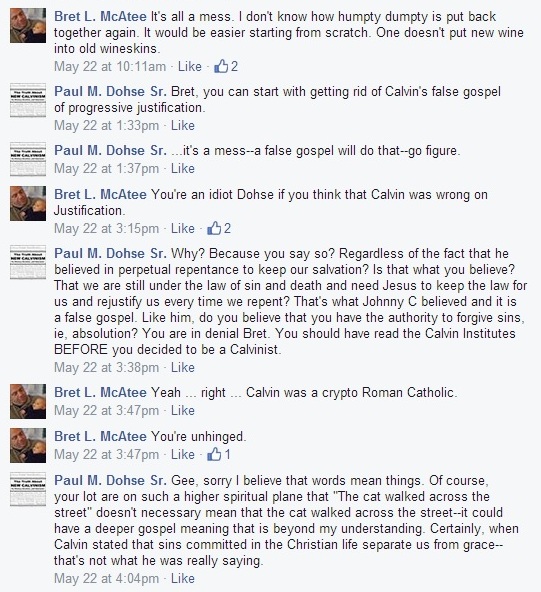


Addendum:


Romans 13:14B; Part 1, “Overcoming Sin and Living Righteously, a Righteous Life of Real and Lasting Change”
“I only have ONE comment concerning all of the drama that is part and parcel with the institutional church: ‘under law.’ That’s it. To be under law is to be cut off from bearing fruit for God. To be under law is to be cut off from its life and love.”
“This whole idea dominating the institutional church that Jesus keeps the law for us or, ‘Christ 100% for us,’ cuts off ‘life and peace’ from God’s people…The idea that we are still sinners and need to return to the cross daily to keep our sins covered is the blue chip of satanic gospels.”
“We are NOT sinners, we are saints. If we do not know this, sin will rein in our lives—it will be empowered by condemnation. The first step to living a life of change is to know that we are no longer condemned.”
As I reviewed Romans 13:14 in preparation to move on in our Romans study via 14:1, I noticed that the primary focus of our last study was the first part of 13:14 and we emphasized putting off sin and putting on Christ. In this study, I want to pause and focus on the second part of 13:14: Paul’s command to not “gratify” the “desires” of the “flesh.”
Let’s be clear and concise: what distinguishes the home fellowship movement from the institutional church follows: we believe that Christians are not only declared righteous, we are in fact personally righteous. We are perfect because there is no law to condemn us, and we possess the same desires of the Holy Spirit. The sin we commit in our Christian lives is sin against the fellowship of our heavenly family, and cannot remove us from our sonship. We only sin because we remain in these mortal bodies that tempt us with contrary desires which we sometimes “gratify.”
The institutional church, by and large does not believe this. Because Christians supposedly remain unrighteous, their sins need to be covered until the return of Christ, and the institutional church supplies that covering. Of course, there are varied doctrinal opinions regarding the “correct” process for keeping our sins covered, but it is usually referred to as “absolution.” The vast majority of institutional churches came from either Catholicism or Protestantism, and though most professing Christians assume that Protestantism is not predicated on absolution, this is NOT true at all. Both are clearly salvation by an institution given authority on earth by God to forgive sins. John Calvin and Martin Luther, the undisputed co-fathers of Protestantism state this fact throughout their writings in no uncertain terms.
Home fellowships believe our sins are ended, not merely covered. The institutional church believes that we need a continued covering because we are still sinners because we sin. This keeps Christians under [the] law which is the biblical definition of a lost person. Protestants think that is ok because Christ fulfilled/fulfills the law for us, but Christ didn’t come to uphold justification by law-keeping, He came to end the law and all of the sin that is imputed to it—justification is apart from the law.
This fact also clears up a lot of confusion about the Old Covenant versus the New Covenant. The Old Covenant, though passing away (Hebrews 8:13), still has a function: all sin that condemns is imputed to it. When someone believes in the death, burial, and resurrection of Christ; the law, its condemnation, and all of the sin imputed to it are ended for that individual. They are no longer under law, but under grace (Romans 6:14).
Another very important thing to know about being under law follows: it is where sin gets its power over people. Of course, if we believe Christians can overcome sin and live righteously, the belief that we are no longer under law is vital. The law’s ability to condemn is what gives sin its power:
1Corinthians 15:56 – The sting of death is sin, and the power of sin is the law. 57 But thanks be to God, who gives us the victory through our Lord Jesus Christ. 58 Therefore, my beloved brothers, be steadfast, immovable, always abounding in the work of the Lord, knowing that in the Lord your labor is not in vain.
Romans 7:4 – Likewise, my brothers, you also have died to the law through the body of Christ, so that you may belong to another, to him who has been raised from the dead, in order that we may bear fruit for God. 5 For while we were living in the flesh, our sinful passions, aroused by the law, were at work in our members to bear fruit for death. 6 But now we are released from the law, having died to that which held us captive, so that we serve in the new way of the Spirit and not in the old way of the written code.
7 What then shall we say? That the law is sin? By no means! Yet if it had not been for the law, I would not have known sin. For I would not have known what it is to covet if the law had not said, “You shall not covet.” 8 But sin, seizing an opportunity through the commandment, produced in me all kinds of covetousness. For apart from the law, sin lies dead. 9 I was once alive apart from the law, but when the commandment came, sin came alive and I died. 10 The very commandment that promised life proved to be death to me. 11 For sin, seizing an opportunity through the commandment, deceived me and through it killed me. 12 So the law is holy, and the commandment is holy and righteous and good.
What does it mean that the law “held us captive” before we were saved? That is answered from the book of Galatians:
Galatians 3:21 – Is the law then contrary to the promises of God? Certainly not! For if a law had been given that could give life, then righteousness would indeed be by the law. 22 But the Scripture imprisoned everything under sin, so that the promise by faith in Jesus Christ might be given to those who believe.
23 Now before faith came, we were held captive under the law, imprisoned until the coming faith would be revealed. 24 So then, the law was our guardian until Christ came, in order that we might be justified by faith. 25 But now that faith has come, we are no longer under a guardian, 26 for in Christ Jesus you are all sons of God, through faith. 27 For as many of you as were baptized into Christ have put on Christ.
So, the idea of being enslaved to the law is to be under its condemnation. Sin feeds on the ability to condemn. It is interesting to note that regardless of the fact that there is “now no condemnation” (Rom 8:1) for Christians, Satan is the “accuser of the brethren.”
Look, the issue of condemnation is a big deal. This is where sin gets its power. Watch out for condemnation. Gospels that keep people under the law will often be predicated by lots of condemnation. Do you now understand why, as a Protestant, primarily of the Baptist variety, that you go to church week after week and hear about what a bad person you are even as a Christian? That’s because you are still under the law.
Listen, it doesn’t matter if Jesus supposedly keeps the law for you, if you can’t keep it, you are still under it (See Romans 8, nothing is clearer). Any doctrine that indicates that all bets are off if you can’t keep the law perfectly, or that you can’t please God on any wise save obedience to the one idea that the former is true, is an under law/under condemnation very bad news gospel. In fact, many in the Reformed camp are often heard saying the following: the idea that you can please God by keeping the law is just, “more bad news,” “pretending,” and “trying to gain merit with God” etc.
But another bad angle on being under law and its condemnation is the fact that Christians are cut off from the life of the law. I only have ONE comment concerning all of the drama that is part and parcel with the institutional church: “under law.” That’s it. To be under law is to be cut off from bearing fruit for God. To be under law is to be cut off from its life and love. Please note the following:
Romans 7:7 – What then shall we say? That the law is sin? By no means! Yet if it had not been for the law, I would not have known sin. For I would not have known what it is to covet if the law had not said, “You shall not covet.” 8 But sin, seizing an opportunity through the commandment, produced in me all kinds of covetousness. For apart from the law, sin lies dead. 9 I was once alive apart from the law, but when the commandment came, sin came alive and I died. 10 The very commandment that promised life proved to be death to me. 11 For sin, seizing an opportunity through the commandment, deceived me and through it killed me. 12 So the law is holy, and the commandment is holy and righteous and good.
When Paul states, “The very commandment that promised life proved to be death to me,” that isn’t a hypothetical or the law promising a pipe dream, it is a statement of fact: the law does promise life, and in fact gives life to those who are not under it. When you are under grace, the law gives life, when are under law, the law only bears fruits of death. What is more obvious in the Scriptures?
Romans 7:4 – Likewise, my brothers, you also have died to the law through the body of Christ, so that you may belong to another, to him who has been raised from the dead, in order that we may bear fruit for God.
Romans 8:1 -There is therefore now no condemnation for those who are in Christ Jesus. 2 For the law of the Spirit of life has set you free in Christ Jesus from the law of sin and death. 3 For God has done what the law, weakened by the flesh, could not do. By sending his own Son in the likeness of sinful flesh and for sin, he condemned sin in the flesh, 4 in order that the righteous requirement of the law might be fulfilled in us, who walk not according to the flesh but according to the Spirit. 5 For those who live according to the flesh set their minds on the things of the flesh, but those who live according to the Spirit set their minds on the things of the Spirit. 6 For to set the mind on the flesh is death, but to set the mind on the Spirit is life and peace. 7 For the mind that is set on the flesh is hostile to God, for it does not submit to God’s law; indeed, it cannot. 8 Those who are in the flesh cannot please God.
This whole idea dominating the institutional church that Jesus keeps the law for us or, “Christ 100% for us,” cuts off “life and peace” from God’s people. This is why church is at worst boring, repressive, and depressing, and at best repetitious. You can dress it up with contemporary décor, programs, and praise music all you want to, but it will eventually go the way of Mark Driscoll’s Mars Hill dynasty. Why is it like this? Because you are under law and cut off from the law’s life and peace that comes from being under grace. Your sin is not ENDED, it is only covered by allegiance to the institutional church and its bogus authority.
Be sure of this: all of the rage about Joel Osteen is a pushback against 500 years of incessant condemnation. For the first time since anybody can remember, you can actually go to church without getting your weekly dose of deserved condemnation. Sure, he offers a cheap substitute for discipleship, and only time will tell where that will end up, but for now, this is what you are seeing. Susan and I went to an institutional church yesterday for a school project she is working on and we received our weekly dose of condemnation through the whole worn-out “forgive others as Christ forgave you” motif. It’s blank check forgiveness written on funds from the bank of moral equivalency. Basically, it teaches that all of humanity is equally evil; i.e., here we go again, “under law.” That’s where all of these ideas come from fundamentally. A transfer from death to life only regards a position in Christ and not a practical application in Christ other than the one obedience to the idea that we can’t keep the law perfectly so all bets are off.
There has been a lot of conversations recently on PPT regarding T-shirts, a lot of it is just pun, but seriously, let me recommend a T-shirt that will give you massive opportunities to present the gospel—especially to the Reformed. In big letters, “Yes, as a matter of fact, I AM PERFECT,” or simply, “I’m Perfect.” This will invoke comments from the Reformed like vultures are attracted to road kill. The conversations will go something like this:
Them: “That’s an interesting T-shirt you are wearing, what exactly do you mean by it?”
You: “Pretty much what it says, ‘I’m perfect.’”
Them: “Oh, you mean to say that you are ‘perfect in Christ.’”
You: “No, I am not only perfect in Christ, I am in fact perfect.”
Them: “Oh, so you didn’t sin today?”
You: “See, that statement right there tells me that you believe a false gospel.”
Them: “How so?”
You: “Because obviously, you believe perfection to the law is what justifies us when in reality we are justified apart from the law, and where there is no law there is no sin.”
Them: “No, I agree with you, there is no law in Christ.”
You: “No, you do not agree with me, you are saying that there is no law for us to keep because Jesus keeps it for us, but we are still under it; yet, it doesn’t matter who keeps it, we are either under law or under grace. Your very statement about sin indicates that you see sin against justification and sin against God’s family (or grieving the Holy Spirit; Eph 4:30) as the same thing—we are still under law in your mind. Sin for us is not ended, it is only covered by Christ’s obedience and not ours which also separates us from the life, peace, and fruits of the Spirit received as those under grace.
If Satan cannot hoodwink us into remaining under law, he will at least try to empower sin within us through condemnation. Be careful my friends, a critical spirit towards others is often the spirit of condemnation seeking to inflame sin within others. In the Old Testament, we have a very vivid picture of this:
Zechariah 3:1 – Then he showed me Joshua the high priest standing before the angel of the Lord, and Satan standing at his right hand to accuse him. 2 And the Lord said to Satan, “The Lord rebuke you, O Satan! The Lord who has chosen Jerusalem rebuke you! Is not this a brand plucked from the fire?” 3 Now Joshua was standing before the angel, clothed with filthy garments. 4 And the angel said to those who were standing before him, “Remove the filthy garments from him.” And to him he said, “Behold, I have taken your iniquity away from you, and I will clothe you with pure vestments.” 5 And I said, “Let them put a clean turban on his head.” So they put a clean turban on his head and clothed him with garments. And the angel of the Lord was standing by.
Presently, Satan is allowed access to heaven and he uses the privilege to condemn us. He is called the “accuser of the brethren.” The Bible states that Christ intercedes for us in regard to these accusations. Not only do we see this type of activity by Satan clearly in the book of Job, but we see Christ interceding for Peter while he was among the disciples (Luke 22:31,32). This is a ministry of intercession that Christ presently performs for us in heaven and is often confused with intercession concerning justification which is a finished work.
There is NOW no condemnation for us, and beware of spiritual bumper stickers that condemn us: “We are all just sinners saved by grace.” These are satanic ploys meant to condemn us and empower sin within us. Sin is empowered by the law’s condemnation.
We are NOT sinners, we are saints. If we do not know this, sin will reign in our lives—it will be empowered by condemnation. The first step to living a life of change is to know that we are no longer condemned. The idea that we are still sinners and need to return to the cross daily to keep our sins covered is the blue chip of satanic gospels.
Next week, we will look at the other concrete elements critical to the subject at hand. We have looked at “condemnation,” “perfection,” “life,” “love,” “peace,” and “law” this morning, we will also, Lord willing, look at “sin,” “flesh,” “weakness,’ “love,” and the primary crux, “desire.”
Decoding Protestant/Calvinist Brainwashing
This chart needs a lot of work, but in regard to Christian living versus salvation, the cause for confusion in our day follows: Protestantism and Calvinism in particular fuse the different applications of single words together to mean one thing…for the most part…justification. Take the word “repentance”: it has a different meaning and application for the Christian versus the unbeliever. This chart is meant to get the ball rolling in the direction of teaching people to interpret the Bible according to the sanctification/justification dichotomy. Protestantism and Calvinism make sanctification and justification the same thing, and make under law/under grace the same thing, and call for an interpretation of Scripture in this way which makes their false gospel feasible. Again, this chart merely gets the ball rolling; I trust that your own independent study can improve upon it greatly.

Acts 14:21-15:6 | Lesson 38
Tuesday Night Bible Study
October 21, 2014
Study of the Book of Acts
Tonight’s Text – Acts 14:21 – 15:6Brief review
To perseverance To produce maturity
(Refer to “The Desire for and Qualifications of an Overseer, Part 1 and Part 2” on Paul’s Passing Thoughts)
χειροτονεω (kee-ro-toh-neh-oh) χειρ (keer) – “hand” τεινω (tee-no) – “to stretch.”
Casting a vote in an election – No apostolic authority – Laity selects their elder
Opening the door of faith to the Gentiles – Most important aspect – Not expected to happen.
III. Contention with Circumcision
– From Jerusalem – “They of the circumcision” – Authority to teach this doctrine?
– Law fulfilled by circumcision – Under law vs. under grace
|
es: |


 Paul's Passing Thoughts
leave a comment