Take Heart, the Scotts are Out There, We are NOT Alone
 Sometime in the night while sleeping, I received an article via email written by the Queen of Anomia, Elyse Fitzpatrick. So as I sit here this morning not without coffee and reviewing emails, I have decided to use this specimen to make some points.
Per the usual, this New Calvinist diva arrogantly pontificates while the following fact runs in the background like Lou Priolo justification: the New Calvinists have been working on running the American church for 44 years now, and have dominated American evangelicalism for ten years; so, where’s the beef?
Second point: New Calvinism is a return to authentic Protestantism which is Gnostic at its core. Of course we can’t be saints in the flesh—flesh is of the material realm. Again, I beseech Christians everywhere to read the foundation of Protestant doctrine, the Heidelberg Disputation; it is expressly Gnostic. I might also add that the New Calvinist movement is a good thing because it is forcing God’s people to come to grips with our evil Protestant roots.
Third point: Queen Elyse, like the commentator “Lori,” states something we hear often that is a smoking gun…pointing out that we aren’t perfect—we don’t keep the law perfectly.
Stop right there. This simply means that they see Christians as still under the law whereof the standard is perfection. This is a twofold error: there is NO law in justification, and justification is a finished work and is no longer to be of concern to the Christian. The unjustified are “under law,” but the justified are justified “apart from the law.” Protestantism fuses justification with the law, and keeps Christians under the law. That’s the Pauline definition of the unregenerate.
Point A under point three: antithetical to Pauline soteriology, this posits the idea that there is life in the law because Jesus keeps it for us. Who keeps it isn’t the point—the point is that there is no life in the law.
Point B under point three: contrary to Pauline theology, if perfect law-keeping can bring life, there are TWO SEEDS and not ONE; Jesus and the law both. No! Jesus came to “end the law.” The Promise did not say that there are two seeds, but only one. The Promise is not of law.
Point C under point three: if law and justification are fused together, there is still condemnation for the believer. Our sins are only covered, not ended.
Point D under point three: if perfection is still the standard for Christians, there is no new birth because the old us who died with Christ is still under the law and not free to serve under the law of the Spirit. See Romans 7:1ff. By the way, this is not to be confused with the GOAL of perfection in sanctification.
Point E under point three: yes, in regard to justification, we are, in fact, perfect because there is no law to judge us. Protestantism therefore makes sin against a law justification (a metaphysical anomaly for the Christian) the same as sin in family relationship. Hence, they are saying we sin under the old seed that died. We are not truly brothers/sisters with Christ—we are not literally born of God.
Point four: This is why Protestantism is a vile and egregious false gospel that turns holy writ completely upside down from Genesis to Revelation.
Point five: almost everyone, Prince, MacArthur, Osteen, Driscoll, Jeremiah, Lawson, Wright, Mohler, Johnson, et al, either believe or unwittingly function according to this progressive justification. They are all theological thieves sitting at the poker table bickering at one another.
Point six: making the law of sin and death the same thing as the law of the Spirit of life is the essence and formal definition of antinomianism, the paramount religion of the last days according to Christ. The king of antinomianism will be the antichrist himself. We know who the queen is.
Point seven: not everyone is wrong; we have “Scott”:
Thanks for this, Elyse. I would like to suggest that in your desire to bring folks to reality, you miss a distinction that is too often overlooked by my reformed brothers and sisters. Paul does not describe us as, by NATURE, sinners. He says we are new creations in which old things have (past tense) passed away. He says we ‘became obedient from the heart’ in Romans 6:17. He commands us to ‘Let not sin reign…’ In Romans 6:12. And in Romans 8:9 he says, after telling us to now expect to see the law fulfilled as we walk according to the Spirit, that we are not even in the flesh anymore! ‘You are not in the flesh, but in the Spirit.’ (I’m not making this up.)
So what’s the catch? Certainly we should all agree with you that there is plenty of sin that flows in our marriage and that we are no longer under condemnation. So what’s the difference in what I am saying?
Here it is: Paul says that our problem is not that we are by nature sinners. He says that we are by nature saints. Yes he does, in each of his letters. But he also says that we live in unredeemed bodies where the power of sin still dwells, and he calls that the flesh. Nothing good dwells in my flesh! Nada. But I am no longer in the flesh. I’m in the Spirit, and that is not just “positional truth,” any more than Christ being in us by the Holy Spirit is just “positional truth.”
At this point most people will tune out and say “What’s the big deal? It’s just semantics.” Well, Paul spends two and a half chapters in Romans and many other key verses in Galatians, Ephesians and Colossians talking about those “semantics”.
But here’s the secret: If we remember a few key things in the gospel, we can accomplish what you desire in this article and a lot more.
First, remember that, as you kind of said, any emphasis on technique in marriage that takes our focus away from Christ and Christ in us is law!
Second, remember that if we never get it right, we are still justified and destined to reign with Christ forever!
Third, expect nothing good to come from your flesh. If Paul said nothing good dwells in His flesh, then we need to be comfortable with that! Don’t be shocked. Your flesh is capable of any sin you can imagine.
But fourth, know that you really are a brand new creature in Christ where old things have passed away and new things have come. Expect righteousness to flow as you learn to walk in the Spirit and not after the flesh! Expect Galatians 2:20 to become a reality as you recognize who you are in Christ and live by faith in the indwelling Christ.
If I am finding my joy and peace and identity in Christ rather than in my spouse, then I will, like you and your husband, be in it for the long haul because of the covenant we have made.
Point eight: I would only correct Scott on a few issues. First, you are wrong Scott. Queen Elyse does not have good intentions; she is a wicked false teacher. Secondly, yes, Paul said that there is no good thing in our flesh, but that is not to say that flesh (also “members”) cannot be used for good purposes as you pointed out. Flesh is not inherently evil in and of itself, that’s Gnosticism. It is the sin in the flesh that is inherently evil; the sin is the sin. “In the flesh” does not mean flesh is inherently evil; it refers to when the members are being used for evil purposes rather than holy purposes. Something that is inherently evil cannot be used for holy purposes or “holy sacrifice.” The flesh is “weak,” but not inherently evil. The earth is also weak, but not inherently evil, and groans with us for redemption. The earth also proclaims the glory of God and testifies to His glory.
Last point: Scott, you get it; come out from among them and be separate. Do not continue to touch the unclean thing.
paul
John Piper Continuationism, and Preaching the Gospel to Yourself
 One of the more valuable lessons taught to us here at TANC was during our first conference in 2012. John Immel demonstrated historically and philosophically that people always believe what they believe and do what they do for a reason, and that reason is logic—logic drives behavior. Find the logic—find the reason for the behavior, or belief.
At the time, I was in good graces with Old Calvinists because I had published The Truth About New Calvinism: Volume One, exposing the dastardly evils of the Neo-Calvinist movement which was supposedly an aberration of Reformed soteriology. They threatened to boycott the conference because Immel hadn’t been vetted by them. At the time, the decision to tell them to hang it on their beaks was based on principle alone while unaware I was trading orthodoxy for knowledge that really gets down to why church looks like it does in our day.
So, why do bosom buddies John MacArthur and John Piper differ on Cessationism (first century miracles ceased after they served their purpose)? MacArthur is very inconsistent because he started out as a grammarian interpreter of the Scriptures. Later, circa 1994, John Piper et al convinced him that New Calvinism was authentic Reformed soteriology, and I don’t think MacArthur was willing to reject the Protestant narrative wholesale. If you understand how the Reformers interpreted reality, you understand how taking the Scriptures at face value is going to cause the mass confusion that we see today.
Hence, one example among many: MacArthur’s dispensationalism is going to drive many New Calvinists nuts because one of the pillars of Platonism follows; truth is immutable. Regardless of what the Bible plainly states literally, viz, that God has used different economies to bring about His will, the Reformers insisted that the Bible had to be reconciled to the great thinkers of old. That would be Plato and company. This is by no means ambiguous history. MacArthur’s unwillingness to reject Protestant tradition makes him what he is: one of the most confused pastors to occupy the pulpit in our day. He can be defined as one who interprets reality using two contrary epistemologies: grammatical and redemptive. This is indicative of most Protestant pastors who must try to interpret truth with two contrary epistemologies in order to hang on to Protestant tradition. This is the very reason for the confused mess that we see in the institutional church. For this reason, the institutional church is intellectually bankrupt.
This ministry is benefiting greatly from information sent to us. A reader sent me a video of John Piper being interviewed at a conference in London. In regard to how Piper answered a question, the reader wanted to know if his answer was related to the whole, We must preach the gospel to ourselves every day. Answer: yes. And, I believe I have learned something new in regard to Piper being a Continuationist. In his answer, Piper put together Galatians 3:2 and 3:5 to make the case that we are sanctified by the same gospel that saved us. Because the Christian life is supposedly powered by the finished work of justification, Christians must return to the gospel daily in order to be sanctified.
However, take serious note: to the Reformed crowd who know what they are talking about, this isn’t semantics about the best way to be sanctified, this is stating that we must keep ourselves saved by faith alone in Christian living. If we “move on to something else” other than the same gospel that saved us, we “lose both” justification and sanctification. Get this into your head: they make epistemology a salvific matter. Many Calvinists like Paul David Tripp have stated that a literal interpretation of Scripture is equal to works salvation.
In the Conference Q and A, Piper notes verse 2…
Let me ask you only this: Did you receive the Spirit by works of the law or by hearing with faith? 3 Are you so foolish? Having begun by the Spirit, are you now being perfected by the flesh?
Then he connects it to verse 5…
Does he who supplies the Spirit to you and works miracles among you do so by works of the law, or by hearing with faith—
Piper uses the adjoining of these two verses to make the case that the Holy Spirit only continues to work in our lives after salvation via the same way we were saved (by faith alone). In other words, Piper makes this verse an issue of sanctification, and not the context: justification. But, to make this point, he must concede that miracles are also a continuing part of His works when people live by faith alone in their Christian lives. This is a good indication of why he is a Continuationist.
It also bolsters the Reformed view of obedience as realm manifestation. Obviously, miracles result when God manipulates the laws of normality; in the same way, the works of Christ can be imputed to us without us actually doing the work. It’s just a lesser miracle. Christians are to live by faith alone and assume that any good works we do are wrought by the Holy Spirit and not us. Martin Luther was very specific about this in the Heidelberg Disputation. For the Christian to think himself able to do a good work is a “mortal sin.” The Christian life is to be lived by experiencing justification subjectively. As long as we “attend good works with fear” of accreditation, our good works are only “venial” and perpetually covered by Christ’s death. This is the Reformed formula for living our lives by faith alone. This is nothing new, and is the exact same thing that James railed against in his epistle to the 12 dispersed tribes.
Paul was making the point that justification is completely out of the control of those who choose to believe. Man didn’t seek out God and collaborate with Him on reconciliation. Man didn’t call for peace negotiations. God pursues man, corners him, and presents the plan and the terms. If man accepts, the Holy Spirit quickens him or her. Even when man believes and accepts the terms, he/she cannot rebirth themselves any more than they can wrought miracles on their own like the Holy Spirit does—they can only believe.
That was Paul’s point; justification is completely apart from the law of sin and death. The Galatians were being taught that keeping a dumbed down version of the law of sin and death kept them saved. Paul said NO, if you want to justify yourself by keeping the law of sin and death, you must keep all of the law perfectly. He added that circumcision did not matter (justification by keeping the ritualistic parts of the law), but only faith working through love (obedience to the law of the Spirit of life).
paul
A Doctrinal Evaluation of the Anti-Lordship Salvation Movement: Part 2
The root of all controversy: the golden chain of salvation.
Before we start part 2, we have a little unfinished business from part 1. The astute observer will ask, “If Jay Adams had the right idea about sanctification while misunderstanding what Calvin really believed, what of his biblical counseling movement that moved from mere generalities to the finer points of Christian living?” Answer: it WAS a revival…probably the only real revival the church has seen since the previous focus on practical application of the Scriptures versus redemptive focus/meditation. And when was that? I have no idea.
You remember my mention of the John “Jack” Miller disciple David Powlison. He started a contra biblical counseling movement against the Jay Adams movement. This is often referred to as first generation biblical counseling versus second generation biblical counseling. The second generation effectively wiped out the first. The crux of that civil war is relevant to this study. One model sees salvation and sanctification as separate. Salvation is completely vertical, but sanctification is mostly horizontal. Jay Adams argued in his aforementioned book against Sonship theology that the source of power in the Christian life is not salvation, but regeneration. In other words, justification is a finished work and a static declaration while the Christian life flows from the “quickening” of the new birth. We don’t return to the cross for power in the Christian life, we learn and obey the Spirit’s instrument for changing us, the law of the Spirit of life. What Adams didn’t realize is that this whole idea of life coming from a perpetual revisitation of our justification is in fact authentic Reformed dogma (see the Calvin Institutes 3.14.9-11).
Every Christian controversy from the Reformation till the present finds its roots in the golden chain. Reformed pastors wax eloquent in regard to who builds the links in the chain between justification and glorification: it’s either us, or the Holy Spirit using “what Jesus has done, not anything we do.”
From the latter 40’s to 1970, the first gospel wave (Billy Graham et al) ruled the Christian scene via EB. Cogous pushed back with a vengeance from 1970 till the present with the second gospel wave. The first wave saw a commitment to obedience as synonymous with keeping yourself saved because of the golden chain idea. To say that they overemphasized the gospel would be a gargantuan understatement. Obviously, they saw a commitment to obedience as transposed upon the Christian life. The second gospel wave demanded a commitment, and recognition of Christ as Lord, but also demanded a life of faith alone to keep the law satisfied with Christ’s perfect obedience. Again, the ALS camp misunderstands the Reformed on this point. Both camps hold to sanctification by faith alone. This is the very idea that James rudely pushed back against in his epistle.
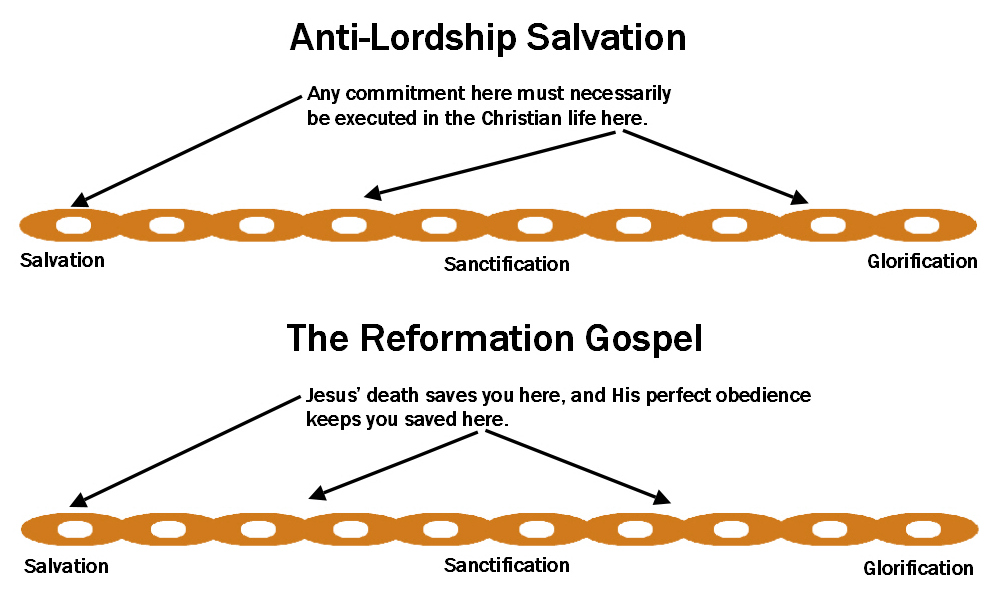
The issue made simple: Romans 8:30.
In Romans 8:30 we read the following:
And those whom he predestined he also called, and those whom he called he also justified, and those whom he justified he also glorified.
Notice that sanctification is missing from this verse even though the context spans the beginning of our salvation to our resurrection. This is the distinction between all golden chain gospels and the real gospel, the kingdom gospel. Jesus came preaching the “gospel of the kingdom.” Hereafter, KG. The golden chain gospel says that sanctification is missing from this verse because justification and sanctification are the same thing. The KG says that sanctification is missing from this verse because justification and sanctification are mutually exclusive. The context is assurance of salvation (see verses 31ff.).
Curiously, the golden chain gospel which includes both ALS and LS/Calvinism, teaches us to remind ourselves of God’s grace alone regardless of anything we do. If our behavior brings doubt, this is evidence of a fundamental misunderstanding of God’s grace and we should therefore remind ourselves of such. ALS says that concern over behavior suggests that you believe behavior finishes justification and not grace alone. With the KG, that consideration is not even on the radar screen because justification and sanctification are completely separate; finishing a finished work is impossible. You can’t have that mentality if you understand it to be an impossible reality. I might also add that simply returning to the same gospel that saved us to cure a troubled conscience instead of changing behavior sears the consequence over time. This is ill advised.
In other words, the KG says it is impossible to unwittingly attempt to please God to gain justification because that work is finished. One is free to aggressively obey God without any fear that they are unwittingly attempting to earn their justification. ALS and LS/Calvinism do not have this convenience because justification is both finished and not finished. The Reformed, already, but not yet construct that relates to predestination cannot be discussed here for lack of room and fear of confusion, but suffice to say for this study that the convenience is not there for either ALS or LS because justification is not finished. You must continue to remind yourself of free grace because you are in a continuum where unwitting works salvation can take place, and the only solution is to disavow good behavior as an evidence of conversion. Obedience must be completely optional. This used to be criticized as “Let go and let God” theology. According to the KG, such a continuum is impossible and not reality.
Consider some dialogue I have had recently with ALS proponents:
Paul, While you ponder my answer, I’d like to ask you, if you’d identify what you believe you must do, before, during and after, in order to be given eternal life. Thank you, In Him, Holly
“Before, during, and after”? to… “be given eternal life.”? The implied answer is: nothing in justification; nothing in sanctification; and nothing in glorification. But again “during” shouldn’t even be deemed possible.
LS in Cogous form already states that perpetual double imputation is needed, so bad behavior is actually a good thing because it “shows forth the gospel.” In contrast, advocates of the KG are concerned with evidence of the new birth, not the overcoming of a propensity to misunderstand the grace of God because all doing in the Christian life is attached to justification somehow. Advocates of the KG understand that nothing they do in the Christian life has anything at all to do with justification. Much assurance comes from that. However, lazy discipleship forfeits assurance because it violates the conscience, and judgment begins in the household of God regarding consequences for bad behavior in this life. The fear generated from that can get confused with fear of eternal judgment.
But don’t miss my main point here: the solution for a lack of assurance in both ALS and LS are the same: preach the gospel to yourself. Remind yourself that works done by us are completely irrelevant to our salvation which also includes sanctification (the Christian life). Both camps woefully devalue the new birth and its expectations. In effect, we have no righteousness and obedience is not really performed by us, but performed by the Holy Spirit if we are “abiding” in Christ. This is a passive sanctification of our works in sanctification in order to categorize them as living by faith alone. ANY work we do is accredited to the justification process, so it must be sanctified by the right process. In the final analysis, Christians must only EXPERIENCE an obedience imputed to us by Christ. Citations by the Reformed abound, and I can cite one from the aforementioned conversation with advocates of ALS:
We can have righteousness of our own, that is self-righteousness. I didn’t notice, did you answer any of the questions? Do you sin? How much? Or not? Are you sinless?
Park on the fact that both camps assert that the Christian has no righteousness. To have any righteousness is a “righteousness of our own.” It’s either ALL us or ALL Christ. Therefore, we can only EXPERIENCE righteousness imputed to us, but it really isn’t us performing it; hence, in relationship to the same conversation:
This passage has nothing to do with becoming saved or providing evidence through our works that we are saved. The passage is about living experientially in a manner that is consistent with our position on [sic] Christ.
Notice that the Christian lives “experientially” according to “our position [i]n Christ.” In other words, Christians only experience their position, they don’t actually perform obedience themselves. In addition, when talking to either camp, one is challenged with the question, “Did you sin today?” And in both cases, when you qualify the question with, “In justification or sanctification?”…without exception they are thrown for a loop. Why? Because they see sin in justification as no different than sin in sanctification—that’s why they ask the question in the first place. If you believe the Christian is personally righteous as well as positionally righteous, you are immediately challenged by both camps with, “Did you sin today?” Why? Because the same assumption is that righteousness and sin are mutually exclusive. For the world, this is true, but not for Christians.
Another fact of the Reformation gospel is “righteousness” is defined as a perfect keeping of the law. To remove the law’s perfect standard, and its demands for perfection from justification is the very definition of antinomianism according to the Reformers. A perfect law keeping must be maintained for each believer if they are to remain justification.
If you remember, this is a direct quote from part one. ALS and LS/Calvinism both define righteousness by perfect law keeping. Again, why the air of profundity in the terse rhetorical question designed to end the argument on the spot by coup de grace? The very essence of the question reveals a profound misunderstanding of law and grace.
Let’s get a little more full circle now with part one. Because the Christian, according to both camps, cannot be righteous if he/she sins even once (“Do you sin? How much? Or not? Are you sinless?”), the good old Reformed mainstay of double imputation is needed for both of these applications of the same golden chain gospel. From part one:
Thirdly, this requires what is known as double imputation. Christ not only died for our sins so that our sins could be imputed to Him, He lived a life of perfect obedience to the law so that His obedience could be imputed to our sanctification.
The windsock of double imputation is the idea that the righteousness of Christ is imputed to our sanctification. He died for our justification, and His perfect obedience to the law was imputed to our sanctification to keep justification rolling forward:
Model A asserts that since we cannot keep the law perfectly, we must invoke the double imputation of Christ by faith alone in order to be saved and stay saved (part 1).
Now let’s look again at the same recent conversation with ALS proponents:
Thanks Mark, I agree. We are qualified as saints, because of Christ’s righteousness imputed to us, but we still sin,..
Therefore, we only “qualify” as saints because we still sin, in order to keep our sainthood the righteousness of Christ must be imputed to us daily. Yes, that would be daily salvation. In the quote immediately prior, “Holly” was responding to this statement:
Hope you don’t mind me adding a thought, I think Paul is saying we were sinners but we are now saints (forgive me if I am wrong), it is true of course that we are saints but I believe it is also still true that we are sinners saved by grace because the Apostle Paul said, “Christ Jesus came into the world to save sinners; of whom I am chief”, present tense.
So, if Christians are still sinners, because we sin, and Christ came to save sinners, it would only make since that our need for salvation is still ongoing. Direct citations that agree with that point by John Calvin and Martin Luther is abundant low hanging fruit, but granted, such statements from the ALS camp are somewhat surprising. To further the point, I might add that “Holly” referred me to a message taught by a notable figure in the ALS movement who interpreted Romans 7:24 as a daily salvation. This is a very common rendering of that verse by the Reformed as well. The verse obviously refers to the redemption of the body and not a daily salvation.
Both are guilty of the same thing: a false double imputation construct must be applied to the Christian life by faith alone and the subjective experience thereof is optional. Like ALS—like Calvinism.
What is wrong with this gospel?
The golden chain gospel misrepresents the Trinity. The Father is removed from His role in salvation because it is His righteousness imputed to the believer before the foundation of the world. According to Romans 8:30, this guarantees glorification. The Holy Spirit is also misrepresented in regard to His role in salvation. His setting us apart before the foundation of the world is confused with His work in regeneration. Christ’s role is redefined beyond His death for our sins as a onetime act that ended sin. This is not a covering—it’s an ending. Even though the Reformed and ALS both concur that Christ died once, His death is perpetually reapplied to sins we commit as Christians when there is no such need. Neither is there a need to impute Christ’s righteousness to us perpetually. At the Bema event, it will not be God the Father looking at us and only seeing Jesus, it will be Jesus Himself judging His righteous followers. He will not be judging His own righteousness. The golden chain gospel is an egregious distortion of the Trinity.
True double imputation is our sins being imputed to Christ, and the Father’s righteousness imputed to us apart from the law. Christ came to end the law. It is because of this, and the new birth, that we are truly righteous in and of ourselves, but of course not apart from God’s power and plan of salvation. We have God’s seed in us, are no longer under any law that can judge us, and are able to please God with our lives. We are new creatures who are sinless according to justification because even if the old us that died with Christ was exhumed and brought into court, there would be no law to condemn us.
This gospel not only distorts the Trinity, rejects the new birth, and distorts double imputation, it misrepresents sonship. The sins we commit as a family member are considered to be sin against justification: “Did you sin today?” Again, if you ask them, “Sin in justification or sanctification?” all you will here is crickets, or the babblings of confused narcissists.
The golden chain gospel also strips the Christian of ability to love Christ and others by keeping Christians under the law of sin and death that Christ came to end. Said gospel makes that law the standard for righteousness. However, there is no law standard in justification, it is APART from any law—it is God’s righteousness imputed to us. Those under grace serve the law of the Spirit of life which is fulfilled by loving Christ and others:
“If you love me, keep my commandments.”
It is impossible to love Christ by keeping the law of sin and death. Besides, that law is ended when we believe. All of our sins committed before faith were against that law and in essence imputed to it. Before we were saved, we were enslaved to that law and it provoked us to sin. Consider two spouses: we were the spouse that was under the law of sin and death until we died with Christ, now we are free to serve another. Sins we now commit are against family relationship, not sins that fall short of the law of sin and death.
Said gospel prevents us from making a commitment to God’s kingdom because the commitment would have to be executed perfectly in kingdom living to maintain our citizenship. Said gospel demands that we only recognize Christ in a one-way relation while ignoring His kingdom, its law, and the king. Yea, we can only accept Him as savior in a one-way relationship. This assumes that a decision to flee the present kingdom of darkness for the kingdom of light cannot be a commitment totally separate from the kingdom citizenship. If we make a commitment, the commitment must be executed perfectly in order to remain a citizen. No, the commitment is totally separate from our citizenship in the same way justification is totally separate from sanctification.
I realize that only repentance was emphasized to the Jews, but they were already saturated with the concept of God’s kingdom. From the beginning, Abraham looked for a city built by God. As we see Gentiles coming into the church, they must be brought up to speed on their new Jewishness. We should read the Bible with this in mind and the way it affected the presentation of the gospel, and the very definition of the word “gospel” itself.
The golden chain gospel rejects the new birth by ignoring the difference in slavery between two different laws: the law of sin and death that will condemn the world, and the law of the kingdom; the law of the Spirit of life. It makes the law of the Spirit of life a fulfilment of the law of sin and death that is in fact ended. In essence we remain enslaved to a law of condemnation as “sinners.” This is a rejection of the new birth.
It also adds another seed to the covenant of promise. If the law of sin and death could impart life, it would be a second seed from which life would come to the world. It doesn’t matter who obeys it, it cannot impart life.
The golden chain gospel distorts the Trinity, distorts double imputation, misrepresents sonship, strips the Christian of ability to love Christ and others, rejects a biblical definition of the new birth, keeps Christians under the law of sin and death, distorts the atonement, perpetually reapplies the death of Christ to salvation, replaces the righteousness of God with a law standard, propagates a one-way relationship with God, makes sin as a kingdom citizen the same as condemning sin, enslaves us as a spouse still under the law of sin and death, calls for us to accept Christ as savior in a one-way relationship while ignoring His Lordship.
Do Christians have two natures? This will be examined in part 3.
paul

 Paul's Passing Thoughts
1 comment