The Law and Why Calvinists are in Danger of Hell
 “Incredibly, Calvin’s view of double imputation raises its hand and counts itself with the unbelievers.”
“Our attitude towards the law in sanctification shows what we believe about the law in justification, and that’s the difference between a true gospel and a false gospel.”
Calvinists are in danger of hell because of their view of the law. This can be primarily seen in their view of double imputation (will define shortly). This has everything to do with the gospel. Simply stated, Calvinism believes the law is the standard of justification. In contrast, the biblical gospel states that the law has been completely removed from justification. This is why it is ever-so critical that justification and sanctification are separate. If we are justified apart from the law, we can aggressively practice the law to glorify God in sanctification.
Calvin’s view of double imputation clearly shows that the Reformers believed that law is the standard for justification. Because of this, they expanded Christ’s role in the atonement to include His perfect obedience while He was on earth and lived His life among mankind (out of this comes the idea that Christ had to prove Himself to be a worthy sacrifice as opposed to being worthy by virtue of who He is). He died for our sins, but He also obeyed, or “fulfilled” the law in our stead. There are many, many, many problems with this view biblically, but primarily, it keeps believers, “under the law” and NOT “under grace.” These are the ONLY two categories in the Bible that distinguishes the lost from the saved. Calvinism categorizes “believers” as lost people. Incredibly, Calvin’s view of double imputation raises its hand and counts itself with the unbelievers.
The biblical double imputation follows: God the Father’s righteousness is imputed to us, and our sins are imputed to Christ. Therefore, His death took the old us and our sins to the grave. The Holy Spirit raised Christ from the grave, and also regenerates or quickens all of those who believe the gospel.
Calvin’s double imputation recognizes that Christ paid the penalty for our sins, but insists that the law had to be perfectly obeyed for us, or we cannot be truly righteous because we fall short of perfect law keeping. This perfect law keeping must then be perpetually applied to our sanctification by faith alone. It keeps Christians under the law for justification (Rom 6:14). Supposedly, this is ok because Christ kept the law for us.
Though the Bible continually states that the law has been voided in regard to our justification, Calvinism insists the following: It’s voided because Christ fulfilled it. This is why Calvinists are constantly referring to the righteousness of Christ being imputed to us, but the Bible doesn’t say that—it states that the righteousness of God the Father was imputed to us. Christ’s death put an end to the law, not His perfect obedience. The imputation of Christ’s obedience to sanctification to keep us justified is a “relaxing” of the law, and Christ sternly warned against that. Our attitude towards the law in sanctification shows what we believe about the law in justification, and that’s the difference between a true gospel and a false gospel.
What does the Bible say about the law in regard to our justification? Let’s see:
Romans 3:19 – Now we know that whatever the law says it speaks to those who are under the law, so that every mouth may be stopped, and the whole world may be held accountable to God. 20 For by works of the law no human being will be justified in his sight, since through the law comes knowledge of sin. 21 But now the righteousness of God has been manifested apart from the law, although the Law and the Prophets bear witness to it— 22 the righteousness of God through faith in Jesus Christ for all who believe.
I am not sure what is clearer. The law speaks only to those under it in regard to justification. The law informs the believer in sanctification (“although the Law and the Prophets bear witness to it” also see Gal 3:21), but we are no longer under it for justification: “Now we know that whatever the law says it speaks to those who are under the law” We are justified by God the Father THROUGH faith in Christ:
Romans 3:25 – whom God put forward as a propitiation by his blood, to be received by faith. This was to show God’s righteousness, because in his divine forbearance he had passed over former sins. 26 It was to show his righteousness at the present time, so that he might be just and the justifier of the one who has faith in Jesus.
Here, we see that Christ’s role in the atonement was His bearing of our sin, not any keeping of the law. And God the Father is the “justifier,” not Christ. To replace the Father as “justifier” with Christ because Christ supposedly fulfilled the law is a false gospel. Why?
Romans 3:27 – Then what becomes of our boasting? It is excluded. By what kind of law? By a law of works? No, but by the law of faith.
No fulfilling of the law for justification was needed. We are justified by the “law of faith.” Think about it, has Christ ever needed faith? Only we need faith, not Christ. Christ didn’t fulfil any law for our justification, that law, in justification, is replaced with the law of faith because there is NO law in justification. Hence…
Romans 3:28 – For we hold that one is justified by faith apart from works of the law.
And that includes works of the law by anyone—it doesn’t matter who is doing the work—it’s irrelevant—we are justified by the “law of faith”—there is NO other law in justification. Why would Christ have to fulfil a law of faith? Did He lack faith? I think not.
Let’s add to our thinking with the following:
Romans 4:15 – For the law brings wrath, but where there is no law there is no transgression.
Romans 4:24 – but for ours also. It will be counted to us who believe in him who raised from the dead Jesus our Lord, 25 who was delivered up for our trespasses and raised for our justification.
Note: the summation of Christ’s role in the atonement is here stated: He died for our sins, and was raised from the dead by God through the Holy Spirit. If a perfect obedience to the law is part of that, why would Paul exclude it here?
The Calvinist view of double imputation removes God the Father as the justifier and makes works of the law the basis of justification rather than the law of faith.
It’s a false gospel.
paul
Does the Law Really Lead People to Christ by Revealing Sin Only?
 The insanely celebrated return to our Reformed roots teaches the following about the law:
We are unable to keep the law perfectly. And since a perfect keeping of the law is the standard for righteousness required to live with God forever, our inability to keep the law perfectly leads us to Christ who must keep/fulfill it for us. As Christians, we continue to use the law in this way to “preach the gospel to ourselves.” The more we use the law to show our innate sinfulness, the more we experience “vivification” (a joyful, perpetual rebirth).
The bogus idea that perfect law-keeping is justification’s standard aside, the most popular text that supposedly supports this idea is Galatians 3:24 –
So then, the law was our guardian until Christ came, in order that we might be justified by faith.
To make that verse work, “guardian” (paidagōgos) is often translated as “tutor.” That’s a stretch. The word is better translated “protector”:
Among the Greeks and the Romans the name was applied to trustworthy slaves who were charged with the duty of supervising the life and morals of boys belonging to the better class. The boys were not allowed so much as to step out of the house without them before arriving at the age of manhood (Strong’s Dictionary).
Furthermore, the Reformed gospel teaches that the law is used by the Christian for this same purpose in our Christian walk—to continually lead us closer and closer to Christ by showing forth sin. This blatantly contradicts the context of the passage:
Galatians 3:25 – But now that faith has come, we are no longer [added] under a guardian,
Reformed doctrine clearly teaches that Christians are still under the law’s purpose to show us a deeper and deeper need for Christ and His grace as we see our own sinfulness in a deeper and deeper way. In other words, for Christians, God’s word still has a redemptive purpose. This is the basis for Historic Redemptive hermeneutics. However, even in regard to the lost, the showing forth of sin is only one purpose for the law, but far from being the only one.
Primarily, the law shows forth life. This is by far the primary theme of law throughout the Scriptures. The law shows forth the wisdom of God, and the wellbeing (blessings) of those who follow it. The law is also framed in the context of promise much more than it is judgment.
This gets into the major crux of the Reformed false gospel; the fusion of justification and sanctification concepts. The blessings of law-keeping can be experienced by unbelievers and believers alike, but such cannot obtain eternal life. The point is that the law shows forth life as much as it does death. It shows both. Again, this is a constant theme throughout the Scriptures. Who will deny that unbelievers will have a higher quality of life to the degree that they follow God’s law? No, it can’t gain salvation for them, but the law brings horizontal blessings by virtue of its wisdom.
Point in case:
1Peter 3:1 – Likewise, wives, be subject to your own husbands, so that even if some do not obey the word, they may be won without a word by the conduct of their wives, 2 when they see your respectful and pure conduct.
In this passage, the husband is not won over by the wife demonstrating how sinful we are and our subsequent need for Christ; she is showing forth the blessings of being a believer. These are blessings that he is also experiencing because the home is sanctified by her presence:
1Corinthians 7:14 – For the unbelieving husband is made holy because of his wife, and the unbelieving wife is made holy because of her husband. Otherwise your children would be unclean, but as it is, they are holy. 15 But if the unbelieving partner separates, let it be so. In such cases the brother or sister is not enslaved. God has called you to peace. 16 For how do you know, wife, whether you will save your husband? Or how do you know, husband, whether you will save your wife?
So, there is a sense in which the unbelieving spouse is blessed by the believing one. The law not only shows forth sin, but also shows forth life. The latter is the way the law leads people to Christ just as much as the former.
paul
Let’s Pretend: Cedarville University Cares About the Gospel
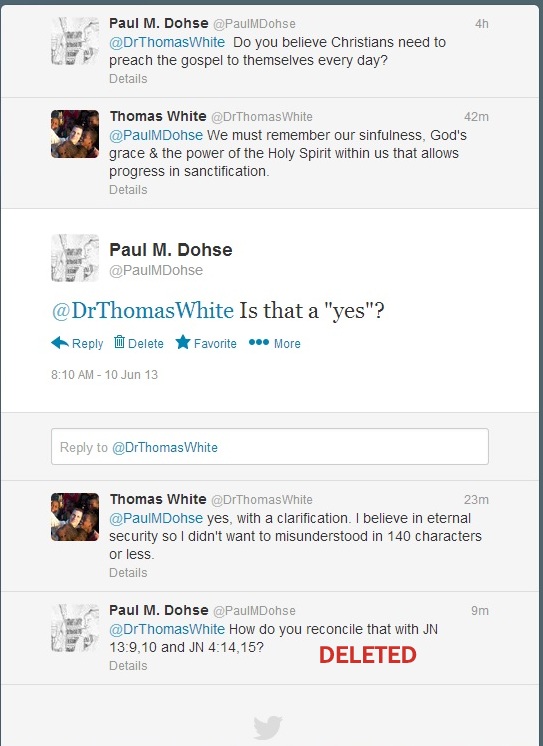
 “Did you know Christians still need to be saved? Well, bless your heart, it may be too late for you, but quickly enroll your children at Cedarville where they can be saved by Dr. White’s gospel.”
Nobody wants to discuss the gospel that has been running the show in the American church for several years. Launched by a Reformed think tank in 1970, it seized control of evangelicalism in the mid-1990s. Propagators continually put forth the idea that they are the new sheriffs in town and they need time to straighten things out, but the fact is that their gospel has been running the show for almost twenty years now. Are we better off? Hardly.
We aren’t talking about mere semantics here. We are talking about the heart of the gospel. We are talking about the law’s relationship to grace. We are talking about the very definition of justification. New Calvinism keeps the believer under law, but supposedly that’s ok because Jesus keeps it for us. No, under law is under law no matter who keeps it. God will not honor a false gospel. The New Calvinists aren’t fixing anything—they are creating the mess with their backdoor antinomianism.
The new President of Cedarville College is just what the trustees were looking for: handsome; educated; an adventurist; sports enthusiast; the appearance of pure orthodoxy; the Mayberry RFD family—all the things that bring in admissions from suburbia Christianity. Hope has returned to Cedarville; the alumni can once again look at themselves in the mirror. Yes, he’s good, even being a student of New Calvinism for six years now, it took me forty minutes to positively identify him as a New Calvinist heretic. I consider him one of the best at masking his false gospel.
Dr. Thomas White and his wife were both educated at Southeastern Baptist Theological Seminary, a bastion of Christian mysticism and New Calvinism. But a statement on his blog says it all:
When the Gospel drives everything we do, we see all of us need grace every day. We all have deceitfully wicked hearts and preaching a moralistic set of rules will never save but will only add a burden that mankind cannot bear. We should teach about theological realities such as adoption, redemption, forgiveness, and grace. We should become protectors of widows and orphans and fathers to the fatherless.
We need to proclaim loudly the biblical message that children are a blessing from the Lord, that life begins at the moment of conception, that we must fear God more than any opinion of man, and that the Gospel brings grace if one repents and believes. No matter any judge’s verdict, we must defend life now, not wait until the morning after.
For the most part this reads well, but the devil is in the details. The greatest errors are always closest to the truth. Does the gospel drive EVERYTHING we do? Does the same gospel that saved us continue to completely drive our Christian life? You know, the “gospel-driven life.” The “gospel-centered life.” Do Christians continue to need grace every day? What does he mean by “grace”? The common grace we expect from God every day, or the same grace that saved us? Do Christians need daily salvific grace? Is that what he means? Sure it is, for he goes on to write,
We all have deceitfully wicked hearts….
Is that true? Do born-again Christians have “wicked hearts”? Yes, according to New Calvinists. That’s why we need the gospel every day.
Like with all New Calvinists, we receive the same ambiguous rhetoric from White that masks his false gospel:
….preaching a moralistic set of rules will never save but will only add a burden that mankind cannot bear.
“Mankind” is thrown in to knock you off the scent. This kind of New Calvinist deception is protocol. The “preaching” refers back to “we” and “us” in the previous sentence including “all.” That would be us, as in CHRISTIANS, the fact that New Calvinists see us as no different than the unregenerate (and therefore still under the law) notwithstanding.
Furthermore, try not to close your eyes because a shocking scene is coming:
1. Rules in the Bible are called “moralistic.”
2. And, preaching rules will never “save” Christians.
Did you know Christians still need to be saved? Well, bless your heart, it may be too late for you, but quickly enroll your children at Cedarville where they can be saved by Dr. White’s gospel.
Somehow, they will become moral and serving as well. Dr. White will teach them two different things that supposedly yield godly results:
A. They are still totally depraved.
B. They should value life and help the poor.
Really? Dr. White also states that we should….”teach about theological realities such as adoption, redemption, forgiveness, and grace.” “Obedience” and “sanctification” and “discipleship” are conspicuously missing. And there is a reason for that.
Like all New Calvinists, Dr. White will propagate a gospel contemplationism that supposedly results in the imputation of Christ’s obedience to the believer in sanctification. That’s because we are still under the law and Christ’s obedience must be imputed to our sanctification so that we can live our Christian life in the same way we were saved: by faith alone. Synergistic sanctification is believed to be works salvation. It’s antinomian let go and let God theology.
Again, these guys have been running the show for twenty years and the results speak for themselves. One result is the GARB response to the ABWE scandal. It’s sad but true: Christians continue to pay good money in the name of a gospel that will not sanctify, or save.
paul


Law: Calvinism’s Achilles Heel
Request free DVD of this message here: Free Offers Link
 The Potter’s House 6/2/2013: Law’s Relationship to Justification and Sanctification
I think if there has ever been a Dark Age in Christianity we are in it. If you think about it, Christ wasn’t concerned with a bunch of ism’s, He continually warned about the traditions of men. I only now understand how powerful that is. I have been a Christian since 1983, and since then I have been functioning as a Christian on rudimentary information. And often in my life, it has shown. And the following is frightening: I was often considered to be an annoying zealot who dared to proclaim that he knew something.
Contemporary Christianity functions on the traditions of men. When people write me to make a theological case, it is made with a long list of quotations from men. “Orthodoxy” is a word that has become synonymous with truth itself. How can this be when orthodoxy is the creeds, confessions, and catechisms written by men? One advertisement for a Seminary boasts that they are “confessional.” We refer to it as “subordinate truth” to the Bible while we wait with bated breath for its next contemporary addition to be available at the Christian book store. While there, we will often pick up a little plaque or bumper sticker to add to our orthodoxy. “What! What do mean when you say that ‘Footsteps in the Sand’ is not in the Bible? That’s blaspheme!”
Truthfully, even though I have learned more in the past six months than my whole Christian life, I now see that I am really just beginning to learn, this is all new to me and I am rethinking everything. But this I do know: Christians in our culture really struggle with a biblical understanding of law. And here we are, Romans 10:4;
For Christ is the end of the law for righteousness to everyone who believes.
This is what is really difficult for us to understand. I had to learn it on my own with the help of the Holy Spirit. I went to Bible college—they didn’t teach it to me. I went to Seminary—never learned it there either. I have been to countless Bible conferences—ditto. No wonder that John said that we have no need for anyone to teach us; that is a good thing, because apparently, they aren’t going to do that anyway. But here it is:
For the believer, law and righteousness are mutually exclusive. Shock and dismay now equals traditions of men. This verse states that the law had to end in order for us to be declared righteous. The law “ended” “for” righteousness. This is to everyone who believes in Christ—that’s why Paul states that He is the end of the law.
As Christians, we don’t obey the law perfectly. That’s unfortunate, but in regard to our just position and present righteousness—it doesn’t matter. The law can no longer condemn us or judge us. Our salvation is lawless. The law doesn’t exist, so there is no sin (ROM 5:13), and it has nothing that it can say to us (ROM 3:19).
Because the apostle Paul knew that law being a standard for our justification would completely sap our salvation power in sanctification, he drives the point home in many different ways. Let’s start with Christ. Turn to Romans chapter seven and we will begin reading in verse one:
Romans 7:1- Or do you not know, brothers—for I am speaking to those who know the law—that the law is binding on a person only as long as he lives? 2 For a married woman is bound by law to her husband while he lives, but if her husband dies she is released from the law of marriage. 3 Accordingly, she will be called an adulteress if she lives with another man while her husband is alive. But if her husband dies, she is free from that law, and if she marries another man she is not an adulteress.
4 Likewise, my brothers, you also have died to the law through the body of Christ, so that you may belong to another, to him who has been raised from the dead, in order that we may bear fruit for God. 5 For while we were living in the flesh, our sinful passions, aroused by the law, were at work in our members to bear fruit for death. 6 But now we are released from the law, having died to that which held us captive, so that we serve in the new way of the Spirit and not in the old way of the written code.
Who is the spouse that died in this case so that we are no longer under the law? Christ, and we died with Him. We are also the other spouse who was resurrected with Christ and is now free to remarry another so that we can serve in the new way of the Spirit. Christ bore our sin on the cross (imputation) so that we could die with Him and be resurrected with Him in the new way of the Spirit—not the old marriage covenant. The old us died with Christ, and our sin died with Him. The new us is no longer under that covenant—the covenant of the law. If we remarry, that law cannot condemn us. The dead are never prosecuted and brought to court. If a cold case is solved and the suspect is dead, he is not indicted by a grand jury. The dead are not exhumed and brought to court. Do you believe that a perfect keeping of the law is required in your Christian life for your just standing? Then the old you is still alive and you are an adulteress.
Paul explains this another way. The law was a will.
Hebrews 9:15 – Therefore he is the mediator of a new covenant, so that those who are called may receive the promised eternal inheritance, since a death has occurred that redeems them from the transgressions committed under the first covenant. 16 For where a will is involved, the death of the one who made it must be established. 17 For a will takes effect only at death, since it is not in force as long as the one who made it is alive. 18 Therefore not even the first covenant was inaugurated without blood.
The law was a will, and like any other will it promised an inheritance. Like any other will, those named in the will are partakers in that promissory note. And before Christ went to the cross all who believed in Him were heirs of the promise. It was a covenant inaugurated with blood because all of the sins of those who believed on Christ were imputed to that covenant. This is yet another thing that I have never been taught before in regard to the subject of imputation. There is the imputation of the Father’s righteousness to us, the imputation of our sin to Christ, and the imputation of the believer’s sins prior to the cross. Our sins were imputed to that covenant/will with the promise of the inheritance upon the death of the testator, forgiveness of sins and eternal life. I am convinced that Old Testament believers were completely aware of this and understood it. Undoubtedly, this fact also opens up an additional wealth of understanding while reading the Old Testament with this in mind.
Let’s look at this a little deeper. Please go with me to Galatians chapter three and let’s start at verse 19:
Why then the law? It was added because of transgressions, until the offspring should come to whom the promise had been made, and it was put in place through angels by an intermediary. 20 Now an intermediary implies more than one, but God is one.
21 Is the law then contrary to the promises of God? Certainly not! For if a law had been given that could give life, then righteousness would indeed be by the law. 22 But the Scripture imprisoned everything under sin, so that the promise by faith in Jesus Christ might be given to those who believe.
23 Now before faith came, we were held captive under the law, imprisoned until the coming faith would be revealed. 24 So then, the law was our guardian until Christ came, in order that we might be justified by faith. 25 But now that faith has come, we are no longer under a guardian, 26 for in Christ Jesus you are all sons of God, through faith. 27 For as many of you as were baptized into Christ have put on Christ. 28 There is neither Jew nor Greek, there is neither slave nor free, there is no male and female, for you are all one in Christ Jesus. 29 And if you are Christ’s, then you are Abraham’s offspring, heirs according to promise.
Notice that Paul said that sin was imprisoned in the Scriptures. As we have discussed before, the law is the same thing as the Bible. Again, we see that here in verse 22. Many teach in our day that this passage means that the law continually shows us our need for Christ and a perpetual forgiveness. The law is a “schoolmaster” that continually leads us to Christ. That’s not what this passage means at all. Ironically, the ESV has this right: the old covenant was a “guardian” that kept us safe from the eternal consequences of sin until the death of the testator. The full inheritance was received when Christ died. Now the law serves a different purpose which we will look at later.
But herein lays the Achilles heel of the Reformed gospel. Herein lays the reason that Calvin’s gospel is a doctrine of demons. It teaches that Christ fulfilled the law for us so that we could be declared righteous. It teaches that Christ is the end of the law in regard to us keeping it. Hence, there is really no END to the law. But worse yet, let’s compare this reasoning with a few texts in the same vicinity of where we are presently:
Galatians 3:10 – For all who rely on works of the law are under a curse; for it is written, “Cursed be everyone who does not abide by all things written in the Book of the Law, and do them.” 11 Now it is evident that no one is justified before God by the law, for “The righteous shall live by faith.” 12 But the law is not of faith, rather “The one who does them shall live by them.” 13 Christ redeemed us from the curse of the law by becoming a curse for us—for it is written, “Cursed is everyone who is hanged on a tree”— 14 so that in Christ Jesus the blessing of Abraham might come to the Gentiles, so that we might receive the promised Spirit through faith.
15 To give a human example, brothers: even with a man-made covenant, no one annuls it or adds to it once it has been ratified. 16 Now the promises were made to Abraham and to his offspring. It does not say, “And to offsprings,” referring to many, but referring to one, “And to your offspring,” who is Christ. 17 This is what I mean: the law, which came 430 years afterward, does not annul a covenant previously ratified by God, so as to make the promise void. 18 For if the inheritance comes by the law, it no longer comes by promise; but God gave it to Abraham by a promise.
19 Why then the law? It was added because of transgressions, until the offspring should come to whom the promise had been made, and it was put in place through angels by an intermediary. 20 Now an intermediary implies more than one, but God is one.
21 Is the law then contrary to the promises of God? Certainly not! For if a law had been given that could give life, then righteousness would indeed be by the law. 22 But the Scripture imprisoned everything under sin, so that the promise by faith in Jesus Christ might be given to those who believe.
To believe that Christ fulfilled the law for us is to also contradict what our beloved brother has said here in the following ways:
1. It relies on the works of the law; who does the perfect work is not the point. If Christ fulfilled the will perfectly, and we could have received the promised inheritance by His fulfilling of the law, why did He have to die? That’s the Hebrew writer’s point: IT’S A WILL—somebody had to die.
2. The law cannot justify because it is not of faith. It doesn’t matter who keeps it. “The law is not of faith.” If Christ fulfilled the law, that fulfillment makes us righteous and we are then indeed justified by the law. Christ’s perfect obedience is transferred to us and then we are in fact justified by its perfect keeping. By the way, this is exactly what Luther himself propagated. He stated that Christ’s obedience becomes our obedience and that obedience is transferred to us by faith alone. It’s backdoor law-keeping. Said Luther,
Mine are Christ’s living, doing, and speaking, His suffering and dying; mine as much as if I had lived, done, spoken, and suffered, and died as He did . . .(Luther’s Works (Philadelphia: Muhlenberg Press; St. Louis: Concordia Publishing House, 1955), Vol. xxxi, pp.297,298).
This makes an imputation of law-keeping the standard for righteousness. The law is therefore not ENDED. For all practical purposes, we are credited with keeping it for our justification albeit by faith in Christ.
3. Furthermore, if the fulfilling of the law by Christ brings righteousness, that means that the law has life. Note verse 21:
For if a law had been given that could give life, then righteousness would indeed be by the law.
This brings us yet to another way that our brother Paul wants us to get this; OFFSPRING. If the law could give life, there is more than one offspring:
Galatians 3:15 -To give a human example, brothers: even with a man-made covenant, no one annuls it or adds to it once it has been ratified. 16 Now the promises were made to Abraham and to his offspring. It does not say, “And to offsprings,” referring to many, but referring to one, “And to your offspring,” who is Christ. 17 This is what I mean: the law, which came 430 years afterward, does not annul a covenant previously ratified by God, so as to make the promise void. 18 For if the inheritance comes by the law, it no longer comes by promise; but God gave it to Abraham by a promise.
This is also why the promise could not come through Ishmael; it had to come through Isaac because the promise concerned Sarah and not Hagar. Hagar represents the Mt. Sinai law, and Sarah represented the promise:
Galatians 4:21 – Tell me, you who desire to be under the law, do you not listen to the law? 22 For it is written that Abraham had two sons, one by a slave woman and one by a free woman. 23 But the son of the slave was born according to the flesh, while the son of the free woman was born through promise. 24 Now this may be interpreted allegorically: these women are two covenants. One is from Mount Sinai, bearing children for slavery; she is Hagar. 25 Now Hagar is Mount Sinai in Arabia; she corresponds to the present Jerusalem, for she is in slavery with her children. 26 But the Jerusalem above is free, and she is our mother. 27 For it is written,
“Rejoice, O barren one who does not bear; break forth and cry aloud, you who are not in labor! For the children of the desolate one will be more than those of the one who has a husband.”
28 Now you, brothers, like Isaac, are children of promise. 29 But just as at that time he who was born according to the flesh persecuted him who was born according to the Spirit, so also it is now. 30 But what does the Scripture say? “Cast out the slave woman and her son, for the son of the slave woman shall not inherit with the son of the free woman.” 31 So, brothers, we are not children of the slave but of the free woman.
Pray tell, why would Christ come to fulfill a covenant with Hagar so that we could be righteous? Christ is the end of that covenant. He came to ABOLISH it—not to fulfill it:
Ephesians 2:11 – Therefore remember that at one time you Gentiles in the flesh, called “the uncircumcision” by what is called the circumcision, which is made in the flesh by hands— 12 remember that you were at that time separated from Christ, alienated from the commonwealth of Israel and strangers to the covenants of promise, having no hope and without God in the world. 13 But now in Christ Jesus you who once were far off have been brought near by the blood of Christ. 14 For he himself is our peace, who has made us both one and has broken down in his flesh the dividing wall of hostility 15 by abolishing the law of commandments expressed in ordinances, that he might create in himself one new man in place of the two, so making peace, 16 and might reconcile us both to God in one body through the cross, thereby killing the hostility.
“But Paul, what then was Christ talking about in the Sermon on the Mount when He said He didn’t come to abolish the law?” Well, he wasn’t talking about that law, He was talking about the law of love. Same words, different law. Hence:
Galatians 5:1 – For freedom Christ has set us free; stand firm therefore, and do not submit again to a yoke of slavery. 2 Look: I, Paul, say to you that if you accept circumcision, Christ will be of no advantage to you. 3 I testify again to every man who accepts circumcision that he is obligated to keep the whole law. 4 You are severed from Christ, you who would be justified by the law; you have fallen away from grace. 5 For through the Spirit, by faith, we ourselves eagerly wait for the hope of righteousness. 6 For in Christ Jesus neither circumcision nor uncircumcision counts for anything, but only faith working through love.
Now, look at what he says in the very next verse:
Galatians 5:7 – You were running well. Who hindered you from obeying the truth?
So, what are we to conclude? We are to conclude that faith working through love….
1. Works (“working”).
2. Runs.
3. Obeys.
4. Is guided by an objective truth.
5. Defines love as truth (2Thessilonoians 2:10).
6. Can be hindered from obeying the truth.
This gives new meaning to Christ’s words, “If you love me, keep my commandments.” In Matthew 5:18 Christ isn’t talking about the Mosaic Law, He’s talking about the law of love. He didn’t say that our righteousness needed to surpass that of Pharisees as a challenge for us to let Him fulfill the Mosaic Law for us because the Pharisees were really, really good at obeying the Mosaic Law, why would He do that? That’s of Hagar and not Sarah; it’s a law that has no life. He fulfilled that law perfectly by virtue of who He is, but not for the purpose of justifying us because after its inherent fulfillment there is still nothing but the dead letters of that law. His problem with the Pharisees is that they sought righteousness in the law rather than in Him. This is why Paul wrote the following just prior to our text at hand:
Romans 10:1-3 – Brothers, my heart’s desire and prayer to God for them is that they may be saved. 2 For I bear them witness that they have a zeal for God, but not according to knowledge. 3 For, being ignorant of the righteousness of God, and seeking to establish their own, they did not submit to God’s righteousness.
Christ’s indictment against the Pharisees was that they sought the Mosaic Law rather than faith working through love. They put faith in the Mosaic Law instead of Christ (JN 5:39). Said another way: they sought the Mosaic Law rather than the law of love. And since love fulfills the law (GAL 5:14, ROM 13:10, EPH 3:14-21, DUE 6:5, LEV 19:18), that is the righteousness that surpasses the righteousness of the Pharisees. It is a righteousness APART from the law (ROM 3:21).
So in what way did Christ come to fulfill the law of love? Not by fulfilling the Mosaic Law—that is certain. It has no life! He came to fulfill the law of love. I would say His death on the cross would be a description of that. But the idea here is a constant fulfilling of the law. As Susan brilliantly pointed out two Sundays ago, the law is not completely fulfilled because of all of the things in the law that haven’t happened yet. Not only that, all of the references in the Bible that pertain to the fulfilling of the law by single acts of truthful love are in the present tense. If Christ fulfilled the law completely, how is that possible? (GAL 5:14, ROM 13:10, EPH 3:14-21, DUE 6:5, LEV 19:18).
Romans 8:3,4 makes it absolutely clear how Christ is fulfilling the law; He is fulfilling it through us as we walk in love. To say otherwise deprives us of our ability to love Christ and others and creates cold-heartedness in the vacuum. Wherever anti-law of love reins, cold-heartedness makes its abode (PS 119:70, MATT 24:12).
Anyone who uses the imperfect law-keeping of the Christian to prove that the law is still the standard for our justification also proves that they believe in a vicarious law keeping of a law that has no life for our salvation. It teaches salvation on Mt. Sinai rather than salvation at Galgotha. Christ was the end of that law because he put it to death along with the sin that held us captive to it (GAL 3:23). He did not end it by fulfilling it. He abolished it on the cross and raised us to a new life that is sanctified by obedience to the perfect law of liberty. Be careful to note James 1:25 on that. The blessings are in the “doing,” not meditation on Christ’s obedience to the dead letter of the law. The standard for that law is a perfect keeping of every letter (GAL 5:3, ROM 10:5) while the Christian fulfills the whole law perfectly with every act of obedience. We are blameless before Him in love (EPH 1:4).
Our Lord’s yoke is a light one for the impossible demands of Mt. Sinai do not terrorize us. We are free to love God aggressively. We bemoan our sin, but the old us who would be judged by that failure according to justification died with Christ (ROM 7:20), and the new us is under grace and not under law (ROM 6:14). There are relational consequences, but not eternal ones.
This is my prayer for the Potter’s House: as we strive to walk in loving obedience to Christ more and more, that our brother Paul’s prayer would be answered:
Ephesians 1:16 – I do not cease giving thanks for you, while making mention of you in my prayers; 17 that the God of our Lord Jesus Christ, the Father of glory, may give to you a spirit of wisdom and of revelation in the knowledge of Him. 18 I pray that the eyes of your heart may be enlightened, so that you will know what is the hope of His calling, what are the riches of the glory of His inheritance in the saints, 19 and what is the surpassing greatness of His power toward us who believe. These are in accordance with the working of the strength of His might 20 which He brought about in Christ, when He raised Him from the dead and seated Him at His right hand in the heavenly places, 21 far above all rule and authority and power and dominion, and every name that is named, not only in this age but also in the one to come. 22 And He put all things in subjection under His feet, and gave Him as head over all things to the church, 23 which is His body, the fullness of Him who fills all in all.
Now, how does this all relate to the perseverance of the saints? Is our perseverance necessary to confirm or salvation? Does salvation require God’s call and our perseverance? I am going to address this next week because there is much confusion in regard to this subject, and I will tie it in with the issue of assurance—that’s next week.
Calvin’s Definition of the Regenerate is the Bible’s Definition of the Unregenerate
There is a slight problem with Calvinism. Calvin’s definition of a Christian is the Bible’s definition of a lost person. Calvin, the supposed genius that he was, therefore declared Christians everywhere to be lost. Brilliant.
It all starts with Calvin’s view of the Christian’s relationship to the law:
1. It is the standard for the Christian’s justification.
2. The law must be kept perfectly in order to be considered righteous presently.
3. Christians cannot please God through obedience to the law because we still sin.
Let’s establish these three points from the Calvin Institutes (3.14.9-11):
We thus see, that even saints cannot perform one work which, if judged on its own merits, is not deserving of condemnation.
Even were it possible for us to perform works absolutely pure, yet one sin is sufficient to efface and extinguish all remembrance of former righteousness, as the prophet says (Ezek. 18:24). With this James agrees, “Whosoever shall keep the whole law, and yet offend in one point, is guilty of all,” (James 2:10). And since this mortal life is never entirely free from the taint of sin, whatever righteousness we could acquire would ever and anon be corrupted, overwhelmed, and destroyed, by subsequent sins, so that it could not stand the scrutiny of God, or be imputed to us for righteousness. In short, whenever we treat of the righteousness of works, we must look not to the legal work but to the command. Therefore, when righteousness is sought by the Law, it is in vain to produce one or two single works; we must show an uninterrupted obedience.
God does not (as many foolishly imagine) impute that forgiveness of sins once for all, as righteousness; so that having obtained the pardon of our past life we may afterwards seek righteousness in the Law. This were only to mock and delude us by the entertainment of false hopes. For since perfection is altogether unattainable by us, so long as we are clothed with flesh, and the Law denounces death and judgment against all who have not yielded a perfect righteousness, there will always be ground to accuse and convict us unless the mercy of God interpose, and ever and anon absolve us by the constant remission of sins. Wherefore the statement which we set out is always true, if we are estimated by our own worthiness, in everything that we think or devise, with all our studies and endeavors we deserve death and destruction.
We must strongly insist on these two things: That no believer ever performed one work which, if tested by the strict judgment of God, could escape condemnation; and, moreover, that were this granted to be possible (though it is not), yet the act being vitiated and polluted by the sins of which it is certain that the author of it is guilty, it is deprived of its merit.
Clearly, Calvin believed Christians are still under the law and its requirement of perfection. Once our past sins are forgiven, the law requires a perfect keeping thereafter:
God does not (as many foolishly imagine) impute that forgiveness of sins once for all, as righteousness; so that having obtained the pardon of our past life we may afterwards seek righteousness in the Law.
Notice that Calvin dismisses a future forgiveness of sins once we are forgiven of “our past life.” Apparently, at the point of salvation, past sins are forgiven but from there forward a perfect keeping of the law is required in order to be considered righteous. Since this is not possible, a perpetual forgiveness of sins is required to maintain our just standing:
For since perfection is altogether unattainable by us, so long as we are clothed with flesh, and the Law denounces death and judgment against all who have not yielded a perfect righteousness, there will always be ground to accuse and convict us unless the mercy of God interpose, and ever and anon absolve us by the constant remission of sins.
Calvin taught a need for the perpetual remission of sin in order to remain just, and a perpetual imputation of Christ’s righteousness as well:
Therefore we must have this blessedness not once only, but must hold it fast during our whole lives. Moreover, the message of free reconciliation with God is not promulgated for one or two days, but is declared to be perpetual in the Church (2 Cor. 5:18, 19). Hence believers have not even to the end of life any other righteousness than that which is there described. Christ ever remains a Mediator to reconcile the Father to us, and there is a perpetual efficacy in his death—viz. ablution, satisfaction, expiation; in short, perfect obedience, by which all our iniquities are covered (Ibid.)
Calvin believed that faith alone in sanctification, the same way we were saved, keeps this process of perpetual justification going. He posed the opposition as those who believed that the new birth enabled the Christian to participate in completing justification, and since the completion would not be a perfect keeping of the law, that it was a false approach:
They admit that the sinner, freely delivered from condemnation, obtains justification, and that by forgiveness of sins; but under the term justification they comprehend he renovation by which the Spirit forms us anew to the obedience of the Law; and in describing the righteousness of the regenerate man, maintain that being once reconciled to God by means of Christ, he is afterwards deemed righteous by his good works, and is accepted in consideration of them (Ibid).
Until this day, the Reformed misrepresent the new birth as a work inside the believer that enables them to participate in the completion of justification because they only recognize a “golden chain of salvation” in which sanctification finishes justification. That is why authentic Calvinism insists on “Christ 100% for us [IN sanctification and justification both]” and any and all works of grace being completely outside of the believer. What about “faith”? Faith must focus on the gospel OUTSIDE of us or it is irrelevant. Any recognition that faith is inside of us leads to subjectivism. So, true faith is that which focuses on another object, or it’s not faith. Whether or not it is inside of us is irrelevant. In fact, God Himself should not be emphasized as much as Christ and His gospel lest we “rather mislead miserable souls by vain speculation, than direct them to the proper mark” (Institutes III.2.i).
The primary contradiction is that Christians are no longer under the law for justification. There is NO law standard that must be maintained for our just standing. That is how unbelievers are biblically framed. Again, Calvin frames believers in the same way that the Bible frames unbelievers:
Romans 3:19 – Now we know that whatever the law says it speaks to those who are under the law, so that every mouth may be stopped, and the whole world may be held accountable to God. 20 For by works of the law no human being will be justified in his sight, since through the law comes knowledge of sin.
Romans 3:21 – But now the righteousness of God has been manifested apart from the law, although the Law and the Prophets bear witness to it— 22 the righteousness of God through faith in Jesus Christ for all who believe.
Romans 3:28 – For we hold that one is justified by faith apart from works of the law.
Romans 4:15 – For the law brings wrath, but where there is no law there is no transgression.
Romans 5:13 – for sin indeed was in the world before the law was given, but sin is not counted where there is no law.
Romans 7:6 – But now we are released from the law, having died to that which held us captive, so that we serve in the new way of the Spirit and not in the old way of the written code.
Romans 7:8 – But sin, seizing an opportunity through the commandment, produced in me all kinds of covetousness. For apart from the law, sin lies dead.
We see that a perfect keeping of the law is completely unnecessary for the Christian. Who keeps it or doesn’t keep it for our justification is completely irrelevant for the standard of the law does not exist in justification: “But now the righteousness of God has been manifested apart from the law.”
Furthermore, if we are still under the jurisdiction of the law for our justification, we are technically, according to the Bible, unregenerate and still enslaved to sin:
Romans 6:14 – For sin will have no dominion over you, since you are not under law but under grace.
Because we died with Christ, the old us that was under the law is like a spouse that died; we are no longer under that marriage law and the new us is free to marry another:
Romans 7:1 – Or do you not know, brothers—for I am speaking to those who know the law—that the law is binding on a person only as long as he lives? 2 For a married woman is bound by law to her husband while he lives, but if her husband dies she is released from the law of marriage. 3 Accordingly, she will be called an adulteress if she lives with another man while her husband is alive. But if her husband dies, she is free from that law, and if she marries another man she is not an adulteress.
4 Likewise, my brothers, you also have died to the law through the body of Christ, so that you may belong to another, to him who has been raised from the dead, in order that we may bear fruit for God. 5 For while we were living in the flesh, our sinful passions, aroused by the law, were at work in our members to bear fruit for death. 6 But now we are released from the law, having died to that which held us captive, so that we serve in the new way of the Spirit and not in the old way of the written code.
We are no longer under the law for justification, and not of the nature that goes along with that: enslavement to sin. Nor are we any longer provoked to sin by the law, which is another characteristic of being under it:
Romans 7:5 – 5 For while we were living in the flesh, our sinful passions, aroused by the law, were at work in our members to bear fruit for death.
Those under the law cannot obey the law, but in direct contradiction to Calvin, those under grace can obey and please God with obedience accordingly:
Romans 8:1 – There is therefore now no condemnation for those who are in Christ Jesus. 2 For the law of the Spirit of life has set you free in Christ Jesus from the law of sin and death. 3 For God has done what the law, weakened by the flesh, could not do. By sending his own Son in the likeness of sinful flesh and for sin, he condemned sin in the flesh, 4 in order that the righteous requirement of the law might be fulfilled in us, who walk not according to the flesh but according to the Spirit. 5 For those who live according to the flesh set their minds on the things of the flesh, but those who live according to the Spirit set their minds on the things of the Spirit. 6 For to set the mind on the flesh is death, but to set the mind on the Spirit is life and peace. 7 For the mind that is set on the flesh is hostile to God, for it does not submit to God’s law; indeed, it cannot. 8 Those who are in the flesh cannot please God.
The law now informs our sanctification (ROM 3:21, GAL 4:21) and provokes us to obedience from our redeemed hearts:
Romans 6:1 – What shall we say then? Are we to continue in sin that grace may abound? 2 By no means! How can we who died to sin still live in it? 3 Do you not know that all of us who have been baptized into Christ Jesus were baptized into his death? 4 We were buried therefore with him by baptism into death, in order that, just as Christ was raised from the dead by the glory of the Father, we too might walk in newness of life.
5 For if we have been united with him in a death like his, we shall certainly be united with him in a resurrection like his. 6 We know that our old self was crucified with him in order that the body of sin might be brought to nothing, so that we would no longer be enslaved to sin. 7 For one who has died has been set free from sin. 8 Now if we have died with Christ, we believe that we will also live with him. 9 We know that Christ, being raised from the dead, will never die again; death no longer has dominion over him. 10 For the death he died he died to sin, once for all, but the life he lives he lives to God. 11 So you also must consider yourselves dead to sin and alive to God in Christ Jesus.
12 Let not sin therefore reign in your mortal body, to make you obey its passions. 13 Do not present your members to sin as instruments for unrighteousness, but present yourselves to God as those who have been brought from death to life, and your members to God as instruments for righteousness. 14 For sin will have no dominion over you, since you are not under law but under grace.
Slaves to Righteousness
15 What then? Are we to sin because we are not under law but under grace? By no means! 16 Do you not know that if you present yourselves to anyone as obedient slaves,[c] you are slaves of the one whom you obey, either of sin, which leads to death, or of obedience, which leads to righteousness? 17 But thanks be to God, that you who were once slaves of sin have become obedient from the heart to the standard of teaching to which you were committed, 18 and, having been set free from sin, have become slaves of righteousness.
Calvin’s soteriology is utterly anti-gospel and the antitheses of truth. It must be rejected with extreme prejudice. It makes a mockery of biblical common sense—describing the regenerate as unregenerate.
paul

 Paul's Passing Thoughts
leave a comment