John Piper’s Vine and Branches Conference: A Synopsis of its Heresy
Originally posted December 14, 2013
“Take note that Calvin is also confirming the Reformed belief that sins in the Christian life separate us from salvation. Therefore, the same repentance and faith that was needed originally continues to be needed as a way to keep ourselves saved. However, according to Calvin, the same gospel that originally saved us must be continually administered by Reformed pastors.”
John Piper states in the promotional video for his Vine and Branch conference that the union with Christ doctrine could be the most important doctrine that you have never heard of. The blogger Alex Guggenheim responded to that notion this way:
Okay, so here we have Neo-Calvinists who have, for the last 15-20 years and certainly the last 10 years, overwhelming their people and those being assimilated, being offered a conference on “the most important doctrine you’ve never heard of.”
Hmmm…so Neo-Calvinists, what have you been doing all this time if this doctrine is central to all things as your promo says? Suddenly you now offer the most important doctrine. I suggest theological and ecclesiastical malfeasance with such an admission.
If it was and is so important, and it is, why haven’t you made it the centrality of your teaching and articulations all this time or…is this just another gimmick to incite spiritual anxiety in people who now believe they have been missing something and cannot miss this?
Good grief.
The Calvin Institutes of the Christian religion is their playbook, and it is a very thick linguistic droning. This is their bible, and they are continually mining it for new ideas. Sometimes these ideas take a while to find in the book of Calvin. However, I believe it is the same document that will hang them because people are starting to read the document for themselves. Piper begins the promotion for the conference with a statement by Calvin, so let’s start with Calvin.
John Calvin
The crux of the Reformation false gospel is the idea that justification is not a finished work. Therefore, they make the separate work of sanctification the growing, or progression of justification. The saint becomes a colaborer in the finishing of justification rather than a colaborer for the kingdom as an ambassador. The saint is not working towards a reward from his Master, he is working towards the final prize of salvation.
Therefore, the saint must obtain that final prize the same way he received it, by FAITH ALONE. So, he must run the race of salvation by faith alone. This is made possible by the “vital union with Christ.” Our “union with Christ” sanctifies our participation in justification. Let me repeat that:
Our “union with Christ” sanctifies our participation in justification.
It makes running the race by faith alone possible. It enables us to gobble up more and more grace in order to keep ourselves saved—by faith alone of course. James addressed the problem of this very notion in James 2:14-26. It hearkens back to the problem of justification and sanctification not being completely separate; one being a finished work and the other being a progressive work. This is the Achilles’ heel of every false gospel that has ever come down the pike.
So, how do we supposedly run the race by faith alone? The same way we started, by faith alone which entails “living by the gospel.” We live to get more grace. If we keep filling up our gas tank at the salvation filling station, we will be able to “stand in the judgment” that we are driving to. In fact, this is exactly how Reformed theologians frame the issue:
We repeat, Justification is not a thing that we pass and get behind us. As Barth rightly said, it is not like a filling station that we pass but once. As we hold to its eschatological implications, justification by faith can never become static but must remain the dynamic center of Christian existence, the continuous present. We are always sinners in our eyes, but we are always standing on God’s justification and, perhaps more importantly, moving toward it. To be justified is a present-continuous miracle to the man who present-continuously believes, knowing that he who believes possesses all things, and he who does not believe possesses nothing. Such a life is only possible where the gospel of justification is continually heard and where God’s verdict of acquittal is like those mercies which Jeremiah declared were new every morning—”great is Thy faithfulness” (Lam. 3:22-23).[1]
Also…
Rather than obsessing through a checklist of necessary Christian behavior, he argued that it is important to get back to the heart of Christianity. Faith, he says, shouldn’t be based on “our performance” but, instead, it should be predicated upon “God’s performance for us in Jesus.”[2]
But there is no “performance” for us by Jesus in the Christian life that maintains justification. That work is done. In regard to justification, “It is finished” and Christ has sat down at the right hand of the Father. We work together with Christ in our sanctification. Again, at issue is the fusion of a finished work with a progressive work. But since the Reformation sees justification/salvation as progressive, we must continually fill our gas tanks with the same grace that saved us. That is the essence of union with Christ; it enables us to receive perpetual fillings of salvation. There are two primary ways that we “keep ourselves in the love of God”[3] or in union with Christ.
1. Mortification and vivification. According to Calvin, mortification and vivification is obtained through the union with Christ.[4] It is a lifestyle of “constant confession and repentance” that avoids the pursuit of a godly life and embraces a life that is “literally Christ himself.”[5] Simply stated, it is perpetual resalvation through the same repentance and sorrow for sin, and belief in the works of Christ only that saved us. By focusing on our depravity (“deep repentance”), a new need for grace is realized and when embraced results in a refreshing of the soul (vivification); viz, a joy experience.
This is the perpetual reliving of our baptism—a “daily dying and rising.”[6] It also results in EXPERIENCING the works of Christ in our life “subjectively,” but it is not really us doing the work—it is a manifestation of Christ’s work that we only experience [7]. This is otherwise known as “new obedience” in Reformed circles. It can be compared to standing in the rain; you experience it, but you are not participating in the work of it or producing it. This enables us to live our Christian lives by the same gospel that saved us, and resulting in being able to “stand in the judgment.”
2. The Sacraments. We get more saving gospel through the Sacraments. Said Calvin:
It is irrational to contend that sacraments are not manifestations of divine grace toward us… We conclude, therefore, that the sacraments are truly termed evidences of divine grace, and, as it were, seals of the good-will which he entertains toward us. They, by sealing it to us, sustain, nourish, confirm, and increase our faith.[8]
God gathers his people together in a covenantal event to judge and to justify, to kill and to make alive. The emphasis is on God’s work for us – the Father’s gracious plan, the Son’s saving life, death, and resurrection, and the Spirit’s work of bringing life to the valley of dry bones through the proclamation of Christ. The preaching focuses on God’s work in the history of redemption from Genesis through Revelation, and sinners are swept into this unfolding drama. Trained and ordained to mine the riches of Scripture for the benefit of God’s people, ministers try to push their own agendas, opinions, and personalities to the background so that God’s Word will be clearly proclaimed. In this preaching the people once again are simply receivers – recipients of grace. Similarly, in baptism, they do not baptize themselves; they are baptized. In the Lord’s Supper, they do not prepare and cook the meal; they do not contribute to the fare; but they are guests who simply enjoy the bread of heaven.[9]
3. Absolution through church membership.
According to Calvin:
Nor by remission of sins does the Lord only once for all elect and admit us into the Church, but by the same means he preserves and defends us in it. For what would it avail us to receive a pardon of which we were afterwards to have no use? That the mercy of the Lord would be vain and delusive if only granted once, all the godly can bear witness; for there is none who is not conscious, during his whole life, of many infirmities which stand in need of divine mercy. And truly it is not without cause that the Lord promises this gift specially to his own household, nor in vain that he orders the same message of reconciliation to be daily delivered to them. Wherefore, as during our whole lives we carry about with us the remains of sin, we could not continue in the Church one single moment were we not sustained by the uninterrupted grace of God in forgiving our sins. On the other hand, the Lord has called his people to eternal salvation, and therefore they ought to consider that pardon for their sins is always ready. Hence let us surely hold that if we are admitted and ingrafted into the body of the Church, the forgiveness of sins has been bestowed, and is daily bestowed on us, in divine liberality, through the intervention of Christ’s merits, and the sanctification of the Spirit.
To impart this blessing to us, the keys have been given to the Church (Mt. 16:19; 18:18). For when Christ gave the command to the apostles, and conferred the power of forgiving sins, he not merely intended that they should loose the sins of those who should be converted from impiety to the faith of Christ;531 but, moreover, that they should perpetually perform this office among believers. This Paul teaches, when he says that the embassy of reconciliation has been committed to the ministers of the Church, that they may ever and anon in the name of Christ exhort the people to be reconciled to God (2 Cor. 5:20). Therefore, in the communion of saints our sins are constantly forgiven by the ministry of the Church, when presbyters or bishops, to whom the office has been committed, confirm pious consciences, in the hope of pardon and forgiveness by the promises of the gospel, and that as well in public as in private, as the case requires. For there are many who, from their infirmity, stand in need of special pacification, and Paul declares that he testified of the grace of Christ not only in the public assembly, but from house to house, reminding each individually of the doctrine of salvation (Acts 20:20, 21). Three things are here to be observed. First, whatever be the holiness which the children of God possess, it is always under the condition, that so long as they dwell in a mortal body, they cannot stand before God without forgiveness of sins. Secondly, This benefit is so peculiar to the Church, that we cannot enjoy it unless we continue in the communion of the Church. Thirdly, It is dispensed to us by the ministers and pastors of the Church, either in the preaching of the Gospel or the administration of the Sacraments, and herein is especially manifested the power of the keys, which the Lord has bestowed on the company of the faithful. Accordingly, let each of us consider it to be his duty to seek forgiveness of sins only where the Lord has placed it. Of the public reconciliation which relates to discipline, we shall speak at the proper place.[10]
…by new sins we continually separate ourselves, as far as we can, from the grace of God… Thus it is, that all the saints have need of the daily forgiveness of sins; for this alone keeps us in the family of God. [11]
Take note that Calvin is also confirming the Reformed belief that sins in the Christian life separate us from salvation. Therefore, the same repentance and faith that was needed originally continues to be needed as a way to keep ourselves saved. However, according to Calvin, the same gospel that originally saved us must be continually administered by Reformed pastors.
John Piper
John Piper is the guru of Christian joy. Most Christians find it strange that he puts so much emphasis on Christian joy, that is, until you understand mortification and vivification. If vivification is not taking place, viz, the upside of mortification and vivification, then you are not in union with Christ. This totally explains the following outrageous statements by him:
“Unless a man be born again into a Christian Hedonist he cannot see the kingdom of God” (Desiring God page 55).
“Could it be that today the most straightforward biblical command for conversion is not, ‘Believe in the Lord,’ but, ‘Delight yourself in the Lord’?” (Desiring God page 55).
“The pursuit of joy in God is not optional. It is not an ‘extra’ that a person might grow into after he comes to faith. Until your heart has hit upon this pursuit, your ‘faith’ cannot please God. It is not saving faith” (Desiring God page 69).
“Not everybody is saved from God’s wrath just because Christ died for sinners. There is a condition we must meet in order to be saved. I want to try to show that the condition…is nothing less than the creation of a Christian Hedonist” (Desiring God page 61).
“We are converted when Christ becomes for us a Treasure Chest of holy joy” (Desiring God page 66).
“Something has happened in our hearts before the act of faith. It implies that beneath and behind the act of faith which pleases God, a new taste has been created. A taste for the glory of God and the beauty of Christ. Behold, a joy has been born!” (Desiring God page 67).
“Before the decision comes delight. Before trust comes the discovery of treasure” (Desiring God, page 68).
Michael Horton
The following statement by Michael Horton is a good summation of the Reformation’s false gospel:
Where we land on these issues is perhaps the most significant factor in how we approach our own faith and practice and communicate it to the world. If not only the unregenerate but the regenerate are always dependent at every moment on the free grace of God disclosed in the gospel, then nothing can raise those who are spiritually dead or continually give life to Christ’s flock but the Spirit working through the gospel. When this happens (not just once, but every time we encounter the gospel afresh), the Spirit progressively transforms us into Christ’s image. Start with Christ (that is, the gospel) and you get sanctification in the bargain; begin with Christ and move on to something else, and you lose both.[12]
Paul David Tripp
Lastly, out of necessity, Calvin’s doctrine must depend on an allegorical interpretation of Scripture. As Rick Holland has stated, “bad grammar makes good theology.”[13] That’s because this doctrine cannot survive a grammatical examination. Tripp, one of the more viral forms of Calvinism, concedes on page 27 of How People Change (2006) that a literal interpretation of Scripture does call us to “change the way we think” (one of the more passive forms of obedience), but that this approach “omits the person and work of Christ as Savior.” In other words, a literal interpretation that circumvents use of the Bible as a tool for returning to the same gospel that saved us cuts off the progressive justification process.
paul
Endnotes
1. “We” are the authors of the theological journal published by the Australian Forum project that launched the present-day Calvinist resurgence: Graeme Goldsworthy, Robert Brinsmead, Geoffrey Paxton, and Jon Zens. Citation from Present Truth Magazine volume 35—article 3, Righteousness by Faith part 4, chapter 8.
2. The Blaze interview with Tullian Tchividjian: Oct. 15, 2013 9:01am | Billy Hallowell.
3. CJ Mahaney has used this theme many times and prescribes “preaching the gospel to ourselves” as the prescription. In reality, this is a means of keeping ourselves saved according to Reformed theology.
4. The Calvin Institutes 3.3.9, first sentence.
5. Paul David Tripp: How People Change Punch Press 2006, p.6
6. Michael Horton’s Systematic Theology for Pilgrims on the Way: p.661
7. Ibid p.661, Ibid note 5, p. 215
8. The Calvin Institutes 4.14.7
9. Michael Horton: Christless Christianity; pp.189-191
10. The Calvin Institutes 4.1.21,22
11. John Calvin: Commentaries on the Catholic Epistles; The Calvin Translation Society 1855. Editor: John Owen, p. 165 ¶4
12. Michael Horton: Christless Christianity; p. 62
13. Rick Holland: Uneclipsing the Son; p. 39


It’s All About the “O” – Mohler, DeYoung, Lucas: We Own You
 Originally posted September 15, 2012
“You could be in a church that is subtly indoctrinating your family with the idea that they are owned by the government; in this case, church polity.”
Join a New Calvinist Church if you will, but let it be known: they now own you. Newsflash for the husbands: Calvinist elders believe they have the ultimate say and authority in your home. And another thing: the gospel they hold to rejects synergism in sanctification as works salvation. So, guess what? If your wife buys into that, you are now in what they call a mixed marriage. You are now dangerously close to divorce court as the divorce rate in these churches has skyrocketed.
In our recent TANC 2012 conference, author John Immel nailed it—it boils down to who owns man: in the Christian realm, does Christ own you or Reformed elders? In the secular realm, does man own man or does government own man? Recently, our President stated that government owns man. Recently, in a trilogy of articles by three Reformed pastors published by Ligonier Ministries, it was stated that the church owns Christians, and I will give you three wild guesses as to who represents the authority of the church. That would be the elders.
So it’s all about the “O.” It’s all about “ownership.”
As we shall see, these articles plainly state the Reformed tradition that came from Catholic tyranny. The Reformers never repented of the same underlying presuppositions concerning man’s need to be owned by enlightened philosopher kings. The Reformation was merely a fight for control over the mutton with the Reformers seeing themselves as the moral philosopher kings as opposed to the Romish ones. Their doctrine was just a different take on how the totally depraved are saved from themselves. But both doctrines reflect the inability of man to participate in sanctification.
The three articles posted were: Should I Stay or Should I Go? by Albert Mohler; Where and How Do We Draw the Line? by Kevin DeYoung; and, Who Draws the Line? by Sean Michael Lucas. All linked together for your indoctrination convenience.
Al Mohler states in his ownership treatise that Christians have “no right” to leave one church for another because of preferences. Emphasis by underline added:
Far too many church members have become church shoppers. The biblical concept of ecclesiology has given way to a form of consumerism in which individuals shop around for the church that seems most to their liking at that moment. The issue can concern worship and music, relationships, teaching, or any number of other things. The pattern is the same, however – people feel free to leave one congregation for another for virtually any reason, or no reason at all.
Church shopping violates the integrity of the church and the meaning of church membership. When members leave for insufficient reason, the fellowship of the church is broken, its witness is weakened, and the peace and unity of the congregation are sacrificed. Tragically, a superficial understanding of church membership undermines our witness to the gospel of Christ.
There is no excuse for this phenomenon. We have no right to leave a church over preferences about music, personal taste, or even programming that does not meet expectations. These controversies or concerns should prompt the faithful Christian to consider how he might be of assistance in finding and forging a better way, rather than working to find an excuse to leave.
Where to begin? First of all, while many New Calvinist churches will bring you up on church discipline for leaving because of “unbiblical” reasons, those reasons vary from church to church. So, not only do the reasons for leaving vary among parishioners, but what constitutes proper “biblical…. ecclesiology” in regard to departure varies as well. Mohler states in the same post that doctrine is a valid reason to leave a church, but yet, one of the more prominent leaders of the New Calvinist movement (CJ Mahaney), who is strongly endorsed by Mohler, states that doctrine is not a valid reason to leave a church. CJ Mahaney substantiated that New Calvinist position and clearly indicated what New Calvinists are willing to do to enforce that position when he blackmailed the cofounder of SGM, Larry Tomczak:
Transcript of Phone Conversation between C.J., Doris and Larry Tomczak on October 3, 1997 pp. 10-11:
C.J.: Doctrine is an unacceptable reason for leaving P.D.I.
Larry: C.J., I’m not in sync with any of the T.U.L.I.P., so whether you agree or not, doctrine is one of the major reasons I believe it is God’s will to leave P.D.I. and it does need to be included in any statement put forth.
C.J.: If you do that, then it will be necessary for us to give a more detailed explanation of your sins [ie, beyond the sin of leaving for doctrinal reasons].
Larry: Justin’s name has been floated out there when there’s statements like revealing more details about my sin. What are you getting at?
C.J.: Justin’s name isn’t just floated out there – I’m stating it!
Larry: C.J. how can you do that after you encouraged Justin to confess everything; get it all out. Then when he did, you reassured him “You have my word, it will never leave this room. Even our wives won’t be told.”
I repeatedly reassured him, “C.J. is a man of his word. You needn’t worry.” Now you’re talking of publically sharing the sins of his youth?!
C.J.: My statement was made in the context of that evening. If I knew then what you were going to do, I would have re-evaluated what I communicated.
Doris: C.J., are you aware that you are blackmailing Larry? You’ll make no mention of Justin’s sins, which he confessed and was forgiven of months ago, if Larry agrees with your statement, but you feel you have to warn the folks and go national with Justin’s sins if Larry pushes the doctrinal button? C.J., you are blackmailing Larry to say what you want!―Shame on you, C.J.! As a man of God and a father, shame on you!
This will send shock waves throughout the teens in P.D.I. and make many pastors’ teens vow, “I‘ll never confess my secret sins to C.J. or any of the team, seeing that they‘ll go public with my sins if my dad doesn‘t toe the line.”―C.J., you will reap whatever judgment you make on Justin. You have a young son coming up. Another reason for my personally wanting to leave P.D.I. and never come back is this ungodly tactic of resorting to blackmail and intimidation of people!
C.J.: I can‘t speak for the team, but I want them to witness this. We’ll arrange a conference call next week with the team.
Doris: I want Justin to be part of that call. It’s his life that’s at stake.
C.J.: Fine.
(SGM Wikileaks, part 3, p.139. Online source)
Of course, this example and many others makes Mohler’s concern with the “integrity” of the church—laughable. But nevertheless, Mohler’s post and the other two are clear as to what common ground New Calvinists have on the “biblical concept of ecclesiology.”
Besides the fact that parishioners “have no right” to leave a church based on preference, what do New Calvinists fundamentally agree on in this regard? That brings us to the article by Sean Michael Lucas :
Because the church has authority to declare doctrine, it is the church that has authority to draw doctrinal lines and serve as the final judge on doctrinal issues. Scripture teaches us that the church serves as the “pillar and buttress of the truth.”
So, even in cases where New Calvinists believe that doctrine is an acceptable reason for leaving a church, guess who decides what true doctrine is? “But Paul, he is speaking of doctrine being determined by the church as a whole, not just the elders.” Really? Lucas continues:
In our age, this understanding—that the church has Jesus’ authority to serve as the final judge on doctrinal matters— rubs us wrong for three reasons. First, it rubs us wrong because we are pronounced individualists. This is especially the case for contemporary American Christians, who have a built-in “democratic” bias to believe that the Bible’s theology is accessible to all well-meaning, thoughtful Christians. Because theological truth is democratically available to all, such individuals can stand toe to toe with ministerial “experts” or ecclesiastical courts and reject their authority.
Creeped out yet? Well, if you are a blogger, it gets better:
Perhaps it is this individualistic, democratic perspective that has led to the rise of websites and blogs in which theology is done in public by a range of folks who may or may not be appropriately trained and ordained for a public teaching role. While the Internet has served as a “free press” that has provided important watchdog functions for various organizations, there are two downsides of the new media, which ironically move in opposite directions. On the one side, the new media (blogs, websites, podcasts, Facebook, Twitter) allow everyone to be his own theologian and judge of doctrinal matters. But because everyone is shouting and judging, the ironic other side is that those who are the most well known and have the biggest blogs gain the most market share and actually become the doctrinal arbiters of our electronic age. In this new media world, the idea that the church as a corporate body actually has authority to declare doctrine and judge on doctrinal issues is anathema.
Lucas continues to articulate the Reformed tradition that holds to the plenary authority of elders supposedly granted to them by Christ:
For some of us, again reflecting our individualism, such understanding of the church unnecessarily limits voices and perspectives that might be helpful in conversation. But restricting access to debates and judgments about theology to those who have been set apart as elders in Christ’s church and who have gathered for the purpose of study, prayer, and declaration actually ensures a more thoughtful process and a surer understanding of Christ’s Word than a pell-mell, democratic, individualistic free-for-all. Not only do we trust that a multiplicity of voices is represented by the eldership, but, above all, we trust that the single voice of the Spirit of Jesus will be heard in our midst.
So, bottom line: the priesthood of believers is a “pell-mell, democratic, individualistic free-for-all.” Still not creeped out? Then consider how they answer the question in regard to elder error:
Of course, such slow and deliberate processes do not guarantee a biblically appropriate result. After all, the Westminster Confession of Faith tells us that “all synods or councils, since the apostles’ times, whether general or particular, may err; and many have erred” (WCF 31.3). Sometimes, entire denominations err significantly as they prayerfully consider Scripture and judge doctrine. Such error, however, does not negate Jesus’ own delegation of authority to the church and set the stage for a free-for-all.
This brings us to another issue that DeYoung propogates in his post: since Reformed elders have all authority, their creeds and confessions are authoritative and not just commentaries. Hence, they declared in the aforementioned confession cited by Lucas that even though they may be in error, they still have all authority. Whatever happened to the Apostle Paul’s appeal to only follow him as he followed Christ?
DeYoung:
Those who wrote the ancient creeds, such as the Apostles’ Creed, the Nicene Creed, and the Chalcedonian Definition, were not infallible, but these creeds have served as effective guardrails, keeping God’s people on the path of truth. It would take extraordinary new insight or extraordinary hubris to jettison these ancient formulas. They provide faithful summaries of the most important doctrines of the faith. That’s why the Heidelberg Catechism refers us to the Apostles’ Creed, “a creed beyond doubt, and confessed through the world,” when it asks, “What then must a Christian believe?” (Q&A 22–23).
FYI: If you see something in your own Bible reading that contradicts a Reformed creed or confession, you are partaking in visions of grandeur.
This is the crux of the matter, the question of authority. It is almost crazy that Christians don’t have this issue resolved in their mind before they join a church. You could be in a church that is subtly indoctrinating your family with the idea that they are owned by the government; in this case, church polity.
Let there be no doubt about it, New Calvinists are drooling over the idea of another Geneva theocracy with all the trimmings. And someone shared with me just the other day how this shows itself in real life. “Mike” is a local contractor in the Xenia, Ohio area. He is close friends with a farmer in the area who lives next door to a man and his family that attend a New Calvinist church.
One day, his new New Calvinist neighbor came over to inform him that he needed to stop working on Sunday because it is the Lord’s Day, and the noise of his machinery was disturbing their day of rest. Mike’s friend told him, in a manner of speaking, to hang it on his beak. Mike believes what transpired after that came from the neighbor’s belief that he was a superior person to his friend, and that his friend should have honored the neighbors request by virtue of who he is.
The neighbor has clout in the community, and to make a long story short—found many ways to make Mike’s friend miserable through legal wrangling about property line issues; according to my understanding, 8” worth. It was clear that Mike’s friend was going to be harassed until he submitted to this man’s perceived biblical authority.
New Calvinists have serious authority issues, and you don’t have to necessarily join in official membership to be considered under their authority. A contributor to Mark Dever’s 9 Marks blog stated that anyone who comes in the front door of a church proclaiming Christ as Lord is under the authority of that church.
It’s time for Christians to nail down the “O.” Who owns you? Are you aware of who owns you (or at least thinks so)? And are you ok with that?
paul
Achieving Total Conquest Over Depression, Part 1: Paul and Susan Christian Living Series on Blogtalk Radio Program 3
 Introduction for all parts:
Everyone wants to be happy. Happiness is the essence of a quality life. Closely akin to happiness is peace; a relaxed and tranquil state of mind. Clinical depression prevents both and thrusts one into the pits of darkness and despair. Trouble in life can put people into a day by day survival mode, clinical depression puts people into an hour by hour survival mode.
This type of depression is an oppression of the soul that often torments people with out of control thoughts coming from a racing mind. The person may experience psychopathic thoughts that are totally out of character for the individual. Interests and enjoyments vanquish—the depressed person loses all self confidence and believes they are losing their mind.
Depression’s greatest ploy is how it is experienced; it seems to be a foe that attacks from outside of us and oppresses whomever it chooses. In fact, the medical model of depression does nothing to lessen that fear. Can depression come upon us in the same way that we catch a cold? What are its causes, and what is the cure? Is there a cure? Is there hope for those stricken with major depression?
Susan and Paul will speak from their own experiences with clinical depression, and how it has stricken others. The topic of depression has been a focus of Paul’s studies for 35 years, and he has experienced it as an unbeliever and believer. But, ideas that come from experience alone are not adequate; facts must explain why life is experienced in the way that it is.
Don’t give depression another year; join Paul and Susan live and contribute to the discussion.
Achieving Total Conquest Over Depression: Part 1; Audio Podcast Link
Greetings truth lovers from the Potter’s House in Xenia, Ohio. This is Paul and Susan Dohse broadcasting live from blogtalkradio.com/falsereformation. Tonight, part 3 of our Christian Living series: “Achieving Total Conquest Over Depression.” [This is part 1 in regard to the subject of depression.]
If you want to join in the discussion, call 937-855-8317—you may remain anonymous—when you hear me say, “This is Paul and Susan, what is your comment or question” just start talking. You can also add to the program by emailing a comment or question to paul@ttanc.com that’s paul@ tyrant, tulip, Alice, Nancy, cat .com. We keep an eye on the email during the program. You can also find our published materials at tancpublishing.com.
So, of course, we are a pretty small-time ragtag operation here at blogtalk, so let me give you instructions on how to listen to the program over your phone if you don’t want to be patched in live to discuss this issue on the air. Call in, wait till you hear the show live; then hangup and call back. That’s our signal that you only want to listen to the show over your phone. If you want to be patched in to discuss the topic with Susan and me live, just call in and wait for us to patch you in. If your PC or MAC is near by, turn down the speakers to prevent feedback.
Let me begin tonight with this: even though depression has been a significant interest of mine for 35 years, it goes without saying that there is a lot about depression and related struggles that I do not know. Tonight is about what I do know, and how you can use it to help others who are in a state of depression.
First, here is what I know about depression’s most formidable weapon in its arsenal: the idea that depression is [always] a chronic medical problem is a lie. Depression is curable…always. I know this from personal study, personal experience, and my experience with helping others with depression. No, just because I am using the nomenclature, “clinical depression,” doesn’t mean I buy into the medical model. With that being said, I know from personal experience that depression can be caused by physiological conditions. Some medications can cause depression, and it is said that thyroid problems can cause depression as well. As far as the latter—don’t know, but in regard to the former—I do know from experience with other people.
Here is the first thing you do when you get depression: you go to the doctor. Doctors are an efficacious ally in the fight against depression, but many get some important things wrong; specifically, the idea that depression is a chronic medical problem—that’s just wrong.
Ok, so, let’s take my own case with depression for example. My doctor at the time was an awesome doctor, but he and I had some disagreement on this whole “chemical imbalance” thing. Undoubtedly part of God’s plan, I joined a church at the time pastored by a disciple of Dr. Jay Adams. And we have much to say tonight in regard to the infamous Dr.J., but suffice to say for now that I had bought into his idea that depression is not hopeless—there is something you can do about it.
Now, no doubt, people with severe depression probably have a chemical imbalance. And no doubt, medication makes the patient feel better. But here is the question: “Which comes first; the cause or the symptoms?” There is no doubt that causes of depression can lead to symptoms that all but totally disable the depressed person. Listen to me, lack of sleep alone will totally put you down. So here is what I decided early on: Adams’ counseling model was the ticket, but I needed the drugs to help me through the physiological symptoms caused by the depression.
At first, I took the doses prescribed by the doctor, and no doubt, the stuff works. But as I improved, I began cutting the doses back without telling the doctor. Of course, he believed that the medication was making me better, but I believed my change of thinking and lifestyle was making me better and the drugs were just taking care of the debilitating symptoms. He would often say, “Wow, this is great, we are finding just the right balance in the dosage” while in reality I was cutting in half whatever he told me to take. See the problem here? And, was that whole experience kinda fun? Yes it was.
But here is the problem: any sane person is going to naturally assume that because the medication is making them feel better, that the “cure” confirms the diagnosis and this is just not true. Listen, here is something else that we know…long term use of psychotropic drugs will mess your body up bad. Drugs are not the cure.
So, the most formidable weapon of depression is this whole idea that it has a medical cause. You get depression like you catch a cold or something. This leads to the medication whack-a-mole game and the real cause is never addressed. This leads to depression’s second greatest weapon: hopelessness. Um, I suppose people can live without hope, but it ain’t pretty. Who wants to hear a doctor say, “There is nothing we can do”? Second to that, “All we can do is help you cope.” However, whenever you can do something, well, obviously, that gives hope. Here is something about hope and please don’t miss this: the Bible makes hope synonymous with TRUTH. If a “truth” has no hope, it’s probably not true. This whole thing with DOING is big in regard to our discussion about Jay Adams which we will get to shortly.
Thirdly, another big weapon of depression follows: the gravity of it is only understood by those who have suffered from it. Those who have never experienced depression seem to assume that it is an overreaction to the blues or merely being bummed out. To the contrary, depression is a debilitating oppression. Imagine not having any interest in anything, or finding no enjoyment in anything that you formally enjoyed. In fact, things that you formally enjoyed like music may disturb and agitate you. The mind races with uncontrolled and disturbing thoughts. Though most of these thoughts are not accompanied by a desire or motive to carry them out, they are yet very disturbing and will involve hurting one’s self or others. Women will often put their children in the care of others because the presence of the children incite thoughts of hurting them. Of course, because one thinks they are losing their mind because of all of this, sleep deprivation follows which only further inflames the situation.
This is what I mean by the term, “clinical depression.”
A fourth weapon of depression is isolation. The depressed person believes that no one but them can understand what they are going through, and therefore, no one can help them. This will often lead the depressed person to suffer alone and not seek help.
The fifth weapon of depression is the downward spiral. Thoughts and actions create certain feelings, BUT feelings also produce thoughts. The depressed person’s worst enemy is thinking provided by feelings, and worse yet, when those thoughts are believed to be true. The depressed person will sometimes say, “I feel like I am losing my mind.” Note: their feelings are telling them something, leading to fear that such might happen. This think, feel, think, feel, think, feel, downward spiral is a very dangerous thing. [Thoughts (fears) produced by feelings accompanied by depression are lies].
Yet a sixth weapon of depression is the idea that depression comes from the outside and inflicts whomever it will. Depression is seen as an ominous force that comes from without and cannot be defeated or controlled. Many depressed people wonder if depression is demon oppression, and in fact I believe this to be the case in many instances. Worse yet however is the belief that Christians can be demon possessed, which definitely adds another recipe for disaster to the situation.
But the beginning of complete victory over depression starts with these facts: You are NOT losing your mind, your depression has a cause or causes, and when you find those causes, there are solutions that overcome the causes. In other words, HOPE. Without hopelessness, depression is dead in the water. Hopelessness is the food that feeds the depression beast. Depression has no greater ally than the medical model. This is not to say that depression doesn’t become a medical problem, this is saying the following idea is proven to be a lie: depression is caused by a chronic medical problem that requires medication throughout the remainder of the person’s life. This robs the depressed of hope as they are continually returning to doctors to get their medication adjusted.
Let’s pause here to make a point based on the obvious. Those who have lost a loved one or suffered some other sort of tragedy may become depressed. The cause is obviously grief. The cure is wisdom in regard to grief. The Bible has a lot to say about the proper way to grieve. We are not to grieve as those who have no hope [1Thess 4:13]. Also, we are created to be social beings; people can become depressed because they are lonely. Now look, I am not that much of a social being, so I don’t relate that much to people who are struggling with loneliness, but let me tell you something…I have seen loneliness utterly destroy people. It can be a very strong emotion. This is where I will point to one of many advantages of home fellowships versus the institutional church. Being around lots of people doesn’t cure loneliness, but can rather merely remind you of how lonely you are. Being around lots of people engaging in superficial conversation doesn’t cure loneliness, real friendships are the cure, not people gathered together to pay their salvation dues by participating in institutional sacraments.
Let’s look at another cause and effect depression issue. The Bible teaches that our heart will be where we invest. This is kind of in the area of preventative medicine regarding what we call a “balanced life.” You have an over-investment in a particular area of your life, and then you lose whatever that is. With women, it’s usually children; with men, it’s usually their careers. When the loss happens, it leaves a huuuuuge empty void in the person’s being. Empty nest syndrome can cause very severe depression in women.
These are easily defined types of depression. Tonight, we are dealing with oppressive types of depression which I described earlier—this type of depression seems to come out of nowhere.
What am I saying in all of this? Debilitating depression (not the depression all of us are bound to experience from time to time) is BOTH preventable and curable. And in both cases, practicality and wise living is the key.
So, we have three areas yet to visit tonight in regard to this issue of depression that is of the oppressive type: history, cause, and cure. As Christians, contemporary church history is very relevant to the subject of mental wellbeing among Christians and depression in particular.
When I became a Christian in 1983, one of the things I assumed was that Christians would be experts in good living. I thought, “I am saved, now it is time to get on with this living godly thing.” Boy, was I ever in for a surprise. Secondly, I assumed that no life problem was too big for God, and that the Bible had the answers for all of them. Again, I was in for a really big surprise. From the outset, I was perplexed about all of the discussion surrounding the same gospel that saved us.
Here is what I didn’t understand: Protestantism, hereafter, “church,” was/is predicated on the idea that salvation is a process that is maintained by faithfulness to church and its sacraments. Catholics are pretty upfront about this; Protestants and their “means of grace” are less so. You get saved by faith alone, but then faithfulness to the “means of grace” (grace refers to salvation) keeps the salvation process moving forward.
Both Catholics and Protestants (authentic Protestantism) believe that salvation is an ongoing process, aka progressive justification. Catholics believe in a literal new birth which qualifies one to do good works as one of the sacraments that progress salvation forward. Protestants cry foul on that and deem it works salvation. How then does Protestantism get around the works salvation charge? Well, since mere belief in the gospel that saved you is not a work, you keep yourself saved by returning to the same gospel that saved you over and over again. The likes of Dr. Micheal Horton call this, “revisiting the gospel afresh.”
So, how exactly do you return to the gospel? Well, how were you originally saved? Right, you repented and were forgiven of sin. Think about this: if you keep yourself saved by returning to the gospel, you must still need the gospel and salvation, right? Paul David Tripp calls this a “lifestyle of repentance.” Right, because of “present sin”, Christians still need ongoing forgiveness. Beginning salvation took care of all of our past sin while “preaching the gospel to ourselves every day” takes care of the “present sin.” IF we live our “Christian” lives by faith alone well enough, we will be able to stand in the final judgment covered by the righteousness of Christ and not a “righteousness of our own.” But take note: there is only ONE place where you can receive forgiveness for present sin and keep your salvation moving forward; that’s right, your good ol’ local institutional Protestant church. Look, this is documented Protestant orthodoxy. This is irrefutable.
But over the course of years from the Protestant Reformation, primarily from people reading the Bible grammatically within the Protestant camp, that gospel began to get integrated with other ideas like OSAS (once saved always saved) and ideas of obedience to the law, but not to the point where it had any real significance. As far as Protestants go, this led to living by biblical generalities. Yet, churchians functioned according to original Protestant tenets, but verbally professed things like OSAS and obedience to the law. As always, real life problems were farmed out to secular “experts” because the church’s business is keeping people saved, not solving life problems. I heard a pastor recently commend himself for not counseling in order to not be distracted from what really matters: the gospel.
In 1970, a Presbyterian pastor, Dr. Jay Adams, decided to pushback against the church’s inability to help people with the word of God. Dr. Adams was like most Protestants of that day; they really didn’t understand what the Reformation was really about. Adams is what we call a grammatical Calvinist; he interprets reality literally, and interprets the Bible grammatically. Much of Adams’ theology is predicated on the plain sense of Scripture, but that’s NOT Calvin and Luther, nor is it Augustine who Calvin and Luther followed. The big three of Protestant soteriology, Augustine, Luther, and Calvin, held to a redemptive view of reality (cross metaphysics) and a redemptive interpretation of Scripture.
These are also two different gospels. A grammatical Calvinist believes that salvation is a finished work and the Christian life, or sanctification, is completely separate from justification. The grammatical interpretation of Scripture and reality begins to formulate a hybrid theology with the redemptive fundamentals of Reformed doctrine. But this is not what the Reformers believed. Adams did not understand why the church was so passive in regard to helping people change, but nevertheless, he sought to apply his studies to changing that mode of operation.
In 1970, his book, Competent to Counsel, launched the biblical counseling movement. Let me also say this: Adams wanted this to be a laity movement. Adams was not the founder of CCEF or NANC. He was not in favor of certifying counselors. This is one of the many things he is to be commended for. His movement resulted in a real revival. I believe this movement, primarily in the 90s when it really picked up steam, was one of the few true revivals, if not the only true one post-Reformation. And don’t bring up the Great Awakening as an argument though that is a great example of many, many pseudo Reformed revivals claimed by that camp. The Great Awakening was a product of the American Revolution and its ideas concerning freedom. Then you have Edwards/Whitefield et al riding in on their mangy horses and taking credit for it. They shared the exact same Puritan soteriology that incited the American Revolution. At any rate, the biblical counseling movement was a true revival in that people’s lives were being changed dramatically. I was there and witnessed it with my own eyes, and was an avid supporter of the movement.
Also in 1970, a Seventh Day Adventist theologian named Robert Brinsmead launched a movement that revealed the real and original tenets of the Protestant Reformation. This movement led to several other movements resulting in a massive resurgence of Reformation soteriology known as the New Calvinism movement. Born out of the New Calvinism movement was an alternative to Adams’ counseling construct known as “second generation biblical counseling.” At first, both movements got along ok with Psychology being the primary whipping boy for both movements, but eventually their conflicting gospels would collide. While Jay Adams is the primary personification of first generation biblical counseling, Dr. David Powlison is such for second generation biblical counseling. While speaking at pastor John Piper’s church (the “elder statesmen of the New Calvinism”), Powlison admitted openly that the difference between the two counseling movements is a contrary gospel.
Now, let me make this as simple as I can. In change and problem solving, if you can do something, there is hope—if you can’t do something, there isn’t hope. If the doctor comes to you and says, “There is nothing we can DO,” that is NOT hopeful. If the doctor says, “There is something we can do,” there is hope. This would seem fairly evident. Listen to what Jay Adams told me himself face to face: when he was traveling about speaking at churches regarding his counseling movement, his talks were treated as if they were a “strange new gospel” because he was saying that we could DO something about our problems. A title of a book Adams wrote during that time is “More Than Redemption.” Say what?!! That title and the idea of it is completely antithetical to the Protestant Reformation which contended that justification is the whole enchilada from beginning to end. The point of all of this? In considering where to go for help in the evangelical church, what gospel is the counseling based on? Can one be helped by a false gospel? I think not.
In addressing the causes and biblical cures of oppressive types of depression we cannot discuss everything tonight, but we can discuss the most important things. In the case of my depression, I was never able to pinpoint a specific cause…until recently. I guess the cause is now so obvious that it escaped recognition as the obvious sometimes does—you are looking for something deeper rather than what is right in front of you.
Like most unbelievers, I believe I had an intuitive understanding of the new birth. I think most unbelievers know salvation means being saved from your present life. And that’s exactly the reason that unbelievers resist; even in the face of imminent disaster there is something about their life that they don’t want to give up. Perhaps they think they are free and the Lord’s commands are “burdensome.” At any rate, in my childlike state of mind as a new believer, I was shocked to realize that I was still sinning. You see, I assumed a radical transformation would take place. Sure, my life greatly improved, but I didn’t want to sin at all! I read book after book and agonized over the Scriptures in order to find out what was going on. And of course, no one in the institutional church could correctly explain it to me. The lame explanations that I received didn’t ring true to me [especially the “two natures” fighting against each other motif].
Bottom line: how could I be absolutely sure that anything I did for God in my life wasn’t an effort to justify myself? This threw cold water on any attempts to love God and kept me in constant doubt and turmoil.
Consequently, I doubted my salvation. Not only that, there were sins in my life that I just couldn’t overcome. Here is what I believe led to my depression: fear of condemnation, AND being under law. That’s where it began, and then some of the other factors we have discussed tonight all joined in resulting in a colossal downward spiral. If you doubt your salvation, your hope is greatly diminished. A basic fear of condemnation and judgment, I have come to believe, prefaces the massive list of phobias that exist in our society. The Bible states that fear and death go hand in hand, and the terror of death is defined by the fear of judgment that follows [Hebrews 2:15].
Moreover, a single perspective on law leading to a mentality verbalized to me just the other day, “sin is sin,” leads to slavery to sin because you are still under law and provoked by it leading to even more fear of condemnation [Romans 7:1-11]. I believe my former depression was the result of my defective understanding of law and gospel and justification specifically.
The Bible states that mature love casts out fear, but this does not speak of acts of love per se [acts of love however do bring peace and joy], but a state of being. Working out our love to the point of maturity is the antithesis of being under law and its condemnation—condemnation is impossible, and all that is left is the wages of life as opposed to the wages of death. We are under grace where love fulfills the whole law. If we still need the gospel, that means we still need salvation from the law’s condemnation. In fact, Calvin and Luther both stated that fear of condemnation is the catalyst for sanctification—they plainly said it! Hence, more depression should be expected in the church than anywhere else! [See the booklet, “It’s Not About Election” @ tancpublishing.com].
Fear is a really really big deal, and is more times than not a perquisite to depression. Please note the following from the Anxiety and Depression Association of America:
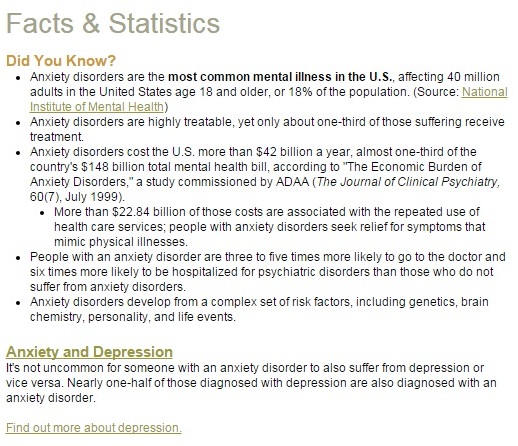


 [Note that fear/anxiety is associated with almost every mental illness that there is.]
I have come to believe that helping people with the deepest needs of life begins with a biblically accurate view of justification and its relationship to sanctification. This is where it begins, let’s go to the phones.

 Paul's Passing Thoughts
leave a comment