Here We Go Again: The New Calvinist Takeover of Southwood Presbyterian Church; Part 1
 “This issue couldn’t be clearer; there are two gospels among us, and New Calvinist David Powlison plainly said so accordingly. He even admitted that the notable Jay Adams doesn’t agree with his gospel. This should incite serious questions among God’s people….Southwood must choose their gospel and stand for it. What else is there?”
It plays out daily in the American church from coast to coast:
Therefore, the pattern is the same: new pastors assume leadership in a church that doesn’t know what New Calvinism is, and the church takes it for granted that their theology is orthodox. Then once in, they replace present leadership with those of like mind, and begin to make vast and rapid changes because they see that church as a bastion of falsehood that has sent many to hell. Then, dissenters are mercilessly mowed down and muzzled, usually via church discipline. In most cases, the dissenters don’t have a full understanding of what they are dealing with, they just know something isn’t right (The Truth About New Calvinism [TTANC] p. 134).
I don’t know any inside details concerning the present controversy at Southwood Presbyterian Church in Huntsville, Alabama. Some or all of the elements cited above from TTANC might be evident, but one thing is clear: a New Calvinist “pastor” recently assumed leadership, and the congregation has realized that he isn’t what he seemed to be. Less than a year after assuming leadership, we read the following on their website:
November 17, 2011
To the members & friends of Southwood Presbyterian Church,
Last evening the Session of Southwood Presbyterian Church met again to consider the matters before the church. After much prayer from both the members of the Session and members of the congregation the Lord provided a decision with no dissension or abstention. The UNANIMOUS motion reads as follows:
“With repentance and conviction over our own personal and corporate sin, particularly for having stirred dissension with a premature motion delivered after Monday night’s meeting, the Session has met and deliberated further on the issues before our church. Having considered the breadth of the situation and our unified desire for the peace and purity of the church, the Session does hereby revise the purpose of the called congregational meeting to begin addressing the myriad of issues brought before us, including Jean F. Larroux, III, but we are not recommending the dissolution of the pastoral relationship with him at this meeting. Furthermore, we are in need of, thankful for and desirous to have further prayer from the congregation in all our deliberations. Submitted by Bob Greenman, Clerk.”
The Session will meet again on Monday evening, November 21st and greatly desires your prayers and support for a continued spirit of unity and peace as we begin to make plans for addressing the myriad of issues before us. The called congregational meeting will be held on Sunday, December 4, 2011, in the sanctuary of Southwood Presbyterian Church commencing at 12:30pm.
God is at work. His Spirit is moving to bring forgiveness and healing. I personally urge you to work toward, pray for and labor after unity, charity and peace. Let your love be known among all men.
Yours and His,
Jean F. Larroux, III
Larroux is the pastor in question. A perusal of their website confirms that he is the epitome of New Calvinism. When the congregation brought him in to assume leadership, did they know what a New Calvinist is? No. Did Larroux know what a New Calvinist is? Yes. Did he know the congregation didn’t know what a New Calvinist is? Yes. Could I be wrong about these assumptions? I doubt it.
What Does Jean F. Larroux, III Represent?
So what’s a New Calvinist? As we shall see, they are legends in their own minds. The movement originated in 1970 when a Seventh-day Adventist named Robert Brinsmead met an Anglican theologian named Geoffrey Paxton in Australia. Brinsmead was attempting to reform Adventism through his studies in Reformed doctrine. Together, they formed a theological think tank named the Australian Forum project. They were later joined by Graeme Goldsworthy who wrote the Goldsworthy Trilogy which is presently the New Calvinist standard for Bible interpretation (TTANC chapters 3 and 4).
The Forum’s magazine became the most widely publicized theological journal among English speaking people (one edition had over one million copies printed), and caught the attention of a Westminster graduate by the name of Jon Zens in the early 70’s. He joined the Forum’s efforts to formulate their central doctrine into a consistent systematic theology. Their primary doctrine that was the hub of everything they taught was called the centrality of the objective gospel (COG). The doctrine fused justification and sanctification together into a progressive justification that replaced sanctification. Zens helped to form a systematic theology that would attempt to make the issues of law and covenants fit with COG doctrine. Today, that doctrine is known as New Covenant Theology (TTANC chapter 5).
The Forum had vast influence at Westminster Seminary during the 70’s and early 80’s. A professor there by the name of Dr. John Miller adapted COG into a doctrine that emphasized more of a counseling model. He dubbed it “Sonship Theology.” His understudies were Tim Keller and David Powlison. Powlison used Sonship/COG to mold his Dynamics of Biblical Change which is the counseling model for Westminster’s CCEF. Two of Powlison’s understudies, Paul David Tripp and Timothy Lane, articulated the doctrine in How People Change, published by Punch Press in 2006. The book fits the Forum’s COG doctrine to a “T.” Donn Arms (M.Div.) of INS recently wrote an unfavorable review of the book and pointed out its disturbing elements.
However, the doctrine experienced a heavy pushback among Presbyterians in 1996-1999, so the Sonship name was dropped and replaced with “Gospel Transformation.” Jay Adams, who wrote a book in contention against the doctrine when it was known as Sonship, thought the doctrine had faded away. Under its stealth era between 2000 and 2008, the movement’s growth exploded. In 2004, a small group of protestants which included Jay Adams dubbed the movement “Gospel Sanctification.” Jay Adams has a GS archives on his blog and has written against it extensively. In 2008, the movement stumbled; it accepted the label “New Calvinism” which was coined by journalist Collin Hansen. New Calvinism is: COG, NCT, GS, and Sonship. It’s all the same doctrine
Visions of Grandeur
As stated in TTANC:
And New Calvinists are no exception, starting with their primary deception that must necessarily lead to arrogance. They believe they are a new Reformation and have the true gospel, and evangelicalism at large has been propagating a false gospel for the past 100 years. This line of thought and the specific differences in the two gospels can be seen in the following statement by New Calvinist Tullian Tchividjian:
“As I’ve said before, I once assumed (along with the vast majority of professing Christians) that the gospel was simply what non-Christians must believe in order to be saved, while afterward we advance to deeper theological waters. But I’ve come to realize that ‘the gospel isn’t the first step in a stairway of truths, but more like the hub in a wheel of truth.’ As Tim Keller explains it, the gospel isn’t simply the ABCs of Christianity, but the A-through-Z. The gospel doesn’t just ignite the Christian life; it’s the fuel that keeps Christians going every day. Once God rescues sinners, his plan isn’t to steer them beyond the gospel, but to move them more deeply into it. After all, the only antidote to sin is the gospel—and since Christians remain sinners even after they’re converted, the gospel must be the medicine a Christian takes every day. Since we never leave off sinning, we can never leave the gospel.”
Notice that Tchividjian refers to the other camp as the “vast majority” of other Christians who don’t believe in New Calvinism’s sanctification by justification gospel. The Major themes of a New Calvinist biannual convention, Together for the Gospel (T4G) have been “the unadjusted gospel” and “the underestimated gospel.” A popular phrase among them in the blogsphere has been the “scandalous gospel.” Regarding the thesis of this book, their gospel makes much of God and little of Man by reducing our role in God’s work to the least common denominator, but they have done that so well, that much is being made of the men who have done such a good job of making much of God. The four men who founded T4G, a Presbyterian, two Southern Baptists, and a Charismatic, have been dubbed the “core four” and have a cult following that approaches creepiness.
This whole Reformation motif was started by the Forum which taught that all doctrines either fall into the objective gospel or subjective experience. Subjective spirituality was supposedly spawned by Rome and resulted in a reversal of justification and sanctification. Therefore, the Reformers rediscovered the objective gospel which ignited the Reformation, and also taught that the job wasn’t done (semper reformanda), and you can imagine who contemporary New Calvinists think that duty has fallen to. This is all covered in chapter four along with documentation concerning the fact that John Piper, one of the “elder statesmen” of the New Calvinist movement agrees with that scenario. This us against them mentality was passed down from the Forum and blossoms in the movement to this very day. They are the children of the Reformers—we are Rome.
And this arrogance translates into a predominant characteristic of New Calvinism: heavy-handed leadership style. As far as New Calvinists are concerned, evangelicals have been leading people into hell for the past 100 years (their estimation of when semper reformanda was lost) and any interference with the “unadjusted gospel” will be dealt with—no holds barred. The weapon of choice is church discipline (pages 130, 131).
The Two Gospels of Our Day
There are two gospels afoot in our day, and those doctrines can be defined by the contention between two notable men:
The crux of the matter can be further ascertained from Powlison’s message at Piper’s church as mentioned before:
“ This might be quite a controversy, but I think it’s worth putting in. Adams had a tendency to make the cross be for conversion. And the Holy Spirit was for sanctification. And actually even came out and attacked my mentor, Jack Miller, my pastor that I’ve been speaking of through the day, for saying that Christians should preach the gospel to themselves. I think Jay was wrong on that.”
At the core of a longstanding contention between Jay Adams and the CCEF clan, and later NANC also because of CCEF influence, was disagreement on the gospel. The distinction cannot be clearer—Adams believes that the gospel is for salvation, and then we move on in making disciples by teaching them to observe the whole counsel of God. Powlison, according to Westminster’s version of the Forum’s centrality of the objective gospel which is Sonship Theology, believes the same gospel that saved us also sanctifies us. Powlison also mentioned the phrase that Miller coined that is the motto of contemporary New Calvinism: We must preach the gospel to ourselves every day (TTANC pages 81, 82).
What’s at Stake?
The truth and many other issues are at stake here, but one of the major concerns is the fact that New Calvinism has a tendency to create cult-like churches:
All this leads to many New Calvinist churches taking on cult-like tendencies. Exclusiveness (new Reformation), an attitude that some higher knowledge is a part of the movement that many are not “ready” for (the scandalous gospel), and a subjective view of Scripture (a gospel narrative, not instruction) is a mixture that will have bad results, and is the perfect formula for a cult-like church (TTANC p. 134).
And endnote 104:
Many New Calvinist churches fit all eight descriptive points published by cultwatch.com: 1. Deception 2. Exclusiveness 3. Intimidation 4. Love Bombing 5. Relationship Control 6. Information Control 7. Reporting Structure 8. Time Control (p. 145).
And Larroux is no exception. The Southwood website and blog is saturated with examples of how New Calvinists control parishioners with their doctrines of deep repentance and the total depravity of the saints. Donn Arms addresses these doctrines in some detail in his book review of How People Change. Frankly, Larroux’s writings on this site are so saturated with this doctrine—I don’t even know where to start. That’s why this post will be a series until their December meeting.
Unlike Coral Ridge, perhaps Southwood parishioners can at least know the details of why they are being ravaged rather than being led to the slaughter like oxen. I can at least do that for them. One can toss a dart onto the Southwood website and nail verbiage by Larroux that is designed to control and manipulate—it’s everywhere, whether putting God’s stamp of approval on everything he does or this: “Would you trust him to determine whether or not you were in sin EVEN IF you didn’t think you were?” Notice that the authority here is what an elder or someone else sees in your life and not Scripture. Sonshippers call this “speaking life into you,” a phrase that I saw being used on the site at least once by Larroux. I also noticed that those who questioned Larroux’s fitness to lead Southwood are the ones who are now repenting. This is typical. I warn the Southwood parishioners, I know of New Calvinist congregations that will barley even buy new cloths without consulting with the elders first.
Southwood Must Choose a Gospel and Contend for It
It is evident, based on what I have read on their blog, that Larroux is controlling the agenda in this situation:
God is at work. His Spirit is moving to bring forgiveness and healing. I personally urge you to work toward, pray for and labor after unity, charity and peace. Let your love be known among all men.
Oh really? Per the usual, New Calvinist “pastors” have a direct line to God’s throne. Southwood better wise-up, this isn’t a time for peace and unity at Southwood, this is a time to earnestly contend for the faith once delivered to the saints. This is like one of the seven letters; if anything, Christ has something against Southwood because they are tolerating false doctrine.
This issue couldn’t be clearer; there are two gospels among us, and New Calvinist David Powlison plainly said so accordingly. He even admitted that the notable Jay Adams doesn’t agree with his gospel. This should incite serious questions among God’s people. Between Jean F. Larroux, III and Jay Adams, I can tell you where I would put my money; that’s a no-brainer. Southwood must choose their gospel and stand for it. What else is there?
paul
Ouch! David Cloud on John Piper
John Piper and Christian Hedonism Part 2
Sep/18/11 17:12 Filed in: Doctrine
A KEY TO SANCTIFICATION?
In contrast to Piper’s idea that there is one “key” to sanctification, the Bible presents a multiple approach.
The following critique by Peter Masters identifies this error:
“Christian Hedonism says that the pursuit of happiness in God is the overruling source of power and energy for the life of the Christian. … delighting in God is the pivotal issue in the Christian walk; the central and most important part of the life of faith. … Delighting in God is made the organising principle for every other spiritual experience and duty. It becomes the key formula for all spiritual vigour and development. Every other Christian duty is thought to depend on how well we obey this central duty of delighting in the Lord. The entire Christian life is simplified to rest upon a single quest, which is bound to distort one’s perception of the Christian life and how it must be lived.
“[Piper’s attempt] to oversimplify biblical sanctification is doomed to failure because the biblical method for sanctification and spiritual advance consists of a number of strands or pathways of action, and all must receive individual attention. As soon as you substitute a single big idea or organising principle, and bundle all the strands into one, you alter God’s design and method. Vital aspects of Truth and conduct will go by the board to receive little or no attention. …
“You cannot reorganise the Lord’s way of accomplishing the fruits of godliness without many duties being swept out of view. Single-principle systems do not intend to cause harm, but, inevitably, they do. To borrow a piece of modern scientific jargon, biblical sanctification is a system of irreducible complexity. Not that it is too complicated–having only seven or eight well-known component virtues which must all be kept to the fore in ministry” (Peter Masters, “Christian Hedonism – Is It Right? Sword & Trowel, 2002, No. 3).
There are indeed many aspects to spiritual victory and neither Christ nor the writers of the New Testament epistles ever present it as any one thing.
If there were any one “key,” we can be sure that Christ would have described it.
Perhaps the closest He comes to such a thing is John 15, where the “key” would be abiding in Him, but this is not offered as the sum of the Christian life or the one overarching key.
As for the apostles, if there were any one “key,” we can be sure that they would have described it in precise and clear terms to the oft-struggling first century churches and they would have emphasized it in the Pastoral Epistles to the preachers who were in the midst of the battle. But we look in vain for a presentation of Christian Hedonism or any other “key.”
Consider examples from Peter and from Paul:
2 Peter 1
Here Peter summarizes the way of spiritual victory and eternal fruit, and he mentions many elements. There is the trusting of the precious promises of God (v. 4). There is the diligent pursuit of spiritual growth by building on the foundation of faith to add virtue, knowledge, temperance, patience, godliness, brotherly kindness, and charity (vv. 5-7). There is the abounding in these things (v. 8). By these means Peter assures us that we will make our calling and election sure and an entrance will be ministered unto us abundantly into the everlasting kingdom of Christ (vv. 10-11).
Ephesians 4-6
In Ephesians 1-3 Paul lays out the doctrinal foundation of the Christian life. He describes the believer’s eternal and unchanging position in Christ. In Ephesians 4-6 he turns to Christian living in this present world. There is no one “secret,” no one “key” or “essence.” Rather, Paul lays out many elements of spiritual victory and fruitfulness. We are to walk worthy of our calling (4:1), forbear one another in love (4:2), and endeavor to keep the unity of the Spirit (4:3). There is the necessity of submitting to the ministry-gifted men God has given to the churches for nurturing and protection (Eph. 4:11-16). We are to cease walking according to the way of the unsaved, to put off the old man and his ways and put on the new man (Eph. 4:17 – 5:15). We are to walk circumspectly (Eph. 5:15), to redeem the time (Eph. 5:16), to understand God’s will (Eph. 5:17), to be filled with the Spirit (Eph. 5:18), to sing Psalms and give thanks (Eph. 5:19-20), to submit ourselves one to another in the fear of God (Eph. 5:21). Wives are to submit to their husbands and husbands are to love their wives (Eph. 5:22-33). Children are to obey their parents and fathers are to bring up their children in the nurture and admonition of the Lord and servants are to be obedient to their masters and masters are to forbear threatening (Eph. 6:1-9). We are to put on the whole armor of God and thereby stand against the wiles of the devil (Eph. 6:10-20).
We could look at the epistles of Romans, Galatians, Corinthians, James, 1 John, and we would find the same thing. Nowhere do we find one fundamental essence of Christian living. Instead, there are many elements of victory, many spiritual and moral responsibilities.
Romans 6-8
The theme of this passage is sanctification, and Paul describes many different things that are necessary for Christian growth and victory. We are to reckon ourselves dead with Christ and alive unto God (Rom. 6:11). We are to refuse to yield our bodies to unrighteous, but we are to yield our bodies to righteousness (Rom. 6:13). We are to walk after the Spirit rather than the flesh (Rom. 8:4). We are to mortify the works of the flesh by the Spirit (Rom. 8:13).
It’s true that Jesus summarized the whole Law into two principles:
“Jesus said unto him, Thou shalt love the Lord thy God with all thy heart, and with all thy soul, and with all thy mind. This is the first and great commandment. And the second is like unto it, Thou shalt love thy neighbour as thyself. On these two commandments hang all the law and the prophets” (Matthew 22:37-40).
But this is the essence of the Law of Moses, not the essence of victorious Christian living. The Law is the schoolmaster to lead men to the Gospel, but the Law is not the Gospel (Galatians 3:24). The Law is death to the sinner because it demands perfection, but the Gospel is life because Christ is our Perfection. For the essence of victorious Christian living we must look to the New Testament epistles, and when we do we never see a statement of Christian Hedonism held forth as an important key.
There are also many right motives for the service of the Lord, not just the one that Piper develops, which is to joy in God. That is indeed a great and high motive, but if it were the essence and sum of proper Christian living, the New Testament would not speak of so many other proper motives. Piper says it should not be “duty for duty’s sake, or right for right’s sake” (Desiring God, Kindle location 2134), but he is wrong. It is legitimate before God to serve Him at times just for the sake of duty and right. Sometimes that’s all we are left with while living in this sin-drenched world in a “body of death,” and it is not an illegitimate motive.
Sometimes I have my daily devotions with God and His Word out of a sense of great passion for Christ; sometimes I just do it because I know it is necessary for spiritual victory and protection from the devil; sometimes I just do because I know I should. None of these are wrong motives.
For example, in 2 Corinthians 8-9, Paul urges the believers to contribute to an offering for the needy saints who were in the throes of a famine. If Piper was right and if the pursuit of joy in God was the essence of proper Christian motivation, Paul would indicate this, but he doesn’t. Instead, he offers several different motives that would please God. In giving, we are to give ourselves to the Lord (2 Cor. 8:5). We are to minister to the needs of needy saints (2 Cor. 8:4). We are to work out the grace of God (2 Cor. 8:7). We are to prove the sincerity of our love (2 Cor. 8:8, 24). We are to follow Christ’s example (2 Cor. 8:9). We are to seek an equality (2 Cor. 8:13-15). We are to encourage the hearts of Christian leaders (2 Cor. 8:24; 9:3-4). We are to sow in expectation of a reward (2 Cor. 9:6-10).
PRESUMPTION IN EXEGESIS
Piper displays a frightful presumption in his exegesis.
Consider his statement, “The chief end of God is to glorify God and to enjoy himself forever.”
Piper is claiming that God is a Hedonist in His own right! His first proof for this is Psalm 115:3. “But our God is in the heavens: he hath done whatsoever he hath pleased.”
Piper says, “The implication of this text is that God has the right and power to do whatever makes him happy.”
But the verse says nothing about God’s happiness. Piper shoehorns that into the verse from his preconceived doctrine. It is presumption.
Piper then says:
“Think about it for a moment. If God is sovereign and can do anything he pleases, then none of his purposes can be frustrated. … and if none of his purposes can be frustrated then he must be the happiest of all beings.”
I don’t doubt that God is a happy being, but that is neither here nor there. The passages that Piper cites as evidence for his “God is a Hedonist” doctrine prove no such thing.
He then says:
“The foundation of the happiness of God is the sovereignty of God … If so much hangs on God’s sovereignty, we should make sure the biblical basis for it is secure.”
He then goes on to demonstrate from Scripture that God is sovereign, but by so doing he proves nothing about his doctrine of divine Hedonism. This is a bait and switch tactic.
Nowhere in Scripture are we taught that “The chief end of God is to glorify God and to enjoy himself forever.” It might be true; it might not be true, but we cannot make a doctrine of it because it is not supported by divine Revelation, and Piper’s use of Scripture to prove it is frightfully presumptuous.
Thus, the foundational error of Christian Hedonism is simply that it is not solidly established upon a a Bible foundation, and this is certainly enough to reject it.
For those wanting to establish their Christian lives upon a solid foundation of truth I recommend the apostolic epistles; I do not recommend John Piper’s books.
MISREPRESENTING THE PURITANS AND OLD PROTESTANTS
For proof of Christian Hedonism, Piper cites Jonathan Edwards, the Westminster Confession, and the Heidelberg Catechism.
He even claims that the “entire Heidelberg Catechism is structured the way Christian Hedonism would structure it.”
He juxtapositions his statements with quotes from Jonathan Edwards, but he takes Edwards out the of context of his overall preaching just as he does the Bible.
In fact, the Puritans would have sharply reproved him and his broader Christian rock, charismatic, emerging associations. For Piper to place himself in the lineage of the old Protestants is not only wrong; it is ridiculous; his soft, hedonistic approach is definitely a new type of Protestantism.
Peter Masters, who occupies the actual pastorate of that old-time Calvinist Charles Spurgeon and who does stand in the place of the old Protestants, reproves Piper and his Christian Hedonism.
“At times in his books Dr. Piper wants us to see this as an old idea, but his claims are not convincing. It does tend to look no older than C.S. Lewis. … Dr. Piper often quotes Jonathan Edwards, who said much about delighting in God and Christian joy. By reference to Jonathan Edwards, Dr. Piper effectively says, look, this is as old as the hills. This is the way our forebears thought. Certainly Jonathan Edwards provides choice passages about delighting in God as did the English Puritan writers, BUT AT NO TIME DOES HE FRAME A SYSTEM IN WHICH THIS BECOMES THE KEY PRINCIPLE OF CHRISTIAN LIVING. JOY IN GOD ALWAYS SITS ALONGSIDE OTHER EQUAL DUTIES.
“Although Dr. Piper seeks to root his system in the past, he seems at the same time well aware that it is a brand new idea. Frequently, he virtually admits it by using the language of innovation, and saying, in so many words, This is explosive; this is stunning; this is radical; this is dangerous. He even uses the term ‘my vision,’ and that is what it is, for however well intended, it is Dr. Piper’s personal vision. He also calls it ‘my theology.’ Dr. Piper’s publisher calls his book a paradigm-shattering work” (Peter Masters, “Christian Hedonism – Is It Right?” Sword & Trowel, 2002, No. 3).
COMPLICATED THEOLOGY
There is infinite depth to the Scripture, because it is the eternal Word of God, but there is also a practical simplicity to Bible truth, because it is geared to the weak and poor of this present world, whom God has chosen rich in faith (Matthew 11:25; 1 Corinthians 1:26-27; James 2:5).
The apostle Paul warned that it is the devil who corrupts the simplicity that is in Christ (2 Corinthians 11:3).
Piper admits that his doctrine is not simple.
“I know this is perplexing at first glance so I will try to take it apart piece by piece then put it back together.”
“… fresh ways of looking at the world … do not lend themselves to simple definitions. A whole book is needed so people can begin to catch on.”
“This is a subtle thing.”
Consider the following statement, which is very typical:
“In other words, yes, love is more that feelings; but, no love is not less than feelings.”
What does that mean, exactly? Who knows? It is too complicated, too obtuse, too easily misunderstood. Piper even admits, “This is liable to be misunderstood.” Indeed, it is, and that is because it is not the simplicity of sound Bible truth.
After having studied (not merely read) two of Piper’s major books on Christian Hedonism and still having difficulty putting his theology into simple terms, and I have a suspicion that he would say that I haven’t gotten it right.
I say, though, that if a theology is so complicated and convoluted that it cannot be understood properly by a reasonably intelligent preacher even after hours of study, then it is not Scriptural.
I have been preaching the gospel and discipling believers in Christian living for nearly 40 years, and the doctrines of salvation and sanctification that I hold from God’s Word can be taught to hillbillies in the hills of Tennessee where I began my preaching career and to the members of our churches in Nepal, many of whom are illiterate.
PSYCHOHERESY
Piper is at least dabbling in psychoheresy, which is the infiltration of the principles of humanistic psychology into the churches through the Christian counseling movement.
For example, he treats sin as “disease.”
“Affluent America has virtually invented a whole new set of diseases: obesity, arteriosclerosis, heart disease, strokes, lung cancer, venereal disease, cirrhosis of the liver, drug addiction, alcoholism, divorce, battered children, suicide, murder” (Desiring God, location 3633).
Drug addiction, alcoholism, child abuse, divorce, suicide, and murder are not diseases!
The influence of psychoheresy is also evident in his exhortation that the husband “submit to your wife’s deep desires” (Desiring God, location 3951). The husband is to love his wife, but to submit to her deep desires is a recipe for frustration and confusion.
Considering the extent to which psychoheresy has permeated evangelicalism and Piper’s rejection of “separatism,” I have no doubt that this theme will be evident in his other writings.
For more about this see Dr. E.S. Williams’ important books Christ or Therapy? and The Dark Side of Christian Counselling. Williams is a medical doctor and a member of the Metropolitan Tabernacle in London, England.
CATHOLIC-CHARISMATIC MYSTICISM
Piper mentions Catholic mystic Bernard of Clairvaux and charismatic mystic Graham Kendrick and says the mystics are the most “God-besotted people in the world” (Desiring God, Kindle location 1815-1826).
This is a powerful and deeply wrong-headed recommendation of mysticism.
While Piper gives an uncertain sound in the matter of contemplative prayer (hinting, for example, in a blog dated May 22, 2010, that Roman Catholic mysticism might be wrong), the fact remains that he recommends Bernard of Clarivaux, who is a Roman Catholic saint and a rabid heretic. Bernard authored the book Homilies in Praise of the Virgin Mother, calling Mary the Queen of Heaven, the Star, the ladder on which sinners may climb to God, the royal road to God, the channel through whom divine life flows to the whole creation.
“Bernard played the leading role in the development of the Virgin cult, which is one of the most important manifestations of the popular piety of the twelfth century” (Norman Cantor, The Civilization of the Middle Ages, 1993, p. 341).
Bernard was a fierce opponent of the Bible believers who refused to submit to the pope, persecuting them in southern France. These separatist Christians were called Petrobrusians and Henricians after the name of two of their leaders, Peter of Bruys (Peter de Bruis) and Henry of Lausanne. Peter was arrested, brutally imprisoned, and burned at the stake in 1126 during Bernard’s lifetime. Henry of Lausanne was arrested in 1134 and condemned to imprisonment in Bernard’s monastery at Clairvaux.
Piper would have us believe that “Saint” Bernard was a “God-besotted person.” It is more likely that he was demon possessed.
Piper also recommends Graham Kendrick as a “God-besotted” mystic. Kendrick is a charismatic Christian rocker of the most radical sort and promotes the heretical “kingdom now” theology and Word faith doctrines. He is a member of the Ichthus Christian Fellowship and welcomed the so-called Toronto Blessing with its spirit slaying, hysterical laughing, barking, braying, rolling. Graham claims that he was “baptized with the Holy Spirit” in 1971 after attending a charismatic meeting. He says, “It was later that night when I was cleaning my teeth ready to go to bed that I was filled with the Holy Spirit! … and I remember lying at last in my bed, the fixed grin still on my face, praising and thanking God, and gingerly trying out a new spiritual language that had presented itself to my tongue with no regard at all for the objections thrown up by my incredulous brain! … That was a real watershed in my Christian experience” (Nigel Smyth, “What Are We All Singing About?” http://www.freedomministries.org.uk/ccm/nsmyth1.shtml). This “new spiritual language” was meaningless gibberish and nothing like the miraculous tongue-languages of the apostolic age.
One of Kendrick’s objectives is to break down denominational barriers and create the broadest ecumenical unity. He was the co-founder of March for Jesus, which has brought together every type of denomination and cult including Roman Catholic and Mormon. A biography at Kendrick’s web site boasts: “Crossing international and denominational barriers, his songs, like the popular ‘Shine Jesus Shine,’ have been used from countless small church events to major festivals–including Promise Keeper rallies, Billy Graham crusades and a four million-strong open air mass in the Philippines capital Manila, where the Pope ‘swung his cane in time to the music.’”
Few things are more spiritually dangerous today than charismatic mysticism, yet Piper recommends one of its chief proponents as a “God-besotted” individual his readers should emulate.
Again, John Piper’s Christian Hedonism has not given him even fundamental spiritual discernment when it comes to the heresies of our day.
MEDDLING WITH THINGS TOO HIGH
Piper tries to answer questions not answered clearly in the Bible and seeks to create a systemic theology with those answers.
For example, how can God be sovereign and not be the author of sin? How can God be grieved at sin and not be frustrated at what men do?
The attempt to answer such things is a foundational error of Calvinistic theology.
Consider some of Piper’s statements:
“What we have seen so far is that God is absolutely sovereign over the world and he can do anything he pleases, and he therefore is not a frustrated God, but a deeply happy God.”
Piper goes beyond what the Bible teaches about God’s sovereignty and adds his own human thinking, which is exceedingly dangerous.
“Why is it that contemplating the mosaic of redemptive history delights the heart of God? Is this not idolatry–for God to delight in something other than Himself? … So now we must ask what does make God happy? … If we could discover what one thing God pursues in everything he does, we would know what delights him most. … My own conclusion is that God’s glory is uppermost in his own affections. … He delights in his glory above all things… God’s ultimate goal is to preserve and display His infinite and awesome greatness and wroth, that is, His glory. God has many other goals in what He does. But none of them is more ultimate than this. They are all subordinate. God’s overwhelming passion is to exalt the value of His glory. … He loves His glory infinitely. … God would be unrighteous (just as we would) if He valued anything more than what is supremely valuable. But He Himself is supremely valuable. If He did not take infinite delight in the worth of His own glory, He would be unrighteous. … Within the triune Godhead (Father, Son, and Holy Spirit), God has been uppermost in His own affections for all eternity. … God loves to behold His glory reflected in His works. … People do not like to hear that God is uppermost in His own affections” (Kindle location, 589-614, 628, 672).
This is human reasoning. It is presumptuous. It is meddling in things much too high for man and things not clearly revealed in Scripture.
I would advise John Piper and anyone considering his theology to heed Deuteronomy 29:29:
“The secret things belong unto the LORD our God: but those things which are revealed belong unto us and to our children for ever, that we may do all the words of this law.”
AN OVER-EMPHASIS ON EMOTIONS IN WORSHIP
Piper’s emphasis on emotions in worship is extremely dangerous and plays into the hands of the contemporary worship movement and its charismatic mysticism.
“Worship is authentic when affections for God arise in the heart as an end in themselves” (Piper, Desiring God, Kindle location 1586).
“Worship is a way of gladly reflecting back to God the radiance of His worth. This cannot be done by mere acts of duty. It can only be done when spontaneous affections arise in the heart” (location 1586).
“The engagement of the heart in worship is the coming alive of the feelings and emotions and affections of the heart. Where feelings for God are dead worship is dead. True worship must include inward feelings that reflect the worth of God’s glory” (location 1498).
“It also becomes clear why it is not idolatrous or man-centered to say that our emotions are ends in themselves. It is not man-centered because the emotions of our worship are centered on God” (location 1630).
While we are opposed to dead, spiritually-lifeless worship, Piper’s emphasis on the emotions is dangerous because of the deception and inherent selfishness of the human heart. It is so easy to think that I am worshiping the true God when I am actually worshiping something else, even myself.
It is especially dangerous because of the emotion-manipulating power of modern worship music, which is designed to produce the very emotions that Piper encourages. It uses heavily syncopated dance rhythms, unresolving chords, repetitious lyrics, the rise and fall of the sound level, and other elements to manipulate emotions. True sacred music doesn’t do this. It fortifies the message of the lyrics, but it doesn’t overwhelm the lyrics. It feeds the mind more than the emotions, the heart more than the body.
Piper’s emphasis on emotions is wrong because the Bible teaches that true worship involves many elements including obedience for obedience’s sake and acts of obedience that involve pain and even deep sorrow.
Consider Abraham walking toward Mt. Moriah with Isaac. He had determined to offer his beloved son to God in obedience to the divine command, in one of the greatest acts of worship recorded in Scripture, but there is no evidence that the journey was characterized by happiness.
Consider Job sitting in an ash heap scrapping his sores with a piece of broken pottery in the deepest grief and confusion at the loss of his children and his fortune and station in life. When Job disregarded his wife’s counsel to curse God and instead bowed before his Creator and said, “the LORD gave, and the LORD hath taken away; blessed be the name of the LORD,” that was one of the greatest acts of worship ever recorded. Yet there is clear evidence that Job was not happy.
While the Bible sometimes mentions the emotions as an aspect of worship there is no emphasis on emotions as with Piper.
True Christian worship is not high emotion; it is living by faith in God’s Word.
“Therefore we are always confident, knowing that, whilst we are at home in the body, we are absent from the Lord: (For we walk by faith, NOT BY SIGHT)” (2 Corinthians 5:6-7).
“For we are saved by hope: but hope that is seen is not hope: for what a man seeth, why doth he yet hope for? But if we hope for that we see not, then do we with patience wait for it” (Romans 8:24-25).
“Now faith is the substance of things hoped for, the evidence of things not seen” (Hebrews 11:1).
George Muller nailed it when he said:
“Faith has nothing to do with feelings or with impressions, with improbabilities or with outward experiences. If we desire to couple such things with faith, then we are no longer resting on the Word of God, because faith needs nothing of the kind. Faith rests on the naked Word of God. When we take Him at His Word, the heart is at peace.”
Former contemporary worship leader Dan Lucarini, author of Why I Left the Contemporary Christian Music Movement, says, “When we try to feel an experience of affirmation from worship, we are not worshipping God; we are worshipping our own egos. The true heart of worship is the heart that bows before God and submits to his Word, no more and no less.”
With his emphasis on emotions, Piper plays right into the hands of the charismatic movement and doubtless encourages confusion in those wanting to worship God acceptably. I recall as a new believer coming out of a very licentious, drug-abusing lifestyle how depressed I still was. This confused me because I was visiting Pentecostal-charismatic churches and was being pressured to “be happy” and to worship God exuberantly. I tried, but it was an act. Then one day I read James 5:13.
“Is any among you afflicted? let him pray. Is any merry? let him sing psalms.”
I was so encouraged by this, because I saw that God didn’t require that I be happy if I wasn’t happy! James expected that the believers would represent different emotional conditions in any church service, and if a believer is afflicted, he is not told to be merry.
CONFUSION ABOUT SALVATION
1. Piper teaches the heresy that regeneration precedes faith.
“… when we hear the gospel, we will never respond positively unless God performs the miracle of regeneration. … We must first experience the regenerating work of the Holy Spirit. … John teaches most clearly that regeneration precedes and enables faith. … Faith is the effect of new birth, not the cause of it. … New birth comes first and enables the repentance and faith of conversion. Before new birth we are dead, and dead men don’t meet conditions. Regeneration is totally unconditional. It is owing solely to the free grace of God” (Desiring God, Kindle location 1007-1067).
This is based on human reasoning, which goes as follows: Men are dead in sins; therefore, they can’t believe and they can’t believe unless they are regenerated. On the other hand, while the Bible does teach that the unsaved are dead in trespasses and sins (Ephesians 2:1), it also says these men can believe. Nowhere does the Bible say that men are born again before they believe. Everywhere in the New Testament men are commanded to believe and salvation is said to follow faith.
The best proof text that Piper offers for this doctrine is a the very liberal New Revised Standard Version translation of 1 John 5:1 —
“Everyone who believes that Jesus is the Christ has been born of God” (Desiring God, location 1055).
Practically every other major version reads the same as the King James:
KJV – “Whosoever believeth that Jesus is the Christ is born of God…”
ASV – “Whosoever believeth that Jesus is the Christ is begotten of God…”
WEB – “Whoever believes that Jesus is the Christ is born of God…”
NIV – “Everyone who believes that Jesus is the Christ is born of God…”
NASV – “Whoever believes that Jesus is the Christ is born of God…”
But even if the NRSV’s translation of 1 John 5:1 was legitimate, it doesn’t say that regeneration precedes faith. One has to read that into the verse, and it is contrary to the teaching of many clear passages of Scripture, such as the following:
“But as many as received him, to them gave he power to become the sons of God, even to them that believe on his name” (John 1:12).
“For God so loved the world, that he gave his only begotten Son, that whosoever believeth in him should not perish, but have everlasting life. For God sent not his Son into the world to condemn the world; but that the world through him might be saved. He that believeth on him is not condemned: but he that believeth not is condemned already, because he hath not believed in the name of the only begotten Son of God” (John 3:16-18).
“And as they went on their way, they came unto a certain water: and the eunuch said, See, here is water; what doth hinder me to be baptized? And Philip said, If thou believest with all thine heart, thou mayest. And he answered and said, I believe that Jesus Christ is the Son of God” (Acts 8:36-37).
“To him give all the prophets witness, that through his name whosoever believeth in him shall receive remission of sins” (Acts 10:43).
“And brought them out, and said, Sirs, what must I do to be saved? And they said, Believe on the Lord Jesus Christ, and thou shalt be saved, and thy house” (Acts 16:30-31).
Had the apostle Paul held Piper’s doctrine, he would have answered the Philippian jailer’s question differently or he would have refused to have answered it at all, since there would be absolutely nothing a sinner could do to assure his salvation. He could only hope that he was elect and that God would regenerate him so that he could believe.
Consider some more verses that teach that faith is “the hand that reaches out to receive salvation” and that faith is not preceded by regeneration:
“For I am not ashamed of the gospel of Christ: for it is the power of God unto salvation to every one that believeth; to the Jew first, and also to the Greek” (Romans 1:16).
“But now the righteousness of God without the law is manifested, being witnessed by the law and the prophets; Even the righteousness of God which is by faith of Jesus Christ unto all and upon all them that believe: for there is no difference” (Romans 3:21-22).
“But what saith it? The word is nigh thee, even in thy mouth, and in thy heart: that is, the word of faith, which we preach; That if thou shalt confess with thy mouth the Lord Jesus, and shalt believe in thine heart that God hath raised him from the dead, thou shalt be saved. For with the heart man believeth unto righteousness; and with the mouth confession is made unto salvation. For the scripture saith, Whosoever believeth on him shall not be ashamed. For there is no difference between the Jew and the Greek: for the same Lord over all is rich unto all that call upon him. For whosoever shall call upon the name of the Lord shall be saved” (Romans 10:8-13).
“But to him that worketh not, but believeth on him that justifieth the ungodly, his faith is counted for righteousness” (Romans 4:5).
“Therefore being justified by faith, we have peace with God through our Lord Jesus Christ” (Romans 5:1).
“In whom ye also trusted, after that ye heard the word of truth, the gospel of your salvation: in whom also after that ye believed, ye were sealed with that holy Spirit of promise” (Ephesians 1:13).
Piper’s Calvinist idea that faith itself is a work is not based on Scripture, which says faith is the opposite of works (Ephesians 2:8-9). Faith is the hand that reaches out to accept the gift that God offers in Christ.
(For more on this see “The Calvinism Debate” at the Way of Life web site.)
2. Piper confuses sanctification and the pursuit of God with conversion.
“The pursuit of joy in God is not optional. It is not an ‘extra’ that a person might grow into after he comes to faith. It is not simply a way to ‘enhance’ your walk with the Lord. Until your heart has hit upon this pursuit, your ‘faith’ cannot please God. It is not saving faith. Saving faith is the confidence that if you sell all you have and forsake all sinful pleasures, the hidden treasure of holy joy will satisfy your deepest desires. Saving faith is the heartfelt conviction not only that Christ is reliable, but also that He is desirable” (Desiring God, location 1180).
Piper quotes Matthew 13:44 as support for this view of salvation.
“Again, the kingdom of heaven is like unto treasure hid in a field; the which when a man hath found, he hideth, and for joy thereof goeth and selleth all that he hath, and buyeth that field.”
Piper says: “This parable describes how someone is converted and brought into the kingdom of heaven. A person discovers a treasure and is impelled by joy to sell all that he has in order to have this treasure.” He says further, “Saving faith also receives Christ as our Treasure. A non-treasured Christ is a non-saving Christ. Faith has in it this element of valuing, embracing, prizing, relishing Christ. It is like a man who finds a treasure hidden in a field and ‘from joy’ sells all his treasures to have that field (Matthew 13:44)” (location 1543).
I realize that many commentators see this as a parable about salvation, but it makes no sense. If the parable refers to the sinner and salvation, then it is saying that salvation is achieved by works, which cannot be, and it would also be saying that salvation is hidden but it is not. It is proclaimed openly to every nation. No, the words are plain. The parable is not talking about the gospel; it is talking about the kingdom, which is an entirely different thing. Christ is the one who has sold everything for the establishment of the kingdom. This is clear from the parable of the pearls, which follows in Matthew 13:45-46.
To make a rather obscure parable a centerpiece of one’s theology about salvation, which is exactly what Piper does in Desiring God chapters 2 and 3, is another example of his misuse of Scripture.
INTO THE ARMS OF ECUMENISM, CHARISMATICISM, AND THE EMERGING CHURCH
Far from protecting Piper from evil, Christian Hedonism has led him into the arms of the ecumenical movement, the charismatic movement, and the emerging church.
Instead of reproving Billy and Franklin Graham and their ecumenical evangelism, he has praised them and speaks in forums with them.
For example, he was a speaker at the 2004 National Religious Broadcasters (NRB) conference in Charlotte, North Carolina, joining hands in that forum with Franklin Graham, James Dobson, Ted Haggard, and Pat Robertson, all of whom have a close relationship with the Roman Catholic Church. Graham follows in his father’s footsteps in turning converts over to the Catholic Church. Dobson has appeared on the cover of Catholic magazines and to our knowledge has never warned his many Catholic listeners to come out of Rome. Robertson wrote the foreword to A House United? Evangelicals and Catholics Together: A Winning Alliance for the 21st Century (NavPress, 1994). He praised Roman Catholic Keith Fournier for his “deep dedication to helping to heal the divide” that “separated the Body of Christ.” Three years earlier Robertson invited Fournier to be the executive director of the American Center for Law and Justice at Regent University. Haggard, who was then Senior Pastor of New Life Church in Colorado Springs and president of the National Association of Evangelicals, said in October 2005: “New Life doesn’t try to ‘convert’ Catholics” and “the church would never discourage its members from becoming Catholic or attending Catholic Mass” (The Berean Call, Jan. 2006). Three Roman Catholic organizations were active at the 2004 NRB conference. The Global Catholic Network ran an ad in the NRB newspaper each day and rented exhibit space. Priests for Life handed out packets of their material; and Catholic Answers, which promotes Roman Catholic dogma, also participated.
Dr. Ralph Colas, who wrote an eyewitness report of the meeting, concluded:
“This year some speakers, like John Piper, had more Bible content than is usually presented at NRB conventions. However, not one identified the apostates, Roman Catholicism as well as those who embrace extra-biblical revelations and dreams, as being a threat to the people of God. As it is so often at such new evangelical meetings, it is not necessarily what they say–but what they fail to say that creates the confusion and further compromise. The NRB continues to be a hodgepodge of believers and unbelievers, and its broad inclusivism reveals it fits exactly in the center of the new evangelical camp.”
Piper even supports the heretical charismatic spirit-slaying phenomena. He took his staff to a “Toronto-style” meeting and admitted that “a whole bunch of my staff went down” (“John Piper: Hedonist Theologian?” Faith and Freedom magazine, Dec. 2006).
Piper said: “I simply know of too many people’s lives who have been profoundly helped for good by lying on the ground for forty-five minutes in a kind of laughter or peace” (tape of Question and Answer Session at conference in Minneapolis, Jan. 31, 1996).
Piper also invited a Vineyard Church pastor to minister in a leadership training session and “he just knocked everybody off their seats.”
Perhaps the clearest evidence of Piper’s spiritual blindness is his close and non-critical relationship with Rick Warren, who is a case study in the emerging church. In April 2011, Piper conducted a Desiring God conference at Warren’s Saddleback Church. Piper is also scheduled to join Warren on the preaching docket at the annual Southern Baptist Pastor’s Conference in June 2011.
Warren preaches the heretical “judge not” philosophy; turns the church into a rock & roll entertainment center complete with pelvic thrusts; says God won’t ask about your doctrinal views; continually and approvingly quotes from heretics in his writings and preaching (such as Roman Catholic universalists Mother Teresa, Henri Nouwen, and Thomas Merton); promotes Catholic contemplative mysticism; likens Christian fundamentalists to Islamic terrorists; calls for unity between Baptists, Roman Catholics, Pentecostals, Anglicans, etc.; promotes the exceedingly liberal Baptist World Alliance; yokes together with New Age practitioners; says that believers should work with unbelievers and pagan religionists to build the kingdom of God; and presents Roman Catholic one-worlder Tony Blair with a peace prize (March 2011). For documentation see http://www.wayoflife.org/database/warrenheader.html
THE ATTRACTION FOR INDEPENDENT BAPTISTS?
What is the attraction of John Piper for fundamentalists and Independent Baptists?
Intellectualism
Piper has depth; he is a student, a thinker. His readers find themselves intellectually satisfied. They are given something of substance to think about. In light of the shallowness that tends to characterize much of the Independent Baptist movement, it is not surprising that many would be attracted to Piper’s intellectualism.
Exaltation of God
Instead of a man-centered theology, Piper’s theology is God-centered. This is why he comes down on the right side of the issue of hell. He understands the holiness and justice of God (Desiring God, Kindle location 949-963).
Cultural Liberalism
One reason why Piper is comfortable associating with men such as Mark Driscoll and Rick Warren is that he shares to some degree their belief in “cultural liberalism.” He believes in the freedom to dabble in the pop culture and seems to warn more against “judgmentalism” and “legalism” than against worldliness. His church is a rock & roll center. This loose principle is enticing to world lovers. As far as we know he doesn’t reprove Warren for his summer dance parties and nine rock & roll worship venues (including country line dancing and Island hulu) and for singing Jimi Hendrick’s drug-drenched song “Purple Haze” at a church function, and he doesn’t reprove Driscoll for his New Years Eve champaign dance parties and dance competitions.
A soft, more tolerant philosophy
Another thing that doubtless attracts some fundamentalists and Independent Baptists to Piper is his soft, more tolerant stance overall. This is reflected in the wide variety of people he approvingly quotes. It is reflected in his associations, in his way of Christian living. Even his warnings are typically framed in a gentle manner. He is definitely not a separatist. His warnings about the dangerous of the world are issued in generalities rather than specifics; they are issued more as suggestions than commandments.
The hour calls for a heavy emphasis on separation, both ecclesiastical and separation from the world, but John Piper is extremely quiet on both fronts.
THE ULTIMATE DANGER OF JOHN PIPER
Because of his careless associations, John Piper can lead you anywhere. He can lead you to Rick Warren and Mark Driscoll, and from there you can go in any direction in the treacherous waters of modern evangelicalism. You can encounter Roman Catholic contemplative mysticism, New Ager philosophy such as Leonard Sweet’s New Light, goddess worship as promoted in The Shack, the downgrade of hell, the downgrade of biblical inspiration, the denial of the substitutionary blood atonement of Christ, a kingdom-now gospel, theistic evolution, self-esteemism, and many other things.
John Piper and his renunciation of “separatism” is a bridge to these treacherous waters.
We have documented this great danger in the report “The Path from Independent Baptist to The Shack, Rome, and Beyond,” which is available at the Way of Life web site.
The Hostile Takeover of the SBC by “Aggressive Calvinism” Began in 1982
Addendum to Second Edition: The Truth About New Calvinism
Very well, if folks want to refer to the New Calvinists taking over the SBC as “aggressive Calvinism,” that will work; New Calvinists are very aggressive. The events going on in the SBC right now are a mirror image of Coral Ridge, Clearcreek Chapel, NANC, and many, many other examples. Some months prior, a Presbyterian pastor/acquaintance of mine warned a church that called him for references regarding a new pastor for their church; in essence, he told them, “there is a dangerous movement afoot and the proponents are very stealth in regard to what they really believe—be careful.” They didn’t listen. The tragic results are all too common. The present debate over the SBC name change is part of it, and Southern Baptists better win that symbolic battle in order to hold ground. There is hope; the Daviess-McLean Baptist Association recently took a stand against “aggressive Calvinism.” If the SBC survives, it will only be because others follow their example.
More hope: there are lots of folks in the SBC who do not like hyper-Calvinists who also concern real Calvinists. New Calvinism is hyper-Calvinism in both justification (salvation) and sanctification (plenary hyper-Calvinism). So if many Southern Baptists do not like hyper-Calvinism, they should dislike the double hyper-Calvinists even more who are in the process of taking over the convention, and seeking to wipe out the memory of the SBC they secretly despise. Yes, there is hope, but SBC protestants need to better identify the enemy. We need to get rid of the “aggressive [New] Calvinists” first, and then have discussion about the hypers and the standards later. Aggressive Calvinists threaten the very existence of the SBC. We have our problems, and we may even be on life support, but Dr. Kevorkian presiding over our condition is not the answer—neither do I think he should be able to plunder SBC resources before he pulls the plug.
The Difference Between the Old and the New
This is not difficult. One only needs to examine their mantras to know the difference between Old and New Calvinism. “The same gospel that saved you also sanctifies you.” “We must preach the gospel to ourselves every day.” “The gospel isn’t the entry point of Christianity, it is the A-Z of Christianity” [even though Christ referred to the gospel as an entry point to the kingdom, and the apostle Paul referred to the gospel as a “foundation”: 1Corinthians 3:10-15, Romans 15:20]. If we are sanctified by salvation, what does that say about what Aggressive [New] Calvinists believe about sanctification? All Christians, whether Calvinistic or otherwise, believe that salvation is by faith alone and not works. Theologians call this “monergistic.” However, we also believe that sanctification is “synergistic,” meaning that the new birth enables us to co-labor with God in the sanctification process as friends devoted to Him in the truest sense. In other words, our marvelous God has made a way to be reconciled to Him while also enabling us to participate in His work in a truly legitimate way despite our weakness. The Bible specifically refers to us as God’s co-laborers in 1Corinthians 3:9, 1Thessalonians 3:2, and 2 Corinthians 6:1.
But obviously, if we are sanctified by monergism, sanctification must also be monergistic (a work by God alone). And as indicated elsewhere in this book, this is critical because the law (Scripture) is a primary conduit used to participate in God’s work. If we cannot participate in sanctification, neither can we uphold God’s law in sanctification any more than we could in justification. This is the crux of the matter. The real issue is the church’s primary nemesis used by the kingdom of darkness throughout the ages: against every word that proceeds from the mouth of God. This is what theologians call “antinomianism,” and as discussed in chapter one, the Bible predicts that it will be the spirit of the last days. Christ and the apostles framed the last days in context of “anomia” (primarily, 2Thessalonians, chapter 2; Matthew 7:23, 13:41, 24:11,12; 2Corinthians 6:14; Titus 2:14). It’s the same type word, used in all of these cited verses regarding the spirit, fellowship, love, antichrist, and redemption of the last days, as our English word “atypical,” or “against/anti what is normal.” Old Calvinists do not believe in monergistic sanctification which necessarily makes us antinomians. And orthodox evangelicalism has never believed in sanctification by faith alone. The modern-day epitome of Old Calvinism, Dr. Peter Masters, stated the following:
The new Calvinism is not a resurgence but an entirely novel formula which strips the doctrine of its historic practice, and unites it with the world (The Merger of Calvinism with Worldliness from Sword & Trowel 2009, No. 1 by Dr Peter Masters).
And this by Calvinistic Baptist Donn Arms, M.Div.:
Justification is monergistic, sanctification is synergistic. Walking is what I do, not something Christ does for me (Institute for Nouthetic Studies blog: Archives; Gospel Sanctification, May 13, 2011 Gospel Sanctification comments section).
Despite their adamant denials concerning the above, the simplicity of the Aggressive Calvinist mantras will always betray them in regard to their lies. And as discussed elsewhere in this book, all of their massive doctrinal pontification is discussion on how to make an overly passive sanctification work with the blessed truth of our Lord and Savior. Our brother Jude called Him our “absolute ruler” (despotace) and “supreme commander” (kooreeos).
Thirdly, Old Calvinists, unlike the Aggressive Calvinists, do not believe in the fusion of justification and sanctification. Listen to what Old Calvinist Jay Adams (no pun intended) said about “Gospel Sanctification” (the name given to New Calvinism [Aggressive Calvinism] before it was realized they are the same thing):
The crux of the issue has to do with the unbiblical fusion of sanctification with justification. The latter is set forth not as “keeping” God’s commandments, but as bringing about change by concentrating on the cross. As one immerses himself in the cross of Christ, sanctifying growth occurs. The biblical truth is that we are to pursue fruit, which becomes a reality and the Spirit helps us grow in grace (Institute for Nouthetic Studies blog: Archives; Gospel Sanctification, May 9, 2011 by Jay Adams).
The fact that Aggressive Calvinism fuses justification and sanctification together can be seen clearly in their mantra-like anthems such as, “The same gospel that saves you also sanctifies you.” This completely distorts the orthodox view of justification which is a onetime declaration by God that His righteousness has been credited to our account in full. According to their own pithy truisms, justification continues and completes itself. That’s a huge problem. If justification is progressive (what they deceptively call “progressive sanctification”), we cannot be involved, except in whatever our involvement was concerning justification. Hence, “….because the believer’s role is reduced to a point that is not according to Scripture, he/she is deprived of the abundant life in a way God wants us to experience it for His glory and the arousing of curiosity from those who don’t have the hope of the gospel.” And, “….while reductionist theologies seek to reduce the believer’s role to the least common denominator, supposedly to make much of God and little of man, the elements that attempt to make it seem plausible are often complex and mutating. Therefore, instead of majoring on the application of what is learned from Scripture, believers are constantly clamoring about for some new angle that will give them a ‘deeper understanding’ of the gospel that saved them.”(p. 77, The Truth About New Calvinism).
Unless this doctrine is exposed and halted, it will leave the SBC in ruins.
New Covenant Theology Cannot be Separated from New Calvinism
It is important to note that New Calvinism entered into the SBC through Reformed Baptist circles. New Calvinism was conceived by the Australian Forum’s Centrality of the Objective Gospel (COG). The detailed history can be observed in the “History” section of The Truth About New Calvinism. Jon Zens, the father of New Covenant Theology (NCT), worked with the Forum to develop a systematic theology that would make COG plausible. Present Truth magazine was the Forum’s theological journal. Citing from volume 16, article 13, it is obvious that the Forum’s doctrine is exactly the same as present-day New Calvinism:
Unless sanctification is rooted in justification and constantly returns to justification, it cannot escape the poisonous miasma of subjectivism, moralism or Pharisaism…. Since the life of holiness is fueled and fired by justification by faith, sanctification must constantly return to justification. Otherwise, the Christian cannot possibly escape arriving at a new self-righteousness. We cannot reach a point in sanctification where our fellowship with God does not rest completely on forgiveness of sins…. Christian existence is gospel existence. Sanctification is justification in action (emphasis mine).
As noted in The Truth About New Calvinism, Robert Brinsmead, the principle figure of the Forum, was intimately involved with Zens and the development of New Covenant Theology before Zens coined the phrase in 1981 (chapter 5). Zens himself said that Robert Brinsmead wrote articles in the Baptist Reformed Review (BRR) that accomplished the following: “The dynamic N.T. approach to law and gospel was stated forcefully by RDB [Robert D. Brinsmead]….” (Id. pages 56,57). The BRR was the primary lightening rod in the law/gospel debate raging in Reformed Baptist circles at that time, and Robert Brinsmead was a contributing author at the behest of Jon Zens. Zens took the doctrine into Reformed Baptist circles, while the Forum was primarily responsible for spreading the doctrine in Presbyterian territory, especially Westminster Seminary. Also, according to Zens, Present Truth magazine was “….the largest English-speaking theological journal in the world at that time” (Id. p. 53).
Though COG/NCT took on different nuances, COG and NCT share the same basic tenets that make the primary doctrine unique. They share the same unique hermeneutic, the same emphasis on progressive justification, the centrality of the gospel, a historic Christocentricity to the understanding and meaning of all reality, the personification of the law, the indicative/imperative prism, so-called “experiential Calvinism,” a majority view of Supersessionism, and especially unorthodox dichotomies of law and gospel (to name a few). The differences come in regard to how law and gospel relate to each other in order to make the doctrine fit together with “truth” in the best possible way. But they all believe that the same gospel that saves us also sanctifies us. Both infuse justification and sanctification.
The recognition that NCT is integral to New Calvinism is grudging and aloof among proponents. For example, DA Carson vigorously supports NCT by his actions, but when cornered verbally, espouses things that sound like, “I was for it before I was against it.” And, “It depends on what the meaning of the word ‘is’ is.” A good example of this is an article by Jim Gunn entitled, A Critique of New Covenant Theology (online source: http://goo.gl/Pm9E9). The article is an apt specimen of how Carson and Tom Nettles vigorously support NCT, but refuse to acknowledge its validity in plain language. Other New Calvinist leaders openly acknowledge that the two are inseparable. One example is the elders of Clearcreek Chapel in Springboro, OH. They are a highly respected New Calvinist church regularly hosting notable teachers such as Paul David Tripp, Stuart Scott, Dr. Robert D. Jones, and Dr. Lou Priolo. While embracing gospel centrality, they consider it all to be under the auspices of NCT. This can be seen best in a series preached there by Dr. Dale Evans entitled, A Gospel-Centered Hermeneutic: Foundations for a New Covenant Theology. In his introduction, Evans stated:
Over the last several weeks, the pulpit ministry at Clearcreek Chapel has focused on presenting texts and issues related to the concept know[n] as New Covenant Theology. This morning we will look at a text and suggest that this idea under this label is exactly how the apostle Paul read and interpreted Scripture.
As a ministry that vigorously supports all the major tenets of New Calvinism such as Heart Theology, Redemptive Historical Hermeneutics, and Christian Hedonism, one of their pastors on staff, former radio personality Chad Bresson, is sometimes referred to as “the golden boy of central Ohio NCT.” He is also a member of the Earth Stove Society formed to promote NCT. On the other hand, he has a blog dedicated to the “Biblical Theology” of Geerhardus Vos, the father of Chrsitocentric Hermeneutics. He often posts articles by two former key figures of the Australian Forum on that same blog: Robert Brinsmead and Graeme Goldsworthy.
The Plot to Take over the SBC With COG
The plot to take over the SBC with the Forum doctrine was hatched in a hotel room in Euless, Texas on November 13, 1982:
Then, on November 13, 1982, [Ernest] Reisinger, Nettles and Malone met at a Holiday Inn in Euless, Texas, for prayer to seek God’s direction with respect to a Southern Baptist conference ministry. Nettles brought to the meeting several young men who had embraced the doctrines of grace. Among them were Bill and Tom Ascol, Ben Mitchell and evangelist R.F. Gates. Reisinger later called this one of the most meaningful prayer meetings in which he had ever participated. The attendees spent the first half of the day in prayer, reading Psalms and hymns. During the second half of the day, they discussed ideas. They finally settled on the idea of a conference with the doctrines of grace as its foundation. Thus began the Southern Baptist Founders Conference (Founders Ministries blog: The Beginnings of Reformation in The Southern Baptist Convention: The Rise of the Founders Movement).
Reisinger was a former Presbyterian turned Reformed Baptist, then Southern Baptist. He also knew Cornelius Van Til personally. Van Til, a Reformed Presbyterian with an inclination towards mysticism like his close friend Geerhardus Vos, attended Reisinger’s ordination in 1971. As far as the movement begun by Reisinger and others to restore the “doctrines of grace” to the SBC, another Presbyterian by the name of John H. Armstrong was apparently present at its conception and describes the movement as the beginnings of the “neo-Calvinism” movement in a review of Time magazine’s 2009 assessment of the New Calvinism movement:
I have watched this movement for neo-Calvinism from its infancy. I personally attended the first meeting (and several more the years following) of the group that started this effort back in the 1980s. I personally knew the founder who dreamed up the idea of recovering Calvinism in the SBC [Ernie Reisinger] and then spread the “doctrines of grace” very widely. He is now with the Lord [ie., five years prior in 2004]….I was also involved in the various “gospel” recovery groups which were begun, now creating large gatherings of folk who believe they are the people who are preaching and recovering the “biblical gospel” (John H. Armstrong blog: The New Calvinism, Archives; March 31, 2009).
The early eighties is when the combination of the Forum, their theological journal, and the push among Reformed Baptist by Jon Zens (with the help of Robert Brinsmead) began to rapidly expand. And the torch carried forth was the idea that the Forum had recovered the lost doctrines of grace. Armstrong makes that clear:
The sixteenth-century rediscovery of Paul’s objective message of justification by faith [and sanctification also because justification is supposedly progressive] came upon the religious scene of that time with a force and passion that totally altered the course of human history. It ignited the greatest reformation and revival known since Pentecost.
Now, if the Fathers of the early church, so nearly removed in time from Paul, lost touch with the Pauline message, how much more is this true in succeeding generations? The powerful truth of righteousness by faith needs to be restated plainly, and understood clearly, by every new generation.
In our time we are awash in a “Sea of Subjectivism,” as one magazine put it over twenty years ago. Let me explain. In 1972 a publication known as Present Truth published the results of a survey with a five-point questionnaire which dealt with the most basic issues between the medieval church and the Reformation. Polling showed 95 per cent of the “Jesus People” were decidedly medieval and anti-Reformation in their doctrinal thinking about the gospel. Among church-going Protestants they found ratings nearly as high.
Reading Scott Hahn’s testimony in his book, Rome Sweet Home (Ignatius Press, 1993), I discovered the same misunderstanding. Here can be found a complete and total failure to perceive the truths of grace, faith and the righteousness of God. No wonder Hahn left his Presbyterian Church of America ordination behind to become a Roman Catholic. He did not understand the gospel in the first place, as his own words demonstrate.
I do not believe that the importance of the doctrine of justification by faith can be overstated. We are once again in desperate need of recovery. Darkness has descended upon the evangelical world in North America and beyond, much as it had upon the established sixteenth-century church (The Highway blog: Article of the Month, Sola Fide: Does It Really Matter?; Dr. John H. Armstrong).
According to Armstrong: “We are once again in desperate need of recovery. Darkness has descended upon the evangelical world in North America and beyond, much as it had upon the established sixteenth-century church.” Apparently, light came “twenty years” prior to his writing of that post via the Forum’s Present Truth magazine. That was the mindset of the “Reformation” movement in the early eighties that is now New Calvinism. The details of this are expanded in chapter four of The Truth About New Calvinism.
A Proven Method
Reisinger was no stranger to how the formation of conferences could affect the taking over of Christian groups. He witnessed firsthand how this was done by Jon Zens in 1979:
At the fall Banner of Truth Conference in 1979, Ron McKinney spoke with lain Murray, Ernie Reisinger and others about the possibility of having a conference where some aspects of Reformed theology could be discussed and evaluated by men of differing viewpoints (Jon Zens: Law And Ministry In The Church: An Informal Essay On Some Historical Developments (1972-1984).
That conference ended up being the first “1980 Council on Baptist Theology” held in Plano, TX. It was the coming out party for New Covenant Theology, and eventually resulted in the formation of a denomination that split a large group of Reformed Baptists. Two years later, Reisinger would be leading the way for the same kind of “revival.” From the beginning, NCT/COG came forth from the womb with visions of grandeur, splitting churches, deceiving, and wreaking havoc on God’s people. It will continue to do so until it is stopped.
But wasn’t Ernest Reisinger an opponent of NCT and a good friend of Walter Chantry who also opposed NCT? Apparently, Chantry was opposed to certain aspects of Zens’ teachings before it was NCT, especially the antinomian parts. As far as the who’s who of the evangelical world mugging together while differing on theology—what’s new? NCT theology cannot be separated from New Calvinism over one of many disagreements among them concerning how law and gospel relate to each other. Still, they all believe in the fusion of justification and sanctification. Ernest Reisinger stated the following in “Lordship and Regeneration”:
The Lordship teaching puts the order of salvation as follows: 1) Regeneration, 2) Faith (which includes repentance), 3) Justification, 4) Sanctification (distinct from but always joined to justification), and 5) Glorification.
The “always joined” justification and sanctification is the fusion thereof, and the “distinct[ion]” he is talking about is the supposed idea that sanctification is the progressive form of justification. Orthodox evangelicals believe no such thing. Also, his view of the distinctions between law and gospel are endorsed by proponents of Sonship Theology, which will certainly save one research on that wise concerning Reisinger (Gospel Discipling—The Crying Need of the Hour: Stephen E. Smallman; Executive Director, World Harvest Mission, November 1997).
Does Chantry believe in the synthesis of justification and sanctification? It’s not relevant—the primary point concerning Chantry is that he recognized antinomian elements of NCT early in the movement, and also, his role refutes the story among New Calvinists that this doctrine has always been widely accepted among other Reformed leaders. It might be noted that he didn’t launch an attempted takeover of the SBC which makes him less relevant than Reisinger, who also promoted the Founders movement among Southern Baptists by claiming that James Boyce believed in their form of “Calvinism.” Did James Boice believe in the fusion of justification and sanctification? That’s doubtful.
Did the COG Come After the Reisinger, or Before the Ascol?
One of the participants in the “prayer meeting”/takeover plot at the Holiday Inn at Euless was Tom Ascol, heir apparent to Reisinger’s pastorate and Founders Ministries. Ascol is a consummate New Calvinist. On Grace Baptist Church’s website, under “core distinctives,” the following statement appears:
The gospel is not an add-on to our services or merely an entry point to Christianity. The gospel is the message we preach and the means by which we persevere in the faith. We focus on applying the gospel to every area of living, including marriage, family, work, personal sanctification, evangelism, and Christian community.
In 2010, Ascol authored a resolution to the SBC’s annual convention entitled, “SBC Resolution on the Centrality of the Gospel.” In part, it reads:
….and be it further
RESOLVED, That we encourage churches in preaching, teaching, and discipleship to proclaim the gospel to unbelievers, showing them how to find peace with God, and to proclaim the gospel to believers, that through the renewing of our minds we might continually be transformed by the gospel.
Did Ascol embrace New Calvinism after the passing of an orthodox Ernest Reisinger? That’s very doubtful. Ascol said the following on Reisinger’s homepage:
Ernie Reisinger has been a mentor, friend and great encourager to me in the ministry. I thank the Lord for his influence in my life. Tom Ascol Pastor of Grace Baptist Church, Cape Coral, Florida, Executive Director of Founders’ Ministries and Editor of Founders Journal. (The Reformed Reader blog homepage).
Ascol represents what Reisinger believed from the beginning. Ascol learned it from Reisinger. Armstrong places Reisinger at the beginning of the movement, and as an eyewitness, describes it to a “T.” And like all New Calvinists, Reisinger possessed an arrogance that crowned him the supposed savior of the SBC.
The SBC’s Dark Future
Unless the hostile takeover of the SBC is halted, Southern Baptists will be removed from history, its service assets compiled by sacred labor plundered, assemblies divided, and replaced with cult-like congregations. The very essence of this movement and its tenets breed cultish assemblies. The following can be read on page 134 of The Truth About New Calvinism:
All this leads to many New Calvinist churches taking on cult-like tendencies. Exclusiveness (new Reformation), an attitude that some higher knowledge is a part of the movement that many are not “ready” for (the scandalous gospel), and a subjective view of Scripture (a gospel narrative, not instruction) is a mixture that will have bad results, and is the perfect formula for a cult-like church.
The footnote accompanying this quote also reads as follows:
Many New Calvinist churches fit all eight descriptive points published by cultwatch.com: 1. Deception 2. Exclusiveness 3. Intimidation 4. Love Bombing 5. Relationship Control 6. Information Control 7. Reporting Structure 8. Time Control.
One example of this is New Calvinism’s dirty little secret about what they really believe concerning church discipline. They don’t believe in a Matthew 18 process to correct a particular situation—they believe in “redemptive church discipline.” What’s that? It holds to the view that all sin is a result of one’s view of justification. Therefore, what they did is not the issue, their view of justification is the issue. So the discipline is “redemptive.” In other words, it is designed to bring the individual into New Calvinism and out of “evangelicalism” which New Calvinists continually liken to the Roman Catholicism that the “first reformers” contended against. This attitude can be seen in the prior citation by Armstrong. Is this creepy and cultish? Absolutely. Hints of this can be seen in a 2008 resolution to the SBC that (according to my understanding) Ascol contributed to:
RESOLVED, That we urge the churches of the Southern Baptist Convention to repent of the failure among us to live up to our professed commitment to regenerate church membership and any failure to obey Jesus Christ in the practice of lovingly correcting wayward church members (Matthew 18:15-18).
Notice the implication that church discipline regenerates.
Much could be discussed here just on the “deception” point alone, but I will close with one example that exemplifies the character of this movement. In heated back and forth correspondence with New Calvinists regarding the proposed connection between Founders and NCT, one of the contenders emailed Tom Ascol and asked him to verify that both Founders and Reisinger are/were anti-NCT. Ascol replied in the affirmative for them, and I was copied on the email. As evidence, Ascol claimed that Founders Press published the book, “In Defense Of The Decalogue” by Richard Barcellos (which is a devastating treatise against NCT). I found this very perplexing, and checked my copy. Sure enough, it was published by Barcellos himself through Winepress Publishing. Both the contenders and I have emailed Founders for an explanation, and are still waiting.
paul
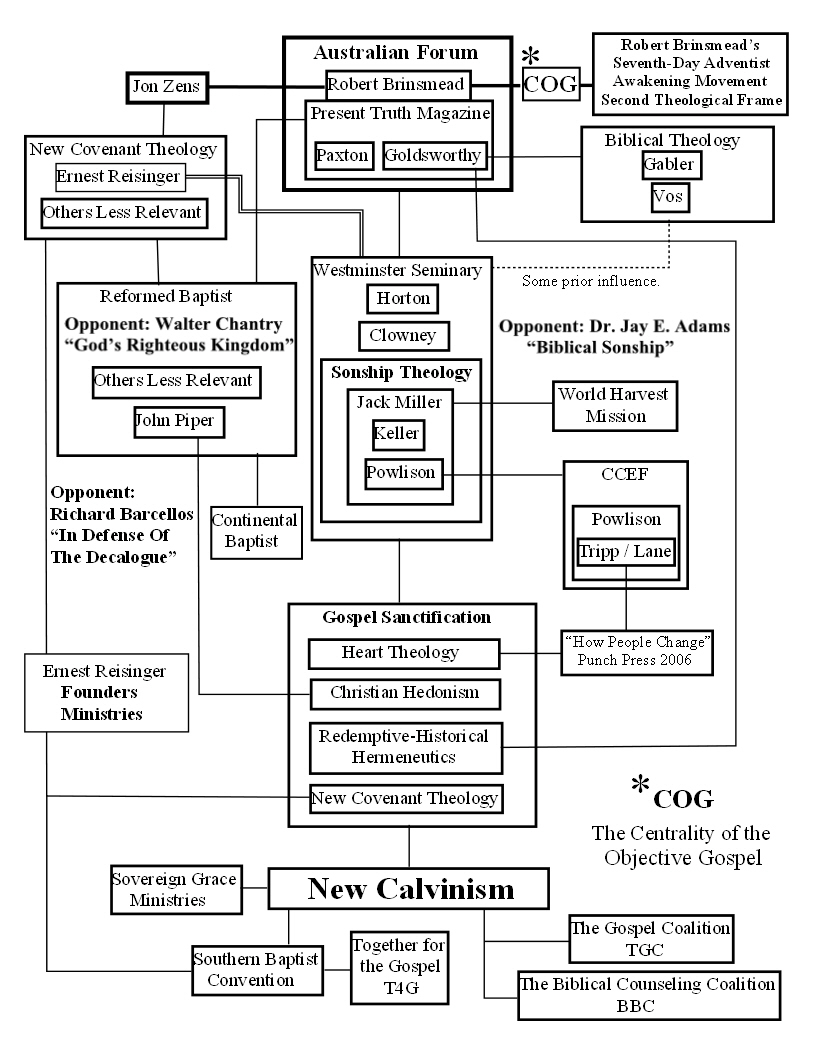
Repost: Comment on “Wolves” Post
|
Submitted on 2011/10/30 at 12:59 am
check out their church website and read their 60 page statement of belief. Some of the big names are in it. http://owensborochurch.com/ (under “about us”) “Seems to me if you are going to break fellowship with people, you should know what they are really guilty of.” Paul, I think people have a hard time putting their finger on it. After all, as you said, how can one go against the “Gospel” and the term “sovereignty of God”? But they are re-defining things and in their quest, their zeal is in your face. Their teaching is so convoluted they need 60 page belief statements. They speak in upside down infused grace justification/sanctification. It is all gobblygook that sounds so intellectually righteous. The weary, the poor in spirit, the uneducated don’t stand a chance with these guys. Perhaps the Association needs your book? So, the Association says, they have no kindness, humility, compassion, etc. Welcome to the world of Driscoll where you oust elders who dare disagree with you and form a coup to take over the church and install only few yes men elders. (My sources tell me it went from 30 elders to 4) Then declare in a sermon, you will go “old testament” on them for daring to speak out. http://www.thestranger.com/seattle/Content?oid=445277 Or where you send a cease and desist letter from your lawyers to a small church (without even calling them first!)in Calif that has the same name:Mars Hill. Acts 29 churches have the Driscoll “spirit”. because they learn church planting at their “bootcamp”. And, guess what? The SBC is funding some Acts 29 churches through NAMB. Our new NAMB president is Mohler’s old pastor who loves Acts 29. I can understand the Associations concern. But they failed to make the case. |



13 comments