The Sevenfold Thesis of TTANC volume 1
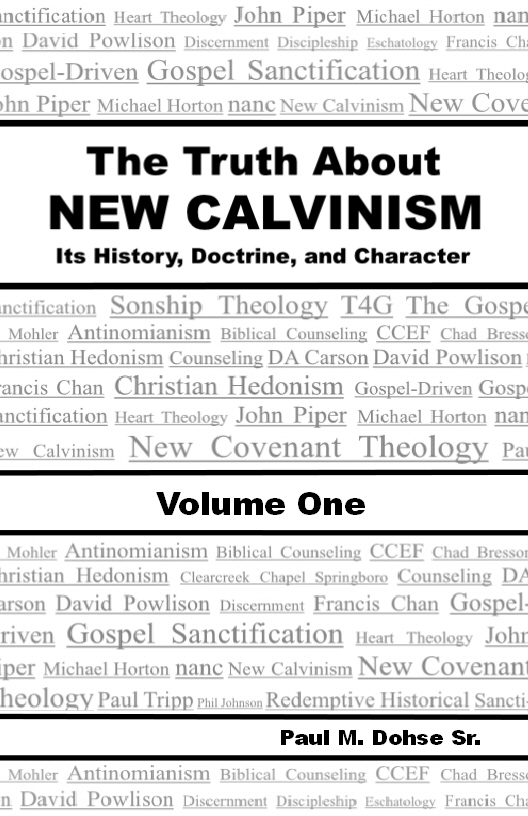 Pages 77 and 78:
The thesis of this book is sevenfold. First, New Calvinism is an expression of antinomian reductionism; specifically, gospel reductionism. It reduces the believers role in God’s spiritual work and plan to the least common denominator—primarily gospel contemplationism.
Second, it reduces the gospel to the saving work of Christ only—eclipsing the Father and Holy Spirit.
Third, because the believer’s role is reduced to a point that is not according to Scripture, he/she is deprived of the abundant life in a way God wants us to experience it for His glory and the arousing of curiosity from those who don’t have the hope of the gospel.
Fourth: it reduces the Scriptures to a historical gospel narrative only—a tool for contemplation. This also “relaxes” the law as a form of antinomianism. While that prism is singular, the system needed to make it work is so complex that it relegates God’s people to a pope-like reliance on those who fancy themselves as masters of meta-narrative interpretation.
Fifth: while reductionist theologies seek to reduce the believer’s role to the least common denominator, supposedly to make much of God and little of man, the elements that attempt to make it seem plausible are often complex and mutating. Therefore, instead of majoring on the application of what is learned from Scripture, believers are constantly clamoring about for some new angle that will give them a “deeper understanding” of the gospel that saved them.
Sixth: Christ and the apostles clearly warned that such doctrines would constantly trouble the church until the return of Christ, and in fact has been the primary nemesis of God’s people throughout redemptive history.
Seventh: All hope in contending against this doctrine is lost if one focuses on all of the theological systems and theories that attempt to make it plausible. This harkens back to lessons learned in contending against first century Gnosticism. For example, as mentioned in chapter five, New Covenant Theology alone has eighty elements. Presently, that is.
Authentic Calvinism has Always Been Anti-Thinking
 Of course, sanctified Calvinists like Jay Adams have always been pioneers in teaching Christians to think biblically. Adams was also the pioneer in advocating the competence of believers to counsel themselves and others from the Scriptures. Adams’ revolution began in 1970 and included themes that embraced the church’s greatest needs at that time and yet today, such as, “Competent to Counsel,” and “More Than Redemption.”
However, in that same year, Robert Brinsmead and the Australian Forum were systematizing the newly rediscovered Authentic Calvinism that dies a social death every hundred years or so. It dies a social death because it is vehemently opposed to major themes that are critical for the Christian life; namely, among many, competence, and the idea that the Christian life is more than “the gospel.”
Let there be no doubt: these two emerging movements clashed continually, and continue to do so today. The Forum doctrine, Authentic Calvinism, found life at Westminster Seminary in the form of Sonship theology. The father of it was Dr. John “Jack” Miller, and he had two understudies named Tim Keller and David Powlison. Powlison formulated the doctrine into a counseling construct known as “The Dynamics of Biblical Change” which is the foundation for Westminster’s counseling curriculum—otherwise known as CCEF.
Powlison himself, while lecturing at New Calvinist heretic John Piper’s church, stated precisely what the contention is between these two schools of thought:
This might be quite a controversy, but I think it’s worth putting in. Adams had a tendency to make the cross be for conversion. And the Holy Spirit was for sanctification. And actually even came out and attacked my mentor, Jack Miller, my pastor that I’ve been speaking of through the day, for saying that Christians should preach the gospel to themselves. I think Jay was wrong on that. I – it’s one of those places where I read Ephesians. I read Galatians. I read Romans. I read the gospels themselves. I read the Psalms. And the grace of God is just at every turn, and these are written for Christians. I think it’s a place where Jay’s fear of pietism, like his fear of speculation, psychologically actually kept him from tapping into just a rich sense of the vertical dimension. And I think Biblical Counseling as a movement, capital B, capital C, has been on a trajectory where the filling in of some of these neglected parts of the puzzle has led to an approach to counseling that is more mature, more balanced. It’s wiser. It has more continuity with the church historically in its wisest pastoral exemplars.
After the Forum got the ball rolling, Authentic Calvinism, dubbed, “The Centrality of the Objective Gospel Outside of Us,” became Sonship theology, and eventually exploded into the present-day New Calvinist movement. Interestingly enough, in the same lecture, Powlison also articulated further upon another difference in the two schools of thought:
I had an interesting conversation with Jay Adams, probably 20 years ago when I said, why don’t you deal with the inner man? Where’s the conscience? Where’s the desires? Where’s the fears? Where’s the hopes? Why don’t you talk about those organizing, motivating patterns?
And his answer was actually quite interesting. He said, “When I started biblical counseling, I read every book I could from psychologists, liberals, liberal mainline pastoral theologians. There weren’t any conservatives to speak of who talked about counseling. And they all seemed so speculative about the area of motivation. I didn’t want to speculate, and so I didn’t want to say what I wasn’t sure was so.
One thing I knew, obviously there’s things going on inside people. What’s going on inside and what comes out are clearly connected cause it’s a whole person, so I focused on what I could see.”
In other words, Adams insisted on drawing conclusions from what could be observed objectively and is uncomfortable with “helping” people with subjective truth/facts. And Powlison has a problem with that. Why? Because authentic Reformed doctrine contains two ideas that are the mega anti-thesis: the average Christian is not competent, and the Christian life is not more than the gospel. THINKING, and worse yet, objective thinking, is a dangerous stunt that shouldn’t be tried at home by the average parishioner. The parishioner has but two duties: See more Jesus and our own depravity, and follow the spiritually enlightened gospel experts. They are responsible for saving as many totally depraved numbskulls as possible—despite themselves. Their “knowledge” is the latest “breakthroughs” regarding the eternal depths of the “unknowable” gospel because it is the only “objective” source of reality. And reality is deep.
And this is messy business where there is no time to fiddle with totally depraved sheep who think they can know things, and worse yet, figure something out on their own. And of course, the unpardonable sin: critiquing the teachings of the spiritually enlightened with critical thinking. Calvin dealt with such by the sword and burning stake. His New Calvinist children are deprived of such tools, but substitute with character assassination (because what the totally depraved are really guilty of is much worse anyway), bogus church discipline, and the supposed power to bind someone eternally condemned by heavenly authority granted to the spiritually enlightened on earth. Luther himself said of Calvin’s Geneva, “All arguments are settled by sentence of death.”
This brings me to a comment that was posted here on PPT by a reader who uses the handle, “Lydia Seller of Purple.” It was in response to a Calvinist that had the audacity to suggest that Calvinism is an intellectual endeavor meant for the masses. Her superb observations:
Submitted on 2012/07/20 at 3:21 am
“Calvinism appeals to the intellect because the Word of God appeals to the intellect. ”
LOL!!! This is hysterical. Right. Jesus was really impressed with those learned intellectual Pharisees. That sermon on the mount was meant for the intellectual elite of Israel. Kinda embarrassing, Christianity appealed to so many ignorant peasants, too. But you Reformed guys took care of that for us by going along with the state church because they were so much smarter than the ignorant peasants. Yep, they understood the Word better which is why Reformed comes out of the state church tradition. .
“The proper order is intellect, then emotions, then will. Much of so called Christianity appeals to emotions first, then will and never intellect. God made us rational beings for a reason. He wants us to think. When we think properly about God’s truth, our emotions will invariably be affected if we have a heart for God. Such an emotional response will move us to make right choices. Paul put it this way working backwards from the will to the intellect, “You obeyed (the will), from the heart (emotions), that form of doctrine (intellect) unto which you have been handed over.””
But you are totally depraved and unable. That is not rational, Randy. 😮 )
The last paragraph is in quotations, so I assume Lydia uses her last statement to comment on that as being from the same guy, but I have some observations on it either way. The only thing that authentic Calvinists want us to think on is the gospel, and with “redemptive” outcomes only, and “redemptive” applications only. And, the emotions always preceding the will, and controlling it, is right out of John Piper’s Christian Hedonism; ie, gospel intellect (gospel contemplationism), then gospel treasure (delight), resulting in joyful obedience which is really a gospel manifestation or “Christ formation” that doesn’t really come from our actions directly. It is also Michael Horton’s Reformed paradigm of doctrine=gratitude=doxology=obedience. I believe my friend, and church historian John Immel has it right: Christian Hedonism was devised to soften the despair and hopelessness that always follows Authentic Reformed theology (leading to its social death) while maintaining Reformed fatalistic determinism.
Such is an insult on the most loving act of all cosmic history. Christ drew deep from truth to overcome his human emotions in obedience to the cross. He endured for the “joy that was set ahead.” His agony preceded obedience in depths that are incomprehensible. Christian Hedonism mocks the very passion of Christ prior to the cross. Hence, the insistence that the totally depraved sheep ignore common sense in exchange for the “gospel context” is the demand of today’s mystical despot abusers. It is also the major ministry theme of Powlison minion Paul David Tripp; this theme can be seen throughout his Gnostic masterpiece, “How People Change.”
I conclude with another apt observation by Lydia regarding the “Reformation”’s tyranny throughout history:
One has to wonder about the Dutch Reformed tradition that made them think making a fortune in the slave trade was Christian. Same with the Presbyterian trained pro slavery Calvinists who were part of the founding of the SBC. Then you have the Calvinist Boers in South Africa and Apartheid. Of course there were no Calvinist slave owners but history seems to show Calvinists have always thought themselves superior to others.
However, I somewhat disagree with the last sentence about Calvinistic slave owners. “The Reformation Myth” will examine the happy Presbyterian slave advocates of the Confederacy, and how their doctrine was an important part of the Confederate machine. And not to mention the roots of Patriarchy that came from the same era as well.
paul
The True Gospel Verses Calvinism: Part 3
 “Pleasing God can’t be the goal because we are not free to aggressively obey and apply the word of God to our lives lest we unwittingly ‘make sanctification the ground of our justification.’”
What’s in a name? With “The Centrality of the Objective Gospel Outside of Us,” much. This is the core doctrine of Reformed theology.
Centrality
Reformed theology puts strong emphasis on the works of Christ to the exclusion of the other Trinity members. In fact, given their concept of “emphasis,” the other members of the Trinity are relegated to insignificance. Reformed theology distorts the Trinity. “Emphasis” is an actual Reformed hermeneutic that has its roots in Gnosticism. Again, let the Reformed scream and cry like alley cats in the night—their theology is deeply rooted in Gnosticism, and if you’re looking for it—it’s easy to see. The very illustration of the two men, one with Christ within, and the other with Christ without, is a Gnostic concept. It’s based on the idea that matter is evil, and spirit is good. That’s why the likes of Piper et al have a problem with “infused grace” as discussed in part 2. The righteousness of Christ (by the way, the Bible always refers to the righteousness of God the Father being imputed to us, not Christ) must always remain outside of us because we are still evil and of the earth. The biblical concept of the new birth flies in the face of Gnosticism. This is at the heart of the recent “Jesus in my heart” controversy of late.
“Centrality” makes Christ (or “gospel”) the key to all truth and relegates all else to insignificance. This clever Gnostic concept enables Reformed academics to agree that something is indeed truth, but insignificant. And in fact, if the insignificant is emphasized, it is an aberration of the truth because a “good thing is being emphasized, but not the BEST thing.” Which is always Christ and the gospel. This comes from the Gnostic concept that reality cannot be seen through the material world, but must be obtained through the spirit world. Matter, and the objects thereof are shadows of reality, or inferior copies of reality and goodness. Life is experienced via the “two worlds” with a minority having insight into the world of reality. Plato, the father of Gnosticism, believed that philosophers who had (through striving) come to see spiritual things, should rule over the masses who function in the shadows of reality.
Reformed theology merely makes “the gospel” that reality, and everything else “shadows.” And they aren’t even ambiguous about it. This concept is a major theme of Rick Holland’s book, “Uneclipsing The Son.” Holland is a former associate of John MacArthur who wrote the Forward to said book. MacArthur’s statements in the Forward are nothing short of shocking:
Rick Holland understands that truth. This book is an insightful, convicting reminder that no one and nothing other than Christ deserves to be the central theme of the tidings we as Christians proclaim—not only to one another and to the world, but also in the private meditations of our own hearts….The pastor who makes anything or anyone other than Christ the focus of his message is actually hindering the sanctification of the flock. Second Corinthians 3:18 describes in simple terms how God conforms us to the image of His Son: ‘And we all, with unveiled face, beholding the glory of the Lord, are being transformed into the same image from one degree of glory to another’ (emphasis added). We don’t ‘see’ Christ literally and physically, of course (I Peter 1:8). But His glory is on full display in the Word of God, and it is every minister’s duty to make that glory known above all other subjects.
This, of course, is not the truth, and gives license to acknowledging the other two members of the Trinity and the new birth as truth while rendering them insignificant due to “emphasis.” In Gnosticism, emphasizing the shadows over the life giving sun is to emphasize a mere reflection or inferior copy of the truth. Hence, challenges by Holland/MacArthur associates like Pastor Steve Lawson to “come out from the shadows” are no mere coincidental use of words. Major Reformed ministries of our day have “Between Two Worlds” and “Between Two Spheres” (well- known Gnostic themes) as their major themes. Am I here right now? What could be more obvious?
Objective Gospel
According to Gnosticism, all reality (objective truth) is outside of man, and in another realm. Reformed theology merely makes Christ and the gospel the totality of all reality in the other world. Like Gnosticism, the gospel is deemed a higher knowledge that can’t be obtained by observing the shadows of the gospel, but the gospel itself must be meditated on to obtain the higher knowledge. That is why the importance of “always getting to Christ and the gospel in every passage” is strongly emphasized. On a Reformed website entitled the “Objective Gospel,” there are several videos posted that are lectures from the who’s who of today’s Reformed teachers. In one video, Paul Washer teaches that the gospel is eternal knowledge and can’t be completely known. I am not sure what I can add to that in order to make my point. Reformed teachers are merely Plato’s philosopher kings in my book. The Earth Stove Society, a Reformed think tank for New Covenant Theology, states the following in regard to tenet number one of New Covenant Theology:
New Covenant Theology insists on the priority of Jesus Christ over all things, including history, revelation, and redemption. New Covenant Theology presumes a Christocentricity to the understanding and meaning of all reality [emphasis mine].
Outside of Us
According to Gnosticism, man cannot possess goodness because he is of the material world. This is why 1st century Gnostics taught that Jesus didn’t really come in the flesh and continually drove the Apostles nuts. The New Testament is replete with contentions against Gnosticism. Hence, Reformation theology rejects the idea that Christians change for the better. The cross illustration in part 2 should make that case. This Reformed concept is articulated well by Reformed pastor/blogger Terry Rayburn:
There are several problems with that essentially Legalistic view of Sanctification, as reflected in the following observations:
1) Our flesh cannot get better. In Romans 7:18 Paul wrote, “For I know that NOTHING good dwells in me, that is, in my flesh…” Your flesh cannot be improved. Flesh is flesh, and spirit is spirit.
2) Our new nature, on the other hand cannot get better, because it has already been made new and perfect through regeneration. We have been given a “new heart” (new nature, or new spirit), and not a defective one, which would be absurd. This new spirit has been made “one spirit with Him” (1 Corinthians 6:17), such that when we “walk according to the Spirit” (i.e., the Holy Spirit), we also walk according to our own new spirit.
3) Those who deal with Sanctification by zeroing in on so-called “Progressive” Sanctification as the main point of Sanctification, are at best in Kindergarten.
Therefore, if one carefully examines the words used by Reformed teachers, they rarely, if ever state specifically that we actually change as born again people. If we are totally depraved, how can we really change? Obviously, we can’t. Therefore, when Reformed academics seem to say that we change, that’s not what they really mean. “Spiritual Transformation” is the term most often used. Or, “Christ is formed in you.” In other words, we somehow manifest a spirit realm without really changing ourselves. Admittedly, I do not have the Reformed details of how this works nailed down completely, but without a doubt, the answer will be found in a deeper understanding of Gnosticism itself. Again, it’s obvious that the totally depraved do not change.
Reformed theology is a form of Gnostic antinomianism that has plagued the church from the beginning when Satan said to Eve, “Has God really said….,” and claimed to have a higher knowledge called “good and evil.” The goal for the believer is justification—not Paul’s imperative to make it our goal to please God. Pleasing God can’t be the goal because we are not free to aggressively obey and apply the word of God to our lives lest we unwittingly, as discussed in part 2, “make sanctification the ground of our justification.” Reformed theology promises to be a greater danger to the church than any cult would ever dream of. It must be exposed.
Anytime that aggressive sanctification is circumvented, lack of assurance fills the void—the Apostle Peter makes this clear in the first chapter of his second epistle. Also, the world is not impressed with a philosophy of incompetence among God’s people—they will not be convinced that he who fathers the inept can save their souls.
I will finish with a last word on the question by a reader that prompted this three-part article. Part of the question concerned the perseverance of the saints. This, of course, is tied closely with the subject of assurance. Unfortunately, false assurance or lack thereof will be rampant in Reformed circles because of the circumvention of free and aggressive sanctification. Like many other aspects of the Christian life, perseverance is a joint colaboring with God. The effort is many faceted. First, God promises to keep us (Jude 24). But that doesn’t mean we have no role in the process. God’s commands are to us, not the Holy Spirit. Secondly, God controls circumstances in order to prevent us from falling (John 18:4-9, 1Cor. 10:13). This indicates that theoretically we could fall away, but He intervenes in circumstances so that we are able to bear it. So, whatever he allows to happen—we can bear it. Thirdly, applying the word of God to our lives builds up our ability to persevere (James 1:2, but especially Matthew 7:24-27). Fourthly, God encourages us by promising rewards for perseverance (James 1:12, Rev. 2:26). But much more could be added here. God’s word and its life applications are deep and rich—not narrow according to Reformed theology.
Lastly, Reformed theology is works salvation by antinomianism, and its practical application, what there is of it, is Gnosticism. The Apostle Paul said that if anyone comes preaching another gospel, “let them be accursed.” And I say amen to that, and I really don’t care what their names are.
paul

 Paul's Passing Thoughts
leave a comment