How to Debate a Calvinist Made Easy
 The first thing one must remember in debating a Calvinist is the Calvinist protocol: set and create the framework for the argument in order to dictate a certain outcome. Calvinists will speak from a certain construct and communicate from that viewpoint only, usually without the opponent knowing what the construct is, but if the Calvinist stays within that framework, he/she will have an answer for everything and this will quickly confuse the opponent. Calvinists win the argument every time because opponents don’t understand their metaphysics and epistemology. But that is a discussion not needed here if you follow my directions carefully.
Do not discuss symptoms. You must distinguish symptoms from the core problem. Stay away from quotes that address other issues (symptoms), and issues such as the doctrine of election. Calvinism encompasses a mass of symptomatic issues. These are the tentacles of the octopus. Fighting an octopus one tentacle at a time will lead to a quick demise—stay focused on the head.
A debate doesn’t have to be limited to one visit, and you are not obligated to move on to other issues from a concern that is not answered. Let me repeat that: “you are not obligated to move on to other issues from a concern that is not answered.” And here are your three concerns:
1. Calvinism denies eternal security.
2. If you can lose your salvation, what do you have to do to keep it?
3. Calvinists don’t believe people change.
John Piper is the universally accepted elder statesman of New Calvinism. Use this short article to establish concerns one and two.
Concern three is the HOW we keep our salvation which answers concern number two. Since we have to live our Christian life the same way we were saved to maintain/keep our salvation, we must live by the same gospel that saved us. The mantra, “We must preach the gospel to ourselves every day” should speak for itself. We keep ourselves saved by staying at the foot of the cross which entails a perpetual need for the same forgiveness that saved us, and that can only be perpetually received by a perpetual reliance on the same gospel that saved us. If we believe we change for the better, the need for the same gospel that saved us is eradicated and we lose our salvation.
This is what is behind the “T” in TULIP (total depravity) which unbeknown to many also includes the saints. Hence, the following chart is universally accepted among the Reformed:

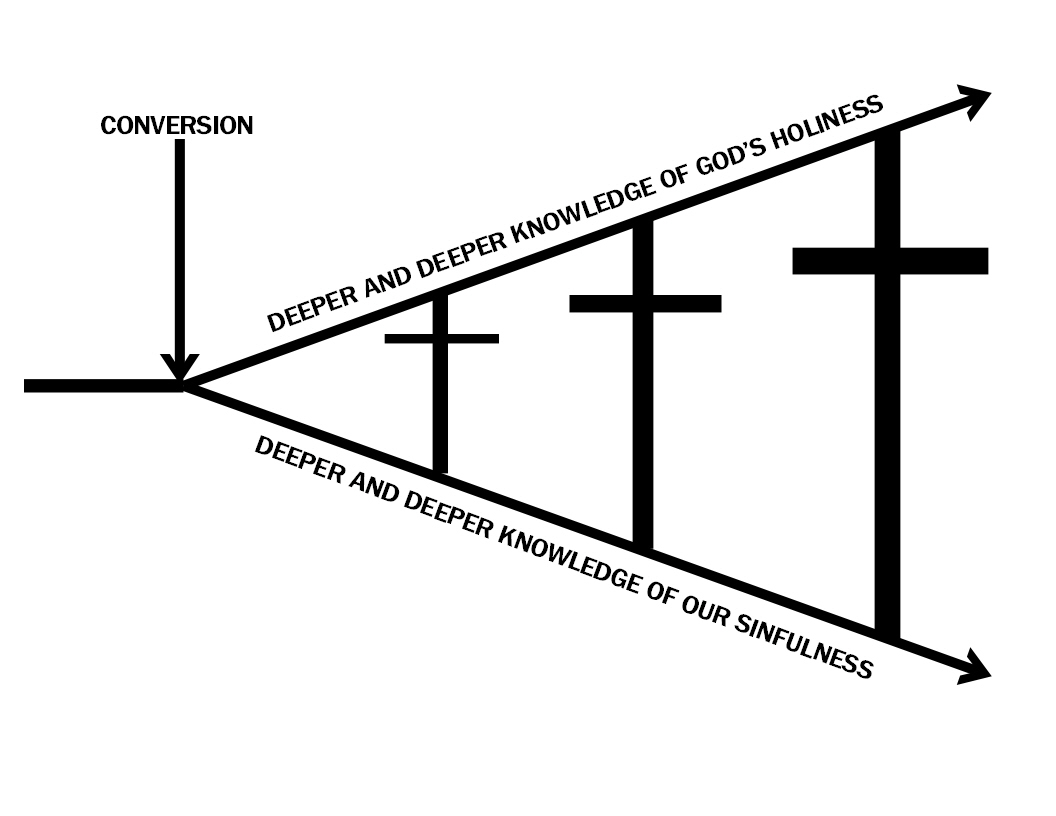
Notice that we don’t change, only the cross changes. Don’t get into what the cross represents in this illustration as that involves complex Reformed metaphysics. Stick with the point/concern, not symptoms. You are not the Calvinist—they are; therefore, you’re the one with the questions and it’s your agenda. “Living by the gospel” in order to stay saved entails focusing on our unchangeable evil verses God’s holiness and thereby perpetually recognizing our need for the gospel and continued salvation from our sins.
Relevant quotes:
“Where we land on these issues is perhaps the most significant factor in how we approach our own faith and practice and communicate it to the world. If not only the unregenerate but the regenerate are always dependent at every moment on the free grace of God disclosed in the gospel, then nothing can raise those who are spiritually dead or continually give life to Christ’s flock but the Spirit working through the gospel. When this happens (not just once, but every time we encounter the gospel afresh), the Spirit progressively transforms us into Christ’s image. Start with Christ (that is, the gospel) and you get sanctification in the bargain; begin with Christ and move on to something else, and you lose both” (Michael Horton: Christless Christianity; p.62).
“Moreover, the message of free reconciliation with God is not promulgated for one or two days, but is declared to be perpetual in the Church (2 Cor. 5:18, 19). Hence believers have not even to the end of life any other righteousness than that which is there described. Christ ever remains a Mediator to reconcile the Father to us, and there is a perpetual efficacy in his death—viz. ablution, satisfaction, expiation; in short, perfect obedience, by which all our iniquities are covered” (John Calvin: CI 3.14.11) [note: “ablution” means “A washing” which refers to salvation and stated as a onetime past event in the Bible; 1COR 6:11, John 13:9-11].
“The flesh, or sinful nature of the believer is no different from that of the unbeliever. ‘The regenerate man is no whit different in substance from what He was before his regeneration.’ — Bavinck. The whole church must join the confession, ‘Have mercy upon us miserable sinners.’ The witness of both Testaments is unmistakably clear on this point (Present Truth: Sanctification-Its Mainspring Volume 16 Article 13).
“There are several problems with that essentially Legalistic view of Sanctification, as reflected in the following observations:
1) Our flesh cannot get better. In Romans 7:18 Paul wrote, “For I know that NOTHING good dwells in me, that is, in my flesh…” Your flesh cannot be improved. Flesh is flesh, and spirit is spirit.
2) Our new nature, on the other hand cannot get better, because it has already been made new and perfect through regeneration. We have been given a “new heart” (new nature, or new spirit), and not a defective one, which would be absurd. This new spirit has been made “one spirit with Him” (1 Corinthians 6:17), such that when we “walk according to the Spirit” (i.e., the Holy Spirit), we also walk according to our own new spirit.
3) Those who deal with Sanctification by zeroing in on so-called “Progressive” Sanctification as the main point of Sanctification are at best in Kindergarten (Terry Rayburn: Grace for Life blog; Progressive Sanctification – Are We Sanctified By Works? 2/16/2012).
paul
A Reformed Myth: Calvinists Believe in Election
“And this is far from being a John Piper exclusive, this is the Reformed tradition.”
It would seem that something good could be said about Calvinism’s doctrine of election; at least if you are one of the lucky chosen, you are guaranteed eternal life, right? Wrong.
So-called “election” only takes care of original sin, you must now continue to live by faith alone in your Christian life so that the perfect obedience of Christ continues to be imputed to your account. The specific terms for this are “Christ 100% for us” and “already not yet.” Since Calvinists see justification and sanctification as the same thing, “100%” means Christ must perform all works in both justification and sanctification.
John Piper preached a series entitled, “How Does the Gospel Save Believers?” Did you know believers still need to be saved? In the series he explains how we are already saved but not yet:
We are asking the question, How does the gospel save believers?, not: How does the gospel get people to be believers? When spoken in the power of the Holy Spirit, the gospel does have power to open people’s eyes and change their hearts and draw them to faith, and save them. That’s what is happening on Tuesday nights and Wednesday nights this summer. People are being drawn to Christ through the power and beauty of the gospel. But I am stressing what Paul says here in verses 16 and 17, namely, that “the gospel is the power of God for salvation to everyone who believes.” Believers need to be saved. The gospel is the instrument of God’s power to save us. And we need to know how the gospel saves us believers so that we make proper use of it.
So, did you know that believers need to make “proper use” of the gospel in order to be “saved” as believers? And this is far from being a John Piper exclusive, this is the Reformed tradition. Piper’s next statement defies the imagination in regard to how mind numb people must be at Bethlehem Temple:
I say it with Paul: I, John Piper, am eager to preach the gospel to you who believe – exactly to you who believe – because this gospel which is laid out in the book of Romans, is the power of God to save you. You believers need to hear the gospel in order to be saved. And Paul labors mercifully for 16 chapters to tell us the gospel and how it works to save believers.
Well, this should be a crude awakening in regard to what Calvinists mean when they say, “We must preach the gospel to ourselves every day.” They mean this as a matter of eternal life and death for the believer.
And so it goes: election isn’t the issue, the gospel of progressive justification is the issue, and besides that, Calvinists don’t even believe in election to begin with.
paul
More on why New Calvinism Has Massive Appeal
“So what is the appeal of New Calvinism? Basically, five things….”
Mass appeal, rarely commendable in the Bible, is an earmark of New Calvinism. But why? As cited in another post, this quote from a New Calvinist organization reveals one primary reason:
What, then, is the subjective power of this message? Firstly, we find that there is real, objective freedom, the kind that, yes, can be experienced subjectively. We are freed from having to worry about the legitimacy of experiences; our claims of self-improvement are no longer seen as a basis of our witness or faith. In other words, we are freed from ourselves, from the tumultuous ebb and flow of our inner lives and the outward circumstances; anyone in Christ will be saved despite those things. We can observe our own turmoil without identifying with it. We might even find that we have compassion for others who function similarly. These fluctuations, violent as they might be, do not ultimately define us. If anything, they tell us about our need for a savior (David Zahl and Jacob Smith: Mockingbird blog).
This enables New Calvinists to boast an objective, factual gospel, while claiming that the objective gospel functions subjectively. In other words, the gospel (Christ and His works) is factual, but obtaining a deeper and deeper knowledge of those facts imputes those objective facts to our lives subjectively. This enables us to live our Christian lives by faith alone, while leaving the subjective results to God. Our primary goal is to contemplate the two things that saved us (the gospel): God’s holiness and our sinfulness (faith and repentance), and then as we go about living our lives, we don’t have to take anything that happens too seriously because it is all preordained by God.
Tragedy is a good thing because it testifies to our need for Christ; good works give us joy as we “experience” them, but we really don’t know whether they are in “our own efforts” or conducted by God. It’s subjective. According to Martin Luther, if we believe that we did the good work, that’s works salvation. If we attend our good works (as Christians) with fear that it could be us who did it and not God, that’s venial sin and not mortal sin. Hence, part of the New Calvinist daily repentance regiment is asking forgiveness for good works that we have done just in case it was us who did them. All in all, it insulates from responsibility for sin, and enables us to detach ourselves from negative emotions. Joy is a result of God’s goodness and good works. Tragedy reminds us of what we deserve and what God has saved us from—it’s just more good news!
Further appeal can be seen in a recent post by Dr. Ed Welch of CCEF. He starts off with the usual metaphysical curve-ball that seems to come in straight with the idea that our faith is objective truth. Then when he gets us swinging at that pitch, it curves with….
Faith is a way of seeing
Scripture is also fond of describing faith as the way to see God’s realities. ( By: Ed Welch Topics: Faith Published: July 17, 2013 http://www.ccef.org/blog/what-faith).
Welch continues to expound on how the subjective facts of the gospel leads to subjective “reality”:
With the naked eye we can see the physical world, but faith—which comes by hearing the word of God—allows us to “see” the Creator of the physical world (Heb. 11:3). Faith allows us to see that Jesus is the Word, the Son of God, the Rescuer of the world.
With a twisting of 2Corinthians 4:18, Welch, like all New Calvinists, attempts to make the case that the physical world isn’t what really needs to be “seen” because the physical can be seen and therefore is not of faith. Hence, the Bible is to be used to see the Savior only, leading to a faith that enables us to see beyond the physical. In other words, borrowing his terminology, the Bible enables us to “see” beyond creation to the Creator Himself. Of course, this is merely hanging Bible verses on Plato’s Theory of Forms.
Welch then explains, in the same post, a technique that can be added to Bible induced gospel contemplationism:
One way to use this perspective on faith is to pray with another, “Lord, open our eyes. Help us to see what is really happening.” And then ask at the end of your time together, “What did we see?”
Here at the Potter’s House, what we study, what we read, is what you get. To the contrary, in this technique also promoted by John Piper and many other New Calvinists, the Bible speaks to you, presumably through the Spirit, subjectively, following a gospel-centered contemplation of the Scriptures. The plain sense of Scripture can now be traded for subjective experience. Apparently emboldened by the mindlessness of American Christians, Welch further explains this approach with the following:
Another way to use this is to encourage others to live with their eyes closed. Let me explain. The world that is available to our physical senses can dominate our spiritual sight. Physical trials, fiscal uncertainty, the safety of those we love, the intrusion of hard pasts—this whirlwind can blind us to the spiritual realities that are deeper and longer lasting. So in a sense, we need to close our eyes to the circumstances of life, so we can open them to hope. It might happen like this:
“What do you see?” ‘I see the rejection of my spouse.’ “Close your eyes, and keep looking. Look around with eyes of faith. Now what do you see?” ‘I see the rejection of my spouse.’ “Okay, keep your eyes closed and look at the world through the lenses of Ephesians 1, now what do you see?” ‘I see . . . nothing.’ “No problem, we just need help. Let’s pray, which, in itself, is an expression of how we see by faith.”
The important point is that you are closing your eyes—not as a form of denial—but as a way to see more.
Welch then completely mocks discernment by suggesting that people are saved by reading Christian mystics like CS Lewis:
Back to the story, my friend became cynical toward his friend’s beliefs, but he was still a seeker. Soon after he graduated from high school, a co-worker gave him Mere Christianity by C. S. Lewis. On the very first page he began to “see.” After taking the next eight hours to read through the book, he knew he wanted to follow Jesus, though he didn’t know what that meant, and he did not know one other Christian he could ask.
So what is the appeal of New Calvinism? Basically, five things:
1. It enables people to deflect the negative emotions of life and trade them for joy by disconnecting from the physical world. This idea is sanctified by eradicating all value of earthly things (and people) for Christ.
2. It gives a simplistic answer for everything. All events in life are to either glorify God or show us our worthlessness.
3. Escape from responsibility and accountability. “I sinned? Well duh, that’s what sinners do.”
4. We already know what every verse in the Scripture is about, and by meditating on that, we can have a subjective result of our own choosing.
5. It eliminates the hard work of studying and wrestling with truth. Every verse is about Jesus, and the results are automatic. Also, hard work in spiritual matters is works salvation. As Calvin and Luther believed, sanctification is represented by the Sabbath rest. If you work, you die; hence, no work is more good news!
6. The Reformed, “power of the keys.” This is the idea that whatever Reformed elders bind on earth will be bound in heaven whether right or wrong. Hence, by merely staying in the good graces of your local neighborhood elders, you’re guaranteed to be in the graces of God. You’re in because the elders say you’re in.
http://apprising.org/2012/01/06/beth-moore-and-john-piper-lead-lectio-divina-lite-at-passion-2012/

Evangelizing the Calvinists
Don’t argue with Calvinists–evangelize them! The mission field of those entangled in the false gospel of progressive justification is white unto harvest. Join the cause!

PPT and TANC are developing tracts to be distributed at the Cross Conference in Louisville Kentucky. You can donate to the cause by sending check or money order to TANC PO Box 583 Xenia, OH 45385. TANC is a non-profit LLC. The tracts and information we are developing will be available for input and suggestions in the near future. Your support of our evangelism team is greatly appreciated!

 Paul's Passing Thoughts
10 comments