Franklin Graham’s Cluelessness Concerning American Culture is Indicative of Most Evangelicals
 Secular bad; Christian good. How did Christians come to think this way? And why are they willing to pay people like Franklin Graham so much money to protect us from the secular boogey man? Graham, like the vast majority of evangelicals, gets his information from other people. No people group can pass superstition and folklore from generation to generation like evangelicals and their information networks established by seminaries and local churches. Truly, the evangelical brain trust of our day must marvel that they can continue to get away with this in an information age. Nevertheless, the likes of evangelical superstar Dr. Albert Mohler often bemoan the evils of internet access. All of this is a long version of saying I think Protestants are brainwashed.
This post is about the Protestant mainstay of secular evil; Christian good. It was once again shoved in my face, as it is daily, and this time by an article in Decision magazine typed by Franklin Graham. The article was picked up and summarized by Michael Chapman @ cnsnews.com:
Reverend Franklin Graham, son of world renowned evangelical preacher Billy Graham, said that America is increasingly embracing a “culture of death” that echoes what has occurred in Europe, and which stems from a “sinful, godless worldview that rejects Christ.”
A further problem in America, he added, is that “Christianity is constantly under siege from the halls of government and education, which seek to suppress any public expressions of faith.”
“In places like Europe, where Christianity has been in decline as the deceptive forces of secularism and materialism have spread across the continent, it’s not surprising to find the practice of euthanasia so entrenched,” said Rev. Graham in a commentary for the January issue of Decision magazine. “Earlier this year, Belgium became the first country in the world to allow child euthanasia with no age limit.”
“I’m concerned that America is not far behind,” said Rev. Graham, who heads the Billy Graham Evangelical Association. “The euthanasia movement—disguised now as ‘death with dignity’—is gaining ground in a number of states. And for every 1,000 live births in the United States, 219 pregnancies end with a murdered child, through abortion.”
“I don’t think there’s any doubt that this rise in the culture of death in our own country coincides with the embrace of an immoral, sinful, godless worldview that rejects Christ,” he said. “Christianity is constantly under siege from the halls of government and education, which seek to suppress any public expressions of faith.”
Sigh. Ok, let’s take this a paragraph at a time. We like to say that America was founded by Christians who fled Europe for religious freedom, right? That’s the foundational premise of the American Protestant myth. First, the Pilgrims were Puritans who were Calvinists who were also Augustinians like Luther who were Platonists. So let’s clear that up to start with. Secondly, they didn’t come here for religious freedom—they came here to start their own socialist theocracy based on Plato’s The Republic. Thirdly, the foundation of their Protestant orthodoxy was/is death.
So, if Graham wants to say America was founded on European Christianity, he cannot also say that “America is increasingly embracing a ‘culture of death.’” Excuse me, the foundational document of the Protestant Reformation in regard to doctrine was the Heidelberg Disputation written by Martin Luther. It is a doctrine of death. In fact, Luther stated in the document that all true knowledge must be obtained by suffering. And being a Platonist, he rejected the idea that the common man can reason because of his addiction to the material realm. Luther merely made Christ Plato’s trinity; the true, good, and beautiful, and made the suffering of the cross the epistemology to obtain wisdom from the invisible realm. Luther’s “theologian of the cross” is Plato’s philosopher king.
Ok, so Graham also states that America is becoming more and more like Europe in this regard; well, ya think? That’s where it came from. Duh! And…
America is increasingly embracing a “culture of death” that echoes what has occurred in Europe, and which stems from a “sinful, godless worldview that rejects Christ.”
No, no, no. The Pilgrims, who were Puritans, who were Calvinists, and also Lutherans, who were Augustinians, who were followers of Plato, who was the father of Western socialism, made death the Christocentric epistemology of the church—it was by no means a rejection of Jesus, or at least their version of Him. This is why an instrument of death, the cross, is the regnant icon of the Protestant church.
The next statement by Graham lends opportunity for further clarification.
A further problem in America, he added, is that “Christianity is constantly under siege from the halls of government and education, which seek to suppress any public expressions of faith.”
“In places like Europe, where Christianity has been in decline as the deceptive forces of secularism and materialism have spread across the continent, it’s not surprising to find the practice of euthanasia so entrenched,”
“Christianity,” viz, Protestantism, has been in decline in Europe, um, where it started, and we are becoming like them, and guess what? The authentic version of Protestantism displayed in New Calvinism straight from the Heidelberg Disputation has been all but totally running the show in American evangelicalism for twenty years. Graham needs to look in the mirror if he wants to see the real problem.
And to further clarify, America was founded on political secularism—NOT European Protestantism. Excuse me, but the American colonies were originally socialist theocracies on steroids. Many of our founding fathers were motivated to act by the Puritan tyranny they experienced growing up. For the first time in human history, a government was formed that separated force from faith. The American Revolution was against European tyranny, but that same tyranny expressed itself in colonial Puritanism which was also tied to Europe politically in many cases. Ten years after the American Revolution, the Puritans tried to weasel their way back into control and James Madison had a total conniption fit over it. Keeping Platonist mystic despots out of government was what the American Revolution was all about. The Puritans were part of American history as enemies, not friends of freedom.
And this statement by Graham reveals the unfortunate and mostly unknown DNA in every Protestant:
…the deceptive forces of secularism and materialism have spread across the continent, it’s not surprising to find the practice of euthanasia so entrenched,”
The deceptive forces of secularism and materialism? Note how secularism is deemed as inherently evil. If it’s not Protestant, it’s evil. Be sure of this my friends: this idea is rooted in ancient dualism that deems the material (or “materialism”) as evil and invisible as good. It is also one of the philosophical pillars of Platonism and Gnosticism which wreaked havoc on the apostolic church.
Furthermore, we must remember that Protestantism was clearly founded on anti-reason which put the Puritans at odds with the founding fathers. Yes, many of the founding fathers were good Christians, but they were Christians who emerged from the Enlightenment Era. They were (not all) Biblicists who rejected dualism and also embraced empirical reason. This is where the discussion falls egregiously short when we discuss the Christianity that this country was founded on: Plato or Aristotle? If you think you can understand and partake in American cultural discussion without understanding these philosophies, you’re sadly mistaken. And please, don’t be like Graham—keep your mouth shut because you don’t know what you are talking about.
If you want to finally get a grip on these realities, I refer you to the university level lectures that John Immel has done in the 2012, 2013, and 2014 TANC conferences. This is world philosophy as it relates to contemporary American Christianity. We offer his lectures online for free, and trust me; this is an education that you would pay thousands of dollars for at a Christian college, and most of it would be orthodox myth to boot.
As Christians, we don’t think enough about what is exactly meant by “secularism,” and how it supposedly distorts our worldview. Also, when talking-orthodox-heads use the word “materialism” we should not assume they are talking entirely about hedonist money-lust; and moreover, when they subtly connect materialism to the “American dream” it should ignite fear of the socialist god within us. Dissing the American dream without qualification is presently in vogue among the New Calvinists who control at least 90% of American evangelicalism.
This is why atheism is on the rise bigtime in America. American Christianity is now totally defined by the Puritan ethic which disavows the material world expressed in quality of life and the average person’s ability to reason. Without the iron fist of a sanctified central government, chaos will supposedly ensue. For the Puritans who really understood what they were about, musings of self-governance was the epitome of folly and arrogance. The New Calvinist movement has successfully defined Christianity in this way resulting in a cultural pushback that rejects a reason-hating god who demands that all knowledge come through suffering. As a Christian thinker, I often seek dialogue with atheists, but find that I am rejected out of hand in every case. Why? Because “Christian” has become synonymous with spiritual oligarchy, and perhaps rightfully so, for what well-known Christian fails to speak well of the Puritans?
In addition to what is cited in this post from Graham’s editorial, one may ask Graham: why wouldn’t secular governments push back against the Neo-Puritan movement expressed in New Calvinism? Their dominion theology is well documented. By their own pronouncement they seek to dominate the world!!! Constantly we hear Mike Huckabee et al espousing the need for “Christian government” coupled with events like New Calvinist John Piper in Dubai proclaiming that Christianity is going to bring down the Burj Khalifa tower!
Really, am I here right now? Secular government is pushing back against a semblance of theocratic Puritan resurgence? Ya think?
Lastly, what about the fruits of death culture that Graham is speaking of? Throughout history, the bulk of death culture has always come from collectivism. What’s that? It starts with the idea that man cannot reason. And by the way, dear Christian, you can wuv somebody with your entire faith-filled intellectual thimble until the cows come home, but if they catch wind that you think they are unable to interpret reality—see ya—you’re history.
Since man is unable to reason and needs those with the gnosis to rule over the masses for the collective good, man is not only perceived as property of the state whether the state is religious or otherwise, man’s worth is defined by his ability to contribute to the greater societal good. In other words, to sing the praises of Puritanism while fustigating the evils of death culture is an oxymoron. Either way, whether secular or Protestant, both feed the death culture. Protestants don’t like voluntary exit strategies because who’s to say you won’t become one of them in the future; atheists simply have no hope because the only Christianity they see is jihad with some sugar on top.
Graham et al remind me of race-baiters like Al Sharpton. With Al, the boogey man is the white man; with Graham the boogey man is the secular materialist out to destroy his definition of Christianity. However, in regard to Graham, I think most of his mentality in this regard comes from ignorance, for many others like John Piper and Al Mohler—not so much.
In the same way liberals think we should ask, “Why do terrorists hate us,” Christians should ask why we are deemed a threat to secular society. We don’t need to ask the terrorists that; we know they believe that Sharia law is the key to world peace. But an answer to our question to those evil material secularists might be revealed in a snippet of Graham’s editorial not cited above:
Life is short. Eternity is long. Do not tarry for you do not know when you will die. Choose sin and you will face eternal damnation, said Rev. Graham. But choose God and you will gain eternal life.
This also applies to our institutions, our laws, our society. “Wherever Christianity flourishes, there is a vibrant culture of life, not death,” said the reverend. “When the precepts of the Christian faith are faithfully taught and followed, there is an abundance of selfless, sacrificial living and giving.”
Do you hear the intellectuals running away as fast as they possibly can? You should. Protestant theocracies have a track record of a “vibrant culture of life”? Oh my, are you kidding me?
Let me explain something. Not long after the Renaissance, Platonism split into a secular expression that later became Marxism. Until then, collectivism was primarily a religious animal. From there, remnants of collectivism have always defined political underpinnings one way or the other. In contemporary America, we bemoan the nanny state mentality found primarily in the Democratic Party. Self-governance? They don’t even think we can choose the right way to wipe ourselves or buy lightbulbs. Often we ask when they make absurd statements, “Do they think we are stupid?” Well, not exactly, it’s just that they don’t think you can properly interpret realty.
Likewise, does Graham think we are stupid? And does he really think we can reach the lost with statements like this that are first degree felonies against reality in broad daylight?
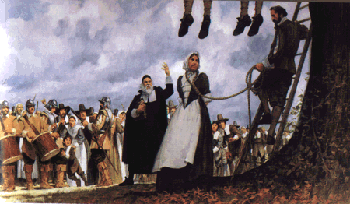
Ya, follow us, believe in Jesus, our idea of a “vibrant culture of life” is Calvin’s Geneva and the Salem Witch Trials. John Piper even went to Geneva to proclaim the next phase of his ministry. During the promotion, he proclaimed the coming of Calvin’s Geneva as “Post Tenebras Lux”—“After Darkness… Light.” Geneva was an early version of communism that just didn’t work, and it didn’t work for colonial America ether.
Yes, trust Franklin, these contradictions only seem outrageous because you don’t comprehend reality—let Graham et al do the thinking for you. Stop supporting abortion and the like—burning witches is much better. “Besides, even though we think the Puritans were absolutely wonderful, if you put us in power, we won’t be like them in every regard. Really, we promise.”
Any takers?
paul
Christianity and Islam: The Pot Calling the Kettle Black?
Originally posted March 10, 2014
Many relate to my personal testimony; despite my best efforts, I have been for the most part at odds with church. Julia Duin noted in her book Quitting Church that she has always sensed that something is fundamentally wrong with the Evangelical church.
I wonder if that mysterious fundamental reason has come to light. Note this statement by Al Mohler, arguably the most influential Evangelical of our day:
Niebuhr’s fifth model is where he seems to be pointing us, that is, to Christ the transformer of culture. These are the conversionists, and they are far more hopeful than the dualists. They understand the distinction between Christ and the culture, but they also understand that it is the mission of the church to transform the culture with the claims of Christ. We continually hear this kind of language: “Let’s go out and redeem the culture. Let’s go out and conquer the culture in the name of Christ. Let’s transform every dimension of the culture, whether the media and the arts, or business and finance, and let’s subdue them to the claims of Christ. Let’s have a more Christian military and a more Christian realm of arts.” This leads to a very progressive impulse, one which looks to a better world and a better condition if we will only do this. It promises transformation, hopes for cultural redemption, and leads to Christian activism. (Preaching the Cross: chapter 3, subheading; Niebuhr’s Treatment of Christ and Cutler, Niebuhr’s fifth model).
What a minute. Is this not the exact same vision as Islam? Moreover, do Muslims understand this better than most Christians? When Christian missionaries travel abroad, are they perceived this way whether they know it or not? When we hear of Christian missionaries being murdered or detained for “conspiracy to overthrow the state,” we immediately assume that’s a crock. Well, maybe not when you consider what the Crusades were all about coupled with this contemporary dominion mentality among leading Evangelicals.
Furthermore, Al Mohler is far from being the only one propagating these ideas. This same idea is the theses of Paul David Tripp’s book Broken-Down House. Many examples could be given, but I will not belabor the point past the following notation by blogger Joel Taylor:
While filming a promo in Dubai (UAE) for the new student missions conference, CROSS, John Piper (standing in front of the Burj Khalifa tower) makes this statement:
“And that tower and this city are coming down!”
Was that a wise thing to say while standing on United Arab Emirates soil? I wonder how the Arab people would understand his remark if they saw this?
It probably wouldn’t surprise them. The American church was founded on the Reformation, and many of its European stalwarts had their own standing armies. And ok, we have much spiritual tyranny and a divine right of kings mentality in the church today; ya think? If they muse about bringing down the Burj Khalifa tower what do you think they will do to you if you ask too many questions?
So this explains everything. It’s really not about the gospel. It’s not about making disciples, it’s about globalism. Making “disciples” is not the primary goal, it’s only a small part of a much larger vision. The whole idea that people can only find salvation in the “local church” is the ploy that funds the global vision while Christians believe it’s about the gospel. We are encouraged to bring people to church to get them saved for that very reason. It also brings to mind all of the hoopla about “lone rangers” who are not “under the authority” of a local church.
Do I think this clarifies the mission of home fellowships? Absolutely. Do you want to make disciples? Or do you want to fund world dominion? Christ’s mandate to the assemblies was to make as many disciples as possible before Christ returns. Why? Because He is not calling on Christians to renovate the earth—He is going to come back and blow up the whole thing and start over.
This is a short post, but one that opens up a very wide avenue of considerations. “There is no perfect church”: that’s not the issue; the issue is the fundamental mandate. That’s not merely a question of perfection, but the difference between eternal investment or a complete waste of time and money.
paul
An Open Letter to the Board of Trustees of Southern Seminary

Originally posted January 2, 2014
Paul M. Dohse
TTANC L.L.C.
PO Box 583
Xenia, Ohio 45385
To Dr. Walter Price and the Board of Trustees of Southern Seminary:
Gentlemen,
It is no surprise that truth is of low value in our day; the apostle Paul informed Timothy that in the latter days people would not tolerate sound doctrine, and we are in those days. Hence, there are no expectations in regard to this letter, but nevertheless, it is a duty to proclaim the truth.
Southern Seminary now offers academic credits for attending seminars at conferences sponsored by various organizations connected with the present-day resurgence of authentic Calvinism. Though the traditions of men and antinomianism was of primary concern as stated by Christ during His earthly ministry, the evangelical academia of our day follows the crowds in wholesale acceptance of any doctrinal name brand that sells.
This blitzkrieg of resurgent conferences targets youth specifically. The resurgence seeks to turn a whole generation of youth to this doctrine. This represents the future of the American church. Evangelicals, and its academia in particular, seem indifferent to the gravity of future accountability attached to this reality.
Our organization researches the Calvin Institutes, and the trustees of Southern Seminary would do well in following our example rather than the opinions of men like Albert Mohler. Calvin’s gospel, as stated in the Institutes, is a call to keep ourselves saved through the practice of antinomianism, and has a distinctive Gnostic application. It is works salvation by Christ plus antinomianism, and reduces obedience to only experiencing the imputation of Christ’s perfect obedience to the Christian life. An example of this would be on page 215 in How People Change (2006), a book written by Paul David Tripp, speaker at the recent Cross Conference endorsed by Southern Seminary. He states the following:
When we think, desire, speak, or act in a right way, it isn’t time to pat ourselves on the back or cross it off our To Do List. Each time we do what is right, we are experiencing what Christ has supplied for us. In Chapter 11, we introduced some of the fruit Christ produces. We will expand the discussion here.
Calvin, as well as Luther, believed that all reality is interpreted through the works of Christ in the gospel, or the “objective” gospel and the imputation of those works are experienced “subjectively” in order to remove our works from sanctification. Hence, “the subjective power of an objective gospel” and other such mantras often heard among evangelicals today. This necessitates, in a manner of speaking, interpreting every verse in the Bible as a justification verse; i.e. “Biblical Theology,” a buzz word at Southern. This way of interpreting the Bible was introduced by Christian mystic Geerhardus Vos circa 1938.
Calvin also redefined the new birth as an experience of perpetual rebirth in order to keep ourselves saved by the same gospel that originally saved us. So, the new birth is not a one-time event, it is a perpetual cycle of the same repentance and new birth experience that originally saved us—that’s why we must “preach the gospel to ourselves every day.” This is the doctrine of mortification and vivification. It is part of Calvin’s systematic theology. This is factually indisputable. The Christian life focuses on our total depravity and repentance only, leading to the experience of vivification, or a joyful experience.
Therein, the human “heart” is redefined as something that is transformed only by its increased ability to experience vivification. This is why John Piper states that joy is essential to the Christian life; if vivification is not being experienced; perpetual rebirth is not taking place:
The pursuit of joy in God is not optional. It is not an ‘extra’ that a person might grow into after he comes to faith. Until your heart has hit upon this pursuit, your ‘faith’ cannot please God. It is not saving faith (Desiring God: p. 69).
Likewise, Southern Baptist Paul Washer states the following:
This cycle simply repeats itself throughout the Christian life. As the years pass, the Christian sees more of God and more of self, resulting in a greater and deeper brokenness. Yet, all the while, the Christian’s joy grows in equal measure because he is privy to greater and greater revelations of the love, grace, and mercy of God in the person and work of Christ. Not only this, but a greater interchange occurs in that the Christian learns to rest less and less in his own performance and more and more in the perfect work of Christ. Thus, his joy is not only increased, but it also becomes more consistent and stable (Paul Washer: The Gospel Call and True Conversion; Part 1, Chapter 1, heading – The Essential Characteristics Of Genuine Repentance, subheading – Continuing and Deepening Work of Repentance).
The new birth is redefined as a “cycle” rather than a one-time event like our physical birth. It is redefined as a perpetual rebirth experience as we focus on our saintly total depravity. We are only righteous positionally; regeneration is a mere experience of Christ’s perfect obedience to the law. This not only keeps Christians under law, but inadvertently calls for a rejoicing in our own supposed total depravity.
This is why authentic Calvinism dies a social death within Christianity every 100 years or so. God’s people eventually catch on to the fact that it is a false gospel. Lighter forms of it survive the rejection while maintaining the label. We are presently within the fifth resurgence since Calvin’s Geneva, and the trustees of Southern are mindless participants accordingly.
We had the wonderful privilege of meeting many, many young people at the recent Cross Conference where you promoted this false gospel. We realize that there will only be a remnant that loves the truth enough to reject this latest academic novelty. But this is a generation of young people capable of great things, and smart enough to know that they only need God Himself to accomplish His mission. We believe that American Christianity has become a mission field in and of itself; namely, YOUR resurgence movement, a movement that bears your name, and we are seeking to reach that remnant of God that loves His truth. This is our duty and calling. A gospel promoting a justification that is not finished cannot save.
Meanwhile, as stated by the apostle Paul, let those who teach another gospel be accursed whether they be angels or men of renown.
Because only truth saves and sanctifies,
Paul M. Dohse
John 17:17
Matthew 4:4
Simple Theological Math: Protestantism’s Age-Old Gospel of Death and Misery
 Originally published June 6, 2014
“When it gets right down to the nitty gritty there is NO difference between John MacArthur Jr. and Joseph Prince. The theological math equation is exactly the same.”
“And of course, there are many different takes on which sanctification by faith alone formula best keeps us justified by reoffering the perfect obedience of Christ upon the alter of the law.”
“Instead of the death of Christ ending the law of condemnation and setting us free to obey the law in order to glorify God, please God, love Christ and others, and abstain from grieving the Spirit by offering our bodies as a living sacrifice, we are told that we must instead continually reoffer the living sacrifice of Christ’s obedience instead… This takes the privilege and calling to love Christ with our obedience in sanctification and makes it part of justification. It circumvents the ability to love our Lord, and makes it works salvation.”
A friend of this ministry sent me some books that have confirmed a suspicion I have had for some time: Protestants, regardless of the stripe, have always primarily functioned by the same core doctrine of “justification by faith.” I heard Joseph Prince use the term just the other day as I walked past a flat screen here at the Potter’s House.
What is “justification by faith” specifically? This is the core doctrine/gospel that has always driven all forms of Protestantism. Even though there are obviously various and sundry applications—the core ideology that drives its function is the same. When it gets right down to the nitty gritty there is NO difference between John MacArthur Jr. and Joseph Prince. The theological math equation is exactly the same.
The least common denominator is the fact that justification is not finished. As I was walking past the aforementioned monitor, Prince also stated in regard to justification by faith… “it is finished.” Yes, Protestants say that, but that’s not how we function—we function according to what the doctrine is really about; the doctrine is really about a justification that is not finished.
When justification is not finished, souls are skittish about what they do as disciples for fear that it will mess up their salvation, and there will be mass confusion in regard to the relationship between law and gospel. The Christian life will become complicated and in need of a priestly expert to give us our best shot at “standing in the judgment.” Protestant souls will be suspicious of obedience and their motives for doing so. Unhealthy introspection and paralyzing fear in sanctification has been the hallmark of Protestantism from the beginning.
“Yes,” they say, justification is a finished work in regard to our “positional justification,” but Jesus’ work is really not finished, He must keep working to KEEP us in that position where we are covered by His righteousness. So, positional justification and practical justification are both a work of Jesus, and we are justified by faith. This is because God has declared us righteous positionally, but that isn’t true unless we are really righteous practically which begs the question:
“How can we be considered truly righteous as people?”
‘The law must be kept perfectly.’
“But we can’t keep the law perfectly.”
‘Yes, that’s why we are saved by justification by faith.’
Therefore, according to the authentic gospel of justification by faith, there are two things we must believe in order to be saved: Christ’s passive obedience, and Christ’s active obedience. Stalwarts of the Protestant faith like Gresham Machen have stated that there is “no hope” without this belief also known as “double imputation.” Christ died for our positional justification, but He also came to live a perfect life of obedience for our positional justification. There are TWO justifications: positional and practical. One is finished, but Christ continues to be an “advocate” for us to keep us justified positionally:
“So, I must believe that Christ died for my justification and lived for my sanctification?”
‘Right.’
“So, what we call sanctification is really a work by Christ that keeps us justified.”
‘Right.’
“…until our resurrection?”
‘Right, we call that final justification.’
“So, there is positional justification, practical justification, and final justification?”
‘Right.’
“So, why do they call practical justification sanctification?”
‘Because sanctification means to be set apart for holiness.’
“Oh, so sanctification describes what practical justification does—it describes the function of practical justification.”
‘That’s a good way to state it.’
“But I can’t keep the law perfectly.”
‘Right, that’s where justification by faith comes in.’
“So, justification by faith means I am justified by faith alone in what Jesus did on the cross for my positional justification, and faith alone in His perfect life of obedience for my practical justification, or what we call sanctification.”
‘You are correct.’
“So, positional justification is a finished work, but practical justification is not.”
‘Both are finished; Christ fulfilled the law by His perfect life so that it could be applied to our sanctification in order to keep us justified positionally. We are justified by Christ positionally and practically.’
This is a false gospel for several key reasons from a biblical perspective, and the reason that Protestantism, like Catholicism, has borne fruits of death over the centuries. It’s a matter of simple theological math. The Bible states explicitly that this very gospel will bear fruits of death for the following reason…
IT KEEPS US UNDER THE LAW OF SIN AND DEATH.
Clearly, the Protestant gospel focuses on one relationship to the law that never changes for the believer. That’s the first and primary element of the equation. Secondly, justification is a finished two-part work for Christ, but not us. The Reformers believed that the essence of all sin was a propensity on the part of man to believe that he/she can contribute to salvation in some way. Because the Protestant gospel demands a standard for justification that defines righteousness as a perfect keeping of the law, what people believe about practical righteousness becomes paramount. The bottom line becomes the following reality: we can’t keep the law perfectly, and if we can’t, we are not really righteous.
All and all, the issue at hand is what the Reformers believed about justification’s standard. Only recognizing ONE relationship to the law, they also made perfect law-keeping the standard for justification. This also necessitated the belief that because man falls short of perfection, even believers, that man remains fundamentally unchanged until the resurrection. Man remains under the same law that he/she was under before salvation, and that law demands perfection. And that is true, THAT one law does demand perfection, and in fact does nothing but condemn those who are under it. Therefore, justification by faith holds to the idea that Christ died to pay the penalty for our sins, and came to also fulfill all of the righteous requirements of the law of sin and death.
The fact that Protestantism keeps man under the law of sin and death is really the crux of the issue. Christ is one who has “satisfied the law” in our stead. But the law is not “satisfied” by His death only, it is also “satisfied” by His life. And if we are still under this one law, it cannot be satisfied by anything we do because we cannot keep it perfectly. Therefore, as ones still under it, we must be COVERED by the righteous obedience of Christ until final justification. Here are the elements of the equation:
One law + perfect covering – man’s contribution = final justification.
The following explanation from a Reformed publication could not explain it better:
The Holy Spirit gives the sinner faith to accept the righteousness of Jesus. Standing now before the law which says, “I demand a life of perfect conformity to the commandments,” the believing sinner cries in triumph, “Mine are Christ’s living, doing, and speaking, His suffering and dying; mine as much as if I had lived, done, spoken, and suffered, and died as He did . . . ” (Luther). The law is well pleased with Jesus’ doing and dying, which the sinner brings in the hand of faith. Justice is fully satisfied, and God can truly say: “This man has fulfilled the law. He is justified.”
We say again, Only those are justified who bring to God a life of perfect obedience to the law of God. This is what faith does—it brings to God the obedience of Jesus Christ. By faith the law is fulfilled and the sinner is justified (The Australian Forum Present Truth Journal: Law and Gospel; volume, 7 article 2, Part 2).
Contemporary Reformed theologian John Piper states it this way:
We are united to Christ in whom we are counted as perfectly righteous because of his righteousness, not ours. The demand for obedience in the Christian life is undiminished and absolute. If obedience does not emerge by faith, we have no warrant to believe we are united to Christ or justified (Matthew 6:15; John 5:28-29; Romans 8:13; Galatians 6:8-9; 2 Thessalonians 2:13;James 2:17; 1 John 2:17; 3:14). But the only hope for making progress in this radical demand for holiness and love is the hope that our righteousness before God is on another solid footing besides our own imperfect obedience as Christians. We all sense intuitively-and we are encouraged in this intuition by the demands of God-that acceptance with God requires perfect righteousness conformity to the law (Matthew5:48; Galatians 3:10; James2:10). We also know that our measures of obedience, even on our best days, fall short of this standard (John Piper: Counted Righteous in Christ; Page 123, 2002).
Though Piper often uses nuance to shade the reality of the less ambiguous prior statement, “We all sense intuitively-and we are encouraged in this intuition by the demands of God-that acceptance with God requires perfect righteousness conformity to the law… We also know that our measures of obedience, even on our best days, fall short of this standard.”
Hence, THE ONE LAW IS STILL THE STANDARD THAT MUST BE SATISFIED IN ORDER FOR US TO REMAIN JUSTIFIED POSITIONALLY.
This requires an ongoing work by us to live our Christian life via a formula that perpetually presents the righteous obedience of Christ upon the alter of the law. This keeps us justified. And of course, there are many different takes on which sanctification by faith alone formula best keeps us justified by reoffering the perfect obedience of Christ upon the alter of the law.
According to Romans 6:14, we are not under law, but under grace :
For sin will have no dominion over you, since you are not under law but under grace.
The word for “over,” kyrieuō, means to “have authority or lordship over.” However, Protestantism holds to the idea that Christians are still under the authority of this particular law which requires/required Christ to fulfill its demands. Remember what John Piper stated?
We all sense intuitively-and we are encouraged in this intuition by the demands of God-that acceptance with God requires perfect righteousness conformity to the law… We also know that our measures of obedience, even on our best days, fall short of this standard.
Clearly, Protestantism keeps us under the authority of this law. This requires a “covering” by Christ to protect us from its condemnation because we are unable to fulfill its righteous requirements. But yet, this does not subtract from the fact that we remain under its jurisdiction.
Law + fulfilment + covering = righteousness ≠ justification.
Another problem is that even if the law is fulfilled, its fulfillment cannot give life:
Galatians 3:21 – Is the law then contrary to the promises of God? Certainly not! For if a law had been given that could give life, then righteousness would indeed be by the law.
We see two things here: the law cannot give life even if it is fulfilled, “For if a law had been given that could give life,” and even if it was fulfilled, it is not the standard for justification; “then righteousness would indeed be by the law.” It doesn’t matter who fulfills it, whether it is fulfilled or not, it cannot give life and it is not the standard for justification—it can only condemn.
8:1 – There is therefore now no condemnation for those who are in Christ Jesus. 2 For the law of the Spirit of life has set you free in Christ Jesus from the law of sin and death. 3 For God has done what the law, weakened by the flesh, could not do. By sending his own Son in the likeness of sinful flesh and for sin, he condemned sin in the flesh, 4 in order that the righteous requirement of the law might be fulfilled in us, who walk not according to the flesh but according to the Spirit.
The apostle Paul drives this point home by reminding us that our father of the faith was declared righteous 430 years before the law:
Galatians 3:17 – This is what I mean: the law, which came 430 years afterward, does not annul a covenant previously ratified by God, so as to make the promise void. 18 For if the inheritance comes by the law, it no longer comes by promise; but God gave it to Abraham by a promise.
What is being missed is the two different relationships of the law: it is the law of sin and death to unbelievers, but it is the law of the Spirit of life to believers. Those UNDER GRACE are led by the law of the Spirit of life, and are not UNDER the law of sin and death. We are no longer under that law’s dominion or jurisdiction. Why would Christ need to fulfill a law that has no jurisdiction over us? Moreover, why does the righteousness of Christ need to cover us in the fulfilling of that law when those under it have died?
Romans 7:1- Or do you not know, brothers—for I am speaking to those who know the law—that the law is binding on a person only as long as he lives? 2 For a married woman is bound by law to her husband while he lives, but if her husband dies she is released from the law of marriage. 3 Accordingly, she will be called an adulteress if she lives with another man while her husband is alive. But if her husband dies, she is free from that law, and if she marries another man she is not an adulteress.
4 Likewise, my brothers, you also have died to the law through the body of Christ, so that you may belong to another, to him who has been raised from the dead, in order that we may bear fruit for God. 5 For while we were living in the flesh, our sinful passions, aroused by the law, were at work in our members to bear fruit for death. 6 But now we are released from the law, having died to that which held us captive, so that we serve in the new way of the Spirit and not in the old way of the written code.
Did not John Piper, like all of the Reformed, state that the law is still binding on us? Not if we died with Christ, and we did:
Romans 6:5 – For if we have been united with him in a death like his, we shall certainly be united with him in a resurrection like his. 6 We know that our old self was crucified with him in order that the body of sin might be brought to nothing, so that we would no longer be enslaved to sin. 7 For one who has died has been set free from sin. 8 Now if we have died with Christ, we believe that we will also live with him.
A dead person who is no longer under the jurisdiction of law does not need to be “covered” with the righteous of Christ’s perfect obedience; we don’t need a covering, in fact, Christ’s death put an END to the law:
Romans 10:4 – For Christ is the end of the law for righteousness to everyone who believes.
We don’t need a righteous covering for a law that has been ended. Our sins are not “covered,” they are ENDED:
Romans 3:19 – Now we know that whatever the law says it speaks to those who are under the law, so that every mouth may be stopped, and the whole world may be held accountable to God.
Romans 4:15 – For the law brings wrath, but where there is no law there is no transgression.
If the law has nothing to say to us, how can we be, as John Piper asserts, under its demands? Why would Christ have to fulfill the law for us when it has nothing to say to us in the first place? Christ didn’t end the law for us because He fulfilled it, he ended it by His death, and if he ended it by His death, why would He have to fulfill it?
Romans 5:8 – but God shows his love for us in that while we were still sinners, Christ died for us.
Romans 5:13 – for sin indeed was in the world before the law was given, but sin is not counted where there is no law.
Romans 10:4 – For Christ is the end of the law for righteousness to everyone who believes.
The Protestant gospel keeps people under the law, and requires a continual living sacrifice on the part of Christ to fulfill the righteousness of the law of sin and death. But that law is ended, and we are set free to follow the Spirit by obedience to the law out of a pure motive of love:
Romans 7:6 – But now we are released from the law, having died to that which held us captive, so that we serve in the new way of the Spirit and not in the old way of the written code.
We are now free to obey the law of the Spirit of life:
Romans 8:1 – There is therefore now no condemnation for those who are in Christ Jesus. 2 For the law of the Spirit of life has set you free in Christ Jesus from the law of sin and death. 3 For God has done what the law, weakened by the flesh, could not do. By sending his own Son in the likeness of sinful flesh and for sin, he condemned sin in the flesh, 4 in order that the righteous requirement of the law might be fulfilled in us, who walk not according to the flesh but according to the Spirit. 5 For those who live according to the flesh set their minds on the things of the flesh, but those who live according to the Spirit set their minds on the things of the Spirit. 6 For to set the mind on the flesh is death, but to set the mind on the Spirit is life and peace. 7 For the mind that is set on the flesh is hostile to God, for it does not submit to God’s law; indeed, it cannot. 8 Those who are in the flesh cannot please God.
Christ died to set us free from the law of sin and death so that we would be free to obey the law of the Spirit of life. It is really the same law, but this all speaks of two different relationships to the law; i.e., those who are under its condemnation, and those who are free to obey it in order to please God. In regard to these two different relationships…
Galatians 4:21 – Tell me, you who desire to be under the law, do you not listen to the law?
Instead of the death of Christ ending the law of condemnation and setting us free to obey the law in order to glorify God, please God, love Christ and others, and abstain from grieving the Spirit by offering our bodies as a living sacrifice, we are told that we must instead continually reoffer the living sacrifice of Christ’s obedience instead.
Romans 12:1 – I appeal to you therefore, brothers, by the mercies of God, to present your bodies as a living sacrifice, holy and acceptable to God, which is your spiritual worship. 2 Do not be conformed to this world, but be transformed by the renewal of your mind, that by testing you may discern what is the will of God, what is good and acceptable and perfect.
This takes the privilege and calling to love Christ with our obedience in sanctification and makes it part of justification. It circumvents the ability to love our Lord, and makes it works salvation.
But it gets worse as keeping people under the law has additional consequences. It not only replaces our obedience in sanctification with the obedience of Christ in order to keep us justified by a perpetual reoffering of Christ’s living sacrifice instead of ours which Paul said was our reasonable service to God, it even takes the death of Christ and reoffers it continually in order to keep us justified as well. Think about it; if we are still under the law of condemnation and its demands, its righteousness requirement not only requires righteous actions, but sinlessness. Therefore, if the law of sin and death is not ended, Christ not only died for our sins under the law, but He must have also died for our sins committed as Christians because we are still under the law. This requires a reapplication of Christ’s death to present sins when we repent of them. Accordingly…
Nor by remission of sins does the Lord only once for all elect and admit us into the Church, but by the same means he preserves and defends us in it. For what would it avail us to receive a pardon of which we were afterwards to have no use? That the mercy of the Lord would be vain and delusive if only granted once, all the godly can bear witness; for there is none who is not conscious, during his whole life, of many infirmities which stand in need of divine mercy. And truly it is not without cause that the Lord promises this gift specially to his own household, nor in vain that he orders the same message of reconciliation to be daily delivered to them (The Calvin Institutes: 4.1.21).
…by new sins we continually separate ourselves, as far as we can, from the grace of God… Thus it is, that all the saints have need of the daily forgiveness of sins; for this alone keeps us in the family of God (John Calvin: Commentaries on the Catholic Epistles; The Calvin Translation Society 1855. Editor: John Owen, p. 165 ¶4).
…forgiveness of sins is not a matter of a passing work or action, but comes from baptism which is of perpetual duration, until we arise from the dead (Luther’s Works: American ed.; Philadelphia: Muhlenberg Press; St. Louis: Concordia, 1955, vol. 34, p. 163).
For the forgiveness of sins is a continuing divine work, until we die. Sin does not cease. Accordingly, Christ saves us perpetually (Ibid., p.190).
Daily we sin, daily we are continually justified, just as a doctor is forced to heal sickness day by day until it is cured (Ibid., p.191).
This is a perpetual return to the same gospel that saved us. In regard to that, the Hebrew writer stated the following:
Hebrews 6:1 – Therefore let us leave the elementary doctrine of Christ and go on to maturity, not laying again a foundation of repentance from dead works and of faith toward God, 2 and of instruction about washings, the laying on of hands, the resurrection of the dead, and eternal judgment. 3 And this we will do if God permits. 4 For it is impossible, in the case of those who have once been enlightened, who have tasted the heavenly gift, and have shared in the Holy Spirit, 5 and have tasted the goodness of the word of God and the powers of the age to come, 6 and then have fallen away, to restore them again to repentance, since they are crucifying once again the Son of God to their own harm and holding him up to contempt. 7 For land that has drunk the rain that often falls on it, and produces a crop useful to those for whose sake it is cultivated, receives a blessing from God. 8 But if it bears thorns and thistles, it is worthless and near to being cursed, and its end is to be burned.
In the final analysis, being yet under the law of sin and death can only bring forth fruits for death, and by and large, that is the testimony of Protestantism. Its original gospel keeps people under the law of sin and death, and under the slavery of sin. Those under the law of the Spirit of life have the seed of God in them because they are born of God, and are not under a law that can condemn them. A perfect fulfilling of the law of sin and death is not the standard of justification. Christians are under the law of liberty (James 1:25) that frees them from that law of sin and death to walk in the Spirit.
In the same way that one act of sin violates the whole law (James 2:10), one act of love fulfills the law of the Spirit of life (Galatians 5:14). It is obedience motivated by love, but weakened by the flesh. Nevertheless, we ARE righteous practically in sanctification accordingly.
paul
Ground Zero: Pope Gregory and New Calvinist Gospel Contemplationism
Originally published December 13, 2012
“Monks. That’s what we are missing here. Martin Luther. Ever heard of him? He was a monk.”
“In that Disputation, Luther postulates Pope Gregory’s take on the gospel which is the exact same calling card of present-day New Calvinism.”
“Powlison points to Pope Gregory and Augustine as the pioneers of biblical counseling using a ‘Christ-centered,’ ‘full gospel’ approach. And what was that approach?”
Let’s just take one contemporary example: a Presbyterian church that is now a mere shell of what it was; the remains of a war over the arrival of a New Calvinist pastor who exhibited outrageous behavior and leadership style. Today, some parishioners stand dumbfounded that the Presbytery took positive steps to keep said pastor in place.
As TANC, our newly formed think tank that researches Reformed theology continues to journey into church history for answers, the reasons for present-day tyranny in the church become clearer every day. First, it is driven by the gospel that founded the Reformation. Simply put, it is a gospel that does not believe that people change, but are rather called to contemplate the saving works of Christ in order for His righteousness to be manifested in one of two realms. Whether Baptist, Methodist, or whatever, this Reformed seed, the idea that people really don’t change is at the core of their function though they would deny it verbally. The Western church as a whole buys into this basic concept.
Secondly, the basic concept of spiritual elitists ruling over the totally depraved. You know, the they really can’t change crowd. The Reformation clarion call of total depravity—what’s our second clue if we need one? The spiritual is accessed through the chief contemplationists, and since they have the dope directly from God, they should rule over the totally depraved. Look, I have been a Baptist since 1983, and this is how it works. Again, we wouldn’t verbalize that, but to some degree it is true of all Western denominations because we are the children of the Protestant Reformation. What were we protesting? Naughty philosopher kings; past that, not much.
If we don’t change, the church doesn’t either. Think about that. And we wonder why things are a mess. Apparent growth in numbers is being driven by something else other than a true gospel. And the Reformers deny that while pontificating total depravity. It is testimony to the depth of which this Protestant construct has dumbed down the average parishioner; i.e., the totally depraved change. And nobody blinks. The assumption is that total depravity only pertains to the unregenerate, but that’s not the case according to the Reformed gospel and its time for people to start doing the math on that. The “Nones” and the massive exodus from the evangelical church is taking place for a reason.
I’m not ready to declare Pope Gregory the Great the father of the Reformation and present-day New Calvinism just yet, but recent discoveries reveal some things that should be fairly obvious. We aren’t stupid, just trusting, and that needs to end. Christians need to take advantage of the information age and start studying for themselves as the Christian academics of our day refuse to be forthcoming. They didn’t forget to mention that sola fide is also for sanctification. They didn’t forget to mention the total depravity of mankind AND the saints. They didn’t forget to mention that the new birth is a realm and not something that happens in us—it’s deliberate deception because the Reformed gospel is “scandalous.” The totally depraved are not “ready” for what the enlightened class of philosopher kings understand. By the way, many seminary students will testify to the fact that they are told as much by their seminary professors. Seminaries are where you go to be certified for the purpose of ruling over the totally depraved in order to, in Al Mohler’s words, “save them from ignorance.” Sorry, I prefer to let the Bible and Google save me from ignorance. Thank goodness for the Gutenberg press.
Monks. That’s what we are missing here. Martin Luther. Ever heard of him? He was a monk. What is the very premise of monkism? It’s the idea that the spiritual is obtained by contemplationism. And monkism is not unique to the Catholic Church—it is the link from the Catholic Church to the ancient concept of mystic dualism. Though it pans out in various different ways, it’s the idea that matter is evil and spirit is good. In other cases, it holds to the idea that both good and evil are necessary to understand true reality. Good defines evil, and evil defines good. The more you understand both, the more “balance” you have in the universe. Then there is the goal to birth the spiritual into the physical through meditation/contemplationism. Like I said, there are many takes on the basic approach.
Monks believe that the physical or world realm is a distraction from the spiritual realm. In some cases, they believe that all matter is merely a form of the perfect, or spiritual. Hence, monasteries. Traditionally, monasteries have been clearing houses for the dope from God through contemplationism. And since they have the dope, they should rule the totally depraved for their own good. In some spiritual caste systems, the monks rule directly, in others like the Catholic Church, the monks are the Scribes and Prophets for the rulers; i.e., the Popes.
The fact that monkism would be part and parcel to any doctrine formulated by Martin Luther is a no-brainer. Mysticism is simply going to be a significant factor, and so it is with Protestantism. This becomes more apparent when you consider the core four of the Protestant Reformation: Martin Luther, John Calvin, St. Augustine, and Pope Gregory the Great. Luther’s 95 Theses was a protest against naughty Popes, but he was completely onboard with the Catholic caste system. When his 95 Theses resulted in the unexpected societal eruption that took place, he presented a doctrinal disputation to the Augustinian Order in Heidelberg. And don’t miss this:
In that Disputation, Luther postulates Pope Gregory’s take on the gospel which is the exact same calling card of present-day New Calvinism. In theses 27 of his Disputation, Luther states the following:
Thus deeds of mercy are aroused by the works through which he has saved us, as St. Gregory says: »Every act of Christ is instruction for us, indeed, a stimulant.« If his action is in us it lives through faith, for it is exceedingly attractive according to the verse, »Draw me after you, let us make haste« (Song of Sol. 1:4) toward the fragrance »of your anointing oils« (Song of Sol. 1:3), that is, »your works.«
There could not be a more concise statement in regard to the New Calvinist gospel. Deeds in the Christian life come from the same acts in which Christ saved us. Secondly, they are not our acts, but the acts of Christ applied to our Christian lives by faith alone. Thirdly, when the works of Christ are applied to our Christian lives by faith alone, it will always be experienced by the exhilarating emotions of first love—this is the mark of Christ’s active obedience being manifested in the spiritual realm through the totally depraved. We “reflect” the works of Christ by faith alone. Even John MacArthur has bought into this nonsense, claiming that obedience to the Lord is “always sweet, never bitter.” Francis Chan states that it always “feels like love.” And of course, poke John Piper’s rhetoric anywhere and this same monkish mysticism comes oozing out.
Moreover, Luther states this same concept from many different angles in his Disputation, and theses 28 is clearly the premise for John Piper’s Christian Hedonism.
No wonder then that New Calvinists of our day sing the praises of Pope Gregory. Here is what heretic David Powlison stated in an interview with Mark Dever’s 9Marks ministry:
Caring for the soul, which we try [try?] to do in biblical counseling, is not new. Two of the great pioneers in church history would be Augustine and Gregory the Great. Even secular people will credit Augustine’s Confessions as pioneering the idea that there is an inner life. Augustine did an unsurpassed job of tearing apart the various ways in which people’s desires become disordered. Gregory wrote the earliest textbook on pastoral care. He pioneered diverse ways of dealing with a fearful person, a brash and impulsive person, an angry person, an overly passive person. He broke out these different struggles and sought to apply explicitly biblical, Christ-centered medicine—full of Christ, full of grace, full of gospel, and full of the hard call of God’s Word to the challenges of life.
Powlison points to Pope Gregory and Augustine as the pioneers of biblical counseling using a “Christ-centered,” “full gospel” approach. And what was that approach? It was primarily contemplationism and dualism. In fact, Gregory practically saw “doing” as a necessary evil. In Roland Paul Cox’s Masters dissertation, Gregory the Great and His Book Pastoral Care as a Counseling Theory, Cox states the following:
The overall theme in Gregory’s dichotomies is balance. It is possible that this comes from Gregory’s own struggles in balancing his desire for the contemplative life of a monk versus his reluctant, but active, service as ambassador to Constantinople and pope.“The Regula Pastoralis was in large part devoted to describing how to reconcile the two types of life. He came to the conclusion eventually that while the contemplative life was the better and more desirable of the two, the active life was unavoidable, and indeed necessary in order to serve one’s fellow man.…There could be no better exemplar of the two lives than Gregory himself, but he would have been less than human had he not from time to time mourned the fact that so much of his time must be given over to the active at the expense of the contemplative” [Jeffrey Richards, Consul of God : The Life and Times of Gregory the Great (London ; Boston: Routledge & Kegan Paul, 1980), 57.].
Powlison, in true Reformed tradition, invokes the either/or hermeneutic, or the either cross story or glory story hermeneutic of Luther’s Disputation by suggesting that any denial of this “Christ-Centered” approach is a wholesale denial of an “inner life.” In other words, suggesting that doing something should be emphasized as much as contemplationism is paramount to denying that there is an inner life. Such statements by Powlison are indicative of his utter lack of integrity.
In addition, Gregory’s penchant for mystic dualism is seen in the same dissertation:
Gregory’s view of health revolved around balance. In Pastoral Care 34 dichotomies are given. For each one Gregory discusses how either extreme is detrimental. The following are a few examples of Gregory’s dichotomies: poor/rich, joyful/sad, subject/superiors, wise/dull, impudent/timid, impatient/patient, kindly/envious, humble/haughty, obstinate/fickly, and gluttonous/abstemious. Further, Gregory explains how certain traits although they appear to be virtues are in reality a vice. For example, in describing the dichotomy of impatient and patient, Gregory says the following about the patient: “…those who are patient are to be admonished not to grieve in their hearts over what they suffer outwardly. A sacrifice of such great worth which they outwardly offer unimpaired, must not be spoilt by the infection of interior malice. Besides, while their sin of grieving is not observed by man, it is visible under the divine scrutiny, and will become the worse, in proportion as they claim a show of virtue in the sight of men. The patient must, therefore, be told to aim diligently at loving those whom they needs must put up with lest, if love does not wait on patient” [Pastoral Care: pp. 109, 110].
In other words, self-control is a vice. Unless cross-centered love is mystically applied according to Luther’s Disputation (theses 28), the latter evil of self-control is worse than the former sin of being offended since such offences serve to humble us (LHD theses 21).
What goes hand in metaphysical hand in all of this is good ole’ ancient spiritual caste tyranny. As Cox further observes,
Shortly after becoming pope, Gregory wrote Pastoral Care. In addition as pope, he reorganized the administration of the papal states, he maintained papal authority in the face of encroachments from the Patriarch of Constantinople, he established links with the Frankish Kingdoms, and most importantly (for these English writers), he sent a party of monks, led by Augustine, to convert the Anglo-Saxons.
Gregory was very influenced by the Rule of St. Benedict and Benedictine monks who came to Rome after the monastery that St. Benedict founded was burnt. In some letters, Gregory calls his work Pastoral Rule. “There is every reason to assume that Gregory in conceiving the plan for Liber Regulae Pastoralis [Pastoral Rule] intended to provide the secular clergy with a counterpart to this Regula [the Rule of St. Benedict].
….This culture of rulers and emperors also helps explain why Gregory saw Pastoral Care and Pastoral Rule as one in the same. By modern day standards, Gregory would be considered overly authoritarian.
A culture of “rulers and emperors” had precious little to do with it, but rather ancient spiritual caste systems that answered the supposed preordained call of God to control the totally depraved. With the sword if necessary. While many of these systems were based on mythology prior to the 6th century, Plato systematized the idea and gave it scientific dignity. But his trifold theory of soul consisting of king, soldier, and producer called for a sociological counterpart that was a mirror image to fit the need. Sir Karl Raimund Popper, considered the greatest philosopher of the 20th century, fingered Platonism as the primary catalyst for religious and secular tyranny in Western culture. And Plato’s mystic dualism (shadows and forms) added not just a little to the MO of the Reformers. According to church historian John Immel:
Calvin’s Institutes (1530) is the formal systematic institutionalization of Platonist/Augustinian syncretism that refined and conformed to Lutheran thinking and became the doctrinal blueprint for the Reformed Tradition [Blight in the Vineyard: Prestige Publishing 2011].
Christ promised us that He would build His Church and the gates of hell would not prevail against it. The idea that the Reformers rescued His church from the gates of the Roman Catholic Church is both laughable and the biggest hoax ever perpetrated on mankind. The idea that Christ needed, and continues to need the services of Plato’s philosopher kings is arrogance on steroids. Somewhere, God’s church moves forward. Let us shed the Reformed load that hinders and find our place in that true church.
paul

 Paul's Passing Thoughts
2 comments