Ground Zero: Pope Gregory and New Calvinist Gospel Contemplationism
 “Monks. That’s what we are missing here. Martin Luther. Ever heard of him? He was a monk.”
“In that Disputation, Luther postulates Pope Gregory’s take on the gospel which is the exact same calling card of present-day New Calvinism.”
“Powlison points to Pope Gregory and Augustine as the pioneers of biblical counseling using a ‘Christ-centered,’ ‘full gospel’ approach. And what was that approach?”
Let’s just take one contemporary example: a Presbyterian church that is now a mere shell of what it was; the remains of a war over the arrival of a New Calvinist pastor who exhibited outrageous behavior and leadership style. Today, some parishioners stand dumbfounded that the Presbytery took positive steps to keep said pastor in place.
As TANC, our newly formed think tank that researches Reformed theology continues to journey into church history for answers, the reasons for present-day tyranny in the church become clearer every day. First, it is driven by the gospel that founded the Reformation. Simply put, it is a gospel that does not believe that people change, but are rather called to contemplate the saving works of Christ in order for His righteousness to be manifested in one of two realms. Whether Baptist, Methodist, or whatever, this Reformed seed, the idea that people really don’t change is at the core of their function though they would deny it verbally. The Western church as a whole buys into this basic concept.
Secondly, the basic concept of spiritual elitists ruling over the totally depraved. You know, the they really can’t change crowd. The Reformation clarion call of total depravity—what’s our second clue if we need one? The spiritual is accessed through the chief contemplationists, and since they have the dope directly from God, they should rule over the totally depraved. Look, I have been a Baptist since 1983, and this is how it works. Again, we wouldn’t verbalize that, but to some degree it is true of all Western denominations because we are the children of the Protestant Reformation. What were we protesting? Naughty philosopher kings; past that, not much.
If we don’t change, the church doesn’t either. Think about that. And we wonder why things are a mess. Apparent growth in numbers is being driven by something else other than a true gospel. And the Reformers deny that while pontificating total depravity. It is testimony to the depth of which this Protestant construct has dumbed down the average parishioner; i.e., the totally depraved change. And nobody blinks. The assumption is that total depravity only pertains to the unregenerate, but that’s not the case according to the Reformed gospel and its time for people to start doing the math on that. The “Nones” and the massive exodus from the evangelical church is taking place for a reason.
I’m not ready to declare Pope Gregory the Great the father of the Reformation and present-day New Calvinism just yet, but recent discoveries reveal some things that should be fairly obvious. We aren’t stupid, just trusting, and that needs to end. Christians need to take advantage of the information age and start studying for themselves as the Christian academics of our day refuse to be forthcoming. They didn’t forget to mention that sola fide is also for sanctification. They didn’t forget to mention the total depravity of mankind AND the saints. They didn’t forget to mention that the new birth is a realm and not something that happens in us—it’s deliberate deception because the Reformed gospel is “scandalous.” The totally depraved are not “ready” for what the enlightened class of philosopher kings understand. By the way, many seminary students will testify to the fact that they are told as much by their seminary professors. Seminaries are where you go to be certified for the purpose of ruling over the totally depraved in order to, in Al Mohler’s words, “save them from ignorance.” Sorry, I prefer to let the Bible and Google save me from ignorance. Thank goodness for the Gutenberg press.
Monks. That’s what we are missing here. Martin Luther. Ever heard of him? He was a monk. What is the very premise of monkism? It’s the idea that the spiritual is obtained by contemplationism. And monkism is not unique to the Catholic Church—it is the link from the Catholic Church to the ancient concept of mystic dualism. Though it pans out in various different ways, it’s the idea that matter is evil and spirit is good. In other cases, it holds to the idea that both good and evil are necessary to understand true reality. Good defines evil, and evil defines good. The more you understand both, the more “balance” you have in the universe. Then there is the goal to birth the spiritual into the physical through meditation/contemplationism. Like I said, there are many takes on the basic approach.
Monks believe that the physical or world realm is a distraction from the spiritual realm. In some cases, they believe that all matter is merely a form of the perfect, or spiritual. Hence, monasteries. Traditionally, monasteries have been clearing houses for the dope from God through contemplationism. And since they have the dope, they should rule the totally depraved for their own good. In some spiritual caste systems, the monks rule directly, in others like the Catholic Church, the monks are the Scribes and Prophets for the rulers; i.e., the Popes.
The fact that monkism would be part and parcel to any doctrine formulated by Martin Luther is a no-brainer. Mysticism is simply going to be a significant factor, and so it is with Protestantism. This becomes more apparent when you consider the core four of the Protestant Reformation: Martin Luther, John Calvin, St. Augustine, and Pope Gregory the Great. Luther’s 95 Theses was a protest against naughty Popes, but he was completely onboard with the Catholic caste system. When his 95 Theses resulted in the unexpected societal eruption that took place, he presented a doctrinal disputation to the Augustinian Order in Heidelberg. And don’t miss this:
In that Disputation, Luther postulates Pope Gregory’s take on the gospel which is the exact same calling card of present-day New Calvinism. In theses 27 of his Disputation, Luther states the following:
Thus deeds of mercy are aroused by the works through which he has saved us, as St. Gregory says: »Every act of Christ is instruction for us, indeed, a stimulant.« If his action is in us it lives through faith, for it is exceedingly attractive according to the verse, »Draw me after you, let us make haste« (Song of Sol. 1:4) toward the fragrance »of your anointing oils« (Song of Sol. 1:3), that is, »your works.«
There could not be a more concise statement in regard to the New Calvinist gospel. Deeds in the Christian life come from the same acts in which Christ saved us. Secondly, they are not our acts, but the acts of Christ applied to our Christian lives by faith alone. Thirdly, when the works of Christ are applied to our Christian lives by faith alone, it will always be experienced by the exhilarating emotions of first love—this is the mark of Christ’s active obedience being manifested in the spiritual realm through the totally depraved. We “reflect” the works of Christ by faith alone. Even John MacArthur has bought into this nonsense, claiming that obedience to the Lord is “always sweet, never bitter.” Francis Chan states that it always “feels like love.” And of course, poke John Piper’s rhetoric anywhere and this same monkish mysticism comes oozing out.
Moreover, Luther states this same concept from many different angles in his Disputation, and theses 28 is clearly the premise for John Piper’s Christian Hedonism.
No wonder then that New Calvinists of our day sing the praises of Pope Gregory. Here is what heretic David Powlison stated in an interview with Mark Dever’s 9Marks ministry:
Caring for the soul, which we try [try?] to do in biblical counseling, is not new. Two of the great pioneers in church history would be Augustine and Gregory the Great. Even secular people will credit Augustine’s Confessions as pioneering the idea that there is an inner life. Augustine did an unsurpassed job of tearing apart the various ways in which people’s desires become disordered. Gregory wrote the earliest textbook on pastoral care. He pioneered diverse ways of dealing with a fearful person, a brash and impulsive person, an angry person, an overly passive person. He broke out these different struggles and sought to apply explicitly biblical, Christ-centered medicine—full of Christ, full of grace, full of gospel, and full of the hard call of God’s Word to the challenges of life.
Powlison points to Pope Gregory and Augustine as the pioneers of biblical counseling using a “Christ-centered,” “full gospel” approach. And what was that approach? It was primarily contemplationism and dualism. In fact, Gregory practically saw “doing” as a necessary evil. In Roland Paul Cox’s Masters dissertation, Gregory the Great and His Book Pastoral Care as a Counseling Theory, Cox states the following:
The overall theme in Gregory’s dichotomies is balance. It is possible that this comes from Gregory’s own struggles in balancing his desire for the contemplative life of a monk versus his reluctant, but active, service as ambassador to Constantinople and pope.“The Regula Pastoralis was in large part devoted to describing how to reconcile the two types of life. He came to the conclusion eventually that while the contemplative life was the better and more desirable of the two, the active life was unavoidable, and indeed necessary in order to serve one’s fellow man.…There could be no better exemplar of the two lives than Gregory himself, but he would have been less than human had he not from time to time mourned the fact that so much of his time must be given over to the active at the expense of the contemplative” [Jeffrey Richards, Consul of God : The Life and Times of Gregory the Great (London ; Boston: Routledge & Kegan Paul, 1980), 57.].
Powlison, in true Reformed tradition, invokes the either/or hermeneutic, or the either cross story or glory story hermeneutic of Luther’s Disputation by suggesting that any denial of this “Christ-Centered” approach is a wholesale denial of an “inner life.” In other words, suggesting that doing something should be emphasized as much as contemplationism is paramount to denying that there is an inner life. Such statements by Powlison are indicative of his utter lack of integrity.
In addition, Gregory’s penchant for mystic dualism is seen in the same dissertation:
Gregory’s view of health revolved around balance. In Pastoral Care 34 dichotomies are given. For each one Gregory discusses how either extreme is detrimental. The following are a few examples of Gregory’s dichotomies: poor/rich, joyful/sad, subject/superiors, wise/dull, impudent/timid, impatient/patient, kindly/envious, humble/haughty, obstinate/fickly, and gluttonous/abstemious. Further, Gregory explains how certain traits although they appear to be virtues are in reality a vice. For example, in describing the dichotomy of impatient and patient, Gregory says the following about the patient: “…those who are patient are to be admonished not to grieve in their hearts over what they suffer outwardly. A sacrifice of such great worth which they outwardly offer unimpaired, must not be spoilt by the infection of interior malice. Besides, while their sin of grieving is not observed by man, it is visible under the divine scrutiny, and will become the worse, in proportion as they claim a show of virtue in the sight of men. The patient must, therefore, be told to aim diligently at loving those whom they needs must put up with lest, if love does not wait on patient” [Pastoral Care: pp. 109, 110].
In other words, self-control is a vice. Unless cross-centered love is mystically applied according to Luther’s Disputation (theses 28), the latter evil of self-control is worse than the former sin of being offended since such offences serve to humble us (LHD theses 21).
What goes hand in metaphysical hand in all of this is good ole’ ancient spiritual caste tyranny. As Cox further observes,
Shortly after becoming pope, Gregory wrote Pastoral Care. In addition as pope, he reorganized the administration of the papal states, he maintained papal authority in the face of encroachments from the Patriarch of Constantinople, he established links with the Frankish Kingdoms, and most importantly (for these English writers), he sent a party of monks, led by Augustine, to convert the Anglo-Saxons.
Gregory was very influenced by the Rule of St. Benedict and Benedictine monks who came to Rome after the monastery that St. Benedict founded was burnt. In some letters, Gregory calls his work Pastoral Rule. “There is every reason to assume that Gregory in conceiving the plan for Liber Regulae Pastoralis [Pastoral Rule] intended to provide the secular clergy with a counterpart to this Regula [the Rule of St. Benedict].
….This culture of rulers and emperors also helps explain why Gregory saw Pastoral Care and Pastoral Rule as one in the same. By modern day standards, Gregory would be considered overly authoritarian.
A culture of “rulers and emperors” had precious little to do with it, but rather ancient spiritual caste systems that answered the supposed preordained call of God to control the totally depraved. With the sword if necessary. While many of these systems were based on mythology prior to the 6th century, Plato systematized the idea and gave it scientific dignity. But his trifold theory of soul consisting of king, soldier, and producer called for a sociological counterpart that was a mirror image to fit the need. Sir Karl Raimund Popper, considered the greatest philosopher of the 20th century, fingered Platonism as the primary catalyst for religious and secular tyranny in Western culture. And Plato’s mystic dualism (shadows and forms) added not just a little to the MO of the Reformers. According to church historian John Immel:
Calvin’s Institutes (1530) is the formal systematic institutionalization of Platonist/Augustinian syncretism that refined and conformed to Lutheran thinking and became the doctrinal blueprint for the Reformed Tradition [Blight in the Vineyard: Prestige Publishing 2011].
Christ promised us that He would build His Church and the gates of hell would not prevail against it. The idea that the Reformers rescued His church from the gates of the Roman Catholic Church is both laughable and the biggest hoax ever perpetrated on mankind. The idea that Christ needed, and continues to need the services of Plato’s philosopher kings is arrogance on steroids. Somewhere, God’s church moves forward. Let us shed the Reformed load that hinders and find our place in that true church.
paul
Are You a “Church” Member of a Little Geneva?
 “Diverting the saints away from a many-faceted application of truth to the narrow mystic prism of Redemptive Historical hermeneutics is the focused and intentional blitzkrieg of the Reformed oligarchy. The sole purpose of this hermeneutic is to stifle independent thought and free thinking.”
“One should note with much ado that ‘sin’ is anything that Reformed elders say it is. Parishioners often assume that Reformed elders define sin worthy of church discipline by a literal biblical definition. While such naivety is adorable, it is far from reality.”
“And ‘church autonomy’ was not intended to protect either church or state from each other. With Reformed history fresh in their minds, the framers of the constitution sought to prevent cooperation between the two for the expressed protection and well-being of the people.”
“The First Amendment has an ‘ embedded theology’? Really? I will say this as lovingly as I can: if you sign a membership covenant with any church, you need your head examined—the Reformed claim that church membership equals being saved notwithstanding.”
_____________________________________________________________________________
TANC, our organization that is in the process of being formed for the purpose of educating the church about Reformed theology, ultimately seeks to have Reformed theology, and Calvinism in particular, labeled as a cult. That is what we will be aggressively propagating with all diligence. And your support is appreciated.
Like all cults, Reformed theology seeks to control their subjects. But why? The reason stems from ancient spiritual caste systems in which an enlightened minority leads the masses. Proponents will include people who merely lust for power along with those with the best of intentions. Initially, governments and religious institutions were one and the same, ruling on earth in God’s behalf. Supposedly. Large numbers of people will buy into this because it offers them some sort of comfort /security, and it is also easy: “I belong to the fill in the blank ; therefore, heaven is guaranteed no matter what I believe or do.”
When these cults are old and survive a long time, they begin to be classified as “religions.” When individuals start religious movements (and ironically) with the exact same elements, they are often labeled, “cults.” Some cults that are poorly managed, and make bad decisions regarding their ancient presuppositions concerning mankind crash with a big bang. Jim Jones’ “People’s Temple” is a good example of this. Others like the Reformed tradition die a social death, but continue on with acceptable adjustments while retaining the same nomenclature. But from time to time the authentic article will resurface as new movements that have “rediscovered” the “true gospel.” This is the exclusiveness claim that is indicative of all cults.
This spiritual caste system always results in tyranny. How cult leaders manage the ebb and flow of comfort versus tyranny determines whether or not their particular brand will reach religious status, or even that of “denomination.” BUT, the same philosophical ideas that drive every cult are always present and operating. In the “success” thereof, the subjects believe that they are receiving something from the religious caste system (cultic religions/denominations) that they otherwise could not receive from God directly. That’s key—direct access to God =’s NO CONTROL.
The proof is in the pudding and John Calvin’s rule over Geneva is well documented and nothing less than Cult 101. The recent “Neo-Calvinism” surge in the church is merely an excellent contemporary study of the same exact elements that drove the tyranny in Geneva. It is a Geneva that the New Calvinists lust for. The only difference is the pesky separation of church and state that exists in many democracies such as the USA. So, they improvise.
Many New Calvinist “churches” pursue close relationships with local authorities with intentionality. A saved policeman that buys into the theology is considered to be a prized possession in Reformed churches. Such individuals can be used to intimidate unofficially, and in some cases, in a construct that is unlawful. For instance, if a Reformed church wants to ban an individual from church premises because of what they know while posing no objective threat to the safety of the parishioners, such a ban may have no lawful merit. And to obtain a restraining order is a due process that may expose the “church” to information that they do not want known. Here is where a phone call from a local police officer, or in my case, someone claiming to be a Springboro, Ohio police detective comes in handy. Churches, in most states, cannot ban members from the premises that do not pose a physical threat to parishioners or create a disturbance (for example, see the Wall Street Journal report here: http://goo.gl/zgf4R). In-house security details are also becoming popular in Reformed churches. They are used to intimidate and escort individuals from church premises making use of assumed authority by those who submit to their intimidation.
The following are the primary elements of a cult and ever present in Reformed churches as well:
I. Control mechanisms.
A. Small groups.
B. “Accountability”
C. “Mentors”
D. Unearned fast friendships.
a. Part of a reporting structure.
E. Time control.
a. Lots of events scheduled.
II. Love Bombing
A. Love is from the heart and transcends propositional truth.
III. Exclusiveness
A. The “unadjusted,” “underestimated,” “scandalous” gospel.
IV. Authoritative interpretation of truth.
A. The elders are the final authority on what the Bible teaches.
B. Parishioners have no authority to interpret the Bible for themselves.
C. Spiritual growth must include elder preaching.
D. Thinking for yourself is a dangerous stunt that shouldn’t be tried at home.
V. Authority to proclaim salvation status.
A. If the elders proclaim an individual unregenerate, whatever they bind on earth will be bound in heaven.
Reformed theologians control independent interpretation of the Bible through academic intimidation and the Redemptive Historical hermeneutic. To say that most parishioners of our day have been brainwashed into to thinking that they are not qualified to interpret the Bible on their own is a gargantuan understatement. But on top of this, the Redemptive Historical hermeneutic (uniquely of the Reformed tradition) demands a redemptive application for every verse in the Bible. Exegetical propositional truth has been replaced with gospel contemplation and an art (seeing the gospel in every verse of the Bible) reserved for the spiritually enlightened Reformed elders. The totally depraved herd should only be concerned with Jesus saving them more and more each day and not drawing any objective conclusions from the Bible that might disagree with Reformed ideas. Diverting the saints away from a many-faceted application of truth to the narrow mystic prism of Redemptive Historical hermeneutics is the focused and intentional blitzkrieg of the Reformed oligarchy. The sole purpose of this hermeneutic is to stifle independent thought and free thinking.
Yesterday, a reader sent me a review of a new book published from the monstrous New Calvinist propaganda machine which has all but completely polluted mainstream Christianity. A vast majority of Christians now depend on para-Bible information as the “subordinate” truth to live by. While recognizing its subordination to the Bible, they also recognize that they can’t understand the Bible. God’s anointed must interpret it for us.
The email heading was entitled, “Geneva Coming?” Probably not, but only because this is America. However, it is more than fair to say that Calvin’s Geneva was cultish to say the least, and New Calvinists will do everything they can to improvise within the present restrictions. It’s who they are—they can’t help it—they are driven by the same philosophy that drove Calvin. And that is what the new book is about: how to control people with church discipline without getting sued, or at least winning the court case if you do get sued as a church.
This is a necessary book for New Calvinists because what drives their church discipline is not based on a literal interpretation of the Bible—it’s based on controlling ideas and free thinking. Furthermore, non-New Calvinistic churches do not have the intestinal fortitude to stand up against the rampant bogus church discipline plaguing the church. Hence, out of frustration, many seek justice in the civil courts—especially because some of the issues are criminal in nature and not merely civil. In many cases, victims are held hostage at New Calvinist churches; elders disallow departure from membership because the reasons for leaving are “not biblical.” Departure would then result in excommunication. Calvinists believe they have the authority to declare someone unsaved, and whether right or wrong, God will honor it. Hence, to disobey the elders could cause you to lose your salvation. Furthermore, in Reformed circles, to be a member of a church is synonymous with salvation; as one Reformed elder has stated: “Since the church is the Body of Christ, a person cannot be “in Christ” unless he is in the church.” Therefore, to be excommunicated for any reason is synonymous with NOT being “in Christ.” In many states the threat of excommunication to control or stop a decision to leave a church is technically kidnapping. Ohio is a prime example:
Route: Ohio Revised Code » Title [29] XXIX CRIMES – PROCEDURE » Chapter 2905: KIDNAPPING AND EXTORTION
2905.12 Coercion.
(A) No person, with purpose to coerce another into taking or refraining from action concerning which the other person has a legal freedom of choice, shall do any of the following:
(1) Threaten to commit any offense;
(2) Utter or threaten any calumny against any person;
(3) Expose or threaten to expose any matter tending to subject any person to hatred, contempt, or ridicule, to damage any person’s personal or business repute, or to impair any person’s credit;
(4) Institute or threaten criminal proceedings against any person;
(5) Take, withhold, or threaten to take or withhold official action, or cause or threaten to cause official action to be taken or withheld.
(B) Divisions (A)(4) and (5) of this section shall not be construed to prohibit a prosecutor or court from doing any of the following in good faith and in the interests of justice:
(1) Offering or agreeing to grant, or granting immunity from prosecution pursuant to section 2945.44 of the Revised Code;
(2) In return for a plea of guilty to one or more offenses charged or to one or more other or lesser offenses, or in return for the testimony of the accused in a case to which the accused is not a party, offering or agreeing to dismiss, or dismissing one or more charges pending against an accused, or offering or agreeing to impose, or imposing a certain sentence or modification of sentence;
(3) Imposing a community control sanction on certain conditions, including without limitation requiring the offender to make restitution or redress to the victim of the offense.
(C) It is an affirmative defense to a charge under division (A)(3), (4), or (5) of this section that the actor’s conduct was a reasonable response to the circumstances that occasioned it, and that the actor’s purpose was limited to any of the following:
(1) Compelling another to refrain from misconduct or to desist from further misconduct;
(2) Preventing or redressing a wrong or injustice;
(3) Preventing another from taking action for which the actor reasonably believed the other person to be disqualified;
(4) Compelling another to take action that the actor reasonably believed the other person to be under a duty to take.
(D) Whoever violates this section is guilty of coercion, a misdemeanor of the second degree.
(E) As used in this section:
(1) “Threat” includes a direct threat and a threat by innuendo.
(2) “Community control sanction” has the same meaning as in section 2929.01 of the Revised Code.
Effective Date: 01-01-2004
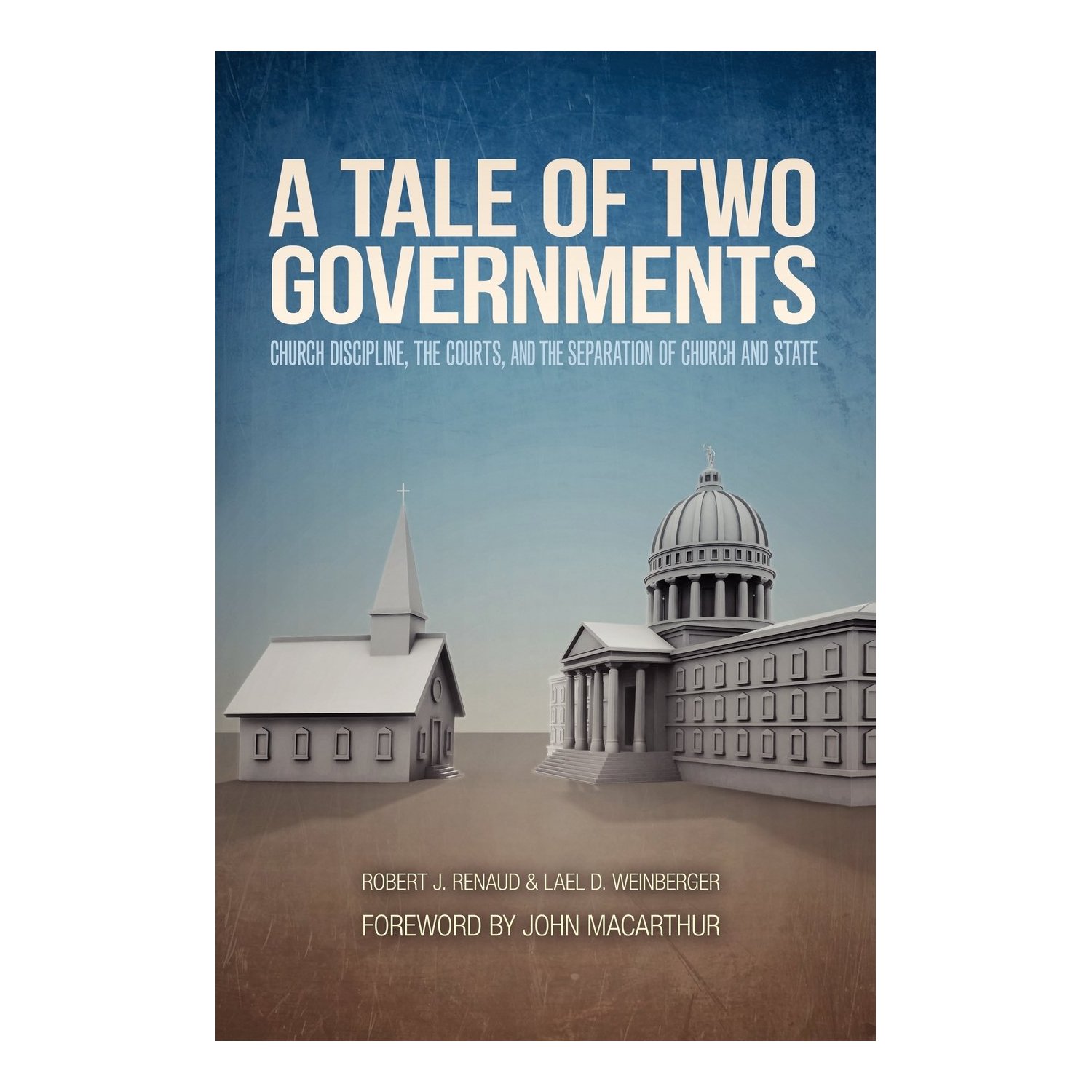
The name of the book that was the subject of the review is, “A Tale of Two Governments” by Robert J. Renaud and Lael D. Weinberger. The review was written by David V. Edling (http://goo.gl/gvPed). Edling is co-author of “Redeeming Church Conflicts”(Baker, 2012) and was the director of church relations at Peacemaker Ministries before his retirement. Peacemaker Ministries was formed to deal with the onslaught of lawsuits resulting from the recent resurgence of authentic Geneva style Calvinism and its tyranny.
The authors and the reviewer bemoan the fact that lawsuits may prevent churches from moving forward with church discipline, and the book apparently offers a clear path to overcoming those fears by implementing protocols that will prevent lawsuits or prevent a negative legal judgment against a church. According to Edling:
While fear of having to interact with the secular courts and fear of man may dampen the zeal to follow the biblical prescription when a church member hardens his or her heart and remains stuck in sin, these authors effectively refute the idea that such excuses hold any validity. The most significant contribution these authors make to life together in the church today is to provide church leaders and members with confidence—confidence that these common fears can be replaced with the knowledge that being biblical is protected by the laws that govern both church and state.
One should note with much ado that “sin” is anything that Reformed elders say it is. Parishioners often assume that Reformed elders define sin worthy of church discipline by a literal biblical definition. While such naivety is adorable, it is far from reality.
Edling continues with the following statement that is chilling to anyone one who knows the real truth about Reformed doctrine and history:
The foundation for their argument is Scripture. They effectively exegete the relevant passages, including an explanation of how Jesus proclaimed he would build his church by giving men “the keys of the kingdom of heaven” (Matt. 16:18-19), that is, the unique authority both to open the kingdom (through the preaching of the gospel) and to regulate its internal administration (through the practice of church discipline, binding and loosing sin). Using a threefold approach of (1) church history (specifically a “high point” review of 2,000 years of church-state relations); (2) a concise review of the common law and American jurisprudence (the development of the current legal doctrine called “church autonomy”); and (3) practical theology (how to keep your church out of court), Renaud and Weinberger deftly weave together their “tale” that leaves the reader with only one conclusion: if we are wise, we need not fear the courts or the reaction of our church members as we fulfill the call of Christ to love his people and build his church as he has directed using church discipline to restore, protect, and keep pure that for which he died.
Did Christ give Reformed elders a “unique” authority to “bind and loose sin” on earth? The apostles claimed no such “unique authority,” but rather constantly referred to the authority of Scripture and the ability of the saints to interpret it for themselves (Acts 17:11). The apostle Paul called on everyday saints to judge what the true gospel is for themselves (Galatians 1:8), and to only follow leaders AS they follow Christ. Furthermore, you can be certain that the authors only cover the “high point[s]” of Reformed history as it is saturated with the blood of those who disagreed with the Reformers. In the same way that people pick their noses in their cars and somehow think others cannot see them, Reformed elders think that the bloody oligarchy of Reformed history cannot be read. And “church autonomy” was not intended to protect either church or state from each other. With Reformed history fresh in their minds, the framers of the constitution sought to prevent cooperation between the two for the expressed protection and well-being of the people.
The reviewer continues with the following statement that can only be said to reveal how ignorant they believe the saints are:
What does it mean for the church to “be wise” from a secular legal perspective in light of the many court cases that have been decided over the years? As these authors summarize, church leaders must be aware of legal principles that will protect the church in its practice of discipline. Failure to stay within these boundaries may leave the church unprotected. The “church autonomy” doctrine is built on the First Amendment’s embedded theology that God established two separate but equal governments, but the First Amendment doesn’t necessarily bar all claims that may touch on religious conduct. To protect the legal distinction church leaders must understand that their jurisdiction to practice discipline depends on following the law. Central to understand is the “implied consent” that exists in a truly voluntary relationship between church and member (typically through formal membership), that an act of discipline must be grounded in a church’s doctrinal commitments that have been clearly articulated and are supported by recognized religious belief and practice, and that the church must have a clearly stated policy for the practice of biblical church discipline (usually set forth in its constitution or bylaws). Further, church leaders must help members understand the limits of confidentiality because church discipline, by definition, requires others knowing of the continuing sin in the life of one who fails to repent and change.
Here is the assertion that the church and the state are two separate “governments” with the church having its own “jurisdiction.” This mentality should send cold chills running up the back of any thinking person while running to reread the membership covenant they signed. The First Amendment has an “ embedded theology”? Really? I will say this as lovingly as I can: if you sign a membership covenant with any church, you need your head examined—the Reformed claim that church membership equals being saved notwithstanding.
In his conclusion, the reviewer states the following:
Consider whether your church may be failing to obey God’s appointed means of soul care through the faithful and consistent practice of redemptive church discipline.
“Redemptive church discipline”? What’s that? The Scriptures never use the term “church discipline” let alone the former. That term should alert you that something may not be exactly right. I address church discipline issues in detail via a free ebook available on this blog: https://paulspassingthoughts.com/wp-content/uploads/2012/04/ebook-church-discipline.pdf and for good measure: https://paulspassingthoughts.com/2012/02/09/new-calvinism-and-hotel-california/
Meanwhile, don’t join a little Geneva. And if you’re in one get out. You’re in a cult. A doctrine/philosophy of control equals cult regardless of the nomenclature.
paul
PsychoHeresy Unawareness: Dr. John Street Shot the Sheriff, but He Didn’t Shoot the Deputy
 No doubt, PAM reveals many problems with the biblical counseling movement that one may expect when it is based on a false gospel. But John Street’s real sin is his participation in a mass propagation of a false gospel.
Dr. John Street, founder of Clearcreek Chapel in Springboro, Ohio has finally made it big in the biblical counseling movement. This is evident from the fact that he has become a target of PAM (PsychoHeresy Awarness Ministries). PAM is directed by Martin and Deidre Bobgan who without a doubt are the most formidable critics of the “biblical” counseling movement.
John Street is an elder at John MacArthur’s Grace Community Church in California, and the Chair of the graduate program for biblical counseling at the seminary associated with MacArthur’s church. Also, last time I checked, Street is the president of the National Association of Nouthetic Counselors (NANC).
In the most recent PAM newsletters (http://www.psychoheresy-aware.org/street_tmc&s.html and http://www.psychoheresy-aware.org/street_tmc&s_2.html) Street is barbecued for practicing counseling methods that the Bobgans deem unbiblical. PAM primarily decries the biblical counseling movement’s “problem-centered counseling” verses “Christ-centered Ministry” (http://www.psychoheresy-aware.org/e-books/CCMpcc-ebk.pdf ).
I am not sure what PAM means by “Christ-centered ministry,” but it seems to be a passive approach regarding the disciple’s role in sanctification:
This is why we say that those who minister to one another need to get in the way and out of the way. They need to be available, but they need to let God work rather than push their own agenda.
The idea of pushing our own agenda could mean “let go and let God” instead of pushing an agenda that just so happens to be God’s agenda. The wording is unsettling. Elsewhere the Bobgans write the following:
Christ-centered ministry encourages spiritual growth and depends on the Lord to do the work in each individual through His Word and Spirit. Therefore, one can confidently assure believers that this ministry is more effective, long-lasting, and spiritually rewarding than problem-centered counseling for those who are willing to go this way.
Depend on the Lord to do the work? At the very least, the Bobgans need to clarify their position more thoroughly because by and large, gospel contemplationism is the primary thrust of NANC counseling. One wonders if PAM is accusing NANC of what they are guilty of: an overly passive approach to sanctification.
And, NANC, when they were (past tense) helping many people, encouraged an aggressive role in sanctification by the counselee. Christians are called to “study to show thyself approved,” and then aggressively apply that truth to their lives in order to have a life built on a rock (Matthew 7:24).
This was NANC’s approach in the past, and it did result in massive professions of faith, and real lasting change. I know; I was there; I am a firsthand witness. This was before David Powlison via CCEF and company infiltrated NANC with the gangrene of progressive justification. Unbelievably, in broad daylight, Powlison admitted (during a lecture at John Piper’s church while Piper was on sabbatical searching for different “species of idols” in his heart) that NANC’s “first generation” counseling was in contention with “second generation counseling” over the very definition of the gospel!
And this is my point: PAM is focused on the supposed evil of “problem-centered” counseling (is the gospel itself not problem-centered? The gospel did not come to solve a problem?) while the real issue is that NANC and CCEF both propagate a blatant false gospel. The counseling is based on the fusion of justification and sanctification with gospel contemplationism as its practical application.
CCEF’s counseling is based on Sonship theology. Dr. Jay E. Adams nailed that doctrine specifically as the fusion of justification and sanctification in his book, “Biblical Sonship” published in 1999. Adams, in the book, decried Sonship’s position that regeneration is powered by the finished work of justification. CCEF then effectively infiltrated NANC and took it over with the same doctrine. I use over 200 pages to document all of this in “The Truth About New Calvinism” (thetruthaboutnewcalvinism.com).
Hence, we must assume that NANC counseling yields many ill results, and I will say this: PAM points them out though they are missing the much larger issue. Case in point:
The truth is that counselors and especially counselors with an agenda (their particular approach) too often take credit for successes and attribute failures to the counselees. The trumping truth is that success is primarily in the hands of the counselees….
And worse yet, The counselee’s “failure” ends up in church discipline!
Also:
Problem-centered counseling is typically a one-to-one relationship. Sometimes couples and families are involved, but the relationship is generally artificial and restrictive. The counseling relationship itself usually does not extend outside the counseling room. The relationship lasts as long as counseling is being provided and normally does not extend to other involvement, even in most biblical counseling centers. Problem-centered counselors commonly do not involve themselves with counselees outside the counseling room. That is why both psychological and biblical counselors sometimes use intake forms requesting a great deal of personal information. Because this relationship is generally isolated, the counselor and counselee can be selective as to what they want to reveal about themselves. In fact, as we mentioned earlier, research shows that counselees often lie to their counselors and protect themselves by concealing important information.
The great advantage of Christ-centered ministry is that it is not limited to an artificial one-to-one relationship where one has the problem and the other supposedly has the solution. In the Body of Christ all are growing together. there are many opportunities to know one another and to interact in genuine relationships. When a believer is experiencing problems, more than one person may be involved in ministering to that individual. One may be teaching. One may be reminding. Another may simply be extending support and fellowship. Another may be helping in practical ways. Another may be exhorting. Another may be admonishing. And, in a few cases, some may be exercising the responsibility of disciplining a fellow believer for the sake of restoration. But, all can be praying and encouraging the individual in the direction of the Lord. And, through all this, all are growing together and the relationships may deepen with one another as well as with the Lord.
No doubt, PAM reveals many problems with the biblical counseling movement that one may expect when it is based on a false gospel. But John Street’s real sin is his participation in a mass propagation of a false gospel. It reminds me of Eric Clapton’s ode to one who objects to being accused of shooting a deputy when he really shot the sheriff.
paul
John MacArthur’s Showing Without Telling: The Reformed Way of Preaching Progressive Justification
“Moreover, this paradigm, according to many Calvinists in our day including John MacArthur, asserts that Christians often obey and experience biblical truth that they are unaware of intellectually.”
“MacArthur had a choice: the authority of Scripture or Reformed orthodoxy; he chose the latter.”
“And, what exactly are the ‘implications’ that John MacArthur ‘explains’ from the text? If you assume a many-faceted full counsel of God, your assumptions would be dead wrong.”
Progressive justification is the gospel of John Calvin and present-day neo-Calvinists of all stripes. Forget the freewill/election debate; forget all of the haranguing over the residual issues; progressive justification is simply a false gospel.
It teaches that the power for our Christian living comes from our salvation or justification. At first, you may object to my objection on the bases that salivation makes Christian living possible, and I agree, but making Christian living possible and being directly powered by it are two opposing ideas with a crucial difference.
If Christian living is powered by our salvation (justification), and if our salvation does more than change our standing, position, or status, Christian living (sanctification) remains connected to our justification. This makes sanctification a spiritual minefield with endless and sobering implications.
Of which the least is not: preaching. When justification and sanctification are fused together, we are interacting with our justification throughout life; this would seem evident and terrifying to those who understand the implications because we can supposedly do things in our sanctification that can affect our standing before God.
Hence, in this fusion of the Reformed “golden chain of salvation” (what’s a chain?) we must be careful in how we (according to John Piper) participate in the links because we are not home free and there is a danger in sanctification. No kidding. There would be when justification and sanctification are fused together.
Furthermore, because this makes sanctification very tricky, the children of God (according to Doug Wilson) will be manifested at the last judgment. I sometimes receive complaints here at PPT that John Piper et al seem to state that we cannot know for certain whether we are saved or not until the last judgment. I am not surprised by these questions; they would be consistent with the logical conclusions one must draw from the theology.
This now brings us to our discussion about preaching. Obviously, Reformed pastors are going to be very careful not to preach in a way that will lead us in making our sanctification the ground of our justification. Or, leaping from the imperative to obedience. If we do not pre-bathe all obedience in our salvation, it is “making our sanctification the ground of our justification.” In Reformed circles, they call this, “The biblical command is grounded in the indicative event.” The indicative “event” is the crucifixion of Christ—all obedience flows from that event directly as the empowerment thereof—not a possibility that we participate in.
Therefore, all true obedience in the life of a believer is a mere natural flow experienced by joy and a willing spirit IF it is powered by our salvation. This is obtained through using our Bible to meditate on our salvation, and the works of Christ, and then just letting the Spirit take things from there. If the Spirit then instigates the obedience, it’s the Spirit applying justification to our sanctification and not us. Hence, we are safe from “making our own sanctification the ground of our justification.” Again, this is supposedly manifested and verified by joy (which Piper makes absolutely synonymous with saving faith and the struggle thereof dependent on our salvation [When I Don’t Desire God p.35]). Likewise, John MacArthur mimics the same nonsense as documented in the following PPT post:
Hence, creepy similarities to Piper’s theology appear in “Slave,” especially Pipers belief that true Christian obedience is always experienced as an unhesitating, natural response accompanied by joy. Throughout the book, MacArthur describes Christian obedience as “pure delight” and “joy-filled.” On page 208, he describes our experience as slaves to Christ as “not partially sweet and partially sour, but totally sweet.” This, despite what the apostle John clearly experienced as recorded in Revelation. But regardless of the fact that there is nothing sweeter than being a slave of Christ, to suggest that our experience is never mixed with bitterness (taste, not attitude) is just plain nonsense. A believer who has lost an unbelieving relative or close friend would be an example. Also, even though I realize the importance of joy in the Christian life, I make this observation in “Another Gospel” (page 78):
“Only problem is, among many, is the eleventh chapter of Hebrews contradicts everything in Piper’s statement above. Hebrews 11 is one of the more extensive statements on saving faith in Holy writ. The Hebrew writer defines the faith of at least twenty believers in regard to the decisions they made and obedience. Joy or pleasure, even pleasure in God, is not named once as being an attribute of their faith. The only semblance of feelings or emotions mentioned is that of strife and fear of God more than man. The truth of Hebrews 11, as well as many other Scriptures, makes a mockery of Piper’s theory of Christian hedonism.”
According to John Piper, if we find ourselves in a situation where we find no joy in the obedience—go ahead and obey, but be sure to ask God for forgiveness because of your sinful obedience (John Piper: Treating Delight as Duty is Controversial; pdf booklet available on Desiring God .org). Moreover, this paradigm, according to many Calvinists in our day including John MacArthur, asserts that Christians often obey and experience biblical truth that they are unaware of intellectually. A prime example of this would be the following excerpt from an article written by New Calvinist Bill Baldwin:
Give me a man who preaches the law with its terror and Christ with his sweetness and forgets to preach the law as a pattern of the fruit of sanctification and what will result? In two months his parishioners will be breaking down his door begging to be told what behavior their renewed, bursting with joy, hearts may best produce. And when he tells them, they will be surprised (and he will not) to discover that by and large they have produced exactly that. And where they haven’t, take them back to Christ again that they may contemplate him in all his glorious perfection so that they may better understand what sort of God and man he was and is (Bill Baldwin: Sanctification, Counseling, and the Gospel 08/02/1996).
My best information is that MacArthur bought into this nonsense circa 1994. He was persuaded by, among others, John Piper and Michael Horton that the Reformers in fact held to a progressive justification. MacArthur had a choice: the authority of Scripture or Reformed orthodoxy; he chose the latter. Therefore, MacArthur’s preaching will ape that of most Reformed teachers: heavy on the glory of God and very light on practical application or specific instruction. As Baldwin states it: “….the law as a pattern of the fruit of sanctification.”
And even though MacArthur is far more subtle in his anti-instruction/application than most Calvinists (probably due to the habits of his prior preaching which was heavy on sanctification elements), Christians have nevertheless noticed his lack of application (most likely due to the contrast) and questioned him on it. His defense reveals his dastardly selling out of the truth.
In, “Why doesn’t John MacArthur add much application to his sermons?” (Online source: http://goo.gl/P0eR9), MacArthur defends his Reformed Application Light sermons. But for you skeptics, let me get your attention. In regard to my accusation that this paradigm doesn’t require intellectual knowledge for experience or application, MacArthur concludes his defense by stating the following:
So now you know. You’ve been experiencing this. You had no idea what you were experiencing, right? (Applause) Okay.
The “applause” part of the transcript is the barf factor when one ponders the mindless following of philosopher kings such as “Pastor” John MacArthur Jr. Nevertheless, MacArthur continues:
Now let me tell you what happens when you preach effectively. You do explanation. In other words, you explain the meaning of Scripture, okay? The explanation carries with it implication. In other words, there are implications built into this truth that impact us. You add to that exhortation. And I’ve said things tonight to exhort you to follow what is implied by the text. Now when you deal with the text and the armor of God, like tonight, all I can do is explain it. That’s all it does. There aren’t any applications in that text. It doesn’t say, “And here’s how to do this if you’re 32 years old, and you live in North Hollywood.” “Here’s how to do this the next time you go to a Mall.” “Here’s how to do this when you go in your car and you’re driving in a traffic jam.” It doesn’t tell you that. And if I made my message mostly a whole lot of those little illustrations, I would be missing 90 percent of you who don’t live in that experience.
Unfortunately, MacArthur has gone the way of New Calvinist ungodly communication. He makes application of Scriptures the same thing as applying it to petty life concerns; such as, going to the mall. It’s the classic New Calvinist demeaning of biblical application and obedience. What is really behind it is an antinomian spirit. Let me point out MacArthur’s error in regard to the above quote concerning the idea that there is no application in Ephesians 6:16-20, only “explanation.” That text is full of imperatives and applications in regard to the full armor of God: “Put on…., stand against…, take up…, that you may be able…., having done all…., having put on…., Stand therefore…., having fastened…., and having put on…., in all circumstances [what circumstances? It would be wrong to draw examples from our life?]…., with which you can…., to that end…., [etc., etc., etc].” To imply that Ephesians 6:16-20 doesn’t contain instruction for practical application is ludicrous.
Also, adding to the absurdity of MacArthur’s statement is the fact that “putting on” is a major theme of that passage. This refers back to Ephesians 4:20-24, and the Apostle Paul’s discussion of putting off the old nature and putting on the new. So, MacArthur is not only denying application from our life experience, but specific life application specified in Scripture. Dr. Jay E. Adams notes 45 life applications to the putting off/putting on concept that he didn’t deduct from life observation, but are specifically mentioned in Scripture regarding life application (INS Training in Biblical Counseling by Extension: Introduction Principles and Practices; pp.22-24).
Surely, other than what good preachers should be able to draw from life for biblical application, specific biblical applications regarding life are too numerous to list. For example, Paul states in I Corinthians 7:41 that Christians should only marry “in the Lord.” The life application is what Nehemiah stated about Solomon when he didn’t follow that mandate; ie., even a man of his spiritual wherewithal fell into grievous sin by violating said spiritual principle.
Nehemiah 13:26
Was it not because of marriages like these that Solomon king of Israel sinned? Among the many nations there was no king like him. He was loved by his God, and God made him king over all Israel, but even he was led into sin by foreign women.
No life application in that? Really?
MacArthur continues:
It’s not for me to do that. Application belongs to the Spirit of God. All I’m interested in is explanation and its implications [What about 2Timothy 3:16,17 and the issue of “instruction” ?]. And the power comes in the implication and the Spirit of God takes the implications of what I’ve said tonight, all these things I’ve said, I don’t need to say all kinds of little scenarios to you and paint all kinds of little individual circumstances. All I need you to know is this is what the Word of God says and the implications are powerfully brought to bear with authority on your life and I exhort you to respond to those implications, it is the Spirit’s work to drive those implications into direct and personal application. That’s why you’re not going to, like so many preachers, you’re not going to hear me create all kinds of practical scenarios about how this all fleshes out in everybody’s world because you may hit somebody, you may hit a person here or there, that’s kind of a rifle-shot approach, the shot-gun approach that sprays everybody is the implicational essence of Scripture. That’s the power. And that’s when everybody walks out and says, “Wow, that hit me!” because you already have a commitment to the authority and the power of Scripture.
So, Reformed preaching merely explains Scripture, and the Holy Spirit applies it. So what do we need “instruction” for? (2Timothy 3:16,17). As we have clearly seen, this is an iffy proposition. If this is the case, why does the Bible command specific life application? Does the Spirit need to inform Christians as to what He may or may not do in their lives? I contend that this is MacArthur’s nuanced way of propagating the whole Reformed idea that the Holy Spirit obeys for us, so that our sanctification will not be the “ground of our justification.”
MacArthur further explains:
You already have a commitment to the truthfulness of Scripture. All I want you to understand is what it means. And in the meaning expanded beyond the given text to other texts so that you build all the theological implications, I leave you with the implications and an exhortation to be obedient and I leave the application to the Spirit.
Obedient to what? Obviously, there can be no specific instruction from the pulpit, only “explaining.” Instruction would imply specific application of the text. So, not only does the Holy Spirit apply the text, does he also teach the Christian how to apply it specifically? Or does that just come as a mere natural flow? Well, since, “So now you know. You’ve been experiencing this. You had no idea what you were experiencing, right?” Answer: like Baldwin, and for that matter, all New Calvinists, the “obedience” is “experienced” (not personally applied) without necessary intellectual understanding or knowledge. Let me reiterate MacArthur’s exact words:
So now [present tense] you know. You’ve been [past tense] experiencing this [experiencing what? Answer: obedience]. You had no idea [this should speak for itself….] what you were experiencing, right?
Right John. Whatever you say.
And, what exactly are the “implications” that John MacArthur “explains” from the text? If you assume a many faceted full counsel of God, your assumptions would be dead wrong. MacArthur makes it clear what should be primarily mined from the Scriptures in his Forward to Rick Holland’s Gnostic masterpiece, Uneclipsing The Son:
As believers gaze at the glory of their Lord—looking clearly, enduringly, and deeply into the majesty of His person and work—true sanctification takes place as the Holy Spirit takes that believer whose heart is fixed on Christ and elevates him from one level of glory to the next. This is the ever-increasing reality of progressive sanctification; it happens not because believers wish it or want it or work for it in their own energy, but because the glory of Christ captures their hearts and minds. We are transformed by that glory and we begin to reflect it more and more brightly the more clearly we see it. That’s why the true heart and soul of every pastor’s duty is pointing the flock to Christ, the Great Shepherd….The pastor who makes anything or anyone other than Christ the focus of his message is actually hindering the sanctification of the flock.
What MacArthur endeavors to “explain” in every verse of Scripture is Jesus and His works (as stated by many New Calvinists), “not anything we would do.” As can be seen in the above MacArthur quote, he also follows the Reformed tradition of making God the Father and the Holy Spirit of lesser significance than Christ. Sadly, throughout church history, those of Reformed tradition has burned many at the stake for misrepresenting the Trinity while they are in fact guilty of the same thing.
There is certainly no reason to believe that MacArthur has not completely embraced this doctrine which also suggests that the saints can only get an adequate explanation of the Scriptures from Reformed elders. Saints dare not even fill up half of their plate with anything but Reformed elder preaching:
You think, perhaps, that [you] can fill up the other half of the plate with personal study, devotions, or quiet times, or a radio program. Beloved, you cannot. Scripture is relatively quiet on such practices. But on preaching, the case is clear and strong. Neglect preaching and neglect your soul (Elder Dr. Devon Berry: How to Listen to a Sermon; Clearcreek Chapel .org).
MacArthur’s defense of his preaching being discussed here implies the same idea:
But I want you to understand, if you don’t already understand, what I think should happen in effective biblical preaching. You heard a testimony tonight in the waters of Baptism from Juan about how he kept coming to Grace Church. And in spite of the fact that he wanted to be a hypocrite, the power of the Scripture began to overwhelm him.
Notice that the “power of the Scripture,” which should be understood in context of what we are discussing here, is not the primary crux of the point, but rather, “….he kept coming to Grace Church.” The “power of the Scripture” coming from the pulpit at Grace Church seems to be the point, and would also fit with the Reformed view of anointed elder preaching. MacArthur’s Bible Commentary is now published in the official New Calvinist translation of the Bible, The English Standard Version. It is published by Crossway, which is totally in the tank for New Calvinism. In the following promotional video clip, MacArthur hails the translation as the best ever: http://youtu.be/L1VxhQqsGXU. Again, MacArthur is now a dyed in the wool New Calvinist in the same order of the ones he supposedly despises like Mark Driscoll. While whining about their view of alcohol use among Christians and other residual issues, he is a believer in the same gospel (progressive justification).
The fact that John MacArthur is one of the most popular preachers in church history should be a chilling realization for those Christians who still love the truth.
He is also an excellent acid test for those who really want to know if they are followers of men or followers of the truth.
paul

 Paul's Passing Thoughts
2 comments