Calvinism’s Denial of Scripture, the New Birth, and the Trinity
 Part and parcel with being a cultist is the ability to communicate your false doctrine in a truthful sounding way. Martin Luther and John Calvin were perhaps the best there has ever been at that.
Volume one of The Truth About New Calvinism sought to primarily do one thing: document the contemporary history of New Calvinism and address some of its doctrinal quirks. New Calvinists claim to have rediscovered the authentic Reformation gospel; I didn’t address that question in volume one because much additional research was required to answer that question. Volume two answers that question, and the answer is “yes.” New Calvinists have the authentic Reformed doctrine down pat, and if not for them, we probably would have never known what the Reformers really believed. I believe John MacArthur has adopted New Calvinism because he was rightfully convinced by John Piper and others that this is what the Reformers believed. In other words, MacArthur’s enamoration with the Reformation motif has led him astray.
What makes Calvinism, the articulation of Lutheranism, so deceptive is the emphasis on two metaphysical realities and the interpretation of all reality through that dualism: our sinfulness and God’s holiness. Much can be written and agreed upon in regard to these two points. So, Sunday after Sunday we hear sermons based on these two biblical concepts only, and probably without much complaint and in many cases much praise.
But this isn’t the full counsel of God, and the overemphasis on these two points and the exclusion of all else eventually leads to the unenviable results. The apostle Paul equated teaching the full of God from house to house night and day with not having the blood of men on his hands.
This brings us to the Emphasis hermeneutic. This is THE Reformation epistemology. This is their key to putting the Bible into use. Luther laid the framework in his Heidelberg Disputation to the Augustine Order and Calvin articulated it in the Institutes of the Christian Religion. In the first sentence of chapter one, Calvin introduces Luther’s dualism, and the rest of the Institutes flow from this concept. All of the Institutes build on the very first sentence that states wisdom is known by knowing us and knowing God more and more. For all practical purposes, the knowledge of good and evil. This is Luther’s Theology of the Cross in his disputation which was written six months after the 95 Theses. The latter was the moral protest; the former is the foundation of Reformation theology. Almost everything that the New Calvinists teach can be found in Luther’s Disputation including John Piper’s Christian Hedonism.
Luther believed that all reality was to be interpreted through the cross story. And by the way, as an aside, this is the first tenet of New Covenant Theology. Luther’s construct was strictly dualist: God’s story, or our story—the cross story or the glory story. A matter of emphasis. Certainly, Luther concurred that many things other than the cross story are TRUE, and to some extent VALUABLE for lesser concerns apart from the Christian faith, but in Luther’s view, any religious matter that distracted from the cross work of Christ diminished God’s glory and in most cases emphasized us instead; i.e., the glory story—our glory, not God’s.
The Emphasis hermeneutic is a Gnostic concept. This shouldn’t surprise us as Augustine’s penchant for Gnosticism is well known and Luther/Calvin were his mentorees. Calvin cites Augustine, on average, every 2.5 pages in the Institutes. Earthly things are a shadow of reality and the “true and the good.” Through education and knowledge one can obtain understanding of the true and the good. In Luther’s construct, Christ was the full representation of the true and the good. Christ is the true and the good; as New Calvinists state it, He is “THE gospel.” The gospel is the true and the good. He is the SUN (Son). The sun/shadows interpretive illustration is key to understanding this Gnostic/Platonist concept.
This interpretive method enables Calvinists to deem many things true, but to the extent that we allow these things to take away from a laser focus on the source of all wisdom and life, THE SUN, sanctification is diminished. Let me repeat that, because it is the crux:
This interpretive method enables Calvinists to deem many things true, but to the extent that we allow these things to take away from a laser focus on the source of all wisdom and life, THE SUN, sanctification is diminished
The diminishing of sanctification: to the extent that we focus on anything else but Christ and the reason for the cross—our wickedness. The focus must be Christ’s crosswork. EVERYTHING points to Christ and interprets Christ. Anything that is true but doesn’t lead to more understanding of Christ casts a SHADOW on reality and wisdom. It is focusing on the shadow caused by whatever is blocking the Sun/Son. Anything that is not seen in a Chrsitocentric reality “ECLIPSES THE SON/SUN.”
Hence, seeing biblical commands in the Scripture as something we should see and do is the what? The glory story. It’s about “what we do, not what Christ has done” a favorite New Calvinist truism. Therefore, biblical imperatives are to be seen in their “gospel context” as a standard that Christ kept for us and imputed to our sanctification. The cross story is then lifted up because it shows Christ’s holiness as set against our inability to uphold the law in sanctification.
To do otherwise is to “eclipse the Son.” Once you know how to look for this, you can see it everywhere in the American church. John MacArthur wrote the Forward to the Rick Holland book, “Uneclipsing the Son” in which this Gnostic paradigm is the very theses. In the Forward, MacArthur states in no uncertain terms that to emphasize “ANYTHING” or “ANYONE” other than Christ is to diminish sanctification. “Pastor” Steve Lawson, in an address at the 2012 Resolved Conference implored young pastors to “come out from the shadows.” Pseudo biblical counselor Michael Emlet framed it as “CrossTalk” in his book that bears that same title. It is a cute play on words that frames any talk other than Christ’s crosswork as crosstalk, a technical communications term that refers to interference from multiple telephone lines transmitting over each other resulting in many jumbled conversations being heard. In this case, shadows and confusion are the same.
Also, another way that this is framed is in regard to our fruits, or good works. By emphasizing anything we do, we are “making a good thing the best thing” or “making the fruit the root.” In other words, to emphasize fruit obscures the root that gives the tree life: Christ. We should focus on Christ only which results in “transformation.” But “transformation” isn’t personal transformation. If we are transformed, that is the what? Right, the glory story. Here, the Calvinistic lingo is very subtle; instead of us changing via the new creaturehood of the new birth, we are transformed “into the image of Christ.” We don’t change, we experience MANIFESTATIONS.
In the recent 2013 Shepherds’ Conference MacArthur used John 3:3 to make a case that our good works are like “the wind blowing.” We feel its effects, we see its effects, but of course, we have no control over the wind. Like Luther, and according to authentic Reformed doctrine, MacArthur believes that these experiences of the wind are rebirths experienced by joy. That’s the Reformed definition of the new birth: a joyful experience of the wind accompanied by joy. This is why MacArthur made the absurd statement in the book “Slave” that obedience is never bittersweet, but always sweet. Right, apparently, Abraham was singing praises while on the way to drive a knife through his son.
This doctrine utterly dismisses any and all work, even by Christ, occurring inside the believer. “Faith” is in us, but according to Reformation doctrine, is not a work. Therefore, anything spoken of as being IN US, is actually, BY FAITH. Which is not a work. FAITH is therefore the conduit that makes ALL works taking place outside of us possible. This is why the doctrine is referred to as “The Centrality of the Objective Gospel Outside of Us.” Anything inside of us is subjective, or shadowy, because it involves the glory story.
Moreover, the work that we see outside of us is also subjective because it deals with wind-like occurrences. And because we are a “reflector” of the image, it will be difficult to know whether the occurrences are through our “own efforts” or the wind. This is why Luther stated in his Disputation that Christians should not be concerned with works or their manifestations. Even when it is the wind and not us, we “see through a glass dimly” and the wind is using a “dull instrument.” New Calvinists call this, “the subjective power of an objective gospel.” We focus on the objective through gospel contemplationism, and leave the manifestations to Christ. This is why John MacArthur has stated that it is his job to explain the biblical text, and then leave the results to the Spirit.
But even in regard to the Holy Spirit and God the Father, they are seen as members of the Trinity that better define Christ. To do otherwise would be to “eclipse the Son.” Remember, MacArthur said, “anything” or “ANYBODY.” It means just that, and is indicative of a large body of Reformed thought.
This undermines and denies the full counsel of God, the new birth, and the Trinity.
paul
NOTES
Forward to Uneclipsing the Son by John MacArthur:
As Christians we have one message to declare: “Jesus Christ, and Him crucified” (1 Corinthians 2:2). “For we do not preach ourselves but Christ Jesus as Lord, and ourselves as your slaves for Jesus’ sake” (2 Corinthians 4:5; cf. 1 Corinthians 2:2; Galatians 6:14).
Rick Holland understands that truth. This book is an insightful, convicting reminder that no one and nothing other than Christ deserves to be the central theme of the tidings we as Christians proclaim—not only to one another and to the world, but also in the private meditations of our own hearts.
Christ is the perfect image of God (Hebrews 1); the theme of Scripture (Luke 24); the author of salvation (Hebrews 12:2); the one proper object of saving faith (Romans 10:9-10); and the goal of our sanctification (Romans 8:2). No wonder Scripture describes the amazing growth-strategy of the early church in these terms: “They ceased not to teach and preach Jesus Christ” (Acts 5:42). That is the only blueprint for church ministry that has any sanction from Scripture.
The pastor who makes anything or anyone other than Christ the focus of his message is actually hindering the sanctification of the flock. Second Corinthians 3:18 describes in simple terms how God conforms us to the image of His Son: “And we all, with unveiled face, beholding the glory of the Lord, are being transformed into the same image from one degree of glory to another” (emphasis added). We don’t “see” Christ literally and physically, of course (1 Peter 1:8). But His glory is on full display in the Word of God, and it is every minister’s duty to make that glory known above all other subjects.
As believers gaze at the glory of their Lord—looking clearly, enduringly, and deeply into the majesty of His person and work—true sanctification takes place as the Holy Spirit takes that believer whose heart is fixed on Christ and elevates him from one level of glory to the next. This is the ever-increasing reality of progressive sanctification; it happens not because believers wish it or want it or work for it in their own energy, but because the glory of Christ captures their hearts and minds. We are transformed by that glory and we begin to reflect it more and more brightly the more clearly we see it. That’s why the true heart and soul of every pastor’s duty is pointing the flock to Christ, the Great Shepherd.
After more than four decades of pastoral ministry, I am still constantly amazed at the power of Christ-centered preaching. It’s the reason I love preaching in the gospels. But I discovered long ago that the glory of Christ dominates Romans, Galatians, Colossians, Hebrews, Revelation—and the rest of Scripture as well. Focusing on that theme has led my own soul and our congregation to a fuller, richer knowledge of Christ—loving Him, worshipping Him, serving Him and yearning for the day when we shall be like Him, having seen Him in His glory (1 John 3:2).
Our prayer is that of Paul: “that I may know Him!” (Philippians 3:10). The apostle knew Him well as Savior and Lord (having been privileged to be the last person ever to see the resurrected Christ face to face, according to 1 Corinthians 15:8)—but never could Paul plumb the rich, sweet depths of the glories of Christ, the inexhaustible, infinite Treasure. Far from allowing Christ to be eclipsed—even partially—by any other object or affection, every believer should pursue with relentless zeal the “full knowledge of the glory of God” provided by a fervent concentration “on the face of Christ” (2 Corinthians 4:6).
The Christian life is Christ—knowing Him in the height and breadth of His revelation, loving Him for the greatness of His grace, obeying Him for the blessing of His promises, worshipping Him for the majesty of His glory, and preaching Him for the honor of His Name: “But grow in the grace and knowledge of our Lord and Savior Jesus Christ. To Him be the glory both now and to the day of eternity. Amen” (2 Peter 3:18).
No greater subject exists than Jesus Christ—no greater gift can be given than uplifting His glory for another soul to see it and be changed by it. This book will be a wonderful help to anyone who senses the need to orient one’s life and message properly with a Christ-centered focus. It is full of fresh, practical, and memorable spiritual insight that will show you how to remove whatever obstacle is blocking your vision of the Son
and allow His light to blind you with joy.
—John MacArthur
Pastor-Teacher, Grace Community Church, Sun Valley, California
April, 2011
John Piper: Don’t Waste Your Life (pp. 58-59).
The sunbeams of blessing in our lives are bright in and of themselves. They also give light to the ground where we walk. But there is a higher purpose for these blessings. God means for us to do more than stand outside them and admire them for what they are. Even more, he means for us to walk into them and see the sun from which they come. If the beams are beautiful, the sun is even more beautiful. God’s aim is not that we merely admire his gifts, but, even more, his glory.
Now the point is that the glory of Christ, manifest especially in his death and resurrection, is the glory above and behind every blessing we enjoy. He purchased everything that is good for us. His glory is where the quest of our affections must end. Everything else is a pointer – a parable of this beauty. When our hearts run back up along the beam of blessing to the source in the blazing glory of the cross, then the worldliness of the blessing is dead, and Christ crucified is everything.
This is no different than the goal of magnifying the glory of God that we saw in Chapter 2. Christ is the glory of God. His blood-soaked cross is the blazing center of that glory. By it he bought for us every blessing – temporal an eternal. And we don’t deserve any. He bought them all. Because of Christ’s cross, the wrath of God is taken away. Because of his cross all guilt is removed, and sins are forgiven, and perfect righteousness is imputed to us, and the love of God is poured out in our hearts by the Spirit, and we are being conformed to the image of Christ.
Therefore every enjoyment in this life and the next that is not idolatry is a tribute to the infinite value of the cross of Christ – the burning center of the glory of God. And thus a cross-centered, cross-exalting, cross-saturated life is a God-glorifying life – the only God-glorifying life. All others are wasted.
New Calvinists Think it is Cool and Funny to Reject the New Birth
“You must be born again.”
~ The Lord Jesus Christ
My Answer to Justin Taylor and Pyro Blog Regarding the “Gospel-Centered” Take on “Gossip.”
 “None of these videos will make sense for anyone who doesn’t follow this brand of blogging or this brand of gospel centrism. I admit that.”
~Frank Turk
“By the way, the term, ‘gospel-centered’ saturates the Pyro blog, and it means much more than you think it does. Understanding the meaning of this term is key to understanding why they think the crying out on behalf of raped children is gossip…. This is much more than just a common understanding of how we are saved—this is a radical worldview.”
“Susan also came from such circumstances and slept one night in contemplation with a gun under her pillow. ‘Survivor’ is a word that is only worthy of irony in the minds of New Calvinists like Frank Turk who have a twisted worldview. And one only needs to read the SGM legal brief to know exactly who Frank Turk is mocking.
As the New Calvinist cartel circles the wagons around CJ Mahaney, an abnormal number of blog posts concerning “gossip” have appeared on the Evangelical blogosphere. I checked my calendar to see if perhaps February 12 is Gossip Awareness Day. Hmmmm, not finding it on the calendar.
Dan Phillips is one of the authors of the Team Pyro blog along with Frank Turk. Phil Johnson, most prominent in the John MacArthur venquilitrist show, is a former author on the blog. Phillips posted the exact same article that Justin Taylor posted (and the same day) on the Gospel Coalition blog. The post insinuates that the survival of a local church is paramount to all else. “Gossip” is a “church-killer.” Bill Gates would be asking me for money if I had a nickel for every time we hear this from the who’s who of New Calvinism:
Yes, yes, what they did to you is horribly wrong! But exposing this under any circumstances could destroy that church, and whoever destroys the temple of God will be destroyed by God!
Per the normal, an exegetical argument from the Bible was not executed, but rather run of the mill Reformed orthodoxy. That brings us to the gospel-centered motif that drives almost everything in the American church in our day. By the way, the term, “gospel-centered” saturates the Pyro blog, and it means much more than you think it does. Understanding the meaning of this term is key to comprehending why they think the crying out on behalf of raped children is gossip. And it starts with orthodoxy. In the Reformed construct, elders receive the word from God, and then repackage it in a way that can be understood by the totally depraved unenlightened masses. Hence:
It is wholly an issue of whether or not authority comes from God through the Scripture to the elders and pastors of your church and is therefore the basis for their credibility and their exercise of spiritual responsibility.
This was a comment made by Frank Turk in the comment thread of a Post by Johnson entitled “Should Type-R Charismatics Get A Free Pass?” Type-R refers to Reformed Charismatics. And yes, according to Team Pyro, they should get a pass because….
I have warm affection and heartfelt respect for most of the best-known Reformed charismatic leaders, including C. J. Mahaney, Wayne Grudem, and Sam Storms. [Let’s call them “Type-R Charismatics.”] I’ve greatly benefited from major aspects of their ministries, and I regularly recommend resources from them that I have found helpful. I’ve corresponded with the world-famous Brit-blogger Adrian Warnock for at least 15 years now and had breakfast with him on two occasions, and I like him very much. I’m sure we agree on far more things than we disagree about. And I’m also certain the matters we agree on—starting with the meaning of the cross—are a lot more important than the issues we disagree on, which are all secondary matters.
Got that? ALL other issues apart from their “meaning of the cross,” i.e., gospel-centered are “secondary.” This is the tie that binds. “Cross-centered” and “gospel-centered” are often used interchangeably. This is much more than just a common understanding of how we are saved—this is a radical worldview. The uniqueness of it can be further demonstrated by this:

We are glad that you admit it Frank. Refreshing. But before we continue, let me interject an example of the kind of hypocrisy that comes part and parcel with this worldview. Here are the five points outlined in the post by Pyro and TGC blogs:
1. Ask, “Why are you telling me this?”
2. Ask, “What’s the difference between what you’re telling me and gossip?”
3. Ask, “How is your telling me that thought, that complaint, that information going to help you and me love God and our brothers better, and knit us closer together as a church in Christ’s love?”
4. Ask, “Now that you’ve told me about that, what are you going to do about it?”
5. Say, “Now that you’ve told me about that, you’ve morally obligated me to make sure you talk to ____ about it. How long do you think you need, so I can know when this becomes a sin that I will need to confront in you?”
But yet, consider this by Phil Johnson:
Shortly after that (in early 1992), John MacArthur, Lance Quinn, and I met with Paul Cain and Jack Deere in John MacArthur’s office at Jack Deere’s request. Deere wanted to try to convince John MacArthur that the charismatic movement—especially the Vineyard branch—was on a trajectory to make doctrinal soundness and biblical integrity the hallmarks of Third-Wave charismatic practice. He brought Cain along, ostensibly so that we could see for ourselves that Cain was a legitimate prophet with a profound gifting.
But Cain was virtually incoherent that day. Lance Quinn remarked to me immediately afterward that it seemed as if Cain had been drinking heavily. (In retrospect it seems a fair assumption that this may indeed have been the case.) Even Deere apologized for Cain’s strange behavior that day, but Deere seemed to want us to assume it was because the Spirit was upon Cain in some unusual way. They both admitted to us that Cain’s “prophecies” were wrong at least as often as they were right. When we cited that as sufficient reason not to accept any of their prophecies at face value, they cited Wayne Grudem’s views on New Testament prophecy as justification for ignoring the errors of prophecies already proven false while giving credence to still more questionable pronouncements (Ibid.)
If Johnson and Quinn confronted Cain about their concerns before they gossiped to Deere about it, they may have known exactly why Cain was acting the way he was. Furthermore, why was his demeanor relevant to what he specifically stated? Moreover, unbeknownst to Deere or anyone else for that matter, Cain could have been on medication for a medical problem. That is why Matthew 18 states that if you have a concern or issue with someone; first, go to them “ALONE.” This is only a grain of sand on the beach in reference to the kind of hypocrisy that is constantly vomited out of the Pyro blog and is indicative of their grossly distorted worldview.
What is that view? I have written on this extensively, but here I go again. Volumes could be written about this, but I am stating what coincides with the subject of justice. Luther’s Heidelberg Disputation was written about six months after the 95 Theses disputation. It is really the magnum opus of the Reformation. Calvin then took Luther’s HD worldview which he got from Pope Gregory/Augustine and developed it into a full orbed philosophical statement adorned with Bible verses. That would be the Calvin Institutes.
Reformed theology sees all reality from Luther’s Theology of the Cross. Basically, there is only two prisms from which to interpret the world: the glory story (existentialism), or the cross story (all reality is seen through objective redemption history outside of us). The cross story objectively categorizes all of life into two categories: God’s holiness and our sinfulness. Reality is the difference between the two and defines each more fully leading to greater and greater understanding. The first known counseling manual written by a clergyman was based on this concept; i.e., Gregory’s “Pastoral Care,” which is the model for most Reformed pastoral counseling in our day. Everything else is the glory story which is considered to be a gargantuan cesspool of subjectivism; specifically, anything at all about us.
….I think that the idea that Christians have been given The Truth, and The Truth is utterly embodied in Christ, and that we shouldn’t pretend like other explanations of reality have any worth because they have no eternal worth is, at its core, the only true monotheism. Its unquestionable that this is the reason we evangelize and not merely discuss our faith as if it was one of several viable choices (Frank Turk: Unleash the Response; Pyro blog).
It’s really a great gig if you want to believe in it. You can totally separate yourself from the realities of the world by focusing your whole mindset on our worthlessness, powerlessness, and hopelessness. All of our hope is in Christ and everything He has done—not anything we do. At all. To the degree that we are able to empty ourselves, we can detach ourselves emotionally from the world. This mindset enabled Puritan Christopher Love’s pregnant wife to write him a seemingly celebratory letter prior to his impending execution for meddling in English political affairs. Love could have escaped execution and not left his wife with a quiver-full to care for on her own by merely promising to mind his own business. He refused. Luther’s worldview, articulated by Calvin, spawned the most radical religious sect ever known to man—the Puritans, who are the envy of New Calvinists—particularity Phil Johnson.
Therefore, all of the misfortunes and tragedy of life serve to humble us. They eradicate the glory story, and lift up the cross story. Luther specifically states this idea in his HD. Life is about deathly humbling that brings about resurrections. These resurrections are experienced by joy in our deprivation for the clay vessel is being shattered and thereby allowing the glory of the cross to shine forth into the world. We have this treasure in earthen vessels; the glory of Christ, which can only be manifested when we suffer the way He did. All suffering is a cross event. Are we not to take up our cross and follow Him daily? Got cancer? Awesome! Another cross event! Been raped? What an awesome opportunity to show forth the forgiveness you have received! There aren’t any victims, just preordained cross opportunities.
This is why the Reformers were indifferent to suffering and didn’t take the concept of justice seriously. Calvin called justice, “mere iniquity” (CI 3.12.4). This is why New Calvinists disdain the idea of victims, justice, and “survivors.” They often preface these words in what we grammatically call scare quotes. Scare quotes preface the word with the idea of “supposedly,” or “so-called.” So, let me give you an example from Pyro blog:
OK: enough is enough. I’m opening this post and the comments below for one reason only: SGM “Survivors”.
Note the scare quotes utilized by Frank Turk. Interesting. You see, Susan and I counsel people who have left abusive church organizations, and when we asked one counselee to tell us about other families that left—this is what we heard:
Some turned their back on the faith. Some do church at home, and some committed suicide. Not many marriages survived.
Susan also came from such circumstances and slept one night in contemplation with a gun under her pillow. “Survivor” is a word that is only worthy of irony in the minds of New Calvinists like Frank Turk who have a twisted worldview. And one only needs to read the SGM legal brief to know exactly who Frank Turk is mocking.
This would also explain why Pyro continually defends the president of SGM, a defendant in the class action sexual abuse lawsuit filed against SGM. The following screen shots from Pyro illustrate this below, including Frank Turks indictment of SGM whistleblower Brent Detwiler:




This Reformed worldview is the reason for the present-day tsunami of spiritual/sexual abuse in the church. While the Reformed accuse dispensationalists of escapism their doctrine is a gnostic-like escape from the here and now. It has always appealed to intellectual elitists and run along the upper socio-economic paths. It avoids the messy, painful experience of fighting for the most vulnerable among us. Embracing pain and suffering as the gateway to joyful resurrections is the pastoral easy-button. This gives them time to blog about the “deep things” of God and supply cover for abusers.
The logic is the same, the mentality is the same, and the behavior is therefore the same: coldblooded, vindictive, and controlling.
paul
The “Cross Story” and Sanctified Rape in the Church
 “Be sure of it: this is how Calvinists think; this is their worldview.”
“Don’t misunderstand: the problem of ‘victim mentality’ is not even on the radar screen—they have removed the word “victim” from their metaphysical dictionary.”
“Justice necessarily implies victim. Victim necessarily implies worth. All three are conspirators with the glory story.”
Martin Luther had more on his mind than silly Popes when he nailed his 95 Theses to the front door of All Saints’ Church in Wittenberg, Germany. That protest launched the Reformation, but six months later Luther presented the systematic theology of the Reformation to the Augustinian Order in Heidelberg. Luther’s Heidelberg Disputation laid the foundation, and John Calvin later articulated and applied its basic principles to the full spectrum of life in his Institutes of the Christian Religion.
The Cross Story and the Glory Story
Luther’s cross story, or theology of the cross is the crux of the Heidelberg Disputation and introduced in the first sentence of the Calvin Institutes:
Our wisdom, insofar as it ought to be deemed true and solid wisdom, consists almost entirely of two parts: the knowledge of God and of ourselves.
That’s Luther’s theology of the cross: a deeper and deeper knowledge of our putrid humanity as set against God’s holiness. And NOTHING in-between. All of creation, all events, and all reality contribute to deeper knowledge of one of these two, and then both as a deeper knowledge of each gives more understanding to the other; knowledge of both, and the experience of both. Hence, every blessing, including our good works which are done by the Holy Spirit to begin with, lends more understanding of God’s glory. Every evil event, sin, and tragedy lends deeper understanding in regard to our total depravity and worthlessness. But of course your mother is dying of cancer; I am amazed that God would give anyone as many years as He has given her. Who are we to think we deserve even one year of life? And what a wonderful opportunity for her to suffer the way Jesus suffered for us!
This is the cross story. See the illustration below. This is a contemporary depiction from that camp—this is their assessment:

Anything else at all that gives any credit to humanity—Christian or non-Christian is the “glory story.” That would be our glory specifically, and not Christ’s. To the degree that humanity is considered, the glory of Christ is “ECLIPSED.” This is the theses of a book written by John MacArthur associate Rick Holland: Uneclipsing The Son. Everything is perceived as speaking through one of these two perspectives. ANYTHING coming from what is perceived as the “glory story” is summarily dismissed. Be sure of it: this is how Calvinists think. This is their worldview.
In one of the former Resolved Conferences sponsored by John MacArthur and Holland, in one of his messages, Holland extols a letter written to Puritan Christopher Love by his wife as he awaited execution. Holland forgot to mention to those listening that Love was executed for espionage against the English government while letting the audience assume he was executed for loftier spiritual-like reasons. The following is excerpts from the letter:
O that the Lord would keep thee from having one troubled thought for thy relations. I desire freely to give thee up into thy Father’s hands, and not only look upon it as a crown of glory for thee to die for Christ, but as an honor to me that I should have a husband to leave for Christ…. I dare not speak to thee, nor have a thought within my own heart of my own unspeakable loss, but wholly keep my eye fixed upon thy inexpressible and inconceivable gain. Thou leavest but a sinful, mortal wife to be everlastingly married to the Lord of glory…. Thou dost but leave earth for heaven and changest a prison for a palace. And if natural affections should begin to arise, I hope that the spirit of grace that is within thee will quell them, knowing that all things here below are but dung and dross in comparison of those things that are above. I know thou keepest thine eye fixed on the hope of glory, which makes thy feet trample on the loss of earth.
Justice? That implies that humanity has some sort of value. That implies that life itself has some sort of value. That implies that humanity should be protected through threat of punishment. That’s the glory story. Therefore, Calvin stated the following:
Those who, as in the presence of God, inquire seriously into the true standard of righteousness, will certainly find that all the works of men, if estimated by their own worth, are nothing but vileness and pollution, that what is commonly deemed justice is with God mere iniquity; what is deemed integrity is pollution; what is deemed glory is ignominy (CI 3.12.4).
Death by Biblical Counseling
The church must face up to a sobering reality in our day. The vast majority of biblical counseling that goes on in our day is based on this construct—you will be counseled from the perspective of the cross story, and anything that smacks of the glory story will be snubbed. You are not a victim. There is no such thing as a victim. Christ was the only true victim in all of history. Don’t misunderstand: the problem of “victim mentality” is not even on the radar screen—they have removed the word “victim” from their metaphysical dictionary. “Victim” is part of the glory story; Christ as the only victim is the cross story. I am not a victim. That’s impossible because my sin nailed Christ to the cross. Thank you oh Lord that I was raped. Thank you for this opportunity to suffer for you. Thank you for the strength to forgive the one who raped me in the same way you forgave me. What a wonderful opportunity to show forth your gospel!
Hence, when the leaders of a Reformed church came to inform parents that a young man in that church had molested their toddler, this was the opening statement:
Today, we have before us an opportunity to forgive.
The parents were then counseled to not contact the authorities. Those who do are often brought up on church discipline. Justice necessarily implies victim. Victim necessarily implies worth. All three are conspirators with the glory story. And be not deceived: this is the logic that drives Reformed organizations that are supposed to be mediators in the church; specifically, Peacemaker Ministries and G.R.A.C.E. A major player in the Biblical Counseling Movement is Paul David Tripp. In 2006, he wrote a book that articulates the horizontal application of Luther’s theology of the cross: “How people Change.” Of course, the title is a lie; if he really believed people change, that would be the glory story. Notice also that it is, “How People Change” and not, “How Christians Change.” That’s because this bunch see no difference in the transforming power of the new birth and ordinary Christ-rejecting people.
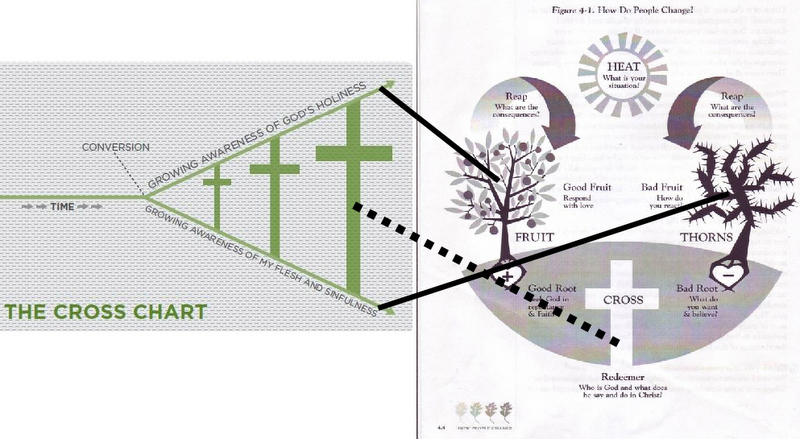
In the book, Tripp, like all who propagate Luther’s theology of the cross, posits the Bible as a “big picture” narrative of our redemptive life. The Bible is a mere tool for one thing only: leading us more and more into the cross story and away from the glory story. This is accomplished by using the Bible to enter into the cross narrative and thereby seeing our preordained part in the “big picture” narrative of redemptive history. Though Tripp is not forthright about it in the book, this is known as the Redemptive Historical Hermeneutic. By seeing our life through the cross story, we are empowered to live life for God’s glory. This is done by seeing ALL circumstances in life (Heat) as preordained in order to show our sinfulness (Thorns) and God’s goodness (Fruit) for the purposes of having a deeper understanding of both resulting in spiritual wellbeing. In other words, all of life’s circumstances are designed to give us a deeper understanding of the cross story: God’s holiness, and our sinfulness. I have taken his primary visual illustration from the book and drawn lines to the cross story illustration to demonstrate the relationship (click on image to enlarge):
Understanding this lends insight to Tripp citations on the Peacekeepers Ministries website:
Paul Trip wrote a great post over at The Gospel Coalition blog all about the need for pastors to pursue a culture of forgiveness in their ministry. Pastors (and anyone serving Christ) have a choice:
“You can choose for disappointment to become distance, for affection to become dislike, and for a ministry partnership to morph into a search for an escape. You can taste the sad harvest of relational détente that so many church staffs live in, or you can plant better seeds and celebrate a much better harvest. The harvest of forgiveness, rooted in God’s forgiveness of you, is the kind of ministry relationship everyone wants.”
Then he describes three ways forgiveness can shape your ministry. I’ve listed them, but you can read how he explains them in detail.
“1. Forgiveness stimulates appreciation and affection.
2. Forgiveness produces patience.
3. Forgiveness is the fertile soil in which unity in relationships grows.”
He closes with this exhortation:
“So we learn to make war, but no longer with one another. Together we battle the one Enemy who is after us and our ministries. As we do this, we all become thankful that grace has freed us from the war with one another that we used to be so good at making.”
And concerning another author, they also stated:
Last week, Steve Cornell at The Gospel Coalition blog posted some really great insight into the difference between forgiveness and reconciliation. They also offered up some excellent and biblically sound steps in dealing with a situation where an offending party is hesitant to reconcile.
Here he summarizes a key distinction:
“It’s possible to forgive someone without offering immediate reconciliation. It’s possible for forgiveness to occur in the context of one’s relationship with God apart from contact with her offender. But reconciliation is focused on restoring broken relationships. And where trust is deeply broken, restoration is a process—sometimes, a lengthy one”…. His ten guidelines for those hesitant to reconcile are rooted in scripture and, I think, incredibly helpful.
1. Be honest about your motives.
2. Be humble in your attitude.
3. Be prayerful about the one who hurt you.
4. Be willing to admit ways you might have contributed to the problem.
5. Be honest with the offender.
6. Be objective about your hesitancy.
7. Be clear about the guidelines for restoration.
8. Be alert to Satan’s schemes.
9. Be mindful of God’s control.
10. Be realistic about the process.
Notice the overall blurring of distinction between the offended and offender with the subject of forgiveness.
The Cross-centered Anti-justice Pandemic is No longer Exclusively a Reformed Thing
Apart from Calvinism, the redemptive historical cross-centered approach is crossing denominational lines en masse. We at TANC see doctrines that were born of Luther’s theology of the cross in non-Reformed circles constantly; specifically, heart theology (deep repentance), exclusive interpretation of the Scriptures through a redemptive prism, Gospel Sanctification, and John Piper’s Christian hedonism. And we also see the same results. It is not beyond the pale for a pastor who has raped a parishioner to be the one counseling the victim sinner. You know, the “sinner saved by grace.”
God is a God of justice, and throughout the Scriptures He demands that we be people of justice. He demands that we come to the defense of the victim. I close with fitting words from church historian John Immel:
And this is the challenge. This is the challenge that I have as a man who is passionate about thinking: to inspire people to engage in complex ideas that drive tyranny. So here’s my challenge to those who are listening.
Do not be seduced into believing that righteousness is retreat from the world.
Do not be seduced into believing that spirituality is defined by weakness and that timid caution for fear of committing potential error is a reason to be quiet.
Do not be intimidated by vague, hazy threats of failure.
Do not let yourself believe that faith is a license to irrationality. I’m going to say that again to you. This is good. Do not let yourself believe that faith is a license to irrationality.
Do not mistake the simple nature of God’s love for a justification for simple-mindedness.
Do not deceive yourself with the polite notion that you are above the fray, that your right to believe is sufficient to the cause of righteousness. There is no more stunning conceit.
Do not pretend that your unwillingness to argue is the validation of truth.
Know this: Virtue in a vacuum is like the proverbial sound in the forest–irrelevant without a witness. Character is no private deed. To retreat is nothing more than a man closing his eyes and shutting his mouth to injustice.
Virtues are not estimates to be lofted gently against evil.
Virtues are not to be withheld from view in the name of grace.
Virtues are not to be politely swallowed in humble realization that we are all just sinners anyway.
Love is not a moral blank check against the endless tide of indulgent action.
Love is not blind to the cause and effect of reality.
Love is not indifference to plunder and injustice and servitude.
The time is now, you men of private virtue, to emerge from your fortress of solitude and demonstrate that you are worthy of a life that bears your name. The time is now, you men of private virtue, to answer Mick Jagger and all the nihilists that insist we are living on the edge and we cannot help but fall. It is time for you men of private virtue to take up the cause of human existence and think.
~TANC 2012 Conference on Gospel Discernment and Spiritual Tyranny: John Immel; session 1, “Assumptions + Logic = Action.”
paul
The 2007 John MacArthur Controversy: “It’s the Judgments, Stupid”
“Here is what many are missing: you can’t separate the gospel from eschatology. Your eschatology will be consistent with your gospel or inconsistent.”
Who can forget James Carville’s motto to keep people focused in Bill Clinton’s 1992 presidential campaign? “The economy, stupid.” Carville didn’t want Clinton’s campaign workers to expend energy on matters that would not ultimately persuade people to vote one way or the other. Likewise, Christians love to pile-up Bible verses in a heap that doesn’t serve change in the least. Carville knew how to get change; Bush’s 90% approval rating could not keep him in office.
At the 2007 “Shepherds” Conference held annually at John MacArthur’s church in California, he opened the conference with a devastating, complete undressing of amillennialism. The controversy among the Reformed raged for several months. The often touted “In essentials, unity; in non-essentials, liberty; in all things, charity” was taken out with the morning trash. Per the usual, most of the Reformed gang who had spent their parishioner’s money to go to the conference moaned and screamed like alley cats in the night that MacArthur dissed “Reformed orthodoxy.” In the debate, also per the usual, Scriptural arguments were replaced with the endless droning of dead mystics and rabid Puritans.
But what’s the real issue? The real issue is sanctification by justification. That’s the authentic Reformed gospel; i.e., progressive justification. Bottom line: if there is a literal millennial kingdom before the new heavens and new earth, there must also be two resurrections and two judgments. That strongly insinuates two different groups and two different purposes in regard to the types of judgments. In the Reformed construct, there must be one judgment that determines everybody’s just state. MacArthur, even with all of his education doesn’t get that; his gospel of progressive justification doesn’t fit the eschatology that he dragged into his partial conversion to the authentic Reformed gospel.
This brings us to the four types of pastors in our day:
1. Authentic Calvinist: Luther and Calvin’s Gnostic progressive justification. These are the Neo-Calvinists wreaking havoc on the church in our day. Progressive justification (justification and sanctification are both monergistic because sanctification finishes justiifcation)/amil. Examples are Al Mohler, David Powlison et al.
2. Sanctified Calvinist: Leftovers from the periods in church history when authentic Calvinism dies a social death because of the tyranny that comes part and parcel with it. They change their soteriology but retain the eschatology of progressive justification. Monergistic justification/synergistic sanctification/amil. Examples are Jay Adams, and many other Presbyterians, and Baptist acadmiacs.
3. Inverted Calvinist: Converts to progressive justification that retain their former eschatology that is some form of dispensationalism. The best example is John MacArthur.
4. Biblicist: The Bible is their authority; not orthodoxy. This breed is an endangered species in our day.
Here is what many are missing: you can’t separate the gospel from eschatology. Your eschatology will be consistent with your gospel or inconsistent.
paul

 Paul's Passing Thoughts
2 comments