Evangelical Intellectual Dishonesty and the Mystery of the Gospel
“Hence, the Reformation was a blatant pushback against the mystery of the gospel revealed in the New Testament.”
As Western Protestants, we despise other cultures that blindly follow, en masse, “ridiculous” myths and superstitions such as emperor worship. However, Protestantism is little different and may be the most intellectually dishonest religion of all time. Never before in human history has a culture invested more time and money, especially money, in pure myth.
In March of 2015, renowned Protestant John MacArthur Jr. will host a shepherd’s summit with the following theme: “we” stand in a long line of faithful men, particularly John Calvin and Martin Luther, who stayed true to the inerrancy and supremacy of the Bible, and now “it is our turn.”
Yearly, young evangelicals spend thousands upon thousands of dollars to receive a diploma in Protestant orthodoxy from MacArthur’s Master’s Seminary, but the foundations of what MacArthur et al believe is a cesspool of contradiction and blatantly anti-gospel orthodoxy. We could discuss their real approach to Bible interpretation which is ancient mythology dressed up in Western intellectualism, but this post will focus on their praise heaped upon those who drove a spear through the very heart of the mystery of the gospel.
What is the mystery of the gospel? We are informed in Ephesians chapter 3:
For this reason I, Paul, a prisoner for Christ Jesus on behalf of you Gentiles— 2 assuming that you have heard of the stewardship of God’s grace that was given to me for you, 3 how the mystery was made known to me by revelation, as I have written briefly. 4 When you read this, you can perceive my insight into the mystery of Christ, 5 which was not made known to the sons of men in other generations as it has now been revealed to his holy apostles and prophets by the Spirit. 6 This mystery is that the Gentiles are fellow heirs, members of the same body, and partakers of the promise in Christ Jesus through the gospel.
After EVERYTHING the Jews did, didn’t do, thought about doing, didn’t think about doing, etc., the mystery of the good news revealed in the New Testament by Paul’s letters is the Gentiles are “partakers” of the promise (the Abrahamic covenant) and “fellow heirs.” The mystery is that Jew and Gentile would be baptized into one body (1 Corinthians 12:13). This is probably why the Holy Spirit was with Old Testament believers and indwelt them from time to time for specials tasks, but now permanently indwells believers until redemption. But admittedly, I lack sufficient study on that particular subject (indwelling in OT versus NT) so that’s not a dogmatic statement. Note “probably.”
We could also discuss, in addition to the Reformed tradition of Bible as narrative (the orthodoxy of mythology; reality as narrative), the progressive justification gospel that the Reformation was founded on, but again, this post only addresses the Reformation’s anti-gospel mystery approach. One of the Holy Spirit’s primary New Covenant objectives was to unite Jew and Gentile into one body. In contrast, the Reformers sought to SEPERATE Jew and Gentile and replace Israel’s place in God’s redemptive plan with the Gentiles. This is known as Replacement Theology and Supersessionism. The fact that this theology is a Reformed tradition is indisputable, and the anti-Semitism of the Reformers is well documented.
Hence, the Reformation was a blatant pushback against the mystery of the gospel revealed in the New Testament. While the Holy Spirit seeks to unit Jew and Gentile into one body with the Gentiles being the “partakers”, clearly, Martin Luther called for a separation between the two and the demarcation of Jews as second class kingdom citizens. To spend thousands of dollars produced on the backs of the laity to uphold Luther as a spiritual hero is the epitome of intellectual dishonesty at best, and a plenary rejection of the gospel at worst.
Intellectual honesty can only call for a complete rejection of Protestantism and everything that came out of it. It is all fruit from the poisonous Reformation tree. The baby needs to be thrown out with the bathwater because the baby is uncleanable. It will only grow up to be the same monster that gave it birth. Protestantism must be repented of, and replaced with a return to the priesthood of believers manifested in home fellowships apart from institutional salvation.
paul
How Election Promotes the Institutional Church
 Election is scary stuff. Bottom line: before the foundation of the earth, God decided who will be saved and who will not be saved. This is even a gospel in and of itself known as the “gospel of sovereignty” or the “gospel of sovereign grace.”
Did God save me or not? In the final analysis, the Reformed admit that we can’t know for certain. You cannot put any stock in your choice to believe the gospel, because you have no choice—it’s God’s choice alone. In fact, telling people they can choose violates the gospel of sovereign grace and is deemed a false presentation of the gospel for that reason. We are to merely “show forth” the gospel and wait to see what God does or doesn’t do. We are to never tell anyone that they can do anything to be saved—that includes believing itself. Pastor John MacArthur even advocates telling people that they can only do one thing and one thing only; “ask.” Yep, ASK and hope for the best.
Some cynically ask if this is really “good news.” It could also be asked if this is a “promise” because no one really knows who the promise is to for certain.
Ah, but a Protestant institutional church near you offers a get out of election free card. They have a program initiated by John Calvin known as the “power of the keys.” Whatever an ordained Reformed elder or elders bind on earth will be bound in heaven, and whatever they loose on earth will be loosed in heaven as well. So, if the elders like you, and you are a “member in good standing,” you’re in! Or, at the very least it’s your best shot.
So, “be faithful” to your local institutional church and obey your elders—it probably means that you are in fact one of God’s elect. Calvin categorized three classes of elect: nonelected, called, and those who persevere. The “called” are those who are temporarily illumined and do not remain faithful to the institutional church. Those who persevere remain in good standing till the end.
So sign up and remain faithful my dear friend—membership has its privileges.
paul
Additional Reading: Calvinism’s Get Out of Election Free Card
An Open Letter to John MacArthur Jr. Concerning Progressive Justification
Originally posted April 13, 2013
Mailed 4/13/2013 by certified letter:
Mr. MacArthur,
I am writing to you openly concerning the fact that you now preach Calvin’s false gospel of progressive justification. As an avid follower of your teachings over the years, and one greatly helped by them in the past, I now implore you to repent of preaching another gospel. I am provoked to write this letter after listening to your general session address at this year’s Shepherds’ Conference.
Sadly, for the most part, the message was a shameless pandering to the Calvinist audience with the same worn-out Neo-Calvinist protocol; e.g., us against evangelicalism, redefinition of the plain sense of Scripture to undermine the interpretive abilities of the laity, etc., etc. Per the usual in these settings, you also insinuated that this movement has a “fresh” take on evangelism and understanding the Scriptures in a “deeper” way.
On the one hand, you expounded on the importance of evangelism and the idea that it is the church’s primary purpose for being here, and then on the other hand propagated the idea via John 3:3 that God is going to do what He is going to do regardless of anything we do. And you also proffered the idea that it is wrong to call unbelievers to do anything in our gospel presentation other than believe, and that was only forthcoming at the very end and stated once.
Primarily presented was the idea that we proclaim the new birth and inform individuals that there is nothing they can do to obtain it. They are simply to “ask” and hope God had decided to save them before creation. In your third party presentation of the question, what can we tell them to do? you are clear: ask only and hope for the best. Shockingly, you also suggested that Reformed elders can “ask” for others as mediators (your personal experience shared about the young man suffering with aids).
Other than the fact that you have harshly criticized Rick Warren for not including repentance in his gospel messages and your hypocrisy is therefore staggering, this idea contradicts a mass of other biblical texts. One of many would be Paul’s description of his ministry that implored people to be reconciled to God. In other instances Paul simply called for repentance. The Calvinist you proudly proclaimed yourself to be in the same message has transformed your prior teachings into confusing messages that raise more questions than are answered.
But these are all symptoms of the basic problem: your false gospel. In one article written by you, the following was stated:
“If sanctification is included in justification, then justification is a process, not an event. That makes justification progressive, not complete” (emphasis added).
But yet the fourteenth chapter of Calvin’s Institutes is entitled: “The Beginning of Justification. In What Sense Progressive?” So, what’s our first clue? Indicative of your Calvinist theology that a child could even dismiss is the simple fact that Paul categorized the lost and the saved in Romans as “under the law” versus “under grace.” Calvin taught that Christians are still under the law. This is plain from his writings in ICR 3.14.9-11 in which he states that Christians cannot please God in sanctification because their works are judged by the law as a continued standard for justification. Calvin makes it clear that no “believer” has ever earned merit with God because their works are judged by the law (first sentence of 3.14.11). In 3.14.10, he even cites James 2:10, a verse that concerns those under the law, to make his case.
As I think you would know, Paul makes it clear in Romans that being under the law is synonymous with being enslaved to sin, unable to keep the law, and destined to a future judgment by law. Under grace is synonymous with having a mind enslaved to the law and free to do righteous acts, and declared righteous apart from the law. But in fact, Calvin’s total depravity also applies to the saints and deems them still enslaved to sin. You often cite Calvin’s concept of total depravity, but when are you going to start being honest and also mention you believe, as Calvin, that it applies to Christians as well?
Calvin stated in no uncertain terms in 3.14.11 that Christ’s “reconciliation with God” is “perpetual” and “not promulgated” in the beginning only. This is because the same forgiveness that saved us needs to be continually applied to our lives according to Calvin:
“For since perfection is altogether unattainable by us [which is not the point because we are under grace and not law], so long as we are clothed with flesh, and the Law denounces death and judgment against all who have not yielded a perfect righteousness, there will always be ground to accuse and convict us unless the mercy of God interpose, and ever and anon absolve us by the constant remission of sins” (3.14.10).
Hence, there is not one complete “washing,” but according to Calvin, a perpetual washing is needed (see JN 13 and 1COR 6:11).
This doctrine always dies a social death and needs to be resurrected again after carnage from the previous “Resurgence” is forgotten. The present movement was resurrected by Robert Brinsmead in 1970. Coming forth from its sectarian womb, it has divided countless families and churches. The seminary you are president of pumps out hundreds of sectarian Calvinists on a yearly basis. One of your graduates split a church two blocks from where we live.
This is your shameful legacy unless you repent.
Paul M. Dohse
A Doctrinal Evaluation of the Anti-Lordship Salvation Movement: Part 1
Originally published August 13, 2014
Introduction and Historical Background Leading up to the Anti-Lordship Salvation Movement
Not long after I became a Christian in 1983, the Lordship Salvation (hereafter LS) controversy arose. This was a movement against “easy believism” (hereafter EB). The climate was ripe for the controversy because churches were full of professing Christians who demonstrated little if any life change. Members in good standing could be living together out of wedlock, wife abusing drunks, and shysters to name a few categories among many. Sin was not confronted in the church.
Of course, no cycle of Protestant civil war is complete without dueling book publications. Without naming all of them, the major theme was that of faith and works. John MacArthur Jr. threw gasoline on the fire with The Gospel According to Jesus published in 1988. This resulted in MacArthur being the primary target among the so-called EB crowd.
During that time as a new believer, I was heavily focused on the issue, but was like many others: I rejected outright sinful lifestyles among professing Christians while living a life of biblical generalities. In other words, like most, I was ignorant in regard to the finer points of Christian living. I resisted blatant sin, and in fact was freed from some serious temptations of the prior life, but had little wisdom in regard to successful application.
We must now pause to consider what was going in the 80’s. Christianity was characterized by two groups: the grace crowd that contended against any assessment of one’s standing with God based on behavior (EB), and the LS crowd. But, the LS group lived by biblical generalities. Hence, in general, both groups farmed out serious life problems to the secular experts. This also led to Christian Psychologist careerism.
This led to yet another controversy among American Christians during the same time period, the sufficiency of Scripture debate. Is the Bible sufficient for life’s deepest problems? Again, MacArthur was at the forefront of the controversy with his publication of Our Sufficiency in Christ published in 1991. Between 1990-1995, the anti-Christian Psychology movement raged (ACS). The primary lightening rod during that time was a book published by Dave Hunt: The Seduction of Christianity (1985).
In circa 1965, a young Presbyterian minister named Jay E. Adams was moved by the reality of a church living by biblical generalities. The idea that the church could not help people with serious problems like schizophrenia bothered him. He was greatly influenced by the renowned secular psychologist O. Hobart Mower who fustigated institutional psychiatry as bogus. An unbeliever, Mower was critical of Christianity for not taking more of a role in helping people with serious mental problems.
Mower believed that mental illness is primarily caused by the violation of conscience and unhealthy thinking. His premise has helped more people by far than any other psychological discipline and Adams witnessed this first hand. Mower’s influence provoked Adams to look into the Scriptures more deeply for God’s counsel regarding the deeper problems of life. This resulted in the publication of Competent to Counsel in 1970, and launched what is known today as the biblical counseling movement (BCM). Please note that this movement was picking up significant steam in the latter 80’s and early 90’s.
In 1970, the same year that the BCM was born, an extraordinary Reformed think tank was established by the name of The Australian Forum Project (AFP). Its theological journal, Present Truth, had a readership that exceeded all other theological journals in the English speaking world by the latter 70’s. Though the project died out in the early 80’s, it spawned a huge grassroots movement known as the “quiet revolution” of the “gospel resurgence.” The movement believed that it had recovered the true Reformation gospel that had been lost in Western culture over time, and frankly, they were absolutely correct about that.
The movement was covert, but spawned notable personalities such as John Piper over time. Piper exploded onto to the scene in 1986 with his book The Pleasures of God which promoted his Christian Hedonism theology. Unbeknown to most, this did not make Piper unique, the book is based on the same Martin Luther metaphysics that the AFP had rediscovered; he got it from them. At this point, the official contemporary name for the rediscovered Reformation gospel, the centrality of the objective gospel outside of us (Cogous), was taking a severe beating in Reformed circles. This is because contemporary Calvinists didn’t understand what Luther and Calvin really believed about the gospel.
John Piper looked to emerge from the movement as a legend because he had no direct ties to the AFP, but during the same time frame of his emergence, Cogous was also repackaged by a professor of theology at Westminster Theological Seminary. His name was John “Jack” Miller. Using the same doctrine, the authentic gospel of the Reformation, Miller developed the Sonship discipleship program. This also took a severe beating in Presbyterian circles. In fact, Jay Adams wrote a book against the movement in 1999. This was a debate between Calvinists in regard to what real Calvinism is. At any rate, Sonship changed its nomenclature to “Gospel Transformation” and went underground (2000). This started the gospel-everything movement. Sonship was saturated with the word “gospel” as an adjective for just about every word in the English language (“gospel centered this, gospel-driven that,” etc.). If anyone refuted what was being taught, they were speaking against the gospel; this was very effective.
If not for this change in strategy, John Piper would have been the only survivor of Cogous. Instead, with the help of two disciples of John Miller, David Powlison and Tim Keller, the Gospel Transformation movement gave birth to World Harvest Missions and the Acts 29 Network. It also injected life into the Emergent Church movement. Meanwhile, most thought the Sonship movement had been eliminated, but this was not the case at all. In 2006, a group of pastors that included this author tried to get a handle on a doctrine that was wreaking havoc on churches in the U.S. and spreading like wildfire. The doctrine had no name, so we dubbed it, “Gospel Sanctification.” In 2008, the same movement was dubbed, “New Calvinism” by society at large. In 2009, spiritual abuse blogs exploded in church culture as a direct cause of New Calvinism. We know now that the present-day New Calvinism movement was birthed by the AFP.
The Protestant Legacy of Weak Sanctification
The anti-Lordship Salvation movement came out of the controversy era of the 80’s. The following is the theses, parts 2 and 3 will articulate the theses. The theses could very well be dubbed, The Denomination Myth. All of the camps involved in these Protestant debates share the same gospel, but differ on the application. The idea that the debate involves different gospels is a misnomer.
The Protestant Reformation gospel was predicated on the idea that the Christian life is used by God to finish our salvation. The official Protestant gospel is known as justification by faith. This is one of the most misunderstood terms in human history. Justification refers to God imputing His righteousness to those whom He saves. Many call this a forensic declaration by God. At this time, I am more comfortable saying that it is the imputation of God’s righteousness to the saved person as the idea of it being forensic; it’s something I have not investigated on my own albeit it’s a popular way of stating it. This is salvation…a righteous standing before God.
Sanctification, a setting apart for God’s holy purposes, is the Christian life. The Reformers saw sanctification as the progression of justification to a final justification. In Reformed circles, this is known as the “golden chain of salvation.” So, the Christian is saved, is being saved, and will be finally saved. Christians often say, “Sanctification is the growing part of salvation.” But really it isn’t, salvation doesn’t grow, this is a Protestant idea. The Christian life grows in wisdom and stature, but our salvation doesn’t grow, the two are totally separate. One is a finished work, and the other is a progression of personal maturity.
The Reformers were steeped in the ancient philosophy of the day that propagated the idea that the common man cannot properly understand reality, and this clearly reflected on their theology. The idea that grace is infused into man and enables him to properly understand reality would have been anathema according to their spiritual caste system of Platonist origins. This resulted in their progressive justification gospel. Justification by faith is a justification process by faith alone.
Every splinter group that came out of the Reformation founded their gospel on this premise. John Calvin believed that salvation was entering into a rest from works. He believed that sanctification is the Old Testament Sabbath rest (The Calvin Institutes 2.8.29). Hence, the Christian life is a rest from works. The Christian life must be lived the same way we were saved: by faith alone. Part 2 will explain why we are called to work in sanctification, and why it is not working for justification.
Another fact of the Reformation gospel is “righteousness” is defined as a perfect keeping of the law. To remove the law’s perfect standard, and its demands for perfection from justification is the very definition of antinomianism according to the Reformers. A perfect law-keeping must be maintained for each believer if they are to remain justified. Thirdly, this requires what is known as double imputation. Christ not only died for our sins so that our sins could be imputed to Him, He lived a life of perfect obedience to the law so that His obedience could be imputed to our sanctification. So, if we live our Christian life according to faith alone, justification will be finished the same way it started; hence, justification by faith. For purposes of this series, these will be the three pillars of the Reformed gospel that we will consider:
1. An unfinished justification.
2. Sabbath rest sanctification.
3. Double imputation.
As a result of this construct, Protestant sanctification has always been passive…and confused. Why? Humans are created to work, but work in sanctification is deemed to be working for justification because sanctification is the “growing part” of justification. Reformed academics like to say, “Justification and sanctification are never separate, but distinct.” Right, they are the same with the distinction being that one is the growing of the other. A baby who has grown into an adult is not separate from what he/she once was, but distinct from being a baby. Reformed academics constantly warn Christians to not live in a way that “makes the fruit of sanctification the root of justification.” John Piper warns us that the fruits of sanctification are the fruits of justification—all works in sanctification must flow from justification. Justification is a tree; justification is the roots, and sanctification is the fruits of justification. We are warned that working in sanctification can make “the fruit the root.” In essence, we are replacing the fruits of justification with our own fruit. This is sometimes referred to as “fruit stapling.”
How was the Reformation gospel lost?
To go along with its progressive justification, the Reformers also developed an interpretation method. The sole purpose of the Bible was to show us our constant need to have the perfect works of Jesus imputed to our lives by faith alone. The purpose of Scripture reading was to gain a deeper and deeper knowledge of our original need of salvation, i.e. “You need the gospel today as much as you needed it the day you were saved.” Indeed, so that the perfect obedience of Christ will continue to be applied to the law. This also applies to new sins we commit in the Christian life as well. Since we “sin in time,” we must also continue to receive forgiveness of new sins that we commit as Christians. So, the double imputation must be perpetually applied to the Christian life by faith alone. John Piper often speaks of how Christians continue to be saved by the gospel. This is in fact the Reformation gospel.
But over time, humanity’s natural bent to interpret the Scriptures grammatically instead of redemptively resulted in looking at justification and sanctification as being more separate, and spiritual growth being more connected to obedience. This created a hybrid Protestantism even among Calvinists. Nevertheless, the best results were the aforementioned living by biblical generalities. Yes, we “should” obey, but it’s optional. A popular idea in past years was a bi-level discipleship which was also optional.
This brings us to the crux of the issue.
Since the vast majority of Protestants see justification as a golden chain of salvation, two primary camps emerged:
A. Christ obeys the law for us.
B. Salvation cannot be based on a commitment—obedience must be optional.
Model A asserts that since we cannot keep the law perfectly, we must invoke the double imputation of Christ by faith alone in order to be saved and stay saved. Model B asserts that since the same gospel that saved us also sanctifies us, any commitment included in the gospel presentation must then be executed in sanctification to keep the process of justification moving forward. Therefore, obedience in sanctification must be completely optional. A consideration of works is just fruit stapling. If the Holy Spirit decides to do a work through someone, that’s His business and none of ours, “who are we to judge?”
This is simply two different executions of the same gospel. Model A does demand obedience because it assumes that Christians have faith, and that will result in manifestations of Christ’s obedience being imputed to our lives. Because this is mixed with our sinfulness, it is “subjective.” The actual term is “justification experienced subjectively”; objective justification, subjective justification, final justification (redefined justification, sanctification, and glorification). However, model B then interprets that as commitment that must be executed in the progressive part of salvation.
This is where the EB versus LS debate comes into play. This is a debate regarding execution of the same gospel while making the applications differing gospels. Out of this misunderstanding which came to a head in the 80’s, comes the anti-Lordship Salvation movement (ALS). Conversations with proponents of ALS reveal all of the same tenets of Cogous. First, there is the same idea of a final judgment in which sins committed by Christians will be covered by Jesus’ righteousness; “When God looks at us, all he will see is Jesus.” Secondly, there is the same idea of one law. Thirdly, there is the idea that our sins are covered and not ended.
They do differ on the “two natures.” Model A holds to the idea that Christians have the same totally depraved nature that they had when they were saved. Model B thinks the new birth supplies an additional Christ-like nature that fights with the old nature. Model A, aka Calvinists, actually think this is Romanism/Arminianism. Indeed, authentic Protestantism rejects the idea that any work of the Spirit is done IN the believer. Model B has several different takes on this including the idea that Christians are still dead, but the life of Jesus inside of them enables them to obey.
In part 2, we will examine why this construct is a false gospel, and why both parties are guilty. In part 3, we will examine the new birth and the idea that Christians have two natures.
paul
The “Cross Story” and Sanctified Rape in the Church
Originally published January 21, 2013

“Be sure of it: this is how Calvinists think; this is their worldview.”
“Don’t misunderstand: the problem of ‘victim mentality’ is not even on the radar screen — they have removed the word “victim” from their metaphysical dictionary.”
“Justice necessarily implies victim. Victim necessarily implies worth. All three are conspirators with the glory story.”
Martin Luther had more on his mind than silly Popes when he nailed his 95 Theses to the front door of All Saints’ Church in Wittenberg, Germany. That protest launched the Reformation, but six months later Luther presented the systematic theology of the Reformation to the Augustinian Order in Heidelberg. Luther’s Heidelberg Disputation laid the foundation, and John Calvin later articulated and applied its basic principles to the full spectrum of life in his Institutes of the Christian Religion.
The Cross Story and the Glory Story
Luther’s cross story, or theology of the cross is the crux of the Heidelberg Disputation and introduced in the first sentence of the Calvin Institutes:
Our wisdom, insofar as it ought to be deemed true and solid wisdom, consists almost entirely of two parts: the knowledge of God and of ourselves.
That’s Luther’s theology of the cross: a deeper and deeper knowledge of our putrid humanity as set against God’s holiness. And NOTHING in-between. All of creation, all events, and all reality contribute to deeper knowledge of one of these two, and then both as a deeper knowledge of each gives more understanding to the other; knowledge of both, and the experience of both. Hence, every blessing, including our good works which are done by the Holy Spirit to begin with, lends more understanding of God’s glory. Every evil event, sin, and tragedy lends deeper understanding in regard to our total depravity and worthlessness. But of course your mother is dying of cancer; I am amazed that God would give anyone as many years as He has given her. Who are we to think we deserve even one year of life? And what a wonderful opportunity for her to suffer the way Jesus suffered for us!
This is the cross story. See the illustration below. This is a contemporary depiction from that camp—this is their assessment:

Anything else at all that gives any credit to humanity—Christian or non-Christian is the “glory story.” That would be our glory specifically, and not Christ’s. To the degree that humanity is considered, the glory of Christ is “ECLIPSED.” This is the theses of a book written by John MacArthur associate Rick Holland: Uneclipsing The Son. Everything is perceived as speaking through one of these two perspectives. ANYTHING coming from what is perceived as the “glory story” is summarily dismissed. Be sure of it: this is how Calvinists think. This is their worldview.
In one of the former Resolved Conferences sponsored by John MacArthur and Holland, in one of his messages, Holland extols a letter written to Puritan Christopher Love by his wife as he awaited execution. Holland forgot to mention to those listening that Love was executed for espionage against the English government while letting the audience assume he was executed for loftier spiritual-like reasons. The following is excerpts from the letter:
O that the Lord would keep thee from having one troubled thought for thy relations. I desire freely to give thee up into thy Father’s hands, and not only look upon it as a crown of glory for thee to die for Christ, but as an honor to me that I should have a husband to leave for Christ…. I dare not speak to thee, nor have a thought within my own heart of my own unspeakable loss, but wholly keep my eye fixed upon thy inexpressible and inconceivable gain. Thou leavest but a sinful, mortal wife to be everlastingly married to the Lord of glory…. Thou dost but leave earth for heaven and changest a prison for a palace. And if natural affections should begin to arise, I hope that the spirit of grace that is within thee will quell them, knowing that all things here below are but dung and dross in comparison of those things that are above. I know thou keepest thine eye fixed on the hope of glory, which makes thy feet trample on the loss of earth.
Justice? That implies that humanity has some sort of value. That implies that life itself has some sort of value. That implies that humanity should be protected through threat of punishment. That’s the glory story. Therefore, Calvin stated the following:
Those who, as in the presence of God, inquire seriously into the true standard of righteousness, will certainly find that all the works of men, if estimated by their own worth, are nothing but vileness and pollution, that what is commonly deemed justice is with God mere iniquity; what is deemed integrity is pollution; what is deemed glory is ignominy (CI 3.12.4).
Death by Biblical Counseling
The church must face up to a sobering reality in our day. The vast majority of biblical counseling that goes on in our day is based on this construct—you will be counseled from the perspective of the cross story, and anything that smacks of the glory story will be snubbed. You are not a victim. There is no such thing as a victim. Christ was the only true victim in all of history. Don’t misunderstand: the problem of “victim mentality” is not even on the radar screen—they have removed the word “victim” from their metaphysical dictionary. “Victim” is part of the glory story; Christ as the only victim is the cross story. I am not a victim. That’s impossible because my sin nailed Christ to the cross. Thank you oh Lord that I was raped. Thank you for this opportunity to suffer for you. Thank you for the strength to forgive the one who raped me in the same way you forgave me. What a wonderful opportunity to show forth your gospel!
Hence, when the leaders of a Reformed church came to inform parents that a young man in that church had molested their toddler, this was the opening statement:
Today, we have before us an opportunity to forgive.
The parents were then counseled to not contact the authorities. Those who do are often brought up on church discipline. Justice necessarily implies victim. Victim necessarily implies worth. All three are conspirators with the glory story. And be not deceived: this is the logic that drives Reformed organizations that are supposed to be mediators in the church; specifically, Peacemaker Ministries and G.R.A.C.E. A major player in the Biblical Counseling Movement is Paul David Tripp. In 2006, he wrote a book that articulates the horizontal application of Luther’s theology of the cross: “How people Change.” Of course, the title is a lie; if he really believed people change, that would be the glory story. Notice also that it is, “How People Change” and not, “How Christians Change.” That’s because this bunch see no difference in the transforming power of the new birth and ordinary Christ-rejecting people.
In the book, Tripp, like all who propagate Luther’s theology of the cross, posits the Bible as a “big picture” narrative of our redemptive life. The Bible is a mere tool for one thing only: leading us more and more into the cross story and away from the glory story. This is accomplished by using the Bible to enter into the cross narrative and thereby seeing our preordained part in the “big picture” narrative of redemptive history. Though Tripp is not forthright about it in the book, this is known as the Redemptive Historical Hermeneutic. By seeing our life through the cross story, we are empowered to live life for God’s glory. This is done by seeing ALL circumstances in life (Heat) as preordained in order to show our sinfulness (Thorns) and God’s goodness (Fruit) for the purposes of having a deeper understanding of both resulting in spiritual wellbeing. In other words, all of life’s circumstances are designed to give us a deeper understanding of the cross story: God’s holiness, and our sinfulness. I have taken his primary visual illustration from the book and drawn lines to the cross story illustration to demonstrate the relationship (click on image to enlarge):
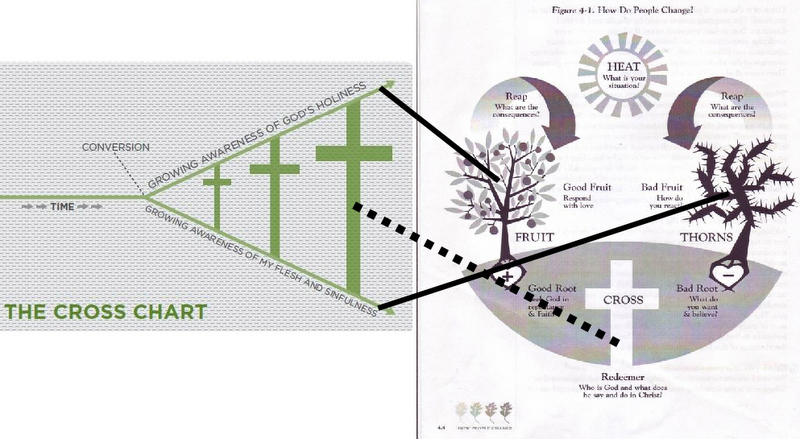
Understanding this lends insight to Tripp citations on the Peacekeepers Ministries website:
Paul Trip wrote a great post over at The Gospel Coalition blog all about the need for pastors to pursue a culture of forgiveness in their ministry. Pastors (and anyone serving Christ) have a choice:
“You can choose for disappointment to become distance, for affection to become dislike, and for a ministry partnership to morph into a search for an escape. You can taste the sad harvest of relational détente that so many church staffs live in, or you can plant better seeds and celebrate a much better harvest. The harvest of forgiveness, rooted in God’s forgiveness of you, is the kind of ministry relationship everyone wants.”
Then he describes three ways forgiveness can shape your ministry. I’ve listed them, but you can read how he explains them in detail.
“1. Forgiveness stimulates appreciation and affection.
2. Forgiveness produces patience.
3. Forgiveness is the fertile soil in which unity in relationships grows.”
He closes with this exhortation:
“So we learn to make war, but no longer with one another. Together we battle the one Enemy who is after us and our ministries. As we do this, we all become thankful that grace has freed us from the war with one another that we used to be so good at making.”
And concerning another author, they also stated:
Last week, Steve Cornell at The Gospel Coalition blog posted some really great insight into the difference between forgiveness and reconciliation. They also offered up some excellent and biblically sound steps in dealing with a situation where an offending party is hesitant to reconcile.
Here he summarizes a key distinction:
“It’s possible to forgive someone without offering immediate reconciliation. It’s possible for forgiveness to occur in the context of one’s relationship with God apart from contact with her offender. But reconciliation is focused on restoring broken relationships. And where trust is deeply broken, restoration is a process—sometimes, a lengthy one”…. His ten guidelines for those hesitant to reconcile are rooted in scripture and, I think, incredibly helpful.
1. Be honest about your motives.
2. Be humble in your attitude.
3. Be prayerful about the one who hurt you.
4. Be willing to admit ways you might have contributed to the problem.
5. Be honest with the offender.
6. Be objective about your hesitancy.
7. Be clear about the guidelines for restoration.
8. Be alert to Satan’s schemes.
9. Be mindful of God’s control.
10. Be realistic about the process.
Notice the overall blurring of distinction between the offended and offender with the subject of forgiveness.
The Cross-centered Anti-justice Pandemic is No longer Exclusively a Reformed Thing
Apart from Calvinism, the redemptive historical cross-centered approach is crossing denominational lines en masse. We at TANC see doctrines that were born of Luther’s theology of the cross in non-Reformed circles constantly; specifically, heart theology (deep repentance), exclusive interpretation of the Scriptures through a redemptive prism, Gospel Sanctification, and John Piper’s Christian hedonism. And we also see the same results. It is not beyond the pale for a pastor who has raped a parishioner to be the one counseling the victim sinner. You know, the “sinner saved by grace.”
God is a God of justice, and throughout the Scriptures He demands that we be people of justice. He demands that we come to the defense of the victim. I close with fitting words from church historian John Immel:
And this is the challenge. This is the challenge that I have as a man who is passionate about thinking: to inspire people to engage in complex ideas that drive tyranny. So here’s my challenge to those who are listening.
Do not be seduced into believing that righteousness is retreat from the world.
Do not be seduced into believing that spirituality is defined by weakness and that timid caution for fear of committing potential error is a reason to be quiet.
Do not be intimidated by vague, hazy threats of failure.
Do not let yourself believe that faith is a license to irrationality. I’m going to say that again to you. This is good. Do not let yourself believe that faith is a license to irrationality.
Do not mistake the simple nature of God’s love for a justification for simple-mindedness.
Do not deceive yourself with the polite notion that you are above the fray, that your right to believe is sufficient to the cause of righteousness. There is no more stunning conceit.
Do not pretend that your unwillingness to argue is the validation of truth.
Know this: Virtue in a vacuum is like the proverbial sound in the forest–irrelevant without a witness. Character is no private deed. To retreat is nothing more than a man closing his eyes and shutting his mouth to injustice.
Virtues are not estimates to be lofted gently against evil.
Virtues are not to be withheld from view in the name of grace.
Virtues are not to be politely swallowed in humble realization that we are all just sinners anyway.
Love is not a moral blank check against the endless tide of indulgent action.
Love is not blind to the cause and effect of reality.
Love is not indifference to plunder and injustice and servitude.
The time is now, you men of private virtue, to emerge from your fortress of solitude and demonstrate that you are worthy of a life that bears your name. The time is now, you men of private virtue, to answer Mick Jagger and all the nihilists that insist we are living on the edge and we cannot help but fall. It is time for you men of private virtue to take up the cause of human existence and think.
~TANC 2012 Conference on Gospel Discernment and Spiritual Tyranny: John Immel; session 1, “Assumptions + Logic = Action.”
paul

 Paul's Passing Thoughts
leave a comment