From the Reformation to the Third Reich: Protestantism’s Impact on Western Culture – Part 3
The following is part three of a multi-part series.
Taken from John Immel’s third session
at the 2014 Conference on Gospel Discernment and Spiritual Tyranny
~ Edited by Andy Young
The Re-Discovery of Aristotle!
St. Thomas Aquinas
In the previos two posts I have brought you up to the collapse of civilization. That collapse lasts for almost 800 years because Augustine stands virtually intellectually unopposed. There are some medieval theologians and so forth that do rise up, and some of them were pretty smart, but when it came right down to it, they had nothing important to say in the evolution of Western thought. The result is for all of their departures and all of their good ideas, they never abandon the rudiments of orthodoxy.
Then around 1250, St. Thomas Aquinas appears on the scene and reintroduces Aristotle into Western thought in 1250. Aquinas is critical because he integrated the philosophies of Aristotle into Christianity. I cannot understate the importance of this because the re-discovering of Aristotle is what makes the concepts of freedom and liberty as we know it possible. Aristotle is responsible for the coming Enlightenment Era and thinkers such as John Locke. I dare say that the United State would not have happened had it not been for Aristotle.

I want you to notice this timeline. Even with the contributions of Aquinas in 1250 AD, we do not get to freedom, liberty and knowledge until almost 1700! That means that man still spends another 500 years or so in this doleful horror story of the Dark Ages. But it is Aquinas who gives us Aristotle, and Aristotle bails us out of the madness.
The reason I want to talk about Aristotle is because because ultimately I am going to get to the impact of Neo-Calvinism on the United States of America. By the time I get to the next two parts of this series, I want you to be absolutely aware that America is not possible without Aristotle and without John Locke. You must know what you are about to lose and why you are about to lose it. And if you don’t understand this much, then you will never understand why I object so vehemently to Augustine and Luther and Calvin.

Now I’m not going to go over how Aquinas integrated Aristotle into Christianity. That would be a long and tedious project. So I’m just going to start with Aristotle and the elements and roots of Aristotle. Aristotle is the most important figure in all of Western thought. Aristotle was a student of Plato and spent 20 years in Plato’s Academy. For a series of reasons, he left Athens, and eventually, those series of reasons resolve and he came back to Athens and created his own school called The Lyceum. But while he was in Plato’s Academy, he was considered one of Plato’s best students, and he was a committed Platonist.
In the beginning he accepted the premise of Platonism and its full philosophical statement from the beginning to the end. However, during his time away from Athens, he began to rethink, and he decided Plato was wrong, and not just a little wrong, catastrophically wrong. As such, he began to rethink the whole of philosophy and the whole shape and scope of philosophy.
Now in the grand scheme of intellectuals, Plato was a genius on levels that is hard to grasp for people in everyday life. Still, Plato had ideas that came before him that he built on. Aristotle had nothing before him to arrive at his conclusions. Everything before him was exactly the opposite of what he said. So for Aristotle to arrive at the conclusions that he did is illustrative of the capacity of his own genius.
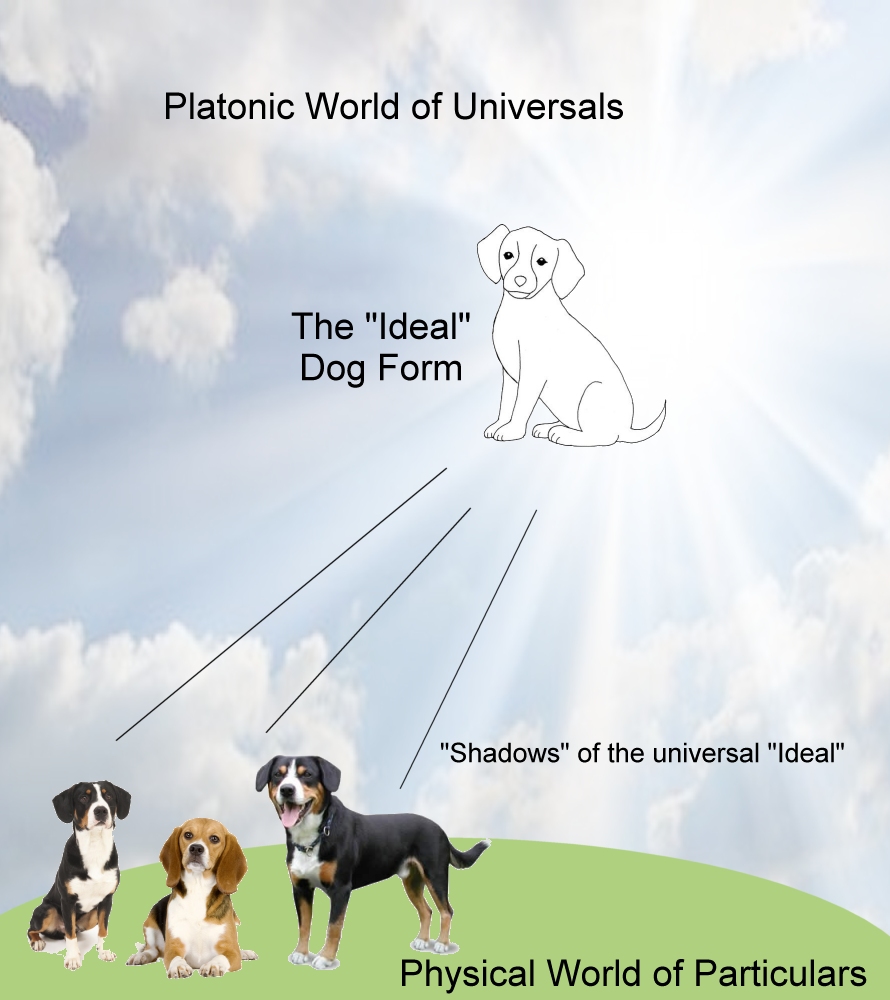 Aristotle objects to Plato’s world of Forms. He rejects Plato’s metaphysics at the root. Plato created a transcendent world where everything you see is actually a shadow of the real thing, of the perfect thing. Those perfect things were actually located in this world called the Forms. There was a perfect table in the world of Forms, and the table that you see is a shadow. It is imperfect and therefore a shadow of this perfect thing.
Aristotle rejected this idea because he believed the Forms are a useless theory because it does not explain this world. This world is filled with particulars, things that move, change, grow and act. Particulars are independent entities that can be categorized by what they have in common, such as a dog, a tree, a man, a remote control. They are self-contained and self-enclosed things, something that exists in and of itself.
This is the world that man needs to understand. Man does not need to know Plato’s static supernatural world.
Here’s an example. This world has chairs, tables, dogs, and Calvinists. Plato says that to understand this world, another world must first have chairs, tables, dogs, and Calvinists. As far as Aristotle is concerned, this creates a useless duplication. All that Plato has done is create a useless metaphor that does not address the root question, how does this world reflect the world of Forms? By what mechanism does this take place? And of course there is no answer, because by definition, all that Plato was saying is this world of Forms is somehow a bright enough light that it casts a shadow here. But yet there is still this fundamental division, which means that man is still living in a world that is somehow functionally unreal.
Here is Aristotle’s major substantive objection. To understand this objection, I need to help you understand the distinction between universals and particulars. I have already defined particulars for you. Aristotle recognized that particulars can be categorized into universals. Universals are what is common to a number of particulars. It is the characteristic possessed by many particulars. What is the common denominator of say table-ness or chair-ness or circle-ness? When men conceptualizes these things, he universalizes the concepts into an abstraction.
Let me see if I can explain this. Consider a remote control for your television. That particular remote controls a particular device, namely your television. You can generalize “remote” into a universal concept. That concept can be abstracted to the nth degree because now you do not have to remember every single remote you have ever see in your lifetime. You can now hold in your head the concept, the abstraction, of  remote, and it encompasses all of the remotes on the planet. You see, this is an enormously powerful part of human cognition. It is Aristotle’s ability to identify the process of going from a particular to the universal (concept), to the abstraction that gives Aristotle’s metaphysics and epistemology such enormous power.
What Plato did is he took the human mind’s ability to conceptualize a universal and instead said “remote” has a perfect “remote” somewhere else, and that is how we know a “remote” generally. Aristotle says that is silly. What you just did is took the abstraction, “remote-ness”, created universal perfect “remote” somewhere in another world, and then said, oh by the way, this particular remote is only a reflection. So in other words, Plato took the universal and made it a particular. This is a powerful, powerful argument. He pretty much said Plato made up this world that had no function and no purpose and that all that was necessarily important was here and now.
Here’s how Aristotle explains this. We separate common characteristics of entities, particulars, by our selective awareness, by observing the differences among them. We then reduce things to a common denominator. And this is how we go from particulars to universals. When a baby first enters the world, he looks around and sees chair, chair, chair, chair, chair, chair, but he does not understand all of these chairs. At first to him these are all somehow unique and individual events. But eventually, he begins to identify the common denominators of all chairs, and he begins to conceptualize “chair” in general, and then he abstracts to the bigger picture.
Notice Aristotle’s distinction. Just because we can perform the action of abstraction does not mean that the common denominator exists in a separate supernatural reality. Separating things in thought is very different from separating in reality. When man practices this selective process, he is performing abstraction. For example, within your room, you could identify all the shapes of the circle in the room, so you can ignore color, or if it is a part of a chair or connected to the wall you can extract the concept “circle” from each instance. But this mental process does not mean that “circle” is out there somewhere in a Form.
Aristotle called Plato’s world of Forms the “Fallacy of Reification”, literally “thing-making.” Plato is making a particular out of a human cognitive process. This is a brilliant deduction. Aristotle identifies a fundamental flaw by pointing out that this is really nothing more than how the human consciousness works. It is part of the human consciousness identity.
Now you should have some basic insight into how Aristotle conceptualizes the world. Here are the basics. Reality exists. What man perceives is reality. There is no conflict between reality and appearance. Reality is what man observes, and any formulation that says otherwise is error. Particulars are the units of reality. The things you see are particulars. As I said, anything you can physically point at, look at, identify, subtract and blank out everything else and look at, that is a particular. Everything is an individual and a concrete. Individuality is the particular’s irreducible element. The thing that individualizes it is the thing itself.
Here is Aristotle’s distinction, and this is a direct contrast to Plato. Universals are real. Universals are the objects of conceptual thought. Universals are the abstraction of particulars, but only particulars actually  exist. Let me make a distinction. There was a common tool of debate that was called Zeno’s Paradox. Zeno said you couldn’t actually cross a room because you could not cross distance. You would go to half and then to half again and then to half again and then to half again and to half again, and you could not cross a room by definition. Of course, this is error because it takes the concept of infinity and turns it into a thing. You do not cross infinity. You cross an identity. And the identity is the distance of a room, 30 feet. Aristotle correctly destroyed Zeno’s Paradox by observing that the abstraction “infinity” was not real. We use it as a mental organizer, but it is not in existence like this. So can we cross a room? Absolutely. Why? Because we’re not crossing infinity. We’re crossing an identity, 30 feet.
Side Bar: Most of the conflicts that we have regarding the Neo-Calvinist group and all collectivist ideologies are the failure to grasp the distinction between concretes and particulars, concepts and abstractions. Most of our theological discussion has failed because it has misunderstood these specific distinctions. And the reason the Neo-Calvinists kick our butt so consistently is because they are masters at manipulating the difference between concept and abstraction. I’ll let you mull that over.
Aristotle said matter is the uniqueness of a particular. Form is the universalizing of those things that a particular shares with other things. So he takes over Plato’s concept of form, but he uses it entirely differently. Aristotle noted that you cannot have form without matter, and you cannot have matter without form. This is Plato’s fundamental error; he created a world of Forms without matter. This is the exact same failing in Augustinian doctrine. Augustine’s Form is the heavenly and the universal worldly godly realm. This earth has no Form. Augustine manipulates this to the nth degree throughout the entirety of his ideology.
Aristotle’s Metaphysics
Everybody prior to Aristotle said that consciousness was primary. Some consciousness, whether some variation of man’s consciousness or some divine consciousness, imposed its will on the world and shaped it after its fashion. Aristotle said that is backwards. It is reality that comes first and consciousness engages reality. This is known as the Primacy of Existence, and this is the Copernican shift in philosophy, because it puts reality and consciousness as co-counterweights in the ability to define what is. It gives the ability for objective knowledge.
With the primacy of consciousness, you have no guarantee of objectivity because the first question you must ask is, whose consciousness defines reality? Is it Allah? Is it God? Is it Isis? Or if you are a follower of Hegel, is it the state that defines reality? Can the state impose its collective will on the world? With this, all you have is the term subjectivism. The primacy of consciousness is nothing more than subjectivism. But it is reality first, the primacy of existence first, the correlation of consciousness perceiving that reality that gives you the ability to have objective knowledge; it gives you a plumb line, because man has every confidence that what he sees is.
Man’s obsession to alter reality by the mind is the heart and soul of magic. And this is the primacy of consciousness’ preoccupation. This is how pond scum in the Middle Ages magically became frogs. Everything is and it is not. Everything is mutable and changeable. There is no reality and there is no causality.
Man practices the primacy of consciousness metaphysics all the time. You see something horrible and the first thing you do is start saying, “No, no, that can’t be.” The blogosphere is doing this with Calvinists all the time. They see one more manifestation of Neo-Calvinist abuse and just magically go, “No, that can’t be. It can’t be the doctrine.” They pretend the relationship between ideas and outcomes do not exist. That must mean it is not reality. This is the implication of the primacy of consciousness. They are defining the measure of truth by their own determination at a given consciousness.
Aristotle’s Epistemology.
One of the biggest problems with Plato’s world of Forms is if there is this other world, how does man ever get this concept of “table”? Where does that come from? If he has no ability to perceive it by any means, how does he get it? Well, the historic solution to this was the concept of innate ideas, that somehow man just knew it. Before he was born, man knew it and he remembers it as he grows. All of these things, these innate ideas, all originate pre-consciousness.
If you recall from the 2013 series on the evolution of Western thought, practically every system of thought included the idea that somehow man’s senses and his ability to perceive were impaired or invalid. Aristotle opposed this thought. He said that a man starts his existence tabula rasa, as a blank slate. Man has no innate ideas. The way man gets his knowledge is that it begins with the senses, perceptions. Man’s faculty for understanding reality is his perceptions. All formulations that write off the senses at this point are wrong.
 Man sees a rainbow, and he sees it from a distance and it physically looks like it touches the ground. And so he goes to try to find where it is, and of course he can’t find it. And the more he tries to walk towards the rainbow, the harder it is to see the rainbow. Or a similar example is you take a stick. A stick is straight in the air. You stick it in the water and you look at it, and suddenly, the stick bends. The historic criticism was that the senses deceive us. We really can’t rely on the senses.
Aristotle realized that was nonsense. You simply made a crucial error. The senses gave you the correct information, but you interpreted the information wrong. You misunderstood what that information was designed to give you. The stick in the water appears bent because at some point you learn the implications of how water moves and shapes light. The stick didn’t bend. The light coming back at the senses is what changed the appearance of the stick. The same thing is true of the rainbow. A rainbow is the result of light passing through water mist which refracts the light, and so the illusion that you think you see is really the correct manifestation of the entities light and water.
Aristotle’s next epistemological advance was called concept-formation which I have already discussed at length earlier in this article. It is the ability of man to take perceptions and particulars, identify the common denominators between them, and conceptualize abstractions called universals. This is how man brings order to his perceptions and begins to classify reality by identifying identities. It is by this method that man goes from circle to wheel to cart to transportation.
This is how man builds every increasing levels of complexity. He takes the very small, the particular, and he begins to form and shape that until he gets to the broadest abstraction. The order goes this way, perception to conception to abstraction to universal. And I’m going to keep saying this because this is central to the world that we inhabit. Until you understand how this functions, it is very easy to get wrapped up in the Augustinian ideas and their specific effort to divorce the world from reality man’s mind. This is a central attack that we will see over and over again as we progress through this discussion.
To be continued…
The Philosophy of the Reformation and Its Historical Impact, by John Immel – Part 4
Taken from John Immel’s third session at the 2012 Conference on Gospel Discernment and Spiritual Tyranny
Published with permission
~ Edited by Andy Young
Click here for Part 1
Click here for Part 2
Click here for Part 3
(Continued from part 3)
Now I want to make a series of contrasts.
The Enlightenment begins around 1650, give or take. The Enlightenment thinkers included men such as John Locke, David Hume, and Adam Smith. From these men comes a large amount of the foundational thought of human freedom, human competence, and human liberty. Enlightenment thought influence our Founding Fathers – Benjamin Franklin, James Madison, and Thomas Jefferson to name a few.
Recall that the three English civil wars were religious wars. The American Civil War was not a religious war. It was a war specifically fought in pursuit of liberty and freedom.
 In an article written in 1786 by James Madison, “A Memorial in Remonstrance Against Religious Assessments,” Madison weighs in against the establishment of civil government, civil patronage, and religion. I want you to notice the Founding Fathers’ clarity on the arguments against merging the state, no matter how small, with ecclesiastical establishments.
Madison begins:
“We, the subscribers, citizens of the said Commonwealth, have taken into serious consideration [that] a bill establishing provision for teachers of the Christian religion and conceiving of the same if finally armed with sanctions of law, will be a dangerous abuse of power.”
There was no illusion here. The nature of Christianity, as our Founding Fathers understood, was that it was a dangerous force to be contended with when it was merged with the power of the state. Madison then goes on to detail several reasons for this understanding.
“1. Because we hold it for a fundamental and undeniable truth that religion or the duty which we owe our Creator and the manner of discharging it can be directed only by reason and conviction, not by force and violence.”
This was revolutionary. While this idea had circulated amongst any number of different sects and any number of different intellectual ties, for the first time, there was a formal effort to challenge at the root that religion could not ever be merged with the force of the state. But rather the force of government was to be tempered by intellect and reason.
This is a central Enlightenment idea.
Madison Continues:
“2. Because the rulers who are guilty of such encroachment exceed their commission from which they derive their authority and are tyrants. The people who submit to it are governed by laws made neither by themselves nor by an authority derived from them, and are slaves.”
“3. Because the free men of America did not wait till usurped power had stricken itself by exercise and entangled the question in precedents. They saw all the consequences in the principle, and they avoided the consequences by denying the principle.”
Hold that thought. I will come back to that in a moment.
“We revere this lesson too much soon to forget it. Who does not see that the same authority which can establish Christianity, in exclusion of all other religions, may establish with the same ease any particular sect of Christians in exclusion of all other sects?”
This is why the historic fight between Calvinists and Arminians gained some attraction, because we fail to identify the principle that Madison is arguing here. The issue is not necessarily the Arminian perspective versus the Calvinist perspective. The issue at central root is man’s fundamental competence to master his own life, however that may be accomplished. The reason all other doctrinal fights are useless in this instance is because, at the root, until you defend man’s right for moral existence, you have lost. Madison makes this observation in point seven.
“7. Because experience witnesses that ecclesiastical establishments, instead of maintaining the purity and efficacy of Religion, have had a contrary operation. During almost fifteen centuries has the legal establishment of Christianity been on trial. What have been its fruits? More or less in all places, pride and indolence in the clergy, ignorance and servility in the laity, and in both, superstition, bigotry and persecutions.”
It is important to understand that our Founding Fathers had no illusions about the nature of what Christianity was and was not. They understood its broad history. They understood what Puritanism did. They understood what the Massachusetts colony theocracy did. For many of them, it was close enough to their lifetime that it would not have been lore as if we were learning it out of the book. They certainly would have been within striking distance of the religious wars in England and the tides of warfare that swept across the face of the earth.
James Madison goes on to say in Point 8.
“8. Because…what influence in fact have ecclesiastical establishments had on civil society? In some instances they have been seen to erect a spiritual tyranny on the ruins of civil authority; in many instances they have been seen upholding the thrones of political tyranny; and in no instance have they been seen as the guardians of the liberties of the people.”
This is one of the most scathing denunciations ever! Until Christians are guardians of the liberties of the people, all we are doing is perpetuating spiritual tyrants.
Madison wrote this a mere ten years from the Declaration of Independence and the adoption of the U.S. Constitution. I want you to notice that this memorial and remonstrance takes place dead square between two events: from the specific overthrow of tyranny in 1776, within ten years’ time we already have a religious movement trying to use civil authority to create patronage. In other words, you have a specific group of people seeking to create a means by which others pay taxes to support a religious organization. They were trying to use taxation to advance sectarian orthodoxy.
Madison is arguing for the supremacy of human reason, and he is denouncing the use of civil authority – the merging of religious faith and the power of the state. He is saying it is a menace. Christianity is a menace because Calvinism demands war for all who refuse to bow to its edicts. The current Calvinist defenders can pooh-pooh my point all they like, but I win this argument only because all I have to do is educate people on the public record. This is not complicated.
The Founding Fathers had no illusion about the destructive force of Christian religion, and it is the most virulent forms of Christian thought that the Founding Fathers put absolute barriers in place to curtail this acquisition of civil power.  For the first time in human history, men sat down and they finally said, “No, man is entitled to the sum and substance of his own life,” and they penned these words:
“We hold these truths to be self-evident that all men are created equal, that they are endowed by the Creator with certain inalienable rights that among these are life, liberty, and the pursuit of happiness, that to secure these rights governments are instituted among men deriving their just powers from the consent of the governed that whenever any form of government becomes destructive of these ends, it is the right of the people to alter or abolish it, and to institute new governments laying its foundations on such principles and organizing its powers.”
Let’s do a contrast.
Puritan theology:
- Man is incompetent.
- Man is morally guilty.
- Man needs the force of government to compel him to good action.
- Government is an unquestionable manifestation of God’s appointment.
- God is wrathful and offers man no rights of existence.
- God appoints man to a predetermined existence of suffering and bondage.
- God’s sovereignty appoints man to slavery.
This is the Puritan construct. This is Reformation theology. This is Calvinism. This is the most virulent form of Reformation thought.
Contrast this with what comes out of the Declaration of Independence:
- That man is competent to understand.
- That man can understand the world in which he lives.
- That his epistemology is fully intact.
- That by virtue of that ability, truth is self-evident.
The equality of human creation endows all with the same right. There is no election to specific privilege, yet in the Calvinist construct, the men standing in the pulpits today are claiming a special privilege.
Man has a right to life, liberty, and happiness, yet the Calvinist construct says there is no such thing; that any effort towards right or life or liberty or the claim to any happiness is a self-deception and a manifestation of your depraved nature. Just government is a product of human consent.
Consider this, that for almost 1,800 years, the Church had said that it was the divine right of kings to dictate government, and that government was in fact divinely appointed. Man had no right to question, for the most part. Whatever happened was in fact the product of God’s will.
The American Declaration of Independence was the first time in human existence that men articulated that just government must be the product of human consent. I am only governed in as much as I choose to let you govern me. Truth is not the property of the state. The state is in fact the servant of man’s defense. This was revolutionary.
The advances of man, the things that have eradicated human suffering across the board, are directly tied to human liberty, because when man is free, man is free to think. Thinking men are free  to create, and creating men are free to exchange value with whomever they chooses to associate. Man can better his life as he sees fit, and he can solve the problems of the beggarly elements of this earth.
I am able to do in the 21st century what a paltry number of human beings had ever been able to do, and it is directly related to the legacy of human competence, human freedom, and human liberty. You do not get this level of prosperity with the ideology of the Dark Ages. Every place this ideology has manifested itself, it has driven man back to the Dark Ages.
These exact same metaphysical assumptions that are in Calvin are in Augustine. These exact same metaphysical assumptions that are in Augustine are in Islam. Notice that if you go to any place in this world where there is a purely Islamic state you will see the dark ages in modern times: you will see the same paltry human condition from over a millennia ago in western civilization. This is true because the ideas are the same.
Liberty, freedom, thought; they are absolutely tied together. Human competence and human liberty are essential for the benefit of man.
I have now come full circle in my argument. The cohesive structure of ideas from the metaphysical premise to the epistemological ability to the ethical understanding to the political action; all of them run in a progressive line of thought. This is the answer to my original observation:
The Gospel According to John Immel, chapter 3:1-3
1. All people act logically from their assumptions.
2. It does not matter how inconsistent the ideas or insane the rationale. They will act until that logic is fulfilled.
3. Therefore, when you see masses of people taking the same destructive actions, if you find the assumptions, you will find the cause.
Christians love to thump their ESV while laying claim to the Declaration of Independence and the Founding Fathers. They hold freedom of religion as a certainty. They love the prosperity that rational thought, logic, and industry produce. But they do not even blush at the hypocrisy when they pound that same ESV to claim solidarity with Reformation orthodoxy. They will then rate John Calvin as the great reformer of Geneva. They will speak sagely, calling Jonathan Edwards their homeboy, not once realizing the philosophical schizophrenia. These are mutually exclusive worldviews.
In the world of election and limited atonement, there is no such thing as self-appointment and self-determination. There is no such thing as self-governance, because you do not own you.
In a world of irresistible grace, there is no such thing as private property, private possessions, or even personal boundaries, because whatever good you have is a manifestation of God’s grace, and all grace is administered by His stewards of grace.
And in a world of predestination, there is no right to inquire. In a world of predestination, there is no human sensibilities to be conservative. Your pain and your suffering is irrelevant. Who are you, O man, to challenge God, to inquire the things of God, the mysteries of God! Your pain is what you should have.
In the metaphysical world of T.U.L.I.P., there is no real justice. Everything is one great big fat sin before God, because the nature of man is utterly offensive to God. If you happen to be a part of the group that gets picked, it’s all good. And if you don’t, then it sucks to be you. The threat of damnation hangs over your head like the Sword of Damocles. Your sin violates God. So, who are you to demand recompense for a violation of sins against you? How dare you speak justice? You don’t own you.
Or do you?
This is the first choice. This is the fight within the ages. Who owns man?
Father, in the name of Jesus, we must live in understanding. Never before has man been defended. We’ve defended you and we’ve swatted our own. But never have we defended man’s right to live, right to exist, right to live, right to prosperity; never have we done this successfully. To throw off the tyranny of the ages, Father, we need your wisdom and understanding. We need to have the eyes of our understanding opened, that our insides will be filled with light. We ask these things in Jesus’ name. Amen.
~ John Immel

 Paul's Passing Thoughts
2 comments