The History of Western Philosophy and Its Societal Impact on the Church – Part 7
The following is part seven of an eight-part series.
Taken from John Immel’s thirsdsession at the 2013 Conference on Gospel Discernment and Spiritual Tyranny
~ Edited by Andy Young
| Click here for part one Click here for part two Click here for part three Click here for part four |
Click here for part five Click here for part six Click here for part eight |
 We have hammered pretty hard the notion of people being personally responsible for the intellectual content of their minds. As a man who has been pretty much talking to the air about this very subject for the last twenty years of his life because I couldn’t get anybody to pay attention, it is very easy to become cynical about how people respond to this information. I suspect some of the cynicism is warranted, because no matter how many times I start up this conversation I am usually confronted with the deer in the headlights look from people.
However, what I have learned is that mostly the reason is due to the fact that people have never been exposed to any counter-argument. They are usually more dumbfounded that someone actually has the audacity to suggest that there is something implicitly wrong with reformation doctrine- not that it is something of an aberration or that a few stray teachers didn’t seem to get it right, but that reformation doctrine is fundamentally wrong.
During these lectures I have had the opportunity to talk to some people who have traveled the same path and arrived at very similar intellectual conclusions. I find them to be endlessly engaged, and I find that to be enormously gratifying, to find others people who have begun to do similar work, have started to see the big picture and have arrived at the same conclusions. The piece of the puzzle that was lacking was actually the framework of the puzzle itself. It was a commitment to say no, these ideas are morally evil. There is a root problem with this doctrine that corrupts it without end.
This is a very longwinded way of saying I am encouraged at the potential that is out there. In discussing the notion of tyranny, it has always relied on men who fear resisting it. Tyranny can only persist when good men do nothing. But good demands of you to fundamentally believe in your moral virtue. If you cannot believe in your own virtue, then you can never ever fight what is evil. This is perhaps the motivation of tyranny to promote the willful self-destruction of man, to keep good men in a constant state of devaluing their own virtue so as to not have the motivation to resist.
This is why I advocate endlessly for your own rational motivation, your own specific commitment to your rational faculties. In all that TANC Ministries is trying to accomplish, I loathe the idea that it ends up becoming one more cult of personality. I recognize that people like Paul Dohse and myself are very strong personalities. And it would be very easy for people to trade my personality and the force of my ability as an individual with any of the popular teachers who currently dominate the scene of reformed orthodoxy. I would rather wreck my own reputation on your behalf than for you to follow me simply because you trust me specifically.
I want you to trust the conclusions of your own rational mind.
The ultimate goal is for you to carry the fight on your own.
 The beauty of Western culture is that it is ultimately the source of freedom and liberty. In the previous five articles I covered approximately 500 years worth of the evolution of Western thought. It is essentially a masters level course on philosophy crammed into a little more than 8,000 words.
The person I neglected to bring into the discussion is Aristotle. His ability to identify the laws of logic is the only thing that comes close to rivaling Plato. Inasmuch as Plato organized a collectivist ruling dictatorship, Aristotle is essential for the liberties of man. He is the first person to give a systematic presentation on why man specifically is qualified to operate successfully on the earth.
In part one we considered the following quote by Sun Tzu.
“All men can see the tactics whereby I conquer, but what they cannot see is the strategy out of which victory has evolved.” ~ Sun Tzu, The Art of War
He was making the observation that it was the underlying strategy that allowed him to win. Men could see the tactics, but they couldn’t understand the function whereby those tactics were employed. This is essentially what we are now being confronted with. The reason tyranny has been so successful at sweeping across the globe is because it has drilled down to the same fundamental elements.
Because man is a rational being in need of a way to integrate his ideas, it is how those ideas go together that defines how he organizes his political life. Political life is nothing more than how individuals interact. We tend to think of politics in terms of the elaborate game that happens in governments between parties and the endless quest for social power. Yet what happens in the grand halls of government is nothing more than the logical conclusions of ideas, and then those men decide that everyone else should live by those sets of ideas.
Here is the central fight of all political philosophy. The whole of human existence has focused around the question of who owns man. The leading consensus, the predominant assumption, the conclusion of the vast percentage of human intellectual content has been focused on man is the property of the state.
My job in this series was to discuss the societal impact of the development of Western thought. I have put off revealing to you the ultimate impact until now because I was more interested in laying the foundation of how we get to that resulting impact. Once we identify how we get to societal impact, it is actually very simple for individuals to start understanding what is actually happening in society.
So the question is then if man is property of the state, what is the moral justification for some to use force against others? What have we just studied? What were the root presumptions throughout history? Man is incompetent. His senses are invalid. There are a select few who have some form of enlightenment from some extra-worldly source. Such enlightenment then makes them alone qualified to use force over others.
The underlying question historically within Christianity has universally revolved around why “they”, whoever those leaders happen to be, are specifically authorized to define truth. Augustine justified this very end using the same exact assumptions I just mentioned. The sheep are stupid, the sheep are incompetent, the sheep cannot organize their own lives, and more importantly, they should be compelled to do what is good.
 I need to introduce you to yet one more philosophical concept. Any doctrine that services the notion that man is the property of the state is know as collectivism. The systems illustrated in the figure at the right are all manifestations of collectivism. In these systems, the dominant presumption is that your life is to be placed at the disposal of some collective. The collective will is the standard of moral value. The goal is always that man must be chained to the collective. And I do mean chained. Man is property of the state, to subordinate the individual to the collective will.
How do they do this?
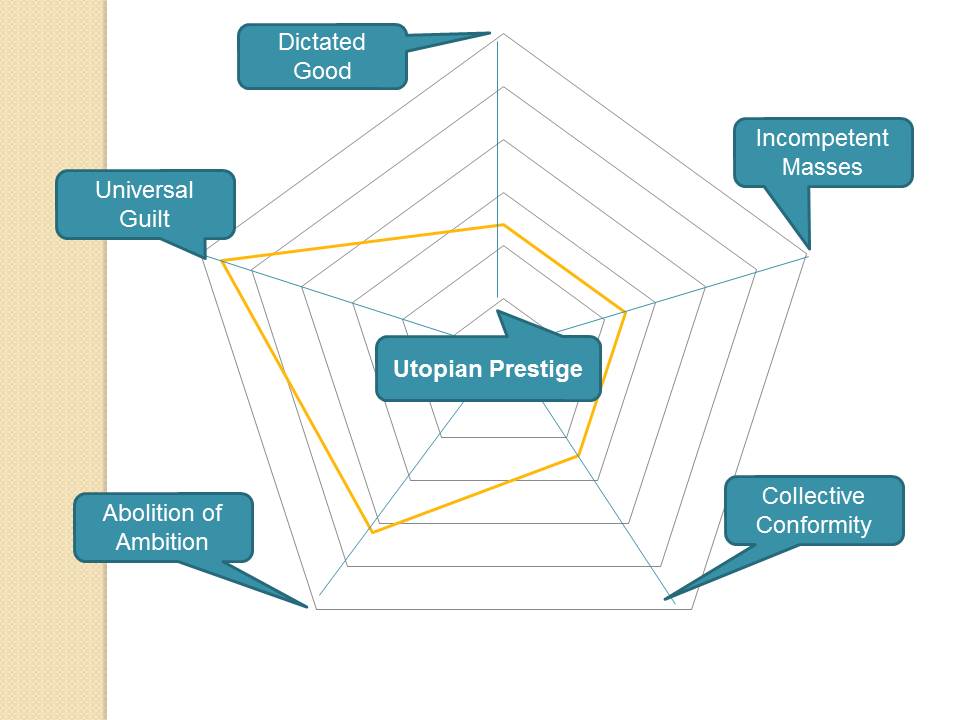 This is my contribution to philosophy. I have identified five fundamental elements of all collectivist doctrines that are designed to produce tyranny. The reason I have organized this as a web is because I want you to understand that this is not linear. All of these elements are interdependent and to not necessarily follow in a progression. There is a dynamic tension between all the arguments. Some arguments that you hear will have facets of each of these categories. Let’s look at each one of these more closely.
Incompetent Masses
The underlying conclusion throughout all the thinkers we have studied has been that man’s senses or his ability to reason were fundamentally flawed. Man could not understand the world in which he lived. This is the bedrock of incompetence. If you separate man from his mind, man from his body, and man from reality, there is no other place for man to live. So if you presume that man is incompetent then you set the groundwork for the next concept.
Universal Guilt
This is a tool designed to drive you to accept your own incompetence. All men are guilty of moral depravity so that no one can advocate a moral standard. If you will accept guilt, a universal guilt, a guilt for no crime whatsoever, a guilt for nothing more than for simply being an incompetent human, you will accept the standard that you are morally incapable of running your own life. This is the death knell of all individualism. If you cannot presume your own moral good then the only thing left is…
Dictated Good
Because man is guilty and incompetent to carry out the important actions, he necessarily needs someone to save him from himself. This is why there has always been a separation between the willing elite and the general masses. This is where the class society comes from. There has always been the presumption that the “true philosopher” had a special access to truth.
The only function of determinism in all of its forms has been to create a class society. If everything is determined, there is no intellectual argument. You cannot persuade me, because whoever I am is nothing more than the outcome of that determinism. Yet this is what sets up select men as the driving force of all political organization. The catch phrase these days among all various forms of Christianity is “God is Sovereign.” This is nothing more than another variation on determinism. If God is “sovereign”, then the very fact that certain men are in positions of authority is evidence of their right to run your life.
But the problem is, man is not a collective being.
He is a contractual being. This is how man successfully operates with other men. Look at all of your successful social interaction, and the quality that makes them successful is men freely engaging in a mutual exchange of value for value. This poses a problem for collectivism.
Abolition of Ambition
 Because man is by nature an individual and not a collective being, he must be talked out of individual action. He must be persuaded that any action done independent of group sanction is the height of moral failing. This is why, within all collectivist doctrines, ambition is synonymous with sin.
The true definition of ambition is to see a value and then organizing an effort to achieve that value. In every effort as a contractual being, man organizes a value that he has and persuades another that he wants that value.
Consider the scope of the charge that God gave to Adam. Be fruitful and multiply and subdue the earth! The scope of Adam’s existence was the earth, and we sit here and worry about how we are going to pay for new tires for the car. God has always been driving man towards his own individual best. So pursuing ambition is not sin. How we break contracts in the pursuit is how we get to sin. Covetousness is not sin because we want something. Ambition becomes covetousness when our means of obtaining value results in broken contracts in our mutual exchange of value with others.
Once you have been talked out of ambition you have arrived at…
Collective Conformity
This is the end game. This is where the full force of government is brought to bear for the sole purpose of creating a neutered humanity without complexion, or variation, or distinction. This outcome is held out as an ethical ideal and forced into existence at all costs.
 In collective conformity, the group is prime. The collective must then define what is authentic “groupness”. It defines the parameters for group inclusion. This is where you get concepts such as “tribalism”. Where we see this most dramatically in the modern age and current culture is the concept of “political correctness”. You are fundamentally immoral if you do not conduct your life in a certain way, if you do not speak a certain way, if you do not hold to a specific set of values.
In the church, this presents itself this way: “Who has the most correct doctrine”, and the yardstick of inclusion is some form of orthodoxy. They hold up that yardstick, and they must pass that yardstick over every individual.
But what happens when someone no longer measures up?
Consider, you attended a church for 15 years or more of your life, you committed enormous amounts of time and resources to that church where everybody hugged and kissed you and told you how wonderful you are. But then you had a conflict, and you got kicked out on your butt. Suddenly you looked around and said, “Where are all my friends?”
Here’s what happened. The whole time you were there, they were holding up that yardstick, and as long as you measured up you were one of them. But the moment they could hold up that yardstick and say, “you are no longer one of us,” they had no other choice but to exclude you from the group. Because everything was about the collective.
Utopian Presitge
All arguments are in service to the collective reputation. Notice what the outcome is at the center of the web of these five elements. How many times have you heard a preacher talk about the reputation of the church? The argument is that individual action will impact the prestige of his “local collective.” This is the presumption of Utopian Prestige.
I have always been a little confused how it is that if man is so morally corrupt how such a great God could ever be concerned that man’s actions would tarnish His reputation. There is no more spectacular conceit. Yet with stunning consistency, Neo Calvinists are obsessed with God’s reputation. In reality, the only way man’s actions could ever affect God’s reputation is if man is God’s equal!
Chew on that one for a while.
Collectivism always seeks some utopian ideal that is never achievable- the Marxist workers’ paradise, Hitler’s Third Reich, the Muslim perception of “Allah”. Every collectivist culture is always driving towards this idea that if we had this perfect thing, whatever that happens to be, and everybody focused all of their pursuits towards that one end, the prestige of that would be so enormously great that it would compel everyone else to fall down before it on their knees.
 Well, it compels everyone to fall to their knees, but with their hands behind their back and a bullet to the back of the head.
The National Socialists of Germany went to war on two fronts for the prestige of the “fatherland”. Alexander the Great conquered nations for his collectivist/statist will. Stalin killed 7 million people in his Workers’ Paradise due to man-made famines, all for the prestige of the Soviet Union.
And what do we hear now? How often in American parlance do you here people say, the world doesn’t like America; that there is something wrong with our reputation in the world? It is always about prestige.
What did the people in the land of Shinar say to themselves? “Let us make a name for ourselves.” What was the mark of that prestige? “We will build a tower to reach unto the heavens.” It was a collectivist ideal, and every resource of human ability was focused into the achievement of that ideal. But they could never get to the heavens. There was never any practical end to that outcome.
Once you know the elements of collectivism and the outcomes to which they are in service it becomes stunningly easier and easier to recognize it all around you. Have this chart in front of you the next time you listen to the news, I don’t care what source, it doesn’t matter, and in less than a half hour your will be sitting there in stunned amazement.
Watch any television drama, which is entertainment, which is nothing more than an artistic expression. These elements are even easier to see in art because art is the most condensed version of a society’s value statement. It is the result of a full philosophical statement boiled down into a picture. And without fail, the greatest villain in most television shows ends up being the one who is successful. This is the manifestation of the abolition of achievement.
These are all reflections of our cultural expectations. They are all designed to drive us towards some collective conformity. Any true individuality is always explained in terms of exploitation, and everything is about sacrifice to the collective.
…To be continued
| Click here for part one Click here for part two Click here for part three Click here for part four |
Click here for part five Click here for part six Click here for part eight |
The History of Western Philosophy and Its Societal Impact on the Church – Part 6
The following is part six of an eight-part series.
Taken from John Immel’s second session at the 2013 Conference on Gospel Discernment and Spiritual Tyranny
~ Edited by Andy Young
| Click here for part one Click here for part two Click here for part three Click here for part four |
Click here for part five Click here for part seven Click here for part eight |
We continue in our discussion of the major contributors in the progression of Western thought. Many concepts and doctrines that we have traditionally come to think of as Biblical orthodoxy in reality have their roots in ancient philosophies. Here is a brief summary of the thinkers and their contributions that we have studied so far:
Thales – The first scientific approach to explaining reality as opposed to a pantheistic approach. The concept of one universal “stuff” and its various forms.
Heraclitus – Because everything is in a constant state of “flux”, man is unable understand the nature of reality. The first to introduce a division of reality. Two “realms”.
Parmenides – Precursor to Aristotle’s “Law’s of Identity” and existence. Existence is real, but change is not. Change is only apparent because of man’s faulty perception.
Zeno – The Dichotomy Paradox. Movement was an illusion and plurality and change was impossible.
The Pythagoreans – Orphic mystics. Introduction of the soul/body dichotomy.
The Atomists – Described a mechanical model for metaphysical concepts. Introduction of determinism.
Sophism – Used deceptive arguments as a means of persuasion. “What is truth?” There is no objective knowledge. Man’s primary social purpose is domination.
Socrates – Introduced the concept of “universals”. Man’s ability to use reason to grasp universal concepts.
Plato – First successful comprehensive system of philosophy. Two world dichotomy, universals/particulars. Only philosopher kings have access to the realm of the “forms”.
This brings us to part six, and we will pick up where we left off.
 Cynicism
These guys could be considered the first “street preachers”. In Christian parlance they were “evangelists”. They considered themselves humanity’s watchdogs. Their favorite pastime was to publicly expose the pretense at the root of everyday conventions. The believed that is was their life task to convert the masses to what they called the declarative.
They rejected all wealth, power, sex, fame, because these pursuits were the stuff of a polluted mind with internal haze. Diogenes of Sinope, one of the founders of the Cynic movement, is reported to have lived in a tub. He refused to wear shoes in the winter, refused to bathe, ran around the streets without clothes, and wandered from street to street in the cities preaching Cynic doctrines. Those doctrines were specifically designed to save men from the bondage of their flesh. If man was liberated from the bondage of flesh they would be liberated from worldly suffering and uncertainty.
The summary of Cynic ideology follows:
- The goal of life is mental clarity or lucidity.
- Freedom from internal haze, which signified ignorance, mindlessness, folly, and conceit.
- Achieving freedom by living in harmony with nature.
- Mental haze, ignorance, mindlessness, et al, is caused by false judgment of values which causes negative heartache, anxiety, unnatural desires, and evil character.
- Man flourishes (he truly lives) by achieving what is called “self-sufficiency”.
Self-sufficiency in the case of the Cynics refers to an internal indifference to life’s hardships. One progresses towards this life and clarity of thought by ascetic practices that help one become free from the influences of the flesh. And since they had a great disdain for fame, they tended to act shamelessly in public in a direct effort to slight all social conventions.
Here is the point I want you to grasp. How does man achieve harmony with nature? By being indifferent to all hardship. The suggestion was that the way man obtained this harmony was by constant arduous training of the body. You see this theme in the apostle Paul’s comment when he says in 1 Corinthians 9:27, “But I keep under my body, and bring it into subjection…” Here he is using a reference that is influenced by the Cynics. (Editor’s note: While the expression might be familiar to his audience because of Cynic doctrine, Paul is using it in the context of a believer’s sanctification so as to not be disqualified from any heavenly reward he might receive at the Bema.)
Notice also how the Cynics have elevated the nature and importance of asceticism. Not only is the flesh bad, but the flesh must be defeated through specific violence towards it. This is crucial because it becomes a dominant theme later as we shall see.
 Stoicism
Stoicism finds its beginnings in a school founded by Zeno of Citium in the early 4th century BC. Zeno taught in the public square located on the north side of the Ancient Agora of Athens. The name “stoicism” is derived from this square which was named ποικίλη στοά (Poikile Stoa) which means “Painted Porch”. The Stoics taught that destructive emotions resulted from errors in judgment. Someone of moral and intellectual perfection would not suffer such emotion.
Stoics were concerned with the active relationship between cosmic determinism and human freedom and the belief that it is virtuous to maintain a will that is in accord with logos. Remember it was Heraclitus who was the first to use the term logos. Aristotle used it to mean reasoned discourse. However the Stoics were the first to use it in conjunction with god. They said the logos was the animating force of the universe. It was this conceptual and linguistic shift that made the introductory chapter to the gospel of John possible.
Of course, later Christianity condemned Stoicism, but that didn’t stop them from using Stoic concepts and advocating the primary themes of Stoic metaphysics and ethics: an inner freedom in spite of worldly hardships, the innate depravity of man called “persistent evil” by the Stoics, and the futility and temporal nature of worldly possessions and attachments.
Stoic religion emphasized prayer, self-examination, and praise. They described spiritual pursuits like this: God is best worshipped in the shrine of the heart, by the desire to know and obey Him. Where have we heard that theme before?
The four cardinal virtues of Stoic philosophy where:
- Wisdom
- Courage
- Justice
- Temperance
Virtue alone was sufficient for happiness. A sage was immune to misfortune because he is dispassionate about all things both good and evil. Epictetus is quoted as saying, “Sick and yet happy, in peril and yet happy, dying and yet happy, in exile and yet happy, in disgrace and yet happy”
A sage achieved freedom by studying and seeking “universal reason”, which was their logos concept, and through practicing asceticism. Notice, now we have the correlation. Not only is it necessary to study this higher mystical concept, but it is specifically essential that the flesh is purged in the process. The flesh is beaten, and the study continues. Those who practice these virtues are enlightened and can achieve freedom from the vicious materialism and emotionalism of this world.
Stoics were determinists. They said that everything is subject to the laws of fate. The logos acts in accord with its own nature and governs matter. Souls are emanations from the logos and are therefore subject to logos dictates.
They describe the wicked man like this: he is like a dog tied to a cart and compelled to go wherever it goes. For you history buffs, you will recognize this from the Christian deterministic traditions that describe man like this: man is on the back of a horse being led around by the devil. This is Reformed Theology 101.
I want to illustrate how the Pythagoreans’ soul/body dichotomy weaved its path from their own relative hedonism to the Stoic doctrines we see before us. How did we get to the point where man must use violence against his own body to achieve enlightenment? And just so you understand, when we start talking about asceticism, we are not talking about giving up a few McDonald’s apple pies or a doughnut for breakfast in the morning. The accepted expression of virtue involved the literal beating of flesh as an ethical ideal
From the late 3rd century to almost the 1100s, here is what these people did:
- They sat on stone pillars until their legs rotted away.
- They drank laundry water.
- They slept on beds of nails.
- They inflicted on themselves personal and/or public floggings for sins.
This is the corruption implicit to these ideas. When you so divide man from reality, when you so divide man from life, you can only worship death!
…And that’s exactly where these doctrines trend.
To be continued…
| Click here for part one Click here for part two Click here for part three Click here for part four |
Click here for part five Click here for part seven Click here for part eight |
The History of Western Philosophy and Its Societal Impact on the Church – Part 5
The following is part five of an eight-part series.
Taken from John Immel’s second session at the 2013 Conference on Gospel Discernment and Spiritual Tyranny
~ Edited by Andy Young
| Click here for part one Click here for part two Click here for part three Click here for part four |
Click here for part six Click here for part seven Click here for part eight |
Plato
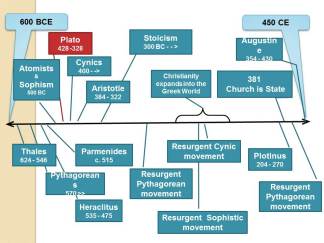 I think it is important for me to make this point at the outset. Plato was a genius virtually unparalleled by anyone in human history. His system dynamics, his creativity, his ability to integrate enormous amounts of information are rivaled only by Aristotle. Now of course they arrived at two very different conclusions, but Plato is not a villain as such. He was not deliberately trying to devise a bad system of thought. He was attempting to take the arguments of his day, all of the ideas from the various and sundry thinkers we have thus far discussed, and turn it into a system of thought that is useable.
Plato is the very first thinker to successfully develop a fully comprehensive system of thought from metaphysics to epistemology to ethics to politics. His metaphysical assumptions have an enormous impact on Western thought. Plato took Socrates’ grasp of universals and then proceeded to develop a metaphysical conclusion, and since everything that follows revolves around a metaphysical foundation, we need to start at the beginning.
Universals must be knowable. Without knowable universals man is little more than an animal and less moral than the Sophists. Parmenides told us that “thou canst know what is not.” In other words, if it doesn’t exist, you can’t know it. If universals are knowable then they must be real. If universals are real, then they must exist. Plato decided that the next two questions that must be answered are where do universals exist and how do universals exist. The question later became known as “The Problem of Universals.”
Plato’s answer to these questions is that there must be two worlds (once again we see this theme of dividing reality) because the universals and the particulars are not elements of the same thing, but fully different things. Plato is taking his influence by the Pythagoreans and developing it into a primary element of his metaphysics. Plato’s conclusion was that universals are one per category, particulars are many in any given instance.
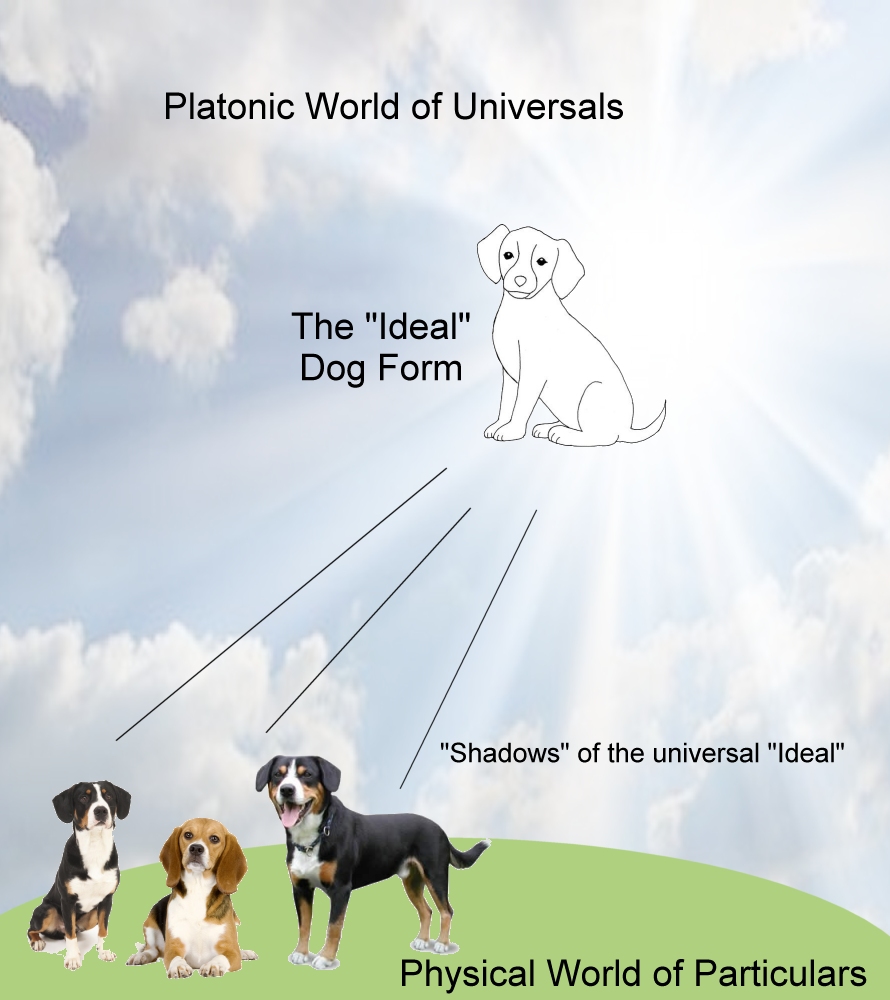 Now remember the background. The conflict is between Heraclitus and Parmenides. From the beginning, everyone was trying to solve the riddle of change and multiplicity. So the next question was how to deal with change and multiplicity and immutability? His solution was to say that universals must be eternal and indestructible. Without something that is unchanging, the world is fully unintelligible.
The logic goes like this. Think of the idea of “dog-ness”. We can say that the nature of dogs requires floppy ears, a bark, four paws, and so on. These are particulars, but there are many, many dogs with variations on those specifics, yet we understand that there is one concept of “dog-ness”. This must be an immutable law of “dog-ness”, because without immutability there would never be a law of “dog-ness”. Therefore, the universal of “dog-ness” must be eternal and indestructible.
His logic continues. Particulars are necessarily material and physical. Animals can see them, hear them, taste them, but do they grasp universals? Dogs can certainly see bones but do they see “bone-ness”? Does “dog-ness” see “bone-ness”? Plato concludes that “bone-ness” is somehow abstract and not part of the physical world, because it can’t be grasped by the physical senses. So particulars are physical, and universals are non-physical.
 And what followed from that premise was that particulars were understood by the means of the senses, and universals must be understood by the means of reason. With this conclusion, Plato completes his argument about two worlds. It is the obvious necessity based on the functions of human existence. Universals, defined by one group category, exist as immutable, unchanging, and non-material world and are known only to the mind. Particulars, defined by multiplicity and change, are physical and material and are grasped by the senses.
This conclusion, of course, begs the question. If universals are somewhere outside human perception and material existence, how does man ever access the knowledge? Plato’s answer was that man gets his understanding of universals before existence. So what we have really just introduced is the concept of innate ideas. If we possess knowledge at birth, man then must have what are called innate ideas that are the product of another world, and the soul is independent of the body. This concept is central to Pythagorean mysticism.
Notice what we have. A soul/body dichotomy where the soul is eternal that is somehow intimately involved with universal knowledge that is non-specifically a part of sensory apparatus. We have man utterly divided.
Plato made many other arguments for the existence of two realms, but many of you are familiar with one that is a very popular Christian proof. It is generally called the argument for perfection. Plato asks, where do we get the standards for perfection in any category? Where do we get the concept of a perfect circle, a perfect latte, a perfect Oreo cookie? All concepts of perfection cannot come from this material world because nothing in this world is perfect. This world is made up of particulars, and particulars are always changing. If you are changing, you cannot be perfect. Change implies some kind of deficiency. Perfection requires immutability. You can hear the echoes of Christian doctrine all over this.
The most obvious example is the perfect cow. What would it eat? It doesn’t lack food because it is perfect. It doesn’t lack knowledge because it is perfect. It doesn’t need to breathe because it doesn’t lack air. If nothing in this world can be perfect, where do we get our concept of perfect? The only conclusion is that man gets it from contemplating another world, a world that hold the perfect embodiment of everything in this world, a perfect archetype of universals.
And the reason this gets so much traction is because this is exactly how we prove the existence of God. This is what we say. We have a concept of God in our thinking. And where do we get that concept? Well, it must necessarily exist because we wouldn’t have it in our thinking if it didn’t exist.
 Now you know how Plato came up with the world of forms and the world of the senses. The realm of universals is the world of forms. Step by step, man is taken farther and farther away from life in this world. By incremental steps man has been taken down a path that says that he is absolutely not a part of this world. He is not able to understand it, he is not really able to interact with it, and in some instances he is not even really able to know it.
While Plato’s solution was an elegant response to the Sophists, he unwittingly sets man up for the tyranny that necessarily must follow from this progression of thought. Remember what I said: human life is defined by how ideas go together. This is the principle:
Foundational assumption (Metaphysical premise) determines…
-> Epistemological qualification, which in turn defines…
-> Ethical standards, which in turn prescribes…
-> Political culture (government force)
What you assume to be true about man determines what you think man can do. What you think man can do defines his ethical standard or his definition of value. And man’s definition of value dictates the government structure with which he surrounds himself.
How does this look when applied to Plato’s philosophy?
Foundational assumption – This world is a reflection of other-worldly forms. This determines…
Epistemological qualification – Man cannot know truth because he experiences the imperfect from a shadow world. That defines…
Ethical standards – Only select men of the highest character and longstanding study can achieve enlightenment. This prescribes…
Political force – A select few who have the right to rule over the masses.
 Now we’ve actually caught this theme repeatedly. It is always a select few that have the ability to understand this grand mystical truth. It is everybody else that cannot understand it for whatever disqualification they may possess. This two-world distinction ultimately creates a class society, the endless presumption that some are uniquely qualified, by virtue of some ethical achievement, to ultimately govern those who cannot arrive at that ethical achievement.
We have seen endless examples of this. Slavery was justified for this exact reason. The white man was superior because the black man was inferior, and so the white man must rule over the slave. Our treatment of the American Indians was the same way. This two-world concept always boils down to a class society that is determined, pre-destined to rule over a sub-class.
 The only reason to advocate determinism and pre-destination is to establish a class society, always. There is no logical, rational reason to advocate determinism otherwise. Because if everything is determined, then why is there any argument? What are you trying to persuade? By definition, I am who I am because I am determined to be that. There is no rational appeal to achieve any other end.
So if you are arguing with a determinist, the answer is, “why are you arguing?” At the end of the day the only reason he is arguing is because at some point he believes he should be in charge of your life. It is that stark, that ugly, and that bold. If you get this point, you can unravel 99% of all determinist’s arguments.
Are you starting to get the picture of how philosophy integrates ideas? Are you starting to see how what man believes affects the existence of what he knows? Are you starting to see how what man knows affects how he thinks he should act?
To be continued…
| Click here for part one Click here for part two Click here for part three Click here for part four |
Click here for part six Click here for part seven Click here for part eight |
The History of Western Philosophy and Its Societal Impact on the Church – Part 4
The following is part four of an eight-part series.
Taken from John Immel’s second session at the 2013 Conference on Gospel Discernment and Spiritual Tyranny
~ Edited by Andy Young
| Click here for part one Click here for part two Click here for part three |
Click here for part five Click here for part six Click here for part seven Click here for part eight |
We continue in our discussion of the major contributors in the progression of Western thought. Many concepts and doctrines that we have traditionally come to think of as Biblical orthodoxy in reality have their roots in ancient philosophies. Here is a brief summary of the thinkers and their contributions that we have studied so far:
Thales – The first scientific approach to explaining reality as opposed to a pantheistic approah. The concept of one universal “stuff” and its various forms.
Heraclitus – Because everything is in a constant state of “flux”, man is unable understand the nature of reality. The first to introduce a division of reality. Two “realms”.
Parmenides – Precursor to Aristotle’s “Law’s of Identity” and existence. Existence is real, but change is not. Change is only apparent because of man’s faulty perception.
Zeno – The Dichotomy Paradox. Movement was an illusion and plurality and change was impossible.
The Pythagoreans – Orphic mystics. Introduction of the soul/body dichotomy.
The Atomists – Described a mechanical model for metaphysical concepts. Introduction of determinism.
This brings us to part four, and we will pick up where we left off.

Sophism
The modern disparaging term sophistry is used to describe someone offering a false argument for the express purpose of clouding the issue. The word’s origin comes from a professional class of philosophy and rhetoric teachers of the fifth century. The name became a criticism because of the way the Sophists conducted their teaching business. At the time their great sin was taking money for teaching philosophy to the aristocracy, and they engaged in open deception. And the reason they engaged in open deception you will understand shortly.
Their goal when teaching the nobles was to win the argument by whatever means. Persuasiveness was a desirous skill in Athens because it was a means to political power and wealth, and the Sophists focused their instruction on these skills. Since they didn’t believe in truth, they saw no moral failing in their methods, and this made them villains to most of their contemporaries.
Actually, they were villains for probably two reasons. Plato didn’t like them at all. And most of what we know about them is from Plato. He often used them as straw men for Socrates to knock down. But the second reason they were considered villains was that they are credited with starting was is called “egoism”. This is the “egoism” that everybody fears, the idea that the world is mine to conquer and your needs and rights don’t matter.
There were two main Sophists. One is Protagoras, considered to be the father of Sophism. The other is Gorgias.
Now I need to introduce you to another philosophical concept. This is called skepticism. Skepticism means there is no objective or certain knowledge. It is impossible to know anything absolutely. There is no absolute truth. If you hear somebody say that, they are a skeptic. Nothing can be known, and when I say nothing I do mean nothing. The Sophists where skeptics.
The Sophists said that there was no certainty to be had for any creature, and they sought to prove that every sense perception to any creature was necessarily invalid. Others had suggested that man’s senses were invalid, but the Sophists took this argument to new heights (or lows depending on how you look at it). They made an all-out attempt on the faculties of man to show that every sense perception is wrong, not just that man can be taken in by the occasional illusion or hallucination, but that man can never trust anything from his senses.
The Sophists taight that whenever we perceive, what we perceive depends on two factors. It depends on the object being perceived and the nature and condition of your sensory apparatus. For example, the colorblind man looks at a tree and says the tree is gray, but a man with normal vision looks at the same tree and says it is green. The same object, but different sensory outcomes. One man is sick, the other healthy. They both eat pie. One says it tastes sweet, the other says it tastes bitter. One man is in a hot tub and gets sprayed with water from the hose and says, “how cold!” Another man craws out of the Arctic Ocean and gets sprayed with water from the hose and says, “how warm!”
What was the conclusion the Sophists drew from this? The key factor in each instance was that the quality of the sensory apparatus determined the effectiveness of the experience, so that it appears that all sensory information is utterly subjective. How then can we ever know anything for sure? What is the right experiential knowledge? Who has it?
According to the Sophists, nobody. No one can perceive reality except as a subjective function of his specific senses. All we can ever know is that what you perceive right this second is what you perceive right this second. So the only certainty is, “it seems to me now,” because in a few minutes your senses will probably change. The inescapable conclusion then is that since the perceptions change from person to person and from time to time, each individual lives in his own private subjective little world.
According to the Sophists, there is no such thing as “truth”, there is only subjective experience.
 Now watch what happens to man when this happens.
If the senses are invalid then reality is unknowable. If reality is unknowable then reason is useless. If reason is useless then truth is unknowable. They have just reduced man to less than nothing.
Here is the main argument for these conclusions. Everybody disagrees about what is rational. Who is to say what is really true? Since everyone seems to disagree about everything, the whole question must be hopeless. If man had a way of arriving at the truth, they would agree. The fact of disagreement means that reason is incapable of arriving at truth.
There was a second argument best expressed by Gorgias who offered up three propositions.
- Nothing exists
- If anything existed you couldn’t know it
- Even if you could know it, you couldn’t communicate it.
This is the most succinct statement for absolute skepticism, and you can see now why skepticism descended into complete subjectivism and complete relativism. There are no absolutes, and there is no objective truth.
Has anyone ever heard this before? Think about an aristocrat in the Bible, a government official, maybe taught by the Sophists. Think Jesus. Think crucifixion. Think of the words of Pontias Pilate, “What is truth?”
This was a predominant way of thinking for centuries.
It is the single greatest attack on human senses ever constructed. It is foundational for Plato’s teaching and then subsequently applied to Christian teaching from Augustine and on. So this perspective effectively crippled epistemology, man’s qualification for discerning truth, for over one thousand years. And you wonder why there was ever a time called the “Dark Ages.” It was dark on principle. It was dark metaphysically, it was dark because the “church” said it was impossible to know.
You actually see some variation of this in the modern day. But you see it in more subtle forms in very reasonable conversations about the nature of truth. On a blog, one individual by the name of “Ben” asked me a series of questions and made the following comments:
“…also by definition, truth must be absolute. Said another way, truth cannot be relative. This is not to say that all human action has a case-specific absolute, but that eventually, at some hierarchical level absolutes must exist. Most secular ethics are relative. To say, for example, that some morality naturally selects itself is relative. Utilitarians are relative, and obviously so is majority rule in all its forms.
“It follows then that absolutes must be derived from a source outside the human sphere. Any configuration conceived by humans, even unintentionally through biological processes, always reduces to relativism.”
What is the fundamental assumption about the nature of human existence? That man cannot fully grasp the nature of truth. This is skepticism at its root. Ben’s assumptions are two-fold. Ethics are the providence of a supernatural source, and the reason is because man is incompetent to know the truth.
When you hear a preacher talking about your cramped little subjective lives, he is staking a claim to the roots of Sophism. He is seeking to condemn individual men for their inherent subjectivism. Any time you hear someone say, “it is true for you,” they are giving away their philosophical pedigree. The Calvinist doctrine is true for me even though you are an Armenian with a bad attitude.
One final note on the Sophists and their politics. Remember I said that from the beginning that a philosophical progression starts with metaphysics and ends with politics. Our ethics that arrive from our metaphysical assumptions produce our government action. If you remove reason and senses from human existence, how do you deal with another man? What happens when another man does not accept your version of truth? The only method left at your disposal is the use of force to compel another into your desired behavior. This is the source of all violence in the world. When you remove reason from man and you assume that he cannot know truth, the only thing left is to treat every other man as prey.
Since there is no truth and there is no reason, this of course affects public policy. Your government and public policy is always an expression of your philosophy. And once reason is no longer valid the only means to deal with other men is violence.
(Remember when I said that Sophism became the definition of egoism? This was why they were such villains. This kind of thing is utter anarchy, and it’s not livable. Any rational human being recognizes this. Liberty and anarchy are not the same creature. We are often told that liberty is really anarchy, but that is error because it removes from man his fundamental apparatus of reason. You have two ways to deal with men, by force of ideas or force of violence. The moment we are pointing a gun we are no longer discussing ideas, we are no longer reasoning. So an argument is by far the better course of action because that can be engaged freely, which is the very definition of liberty.)
The Sophists are the first people to pose the Nietzschian will to power as the ethical ideal, which means that man’s primary social purpose is domination. And now you can understand why the Caesars were constantly waging wars of domination. It naturally followed that the ethical premise produced the political outcome.

Socrates
There is some academic debate whether Socrates really ever existed or whether he was simply an alter ego created by Plato as a vehicle to deliver his own ideas. The debate doesn’t really matter though, because ultimately the development attributed to Socrates was crucial in the evolution of Western thought.
Socrates is the first philosopher to take up the task of grounding objective knowledge and objective morality into human existence. This is a huge undertaking considering the pervasiveness of Sophism to this point. Socrates’ focus was on the philosophical discipline of Ethics. He had a specific approach that was ultimately systematized into Plato and Aristotle.
This was the approach. Socrates said that the reason people are confused, so habitually in disagreement, so endlessly mired in subjectivism, the reason they despaired at ever knowing the truth was because their concepts were never defined. Now that seems obvious to most of us, the need to understand the commonalities of a particular argument. Socrates went on to say that people will fight over the question of is a man good or honorable or virtuous and never arrive at a conclusion. Identifying this problem, for Socrates and his contemporaries, was an evolution of thought. We will never come to agreement until we can first agree over the definitions of good, honorable, or virturous.
The question then is what are the characteristics of particulars so that we can arrive at a definition? What are the particulars of good? What are the particulars of honor? What are the particulars of virtuous? For example, when we discuss honor, what is the common denominator that is the class called “honor”? To define the concept you must generalize what is common to the whole group of a class. So when you think of “circles”, you don’t have to think of every circle you have ever seen. You can simply see what is common to all circles.
 Socrates identified what was the need and the essential nature of what is called universals. This concept is huge. It is the dividing line of every system of thought that comes after. Universals are the set of properties common to every member of a class, and it is the basis of its classification.
Every item that can be categorized into a specific class is called a particular. Man engages in this process constantly. This is his unique ability, to reduce down to commonalities, to universals, a class. He doesn’t need to remember every single instance of a particular in order to identify it. Using the concept of universals he is then able to see any given particular and identify it by instinctively categorizing it into a given class.
Man’s conceptual faculty is what gives him the ability to understand principles and laws which in turn gives him the ability to predict the future. This is important. If I can derive a principle by generalizing a particular, then I can look into the future and see the application of that principle to other instances and reasonably predict an outcome. If my reasoning is valid, and I can understand laws, suddenly the world is not such a scary, confusing, chaotic place.
This is the importance of the difference between conceptual versus perceptual knowledge. Conceptual knowledge is founded on the recognition of universals. Perceptual knowledge is founded on what man understands from reality’s interaction with his senses, and that varies from man to man. Socrates goal was that if we can validate universal knowledge, we can answer the skeptics’ rejection of truth. Man must rise from the merely perceptual stage to the conceptual stage, and this is what stops the fights. At the conceptual stage, man can grasp a universal standard and end all argument and all subjectivism.
To be continued…
| Click here for part one Click here for part two Click here for part three |
Click here for part five Click here for part six Click here for part seven Click here for part eight |
The History of Western Philosophy and Its Societal Impact on the Church – Part 2
The following is part two of an eight-part series.
Taken from John Immel’s second session at the 2013 Conference on Gospel Discernment and Spiritual Tyranny
~ Edited by Andy Young
| Click here for part one Click here for part three Click here for part four |
Click here for part five Click here for part six Click here for part seven Click here for part eight |
My job is explaining cultural impact. That’s a tall order. There are three reasons for that because diagnosing a cultural disease requires being an epidemiologist, or one who studies and analyzes the patterns, causes, and effects of health and disease conditions in defined populations. To be an epidemiologist you have to know:
- What the pathogen is
- Where the problem starts
- How to respond to it
Explaining the complex factors that impact all this takes a lot of time. So when I was thinking about this and what all it needed to entail, I decided that for us to really understand where we are in history intellectually, the only way to do that was to do a review of the development of Western thought. We need to pretty much start at the beginning. And that means we are going to have to put on our thinking caps.
What we are discussing is, in my estimation, of incalculable importance. Those who make it their aim to understand these subjects will be at the forefront of being able to withstand the tide of collectivism that we see washing across the face of this earth. To be sure, the resurgent Neo-Calvinist ideology is merely a subset of a broader collectivist trend. If history is any measure, the Neo-Calvinist movement and its intellectual children will go a long way to paving the way for the tyranny that is on the horizon.
Since I am going to start with the basics, I fully expect what I am about to tell you to be disturbing.
 If you look at your life, your greatest miseries are when chaos prevails. Your greatest joys and pleasures are when you bring order to the world in which you live. I don’t care if the world in which you live is as narrow as cleaning up your children’s toys in the living room. You will take great satisfaction in taking that chaos and bringing it back to order. I believe this is part of the nature of how we are built. I contend that the nature of human existence is this: we are the “order-bringers.” Having been created in the image of God, since God is an order-bringer, man is as well.
With that understanding, the nature of our challenge in this earth has always been to rule and subdue the chaos that is around us and to produce order in whatever we choose. This is going to be a radical thought for many of you. The purpose of life is the purpose of your life, whatever you choose that to be. It is your job to find your meaning and identity in the context of the work that you do in bringing order to the world in which you live.
You are the order-bringer of your life. The absolute that you are seeking is staring you in the face every time you look in the mirror. Pain and misery are the result of looking outward at the surrounding chaos in an effort to find order. Satisfaction and joy come when man finishes his work, deems it good, and then wants to share it with others.
This is exactly what God did. God created the world and all that is in it, deemed it good, and took joy and satisfaction in what He accomplished, so much so that He shared it with man, a creature designed and created in God’s very own image with the ability to appreciate exactly what God accomplished because he shares that same sense of satisfaction in accomplishment.
When you understand that context, you will be able to understand what happened in Western thought. The reason Western thought stands so profoundly unique is that it arrived at some revolutionary concepts independent of anything else.
Man looked around and saw the tides of change everywhere, chaos. He saw oceans rolling, mountains upheaving, volcanoes erupting, tornadoes, earthquakes and all manner of natural disasters. He saw social evolutions, conquest, counter-conquest, wars and famines and destructions. And he looked at all of this and said, “where can we find order in the chaos?” The constant disarray told him there is in fact no order. The question was how do we make sense of this all?
While not every thinker is represented in the timelines that follow, each person represents a new idea in the evolution of human thought. It is by design that I purposefully chose to stop at St. Augustine, and the reason why will become evident as we go on. In the west, we are the direct recipients of this progression.
The progression itself isn’t specifically evil. There is no nefarious intent in what these men were seeking to accomplish. They are trying to answer a very fundamental question, and it is the same question that we ask ourselves when we were old enough to look at the world and say, “This is scary!”
Thales
 The first man who tried to make sense of the world was Thales. He was one of the first people in Western thought to take a stab at answering this question. And for this reason he is regarded as the father of philosophy. He lived in a town called Miletus in Asia minor, hence the name of the school he founded, the Miletians. Only four sentences from his works survive, however we can reconstruct his ideas from his disciples and other sources that reference the Miletian school’s tradition in subsequent centuries.
Here is Thales’ theory. The universe is made up of one substance. Computers, animals, stars, theologians; they all boil down to one “stuff”. This is called monism. His reasoning went like this. If there is a universal “stuff”, man can explain how everything is related. The first question then was why was this an important thing to identify? The answer was that if everything was one substance, then we would be able to explain change. Now in this context, “change” means chaos. In Thales’ mind, it followed that all the chaos around us is really just another form of this universal “stuff”. This would be the common denominator to tying everything together.
For Thales, this universal “stuff” was water. While it seems absurd to us, from his point of view this seemed completely logical. Water was the “stuff” that took three forms: solid, liquid, and gas. Water seemed to be able to turn into air (what we know as evaporation). If you dug into the earth deep enough, eventually you would find water. After the rain it seemed that you would find things living in the puddle left behind.
Even though he got the wrong answer, here is what is important by geometric factors. He is the first person in recorded history to employ a scientific approach. He observes the world and draws a conclusion. This is the essence of science. For the first time he offers an explanation of the cosmos that isn’t related to some god somewhere.
We have a hard time from our perspective in history because we are so familiar with the scientific method. From the time we are very small, our minds are geared to make these rudimentary observations. This was not so in the ancient world, where everything was some kind of a god. The air you breathe was a god. The grass you walked on was a god. There was a water god, a sun god, a fire god, a moon god, fish god, harvest god. So the universal explanation for everything that happened had been because some god of something caused it. What Thales did is the intellectual equivalent of going from a three-year-old who still believes in Santa Clause to a twelve-year-old who is finally being introduced to calculus.

Heraclitus
Heraclitus used the word logos to describe the defining force behind the universe. However he didn’t use it like the Christians used it. Logos has a number of interpretations and usages. Most Christians are familiar with the Stoic interpretation that logos = the word of God. Heraclitus thought that the logos had immeasurable properties as if it were some extra-worldly entity.
According to Heraclitus, man is not able to understand the logos. The universe is in constant change. His aphorism describing these concepts survives to this day.
“Ever newer waters flow on those who step into the same river.”
Heraclitus is basically telling us that no matter what you do, it is in constant change. He describes reality as a unity of opposites, which meant all existing entities are characterized by pairs of contrary properties. He described his idea like this: the path up and down are one in the same.
Here is Heraclitus’ explanation for change.
“Reality’s essential nature lies in being both the same as itself and different from itself. In order to change, a thing must become different from itself. If it remains the same as itself, it hasn’t changed. But also after it has changed it must still be the same thing. Otherwise there has been no change but simply the substitution of one object for another. If a changing thing then is an identity of opposites it is both “is” and “is not”, and what “was” and “was not” what it will be.”
Clear as mud, right? When Heraclitus looks at reality he doesn’t see one “stuff” as Thales’ did. Instead, he sees nothing everywhere. He sees everything changing. He sees everything “becoming”. His conclusion was that everything changes all the time. It is change that is the governing force of the universe.
Now his river metaphor makes sense. Now you can understand why Heraclitus arrived at this disastrous conclusion – there is no such thing as a universal “stuff”. On the contrary, there are no things at all because everything is changing. A contemporary historian of philosophy summarizes Heraclitus this way:
“All things flow. No man can ever step twice into the same river.
“How could he?
“The second time he tried to step, new waters would have flowed down from upstream. The waters would not be the same. Neither would the bed and the banks be the same, for the constant erosion would have changed them, too. And if the river is the water, the bed, and the banks, the river is not the same river at all. Strictly speaking, there is no river.
“When people talk about a river, they suppose that a name applies to something that will remain there for a time at least. But the river remains there no time at all. It has changed while you pronounced its name. There is no river. Worse yet, you cannot step into the same river twice, because you are not there twice. You too changed. And the person who stepped the first time no longer exists to step the second time. Persons do not exist.
“When anyone says that something exists, the meaning is that that something does not change, at least for a short time.
“An object that is real must be an object that stands still.
“Suppose a cleaver sculptor takes a lump of children’s modeling clay and begins to work it rapidly, it shortly takes on the appearance of the child’s teddy bear. And if the sculptor should stop, we would call it a teddy bear. But he doesn’t stop. His nimble fingers keep working, and the momentary bear turns into a small statue of Zeus, only quickly to disappear into the form of the Empire State Building.
“But, ‘What is it?’ you ask. The answer is not that it’s a bear or a god or a building.
“Under these circumstances, all we could say is that it is modeling clay. And we could call it clay because the clay remains the same throughout the changes. But if the clay itself never remained the same, if it changed from clay to wax to paper maché and so on and never stopped changing, we could call it nothing.
“Nothing, that is, it does not exist. It is unreal.”
~Gordon H. Clark: Thales to Dewey, A History of Philosophy
This is the implication of Heraclitus’ philosophy, and he was profoundly influential.
Is your head spinning yet? If it is, this is by design.
Question: if you think that chaos (i.e. change) is the core of existence, what does that do to man’s senses? Answer: It strips him of any effectiveness whatsoever. It makes man’s senses invalid, because while they show us solid things, “reason” explains that everything is changing, therefore man’s senses must be too base, too unrefined to understand reality.
This poses a huge problem for human existence. The solution, therefore, was to divide reality, because we also know that things can’t always change. This is the source of the two “realms” philosophy
- The Realm of Reason – The capacity to understand the constant change. True reality is a Heraclitean flux.
- The Realm of Appearance – Shaped by incompetent human senses. Reality as it appears to man.
Anytime you hear someone talking about dividing reality somehow, they are utilizing a Heraclitean philosophy.
“Our wisdom, in so far as it ought to be deemed true and solid Wisdom, consists almost entirely of two parts: the knowledge of God and of ourselves.”
~ John Calvin, The Institutes of Christian Religion, Book I, Chapter 1, Section 1

Parmenides
In opposition to Heraclitus, Parmenides bases his entire thought on this one principle:
What is, is. What is not, is not.
He contended that nothing cannot be. In other words, you cannot have “nothing” and have it be something. He made his point this way:
“For never shall this prevail, that things that are not, are… Thinking and the thought that it is are the same; for you will not find thinking apart from what is, in relation to which it is uttered…For to be aware and to be are the same… It is necessary to speak and to think what is; for being is, but nothing is not.
“[In criticism of Heraclitus] Helplessness guides the wandering thought in their breasts; they are carried along deaf and blind alike, dazed, beasts without judgment, convinced that to be and not to be are the same and not the same, and that the road of all things is a backward-turning one.”
His conclusion was that existence is an obvious fact. Existence is universal. Existence is eternal. Therefore non-existence is impossible. A thing cannot disappear, and something cannot originate from nothing. So man can’t even think about what does not exist. That which does exist is called the Parmenidean One, which is timeless, uniform, and unchanging.
Lastly, Parmenides goes on to argue that movement was impossible because it required moving into the void. Now here is the thing, he’s got existence, but now he has to figure out how to deal with the implications of change, and so his solution is to decide that change is really not possible. Here is his logic:
“How could what is perish? How could it have come to be? For if it came into being, it is not; nor is it if ever it is going to be. Thus coming into being is extinguished, and destruction unknown.”
I want you to notice that Parmenides is actually the early form of Aristotle’s laws of existence. “A” is “A”. The law of identity. What you see is exactly what you see. There is no disconnect here, which is a substantial leap forward in the evolution of human thought. Unfortunately, Parmenides drew an erroneous conclusion, which is understandable when seen from the context of the Heraclitean Flux that he was trying to counter. He concluded that the word is packed completely full. There are no holes and no spaces, but rather one big slab of “stuff”.
When he concluded that change was impossible, he meant change of any type; motion, alteration, course correction. And of course the logical conclusion of this premise is that there is no such thing as talking, moving, smiling, vibrating, waves on the ocean; it is all a gigantic illusion. Therefore he concluded there is no change at all, this world is completely motionless in every respect. The way we explain change is that we are calling man’s senses into question.
Now notice, even though Heraclitus and Parmenides disagree about the nature of chaos and change, both of them blame man’s senses as the culprit in the explanation. The failure is not a faulty assumption. The failure is man.
To be continued…
| Click here for part one Click here for part three Click here for part four |
Click here for part five Click here for part six Click here for part seven Click here for part eight |

 Paul's Passing Thoughts
3 comments